Ananda in the Himalayas, Rishikesh — Marrying Above the Ganges in a Maharaja's Palace Estate: The NRI Wellness Wedding Guide
The Morning Aarti
The groom had not expected to cry.
He was not, by his own accounting, the person who cries at the expected moments — the film's emotional climax, the wedding speech whose structure builds to the tearful conclusion, the specific, designed occasions of the sentimental whose engineering he usually observes with the mild appreciation of the person who recognises the craft but does not quite surrender to it.
He had not expected the Ganga Aarti to be different.
They had come down to the Triveni Ghat at dusk — the bride, the groom, the planner who had insisted on the Rishikesh evening as the site visit's second day, the specific addition to the Ananda itinerary that she had said was not optional. The Triveni Ghat at dusk in November — the ghats of the Rishikesh city, the stone steps descending to the Ganges whose water at this specific point in the river's long journey from the Gangotri glacier is the water of the mountain rather than the plain, the clear, green, cold, fast Himalayan water rather than the wide, slow, silt-coloured water of the lower river.
The priests had begun.
The brass lamps. The specific, circular movement of the flame whose choreography the Hindu devotional tradition has refined across the centuries into the specific, practiced, unhurried ceremony of the Ganga Aarti. The chanting. The bells. The specific, accumulated sound of the ritual whose layers — the priest's voice, the bells, the river's own sound beneath everything — are the layers of the place rather than the performance.
The groom had looked at the river.
The Himalayan water. The Ganga. The river whose specific, sacred significance in the Hindu tradition is not the significance of the metaphor — the metaphorical river of the purification and the blessing and the dissolution — but the literal, physical, specific river whose water has been running from the glacier to the sea for the centuries before the tradition and whose presence at the Triveni Ghat at this specific moment was the presence of the thing itself rather than the symbol of it.
He had looked at the river for a long time.
Then the lamp had passed close and the chanting had been at its fullest and the specific, collective, devotional weight of the gathered people — the pilgrims, the tourists, the local people for whom this was the Tuesday evening rather than the special occasion — had produced the specific, ambient quality of the place that is doing what it has always done, that was doing this before any of the people present were born and that will be doing it after they are gone.
The groom had cried.
Not the designed sentimental. The specific, unbidden, completely unprepared response of the person who has encountered the genuine — the real thing, the specific weight of the sacred geography, the river that the tradition is not metaphor for but the actual river — for the first time.
The bride had not said anything. She had taken his hand.
Later — at the dinner on the Ananda estate, the Maharaja's palace visible on the hillside above in the specific illumination of the Himalayan night — the planner had said: now you understand why the Ananda wedding begins at the Ganga Aarti.
She had been right.
The Ananda wedding begins at the Ganga Aarti because the Ananda wedding happens in the place where the Ganges flows through the Himalayas at the foot of the Maharaja's estate — the specific, sacred, geographically extraordinary setting whose combination of the ancient river, the mountain range, the royal palace, and the world's most celebrated wellness resort is the combination that no other wedding venue in India, and arguably in the world, provides in the same form.
This guide is for the NRI couple who understands what it means to marry above the Ganges. And who needs the complete knowledge to plan the occasion that the meaning deserves.
The Property: Ananda in the Himalayas
The World's Most Awarded Wellness Resort
Ananda in the Himalayas — the destination spa resort whose consistent, sustained, global recognition by the international wellness and luxury travel press has made it the most awarded wellness resort in the world — sits on the one-hundred-acre estate of the Maharaja of Tehri Garhwal above the town of Rishikesh in the foothills of the Himalayas.
The awards are not the marketing. They are the specific, sustained, credible assessment of the international wellness travel community whose standards for the destination spa are the standards of the institution that understands the difference between the spa hotel and the transformative wellness destination — the difference between the property that offers the massage and the property that offers the change.
The Condé Nast Traveller recognition: the Condé Nast Traveller readers whose annual ranking of the world's best destination spas has placed Ananda in the Himalayas at or near the top of the global list with the consistency that the genuinely excellent sustains across the years — these readers are the readers whose aggregate assessment is the aggregate assessment of the people who have been to the world's destination spas and who have found Ananda to be the finest. Not the most luxurious. Not the most expensive. The finest — the specific, sustained, transformative, deeply Indian, deeply Himalayan wellness experience that the international traveller finds only here.
The Travel + Leisure recognition: the Travel + Leisure World's Best Awards whose recognition of Ananda in the Himalayas as the world's best destination spa has been the recognition not of the single exceptional year but of the consistent excellence that the genuinely excellent property delivers as its operational baseline.
The Maharaja's Palace Estate
The Ananda in the Himalayas occupies the estate of the Maharaja of Tehri Garhwal — the specific, royal, one-hundred-acre property on the Sal forest hillside above the Rishikesh valley whose Viceregal Palace, built in 1910 as the guesthouse for the Viceroy of India, is the architectural centrepiece of the estate and the Ananda's primary heritage building.
The Viceregal Palace: the Viceregal Palace — the 1910 colonial construction whose specific, formal, colonial-era architecture sits on the hillside above the Ganges with the specific, commanding quality of the building that was built to impress from the river below — is the Ananda's palace building whose renovation has preserved the original architecture while installing the contemporary luxury standard whose quality the world's most awarded wellness resort most naturally demands.
The Maharaja's connection: the Tehri Garhwal royal family's ongoing relationship with the estate gives the Ananda the specific, historical continuity of the property whose royal heritage is the active, living heritage rather than the theme park's managed narrative. The estate has been the Maharaja's property. It continues to carry the weight of that possession in the specific, ambient quality of the place that knows its own significance.
The one-hundred-acre estate: the Ananda's one-hundred-acre Sal forest estate — the specific, wooded, hillside landscape whose mature Sal trees and whose specific, mountain-forest character give the property the ambient quality of the forest retreat rather than the manicured resort — is the estate whose scale most powerfully amplifies the specific, contemplative, wellness-oriented character of the Ananda's programme. The walk through the Sal forest on the estate's trails, the morning yoga on the terrace whose view extends to the Ganges below and the Himalayan foothills above, the specific, forest-and-mountain air of the one-hundred-acre Himalayan estate — these are the ambient conditions of the Ananda whose combination with the world's finest wellness programme produces the specific, transformative quality that the awards most inadequately capture.
The Rishikesh Setting
Rishikesh — the specific, sacred, Himalayan town whose position at the point where the Ganges emerges from the Himalayan foothills into the northern plains has made it the gateway to the Char Dham pilgrimage, the world capital of yoga, and the specific, sacred geography whose combination of the mountain, the river, and the devotional tradition is the combination that has drawn the seekers — the pilgrims, the yogis, the spiritual travellers, and the curious — for the centuries before the wellness resort industry discovered what had always been there.
The yoga capital: Rishikesh's specific designation as the world capital of yoga — the town whose ashrams and whose yoga schools and whose specific, living tradition of the Himalayan yoga practice have produced the specific, internationally recognised claim — gives the Ananda wedding the specific, authentic, deeply rooted yogic context that the branded wellness resort in the city hotel cannot provide. The yoga at Ananda in the Himalayas is the yoga in Rishikesh — the yoga in the place where the tradition most authentically lives.
The sacred geography: the Ganges at Rishikesh, the Himalayan foothills whose peaks are visible from the Ananda's terraces on the clear morning, the Char Dham pilgrimage route whose beginning is the Rishikesh road, the specific, sacred geography whose concentrated devotional energy the Hindu tradition recognises as the tirth — the crossing place, the threshold between the ordinary and the extraordinary — is the sacred geography that the Ananda wedding inherits as the ambient condition of the venue.
The Wellness Programme
The Ananda in the Himalayas' wellness programme — the specific, comprehensive, deeply Indian wellness philosophy whose foundation is the Ayurvedic tradition combined with the Vedanta and the yoga and the specific, Himalayan perspective on the human being's relationship to the natural world — is the programme whose quality is the quality that the world's most awarded wellness resort delivers as its baseline rather than its aspiration.
The Ayurvedic treatment: the Ananda's Ayurvedic doctors — the trained practitioners whose assessment of the individual's prakriti and whose personalised treatment plan are the core of the Ananda's wellness philosophy — are the practitioners whose specific, deep, medically serious engagement with the Ayurvedic tradition gives the Ananda its specific credential as the Ayurvedic destination: not the spa whose treatment menu includes the Ayurvedic massage as the culturally appropriate addition, but the destination whose entire programme is organised around the Ayurvedic understanding of the human being and whose treatments are the treatments of the qualified practitioner rather than the wellness technician.
The yoga and the meditation: the Ananda's yoga programme — the daily yoga sessions on the terrace whose view is the view of the Himalayan foothills and the Ganges valley below, the meditation in the Ananda's dedicated meditation spaces, the specific, Himalayan, depth-of-tradition yoga that the Rishikesh location provides in the form that the city studio cannot approximate — is the programme whose quality is the quality of the place and the tradition combined.
For the wedding: the wellness programme is not the optional guest amenity of the Ananda wedding. It is the wedding's primary dimension alongside the ceremony and the reception — the specific, transformative experience of the world's finest wellness resort in the most sacred Himalayan setting, applied to the specific, demanding, physically and emotionally exhausting period of the destination wedding's final days. The couple who arrives at the Ananda three days before the ceremony and whose every morning includes the yoga and whose every afternoon includes the Ayurvedic treatment and whose every evening includes the meditation and the Ganga Aarti — this couple arrives at the ceremony day with the specific, restored, centred, present quality that the occasion requires and that the unmanaged pre-wedding stress most consistently prevents.
The Himalayan Context
The View
The Ananda in the Himalayas' view — the specific, extraordinary visual that the hillside position above the Rishikesh valley provides — is the view that the groom had not prepared for and that the bride had studied in the photographs for three months and that both had found the photographs inadequate to prepare for.
The Ganges below. The Rishikesh valley. The Himalayan foothills extending to the north. The specific, layered, blue-grey quality of the mountain range whose peaks on the clear winter morning are the peaks visible at the horizon whose identification requires the guide and whose presence requires nothing more than the standing on the Ananda's terrace and the looking.
The Himalayan light: the Himalayan light at the Ananda — the specific, clear, high-altitude quality of the light that the mountain air produces and whose effect on the landscape and the architecture and the faces of the people is the effect that the plain's diffused light cannot replicate — is the wedding photography's specific gift. The ceremony photograph taken on the Ananda's terrace with the Himalayan foothills behind and the Ganges valley below and the specific, clear, Himalayan light on the couple — this is the wedding photograph whose context is the most geographically extraordinary of any wedding venue in this guide series.
The Ganga Aarti as the Wedding Programme's Foundation
The Triveni Ghat Ganga Aarti — the evening devotional ceremony at the Rishikesh ghat whose flame and whose chanting and whose specific, collective, devotional quality are the qualities that had produced the groom's unprepared tears — is the wedding programme element that the Ananda wedding should include as the non-negotiable foundation rather than the optional cultural excursion.
Why the Aarti is the foundation: the NRI couple whose wedding happens at the Ananda has chosen the world's most celebrated wellness resort in the most sacred Himalayan setting. The Ganga Aarti is the specific, living expression of the sacredness of that setting — the ceremony that the Ganges has been receiving from the Rishikesh ghats for the centuries before the resort and that it will continue to receive after the wedding is over. The couple who attends the Aarti before the ceremony has stood at the river and understood where they are. The couple who does not attend has the Ananda without the Ganges — the resort without the river whose presence is the reason the resort is here.
Include the Ganga Aarti in the programme. Make it the arrival evening's primary occasion. The twenty-minute drive to the Triveni Ghat, the dusk, the ceremony, the return to the Ananda estate for the welcome dinner — this is the programme that most completely introduces the Ananda wedding's specific, sacred, Himalayan character.
The Wedding Spaces
The Viceregal Palace Terrace
The Ananda's Viceregal Palace terrace — the elevated outdoor space whose position on the hillside above the Rishikesh valley provides the specific, panoramic view of the Ganges and the Himalayan foothills — is the wedding's primary ceremony space and the most geographically extraordinary ceremony setting in this guide series.
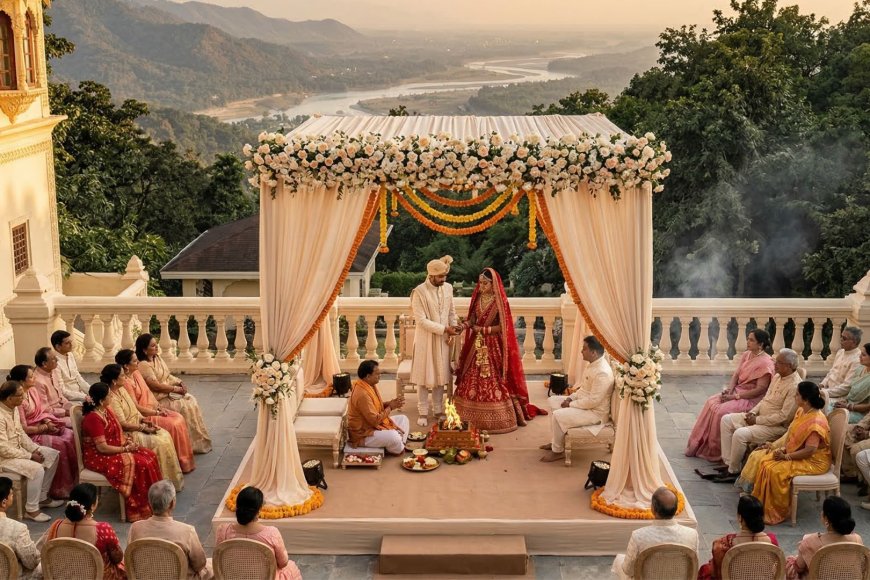
The ceremony on the Viceregal Palace terrace — the mandap installed on the terrace whose view extends to the Ganges below and the Himalayan foothills above, the guests seated with the mountain range behind the couple, the Ananda's Sal forest estate surrounding the palace, the specific, clear, Himalayan light on the ceremony — is the ceremony whose setting is the specific, complete, only-at-Ananda combination of the royal palace, the sacred river, and the mountain range.
The terrace accommodates up to one hundred guests for the ceremony — the intimate to moderate scale that most naturally fits the Ananda's specific, contemplative, wellness-oriented character and that the Viceregal Palace terrace's proportions most beautifully serve.
The Palace Ballroom
The Viceregal Palace's ballroom — the formal indoor event space of the 1910 colonial building whose specific, heritage interior provides the grand indoor setting for the reception dinner and the sangeet — is the Ananda's primary large indoor event space whose historical character gives it the specific, warm, colonial-era quality of the room that has been the setting of the important occasion since 1910.
The palace ballroom accommodates up to one hundred and fifty guests for the standing reception and up to eighty for the seated dinner — the intimate to moderate scale that the Ananda's specific character most naturally serves and that the heritage ballroom's proportions most comfortably contain.
The sangeet in the palace ballroom: the sangeet in the Viceregal Palace's heritage ballroom — the celebration in the Maharaja's guesthouse above the Ganges, the Himalayan night outside the colonial windows — is the sangeet whose specific, heritage, mountain-palace character is the character of the occasion that most completely expresses the Ananda's irreplaceable credential.
The Outdoor Terraces and the Gardens
The Ananda's outdoor terraces and the formal gardens — the Sal-forest-surrounded outdoor spaces of the one-hundred-acre estate whose specific, mountain, forested character gives them the specific quality of the outdoor occasions in the Himalayan landscape — are the wedding spaces for the cocktail reception, the welcome dinner, and the outdoor function whose character the Himalayan winter's specific, clear, cool, mountain-air quality most beautifully supports.
The outdoor terraces accommodate up to one hundred and fifty guests for the standing reception — the moderate scale that the Ananda's outdoor spaces most naturally contain and that the intimate destination wedding's guest count most comfortably fills.
The cocktail reception on the terrace at sunset: the cocktail reception on the Ananda's terrace at the specific hour when the Himalayan sunset produces the specific, warm, golden-light quality of the mountain evening — the Ganges visible below, the foothills against the coloured sky, the guests on the terrace of the Maharaja's estate in the Himalayan winter — is the cocktail reception whose setting is the most geographically extraordinary of any cocktail reception in this guide series.
The Yoga Pavilion
The Ananda's yoga pavilion — the dedicated, professionally equipped, view-facing yoga and meditation space whose position on the estate provides the specific, contemplative setting of the Himalayan yoga practice — is the pre-wedding programme space for the couple and the wedding party whose morning yoga sessions in the days before the ceremony most directly address the specific, accumulated demands of the wedding period.
The dawn yoga on the Ananda's pavilion — the couple in the yoga session as the Himalayan morning light arrives, the Ganges valley below, the mountain air, the specific, centred quality of the person who has begun the wedding day with the practice rather than the anxiety — is the pre-wedding wellness programme element that the Ananda provides in the form that no other wedding venue in this guide series can replicate, because no other wedding venue is the world's most awarded wellness resort in the Himalayan yoga capital.
The Spa Ananda
The Spa Ananda — the treatment facilities whose Ayurvedic programme is the programme of the qualified Ayurvedic doctors and whose specific, comprehensive, personalised wellness approach is the approach of the world's most awarded destination spa — is the pre-wedding wellness infrastructure whose engagement by the couple and the wedding party most directly produces the specific, physical and emotional restoration that the ceremony day most requires.
The Ayurvedic consultation and the personalised treatment plan — the specific, medically serious engagement with the individual's constitution and the treatment prescription whose design addresses the specific requirements of the person in the days before the wedding — is the wellness programme element whose depth and whose quality at the Ananda has no equivalent in the Indian wedding venue landscape.
The Rishikesh Experience: The Guest Programme
The Ganga Aarti
Already established as the wedding programme's foundation. The arrival evening's non-negotiable. The ceremony whose flame and chanting and sacred geography produce the specific, unprepared response that no description adequately prepares for.
The Char Dham Context
The Ananda's position on the Char Dham pilgrimage route — the specific, sacred circuit of the four Hindu dhams in the Himalayan Uttarakhand whose pilgrimage is among the most significant in the Hindu tradition — gives the wedding's guest programme the access to the sacred geography of the Himalayan pilgrimage tradition in the specific, accessible, beginning-of-the-route form that the Rishikesh position provides.
The Haridwar visit: the Haridwar Har Ki Pauri — the specific, sacred ghat of the pilgrimage town thirty kilometres from Rishikesh whose evening Ganga Aarti is the Ganga Aarti at the larger scale, the massed gathering of the pilgrims at the river whose devotional energy is the energy of the Char Dham's gateway — is the guest programme excursion whose addition to the Rishikesh Ganga Aarti gives the international guest the complete Himalayan sacred geography experience in the two consecutive evenings.
The Himalayan Yoga and the Ram Jhula
The Rishikesh yoga programme — the specific, authentic, tradition-rooted yoga experience of the world capital of yoga whose ashrams and whose specific, living tradition are the tradition that the international yoga community recognises as the source — is the guest programme element that the Ananda's Rishikesh location most directly provides.
The Ram Jhula: the Ram Jhula — the specific, iconic, pedestrian suspension bridge across the Ganges at Rishikesh whose crossing from the east to the west bank is the crossing through the specific, dense, ashram-filled, market-lined Rishikesh that the Ananda's hillside estate overlooks — is the guest programme's walking cultural experience whose combination of the river crossing, the ashram lane, the specific, ambient, devotional-and-commercial character of the sacred town is the experience that the international guest whose India knowledge is the knowledge of the tourist finds the most specifically, vividly Indian of the trip.
The Rafting on the Ganges
The white water rafting on the Ganges — the specific, Himalayan, adventure sport whose Rishikesh stretch of the river is the established, internationally recognised rafting destination whose clear, fast, mountain water provides the specific quality of the Himalayan river experience — is the guest programme element for the younger international guests whose engagement with the Ananda wedding's Himalayan setting includes the active outdoor experience alongside the contemplative wellness programme.
The Ganges rafting — the raft on the river that the previous evening's Ganga Aarti had made the sacred geography of the ceremony — is the specific, kinetic, physically engaged experience of the same river from the inside rather than the riverside, and whose specific, Himalayan quality of the fast, clear, cold mountain water is the water experience that no other Indian wedding destination's guest programme can provide.
The Complete Planning and Pricing Table
Comprehensive Wedding Planning Table: All Spaces, Costs, Accommodation, and Budget
| Category | Detail | Capacity / Scope | Approx. Cost (INR) | Approx. Cost (USD) | Notes |
|---|---|---|---|---|---|
| WEDDING SPACES AND VENUE COSTS | |||||
| Viceregal Palace Terrace – Ceremony | Himalayan view, Ganges below | Up to 80 seated / 100 standing | ₹15,00,000 – ₹28,00,000 | $18,000 – $33,600 | Most geographically extraordinary |
| Palace Ballroom – Sangeet | Heritage interior, 1910 palace | Up to 80 seated / 150 standing | ₹20,00,000 – ₹38,00,000 | $24,000 – $45,600 | Heritage palace sangeet |
| Palace Ballroom – Reception Dinner | Formal heritage dinner | Up to 80 seated / 150 standing | ₹25,00,000 – ₹45,00,000 | $30,000 – $54,000 | Maharaja's palace dining |
| Outdoor Terrace – Welcome Dinner | Himalayan arrival evening | Up to 80 seated / 120 standing | ₹15,00,000 – ₹28,00,000 | $18,000 – $33,600 | First evening, mountain air |
| Outdoor Terrace – Sunset Cocktails | Ganges valley, golden hour | Up to 80 seated / 120 standing | ₹10,00,000 – ₹20,00,000 | $12,000 – $24,000 | Pre-ceremony, Himalayan light |
| Garden – Mehendi | Estate garden, Sal forest | Up to 50 seated / 80 standing | ₹5,00,000 – ₹10,00,000 | $6,000 – $12,000 | Pre-wedding estate function |
| Garden – Haldi | Morning ritual, mountain air | Up to 30 seated / 50 standing | ₹3,50,000 – ₹7,00,000 | $4,200 – $8,400 | Inner circle, Himalayan morning |
| Yoga Pavilion – Dawn Ceremony | Sunrise over Ganges valley | Up to 40 seated | ₹5,00,000 – ₹10,00,000 | $6,000 – $12,000 | Pre-wedding sunrise occasion |
| Palace Terrace – Pre-Wedding Photos | Mountain and palace session | Couple and party | ₹1,00,000 – ₹3,00,000 | $1,200 – $3,600 | Himalayan light photography |
| Full Property – Exclusive Buyout | All spaces, full estate | Per day | ₹2,50,00,000 – ₹4,50,00,000 | $3,00,000 – $5,40,000 | Complete estate exclusive use |
| Full 3-Day Wedding Package | All functions, full programme | 60–100 guests | ₹2,50,00,000 – ₹5,00,00,000 | $3,00,000 – $6,00,000 | Wellness wedding, full programme |
| WELLNESS PROGRAMME COSTS | |||||
| Ayurvedic Consultation | Doctor assessment, prakriti | Per person | ₹5,000 – ₹12,000 per session | $60 – $144 per session | Pre-wedding essential |
| Ayurvedic Treatment Programme | 3-day pre-wedding course | Per person | ₹25,000 – ₹60,000 per person | $300 – $720 per person | Couple and wedding party |
| Daily Yoga Sessions | Himalayan yoga, terrace | Per session | ₹2,000 – ₹5,000 per session | $24 – $60 per session | Morning programme |
| Meditation Programme | Guided Himalayan meditation | Per session | ₹2,000 – ₹4,000 per session | $24 – $48 per session | Pre-wedding contemplative |
| Spa Ananda – Full Treatment | Complete spa programme | Per person | ₹8,000 – ₹25,000 per session | $96 – $300 per session | World's finest destination spa |
| GUEST PROGRAMME COSTS | |||||
| Ganga Aarti – Triveni Ghat | Arrival evening, essential | All guests | ₹1,00,000 – ₹3,00,000 | $1,200 – $3,600 | Non-negotiable foundation |
| Haridwar Har Ki Pauri | Sacred ghat, 30 minutes | Up to 100 guests | ₹1,50,000 – ₹4,00,000 | $1,800 – $4,800 | Char Dham gateway |
| Ganges White Water Rafting | Himalayan river adventure | Up to 60 guests | ₹1,50,000 – ₹4,00,000 | $1,800 – $4,800 | Active, Himalayan river |
| Ram Jhula Walking Tour | Rishikesh ashram lanes | Up to 30 per group | ₹50,000 – ₹1,50,000 | $600 – $1,800 | Cultural immersion walk |
| Yoga Class – Rishikesh Ashram | Authentic yoga capital visit | Up to 20 per group | ₹50,000 – ₹1,50,000 | $600 – $1,800 | Source of the tradition |
| CATERING PER HEAD | |||||
| Welcome Cocktails | Himalayan herbs, local | Per head | ₹4,000 – ₹7,000 per head | $48 – $84 per head | Ananda quality, wellness menu |
| Buffet Dinner | Sattvic and continental | Per head | ₹10,000 – ₹16,000 per head | $120 – $192 per head | Wellness cuisine philosophy |
| Seated Dinner | Formal wellness-led menu | Per head | ₹15,000 – ₹25,000 per head | $180 – $300 per head | Ananda sattvic tradition |
| ACCOMMODATION | |||||
| Deluxe Room | Estate or valley view | Per night | ₹45,000 – ₹70,000 per night | $540 – $840 per night | Entry level, world's best spa |
| Premium Room | Enhanced Himalayan view | Per night | ₹65,000 – ₹95,000 per night | $780 – $1,140 per night | Better position, valley view |
| Deluxe Suite | Separate sitting, panorama | Per night | ₹95,000 – ₹1,40,000 per night | $1,140 – $1,680 per night | Key family, senior guests |
| Grand Deluxe Suite | Premier suite, Himalayan view | Per night | ₹1,40,000 – ₹2,00,000 per night | $1,680 – $2,400 per night | VIP family, close relatives |
| Vice Regal Suite | Palace wing, finest suite | Per night | ₹2,50,000 – ₹4,00,000 per night | $3,000 – $4,800 per night | Wedding couple, palace wing |
| Total Rooms Available | Boutique resort scale | ~70–75 rooms | Group rate negotiated | Full buyout recommended | Intimate, full buyout ideal |
| OVERFLOW ACCOMMODATION | |||||
| Rishikesh heritage properties | Ashram and retreat style | Per night | ₹8,000 – ₹30,000 per night | $96 – $360 per night | Contemplative overflow |
| Rishikesh boutique hotels | Quality mid-range options | Per night | ₹5,000 – ₹20,000 per night | $60 – $240 per night | Mid-range overflow |
| Haridwar hotels | Pilgrimage city, 30 minutes | Per night | ₹3,000 – ₹12,000 per night | $36 – $144 per night | Budget overflow option |
| COMPREHENSIVE BUDGET SUMMARY | |||||
| Venue hire – all functions (3 days) | All spaces, full programme | All events | ₹1,00,00,000 – ₹2,00,00,000 | $1,20,000 – $2,40,000 | World's best spa premium |
| Catering – all functions (80 guests) | Ananda in-house, wellness | Three events | ₹70,00,000 – ₹1,30,00,000 | $84,000 – $1,56,000 | Sattvic and wellness cuisine |
| Accommodation – full estate (3 nights) | 70–75 rooms, group rate | Full buyout | ₹1,20,00,000 – ₹2,20,00,000 | $1,44,000 – $2,64,000 | World's best spa room rate |
| Wellness programme | All guests, 3-day Ayurveda | Full group | ₹20,00,000 – ₹50,00,000 | $24,000 – $60,000 | Core Ananda offering |
| Decoration and florals | Mountain and heritage install | Full programme | ₹30,00,000 – ₹60,00,000 | $36,000 – $72,000 | Heritage-responsive design |
| Photography and videography | Himalayan specialist | Full programme | ₹15,00,000 – ₹35,00,000 | $18,000 – $42,000 | Mountain light specialist |
| Entertainment | Intimate, classical, folk | Contemplative format | ₹12,00,000 – ₹28,00,000 | $14,400 – $33,600 | Classical Indian, not DJ-led |
| Destination wedding planner | Ananda and Himalayan exp | Full service | ₹10,00,000 – ₹22,00,000 | $12,000 – $26,400 | Wellness wedding expertise req |
| Ganga Aarti and Haridwar prog | Sacred geography programme | All guests | ₹2,50,000 – ₹7,00,000 | $3,000 – $8,400 | Non-negotiable foundation |
| Ganges rafting and activities | Adventure programme | Active guests | ₹1,50,000 – ₹4,00,000 | $1,800 – $4,800 | Optional active programme |
| Bridal and groom's clothing | Full trousseau | Personal | ₹15,00,000 – ₹45,00,000 | $18,000 – $54,000 | Personal to couple |
| Hair and makeup | Premium bridal team, travels | On-site | ₹4,00,000 – ₹10,00,000 | $4,800 – $12,000 | Artists travel from Delhi |
| Guest transport | Delhi airport, Rishikesh | All guests | ₹6,00,000 – ₹15,00,000 | $7,200 – $18,000 | 6-hour drive or Dehradun fly |
| Invitations and stationery | Himalayan and lotus design | Full suite | ₹2,00,000 – ₹6,00,000 | $2,400 – $7,200 | Sacred river aesthetic |
| Pandit and religious requirements | Ceremony and Ganga elements | Ceremony | ₹1,50,000 – ₹4,00,000 | $1,800 – $4,800 | Himalayan ceremony protocol |
| Miscellaneous and contingency (10%) | Mountain wedding variance | Standard | ₹15,00,000 – ₹35,00,000 | $18,000 – $42,000 | Weather and access contingency |
| TOTAL ESTIMATED RANGE | 80 guests, 3-day wedding | Full buyout | ₹6,24,00,000 – ₹12,71,00,000 | $7,49,000 – $15,25,000 | Premium wellness, Himalayan |
| PLANNING TIMELINE | |||||
| Initial inquiry | Ananda events team directly | 24 months | 24 months before | Most limited dates, global demand | |
| Full buyout confirmed | Essential for wedding | 20–22 months | 20–22 months before | Full buyout only approach | |
| Destination planner engaged | Ananda wellness specialist | 20 months | 20 months before | Wellness wedding expertise | |
| Wellness programme designed | Ayurvedic consultation pre-plan | 12 months | 12 months before | Personalised 3-day programme | |
| Photographer confirmed | Himalayan light specialist | 14–16 months | 14–16 months before | Mountain photography expertise | |
| Transport plan confirmed | Delhi or Dehradun routing | 8 months | 8 months before | All guests, arrival coordination | |
| Ganga Aarti programme | Triveni Ghat arrangement | 6 months | 6 months before | Arrival evening confirmed | |
| Haridwar excursion | Group coordination | 6 months | 6 months before | Sacred geography programme | |
| Guest communications | Invitation, wellness guide | 6 months | 6 months before | Include Himalayan arrival guide | |
| Catering menu finalised | Sattvic and wellness menu | 6 months | 6 months before | Ananda culinary philosophy | |
| Weather contingency | Mountain weather protocol | 8 months | 8 months before | October–March optimal | |
| Final guest count | Confirmed to Ananda team | 6 weeks | 6 weeks before | Intimate scale, precise planning | |
| Final payments | All vendors and venue | 4 weeks | 4 weeks before | Confirm in writing |
The Ananda in the Himalayas' total budget range is the guide series' highest — reflecting the world's most awarded wellness resort's premium pricing, the full estate buyout's comprehensive scope, the Viceregal Palace's heritage quality, and the specific, irreplaceable credential of the Himalayan sacred geography that no other property in any guide series can provide. The NRI couple whose wedding vision includes the wellness transformation, the Himalayan setting, the sacred river, and the royal palace estate will find the Ananda in the Himalayas the most extraordinary and the most specifically appropriate venue for the occasion that deserves all four.
The Honest Assessment
Who the Ananda Is For
The Ananda in the Himalayas is for the couple whose wedding vision is not the party — not the several-hundred-guest production, not the celebrity performer's appearance at the sangeet, not the grand ballroom at the capital city's premier address.
It is for the couple whose wedding vision is the transformation — the specific, contemplative, deeply Indian, deeply Himalayan occasion whose ambient register is the register of the sacred geography and the wellness philosophy and the royal palace estate above the Ganges, and whose guest count is the intimate count of the inner circle for whom this specific, extraordinary place is the appropriate occasion.
The wellness wedding: the Ananda wedding is specifically and primarily the wellness wedding — the occasion whose programme includes the Ayurvedic treatment and the yoga and the meditation and the Ganga Aarti as the essential, foundational elements rather than the optional amenities. The couple who chooses the Ananda and does not engage the wellness programme has chosen the world's most awarded wellness resort and used it as the scenically spectacular heritage hotel. The wellness is the point. Engage it.
The Access Consideration
The Ananda in the Himalayas' location — the Himalayan foothills above Rishikesh, approximately six hours by road from Delhi or one hour to Jolly Grant Airport in Dehradun followed by the forty-five-minute drive to Rishikesh — is the access consideration that the planning must address with the specific, practical honesty that the remote destination always requires.
The international guest who arrives at Delhi's Indira Gandhi International Airport and whose transfer to the Ananda is the six-hour road journey through the northern plains and into the Himalayan foothills has the journey whose duration is the duration of the significant rather than the convenient. The organised coach transfer from Delhi — the group convoy whose journey is the introduction to the Himalayan landscape through the increasingly dramatic scenery of the approach — is the arrival experience that the Ananda wedding most appropriately provides: the journey that prepares the guest for the destination rather than the transfer that deposits the guest at the hotel.
The Dehradun flight — the domestic flight from Delhi to Jolly Grant Airport whose forty-five-minute flight time reduces the surface journey to the forty-five-minute drive from the airport to Rishikesh — is the access option for the international guests whose connection through Delhi most naturally includes the domestic connection and whose journey preference is the flight rather than the road.
Common Mistakes NRI Couples Make When Planning the Ananda Wedding
The first mistake is not booking at twenty-four months for the October through February optimal season dates. The Ananda in the Himalayas is the world's most awarded wellness resort whose global recognition has produced the global competition for the limited dates whose peak season availability — the October through February window whose Himalayan climate is the climate of the clear sky and the cool, mountain-air quality of the destination wedding's most beautiful natural context — is the availability that the international wellness traveller and the NRI wedding couple compete for with the same calendar's constraints. Twenty-four months is the minimum for the December wedding. The couple with the flexibility to consider the October or November dates — the post-monsoon Himalayan season whose clarity and whose specific, post-rain freshness are the qualities that the January dates cannot replicate — will find the availability and the pricing more favourable.
The second mistake is not designing the wedding programme around the wellness philosophy from the planning's beginning rather than adding the wellness elements as the amenity layer on top of the event programme. The Ananda wedding is not the heritage palace wedding that happens to have a good spa. It is the wellness wedding that happens in the heritage palace — the specific inversion of the priority whose correct expression is the programme whose daily structure begins with the yoga and the Ayurvedic treatment and the meditation and the Ganga Aarti and whose wedding events — the sangeet, the ceremony, the reception — are the formal occasions within the wellness programme rather than the programme's primary substance with the wellness added. Design the three-day programme with the wellness at the foundation. The yoga at dawn, the Ayurvedic treatment in the morning, the free afternoon, the Ganga Aarti at dusk, the wedding event in the evening — this is the Ananda wedding's daily structure. Build it this way from the planning's beginning.
The third mistake is not engaging the Himalayan light specialist photographer before any other vendor. The Ananda in the Himalayas' specific photographic quality — the Himalayan light on the Viceregal Palace's colonial architecture, the Ganges valley visible below the terrace, the mountain range on the clear morning horizon, the specific, extraordinary combination of the royal palace and the sacred river and the mountain range in the single composition — is the photographic subject whose quality is fully realised only by the photographer whose specific experience with the high-altitude, mountain light and whose compositional knowledge of the Himalayan landscape include the specific knowledge of the golden hour's angle and the dawn's particular quality and the afternoon's specific warmth at this altitude. The photographer who arrives at the Ananda without the prior Himalayan experience has the site learning on the wedding day — the most expensive time for this learning to occur. Engage the Himalayan specialist at fourteen to sixteen months. The mountain photography is the credential that most specifically distinguishes the Ananda wedding's visual record from every other Indian destination wedding's photographs.
The fourth mistake is not managing the guest transport as the integrated programme element rather than the logistical background. The six-hour road journey from Delhi to Rishikesh — whose passage through the northern plains and into the Himalayan foothills is the journey whose specific, increasingly dramatic scenery is the introduction to the Himalayan landscape that the arrival by plane cannot provide — is the journey that the organised coach transfer converts from the logistical inconvenience into the programme's first experience of the destination. The convoy of coaches whose departure from Delhi is coordinated, whose stops at the specific viewpoints along the Haridwar highway are the deliberate programme elements rather than the rest stops, and whose arrival at the Rishikesh valley is the arrival that the Himalayan landscape most beautifully frames — this is the guest transport whose design transforms the access challenge into the arrival experience. Brief the planner with the transport programme at eight months. The road journey is the destination's first gift to the guest. Design it accordingly.
The fifth mistake is not preparing the international guests for the sattvic dietary philosophy that the Ananda's wellness programme most naturally incorporates into the wedding catering. The Ananda's sattvic cuisine — the specific, traditional, Ayurvedic dietary philosophy whose avoidance of the onion, the garlic, and the heavy, tamasic foods is the avoidance of the ingredients that the Ayurvedic tradition associates with the agitation of the mind rather than its clarity — is the dietary philosophy whose application to the wedding banquet may require the specific communication to the international guest whose expectation of the Indian wedding banquet includes the specific, onion-and-garlic-rich North Indian flavours of the standard wedding menu. The couple whose catering brief engages the sattvic philosophy fully, and whose communication to the guests prepares the expectation for the specific, clean, herb-and-spice flavour of the Ananda's culinary tradition, gives the guests the understanding that most directly prepares them to receive the food as the wellness gift rather than the unusual omission. Communicate the sattvic philosophy in the welcome letter. The food is part of the wellness programme. The guests who know this arrive ready to experience it as such.
Above the Ganges
The groom had not expected to cry.
He had stood at the Triveni Ghat at dusk and watched the priests and the flame and heard the chanting and looked at the Himalayan water and had encountered the genuine — the real thing, the specific weight of the sacred geography, the river that is not the metaphor for the sacred but the actual sacred — and had cried.
The bride had taken his hand.
Later, the planner had said: now you understand why the Ananda wedding begins at the Ganga Aarti.
She had been right.
The Ananda wedding begins at the Ganga Aarti because the Ananda wedding is the wedding whose setting is the most geographically, historically, spiritually extraordinary setting in this guide series — the Maharaja's palace estate on the Himalayan hillside above the sacred river in the world capital of yoga — and the Ganga Aarti is the ceremony that most directly introduces the guest to the specific weight and the specific beauty of that setting.
Not the helicopter arrival. Not the celebrity performer. Not the grand ballroom whose technical infrastructure is the infrastructure of the world's finest production capability.
The brass lamp. The chanting. The Himalayan water. The dusk.
The Ganges at Rishikesh.
The beginning of the Ananda wedding.
Contact the Ananda events team at twenty-four months.
Book the full estate buyout from the first inquiry.
Design the three-day programme with the wellness at the foundation.
Engage the Himalayan photographer at fourteen months.
Design the coach transfer as the programme's first experience.
Communicate the sattvic philosophy in the welcome letter.
And on the arrival evening — before the welcome dinner, before the Viceregal Palace's illuminated presence on the hillside, before the Himalayan night has settled fully over the Sal forest estate — go to the Triveni Ghat.
Stand at the river.
Let the ceremony be the ceremony.
The groom who does not expect to cry will cry.
The bride who has been planning this for twenty-four months will understand why.
And the wedding that begins here — at the Ganga Aarti, at the sacred river, in the Himalayan dusk — will be the wedding that begins in the right place.
Above the Ganges.
In the Maharaja's palace.
In the world's most extraordinary setting for the occasion that deserves it.
Published by NRIWedding.com — The Premium Global Platform for Non-Resident Indians Planning Indian Weddings From Abroad.
0 comments
Real names and courtesy, please. Every comment is read by a person before it appears.
Nothing yet. Start it off.
Comments are closed on this article.