Andaz Delhi Aerocity — The Airport Hotel That Became Delhi's Coolest Wedding Venue: NRI Guide — The Complete NRI Wedding Planning Guide
Sanjana had a constraint that the destination wedding industry was not designed to accommodate.
The constraint was her grandmother.
Her grandmother was eighty-seven years old and lived in Green Park, South Delhi. She had arthritis in both knees and a cardiac condition that her doctor managed with medication and monitored with quarterly appointments and that made long journeys inadvisable and domestic flights effectively impossible. She had attended every significant event in Sanjana's life — every birthday, every school function, every family gathering — and the suggestion that the wedding would be in Rajasthan or Goa and that the grandmother would attend via a video call from Green Park was the suggestion that Sanjana had rejected without discussion the first time the wedding planner had raised it.
The grandmother would be at the wedding. This was not a preference. It was a requirement, the way that certain requirements have a moral weight that converts them from preferences into imperatives. The grandmother had been a presence at every significant event of Sanjana's life. She would be a presence at this one.
The constraint produced by this requirement was logistical but not, Sanjana had come to understand after three months of trying to solve it, unsolvable. The grandmother could not fly. The grandmother could manage a car journey of up to forty-five minutes without significant difficulty. The wedding venue needed to be within a forty-five minute drive of Green Park, South Delhi.
This constraint had, in the first instance, seemed to eliminate all the destination options entirely and to point inexorably toward the Delhi palace hotel circuit — the large city properties that the South Delhi wedding community used for its significant events and that Sanjana and her fiancé Aditya had both attended at various cousins' and friends' weddings and that were perfectly appropriate and that neither of them found genuinely exciting.
Then Aditya had suggested the Andaz.
He had suggested it not because he had been researching wedding venues but because he had stayed there for a work trip three months earlier and had spent an evening at the hotel's outdoor bar and had noticed, in the specific way that people with design sensibilities notice things that other people walk past, that the Andaz was doing something different from what Delhi's luxury hotel landscape was doing and that the difference was not cosmetic but substantive.
What it was doing differently was the aesthetic. The Andaz Delhi was not attempting to be a palace. It was not attempting to be a heritage property. It was not applying the Mughal architectural vocabulary to a contemporary hotel in the manner of The Leela or the Taj. It was something else — the contemporary Indian luxury hotel, designed with a rigorous and specific aesthetic sensibility that drew from the Indian craft tradition and from the contemporary design vocabulary simultaneously, producing interiors that were immediately, recognisably Indian in their references and unmistakably contemporary in their execution. Not the heritage India. The now India. The India that was producing extraordinary contemporary design from the same craft traditions that had always produced extraordinary design.
He had taken photographs on his phone. He had sent them to Sanjana. She had called him back in twenty minutes. She had said: this is not what I expected Delhi to look like. He had said: that is why I sent them. She had said: is it an airport hotel? He had said: technically. Aerocity. Twenty minutes from the airport. She had said: and from Green Park? He had said: thirty-five minutes. She said: I think you found the venue. He said: I think I found the venue.
This guide is for every NRI couple who has a grandmother in Green Park or an equivalent constraint that the destination wedding industry is not designed to accommodate — for Sanjana and Aditya and every couple who deserves the complete framework for the hotel that became Delhi's coolest wedding venue despite being technically an airport hotel.
Understanding Andaz Delhi: The Aerocity Position and the Design Identity
The Andaz Delhi is a hotel in the Aerocity district of Delhi — the purpose-built hospitality and commercial district adjacent to Indira Gandhi International Airport that has developed over the past decade into one of the most hotel-dense areas in India, with multiple luxury and business hotel properties positioned to serve the airport's passenger flow.
The Aerocity location is the source of the Andaz Delhi's most significant practical advantage and its most significant reputational challenge simultaneously. The practical advantage is the airport proximity — the hotel is five minutes from the T2 and T3 international terminals of IGI Airport, giving it the most accessible airport-to-venue transfer of any luxury hotel in Delhi and the most convenient arrival-to-wedding-venue journey available at any destination in this series. The reputational challenge is the airport hotel association — the assumption that a hotel in an airport district is a transit accommodation rather than a destination, a place where people sleep between flights rather than a place where people choose to be.
The Andaz Delhi has resolved this challenge through the quality and the specificity of its design — the specific quality of design that Aditya had noticed on his work trip and that the hotel has been consistently recognised for since its opening. The Andaz brand — a Hyatt Hotels group brand positioned as the lifestyle luxury category, the brand designed for travellers who want the luxury hotel standard with the design sensibility of a boutique property — brings to the Delhi property a design approach that is different from the standard luxury hotel brief and that has produced, in the Aerocity location, a hotel that is genuinely worth choosing for its design rather than merely for its proximity to the airport.
The Andaz Delhi's interiors were designed with the specific intention of creating a contemporary Indian aesthetic — an aesthetic that drew from the Indian craft tradition's specific vocabularies without replicating them in the static form of the heritage recreation. The block-printed textiles used in unexpected applications. The natural stone in the colours of the Indian landscape. The traditional craft objects in contemporary spatial contexts. The hand-painted details in the vocabulary of Indian folk art applied to contemporary architectural surfaces. The specific quality of a design brief that said: be Indian, be contemporary, be both simultaneously, and be neither by diluting the other.
The result is an interior landscape that is immediately and specifically Indian in its references and that reads, to the international visitor who has been through many luxury hotels in many countries, as something genuinely different — the luxury hotel that has found a specific and defensible design identity rather than the default of the international luxury aesthetic.
Why Aerocity Is Actually Ideal for the NRI Wedding
The airport hotel designation that has been the Andaz Delhi's reputational challenge in the wedding market is, examined carefully, one of the most significant practical advantages available to the NRI couple planning a wedding in Delhi.
The international guests who fly to Delhi for the wedding — from London, from Toronto, from Singapore, from Dubai — land at IGI Airport's international terminals and are at the Andaz Delhi in five minutes. Not twenty-five minutes in a taxi through the Delhi traffic. Not the forty-five minutes that the journey from Aerocity to the city centre's luxury hotel district requires in normal traffic. Five minutes. The international wedding guest who has been in the air for eight or ten or twelve hours is at the hotel, in the room, with the luggage unpacked, in a timeframe so short as to be almost negligible.
The efficiency of this arrival — the absence of the Delhi traffic experience for the first hours of the international guests' India visit — is a gift that the NRI couple is giving to their guests without most of them fully appreciating what the alternative would have been. The guests who have attended Delhi weddings at the Taj Mahal Hotel or the Taj Palace or the Leela in Chanakyapuri have experienced the Delhi airport-to-hotel journey in its full character. The guests at the Andaz Delhi Aerocity have not had this experience. This is a gift.
For the domestic guests — the Delhi family and community who make up the majority of the wedding's guest list for the NRI couple from Delhi — the Aerocity location is a destination in the sense that it is not within the immediate social geography of the residential neighbourhoods. The Aerocity is a purpose-built district, clean and planned and different from the density and the history of the residential Delhi, and the drive to the Aerocity for a wedding — the highway road to the airport, the specific quality of the planned district — has a destination quality that the wedding at the neighbourhood's standard luxury hotel does not provide.
And for Sanjana's grandmother in Green Park: thirty-five minutes by car on a good South Delhi evening. Within the constraint. Present at the wedding.
The Design Identity: Why It Matters for the Wedding
The Andaz Delhi's design identity — the specific contemporary Indian aesthetic that the hotel's interior design programme has produced — matters for the NRI wedding in a specific and important way that the aesthetic discussion of the palace and the heritage property does not fully address.
The NRI couple who is planning a wedding in 2025 is planning a wedding for a guest list that includes a significant proportion of design-literate, internationally experienced guests — guests who have been to many luxury hotels, who have been to many weddings, who have a developed sensitivity to the quality and the specificity of the designed environment. These guests can distinguish between the luxury hotel that is applying a standard international aesthetic and the luxury hotel that has developed a specific and defensible design identity of its own.
The Andaz Delhi's design identity is in the second category. The hand-painted folk art details on the walls are not generic Indian motifs applied as wallpaper. They are the specific vocabulary of specific Indian folk art traditions applied by skilled practitioners. The block-printed textiles are not machine-printed approximations of block print. They are the genuine article. The craft objects are not decorative imports from a craft vendor's catalogue. They are selected pieces that communicate specific cultural knowledge about the traditions they represent.
For the design-literate NRI guest from London or Singapore or New York — the guest who knows the difference between genuine craft and the representation of craft, who has been to enough heritage hotels to know when the heritage is genuine and when it is the managed approximation — the Andaz Delhi's design identity communicates something specific: this hotel took the Indian design brief seriously. It is the contemporary Indian hotel done with genuine conviction.
The wedding at this hotel carries this conviction as its aesthetic identity. The photographs from the Andaz Delhi wedding are photographs in a specific, recognisable aesthetic environment — the now India, the India that produces extraordinary contemporary design from ancient craft traditions, the India that the NRI who is both of India and of the world understands as the most authentic version of the contemporary Indian identity.
The Event Spaces: Contemporary India at Every Level
The Grand Ballroom: The Primary Event Space
The Grand Ballroom of the Andaz Delhi is the primary event space — the large indoor venue that provides the capacity for the Delhi NRI wedding's guest list requirements and the Andaz design vocabulary applied at the scale of the full wedding production.
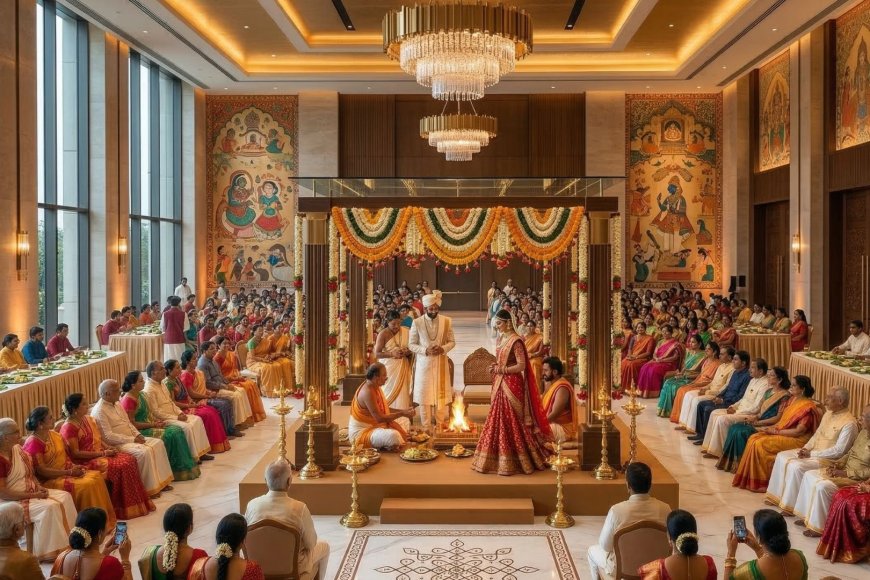
The Grand Ballroom accommodates up to eight hundred guests for a standing reception and up to five hundred for a seated dinner. The ballroom's specific quality is the application of the Andaz design aesthetic at the ballroom scale — the folk art details, the craft vocabulary, the contemporary Indian design sensibility in a space of genuine event capacity. The sangeet in the Grand Ballroom, the formal wedding dinner, the ceremony with its full Delhi community guest list — these are events that the ballroom accommodates with the combination of the Hyatt group's operational event management standard and the Andaz brand's specific design identity.
The production capability of the Grand Ballroom — the sound system, the lighting grid, the staging infrastructure, the technical capacity for the large event production — is the contemporary Hyatt Hotels standard applied to a space that has the design identity to reward the production investment. The sangeet at the Andaz Delhi Grand Ballroom, with the full production treatment of the contemporary Indian luxury hotel wedding, is the sangeet that uses the design identity as the visual context for the entertainment rather than the generic ballroom backdrop.
The Outdoor Venue: The Garden and Pool Area
The Andaz Delhi's outdoor event spaces — the garden areas and the pool deck within the hotel's grounds — provide the outdoor ceremony and reception options for the wedding program. The outdoor venue accommodates up to four hundred guests for a standing reception and up to two hundred and fifty for a seated ceremony or dinner.
The outdoor event at the Andaz Delhi — with the hotel's contemporary architecture as the backdrop and the Aerocity's planned landscape providing the specific quality of the designed outdoor environment — is the outdoor wedding event in the contemporary Delhi setting rather than the heritage courtyard or the hilltop lawn. The mandap in the Andaz garden, with the hotel's architecture framing the ceremony space, is the ceremony in the contemporary Indian design environment rather than the historic one.
The Ballroom Pre-Function Area: The Cocktail and Transition Space
The Grand Ballroom's pre-function area — the generous lobby and corridor space that connects the outdoor areas to the ballroom and provides the cocktail reception and arrival gathering space — accommodates up to three hundred guests for a standing reception and is the natural setting for the welcome cocktail, the transition between the ceremony and the dinner, and the arrival gathering of guests at the wedding's beginning.
The pre-function area's specific quality at the Andaz Delhi is the design vocabulary of the Andaz interior applied at the transition space scale — the folk art details, the craft objects, the contemporary Indian aesthetic in the spaces through which the guests move between events. The gallery-like quality of the pre-function area — the design sensibility that makes the transition spaces as intentional as the event spaces themselves — is the quality that the Andaz brand's commitment to the complete design experience produces.
The Andaz Studio: The Intimate Creative Space
The Andaz Studio — a smaller, more intimate event space within the hotel that reflects the brand's creative sensibility — accommodates up to one hundred guests for a standing reception and up to sixty for a seated dinner. The Studio is the natural choice for the mehendi ceremony, the family dinner on the evening of arrival, the intimate gathering that requires the Andaz aesthetic at a smaller and more personal scale.
The Studio's specific quality is the concentration of the Andaz design vocabulary in a more intimate space — the folk art, the craft objects, the contemporary Indian aesthetic in a room whose scale allows the design to be experienced at close range rather than across the distance that the Grand Ballroom requires.
The Rooftop: The Sky View Social Space
The Andaz Delhi's rooftop — an outdoor space at the building's highest accessible level, with the Aerocity's planned landscape visible below and the Delhi sky above — is the social gathering space for the informal events of the wedding program. The rooftop accommodates up to one hundred and fifty guests for a standing reception and provides the elevated view of the Aerocity and the Delhi horizon that the hotel's position in the capital's planned district makes available.
Comprehensive Pricing and Planning Reference
| Category | Detail | Approximate Range | Notes |
|---|---|---|---|
| Grand Ballroom venue hire | Up to 500 seated / 800 standing | ₹12,00,000–₹22,00,000 per event | Primary event; Andaz design identity |
| Outdoor Garden and Pool | Up to 250 seated / 400 standing | ₹7,00,000–₹14,00,000 per event | Ceremony, reception, outdoor dinner |
| Pre-Function Area | Up to 200 seated / 300 standing | ₹4,00,000–₹8,00,000 per event | Cocktail, arrival, transition event |
| Andaz Studio | Up to 60 seated / 100 standing | ₹2,50,000–₹5,00,000 per event | Mehendi, intimate dinner, family event |
| Rooftop Social Space | Up to 80 seated / 150 standing | ₹3,00,000–₹6,00,000 per event | Sundowner, informal gathering |
| Full Hotel Exclusive Buyout | All spaces combined | ₹35,00,000–₹65,00,000 per day | Complete Andaz design exclusivity |
| Accommodation — Standard Room per night | Entry rooms | ₹12,000–₹20,000 | Andaz design throughout; airport views |
| Accommodation — Deluxe Room per night | Superior rooms | ₹18,000–₹28,000 | Enhanced design; better views |
| Accommodation — Suite per night | Full suite | ₹38,000–₹65,000 | Design suites; Delhi horizon views |
| Accommodation — Grand Suite per night | Flagship | ₹80,000–₹1,50,000+ | Full Andaz experience; complete design |
| Accommodation — Full Hotel Buyout per night | All rooms | ₹20,00,000–₹38,00,000 | Complete design hotel exclusivity |
| Catering per cover — multi-course dinner | Wedding dinner | ₹3,500–₹6,000 | Andaz culinary; contemporary Indian |
| Catering per cover — daytime event | Lunch or breakfast | ₹2,000–₹3,500 | Full service; craft-focused menu |
| Craft workshop for guests | Per session | ₹30,000–₹80,000 | Block printing, pottery, folk art |
| Delhi cultural experience | Per group | ₹20,000–₹50,000 | Heritage tour, street food, markets |
| Décor and florals per event | Wedding decoration | ₹6,00,000–₹22,00,000 | Contemporary Indian palette |
| Photography and videography | Full wedding | ₹3,00,000–₹10,00,000 | Contemporary design specialists |
| Sound and lighting per event | Indoor and outdoor | ₹3,00,000–₹8,00,000 | Full production; design-sensitive |
| Wedding planner fee | Full service | ₹5,00,000–₹14,00,000 | Andaz contemporary wedding experience |
| Transport — IGI Airport T3 to Andaz | Per vehicle | ₹300–₹600 | 5 minutes; adjacent to airport |
| Transport — Green Park to Andaz | Per vehicle | ₹800–₹1,500 | 35 minutes; South Delhi access |
| Total three-day wedding — 150 guests | Without buyout | ₹80,00,000–₹1,40,00,000 | Full Andaz design wedding |
| Total three-day wedding — 300 guests | Full program | ₹1,20,00,000–₹2,20,00,000 | Complete contemporary Indian wedding |
| Total three-day wedding — 500 guests, buyout | Full hotel | ₹1,80,00,000–₹3,20,00,000+ | Peak season; full design exclusivity |
The Craft Workshops: Activating the Design Identity
The Andaz Delhi's design identity — rooted in the Indian craft tradition — creates a specific opportunity for the wedding program that the heritage palace venue and the beach resort do not: the craft workshop that is specifically related to the hotel's own design vocabulary.
The block printing workshop — the guided session in which the wedding guests produce their own hand-block-printed piece using the printing technique that appears throughout the Andaz Delhi's textiles — is the activity that most directly connects the wedding guests to the hotel's design identity. The guest who block-prints a small fabric piece in the Andaz workshop, who understands the registration process and the depth of the block and the specific quality of the natural dye — that guest looks at the block-printed textiles of the Andaz's interior with a different quality of attention than the guest who has not had this encounter.
The folk art workshop — the guided session in which guests learn the basic techniques of the folk art tradition represented in the Andaz's wall paintings — is the activity that most directly communicates the living character of the Indian folk art tradition. Not as museum objects but as skills — the techniques that the tradition has transmitted across generations and that the workshop participant acquires in a simple and accessible form.
These workshops are available through the hotel's cultural programming and should be designed into the wedding program as the morning activity on the pre-wedding day — the activity that gives the guests the encounter with the Indian craft tradition in the active, participatory form that makes the hotel's design identity legible and personal rather than merely visual and ambient.
The Delhi Cultural Complement: Using the Capital
The Andaz Delhi's Aerocity location provides the NRI couple's international guests with access to the full cultural richness of the Indian capital — the monuments, the markets, the food culture, the performing arts — in the specific form of a city that has been the seat of successive Indian empires for several centuries and that contains within its geography the most concentrated collection of significant architecture and cultural institutions in the subcontinent.
The Mughal monuments of Old Delhi — the Red Fort, the Jama Masjid, the Humayun's Tomb, the Qutb Minar — are the heritage experiences that give the international Delhi wedding guest the encounter with the Indian antiquity in its most immediately legible form. The Red Fort's Diwan-i-Khas, the Humayun's Tomb's garden design — these are the architectural experiences that the Mahabalipuram guide provides in the Tamil tradition and the Taj Falaknuma guide provides in the Hyderabadi tradition, available here in the Mughal tradition of the Delhi empire.
The Chandni Chowk experience — the old city market of the Shahjahanabad that the Mughal emperor built in the seventeenth century and that continues to function as one of the most specific and most extraordinary urban markets in India — is the guest experience that most directly gives the international visitor the encounter with the living heritage of the Delhi urban tradition. The guided walk through the Chandni Chowk lanes, from the Jama Masjid through the specific wholesale markets of the old city to the specific street food vendors that have been feeding Delhi at the same locations for generations — this is the cultural experience that the heritage palace wedding's destination does not provide in the same accessible form.
The contemporary Delhi cultural scene — the India Habitat Centre, the National Museum, the National Gallery of Modern Art, the specific gallery and cultural space ecosystem of the South Delhi arts community — is the cultural complement to the heritage tour that gives the design-literate international guest the encounter with the contemporary India that the Andaz Delhi's own design identity represents and that the city's cultural institutions have been developing for decades.
Décor at the Andaz Delhi: Working With the Contemporary Indian Aesthetic
The décor philosophy at the Andaz Delhi is the most contemporary of any venue in this series and the most specifically in conversation with the living Indian design tradition rather than with the historical vocabulary of the palace and the fort.
The primary principle is that the décor must be of the same quality and the same conviction as the hotel's own design vocabulary. The Andaz Delhi's interiors communicate a specific commitment to the Indian craft tradition in its contemporary application — the commitment of a design team that spent significant time and resources sourcing the genuine article rather than the approximation. The wedding décor that matches this commitment is the décor that sources from the same tradition — the genuine block print, the handmade paper, the craft objects from the living practitioners of the specific traditions the hotel represents.
The colour palette that works at the Andaz Delhi is the palette of the Indian craft tradition in its contemporary application — the specific natural dye colours that the block printing and the hand-weaving traditions produce, the earthy terracottas and the natural indigos and the specific ochres and reds of the vegetable dye vocabulary, applied in the contemporary compositions that the hotel's own design vocabulary demonstrates. The imported luxury palette of white and gold and generic tropical flowers is the palette that reads as incongruous against the Andaz Delhi's specific design identity.
The floral vocabulary should draw from the Indian flower market tradition — the marigold and the jasmine and the rose, the specific flowers of the Indian ceremonial tradition, arranged in the contemporary compositions that acknowledge both the tradition and the contemporary space simultaneously. Not the formal French flower arrangement of the standard luxury hotel. Not the generic tropical floral of the beach resort. The Indian flower in the contemporary arrangement — the specific vocabulary of the contemporary Indian floral design tradition that the Delhi flower market and the contemporary Indian florist community have been developing.
The Grandmother Principle: Why It Matters Beyond the Specific Case
Sanjana's grandmother in Green Park is the specific instance of a general principle that the destination wedding planning conversation consistently undervalues: the principle that the wedding's value is not only in the experience it provides to the couple and the international guests but in the quality of the witness it receives from the community and the family who have known the couple throughout their lives.
The grandmother who has been present at every significant event of Sanjana's life — who attended the birthday parties and the school functions and the family gatherings and who has been the continuous human presence connecting Sanjana to her own history — is the witness whose presence at the wedding has a weight that the beautiful setting and the extraordinary production cannot substitute for. The wedding that the grandmother attends, at the Andaz Delhi in Aerocity, thirty-five minutes from her Green Park home, is the wedding that has the full weight of its family witness. The wedding that the grandmother does not attend, because she cannot travel to Rajasthan or Goa, is the wedding that is missing the most important witness.
The NRI couple who makes the wedding accessible to the grandmother — who chooses the venue that respects the constraint imposed by the family's most vulnerable member rather than the venue that produces the most extraordinary photographs — is the couple who has understood what the wedding is for. The wedding is not only the photograph. The wedding is the witness. The grandmother is the witness. The venue that allows the grandmother to be present is the venue that understands this.
Common Mistakes NRI Couples Make With the Andaz Delhi Wedding
The first mistake is apologising for the Aerocity location. The airport hotel designation is a reputational challenge that the design quality of the Andaz Delhi more than compensates for, and the couple who introduces the venue with the disclaimer it is technically an airport hotel but — is starting the venue relationship with a frame of insufficiency that the venue does not deserve. The Andaz Delhi is five minutes from the airport, thirty-five minutes from Green Park, and in possession of the most specific and the most convicting contemporary Indian design identity of any Delhi wedding hotel. Present it as the choice it is.
The second mistake is not using the craft workshops as the signature activity of the wedding program. The block printing workshop and the folk art session are the activities that most directly connect the wedding guests to the Andaz Delhi's specific design identity — the activities that make the hotel's design legible as a living tradition rather than a visual statement. Include the workshops in the program. Commission them through the hotel's cultural programming team. Make them the first morning's activity for all guests.
The third mistake is not using the Grand Ballroom's production capability for the sangeet. The Andaz Delhi's Grand Ballroom has the technical infrastructure for the large-scale event production — the sound, the lighting, the staging — and the contemporary Indian design aesthetic of the venue as the visual context for the production. The sangeet that uses the full production capability of the Grand Ballroom, with the contemporary Indian aesthetic as the event's visual language, is the sangeet that most completely uses the Andaz Delhi's specific gift. Do not treat the ballroom as a generic event space. Use its design identity as the production's visual foundation.
The fourth mistake is not designing the décor in the contemporary Indian vocabulary. The decorator who brings the standard heritage wedding vocabulary — the palazzo curtains, the crystal chandeliers, the generic luxury event aesthetic — to the Andaz Delhi is decorating the wrong venue. The Andaz Delhi requires the décor of the contemporary Indian design tradition — the natural dye colours, the craft objects, the Indian flower in the contemporary arrangement. Brief the decorator on the hotel's specific design identity. Visit the hotel's interiors with the decorator before the brief is finalised. The decorator who understands what the Andaz Delhi is doing with Indian design will produce the wedding décor that belongs at this venue.
The fifth mistake is not acknowledging the accessibility dimension of the venue choice explicitly in the wedding's narrative. The choice of the Andaz Delhi because it allows the grandmother to be present is the most specific and the most human reason for any venue choice in this entire series, and it should be acknowledged rather than hidden. The family members who know that the venue was chosen partly so that the grandmother could attend will respect this choice in a way that they would not respect the choice made purely for the photographs or the social media. Tell the story. It is the best story in the series.
Sanjana's wedding was in November — the Delhi winter beginning to establish itself, the air in Aerocity the specific quality of the planned district's clean environment, the folk art details of the Andaz visible in the Grand Ballroom as the guests gathered for the ceremony.
The grandmother arrived at thirty-five minutes past three in the afternoon, having been driven from Green Park by her son in a time of thirty-eight minutes that the Delhi traffic had cooperated with in the specific way that Delhi traffic cooperates when you need it to. She was helped from the car by her son and walked — slowly, with the specific deliberateness of someone who has learned to pace herself against the resistance of her own body — to the Grand Ballroom's entrance.
She sat in the front row. She had been asked if she wanted a special chair. She had said: I want the front row. The front row it was.
The ceremony was at four-thirty. The Andaz's folk art details were visible on the walls. The block-printed textiles of the tablecloths were the genuine article. The marigold and jasmine of the Indian ceremonial tradition were in the contemporary arrangements of the Delhi florist who had been briefed on the hotel's design vocabulary.
At the end of the ceremony, Sanjana looked at the front row. Her grandmother was looking back at her. She had been present at every significant event of Sanjana's life. She was present at this one.
Present the Aerocity location as the deliberate choice it is. Use the craft workshops on the first morning. Use the Grand Ballroom's production capability for the sangeet. Brief the decorator on the contemporary Indian vocabulary. Tell the grandmother story.
The Andaz Delhi is five minutes from the airport. Thirty-five minutes from Green Park. Designed with the conviction of the contemporary Indian aesthetic. Accessible to the grandmother.
All of these things are true simultaneously. All of them are reasons to be here.
The grandmother was in the front row. That is the only review that matters.
Published by NRIWedding.com — The Premium Global Platform for Non-Resident Indians Planning Indian Weddings From Abroad.
0 comments
Real names and courtesy, please. Every comment is read by a person before it appears.
Nothing yet. Start it off.
Comments are closed on this article.