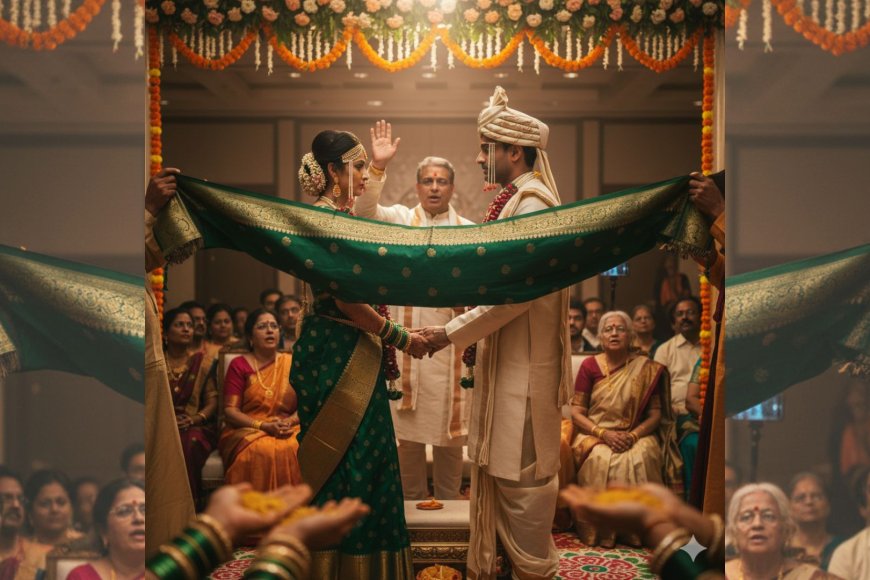
In the entire landscape of Indian wedding ritual, few moments carry the specific, suspended tension of Antarpat — the moment in a Maharashtrian Hindu wedding when a silk cloth is held between the bride and groom, separating them at the threshold of the mandap, keeping them in two different worlds until the exact auspicious second when the cloth falls and they see each other for the first time as husband and wife. Antarpat is not a theatrical device. It is a cosmological one. And for Maharashtrian NRIs from Pune to Perth, from Nashik to New Jersey, from Mumbai to Melbourne, it is the ritual that makes time itself hold its breath.
You have felt it even if you have never experienced it yourself. That specific quality of stillness in a Maharashtrian mandap when the antarpat is raised — when the silk goes up between the couple and the priest's chanting deepens and the entire assembled family leans forward slightly, as if pulled by something they cannot name. The mothers on both sides are holding each other's hands or holding their own. The children have gone quiet. Even the uncles in the back row who have been talking about cricket have stopped.
Something is about to happen. Everyone in the room knows it. No one can say exactly when.
You are planning your own wedding now. You are in a house in Fremont or a flat in Harrow or an apartment in Scarborough, and your mother is on the phone from Pune or Nagpur or Nashik saying, "The antarpat must be proper silk — not any fabric, not a dupatta, proper Paithani or pure silk — and it must be held by the right people, and when it drops it must drop at the right muhurta." She means every word. Because Antarpat without the right cloth, the right moment, and the right people holding it is not Antarpat. It is a curtain. And a curtain is not what your wedding needs.
This is Antarpat. And it makes time hold its breath.
🌟 DID YOU KNOW?
- The word Antarpat combines two Sanskrit roots — antar (between, interior, hidden) and pat (cloth, screen, leaf) — and its theological function is to create a tirtha (sacred boundary or threshold) between the bride and groom that can only be crossed at the precise muhurta (auspicious moment) calculated by the priest from the Panchanga (Vedic almanac). The cloth is not a barrier — it is a consecrated space of preparation, a moment of the sacred held in fabric.
- In the traditional Maharashtrian Brahmin wedding, the Antarpat cloth is specifically a Paithani sareeor a length of pure Paithani silk — the iconic Maharashtra weaving tradition from Paithan in Aurangabad district, characterised by its silk weft, zari border, and peacock or lotus motifs. The use of Paithani for Antarpat is not merely aesthetic — the Paithani saree is considered mangalik (supremely auspicious) in Maharashtrian culture, and its specific motifs carry protective and prosperous symbolism.
- At the exact moment the Antarpat drops — when the cloth falls and the couple sees each other — the assembled family showers them with akshata (turmeric-dusted rice) while simultaneously shouting "Shubha Mangal Savadhan" (Be alert to the auspicious blessing) — a phrase so specific to the Maharashtrian wedding experience that it has become a cultural shorthand for the entire tradition, instantly recognisable to any Maharashtrian regardless of where in the world they grew up.
What Is Antarpat?
Antarpat — from the Sanskrit antar (between) and pat (cloth) — is the ritual in which a silk cloth is held between the bride and groom at the entrance to the wedding mandap (sacred canopy), separating them from each other's sight at the moment they are brought together for the wedding ceremony. It is held in place by family members — traditionally the bride's and groom's maternal uncles (mama) or other designated senior relatives — while the priest chants the consecrating mantras. At the exact auspicious moment calculated from the Panchanga, the priest signals and the cloth is simultaneously lowered by both holders, revealing the couple to each other for the first time in the ceremony.
The ritual occurs at the very opening of the formal Maharashtrian wedding ceremony — specifically at the Lagna Muhurta (the auspicious wedding moment) — and its placement means that the dropping of the Antarpat is the precise instant the wedding begins to be real. Everything before it is preparation. The moment the cloth falls is the moment the wedding has started.
What physically happens is this: the bride and groom are led to opposite sides of the raised Antarpat cloth, close enough that they can hear each other's breathing, close enough that the fabric between them is the only thing maintaining the separation. The cloth is held at approximately chest height by the designated family members — one on the bride's side, one on the groom's side — creating a visual and spatial division that is simultaneously intimate and absolute. The priest chants the Mangalashtaka (eight sacred auspicious verses specifically composed for this moment in Maharashtrian tradition) — and the assembled family joins in, often knowing the verses by heart, their voices building with each of the eight verses toward the moment of the cloth's falling.
The Mangalashtaka is one of the most musically distinctive elements of the Maharashtrian wedding. These eight Sanskrit verses, set to a specific melody that every Maharashtrian family knows, are chanted or sung in call-and-response between the priest and the family while the Antarpat is held. With each verse, the energy in the room builds. By the eighth verse, the entire mandap is vibrating with anticipation. When the priest reaches the final syllable and signals the drop — when the cloth falls and the akshata rises and the room erupts in "Shubha Mangal Savadhan" — it is one of the most complete moments of communal joy that any wedding tradition produces.
The specific instant the cloth drops must coincide with the muhurta — the auspicious time calculated by the pandit from the planetary positions on the wedding day. This means the timing of the cloth's falling is not in the priest's hands or the family's hands but in the hands of the cosmos. The priest watches the time. The priest signals. Everything else follows.
Community Comparison Table
| Community / State | Local Name | Key Tradition | How NRIs Abroad Adapt It |
|---|---|---|---|
| Maharashtrian (Brahmin — Deshastha) | Antarpat | Paithani silk cloth; Mangalashtaka chanted; mama holds cloth; akshata at moment of drop | Paithani sourced from Maharashtra retailers online; mama's role preserved; muhurta timed precisely |
| Maharashtrian (Brahmin — Kokanastha/Chitpavan) | Antarpat | Similar sequence; specific Kokanastha mantra variations; Paithani or pure silk | Kokanastha pandit essential; cloth sourced from Maharashtra; muhurta calculation confirmed |
| Maharashtrian (Brahmin — Saraswat) | Antarpat | Saraswat-specific mantra sequence; coastal Maharashtra tradition variations | Saraswat pandit sourced through community networks; ritual fully preserved |
| Maharashtrian (Maratha) | Antarpat | Community-specific variations; Mangalashtaka sung by family; colourful silk cloth | Family singing preserved; silk cloth in auspicious colours sourced locally |
| Maharashtrian (Varkari tradition) | Antarpat with Abhanga | Varkari devotional songs incorporated alongside Mangalashtaka; Vitthal invocation | Abhanga recordings played if live singer not available; Vitthal image at mandap |
| Gujarati | Antarpat equivalent / Kansar threshold moment | No direct equivalent; threshold moment at Vara Puja serves similar function | Threshold ceremony at Vara Puja maintains the separation and revelation dynamic |
| Tamil (Iyer) | Kashi Yatrai separation | Groom pretends to leave; bride's father pleads; couple united through garland exchange | Kashi Yatrai sequence fully preserved; Tamil Brahmin pandit essential |
| Telugu | Antarpat equivalent / Jeelakarra Bellam threshold | Couple separated by priest's positioning until binding moment; no cloth equivalent | Positioning and timing managed by Telugu pandit; muhurta calculation essential |
| Bengali | Shubho Drishti | Sacred first look through betel leaves; bride carried in; eye contact at auspicious moment | Betel leaves sourced from Bengali stores; moment of first look preserved |
| Kashmiri Pandit | Lagan separation | Couple kept apart until Lagan muhurta; priest signals coming together | Kashmiri pandit coordinates separation and union; muhurta strictly observed |
| Rajasthani | Jaimal threshold moment | Groom arrives; separation maintained until garland exchange at muhurta | Jaimal garland exchange timed to muhurta; moment of union celebrated |
The Meaning Behind the Ritual
To understand Antarpat at its philosophical depth, you need to understand the Vedic concept of tirtha — and it is not simply what modern usage has reduced it to.
Tirtha in Sanskrit means a crossing place — specifically a ford in a river, a place where the world of the ordinary and the world of the sacred are close enough to each other that passage between them is possible. Hindu pilgrimage tradition designates certain rivers, temples, and geographical locations as tirthas because at these specific points, the membrane between human and divine reality is thin enough to cross. A tirtha is not simply a holy place. It is a threshold. It is the point where transformation happens.
The Antarpat cloth is a tirtha made of silk. By raising it between the bride and groom, the tradition is creating a sacred boundary — a threshold between the state of being unmarried and the state of being married, between two individuals and one family, between the world that existed before this moment and the world that will exist after it. The bride on one side of the cloth is still who she was when she woke up that morning. The groom on the other side is still who he was. When the cloth falls, they cross the tirtha together. They are different on the other side.
The Mangalashtaka chanted during the Antarpat holding is not merely a musical accompaniment. The eight verses are a specific invocation of eight different divine blessings — each verse calling upon a different aspect of the auspicious to be present at the moment of union. The first verse invokes Brahma (the creative force). The second invokes Vishnu (the preserving force). The tradition is building, verse by verse, a complete divine witness list — ensuring that when the cloth falls and the marriage begins, every dimension of the sacred has been invited and is present.
The muhurta — the precise auspicious moment for the cloth's falling — carries its own philosophy. By placing the moment of union not in the couple's hands or the priest's hands but in the hands of the cosmos, the tradition is making a statement about what marriage is. It is not a human decision that happens to occur in a divine context. It is a cosmic event that the humans are privileged to participate in. The planets, the stars, the specific configuration of the universe on this day at this time — the universe itself is saying: now. This is the moment. Cross the tirtha.
For a non-Indian partner or family member seeking the simplest truth: the cloth keeps them apart until the universe says it is time. And when the universe says it is time, everyone in the room knows it simultaneously.
Doing Antarpat Abroad: The Practical Reality
Antarpat abroad is logistically one of the more manageable Maharashtrian wedding rituals — it requires no fire necessarily, no large quantities of ingredients, and no special venue infrastructure beyond a mandap space and a cloth. The complexity lies in the three non-negotiables: the right cloth, the right muhurta, and the right pandit who knows the Mangalashtaka sequence.
The Antarpat cloth is the first and most important sourcing task. The traditional cloth is Paithani silk — the iconic Maharashtra weaving from Paithan in Aurangabad — and for NRI families who want the full cultural authenticity of the ritual, this means sourcing a genuine Paithani. Paithani sarees and lengths of Paithani silk are available from Maharashtra-based retailers who ship internationally — several established Paithani weavers in Yeola and Paithan have developed international shipping capability specifically for the diaspora market. Order at least six to eight weeks before the wedding to allow for shipping and customs. If a genuine Paithani is not obtainable, a pure silk cloth in auspicious colours — green, red, or gold — is an acceptable alternative; discuss with your pandit and family elder. In diaspora cities with significant Maharashtrian communities — Fremont and the San Francisco Bay Area, London, Toronto, Melbourne — some Maharashtrian cultural associations maintain a community Paithani that is lent for weddings. It is worth asking within your community network before ordering.
The muhurta calculation is the most time-sensitive preparation task and must be completed well in advance. Your pandit will calculate the Lagna Muhurta — the auspicious moment for the Antarpat to drop — from the couple's astrological charts and the Panchanga for the wedding date. This calculation typically happens at least one to two months before the wedding, and the resulting muhurta time is the fixed point around which the entire wedding day timeline is built. Everything else in the ceremony — the arrival times, the Ganesh Puja, the Vara Puja, the guest seating — must be arranged so that the couple is standing at the Antarpat at the exact calculated moment. Build a thirty-minute buffer into your timeline around the muhurta, and communicate the muhurta time to your venue coordinator, your photographer, your caterer, and every family member who has any role in the ceremony timing. The Antarpat does not wait for caterers. The cosmos is not interested in catering schedules.
The Mangalashtaka — the eight sacred verses chanted during the Antarpat holding — is the ritual element that most NRI families are concerned about preserving authentically abroad. The concern is valid and the solution is specific: you need a pandit who knows the Maharashtrian Mangalashtaka in its correct melody and complete verse sequence, not a generic Sanskrit priest who can chant something similar. When interviewing your pandit, ask specifically: "Can you chant the full Mangalashtaka for Antarpat in the Maharashtrian tradition?" A priest who knows the ritual will respond immediately and specifically. A priest who hesitates or offers a generic alternative is not the right priest for this moment.
Finding a Maharashtrian pandit abroad who knows the specific sub-community tradition — Deshastha, Kokanastha (Chitpavan), or Saraswat — is essential and requires early action. The Maharashtra Mandal organisations in major diaspora cities — there are active Maharashtra Mandals in London, the San Francisco Bay Area, Toronto, Melbourne, and several other cities — maintain lists of Maharashtrian priests and are the best starting point. NRI.Wedding's pandit directory filters by Maharashtra sub-community tradition. Book your pandit at least five to six months before the wedding — Maharashtrian pandits in diaspora cities who know the full Mangalashtaka sequence are in significant demand during peak wedding season.
The mama's role — the maternal uncles who hold the cloth on each side — must be confirmed and briefed at least two months before the wedding. The mama's role in Maharashtrian weddings generally carries significant ceremonial weight, and Antarpat is the most visible expression of this role. If the mama from either side cannot attend, the next most senior maternal male relative steps in. Brief both mama figures the day before on exactly how to hold the cloth (at chest height, taut but not rigid), when to release it (on the priest's signal, simultaneously), and how to release it (a clean, simultaneous drop — not a gradual lowering, not a dramatic flourish, a clean drop). The simultaneous drop from both sides is essential — an uneven drop, where one side releases before the other, creates a cloth that falls crookedly, which most Maharashtrian family elders will register immediately.
The akshata for the dropping moment should be distributed to guests in small pouches before the ceremony begins, just as with Talambralu or Gol Dhana. This ensures every guest is ready to shower at the exact moment the cloth falls — because the showering must be simultaneous with the drop, not a moment after. Individual organza pouches or small paper cones work perfectly. Prepare them the evening before with the help of the family.
For streaming to family in India, the Antarpat moment is the most important single frame to capture on video for any Maharashtrian wedding — the cloth held, the Mangalashtaka building, the drop, the akshata shower, the eruption of "Shubha Mangal Savadhan." Position your streaming camera wide enough to capture the full mandap — both the cloth and the family's faces — and ensure your India-side family knows exactly when in the ceremony timeline the Antarpat moment occurs. If your wedding is at 11am in Toronto (EST), your family in Pune will be watching at 9:30pm — brief them the night before and confirm they have set their alarms.
Doing Antarpat as a Destination Wedding in Maharashtra
To have the Antarpat drop in Maharashtra — in a traditional mandap in Pune, or in an open-air venue in Nashik, or in a heritage property in the Konkan coast — is to have it drop in the landscape that shaped the ritual. The Mangalashtaka sounds different when the air around it is Maharashtrian air. The Paithani silk catches the light differently when it is held in a mandap that has hosted a hundred such moments before yours.
The most resonant destination wedding locations for a full traditional Maharashtrian Antarpat ceremony are the heritage wadas (traditional Maharashtrian mansions) of Pune's old city — Kasba Peth, Narayan Peth, and Sadashiv Peth particularly — the farm and resort properties of the Nashik valley with their extraordinary light, the coastal properties of the Konkan in Ratnagiri and Sindhudurg districts for Kokanastha families, and the Kolhapur and Sangli regions for families with strong western Maharashtra traditions.
For non-Indian guests at a Maharashtra destination wedding, the Antarpat moment is the most naturally theatrical and emotionally immediate ritual in the ceremony — the suspense of the cloth, the building of the Mangalashtaka, the drop, the explosion of rice and sound — requires no prior knowledge of Maharashtrian culture to be completely understood. The emotion of the room at the moment the cloth falls is universal. Brief your international guests before the ceremony on what is happening and when, and watch them lean forward with the rest of the family when the priest reaches the seventh verse of the Mangalashtaka.
What You Need: The Antarpat Ritual Checklist
Ritual Items The Antarpat cloth (Paithani silk preferred — source from Maharashtra retailers online at least six to eight weeks before; pure silk in auspicious colour as alternative), akshata (turmeric-dusted rice — prepared the morning of the ceremony), individual organza pouches or paper cones for distributing akshata to guests (one per guest plus extras), a decorated mandap space with clear threshold area for the Antarpat holding, fresh flowers for the mandap decoration, the family's puja items for the Ganesh Puja preceding the Antarpat, and a Panchanga (Vedic almanac) for the muhurta confirmation — your pandit will bring this.
People Required The officiant pandit with full knowledge of Maharashtrian Mangalashtaka and Antarpat sequence for your sub-community tradition, the bride's mama (maternal uncle) to hold the cloth on the bride's side, the groom's mama(maternal uncle) to hold the cloth on the groom's side, the bride and groom positioned on opposite sides of the cloth, both sets of parents as primary witnesses, all assembled guests with their akshata pouches ready, and your wedding photographer and videographer specifically briefed that the cloth drop is the single most important capture moment of the entire wedding — requiring both a wide-angle shot for the full room and a close shot for the couple's faces at the moment of first sight.
Preparation Steps Source the Antarpat cloth at least six to eight weeks before the wedding. Confirm the Lagna Muhurta with your pandit at least two months before and build the full wedding day timeline around it. Distribute akshata pouches to guests before they are seated. Brief both mama figures the day before on holding technique and simultaneous drop signal. Confirm your pandit's knowledge of the full Mangalashtaka sequence when booking. Brief your photographer on the muhurta time and the drop moment at least one week before. Set up the India video call stream at least thirty minutes before the ceremony begins.
NRI.Wedding connects Maharashtrian couples abroad with verified sub-community specific pandits who know the full Mangalashtaka, Paithani silk suppliers, and wedding photographers who understand that the Antarpat drop is the frame that defines the entire wedding album. Begin planning at NRI.Wedding.
5 Questions NRI Couples Always Ask
Our venue has a low ceiling and the mandap canopy takes up most of the space. How do we arrange the Antarpat holding?
The Antarpat cloth does not need a large overhead clearance — it is held horizontally between two people at approximately chest height, not suspended from the ceiling. The practical space requirement is simply enough room for the bride on one side, the groom on the other, and two mama figures holding the cloth between them, with enough space for the priest to stand to one side and signal the drop. In a compact mandap, this can be managed within a surprisingly small footprint — speak to your mandap decorator about the Antarpat arrangement at least four weeks before the wedding so the mandap is designed with this specific moment in mind. Many NRI mandap decorators in diaspora cities are entirely familiar with the Antarpat spatial requirement and design for it naturally.
The muhurta time calculated by our pandit falls at 2:47am. How do we handle a midnight wedding abroad?
This is genuinely one of the most common and most challenging timing situations in NRI Maharashtrian wedding planning. A muhurta in the middle of the night is astronomically significant but practically very difficult in a diaspora context where venues have closing times, guests have work the next morning, and vendors operate on standard hours. There are two approaches. The first is to negotiate with your venue for an extended booking that covers the muhurta time — some venues in diaspora cities with significant Indian wedding business are accustomed to late-night muhurtas and offer late-night packages. The second is to consult with your pandit about whether there is a secondary muhurta on the same date that falls at a more manageable hour — most wedding dates have multiple auspicious moments, with the primary and secondary muhurtas varying in their level of auspiciousness. Many experienced NRI pandits navigate this conversation regularly and will work with you to find a solution that honours the tradition while being realistic about diaspora constraints. Discuss this specifically and early — at least four months before the wedding.
Can we incorporate the Antarpat into a civil ceremony or a non-Hindu wedding context?
The Antarpat as a ritual gesture — the cloth, the separation, the moment of union — is powerful enough that many NRI couples with mixed-faith or civil ceremonies have incorporated it as a symbolic moment even outside its full religious context. The cloth held, the building anticipation, the drop — these are universally understood gestures of threshold and crossing that need no Sanskrit explanation to be felt. If incorporating Antarpat outside the full Maharashtrian ceremony context, brief your celebrant or officiant on the gesture and its meaning, prepare the cloth and the mama figures, and choose a moment in your ceremony that corresponds to the union moment — the exchange of vows, the ring exchange — as the signal for the drop. The Mangalashtaka can be played as recorded music during the holding. Many non-Maharashtrian guests at such ceremonies describe the Antarpat moment as the most memorable of the entire event.
How do we find a Kokanastha Chitpavan Brahmin pandit in the UK specifically?
The Kokanastha community in the UK is concentrated primarily in London — particularly in areas like Harrow, Wembley, and Ealing — and the Maharashtra Mandal London is the best starting point for a priest referral. When contacting the Mandal, specify that you need a Kokanastha Brahmin pandit familiar with the specific mantra sequence of the Chitpavan tradition, including the Mangalashtaka for Antarpat. The Mandal maintains a list of priests and community elders and can make specific referrals. NRI.Wedding's UK pandit directory also filters by Maharashtra sub-community. Book at least five months in advance — Kokanastha priests in the UK who are genuinely trained in the full sub-community ritual sequence are few and in high demand.
My partner is not Indian and finds the idea of not seeing each other before the ceremony meaningful but wants to understand the spiritual reason. What do we tell them?
This is one of the most beautiful questions an NRI couple can be asked, because the answer connects the Antarpat tradition to a universal human intuition. Tell your partner this: the cloth is not keeping you apart. It is holding a space open — a space that belongs to the threshold between who you were before this moment and who you will be after it. The tradition calls this space a tirtha — a sacred crossing place. Every human culture has some version of it: the moment before the door opens, the pause before the first breath, the instant before the word is spoken that cannot be unspoken. The Antarpat is Maharashtra's way of honouring that moment. Of giving it its full weight. Of saying: this crossing deserves a ceremony. The universe itself is marking it. And when the cloth falls, you will cross it together, and everything will be different on the other side. That is what the cloth is for. Not separation. Preparation.
The Emotional Angle
Nobody tells you about the sound.
You have thought about the moment the Antarpat drops many times. You have imagined the cloth falling, the rice rising, the faces of your family. You have perhaps seen it at other weddings and stored it in some archive of things that moved you without knowing quite why.
What you have not imagined is the sound. The specific sound of the Mangalashtaka building toward its eighth verse in a room full of people who know the words — your mother's voice somewhere behind you, your aunties' voices, your grandmother's voice thinner now but still there, still on the right note, still saying the words she has said at every Maharashtrian wedding she has attended since the age of eight. The priest's voice leading and the family's voice following and the eight verses rising like something with weight, like something that is actually changing the air in the room, because it is, because this is what the Mangalashtaka does, because this is what it was written for.
You are standing at the Antarpat. The silk is in front of your face. You can hear the person on the other side of it — the person you have chosen, who has chosen you, who is standing close enough that if the cloth were not there you would reach for each other without thinking. But the cloth is there. And the priest is on the seventh verse. And the room is so full of sound and anticipation and the specific, unbearable weight of a moment that is about to happen that you cannot breathe properly.
And then the priest signals. And the cloth drops. And you see each other.
And the rice rises. And the room says Shubha Mangal Savadhan. And your grandmother's voice is in that sound, and your mother's voice, and the voices of every generation of your family that ever stood at an Antarpat in every mandap in every city in every country, going back to a Maharashtra that exists now only in the silk of the cloth and the melody of the verses and the specific sound of a room full of people saying: be alert to the auspicious blessing. It is here. It is now. Look at each other. You have crossed the tirtha.
You are married.
A Moment to Smile
At a Maharashtrian Brahmin wedding in Fremont, California, in the summer of 2023, the Antarpat was set up with great care — the Paithani cloth sourced directly from a weaver in Yeola, the mama figures briefed on the simultaneous drop, the akshata pouches distributed to every guest, the photographer positioned for the wide-angle shot.
The priest reached the eighth verse of the Mangalashtaka. The room held its breath. The priest signalled.
The bride's mama dropped his side of the cloth perfectly. The groom's mama, who had been holding his side with great concentration and slightly more force than necessary, released with such decisive commitment that the cloth did not fall gently between them but launched forward and draped itself over the bride's floral headdress.
There was a moment of complete silence.
The bride, who is a woman of remarkable composure, reached up and removed the Paithani cloth from her head with both hands. She looked at it. She looked at the groom. The groom was shaking with suppressed laughter.
She handed the cloth to her mama with a look that communicated, without words, several complete sentences.
"Shubha Mangal Savadhan," said the priest, with the serenity of a man who has seen everything.
The room erupted. The photographer got the shot — the bride holding the Paithani cloth above her head like a trophy, the groom unable to contain himself, the mama looking at the ceiling with the expression of a man making peace with his choices.
It is the most viewed photograph from that wedding. It is framed in the bride's parents' living room in Nashik. The mama is still slightly apologetic at family gatherings.
Nobody minds. The marriage is excellent.
Quotes from the Diaspora
"I grew up going to Maharashtrian weddings in Pune every wedding season. I thought I knew what Antarpat felt like. Then it was my own wedding in Melbourne and the Mangalashtaka started and I heard my mother's voice in the family chanting and I thought: I have never actually heard this before. I have only been in the room while it happened. That day, with the silk in front of my face and my husband on the other side, I heard it for the first time. It is the most beautiful thing I have ever heard." — Gauri Joshi, Deshastha Brahmin community, Melbourne, Australia
"My daughter-in-law is from New Zealand. She stood on her side of the Antarpat in our community hall in Toronto and when the cloth dropped and she saw my son for the first time, her face — I cannot describe her face. She had not expected to feel what she felt. Nobody expects it until it happens to them. That is the point of the Antarpat. It teaches you something about yourself at the moment you are least prepared to learn it." — Madhuri Deshpande, Kokanastha Brahmin community, mother of the groom, Toronto, Canada
"Our pandit drove four hours from another city because he was the only Maharashtrian priest in our region who knew the full Mangalashtaka correctly. He arrived the evening before, had dinner with our family, and listened to my grandmother describe how her father had performed the Antarpat at her wedding in Nagpur in 1962. The next morning, when he chanted, every verse was exactly right. My grandmother said nothing. She just nodded once. That was everything." — Pooja Kulkarni, Varkari tradition community, London, UK
Your Roots Travel With You
Your mama flew from Nashik to Fremont to hold one side of the silk. The Paithani was ordered from a weaver in Yeola eight weeks before the wedding and arrived in a flat parcel that your mother opened with the specific care she applies to things that matter. The pandit drove four hours because he was the only priest in the region who knew the Mangalashtaka correctly and some things you do not approximate.
And when the eighth verse built — when the priest's voice and your family's voices rose together in a community hall in Fremont that had been transformed, for this hour, into every mandap in Maharashtra that has ever held an Antarpat — the silk was in front of your face and the person you had chosen was on the other side of it, close enough to hear, close enough to reach for.
The priest signalled. The cloth dropped. The rice rose. The room said Shubha Mangal Savadhan.
You saw each other. And the tirtha was crossed. And everything was different on the other side.
NRI.Wedding is here for every silk thread of that journey — from finding your Maharashtrian pandit to sourcing your Paithani, from calculating your muhurta to connecting you with photographers who know that the drop of the Antarpat cloth is the frame that defines the wedding album.
Your roots traveled with you. And when the cloth fell, they were there — in the silk, in the sound, in the eight verses, in every voice that knew the words.
This article explores Antarpat, the sacred silk cloth divider ritual at the heart of Maharashtrian Hindu weddings across Deshastha, Kokanastha, Saraswat, and Maratha traditions, its Vedic philosophical roots in the concept of tirtha, the Mangalashtaka chanting sequence, and complete practical guidance for Maharashtrian NRI couples planning the ritual in the US, UK, Canada, UAE, and Australia — and as a destination wedding in Maharashtra.
0 comments
Real names and courtesy, please. Every comment is read by a person before it appears.
Nothing yet. Start it off.
Comments are closed on this article.