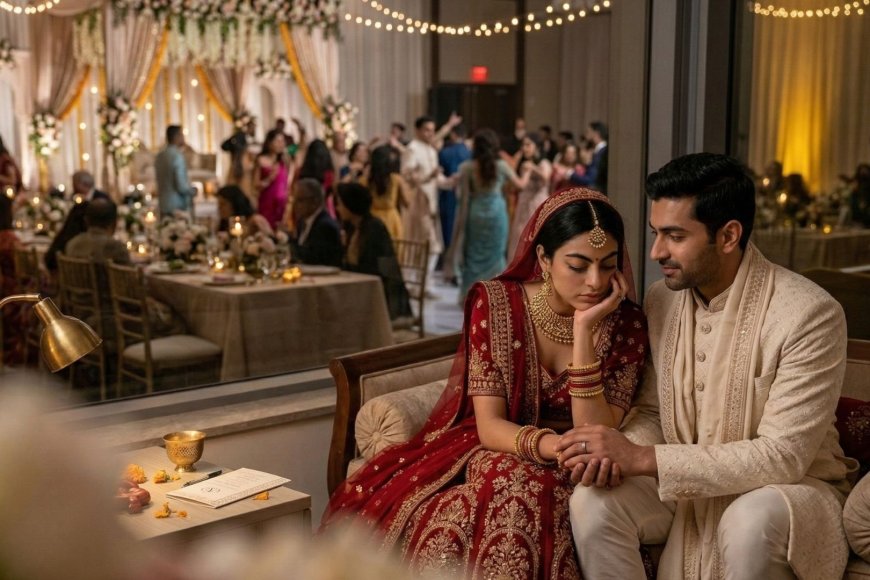
Anxiety Management for Introverted Brides and Grooms
The NRI couple's honest guide to the specific experience of the introverted person at the centre of the most extroverted occasion in the Indian cultural calendar — what the introvert actually needs, why the wedding's demands are genuinely harder for them, and how to design the occasion that is survivable and even, in the right conditions, genuinely wonderful
The Groom Who Did Not Want a Big Wedding
The groom had known, for most of his adult life, that he was an introvert.
Not in the popular misunderstanding of the term — the shy person, the socially anxious person, the person who does not like people. He liked people. He had friends he was deeply fond of, relationships he maintained with genuine investment, conversations he found genuinely stimulating and genuinely restorative. He was good at his job, which required the sustained engagement with colleagues and clients whose demands he met with competence and with warmth.
What he knew about himself was more specific than the popular understanding. He knew that the social engagement that restored other people depleted him. He knew that the large gathering — the party, the conference, the family occasion with forty people in a single room — required a specific expenditure of energy that left him, afterward, with the specific need for the quiet that was not the preference but the requirement. He knew that the sustained performance of the social self — the version of himself that was appropriate for the public occasion — was genuinely tiring in a way that it was not for the people around him who seemed to draw energy from the same conditions that depleted his.
He had known all of this. He had built a life that accommodated it — the specific social architecture of the introvert who has learned to manage the demands of an extroverted world without the world necessarily knowing that the management is happening.
What he had not fully accounted for was the wedding.
The wedding — the Indian wedding, the NRI wedding with its multi-day programme and its four hundred guests and its sustained requirement for the public performance of joy and gratitude and social engagement across every hour of every event — was the most extroverted occasion in the Indian cultural calendar. It was designed, in its every element, for the person who was energised by the crowd, the noise, the sustained social intensity of the occasion. It was designed for the extrovert.
He was not the extrovert.
The planning period's first significant conversation with the bride — who was also, it emerged, the person whose relationship to large social occasions was more complicated than her social facility suggested — was the conversation about this specific thing. Not the venue or the catering or the guest list in the abstract. The specific question: how do we design a wedding that we can actually survive, and possibly enjoy, when neither of us is the person this occasion was designed for?
This guide is built on that question.
Understanding the Introvert's Specific Experience
What Introversion Actually Is
The introvert's experience is the experience of the person whose energy system responds to social stimulation differently from the extrovert's — not better or worse, but differently in a way that has specific, real consequences for the management of the occasions that require sustained social engagement.
The neurological basis: the introvert's nervous system is more sensitive to external stimulation — more responsive to the input of the social environment — and reaches the optimal stimulation level at a lower threshold than the extrovert's. The social environment that is energising for the extrovert — the large gathering, the noise, the sustained social input — is the social environment that pushes the introvert past the optimal threshold and into the overstimulation whose experience is the depletion, the fatigue, and the specific need for the quiet that restores the nervous system to its functional range.
The wedding's specific challenge for the introvert: the four-hundred-person reception, the sustained requirement for the performance of social engagement across multiple days, the specific cultural expectation that the bride and groom are the occasion's central, accessible, continuously present figures — these are the conditions of sustained overstimulation that the introvert's nervous system is least equipped to manage without the specific planning that accounts for what the introvert actually needs.
The Indian Wedding's Specific Demands on the Introvert
The Indian wedding is the specific occasion whose demands on the introvert are the most concentrated and the most sustained of any social occasion in the cultural calendar.
The duration: The multi-day programme — the mehendi, the haldi, the sangeet, the ceremony, the reception — is not the single occasion whose demands can be managed with a single expenditure of social energy and a single period of recovery. It is the sustained, multi-day requirement for the public performance of the social self that the introvert's energy system is not designed to maintain without specific support.
The centrality: The bride and the groom are not guests at the Indian wedding. They are the occasion's central figures — the people to whom every guest comes, to whom every conversation is directed, for whom every photograph is arranged. The introvert who is a guest at the large gathering can manage the occasion through the selective engagement with specific people and the strategic withdrawal from the crowd. The introvert who is the bride or the groom cannot. The centrality removes the management strategies that the introvert has spent a lifetime developing.
The expectation of continuous accessibility: The Indian wedding's cultural expectation is the bride and groom who are present, accessible, and visibly joyful across every hour of every event. The bride who disappears for twenty minutes is the bride whose absence is noticed and whose absence generates the specific social management of the family member who goes to find her. The groom who retreats to a corner for a conversation with a single close friend is the groom who is observed retreating and whose retreat is interpreted within the social framework of the occasion.
The performance requirement: The Indian wedding requires the performance of specific social emotions — the joy, the gratitude, the specific warmth of the host — in the public context of the occasion whose every moment is being observed and whose every moment is being photographed. The introvert who is depleted is the introvert who is performing the emotional states that the occasion requires rather than experiencing them — and the performance of the states that are not currently present is the specific additional expenditure that compounds the depletion.
The Anxiety That Accompanies Introversion
The introvert's pre-wedding anxiety is the anxiety that is partly the general pre-wedding anxiety that the previous guide addressed and partly the specific anxiety of the introverted person who is facing the sustained social demands of the occasion they are least equipped to manage.
The specific shape of the introverted person's pre-wedding anxiety: the anticipatory anxiety about the specific social demands — the specific fear of the reception's first hour when the couple is being greeted by every guest in sequence, the specific anxiety about the sangeet's performance expectations, the specific dread of the multi-day sustained engagement that the wedding requires. The anxiety about the anxiety — the specific fear that the introvert will be visibly depleted in the photographs, that the management will be observable, that the performance of the social self will fail in the public occasion whose every moment is being documented.
The anxiety that is specifically introverted rather than generally anxious: the anticipation of the depletion rather than the fear of the social judgment. The introvert is not afraid that people will dislike them — they are afraid of the exhaustion of the sustained performance, and of the specific experience of being required to be available and engaged beyond the capacity that their energy system can sustain.
The Planning: Designing the Wedding for the Introvert
The Permission
The first planning act for the introverted bride or groom is the permission — the specific, explicit permission to design the wedding around the people who are actually getting married rather than around the cultural template that assumes the couple is energised by the scale and the social intensity that the template produces.
The permission is not the rejection of the Indian wedding's tradition. It is the recognition that the tradition's scale and format are not compulsory in every element — that the introvert who designs the wedding with their actual needs in mind is not diminishing the occasion but designing it for the people whose occasion it is.
The permission is also not the permission to have a small wedding against the family's wishes — the negotiation with the family about the wedding's scale is its own conversation, addressed below. It is the permission to treat the introvert's specific needs as legitimate design considerations rather than as the weaknesses to be managed and concealed.
The Scale Conversation
The guest list is the wedding design's most direct intervention in the introvert's experience — the variable that most directly determines the social demands the occasion will place on the couple.
The honest conversation about the guest list should begin with the honest acknowledgment of what the scale means for the introverted bride or groom — not as the complaint or the preference but as the specific, real impact that the guest count has on the couple's experience of their own wedding.
The introvert's honest guest count:
For the introvert, the meaningful guest — the person whose presence at the wedding adds to rather than depletes the experience — is the person with whom the bride or groom has a genuine relationship that is specific rather than categorical. The colleague who is invited because colleagues are invited. The cousin's spouse who is invited because the cousin is invited. The family friend who has been known for twenty years but with whom the relationship is the occasion rather than the connection — these are the guests whose presence adds to the social load without adding to the occasion's meaning for the introvert.
The introvert's guest list exercise: for each invited guest, the honest question — will this person's presence on the day add to my experience of the wedding, or will it add to the social load that I am managing? The guest list that reflects the honest answer to this question is the guest list that is most likely to produce the wedding that the introvert can genuinely experience rather than survive.
The family negotiation:
The guest list conversation with the family — the conversation about the reduction of the scale that the introvert's needs suggest — is the conversation that requires the specific honesty about why the scale matters. Not the preference for the smaller gathering as an aesthetic choice but the specific, honest explanation of what the large gathering does to the introverted person and why it matters for the couple's experience of their own occasion.
The family who understands that the bride or groom is not being precious about the guest count but is describing a genuine, real limitation of their energy system is the family most likely to engage with the conversation as the problem to be solved together rather than the preference to be overridden.
The family who does not understand — who receives the conversation as the preference to be managed rather than the genuine need to be accommodated — is the family with whom the negotiation is harder and whose outcome may not be the guest list the introvert would design. The compromise that is reached is the compromise between the introvert's genuine need and the family's genuine investment in the occasion's cultural function. The compromise is real — both sides give something — and the outcome is not the introvert's ideal but is better than the accommodation of the cultural template without the conversation.
The Programme Design
The wedding's programme — the sequence of events, the timing, the structure of each occasion — is the design variable whose management most directly supports the introvert's ability to sustain the multi-day engagement.
The recovery time built into the programme:
The programme that accounts for the introvert's need for recovery — the specific, protected time between events during which the introvert can be genuinely alone or in the company of only the most restorative people — is the programme whose design acknowledges what the wedding actually requires from the person at its centre.
The recovery time does not need to be long. The twenty minutes of genuine quiet between the ceremony's end and the reception's beginning — the twenty minutes in which the couple is alone, or with only the most specific people, in the space that has been protected for this purpose — is the recovery time that meaningfully restores the introvert's capacity for the reception's engagement.
The recovery time should be designed into the programme rather than hoped for in its margins. The programme that has no protected quiet between events is the programme that produces the specific experience of the introvert who arrives at each subsequent event more depleted than the previous.
The event sequence:
The multi-day programme's sequence should be designed with the introvert's energy arc in mind. The event that is most socially demanding — typically the reception, with its largest guest count and its most sustained requirement for the accessible, engaged couple — should not be the programme's final event if it can be avoided. The couple who has been managing the social demands for three days before the most demanding event arrives at the most demanding event with the least energy.
Where the programme's sequence is constrained by the ceremony's religious timing, the recovery provisions within the sequence are the primary management tool.
The structured versus the unstructured time:
The introvert manages structured social time more easily than unstructured social time — the ceremony's ritual, the scheduled reception's specific activities, the programme's named events — because the structure provides the specific framework within which the social engagement is contained and legible. The unstructured social time — the cocktail hour, the pre-dinner milling, the post-programme lingering — is the social time the introvert finds most depleting, because it requires the sustained, self-directed social engagement without the structure that contains and defines it.
The programme that minimises the unstructured social time — that moves efficiently from the structured event to the structured event, that provides the recovery time in the intervals rather than the unstructured social milling — is the programme most supportive of the introvert's experience.
The Sanctuary Space
The sanctuary space — the specific, known, accessible space at each venue to which the bride or groom can briefly withdraw when the depletion requires it — is the single most practical planning provision for the introverted bride or groom.
The sanctuary space is not a hiding place. It is the recovery provision — the room, the corner, the specific outdoor space — that the introvert knows they can access for five to fifteen minutes when the social demands have exceeded the energy available, and from which they can return to the occasion restored enough to continue.
The sanctuary space should be: genuinely quiet and genuinely private, accessible without requiring the navigation of the main event space and the social interactions that the navigation produces, known to the partner and to the one or two trusted people who are managing the occasion on the couple's behalf, and provisioned with the specific restorative elements that work for the specific introvert — the glass of water, the five minutes of silence, the brief text exchange with the partner.
The sanctuary space should be identified at each venue during the planning phase — not discovered in the moment of need, when the identification requires the social navigation the introvert is already too depleted to manage.
The Partner as the Primary Resource
The introverted bride or groom whose partner understands their introversion — who has had the specific, honest conversation about what the wedding's social demands mean for the introverted person and what the partner can do to support the management — has the primary resource that the wedding's management requires.
The specific support the partner can provide:
The social buffering — the partner who positions themselves between the introvert and the sustained group engagement, who facilitates the conversations and manages the social flow in ways that reduce the introvert's direct management load.
The signal system — the agreed signal between the couple that communicates the introvert's depletion without requiring the public naming of the state. The specific look, the specific touch, the specific word that means: I need the sanctuary space in the next ten minutes.
The extraction — the partner who, having received the signal, creates the specific social exit that allows the introvert to withdraw without the withdrawal requiring the public explanation. "We need to go say hello to the family" — the social excuse that extracts the introvert from the conversation and moves them toward the sanctuary space or the recovery transition.
The check-in — the specific, private check-in between the couple at the planned moments in the programme — the brief, genuine inquiry into how the introvert is doing that is not the performance of wellness management but the specific partner attention that the introvert most needs.
The Trusted People
Beyond the partner, the introvert benefits from the specific, briefed trusted people — the two or three people at the wedding whose role includes the specific awareness of the introvert's needs and the specific capacity to support the management.
The trusted person who knows: that the bride or groom is introverted, what this means in practice at the wedding's social demands, what the signal looks like when the depletion is approaching, and what the specific support looks like that helps.
The trusted person's specific role: the social companion who provides the specific cover of the conversation that the introvert can engage with rather than the open social field that requires the introvert's self-directed management, the person who extracts the introvert from the sustained group engagement when the signal is received, the person who manages the sanctuary space's availability and the programme's recovery provisions.
The Specific Events: Managing Each Occasion
The Mehendi and the Haldi
The mehendi and the haldi — the smaller, more intimate pre-wedding events — are the introverted person's most manageable events and the events whose guest list most directly reflects the introvert's comfort. The guest list for these events is typically the inner circle — the people whose presence the introvert finds most restorative rather than most depleting — and the duration is contained relative to the reception.
The management for these events: the programme that is specific rather than open-ended, the guest list that genuinely reflects the inner circle rather than the extended invitation, and the recovery provision between the mehendi and the haldi if both are on the same day.
The Sangeet
The sangeet — the music and performance event whose energy is the most extroverted of the programme's occasions — is the event the introverted person typically finds the most socially demanding of the pre-wedding events.
The management for the sangeet: the couple's agreement about their own participation in the performance elements — the introvert who is required to perform a group dance for which they have not been given genuine choice is the introvert whose experience of the sangeet is the specific additional anxiety of the performance expectation on top of the social depletion. The couple who has been given the genuine option to participate or to be the enthusiastic audience rather than the performer has the sangeet that is more manageable.
The structured element of the sangeet — the specific programme of performances, the specific sequence — is the introvert's friend. The sangeet that moves efficiently through its programme is more manageable than the sangeet whose unstructured elements extend past the couple's capacity.
The Ceremony
The ceremony — the most structured event of the programme — is paradoxically the most manageable for many introverts, precisely because its structure is the most specific. The couple is seated. The ritual has a sequence. The social engagement is contained within the ceremony's framework. The introvert who finds the unstructured social occasions most depleting often finds the ceremony itself more manageable than the reception.
The management for the ceremony: the recovery provision immediately after — the twenty minutes of genuine quiet before the photography session and before the reception begins — is the most important single provision for sustaining the introvert's capacity through the rest of the day.
The Reception
The reception is the introverted person's most demanding event — the largest guest count, the most sustained requirement for accessibility and engagement, the longest duration, the least structured social time.
The management for the reception:
The receiving line — the specific, structured format in which the couple greets every guest in sequence — is the reception's most common format for managing the guest greeting requirement. For the introvert, the receiving line has a specific advantage over the ambient greeting: it structures the engagement, makes it sequential rather than simultaneous, and gives each interaction a defined beginning and end. The receiving line that is efficient — that moves through the guest greeting without the extended conversation that the open format produces — is more manageable for the introvert than the ambient circulation.
The programme that gives the couple the specific licence to be with each other — the moments in the reception's programme where the couple is seated together at their table, or dancing together, or in the specific company of the people they most want to be with — is the programme that provides the most restorative moments within the reception's sustained demands.
The exit time — the specific, planned exit time that the couple knows in advance and that the evening's programme is designed to reach — is the provision that makes the reception's demands manageable because they are finite. The introvert who knows the reception ends at eleven manages the nine o'clock's depletion differently from the introvert who does not know when the occasion will end.
The Photographs: The Introvert's Specific Challenge
The photograph session — the sustained, directed, public performance of specific emotions for the camera — is the specific additional demand that the introvert finds particularly challenging. The photograph session requires the performance of the emotions on request, in the specific format the photographer directs, in the sustained engagement with the direction that the session's length requires.
The management for the photographs:
The photographer briefed on the introvert's specific needs — who knows that the couple finds the natural, candid photograph more comfortable than the directed pose, who designs the session around the genuine interaction rather than the performed emotion, who gives the couple the specific direction that produces the natural expression rather than the sustained performance of it — is the photographer who produces the photographs that look most like the people they are documenting.
The photograph session scheduled with the recovery provision — the short break between the ceremony and the session, the session that is efficient rather than extended, the session that ends before the depletion has reached the level where the photographs capture the exhaustion rather than the couple — is the session most likely to produce the photographs the couple will want.
The specific instruction to the photographer: candid rather than posed wherever possible. The photograph of the couple talking to each other is more likely to produce the genuine expression than the photograph of the couple looking at the camera on request.
The Anxiety Management: Specific to the Introvert
Before the Wedding
The anticipatory anxiety that the introvert experiences in the weeks before the wedding — the specific, sustained anxiety about the social demands of the occasion — is managed by the planning that reduces the uncertainty.
The uncertainty is the anxiety's primary fuel. The introvert who does not know what the reception's social demands will look like, who has not identified the sanctuary space, who has not agreed the signal system with the partner, who has not designed the programme's recovery provisions — this introvert's anticipatory anxiety is fed by the specific unknowns that the planning can resolve.
The planning itself is the anxiety management. The introvert who has designed the wedding with their specific needs in mind — who has identified the sanctuary space at each venue, who has agreed the signal system with the partner, who has built the recovery provisions into the programme — has significantly reduced the specific unknowns that the anticipatory anxiety feeds on.
The specific practices:
The daily quiet practice — the meditation, the specific time of genuine solitude that the planning period's demands most frequently eliminate — is the anxiety management practice whose importance for the introvert is highest in the planning period. The introvert whose daily solitude is being consumed by the planning calls and the family coordination and the decision fatigue is the introvert who is arriving at each week with fewer resources than the previous one.
Protect the daily solitude. Even twenty minutes. Especially twenty minutes.
The social budget management — the conscious management of the social commitments in the weeks before the wedding, the deliberate reduction of the non-essential social engagements that deplete the energy reserves that the wedding will require — is the introvert's specific pre-wedding resource management. The friend's birthday dinner in the week before the wedding is the social commitment whose opportunity cost is the energy that the wedding requires.
During the Wedding
The in-the-moment anxiety management for the introvert at their own wedding: the specific, practiced breathing technique that can be used in the thirty seconds before the receiving line, the signal system activated without the public naming of the state, the sanctuary space accessed without the public explanation.
The acceptance that the depletion will arrive — that the wedding's demands will, at some point in the multi-day programme, exceed the energy available — and the specific plan for when it does rather than the hope that it will not. The introvert who has the plan is the introvert who manages the depletion rather than being managed by it.
The partner's check-in at the planned moments — the brief, private, genuine inquiry that is not the performance of wellness management but the specific, practical support that the signal system and the plan enable.
After the Wedding
The introvert's post-wedding recovery — the specific, extended recovery that the sustained multi-day social demands of the wedding require — is the provision that the first days after the wedding should protect.
The honeymoon that is the quiet, restorative experience rather than the socially intensive destination is the honeymoon most appropriate for the couple whose introversion has been managing the wedding's social demands across multiple days. The active, social, group-tour honeymoon that immediately follows the wedding is the honeymoon that does not provide the recovery that the introvert requires.
The specific, protected quiet of the post-wedding days — the permission to be unavailable, to not respond to every message and photograph and expression of congratulation, to be genuinely alone with the partner in the specific recovery that the wedding's demands have made necessary — is the post-wedding provision that most directly serves the introvert's needs.
The Wedding That Was Survivable and Then Some
The groom had designed the wedding with the specific honesty that his introversion required.
The guest list was smaller than the family had initially imagined — the conversation had been had, the honesty had been offered, the compromise had been reached. The programme had the recovery provisions built in. The sanctuary space at each venue had been identified. The signal system had been agreed with the bride, who was, it turned out, navigating the same specific needs from the same specific experience.
The reception had an exit time. The photographer had been briefed. The trusted people knew what to watch for and what to do.
On the day, the groom used the sanctuary space once — at the sangeet, for twelve minutes, in the specific quiet of the side room that he had identified at the venue visit two months before. He returned to the sangeet restored enough to genuinely enjoy the final hour.
He said afterward that the wedding had not been the occasion he had been dreading. It had been the occasion he had designed for the person he actually was — and the person he actually was had been able to be genuinely present at his own wedding in a way he had not been sure was possible.
The design had made it possible.
Not by making the occasion less than it was.
By making it right for the people it was for.
NRIWedding.com — Expert guidance for Indian weddings planned across borders.
0 comments
Real names and courtesy, please. Every comment is read by a person before it appears.
Nothing yet. Start it off.
Comments are closed on this article.