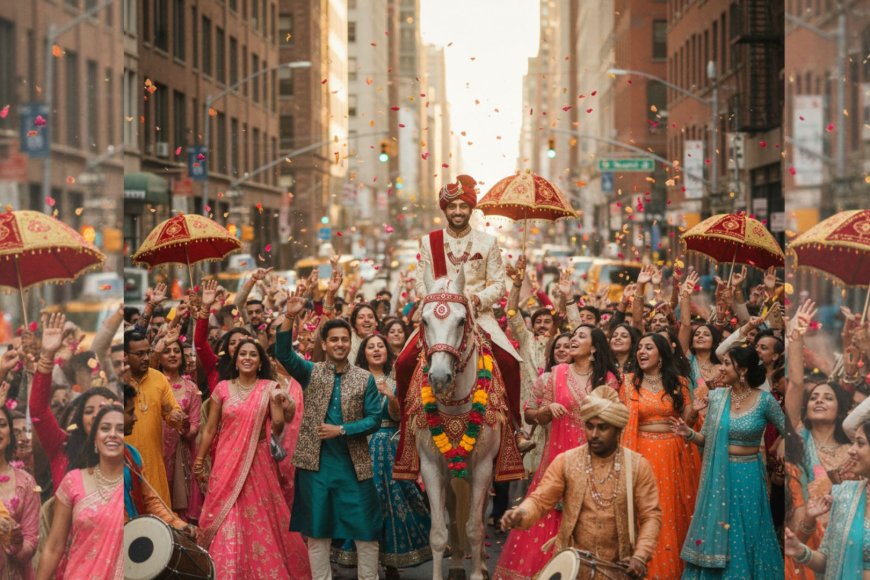
When the Streets Become Sacred: How NRIs Are Bringing the Baraat Home
You grew up watching your cousins arrive on a decorated horse, the sound of dhol echoing through narrow Indian lanes, neighbours leaning out of balconies to bless the groom with smiles and petals. Now you’re in Brampton, or Birmingham, or Melbourne, standing outside a banquet hall with a Bluetooth speaker, wondering if the magic can survive zoning laws and parking restrictions.
You want the noise. The colour. The chaos. But more than anything, you want the feeling — that moment when your family arrives not just at a venue, but at a new chapter of your life, together.
For NRIs, the Baraat is no longer just a procession. It’s a declaration that culture doesn’t stay behind at immigration counters.
🌟 DID YOU KNOW?
• Over 68% of Indian-origin weddings in the UK and Canada now include a public baraat, even when held in Western venues.
• In Birmingham’s Southall area, police departments routinely issue “baraat permits” for wedding processions.
• The global Indian wedding industry is valued at over USD 40 billion, with baraat services becoming a dedicated niche abroad.
WHAT IS BARAAT (Groom’s Wedding Procession)?
The Baraat is one of the most visually iconic elements of an Indian wedding. Traditionally, it marks the groom’s ceremonial arrival at the wedding venue, accompanied by his family and friends, dancing, singing, and playing music as they escort him to meet the bride’s family.
The word Baraat itself comes from the Sanskrit root “varayati”, meaning “to choose or accept”. In ancient times, it symbolised the groom’s community presenting itself to the bride’s household, not as strangers, but as future kin. The procession is both celebratory and symbolic — joy on the surface, ritual beneath.
Physically, the groom rides a horse (Ghodi), sometimes a decorated car, elephant, or even a boat in coastal communities. His relatives dance around him, led by live drummers (Dholwalas), carrying lamps, flowers, and occasionally ceremonial swords (Talwar) representing protection and honour. The bride’s family welcomes the baraat with Aarti (ritual lamp offering), Tilak (forehead mark), and Var Mala (garland exchange) before formal wedding rituals begin.
In the wedding sequence, the baraat is the emotional bridge between private preparation and public union. It’s the moment when two families physically and spiritually cross into each other’s lives.
For NRIs, this ritual carries even more weight — it becomes proof that even in foreign lands, Indian weddings still arrive with rhythm, colour, and unapologetic joy.
COMMUNITY COMPARISON TABLE
| Community / State | Local Name | Key Tradition | How NRIs Abroad Adapt It |
|---|---|---|---|
| Himachali | Barat | Groom arrives with village band | DJs replace bands, procession inside venues |
| Garhwali | Baraat | Sword-bearing relatives | Symbolic swords, no public weapons |
| Kumaoni | Janot | Singing folk songs | Recorded folk playlists |
| Ladakhi | Changpa Procession | Yak or horse ride | Decorated SUVs |
| Kashmiri Pandit | Boon | Quiet dignified arrival | Minimalist indoor ceremonies |
| Punjabi | Baraat | High-energy dancing | Full DJ, LED dhol |
| Marathi | Varat | Aarti and tilak | Condensed reception version |
| Tamil | Mapillai Azhaippu | Formal welcome | Integrated into stage entry |
| Bengali | Bor Jatri | Conch shells and ululation | Virtual family participation |
| Rajasthani | Baraat | Camels and elephants | Themed decor, vintage cars |
THE MEANING BEHIND THE RITUAL
At its core, the baraat represents transition. It is the groom leaving his identity as a son and arriving as a husband. In Indian philosophy, movement itself is sacred. Nothing transformative happens in stillness — you must walk, travel, cross thresholds.
The dancing crowd symbolises collective blessing. No one marries alone in Indian culture. A marriage is not just two individuals choosing each other; it is entire communities agreeing to merge futures.
Spiritually, the baraat mirrors life itself: noisy, unpredictable, full of obstacles, but always moving forward. The groom is carried by the energy of others, a reminder that love survives only when supported by family, friends, and shared memory.
As one intercultural couple once described it:
“The baraat is how Indian culture explains marriage to the universe — not with vows, but with rhythm.”
DOING BARAAT ABROAD: THE PRACTICAL REALITY
This is where romance meets regulations.
In London, Southall and Wembley have become unofficial baraat hubs, with councils accustomed to issuing procession permits. In Toronto and Brampton, venues often allow indoor baraats through banquet hall corridors. In Dubai, hotel policies usually restrict outdoor music, pushing couples toward indoor grand entries instead.
Sourcing essentials is easier than ever. You’ll find dhol players in Southall, Jackson Heights (New York), Surrey (Vancouver), Harris Park (Sydney), and Al Karama (Dubai). Costume rentals, fake swords, turbans, and LED umbrellas are now standard services.
The biggest challenge? The pandit problem. Finding a priest who understands your regional customs abroad requires early planning. Many families now fly pandits from India or conduct hybrid ceremonies — physical baraat abroad, ritual blessings live-streamed from grandparents in Delhi or Ludhiana.
Fire and smoke restrictions mean traditional torches (Mashaal) are often replaced with battery-powered lamps. Horses are replaced by vintage cars or decorated bikes. And yet — the feeling survives.
Time zones matter too. A Toronto baraat at 6 pm means grandparents in India waking up at 3:30 am to bless you over video call. And they will. Because some rituals refuse to stay within borders.
DOING BARAAT AS A DESTINATION WEDDING IN INDIA
For many NRIs, bringing the wedding back to India feels like coming full circle. Rajasthan, Punjab, Goa, and Udaipur remain top destinations for elaborate baraats, offering open streets, live bands, and community participation without restrictions.
Briefing local pandits is essential. They often assume full traditional setups, while NRI couples may want shortened ceremonies, bilingual explanations, and guest-friendly timelines.
The biggest gift? Letting non-Indian guests experience the baraat without filters — not as a performance, but as living culture. When your American or British friends dance beside your cousins on Indian soil, something irreversible happens. They stop being visitors. They become part of your story.
WHAT YOU NEED: RITUAL CHECKLIST
Ritual Items
Ghodi or decorated vehicle, dhol, groom’s attire, ceremonial sword or accessory, floral garlands, lamps, welcome tray.
People Required
Groom’s family, dhol players, coordinator, pandit or officiant, venue manager.
Preparation Steps
Confirm venue permissions, book musicians early, plan procession route, coordinate video calls, brief photographer on entry shots.
NRI.Wedding connects couples with trusted baraat vendors and regional pandits across continents.
5 QUESTIONS NRI COUPLES ALWAYS ASK
Can we do a baraat in a hotel?
Yes, most international hotels allow indoor processions if planned with coordinators.
What if my partner isn’t Indian?
Baraats work beautifully for mixed couples. Guests love learning through participation.
How do we find a Punjabi or Tamil pandit abroad?
Use diaspora networks or NRI.Wedding’s global priest listings.
Can grandparents join virtually?
Yes, many couples place iPads at the front of the procession.
Should the civil ceremony come before or after?
Most NRIs do civil paperwork earlier, keeping baraat as emotional centre.
THE EMOTIONAL ANGLE
You don’t realise how heavy culture feels until you’re the one carrying it. Your parents saved recipes in their heads, languages in their hearts, rituals in their muscle memory. And now it’s your turn.
The baraat abroad feels like rebellion and responsibility at once. You’re asking foreign streets to hold sacred space. You’re asking your children — not yet born — to inherit something ancient.
And when the dhol starts, something breaks open. For a few minutes, the world feels aligned. No visas. No accents. No explanations. Just rhythm and belonging.
A MOMENT TO SMILE
In Mississauga, one groom’s horse refused to walk into the parking lot. Traffic built up. Guests panicked. So the groom climbed off, danced instead, and the entire procession followed him on foot — horse included, eventually, after bribery with carrots.
The photos went viral in the family WhatsApp group. The groom still says it was the most “Indian” thing that could’ve happened abroad.
QUOTES FROM THE DIASPORA
“When my son danced in the streets of Birmingham, I felt like my village had arrived with him.” — Sunita Sharma, Punjabi, UK
“Our baraat in Toronto was louder than any wedding I’d seen in Mumbai.” — Riya Mehta, Gujarati, Canada
“My American husband said the baraat taught him more about India than any book.” — Neha Iyer, Tamil, Texas
YOUR ROOTS TRAVEL WITH YOU
Indian weddings were never meant to be quiet. They were meant to interrupt the world. To remind strangers that joy exists loudly, visibly, unapologetically.
At NRI.Wedding, we don’t just plan events. We protect memories. We help you find pandits who speak your language, musicians who understand your rhythm, photographers who know when culture is happening — not just posing.
Because no matter where you stand on the map, your roots don’t stay behind.
Your roots travel with you. Let them dance.
0 comments
Real names and courtesy, please. Every comment is read by a person before it appears.
Nothing yet. Start it off.
Comments are closed on this article.