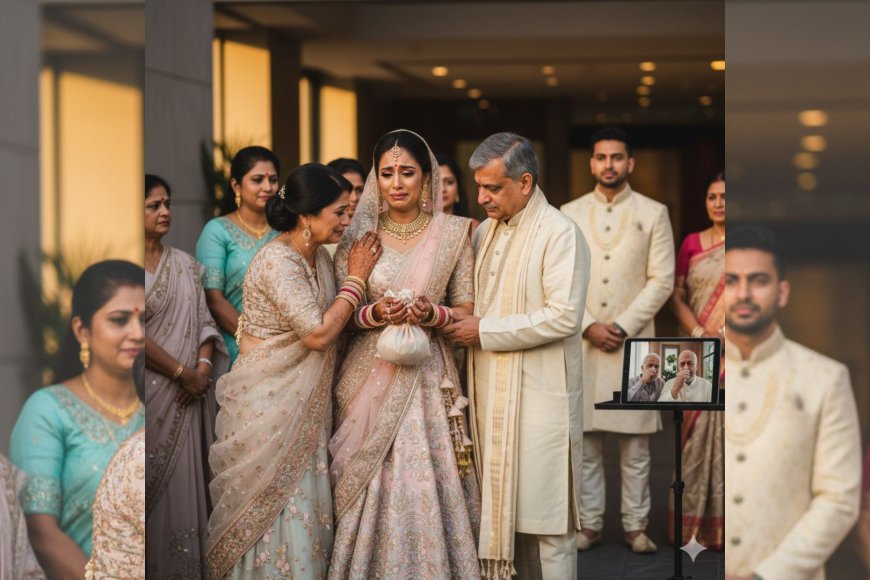
For Indian families living abroad, Bidaai is no longer just a wedding ritual — it is an emotional reckoning with distance, memory, and identity. As NRI weddings unfold in foreign cities and global venues, this ancient farewell takes on deeper meaning, layered with migration, separation, and the quiet grief of letting go across continents. This is the story of how one ritual carries centuries of emotion into modern diaspora life.
You grew up hearing stories about your parents’ wedding in India — the crowded courtyard, the crying relatives, the final goodbye at the gate. You were too young to understand then what Bidaai meant. It was just another word in a language you half-spoke.
Now you’re standing outside a hotel ballroom in Toronto, holding your parents’ hands while guests wait inside. Your wedding has been perfect. But suddenly, there’s this moment no one warned you about — the moment where you realise you are not just getting married.
You are leaving.
Not just your house. Not just your surname. You are leaving a version of home that no longer exists in one place.
🌟 DID YOU KNOW? FACT BOX
Did You Know?
The ritual of Bidaai is mentioned in medieval North Indian wedding texts dating back over 700 years.
Over 60% of Indian parents in diaspora communities say Bidaai is the most emotionally difficult part of their child’s wedding.
In NRI weddings, Bidaai is often the only ritual where both families insist on strict tradition, even when everything else is modernised.
WHAT IS BIDAII?
Bidaai (bride’s farewell ceremony) marks the symbolic departure of the bride from her parental home to her marital home. The word comes from the Sanskrit root Vidai (departure or parting), and it is one of the final rituals of an Indian wedding.
Traditionally, Bidaai happens after the wedding ceremony, just before the bride leaves with the groom. The bride stands with her parents, holding a handful of rice, coins, or flower petals. She throws them backward over her head into her parents’ home while walking away, symbolising gratitude for everything she has received and blessings for prosperity in the home she is leaving behind.
Physically, it is simple. Emotionally, it is devastating.
The bride often weeps openly. Parents try to remain composed and fail. Relatives offer comfort and blessings. The groom’s family waits respectfully at a distance. The ritual ends when the bride enters the groom’s vehicle or home.
Spiritually, Bidaai represents the transfer of responsibility — from one household to another. In Indian philosophy, marriage is not just union; it is relocation of identity. The bride does not simply gain a new family. She leaves behind a universe where she was once the centre.
For NRI families, this moment carries additional weight. It is not just about leaving parents. It is about leaving countries, childhoods, languages, and entire emotional landscapes.
COMMUNITY COMPARISON TABLE
| Community / State | Local Name | Key Tradition | How NRIs Abroad Adapt It |
|---|---|---|---|
| Himachali | Bidaai | Rice and tears | Symbolic rice toss in venue |
| Garhwali | Bidai | Mother’s final blessing | Video call blessings from India |
| Kumaoni | Bidai | Bride touches threshold | Touching apartment doorway |
| Ladakhi | Kha-chak | Quiet farewell | Minimal ritual indoors |
| Kashmiri Pandit | Send-off | No rice, just blessings | Hybrid with North Indian style |
| Punjabi | Bidaai | Emotional singing | Recorded folk songs |
| Marathi | Kanyadaan exit | Father escorts bride | Parents walk bride to car |
| Tamil | Kalyana pirivu | No public crying | Private family moment |
| Bengali | Bashor ghor exit | Ululation sounds | Phone recordings |
| Rajasthani | Bidaai | Heavy emotional rituals | Shortened ceremony |
THE MEANING BEHIND THE RITUAL
Bidaai exists because Indian culture understands something most modern societies forget — that transitions deserve grief.
Marriage is not only celebration. It is loss. It is the end of one role and the beginning of another. In Indian philosophy, the home is not just a building; it is an extension of the self. Leaving it is a kind of death, and Bidaai allows that death to be acknowledged, not hidden.
The rice thrown backward symbolises that a daughter repays her parents not with money, but with blessings. She cannot give them her future, so she leaves them abundance.
Spiritually, Bidaai reflects the Indian worldview that life is cyclical. We are always leaving something behind to become something else. The ritual teaches that love is not possession. It is release.
For a non-Indian partner, this can be explained simply: Bidaai is how Indian families say goodbye with honesty, not pretending that joy erases loss.
DOING BIDAII ABROAD: THE PRACTICAL REALITY
This is where culture collides with modern life.
Most NRI weddings happen in hotels, banquet halls, vineyards, or beach resorts. These spaces are designed for exits, not emotions. There is rarely a gate, a threshold, or a symbolic “home” to leave.
Couples adapt creatively. In London, families often designate a specific doorway in the venue as the “home gate.” In Sydney, some brides perform Bidaai at the hotel entrance. In Houston, community halls with outdoor spaces allow more traditional setups. In Dubai, private villas are often rented just to recreate the farewell moment.
Sourcing ritual items is simple — rice, petals, coins — but sourcing emotional context is harder. Many NRI parents insist on calling relatives in India live during Bidaai. Time zones mean late-night calls for grandparents, early mornings for couples abroad. Phones are passed around so blessings can be given through screens.
The pandit issue is real. Many priests abroad are unfamiliar with region-specific Bidaai customs. Families often coach them, sending voice notes and instructions from elders in India.
Fire restrictions don’t apply here, but privacy does. Western guests often feel awkward watching public crying. Couples now explain the ritual beforehand, so emotion is seen as cultural honesty, not discomfort.
The hardest part is not logistics. It is that in diaspora weddings, Bidaai often marks not just the bride’s departure, but the family’s acceptance that their child’s life will never fully belong to one place again.
DOING BIDAII AS A DESTINATION WEDDING IN INDIA
Some NRI couples return to India specifically for Bidaai. They may marry abroad but perform farewell rituals in ancestral homes.
Popular locations include family houses in Delhi, Jaipur, Chandigarh, Dehradun, and smaller hometowns. The emotional intensity is unmatched. The physical space carries memory — walls that watched you grow up, neighbours who remember your childhood.
The key is briefing local pandits about diaspora realities. Many assume traditional timelines and extended family presence, which may not be possible. NRI couples must clearly communicate schedules and emotional priorities.
For non-Indian guests, cultural translation is essential. Printed explanations, bilingual guides, and gentle narration help them understand that they are witnessing something sacred, not awkward.
WHAT YOU NEED: RITUAL CHECKLIST
Ritual Items: Rice, flower petals, small coins, dupatta, tissues.
People Required: Bride, parents, close relatives, pandit or elder.
Preparation Steps: Choose farewell location, brief guests, coordinate video calls.
NRI.Wedding connects families with regional pandits and planners who understand diaspora customs.
5 QUESTIONS NRI COUPLES ALWAYS ASK
Can we do Bidaai in a hotel?
Yes. Most families designate a symbolic doorway or outdoor exit.
What if my partner isn’t Indian?
Many intercultural couples explain the ritual in advance and involve both families.
How do we find a pandit who understands our region?
Community referrals and NRI.Wedding’s verified network are the safest options.
Can family in India participate live?
Yes. Video calls are now a central part of diaspora Bidaai.
Should Bidaai happen after civil or religious ceremony?
Traditionally after religious rites, even if legal marriage happened earlier.
THE EMOTIONAL ANGLE
You don’t realise how heavy your childhood is until you try to carry it into adulthood.
For NRI families, Bidaai is not just about marriage. It is about migration repeating itself. Parents who once left India now watch their children leave home in countries that never felt fully permanent.
Mothers cry because they see their daughters repeating a pattern they never chose — building lives far from roots. Fathers struggle because goodbye feels final in a way distance makes irreversible.
For you, standing between two passports, two cultures, two identities, Bidaai feels like grief layered on grief. You are not just leaving a house. You are leaving a version of yourself that existed only in one place, one language, one emotional universe.
And yet, you walk forward. Because Indian culture teaches that love does not stop at borders. It stretches. It adapts. It travels.
A MOMENT TO SMILE
At a Bidaai in Mississauga, the bride’s father forgot the rice. He panicked, ran into the kitchen, and came back with popcorn.
The bride threw popcorn over her head, everyone burst into laughter, and her mother said, “Even better — now we’ll never forget this.”
QUOTES FROM THE DIASPORA
“My Bidaai in Southall felt heavier than my wedding. That’s when I understood what I was leaving.” — Neha, Punjabi bride, London
“I watched my daughter leave again, this time not just India, but her childhood.” — Ramesh, father, Ahmedabad to Sydney
“I didn’t cry at the ceremony. I cried in the taxi.” — Kavya, Tamil bride, Melbourne
YOUR ROOTS TRAVEL WITH YOU
You may live in glass apartments, speak in borrowed accents, and celebrate in rented spaces. But when Bidaai happens, something ancient awakens.
NRI.Wedding exists for this reason — to honour not just weddings, but emotions. Through regional pandits, cultural planners, photographers, and checklists, the platform helps diaspora families carry tradition without carrying loneliness.
You are not abandoning your roots. You are carrying them into a future they never imagined.
Your roots travel with you. Let them bloom.
0 comments
Real names and courtesy, please. Every comment is read by a person before it appears.
Nothing yet. Start it off.
Comments are closed on this article.