CGH Earth Marari Beach — An Organic Coconut Grove Wedding in a Kerala Fishing Village: NRI Eco Guide — The Complete NRI Wedding Planning Guide
Lakshmi had been explaining her wedding vision to people for six months and nobody had understood it until she explained it to her grandmother.
She had explained it to the wedding planners first. She had described what she wanted — the organic materials, the fishing village context, the coconut grove, the Kerala backwater light, the wedding that was of the landscape rather than imported into it — and the planners had listened with the professional attention of people who were simultaneously understanding and translating, converting the vision into the vocabulary of the destination wedding industry whose categories were the heritage palace and the beach resort and the hill station and the backwater houseboat. Each planner had taken the description and produced a shortlist of venues that approximated various elements of it without quite assembling the whole.
She had explained it to Karan, her fiancé in London, who had understood the ecological and the aesthetic dimensions of the vision but whose specific, City-of-London, investment-banking professional context made the fishing village dimension feel more romantic than literal. He had said yes to everything she described and had meant it sincerely without quite connecting it to the specific, granular, what-does-it-actually-feel-like-to-be-there quality that she was trying to describe.
She had explained it to her parents, who were from Thiruvananthapuram and who had their own, specific, Kerala wedding vision that included elements of what she was describing and other elements that were the family's traditional expectations about the occasion's scale and the community's presence and the specific hospitality that the Tamil-Malayali wedding tradition required.
None of these conversations had fully communicated it.
Then she had explained it to her grandmother.
Her grandmother was seventy-nine years old and had grown up in a fishing village on the Kerala coast — not Mararikulam specifically but the specific, Alappuzha-district, coastal, fishing-community geography whose character was the character of every Kerala fishing village of that generation: the coconut palms, the laterite soil, the backwater fishing, the specific quality of the Kerala coastal light, the morning with the boats going out and the evening with the catch coming in and the specific, unhurried, water-and-coconut-grove rhythm of the life that was organised around the sea and the land's edge.
She had said to her grandmother: I want to get married in a place that feels like where you grew up. The grandmother had been quiet for a moment. Then she had said: Marari.
Lakshmi had said: you know it? The grandmother had said: I have a cousin in Mararikulam. The beach there — the fishing village beach — it is the Kerala coast as it was. And there is a resort there. The CGH Earth resort. It is in the coconut grove. The people who made it understood something. She said: what did they understand? The grandmother had said: that the coconut grove is more beautiful than anything you can put in it.
Lakshmi had looked up CGH Earth Marari Beach that evening. She had found the photographs: the coconut grove, the thatched bungalows under the palms, the organic garden, the fishing village adjacent to the property, the specific, unhurried, water-adjacent, coconut-and-laterite quality of the Kerala coastal landscape that her grandmother had been describing without describing it.
She had called Karan. She said: I found the venue. He said: where? She said: Mararikulam. Kerala. The Alappuzha coast. He said: the backwater area? She said: the fishing village beach. In a coconut grove. An organic resort. CGH Earth. He said: CGH Earth has a very specific following. She said: I know. He said: do you know the philosophy? She said: I've been reading about it. He said: the founder —— She said: CS Vaidyanathan. Yes. He said: he changed something about how the Kerala resort was understood. She said: yes. He said: send the photographs. She sent the photographs. He looked at them for ten minutes. He called back. He said: your grandmother was right. She said: she usually is.
This guide is for every NRI couple who has been trying to describe a wedding vision that the destination wedding industry's categories have not accommodated — for Lakshmi and Karan and every couple who deserves the complete framework for the organic coconut grove wedding in the Kerala fishing village that the grandmother recognised before the planner did.
Understanding CGH Earth Marari Beach: The Philosophy Before the Property
Before the event spaces and before the pricing, the CGH Earth philosophy requires the specific explanation that most directly communicates why CGH Earth Marari Beach is different from every other Kerala beach resort and from every other venue in this series.
CGH Earth — the hospitality group founded by CS Vaidyanathan whose Kerala properties have been defining the responsible luxury hospitality standard in India since the 1990s — is not a luxury hotel group in the conventional sense of the term. It is a hospitality group whose founding philosophy was the specific, Kerala-ecology-engaged, community-integrated, low-impact, high-authenticity approach to the luxury stay that most directly expressed the understanding that the Kerala landscape — the backwaters, the coconut groves, the fishing villages, the Ayurvedic tradition, the specific, only-in-Kerala, water-and-palm-and-laterite quality of the coastal and inland environment — was itself the luxury, and that the resort's role was to provide access to this luxury rather than to substitute for it with the manufactured luxury of the international hotel standard.
This philosophy — the landscape as the luxury, the resort as the access point — is the philosophy whose expression at Marari Beach most completely produces the wedding venue that Lakshmi had been trying to describe and that her grandmother had recognised.
CGH Earth Marari Beach is built within a sixty-acre organic coconut grove on the Mararikulam coast of Kerala's Alappuzha district. The resort's sixty acres of coconut palms — the oldest and the most established of the grove's trees planted decades before the resort was conceived — is the primary architectural element of the property, more significant than any built structure the resort contains. The thatched bungalows under the palms are built to occupy the grove's existing spaces rather than to reshape the grove to accommodate the buildings. The organic garden within the property produces the ingredients for the kitchen. The fishing village of Mararikulam is adjacent to the property's boundary — the fishing community whose daily life, the boats going out and the catch coming in and the specific, coastal-village rhythm of the Alappuzha fishing tradition, is visible and accessible from the resort's grounds.
The Mararikulam Fishing Village: Understanding the Wedding's Context
Mararikulam is a fishing village on the Alappuzha coast — the specific stretch of the Kerala coastline south of Alappuzha town and north of Kollam, characterised by the specific, Kerala-coastal, fishing-community, coconut-grove, laterite-soil quality of the Alappuzha district's coastal geography that has been shaped over centuries by the specific relationship between the Arabian Sea, the Kerala backwater system, and the fishing communities whose livelihood and whose culture are the product of this specific, only-in-Kerala, water-and-land-edge landscape.
The fishing community of Mararikulam — predominantly the Latin Catholic fishing community of the Kerala coast whose specific, Portuguese-influenced, Catholic, fishing-village cultural identity is one of the most specific and most extraordinary cultural identities in South India — is the community adjacent to CGH Earth Marari Beach and whose visible, daily-life, boats-and-nets, fishing-village presence gives the resort its most specific and most irreplaceable cultural context.
The morning at Marari Beach — the fishing boats returning from the overnight catch, the nets being drawn in on the beach, the fish sellers gathering at the water's edge, the specific, only-in-the-Kerala-fishing-village, morning-catch, coastal-community activity that the resort's beach position makes accessible to the guest who wakes early enough for it — is the cultural encounter that gives the CGH Earth Marari Beach wedding its most specific and most humanly extraordinary dimension. Not the heritage palace's architecture. Not the desert fort's drama. The fishing village's morning.
The Organic Coconut Grove: The Primary Architecture
The sixty-acre organic coconut grove of CGH Earth Marari Beach is the venue's primary architectural element — the structure that predates the resort, that will outlast the resort, and that most completely provides the wedding's specific quality of being inside the Kerala landscape rather than visiting it.
The organic certification — the specific, third-party verified, chemical-free, composting-supported, biodiversity-managed organic management of the sixty acres of coconut grove and the resort's agricultural land — is the environmental credential that gives the CGH Earth Marari Beach wedding the specific, institutional, verified organic quality that the eco-conscious NRI couple's wedding vision requires and that most directly parallels the ITC Gardenia's LEED Platinum in the organic agriculture domain.
The organic garden within the resort grounds — the kitchen garden that produces the vegetables and the herbs and the specific, fresh, seasonal produce that the resort's kitchen uses in the meals it serves — is the culinary infrastructure whose engagement in the wedding catering most directly produces the wedding dinner of genuine local provenance. The vegetables on the wedding dinner table were in this garden yesterday. The coconut oil in the preparation is from this grove. The specific, farm-to-table, only-here, organic-provenance quality of the CGH Earth Marari Beach catering is the quality that the organic garden's institutional management produces as the daily operational standard rather than the special-occasion exception.
The coconut palm is not merely the botanical character of the resort's landscape. It is the economic and cultural foundation of the coastal Kerala community's life — the tree whose every part serves a specific function in the traditional Kerala household and whose grove represents, for the Kerala coastal community, the specific, accumulated, multigenerational investment of the family's agricultural heritage. The wedding in the coconut grove is the wedding inside this heritage rather than in front of it.
The CGH Earth Ayurveda: The Wellness Dimension
CGH Earth's specific, institutional, Ayurveda expertise — the group's decades of experience developing and operating the Ayurvedic wellness programs at their Kerala properties — is available at Marari Beach in the form of the pre-wedding wellness program that most specifically uses the Kerala Ayurvedic tradition for the preparation of the bride, the groom, and the wedding party in the days before the ceremony.
The Kerala Ayurvedic tradition — the specific, eight-branch, classical, Ashtangahridayam-based, only-in-Kerala, hereditary-physician, vaidya-tradition medical system whose coastal Kerala geography and whose specific, medicinal-plant, monsoon-harvested, seasonal-ingredient character gives it the specific, only-in-Kerala, classical-Indian-medicine quality that the global wellness industry has been unable to replicate outside the state — is available at CGH Earth Marari Beach in the form of the authentic, vaidya-directed, traditional-preparation, genuinely-practiced Ayurvedic program rather than the spa-industry approximation.
The abhyanga — the traditional two-person, synchronised, warm-oil, full-body Ayurvedic massage whose pre-event preparation function has been documented in the classical texts — is the pre-wedding preparation treatment that most specifically prepares the wedding couple for the ceremony in the manner that the Kerala Ayurvedic tradition has always understood preparation to work: the nourishment of the body's tissues through the oil's penetration, the calming of the nervous system through the specific, rhythmic, synchronised pressure, the specific, visible, skin-and-muscle quality of the person who has received the full-body Ayurvedic treatment in the days before the ceremony.
Brief the CGH Earth Marari Beach Ayurvedic team on the pre-wedding wellness program from the first planning conversation. Commission the three-day pre-wedding Ayurvedic program for the couple and the immediate wedding party. The preparation is part of the ceremony's integrity.
The Event Spaces: Coconut Grove and Beach at Every Level
The Coconut Grove Ceremony Space: The Primary Outdoor Setting
The coconut grove ceremony space — the outdoor area within the sixty-acre organic grove where the wedding ceremony takes place, with the mature coconut palms providing the natural canopy and the organic garden adjacent and the specific, only-in-the-coconut-grove, filtered-light, palm-shadow, Kerala-agricultural quality of the ceremony setting — is the primary ceremony space and the space that most completely delivers CGH Earth Marari Beach's specific promise.
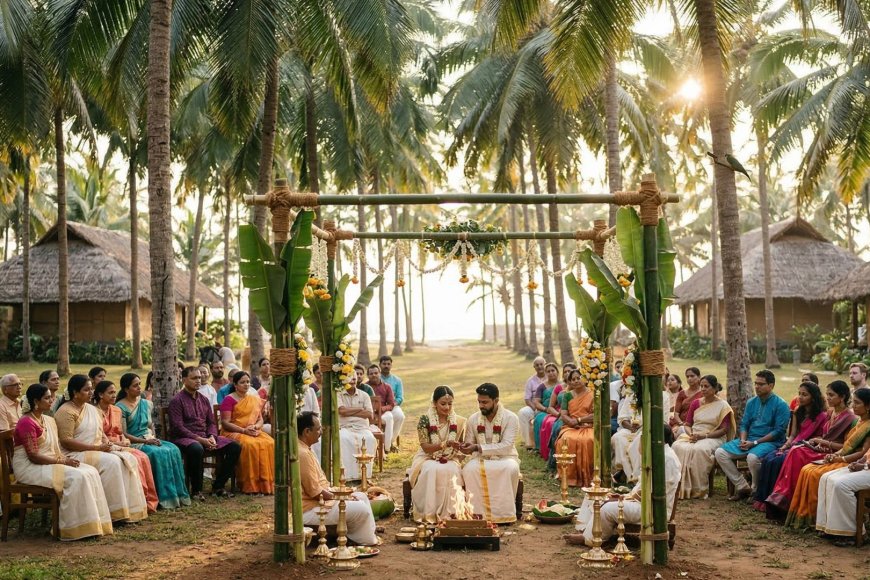
The ceremony in the coconut grove — the mandap under the palms, the filtered Kerala light on the ceremony space, the specific fragrance of the organic grove, the birds of the Kerala coastal forest audible in the palms above — is the ceremony that is most completely inside the Kerala landscape rather than in front of it. Not a ceremony with the coconut grove as the backdrop. A ceremony inside the organic, sixty-acre, decades-old coconut grove that predates the resort and that will outlast the occasion.
The grove ceremony space accommodates up to one hundred guests for a seated ceremony and up to one hundred and fifty for a standing gathering. The intimate scale is the natural scale of the coconut grove ceremony — the human scale of the landscape rather than the production scale of the ballroom.
The ceremony lighting in the coconut grove — the nilavilakku and the traditional oil lamps at the ceremony's perimeter, the filtered natural light of the Kerala afternoon in the palm canopy, the specific, only-in-the-coconut-grove, light-and-shadow quality of the ceremony's natural illumination — is the ceremony lighting that no artificial installation replicates and that no production budget improves.
The Marari Beach: The Sunset Reception Space
The Marari Beach — the Arabian Sea beach directly accessible from the resort grounds, with the fishing village visible to the north and the Kerala coastal landscape extending in both directions — is the sunset reception space and the primary post-ceremony gathering area.
The beach accommodates up to one hundred and fifty guests for a standing reception and up to eighty for a seated beach dinner. The sunset reception on the Marari Beach — the assembled wedding party at the water's edge as the Arabian Sea sun descends into the western horizon, the fishing village visible in the distance, the Kerala coast extending northward — is the reception that uses the specific, Kerala-coastal, fishing-village, Arabian-Sea-sunset quality of the Mararikulam location most completely.
The beach is the public beach of the fishing village community — the specific, shared, fishing-community, Kerala-coastal, community-property beach whose public character gives the wedding reception the specific quality of an event that is of the community's landscape rather than sequestered from it. The fishermen's boats are on the beach. The fishing village is visible. The wedding is in the village's beach, by the village's hospitality, in the manner that the Kerala coastal tradition has always organised its significant occasions — in the community's landscape, witnessed by the community's presence.
The Garden Restaurant: The Covered Dining Space
The garden restaurant of CGH Earth Marari Beach — the open-sided, thatched, naturally ventilated dining space within the resort's garden — is the primary covered dining venue for the wedding program's formal meals. The restaurant accommodates up to sixty guests for a seated dinner and provides the weather-protected format that the Kerala coastal weather's occasional rain requires.
The garden restaurant's specific quality is the integration of the organic garden's produce into the meals served within it — the vegetables from the kitchen garden on the table of the guests who are seated within sight of the garden — and the specific, thatched, naturally ventilated, only-in-the-Kerala-resort quality of the indoor-outdoor dining space that acknowledges the climate rather than fighting it.
The Backwater Experience: The Journey to the Venue
The backwater approach — the arrival by country boat through the Kerala backwater system from Alappuzha to the Mararikulam area — is the arrival experience that most completely places the wedding in the context of the Kerala water landscape. Not the taxi from Kochi airport. The country boat through the backwater — the specific, palm-fringed, still-water, only-in-Kerala, Alappuzha-backwater quality of the arrival that the boat journey through the inland waterway provides.
The wedding program that designs the backwater arrival for the international guests — the group on the country boats, the palm-fringed backwater channels, the Kerala agricultural landscape passing at the water's pace — is the program that gives the guests the most complete encounter with the Kerala landscape before the ceremony begins.
Comprehensive Pricing and Planning Reference
| Category | Detail | Approximate Range | Notes |
|---|---|---|---|
| Coconut grove ceremony hire | Up to 100 seated / 150 standing | ₹3,00,000–₹6,00,000 per event | Primary ceremony; organic grove |
| Marari Beach reception | Up to 80 seated / 150 standing | ₹2,50,000–₹5,00,000 per event | Sunset reception; fishing village |
| Garden Restaurant dinner | Up to 60 seated | ₹2,00,000–₹4,00,000 per event | Organic produce; covered dining |
| Backwater arrival experience | Per group boat journey | ₹50,000–₹1,50,000 | Country boat; Kerala backwater |
| Full Resort Exclusive Buyout | All spaces combined | ₹12,00,000–₹22,00,000 per day | Complete organic grove exclusivity |
| Accommodation — Standard Bungalow | Thatched; grove position | ₹12,000–₹20,000 per night | Organic coconut grove setting |
| Accommodation — Superior Bungalow | Better grove position | ₹18,000–₹28,000 per night | Enhanced; garden facing |
| Accommodation — Premium Bungalow | Best grove or beach | ₹25,000–₹40,000 per night | Premium; sea or grove view |
| Accommodation — Full Resort Buyout | All bungalows | ₹5,00,000–₹10,00,000 per night | Complete organic resort possession |
| Overflow — Mararikulam area | Local homestays and resorts | ₹3,000–₹12,000 per night | Village adjacent accommodation |
| Catering per cover — organic feast | Kerala oota; organic | ₹2,500–₹4,500 | Garden produce; traditional Kerala |
| Catering per cover — beach dinner | Coastal seafood; organic | ₹3,000–₹5,500 | Arabian Sea catch; fishing village |
| Catering per cover — daytime | Breakfast or lunch | ₹1,200–₹2,500 | Full organic service; garden produce |
| Pre-wedding Ayurveda — couple | 3-day program; classical | ₹30,000–₹80,000 per couple | CGH Earth Ayurveda; authentic |
| Ayurveda — wedding party | Per person per day | ₹8,000–₹20,000 | Preparation program; classical |
| Fishing village cultural tour | Per group guided | ₹15,000–₹35,000 | Morning catch; community access |
| Kerala classical performance | Per performance | ₹60,000–₹2,00,000 | Kathakali, Mohiniyattam, folk |
| Organic garden walk | Per group guided | ₹5,000–₹15,000 | Kitchen garden; organic education |
| Country boat backwater tour | Per group per journey | ₹20,000–₹50,000 | Alappuzha backwater system |
| Décor and florals — organic | Natural Kerala materials | ₹2,00,000–₹7,00,000 | Coconut, banana leaf, local flower |
| Photography and videography | Full wedding | ₹2,50,000–₹8,00,000 | Grove and beach specialists |
| Sound and lighting | Minimal; acoustic | ₹50,000–₹1,50,000 | Natural setting; minimal equipment |
| Wedding planner fee | Full service | ₹3,50,000–₹9,00,000 | CGH Earth and Kerala eco experience |
| Transport — Kochi Airport to Marari | Per vehicle | ₹1,500–₹3,000 | 90 minutes; coastal road |
| Total three-day wedding — 60 guests | Without full buyout | ₹35,00,000–₹60,00,000 | Full organic program |
| Total three-day wedding — 100 guests | Full buyout | ₹55,00,000–₹95,00,000 | Complete coconut grove wedding |
| Total three-day wedding — 120 guests | Full buyout | ₹70,00,000–₹1,20,00,000+ | Peak season; full organic exclusivity |
The Kerala Oona: The Organic Wedding Feast
The Kerala Oona — the traditional feast in the specific, Kerala-cultural, banana-leaf, multi-dish, service-sequence form that the Malayali wedding tradition has always organised its hospitality around — is the wedding feast that the CGH Earth Marari Beach kitchen produces in the most specifically, organically, locally-sourced, genuinely-Kerala-tradition form available at any wedding venue in the Kerala section of this series.
The organic distinction in the CGH Earth Marari Beach kitchen's feast is not the marketing description. It is the operational reality of the kitchen whose primary ingredients come from the sixty-acre organic grove and the organic kitchen garden within the property — the coconut oil that is the specific, cold-pressed, organic-grove, only-from-this-coconut-palm produce of the property's own trees, the vegetables from the kitchen garden, the specific, seasonal, what-is-available-today, only-in-this-season provision of the organic kitchen whose menu is determined by the garden's daily production rather than the wholesale market's standardised supply.
The specific dishes of the CGH Earth Marari Beach wedding feast should be briefed with the organic sourcing requirement as the primary constraint: the avial prepared with the vegetables from this garden, the sambar from the tomatoes grown in this soil, the payasam prepared with the jaggery from the organic farming community adjacent to the resort, the specific, coastal, Arabian-Sea, morning-catch, fresh-fish preparation whose ingredient was in the sea when the wedding party woke at dawn.
The banana leaf service — the traditional feast on the banana leaf whose specific, service-sequence, side-dish-arrangement, sadhya-vocabulary quality is the form that the Kerala wedding tradition's hospitality most specifically requires — is the service format that most completely communicates the cultural identity of the Kerala wedding feast to the guests who receive it.
The Fishing Village Morning: The Cultural Program's Most Specific Element
The morning at Marari Beach — the fishing boats returning from the overnight catch, the nets being drawn in, the fish sellers arriving, the specific, only-in-the-Kerala-fishing-village, morning-catch activity — is the cultural experience that most specifically uses the CGH Earth Marari Beach's adjacent fishing village and that gives the international wedding guests the encounter with the Kerala fishing community's daily life that no other venue in this series provides in the same immediate, unmediated, genuinely-there form.
Design the fishing village morning visit into the wedding program's first day — the morning of the arrival day, the guests who wake early joining the guided walk to the beach for the morning catch. The guide should be someone from the fishing community who knows the specific families, the specific boats, the specific fish that the catch brings in at this season, and who can mediate the encounter between the international guest and the fishing community with the specific, cultural-knowledge, language-mediation quality that the unguided visit cannot provide.
The guests who attend the fishing village morning encounter the Kerala coastal community in the moment of its most specific, most daily, most genuinely-itself activity. Not the cultural performance designed for tourism. The actual morning. The boats. The nets. The catch. The specific, irreplaceable, only-at-this-hour, only-in-this-village, genuinely-there quality of the encounter that no heritage palace and no mountain resort provides.
The Organic Décor: The Coconut Grove's Own Vocabulary
The décor philosophy at CGH Earth Marari Beach is the most radically natural in this entire series — the philosophy that the sixty-acre organic coconut grove has been producing the décor vocabulary for decades and that the decorator's role is to acknowledge and arrange it rather than to substitute for it.
The coconut palm frond. The banana leaf. The laterite stone. The jasmine and the chrysanthemum and the specific, seasonal, Kerala-garden florals. The coir — the coconut fibre of the Kerala weaving tradition. The bamboo. The natural clay lamps of the Kerala festival tradition. These are the materials that belong at CGH Earth Marari Beach in the specific, only-here, organic-grove, Kerala-coastal vocabulary that the property's own landscape produces.
The mandap in the coconut grove should be built from the bamboo and the coir and the natural fibre of the Kerala craft tradition rather than the imported steel and the synthetic fabric of the standard event mandap. The ceremony lighting should be the oil lamps and the nilavilakku rather than the LED installation. The table decoration for the beach dinner should be the banana leaf and the fresh jasmine and the specific, Kerala-coastal, natural-material table setting that acknowledges the beach's own beauty rather than competing with it.
The one absolute prohibition — the equivalent of the Andaman guide's coral reef constraint — is the single-use plastic. The CGH Earth property's own operational standard excludes single-use plastic from the resort's operation. The wedding decorator who brings single-use plastic materials to the organic coconut grove is bringing the wrong material to the right place. Brief with the plastic exclusion as the non-negotiable constraint.
Common Mistakes NRI Couples Make With the CGH Earth Marari Beach Wedding
The first mistake is not including the fishing village morning as a designed program element. The Mararikulam fishing community's morning catch is the most specific and the most humanly extraordinary cultural experience available at any beach wedding venue in this series, and the wedding program that does not include a guided fishing village morning visit is the program that has placed the wedding adjacent to the most genuine cultural experience of the Kerala fishing community and has not given the guests access to it. Design the morning visit. Commission the guide from the fishing community. Wake the guests who want this encounter. The morning catch happens at the same time every morning whether or not the wedding program acknowledges it. Put the program where the morning is.
The second mistake is not commissioning the pre-wedding Ayurvedic program through the CGH Earth Marari Beach's authentic Ayurvedic team. The CGH Earth group's specific, institutional, decades-developed, authentically-practiced Ayurvedic expertise is the expertise that most directly addresses the preparation dimension of the pre-wedding program, and the couple who does not commission the three-day Ayurvedic program before the ceremony is the couple who has chosen the eco-luxury Kerala resort for its Ayurvedic heritage without using the heritage. Commission the abhyanga. Brief the vaidya on the pre-wedding preparation requirement. The classical texts understood what the body needs before the ceremony. The CGH Earth Ayurvedic team knows the classical texts.
The third mistake is not briefing the decorator with the organic coconut grove's own material vocabulary as the exclusive design brief. The decorator whose brief is the standard luxury Indian wedding installation — the imported roses, the synthetic fabrics, the single-use plastic backing materials of the standard event production — is the decorator whose installation contradicts the specific, organic, natural-material integrity of the CGH Earth Marari Beach environment. The coconut frond, the banana leaf, the coir, the natural clay lamp — these are the decorator's brief. The organic grove provides the palette. The decorator's role is to arrange what the grove offers rather than substitute what the wholesale market provides.
The fourth mistake is not designing the backwater arrival experience for the international guests. The country boat journey through the Kerala backwater from Alappuzha to Mararikulam is the arrival experience that most completely places the international guests inside the Kerala water landscape before the ceremony has begun. The taxi from Kochi airport is the practical arrival. The backwater boat is the Kerala arrival. The two journeys arrive at the same resort. Only one of them arrives in Kerala. Design the backwater boat for the international guests who have come far enough that the extra hour on the water is the beginning of the experience rather than a delay to it.
The fifth mistake is not telling the grandmother's story. Every CGH Earth Marari Beach wedding has a grandmother — the person in the family who recognises the coconut grove and the fishing village and the laterite soil and the specific, only-in-the-Kerala-coast, organic, unhurried quality of the place as the landscape of origin rather than the landscape of tourism. This person is the most important guest at the wedding because they are the guest whose recognition of the place gives the wedding its deepest cultural grounding. Find this person. Ask them about the place before the wedding. Give them the opportunity to share what they know about this landscape and this community with the guests who are arriving from London and Singapore and Toronto without this knowledge. The grandmother knows something that no travel guide contains. The wedding program that includes the grandmother's telling of it is the wedding program that most completely honours the place.
Lakshmi's wedding was in February — the Kerala February, the northeast monsoon fully departed, the coconut grove in the specific quality of the late-dry-season light that turns the palm fronds to the specific gold-green of the Kerala coastal morning.
The ceremony was in the coconut grove at five in the afternoon — the sixty-acre organic grove, the mature palms above, the filtered Kerala light, the natural oil lamps at the ceremony's perimeter, the mandap in bamboo and coir and the jasmine and marigold of the Kerala garden.
The grandmother had come. Not from Thiruvananthapuram — from Mararikulam. Her cousin had brought her to the resort in the morning and she had walked through the coconut grove with the specific, deliberate pace of someone who is in a landscape she recognises and who is taking the time to recognise it fully.
She had sat in the front row for the ceremony. She had looked at the mandap under the palms in the filtered Kerala light. She had looked at the fishing village beach visible through the grove's seaward edge. She had looked at the organic garden visible at the grove's landward boundary.
After the ceremony, she had said to Lakshmi: I told you. Lakshmi had said: you told me. She had said: the coconut grove is more beautiful than anything you can put in it. Lakshmi had said: yes. She had said: your decorator understood. Lakshmi said: I briefed the decorator with your words. She had said: then the decorator had a good brief.
She had looked at the grove in the evening light. She had said: this is the Kerala coast as it was. Lakshmi had said: is it still? The grandmother had looked at the organic grove, the fishing village beach, the evening light on the palms. She had said: here it is. Here it still is.
Include the fishing village morning in the program. Commission the pre-wedding Ayurvedic program. Brief the decorator with the organic grove's own material vocabulary. Design the backwater arrival for the international guests. Find the grandmother and let her tell the place's story.
The coconut grove has been producing this quality of light for decades. It will produce it on your wedding day. The morning catch has been coming in on this beach for generations.
The grandmother was right.
The coconut grove is more beautiful than anything you can put in it.
Published by NRIWedding.com — The Premium Global Platform for Non-Resident Indians Planning Indian Weddings From Abroad.
0 comments
Real names and courtesy, please. Every comment is read by a person before it appears.
Nothing yet. Start it off.
Comments are closed on this article.