Destination Wedding in Mararikulam, Kerala — A Fishing Village Beach Wedding That Moves at Kerala's Pace: The Complete NRI Planning Guide
The photograph was not professionally taken.
That was the first thing Nithya noticed about it — the slightly tilted horizon, the way the exposure had gone warm in a manner that no photographer would have chosen deliberately but that was, somehow, exactly right. Her cousin had sent it in the family WhatsApp group at eleven-twenty-three on a Tuesday night, with no caption, no context, just the image dropped into the conversation between a meme about Malayali mothers and a forwarded news article that nobody had read.
Nithya was in her flat in East London, sitting cross-legged on the sofa with her laptop open to a venue comparison spreadsheet that had, in the previous two weeks, expanded to include forty-three properties across Goa, Kerala, and Rajasthan. She had been looking at the spreadsheet for forty minutes and had not updated a single cell, which was the particular variety of planning paralysis she had come to recognize as the signal that something was wrong with the approach rather than with the options.
She looked at the photograph her cousin had sent.
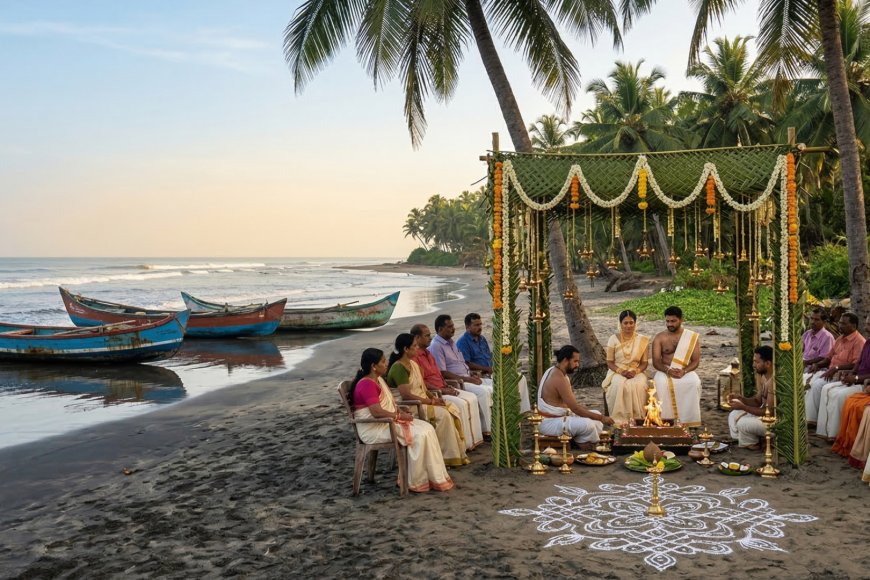
It showed a beach at what she estimated was early morning — the light was the pale, undecided light of just after dawn, not yet golden, not yet white, still in the blue hour's last moments. The sand was not the bright white of a resort beach. It was darker, more textured, the sand of a working coast, and at the waterline three wooden fishing boats had been pulled up and were sitting at angles in the shallow water, their painted sides — blue, red, a faded green — reflected in the wet sand below them. Behind the boats, perhaps thirty metres up the beach, someone had hung a string of brass lamps between two coconut palms, and the lamps were lit, their small flames visible even in the growing light, and below them on the sand someone had drawn a kolam — the white rice-flour pattern of Kerala's threshold tradition — that was elaborate enough to have taken an hour.
There were no people in the photograph. There was no wedding. There was just the beach and the boats and the lamps and the kolam and the light arriving.
Nithya looked at it for a long time. She looked at it with the specific attention of someone who has been looking at venue photographs for four months and has learned to read them not for what they show but for what they suggest — what the place will feel like at six in the morning, what the air will smell like, what the quality of the silence will be before the guests arrive and after they have gone.
She typed into the family group: Where is this.
Her cousin replied in two minutes: Mararikulam. Near Alleppey. It is a fishing village. My friend got married there last February. She said it was the most beautiful thing that had ever happened to her.
Nithya sent the photograph to her fiancé Siddharth in Zurich. He was asleep. She sent it anyway.
He replied at six-forty in the morning his time, which was ten-ten her time, which meant he had looked at it before he had done anything else: This is not a resort. This is a real place.
Yes, she typed back.
I want a real place, he said.
She looked at the forty-three properties on the spreadsheet — the infinity pools, the heritage lobbies, the event lawns with their fairy lights and their identical mandap configurations — and she understood, with the clarity that comes after a long period of confusion, that none of them were what she wanted. What she wanted was the photograph. The fishing boats. The lamps between the palms. The kolam on the sand. The light arriving without being arranged.
What she did not yet understand was that wanting a real place and planning a wedding at a real place are two different undertakings, and that Mararikulam — genuinely, specifically, operationally real in ways that resort destinations are not — requires a planning framework as specific as its character. The fishing village will not become a resort for your wedding. The Arabian Sea will not rearrange its tides. The coconut palms will not straighten themselves into symmetrical rows.
But if you plan for what Mararikulam actually is, rather than for what a resort destination pretends to be, what you will get is something that no resort destination can manufacture.
This guide is for that couple — the ones who want the real place, and who need to understand, precisely and completely, what planning the real place actually requires.
Why Mararikulam Is Categorically Different From Every Other Kerala Wedding Destination
Kerala has a well-developed destination wedding vocabulary. Backwaters. Houseboats. Ayurvedic resorts. Heritage properties in Fort Kochi. The clifftop hotels of Kovalam. These are established categories with established vendor ecosystems, established regulatory frameworks, and established planning templates that competent coordinators can apply with reasonable confidence.
Mararikulam is not an established category. It is a fishing village on the Alappuzha coast, approximately eleven kilometres south of Alleppey town, whose wedding reputation has grown almost entirely through word of mouth among couples who have attended weddings there and who have found the experience so specifically different from the standard destination wedding that they have felt compelled to tell people about it. The village has no marketing budget. It has no destination wedding association. It has a beach, a community of fishing families who have lived on it for generations, a small number of properties that have been developed with enough sensitivity to the place to retain its character, and a quality of slowness — a specific, non-performative, genuinely lived slowness — that is the rarest and most valuable thing a destination wedding can offer.
The first thing to understand about Mararikulam is that its appeal is not visual in the way that a resort destination's appeal is visual. The Kovalam clifftop is visually spectacular in a way that a single photograph can communicate. The Gulmarg snow meadow is visually extraordinary in a way that requires no explanation. Mararikulam is beautiful in a quieter and more specific way — the beauty of a place that has not been arranged for beauty, that is beautiful because it is itself rather than because it has been designed to appear beautiful. This kind of beauty is harder to plan for and harder to describe, but it is also deeper and more durable than the designed variety, and the couples who have married at Mararikulam consistently report that the experience of the place — its pace, its texture, its specific quality of light and sound — was more powerful than any single visual element of the wedding.
The second thing to understand is the pace. Mararikulam moves at a pace that is not the pace of a wedding coordinator's schedule, not the pace of a hospitality industry trained to deliver experiences efficiently, but the pace of a working coast — the pace of tides and fish and light and the specific unhurried rhythm of a community that has been living in relationship with the sea for generations. The NRI couple who arrives at Mararikulam with a fifteen-item daily programme will find that the place does not accommodate the schedule. The couple who arrives with the understanding that the programme must be built around the place's own rhythm — the dawn, the fishing boats going out and coming back, the afternoon quiet, the evening light — will find that the place gives them something better than anything they could have programmed.
The third thing to understand is the scale. Mararikulam is not a large-format wedding destination. The properties that retain the character of the village — the genuine Mararikulam experience rather than a resort that happens to be located near the village — have accommodation capacities of thirty to eighty guests. The wedding that requires three hundred guests in attendance is not a Mararikulam wedding. The wedding that can be genuinely designed for sixty to one hundred guests — the people whose presence is specific and meaningful rather than obligatory and numerous — can be, at Mararikulam, something of extraordinary intimacy and depth.
The Venue Landscape — What Mararikulam Actually Offers
The Heritage Beach Properties
The small number of properties at Mararikulam that have been developed with genuine sensitivity to the village's character — that have used local materials, local craft traditions, local architectural references, that have not imposed the generic luxury resort aesthetic onto a place that has its own aesthetic entirely — represent the most distinctive wedding venue category available anywhere on the Kerala coast.
These properties share certain characteristics that are worth understanding before the venue shortlisting begins. They are small — typically fifteen to thirty rooms, built in the Kerala tharavad architectural tradition with sloping tiled roofs, open courtyards, and the laterite stone walls that are the material signature of Kerala's coastal vernacular. They are set back from the beach by the coconut groves that line the Mararikulam coast, which means that the beach is accessed on foot through the palms rather than directly from the hotel terrace, and this access — the walk through the grove, the sound of the sea arriving before the sight of it — is itself part of the experience.
Their event spaces are correspondingly intimate. The ceremony beach at Mararikulam is not a private resort beach but the fishing village beach, and the ceremonies held there share the space with the fishing boats that are pulled up above the waterline, with the nets drying in the morning sun, with the cats that live on every Kerala fishing beach as a matter of long-standing arrangement. This is not a problem to be solved. It is the place's character, and the wedding that incorporates it rather than apologizes for it will be more powerful for the honesty.
The Tharavad Homestay Buyout
The second category of Mararikulam venue is the traditional Kerala tharavad — the ancestral family home — that has been opened to guests as a boutique homestay and that can be booked in its entirety for a wedding party. These properties, typically with four to eight rooms around a central courtyard, offer the most intimate and most culturally specific Mararikulam wedding experience. They require the most independent vendor sourcing — there is no in-house event team, no banquet manager, no standard wedding package — and they are the highest-reward, highest-coordination option for the NRI couple willing to plan at the level of granularity they require.
The tharavad buyout wedding is, at its best, the wedding that feels least like a wedding in the industry sense and most like a celebration held in a home — because it is held in a home, an actual home with an actual history, and the guests feel that distinction even if they cannot articulate it.
The Backwater-Beach Hybrid Properties
A third category exists in the properties that sit on the narrow strip of land between the Mararikulam beach and the backwater canals that run parallel to the coast. These properties offer the extraordinary combination of beach on one side and backwater on the other — the possibility of a ceremony on the beach at sunset and a houseboat journey through the canals the following morning, or a mehendi by the backwater in the afternoon and a reception on the beach in the evening. For the NRI couple who wants the full Kerala sensory experience — the sea and the backwaters, the coast and the inland water landscape — these properties represent the most complete expression of what the Alappuzha coast offers.
The Coastal Regulation Zone Framework — What Mararikulam Specifically Requires
The CRZ Notification, 2019, administered by the Kerala Coastal Zone Management Authority, governs the use of coastal land within defined distances of the high tide line throughout the Kerala coast, including at Mararikulam. The specific regulations that affect wedding events on the Mararikulam beach cover temporary structure placement, the distance from the high tide line within which no permanent or semi-permanent structures may be erected, sound level restrictions, and the prohibition on certain categories of waste disposal in the coastal zone.
For the NRI couple, the CRZ framework at Mararikulam has an additional layer of complexity beyond what applies at established resort destinations, because the Mararikulam beach is a working fishing beach rather than a resort beach, and the fishing community's traditional rights of access and use of the beach take precedence over private event use. This is not an obstacle — it is a legal and social reality that the well-prepared couple will work with rather than around. The wedding coordinator who has specific Mararikulam experience will have established relationships with the village fishing cooperative and will understand how to coordinate event use of the beach in a manner that respects the community's access rights and that, in many cases, results in the fishing boats and their community becoming part of the wedding's visual and human texture rather than an inconvenience to be managed.
The fishing community of Mararikulam is not a backdrop. They are the people whose home you are borrowing for your wedding, and the couple who acknowledges this — who asks rather than assumes, who includes rather than excludes, who pays the courtesy and the gratitude that the situation calls for — will find that the village gives the wedding something that no production budget can buy.
The Seasonal Framework
November to February: The Primary Season
The post-monsoon winter season is Mararikulam's primary wedding window for reasons that are specific to the village's character as well as its weather. In the winter months, the Arabian Sea is calm, the fishing boats go out in the predawn darkness and return by mid-morning in the manner that has defined this coast for centuries, and the beach in the hours between the boats' return and the afternoon is at its most accessible and its most beautiful. The temperatures are warm without being oppressive — twenty-four to thirty-one degrees Celsius — and the humidity, while never absent on a Kerala coast, is at its annual minimum.
The light in this period is exceptional in a way that is specific to Mararikulam's flat, open beach geometry. With no cliffs and no headlands to interrupt the horizon, the sunrise and sunset at Mararikulam are full and unobstructed — the sky and the sea sharing the same event, the beach receiving the light from both directions in the golden hours, and the coconut palms casting their specific long shadows across the sand in the manner that has made Kerala's coast the subject of a century of photography.
December is the peak month — the highest demand, the most competitive venue availability, the most fully committed vendor calendar. The NRI couple targeting a December Mararikulam wedding should begin venue outreach sixteen to eighteen months before the intended date.
March and April: The Secondary Window
March and April offer a workable secondary window, with the sea still calm, the light still good, and the heat not yet at the levels that May produces. The fishing calendar shifts slightly in these months — certain species move, certain net configurations change — and the beach's morning character is correspondingly different, but the fundamental quality of the place remains.
The Monsoon and Its Absolute Authority
The Kerala southwest monsoon is the most powerful and most punctual meteorological event in the Indian calendar, and at Mararikulam — a flat, exposed fishing beach with no natural shelter and no built infrastructure designed to manage heavy rainfall — its authority is absolute. From the first week of June through mid-October, Mararikulam is not a wedding destination. The sea is rough, the beach is often inaccessible, the fishing boats are pulled far up above the storm line, and the quality of light and air that defines the destination's appeal is replaced by the grey, heavy, beautiful but operationally decisive reality of the full southwest monsoon.
This is not a hardship. It is the rhythm of the coast, and the couple who chooses Mararikulam has chosen a place that lives by the sea's rhythm rather than by the hospitality industry's year-round availability. The wedding window is the winter. The winter is extraordinary. That is sufficient.
NRI-Specific Logistics — Planning Mararikulam From Abroad
The Cochin and Alleppey Gateway
Mararikulam is accessible from two primary gateways. Cochin International Airport, approximately eighty-five kilometres north, is the primary international arrival point, with direct connections from the Gulf region and connecting flights from all major Indian cities. The road from Cochin to Mararikulam follows the NH 66 coastal highway south through Alleppey — a journey of approximately two to two and a half hours in normal traffic, passing through the specific landscape of the Kerala coast: the backwater canals visible from the road, the rice paddies, the coconut groves, the fishing villages succeeding one another with the unhurried frequency of a place that has been continuously inhabited for millennia.
Alleppey town, eleven kilometres north of Mararikulam, is the secondary gateway and the operational hub for vendor sourcing, supply runs, and the logistics support that the wedding programme requires. The Alleppey vendor market is smaller than Thiruvananthapuram or Kochi but is specifically experienced in the coastal wedding format that Mararikulam requires, and the best Mararikulam coordinators will have their primary vendor relationships in Alleppey rather than in the larger cities.
For NRI guests arriving from the Middle East — the Gulf diaspora community for whom Cochin is a home airport in the most literal sense, with Air India Express and IndiGo operating routes from Dubai, Abu Dhabi, Sharjah, Muscat, and Doha — Mararikulam is genuinely accessible in a way that few Indian destination wedding locations are. The total journey from Dubai to the Mararikulam beach is under six hours, which makes the destination practical for Gulf-based family members who might not be able to commit to the longer journey times that Rajasthan or Uttarakhand destinations require.
The Three-Visit Protocol for Mararikulam
The reconnaissance visit for a Mararikulam wedding must include a dawn on the beach — not a midday visit, not an afternoon tour of the property, but the specific experience of arriving at the Mararikulam beach at five-thirty in the morning when the fishing boats are preparing to go out and the light is doing what the light does and the village is awake in its own way before tourism has any claim on it.
This visit is not romantic preparation. It is operational research. The couple who has stood on the Mararikulam beach at dawn knows the direction of the onshore wind, the position of the fishing boats relative to the ceremony area, the quality of the sand underfoot at the waterline, the sound level of the sea in the morning calm — all of which are programme design inputs that cannot be gathered from a venue brochure or a coordinator's brief.
The follow-up visit, four to six months before the wedding, is the operational visit: decor mock-ups, catering tastings of the sadya and any supplementary menu, ceremony layout walks, fishing community coordination meetings, and the CRZ compliance review with the property's legal team. The arrival for the wedding should be five to seven days before the first function, both for the logistical management that the final days require and for the acclimatization to the place's pace that the couple needs before the programme begins.
The Vendor Ecosystem — Alleppey, Kochi, and the Mararikulam Specialists
The wedding vendor ecosystem for Mararikulam events is built around three tiers. The first tier is the small number of coordinators and vendors who have specific Mararikulam experience — who know the beach, the fishing community, the CRZ requirements, the seasonal wind patterns, the properties, and the pace. These vendors are not numerous, and they are not always the most visible in the online search results that NRI couples typically use for initial vendor research. Finding them requires asking specifically for Mararikulam experience rather than general Kerala coast experience, and it requires the investment of the reconnaissance visit to meet them in person rather than selecting remotely.
The second tier is the Alleppey vendor market — caterers, florists, decorators, sound engineers, and support staff who are experienced in coastal Kerala events and who service the Mararikulam area as part of a broader Alappuzha district practice. These vendors provide the operational backbone of most Mararikulam weddings and are essential to the programme's practical functioning.
The third tier is the Kochi specialist market — the higher-end photographers, cinematographers, and creative directors whose work NRI couples have identified through international wedding publications and social media and who travel to Mararikulam for specific events. The cost of bringing a Kochi-based team to Mararikulam — two to three hours by road — is the travel and accommodation premium that must be budgeted from the initial planning stage.
The NRI Wedding Planning Master Reference Table
| Planning Parameter | Mararikulam-Specific Detail | NRI Action Required | Recommended Timeline |
|---|---|---|---|
| Venue Categories | Heritage beach properties (30–80 guests), tharavad homestay buyout (20–50 guests), backwater-beach hybrid properties (40–100 guests) | Finalize guest count before venue shortlisting; confirm all venues have genuine Mararikulam character rather than generic resort aesthetic | 14–18 months before wedding |
| Best Wedding Season | November to February (primary); March to April (secondary); avoid June to mid-October (monsoon) | Book peak December–January dates 16–18 months ahead; confirm property's seasonal operational calendar | 16–18 months for peak dates |
| CRZ Regulations | CRZ Notification 2019 applies to working fishing beach; fishing community access rights take precedence; temporary structure and sound restrictions apply | Hire coordinator with Mararikulam CRZ and fishing community coordination experience specifically; obtain documentary evidence of beach use permissions | 10–12 months before wedding |
| Fishing Community Coordination | Working fishing beach — boats, nets, community members present at dawn and morning; coordination with village fishing cooperative required | Engage coordinator with established fishing cooperative relationships; design programme to work with fishing schedule rather than around it | 10–12 months before wedding |
| Scale Constraints | Genuine Mararikulam properties: 30–80 guest maximum; large-format weddings incompatible with village character | Confirm this is the right destination for your guest count; do not attempt to scale Mararikulam beyond its natural capacity | Built into planning from outset |
| Guest Transportation | Cochin Airport primary gateway (85 km, 2–2.5 hrs); Alleppey town 11 km from Mararikulam; NH 66 coastal road | Coordinate Cochin airport pickups; arrange village-approach transfers in smaller vehicles; provide guests with detailed coastal road arrival brief | 6–8 months before wedding |
| Primary Vendor Base | Mararikulam specialists for coordination; Alleppey market for operational vendors; Kochi for specialist photography and creative direction | Budget Kochi vendor travel premium; confirm Mararikulam-specific experience at first vendor meeting; conduct video workspace visits for remote vetting | 10–12 months before wedding |
| Dawn and Fishing Schedule | Fishing boats go out predawn, return mid-morning; beach most accessible late morning to late afternoon; sunrise ceremony possible with fishing community coordination | Design ceremony timing around fishing schedule; brief guests on dawn beach experience as programme element; coordinate lamp-lighting and kolam with property | 6–8 months before wedding |
| Accommodation | Small properties: 15–30 rooms maximum; overflow in Alleppey town or nearby beach properties; houseboat accommodation possible for overflow | Block all rooms immediately upon venue confirmation; arrange houseboat overflow for additional guests; send accommodation map early | 12–14 months before wedding |
| Backwater Integration | Backwater canals run parallel to Mararikulam coast; houseboat journeys available from Alleppey; kettuvallam for wedding party transport | Design backwater houseboat journey as morning-after programme element; book kettuvallam for wedding party canal transport | 6–8 months before wedding |
| Keralan Cultural Elements | Keralan sadya on banana leaf, Thiruvathira dance, Oppana music for Muslim weddings, Pulluvan Pattu for Hindu ceremonies, kolam on sand | Engage local Thiruvathira ensemble; commission sand kolam artist for ceremony beach; confirm sadya caterer's Mararikulam experience | 8–10 months before wedding |
| Decor Philosophy | Natural, organic, anti-resort: coconut shell, banana fibre, laterite stone, brass lamps, local flowers — not imported roses or synthetic materials | Brief decorator explicitly on Mararikulam's material vocabulary; prohibit synthetic decor elements; source local craft materials through coordinator | 6–8 months before wedding |
| Legal and Payments | Indian Contract Act 1872; Consumer Protection Act 2019; FEMA 1999 for NRI payments; CRZ force majeure clause essential in all outdoor contracts | Use NRO/NRE account for INR payments; require weather and CRZ force majeure clause in all outdoor event contracts; verify vendor GST registration | Before first vendor payment |
| Photography Conditions | Flat beach geometry produces unobstructed sunrise and sunset; fishing boat reflections in wet sand at dawn; coconut palm shadow patterns midmorning | Brief photographer on Mararikulam's specific dawn and golden hour conditions; schedule predawn boat shoot; confirm photographer has coastal natural-light experience | 6–8 months before wedding |
| Communication Protocol | IST gap: UK +4.5 hrs, US East +9.5 hrs, Australia East −5.5 hrs; Mararikulam cellular connectivity adequate but variable | Schedule weekly coordinator call; use WhatsApp for vendor communication; maintain shared planning document; test property Wi-Fi on reconnaissance visit | From first vendor engagement |
Common Mistakes NRI Couples Make With Mararikulam Destination Weddings
The first and most consequential mistake is choosing Mararikulam for its photographs and then planning it like a resort wedding. The couples who have the most difficult Mararikulam experiences are not the ones who chose the wrong caterer or booked the wrong date. They are the ones who arrived with a fifteen-item programme schedule, a decorator's brief full of imported flowers and synthetic fabric, and the expectation that the destination would perform on demand — and who discovered that Mararikulam is constitutionally incapable of performing on demand because it is a real place with a real rhythm and a real community, and none of those things answer to a wedding coordinator's timeline. The correct approach is to design the programme around what the place is, at the speed the place moves, using the materials the place provides. The couple who does this will find that the place gives them more than they planned for. The couple who fights the place's rhythm will find that the fight is unwinnable.
The second mistake is failing to engage with the fishing community as partners rather than managing them as a logistical variable. The Mararikulam fishing community has been on this beach longer than any of the properties that now offer wedding packages, and their presence — the boats, the nets, the men and women who work the coast — is not a complication in the venue's event space but the living reality of the place that makes the event space worth having. Coordinators who have Mararikulam experience will have relationships with the fishing cooperative and will know how to coordinate beach use in a manner that is respectful, practical, and mutually beneficial. The couple whose coordinator treats the fishing community as a nuisance to be managed at a distance will produce a wedding that sits awkwardly in its location rather than belonging to it.
The third mistake is over-decorating. This mistake is made specifically by couples who have been conditioned by the Indian destination wedding industry's visual culture — the maximalist floristry, the elaborate mandap constructions, the production-heavy aesthetic that characterizes the Rajasthan palace wedding and the Goa beach resort wedding — and who bring that aesthetic to Mararikulam without reckoning with the fact that it is entirely wrong for the place. Mararikulam is a fishing village. Its beauty is the beauty of simplicity, of natural materials, of the specific aesthetic of a working coast that has never tried to be decorative and is therefore more beautiful than any decorated space. The mandap made of coconut palm fronds and brass lamps on a beach where fishing nets are drying twenty metres away is more powerful than any flower installation. The decorator who understands this will produce something extraordinary. The decorator who does not will produce something expensive and entirely at odds with its setting.
The fourth mistake is neglecting the backwater dimension of the Mararikulam location. The backwater canals that run behind the Mararikulam coast — the same canal system that connects to the Vembanad Lake and the broader Alleppey backwater network — are one of the most distinctive features of the destination, and the wedding programme that uses them only for the ceremony beach and ignores the water behind the property is leaving one of Mararikulam's most extraordinary experiences unused. The morning-after houseboat journey through the backwater canals, the mehendi afternoon on a kettuvallam, the sunset on the backwater as counterpoint to the sunrise ceremony on the beach — these are programme elements that exist nowhere else in the Indian destination wedding landscape and that are available here, in this specific place, simply because of where it is.
The fifth mistake is insufficient advance research into the specific properties that retain Mararikulam's character versus the properties that are located at Mararikulam but deliver a generic resort experience. The destination's growing reputation has attracted investment in properties that use Mararikulam as a location but whose aesthetic and operational approach is indistinguishable from any mid-market Kerala beach resort. These properties are not wrong in themselves, but they are not Mararikulam in the sense that the photograph in the family WhatsApp group was Mararikulam. The NRI couple must research specifically — asking coordinators to describe the property's architecture, its decor philosophy, its relationship to the fishing community, its material choices — rather than accepting the destination name as a guarantee of the destination's character.
The Aesthetic Language of a Mararikulam Wedding
The material vocabulary of a Mararikulam wedding is the material vocabulary of the Kerala fishing coast: coconut palm, banana fibre, laterite stone, bamboo, terracotta, brass, raw cotton, coir. These are the materials that the place is made of, and the wedding that uses them is not making an aesthetic choice but a geographic one — the choice to let the wedding belong to where it is.
The flowers of a Mararikulam wedding are the flowers of Kerala's coastal tradition: white jasmine, which grows everywhere on the coast and whose scent in the evening air is the specific sensory signature of a Kerala night; the marigold, used in garlands and in the kolam; the lotus, which appears in the backwater canals in the morning with a specificity and a beauty that no arrangement can replicate; the banana flower, whose dark purple form against the pale sand produces a contrast that no imported flower achieves.
The kolam is the decor element that is most specific to Mararikulam and most powerful in its setting. Drawn on sand rather than on a threshold floor, with rice flour rather than chalk or synthetic powder, by a woman from the village who has been drawing them since childhood and who brings to the work a knowledge that is not transferable through a brief or a mood board — this is the aesthetic act that most completely expresses what a Mararikulam wedding is. It will be walked through. It will be disturbed by the wind and the sea by midmorning. It is made to be impermanent, and its impermanence is part of its meaning, and no photograph will fully capture it, and that is exactly right.
The light at Mararikulam deserves its own sentence: it is the light of a flat coast with an unobstructed horizon, and at dawn and at sunset it is the light that painters come to Kerala to find, the light that is specific to this latitude and this geography and this quality of atmospheric water, and it will do more for your wedding photographs than any lighting rig that any production company can install.
Resolution
They were married in the last week of January, on a morning that began at five o'clock when Nithya's mother came to her room in the dark and said, simply: The boats are going out.
They walked to the beach in the blue hour — the two of them, and Nithya's mother, and Siddharth's grandmother who had insisted on coming and who had, it turned out, grown up in a fishing village in Tamil Nadu and who walked across the sand with the specific ease of someone who had never stopped knowing how. The fishing boats were in the process of being launched — five of them, the men working in the pre-dawn dark with the efficiency of a practice repeated every morning for a lifetime, the boats going into the small waves and finding their trim and then the outboards starting and the boats moving away from the shore in the direction of the deeper water.
The grandmother watched them go. She said something in Tamil that Nithya did not catch. Then she bent down and picked up a handful of sand and held it for a moment and let it go.
The ceremony was at seven. By then the light had arrived properly — the specific, horizontal, undecorated light of a Kerala dawn on a flat coast, falling on the white cotton of the mandap and the brass of the lamps and the kolam on the sand that the village woman had been drawing since four in the morning, and on the fishing boats visible now as small dark shapes against the silver of the sea beyond.
The boats came back at half past nine, while the wedding breakfast was being served under the palms. The fishermen pulled them up above the waterline with the casual competence of men who have done this every morning of their adult lives, and the wedding party and the fishing boats shared the beach for a while in the late morning sun, both going about their business, neither interfering with the other, the sea between them and the horizon beyond it going on in the manner that seas do, which is to say indefinitely and without reference to the things that happen briefly on its shore.
Siddharth's grandmother found Nithya at the edge of the water after the breakfast, where Nithya had gone to stand alone for a moment in the way that brides sometimes need to.
"You chose well," the grandmother said.
Nithya looked at the beach — the boats, the nets, the lamps still burning in the morning light, the kolam already beginning to be taken by the wind at its edges.
"We wanted a real place," she said.
The grandmother nodded. She looked at the sea.
"This is a real place," she said.
Choose the property that belongs to the village, not the one that merely sits beside it. Design your programme around the fishing schedule, not against it. Commission the kolam. Let the sadya be the feast. Walk to the beach at dawn before the wedding day — you need to know the place before you celebrate in it.
Mararikulam will not perform for you. It will simply be itself — a working coast, a living village, a beach that the sea has been arriving at every morning for longer than the concept of a destination wedding has existed. Plan with enough honesty and enough specificity to belong to that place for four days, and it will give you something that no resort, no matter how luxurious, no matter how perfectly photographed, can manufacture.
Published by NRIWedding.com — The Premium Global Platform for Non-Resident Indians Planning Indian Weddings From Abroad.
0 comments
Real names and courtesy, please. Every comment is read by a person before it appears.
Nothing yet. Start it off.
Comments are closed on this article.