You grew up watching Bollywood brides throw rice over their heads, tears glistening, as they stepped into a flower-covered car.
Maybe you were in New Jersey, or London, or Dubai. Maybe your parents replayed wedding VHS tapes from Punjab or Rajasthan every anniversary. Maybe you rolled your eyes at the crying—until it became your turn.
Now you’re planning your wedding from Toronto or Melbourne, and somewhere between venue contracts and visa paperwork, you find yourself wondering:
Will my vidaai feel real if it happens thousands of miles from home?
Because the truth is, the doli isn’t just a ritual. It’s the emotional heartbeat of an Indian wedding.
🌟 DID YOU KNOW?
• Historical records from Mughal and Rajput courts describe palkis (palanquins) as symbols of nobility, privacy, and feminine dignity.
• In many North Indian communities, the bride traditionally throws rice backward during vidaai to symbolically “repay” her parents for raising her.
• According to diaspora wedding planners in the UK and Canada, over 70% of NRI North Indian weddings now include a stylised doli moment—even when the ceremony takes place in a ballroom or vineyard abroad.
WHAT IS THE DOLI?
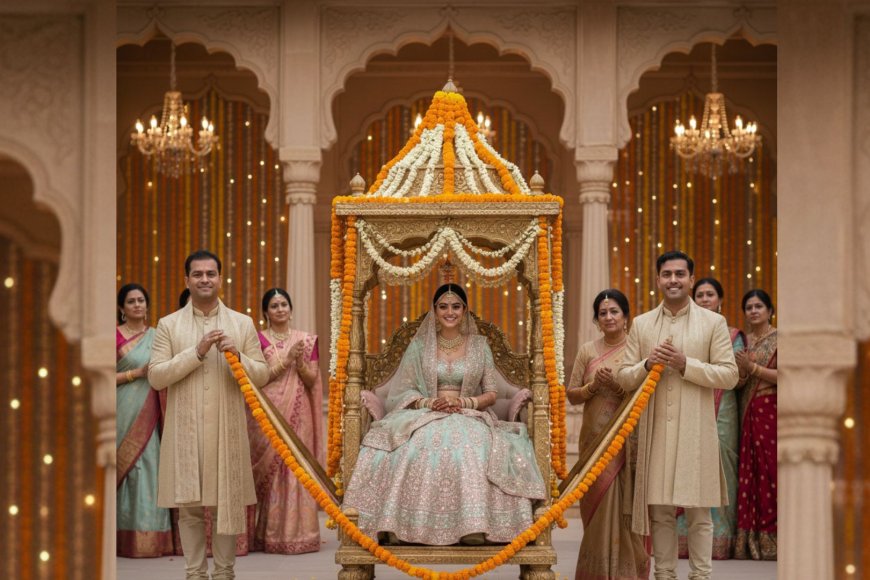
The doli (palanquin) is the ceremonial vehicle in which a bride symbolically departs her parental home after the wedding. It is closely tied to the ritual of vidaai (farewell), which takes place immediately after the marriage rites are completed.
Traditionally, after the sacred fire ceremony or pheras (seven vows around the fire), blessings from elders follow. Once the couple prepares to leave, the bride embraces her family. She performs a deeply symbolic act: she throws handfuls of rice backward over her head, signifying gratitude and the wish that her parental home always remain prosperous.
In earlier centuries, the bride would physically sit inside a covered palki carried by male relatives or attendants. The enclosure represented protection and modesty. Brothers or uncles would lift the structure, reinforcing the idea that the family continued to support her even as she transitioned to a new household.
Over time, cars replaced palanquins—but the symbolism endured.
Today, the bride may step into a vintage Rolls-Royce draped in marigolds or a modern luxury vehicle covered in roses. Her brother may gently push the car forward before it drives away. Women of the family sing farewell songs. Elders raise their hands in blessing.
At its core, the doli represents transition—not erasure. It marks the movement from one griha (home) to another, while acknowledging that identity, lineage, and love remain intact.
For NRIs, that symbolism hits differently. Because you understand transition. You have lived it.
COMMUNITY COMPARISON TABLE
| Community / State | Local Name | Key Tradition | How NRIs Abroad Adapt It |
|---|---|---|---|
| Himachali | Doli / Vidaai | Bride escorted with folk songs, rice-throwing | Floral canopy instead of physical palki in banquet halls |
| Garhwali (Uttarakhand) | Bidai | Emotional farewell songs, maternal blessings | Recorded traditional songs played in UK/Canada venues |
| Kumaoni | Vidaai | Brother symbolically pushes vehicle | Brother pushes decorated car in hotel driveway |
| Ladakhi | Nangsa departure ritual | Community blessings before bride leaves | Condensed blessing circle in diaspora community halls |
| Kashmiri Pandit | Rukhsati | Emotional departure after sacred fire rituals | Small symbolic rice ritual due to venue fire restrictions |
| Punjabi (Sikh) | Doli / Rukhsati | Brothers lift or push vehicle; folk songs | Vintage car departure staged for photography |
| Marathi | Grihapravesh departure | Bride formally leaves after blessings | Rice ritual incorporated before reception exit |
| Tamil | Kalyana vidaai equivalent | Less dramatic farewell, more formal send-off | Joint departure without crying emphasis |
| Bengali | Bidaay | Bride throws rice, touches car, emotional songs | Rice ritual adapted to indoor carpeted venues |
| Rajasthani | Doli | Historically ornate palanquins in royal weddings | Decorative palki used as photo installation |
THE MEANING BEHIND THE RITUAL
Indian philosophy sees marriage as a sacred transition—not a transaction. The doli embodies this worldview.
It recognises that life moves in cycles. A daughter raised with love must one day step into partnership. The rice she throws is not repayment in a literal sense—it is symbolic abundance. It says: “May my leaving never diminish this home.”
The ritual also reflects the Indian belief in continuity of lineage, or parampara (tradition passed through generations). The family does not lose a daughter; it expands its network of relationships.
At a deeper level, the doli acknowledges impermanence. Nothing stays unchanged—not childhood, not geography, not even identity. And yet, love remains.
If you had to explain it to a non-Indian partner’s family, you could say:
It’s not about leaving home. It’s about carrying it with you.
DOING THE DOLI ABROAD: THE PRACTICAL REALITY
Planning a vidaai in Houston is very different from doing it in Ludhiana.
First, venue logistics. Most Western venues have strict exit timelines. Coordinate with your planner to ensure the farewell happens before hard curfews. Many NRIs schedule the doli immediately after the ceremony rather than at midnight.
Fire restrictions can complicate rituals tied to agni (sacred fire). In cities like Toronto and London, indoor venues often prohibit open flames. Work with your priest to use contained havan kundas or LED symbolic flames where necessary.
Sourcing ritual items abroad is easier than you think. In London, Southall Broadway has multiple Indian wedding supply stores. In Toronto, Gerrard Street East (Little India) stocks puja essentials. In Sydney, Harris Park is your go-to. In Houston, Harwin Drive’s Indian shops carry ceremonial rice, coconuts, and decorative items. In Dubai, Meena Bazaar has everything from garlands to brass lamps.
The pandit question is critical. Not all priests are region-specific. If you are Punjabi but living in Melbourne, confirm that the priest understands Sikh rukhsati traditions. If you’re Kashmiri Pandit in New Jersey, seek community referrals through local temples. Virtual consultations weeks before the wedding help align expectations.
Time zones matter when coordinating with elders in India. If your ceremony is at 4 pm in California, it’s early morning in Delhi. Schedule video calls thoughtfully so grandparents can witness the moment live.
And remember: adaptation is not dilution. If the car cannot be pushed due to venue insurance rules, a symbolic hand placed on the hood works beautifully.
You are not recreating Punjab in Toronto. You are honouring Punjab in Toronto.
DOING THE DOLI AS A DESTINATION WEDDING IN INDIA
If you’re planning a palace wedding in Udaipur or Jaipur, the doli can be breathtakingly authentic. Heritage venues often provide traditional palkis. Coordinate with your planner to source regional musicians who can perform authentic farewell songs.
Brief your priest clearly on diaspora adaptations you may want—shorter rituals, English explanations for international guests, or inclusive wording if you and your partner prefer a more equal farewell tone.
For non-Indian guests, include a small card explaining the symbolism of the rice-throwing ritual. When people understand meaning, they respect it more deeply.
WHAT YOU NEED: RITUAL CHECKLIST
Ritual Items
Rice grains, decorative vehicle or palki, floral garlands, ceremonial coconut, tilak materials, tissue boxes (trust us), live or recorded farewell music.
People Required
Bride’s parents, siblings (especially brothers if tradition calls for it), priest or officiant, photographer prepared for emotional candids.
Preparation Steps
Confirm venue exit timing. Brief the photographer about key emotional moments. Rehearse rice-throwing to avoid slippery floors. Coordinate with planner for vehicle staging.
For region-specific priests and vetted planners abroad, NRI.Wedding maintains a curated directory across diaspora hubs.
5 QUESTIONS NRI COUPLES ALWAYS ASK
Can we skip the crying?
Yes. Emotional authenticity matters more than theatrics. Some families choose a joyful farewell instead of a tearful one. Tradition allows interpretation.
What if my partner isn’t Indian?
Explain the symbolism in advance. Invite them to stand beside you during the farewell. Inclusion transforms ritual into shared meaning.
How do we find a regional priest in Canada?
Start with local temples serving your community. Ask for video consultations to confirm familiarity with your customs.
Can we do vidaai after the reception instead of immediately after the ceremony?
Absolutely. Many diaspora weddings schedule it at the end of the evening for dramatic lighting and guest participation.
What if our civil ceremony is separate?
Treat the doli as part of the cultural ceremony. Sequence it after your religious rites, even if civil paperwork happens earlier.
THE EMOTIONAL ANGLE
For NRI families, the doli is layered with another truth.
Your parents left home once too.
When you step into that car in Chicago or Birmingham, your mother might remember her own departure decades ago in Chandigarh. Your father may feel the echo of airports, immigration lines, first apartments in foreign cities.
The rice you throw is not only for prosperity. It is gratitude for sacrifices that crossed oceans.
In that moment, your family’s migration story folds into your marriage story.
And everyone understands that home is not a place. It is people.
A MOMENT TO SMILE
At a wedding in Mississauga, the bride’s brother insisted on pushing the decorated BMW during vidaai. The venue driveway had a slight slope. The car rolled faster than expected, guests gasped, and the groom panicked—until everyone realised the bride was laughing uncontrollably inside.
Later, her father joked, “At least she’s going willingly.”
That unplanned burst of laughter broke the tension. It became the family’s favourite memory of the day.
Sometimes tradition isn’t perfect. It’s human.
QUOTES FROM THE DIASPORA
“I grew up in Vancouver hearing my grandmother talk about her doli in Amritsar. When mine happened in a vineyard in British Columbia, I finally understood why she cried.” — Simran K., Punjabi, Vancouver
“We did a simplified vidaai in Dubai, and my daughter explained the rice ritual to her Emirati friends. They were moved. It made me proud.” — Anjali Mehra, Himachali, Dubai
“I didn’t want a dramatic goodbye. But when I hugged my father in Melbourne, I realised this ritual wasn’t about leaving—it was about honouring everything he built for us abroad.” — Rhea Iyer, Tamil, Melbourne
Your Roots Travel With You
You may live in London. You may marry in Tuscany. You may work in Silicon Valley.
But when the music slows and your father squeezes your hand, you are part of something older than geography.
The doli is not about distance. It is about continuity.
At NRI.Wedding, we help you find the right pandits, planners, musicians, and photographers who understand both tradition and diaspora realities—so your farewell feels authentic, wherever it happens.
Because your roots do not stay behind.
They travel with you.
The doli and vidaai ritual remains central to North Indian weddings across Punjabi, Himachali, Kashmiri, and diaspora communities in Toronto, London, Dubai, Melbourne, and Houston.
0 comments
Real names and courtesy, please. Every comment is read by a person before it appears.
Nothing yet. Start it off.
Comments are closed on this article.