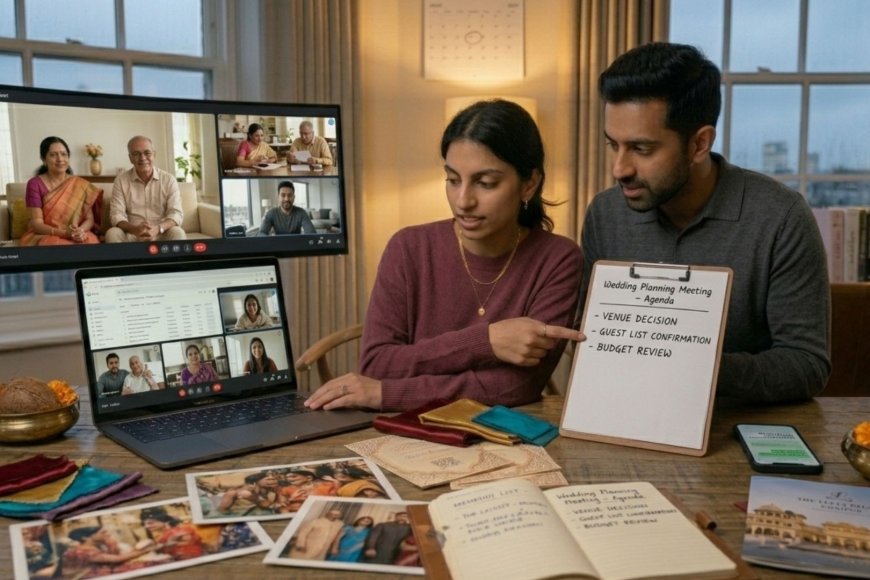
How to Run Effective Virtual Family Planning Meetings
The NRI couple's practical guide to the meeting format that either advances the planning or consumes the time allocated to it — the specific disciplines that make the family video call productive rather than circular
The Call That Lasted Three Hours and Decided Nothing
The meeting had been scheduled for one hour.
The agenda — if the WhatsApp message that said "call Sunday 7pm to discuss wedding" counted as an agenda — had been unspecified. The attendees were the couple in London, the bride's parents in Chennai, the groom's parents in Delhi, and the groom's sister who dialed in from Toronto twenty minutes late on her phone while driving, which meant she could not be told this and which produced a specific audio quality that made everything she said approximately sixty percent intelligible.
The first forty minutes were spent on the guest list — specifically on whether a family in Chennai that the bride had not personally met but whose daughter had attended the bride's parents' anniversary party eleven years ago should be invited. The conversation did not resolve this question. It established that the bride's mother felt strongly that they should be invited, that the bride felt equally strongly that she did not know them, and that the groom's parents had no opinion but expressed it at length.
The next thirty minutes were spent on the venue — specifically on the gap between the couple's preference for a boutique heritage property and the bride's father's preference for a five-star hotel, a conversation that had also occurred in the previous call and that reached the same non-conclusion.
The Toronto connection dropped at the ninety-minute mark. The attempt to reconnect took twelve minutes. When the groom's sister was back on the call, she asked what she had missed. The summary took eight minutes.
At two hours and forty minutes, the bride's mother said she had to go because her neighbor had arrived. The call ended.
The following morning, the couple sat down to update their planning document with the decisions made in the call. The decisions column was empty. The outstanding questions column had three new entries.
The three-hour call that decided nothing is not a failure of the people on it. It is a failure of the meeting's design. The specific people on that call — who love the couple, who are invested in the wedding, who have genuine knowledge and genuine opinions — were capable of making decisions. The meeting was not designed to produce them.
This guide provides the design.
Why Family Planning Meetings Fail
The Structural Failures
The absent agenda:
The meeting without a specific agenda is the meeting whose direction is determined by whoever speaks first and most confidently — which is rarely the direction that produces the decisions the planning requires. The absent agenda is the invitation for every tangent, every prior conversation that has not been resolved, every opinion that has been waiting for an audience.
The agenda is not a formality. It is the meeting's contract with itself — the specific statement of what this meeting is for and what it will produce.
The wrong attendees:
The meeting that includes everyone who has an interest in the wedding is a meeting that includes everyone who has an opinion about every decision — regardless of whether that opinion is relevant to the specific decisions on the meeting's agenda.
The guest list question does not require the photographer's input. The venue decision does not require the presence of the bride's father's colleague who attended the previous call because he happened to be visiting. The budget conversation does not require every family member who will eventually be affected by the budget — it requires the specific people who are responsible for the decisions the budget involves.
The right attendees for a given meeting are the people whose input is required for the specific decisions on that meeting's agenda — not the full set of people who are interested in the outcome.
The unequal preparation:
The meeting where some attendees have reviewed the relevant information and others have not is the meeting that spends its first portion bringing the unprepared attendees up to the level of the prepared ones — which takes the time that was allocated for the decision.
The preparation gap is not a personal failure. It is a structural failure — the meeting that does not send the relevant information in advance, with enough time for preparation, has not created the conditions for informed discussion.
The circular conversation:
The circular conversation — the conversation that returns to the same point, that revisits decisions that have been made, that raises objections after the decision moment has passed — is the specific failure mode of family meetings where the relationships between the participants include historical dynamics that are not about the wedding.
The family meeting that is also a context for the expression of family dynamics — the parent whose contribution is partly about the wedding and partly about their relationship to the adult child's autonomy — is the meeting that is doing two things simultaneously and that serves neither well.
The Relational Failures
The authority question:
The family planning meeting whose authority structure is unclear — where it is not established whose decision it is when the group cannot agree — is the meeting that produces the three-hour discussion of the guest list question that does not get resolved.
The authority question in the wedding planning context: whose wedding is it? The answer — the couple's — must be held consistently throughout the planning process. The family meeting that treats the wedding planning as a family project with equal stakeholders produces the specific gridlock of the call described in the opening scenario.
The family dynamics that predate the wedding:
The family dynamics that exist between the people on the call — the mother-daughter tension, the competition between the two sets of parents, the sibling whose relationship to the couple is complicated — do not disappear because the call is nominally about the wedding. They surface in the specific way that the conversation is conducted: the parent who consistently redirects to their own preferences, the family member who undermines decisions the couple has already made, the in-law pair who compete rather than collaborate.
The meeting design cannot eliminate these dynamics. It can structure the meeting so that the dynamics have less opportunity to consume the agenda.
The Meeting Architecture: The Design That Works
The Pre-Meeting Protocol
The pre-meeting protocol is the work that makes the meeting possible — the preparation that transforms a gathering of people with opinions into a gathering of people who are ready to make specific decisions.
The agenda:
The agenda should be sent to all attendees at minimum forty-eight hours before the meeting — seventy-two hours is better, particularly for attendees who need to prepare.
The agenda format: each item stated as a decision to be made, not a topic to be discussed. Not "venue discussion" but "decision: boutique heritage property or five-star hotel for the reception, with the specific shortlist of three options provided below." Not "guest list" but "decision: confirm the final guest count for the reception, with the current draft list shared below for review."
The decision framing of the agenda item changes the meeting's orientation — from the open-ended discussion that can extend indefinitely to the specific decision that has a natural endpoint when the decision is made.
The pre-reading:
The pre-reading shared with the agenda — the specific documents, photographs, cost comparisons, or other information that the decision requires — should be sent with sufficient lead time for genuine preparation.
The attendee who has reviewed the venue shortlist before the call, who has looked at the photographs and the pricing, arrives at the meeting with an informed position rather than an opinion formed in real time in response to what others are saying. The meeting of informed participants is a different meeting from the meeting of people forming their views as the conversation proceeds.
The individual pre-call:
For family planning meetings where the dynamics are complex — where the history between the participants makes the group meeting difficult — the pre-call with specific individuals before the group meeting produces better outcomes than the group meeting alone.
The bride who speaks with her mother privately before the group call — who understands her mother's specific concerns about the guest list before the call begins, who has heard the argument and thought about the response — arrives at the group call with a position rather than a reactive response.
The pre-call does not make the group call unnecessary. It makes the group call more productive by ensuring that the specific dynamics between specific individuals have been managed before the group context amplifies them.
The Meeting Structure
The opening:
The meeting opens with a brief statement of the agenda and the time allocation — "we have sixty minutes, we have three decisions to make, here is what they are and how long we have for each." The opening statement that orients every attendee to the meeting's purpose and its time constraint is the opening that manages the subsequent discussion.
The time allocation per agenda item should be stated explicitly — "we have twenty minutes for the venue decision, fifteen minutes for the guest list confirmation, ten minutes for the programme discussion, and fifteen minutes for any other items." The explicit time allocation creates the shared awareness that the conversation has a clock that the attendees can all see.
The decision-first approach:
Each agenda item should begin with the specific decision required and the options available — before the discussion opens. Not the discussion that eventually arrives at the decision, but the decision framed at the outset with the options on the table.
"The venue decision is between these three options. We need to confirm one today because the booking window closes on Friday. Here are the three options and the key differences. Who wants to speak first?"
The decision-first framing prevents the discussion from being a general exploration of the topic and makes it specifically about the decision.
The timekeeper:
One person — the couple, the wedding planner, a trusted neutral — keeps the time and manages the transition between agenda items. The timekeeper who says "we have five minutes left on this item" and who moves the discussion to a conclusion rather than allowing it to continue is the specific management function that the meeting requires.
The timekeeper role can be shared with the facilitator role — the person who manages the discussion, calls on specific attendees, and steers the conversation toward the decision — or held separately.
The decision capture:
Every decision made in the meeting should be captured in real time — stated aloud, confirmed by the decision-makers, and written into the shared document that all attendees can see. The decision that is made but not captured is the decision that is contested in the following week's WhatsApp conversation.
The real-time capture — the shared document visible to all attendees, updated as each decision is made — is the specific practice that produces the meeting's output rather than its discussion.
The Closing Protocol
The decision summary:
The meeting closes with a specific, verbal summary of every decision made in the meeting — stated clearly, confirmed by the relevant decision-makers, and visible in the shared document. The summary takes five minutes and prevents the specific failure mode of the meeting that produced agreements that different attendees remember differently.
The action assignment:
Every decision produces actions — specific tasks assigned to specific people with specific deadlines. The decision to book the heritage property is an action for the couple to make the deposit by Friday. The decision to expand the guest list by twenty is an action for the bride's parents to provide the additional names by Tuesday.
The action that is not assigned to a specific person is the action that nobody does.
The next meeting:
The closing of the meeting is the moment to schedule the next one — not the WhatsApp conversation three weeks later that tries to coordinate availability across four time zones. The next meeting scheduled before the current meeting ends has a confirmed time, a confirmed attendees list, and the beginning of an agenda based on the actions whose completion will need to be confirmed.
The Technology: Platform and Setup for Family Calls
The Platform Selection
The family planning meeting's platform selection should prioritize: reliability across the range of devices and connections the attendees will use, ease of access for attendees who are not technically sophisticated, and the specific features — screen sharing, recording with consent, breakout rooms for sub-group discussions — that the meeting format requires.
Zoom:
Zoom's reliability, screen sharing capability, and recording feature make it the most appropriate platform for formal family planning meetings. The recording — with the consent of all attendees — creates the specific reference document that prevents the contested memory problem.
The limitation: the attendee who is not Zoom-literate — the grandparent in India, the family elder who uses WhatsApp video exclusively — may have a worse experience on Zoom than on a familiar platform.
WhatsApp video:
WhatsApp video is the platform on which the Indian family is most comfortable — and the meeting that happens on WhatsApp is the meeting with the lowest technical barrier for the Indian-based family members.
The limitation: WhatsApp video's multi-party call quality degrades with more than four or five participants. The screen sharing is limited. The recording is not native. For the formal family planning meeting with six or more attendees, WhatsApp video is not the optimal platform.
The hybrid approach:
The family planning meeting that uses Zoom as the primary platform — with the couple and the technically comfortable family members on Zoom — and that connects the less technically comfortable family members via a phone call to one of the Zoom participants is a specific workaround that maintains the meeting's technical quality without excluding the family members who are not Zoom-literate.
The Connection Preparation
Every attendee should test their connection before the meeting — not at the meeting's start time but at least thirty minutes before. The attendee who discovers their connection is inadequate at the start of the meeting has used the first ten minutes of the meeting on the technical problem rather than the agenda.
The connection test: join the meeting platform's test call, confirm that the audio and video are working, confirm that the connection speed is adequate, confirm that the background is appropriate.
The backup plan: every attendee should have a specific backup if their primary connection fails — the mobile data connection, the alternative device, the phone call as a fallback. The backup plan should be established before the meeting, not improvised during it.
The Agenda Templates: The Specific Meetings the NRI Wedding Requires
The Venue Decision Meeting
Agenda items: Decision: confirm the venue from the shortlist of three options provided in the pre-reading. Decision: confirm the booking deposit timeline and the person responsible for the payment. Decision: confirm the event dates and the programme structure at the venue.
Attendees: The couple, both sets of parents if they are contributing to the venue cost, the wedding planner if engaged.
Pre-reading: The venue comparison document — photographs, pricing, availability, key terms, the couple's assessment of each option.
Time allocation: Sixty minutes total. Forty minutes for the venue selection. Ten minutes for the deposit and booking logistics. Ten minutes for the programme structure.
The Guest List Meeting
Agenda items: Decision: confirm the final guest count for each event. Decision: confirm the specific names on the contested portion of the list. Decision: establish the process for any additions after today's meeting.
Attendees: The couple, both sets of parents. Not the extended family whose names are being discussed — the conversation about who is invited should not include the people being considered.
Pre-reading: The current guest list draft, with the confirmed names, the names in question, and the current count for each event.
Time allocation: Sixty minutes. Twenty minutes on the total count. Thirty minutes on the specific contested names. Ten minutes on the addition process.
The specific management: The guest list meeting is the meeting most likely to become circular — because the family dynamics around the guest list are the most intense. The decision-first framing is most important here: "we have a budget for one hundred and twenty guests at the reception. We currently have one hundred and fourteen confirmed. We have six spaces. There are fourteen names in the contested list. Today we need to decide which six, if any, fill those spaces and how we decide." The specific framing of the decision — the six spaces, not the general question of who should be invited — makes the conversation finite.
The Budget Meeting
Agenda items: Decision: confirm the total budget and its allocation across categories. Decision: confirm the contribution from each family and the timeline of contributions. Decision: confirm the decision process for items that exceed the category allocation.
Attendees: The couple and the specific family members who are contributing financially. Not the full family — the budget conversation that includes family members who are not contributing financially is the budget conversation that is complicated by opinions without accountability.
Pre-reading: The draft budget with the category allocations, the current committed spend, and the outstanding decisions.
Time allocation: Ninety minutes. Sixty minutes on the allocation. Twenty minutes on the contribution timeline. Ten minutes on the decision process.
The Programme Meeting
Agenda items: Decision: confirm the event programme — which events, what format, what duration. Decision: confirm the ceremony structure and the specific rituals to be included. Decision: confirm the entertainment programme for the sangeet.
Attendees: The couple, both sets of parents, the wedding planner if engaged.
Pre-reading: The draft programme, the ceremony structure options, the sangeet entertainment options.
Time allocation: Ninety minutes. Thirty minutes on the event programme. Thirty minutes on the ceremony structure. Thirty minutes on the sangeet.
The Difficult Participants: Managing the Meeting's Human Variables
The Dominating Voice
The family member who dominates the meeting — who speaks at length on every agenda item, who redirects the discussion to their own position, who does not naturally cede space to other voices — is the specific participant whose management determines whether the meeting produces collective decisions or majority compliance with the loudest voice.
The management: the direct, warm interruption. "Thank you — before we continue, I want to make sure we hear from everyone on this. [Name], what is your view?" The redirection that is not a criticism of the dominating voice but a specific invitation to others changes the meeting's dynamic without creating conflict.
The Silent Participant
The silent participant — the family member who is on the call but who does not speak, who does not share their view, and whose silence may represent agreement, discomfort, or the specific difficulty of finding the space to speak in a call dominated by more assertive voices — is the participant whose view the decision is missing.
The management: the specific, direct invitation. "We haven't heard from [Name] on this — what is your view?" The direct invitation is the specific management that gives the silent participant permission to speak rather than waiting for them to find the space independently.
The Late Arrival
The late arrival — the groom's sister from Toronto, on her phone in the car, twenty minutes after the meeting's start — is the participant whose catch-up consumes the meeting's time.
The management: the meeting does not pause for the late arrival. The late arrival is caught up at the end of the meeting or through the shared document — not through a real-time summary that uses the group's time. The policy should be established before the meeting: "if someone joins late, we will not pause the agenda. The shared document will capture the decisions made before their arrival."
The policy, communicated before the meeting, is the specific boundary that protects the meeting's time without making the late arrival feel unwelcome.
The Off-Agenda Contribution
The family member who raises an agenda item that is not on the agenda — the guest list conversation that surfaces in the venue meeting, the venue preference that surfaces in the programme meeting — is the participant whose contribution is genuine but whose timing is not.
The management: the parking lot. "That is an important point — let me add it to the next meeting's agenda so we give it the time it deserves. For now, let's stay with the venue decision." The parking lot — the list of items raised in the meeting that belong in a future meeting — is the specific structure that acknowledges the contribution without allowing it to derail the current agenda.
The Meeting Cadence: How Often and When
The Cadence by Planning Phase
The frequency of family planning meetings should reflect the intensity of the planning phase rather than a fixed schedule.
Twelve to eight months before the wedding:
Monthly meetings. The decisions at this phase — venue, broad budget allocation, rough guest list, programme structure — are significant but not time-critical. The monthly meeting gives adequate time between meetings for actions to be completed and for the planning to advance.
Eight to four months before the wedding:
Fortnightly meetings. The decisions at this phase — vendor selections, guest list confirmation, programme detail, attire decisions — are more numerous and more time-sensitive. The fortnightly meeting provides the frequency that the planning's pace requires.
Four to six weeks before the wedding:
Weekly meetings. The decisions at this phase — final confirmations, last-minute changes, logistical coordination — are time-critical and numerous. The weekly meeting and the continuous WhatsApp communication that supplements it are both necessary.
The Time Zone Window
The NRI family planning meeting's scheduling must find the time zone window that is reasonable for all attendees — a specific constraint that the domestic wedding does not have.
The London-Chennai-Delhi-Toronto family described in the opening scenario has a specific, narrow overlap window. London is five and a half hours behind Chennai and Delhi. London is five hours ahead of Toronto. The meeting that is reasonable for London is either early morning for Toronto or late evening for Chennai.
The mapping of the time zone window — the hours when every attendee's local time is within acceptable meeting hours — should be done before the meeting cadence is established. The window that exists should be protected: the meetings scheduled in the window, consistently, rather than negotiated for each meeting.
The Meeting as Relationship
The family planning meeting is not only a decision-making mechanism. It is a specific form of the relationship between the couple and their families during the planning period — the regular contact that either builds the shared investment in the wedding or erodes it through frustration and circular conversation.
The meeting that works — that produces decisions, that respects everyone's time, that treats every attendee as a capable and valued contributor — is the meeting that builds the relationship. The meeting that fails — that decides nothing, that becomes the context for the expression of family dynamics, that leaves attendees feeling unheard or overridden — is the meeting that adds friction to the relationships the wedding is meant to celebrate.
The design of the meeting is an act of respect — for the family members' time, for their genuine investment in the wedding, and for the relationships that the wedding planning period should strengthen rather than strain.
The three-hour call that decided nothing did not fail because the people on it were incapable. It failed because nobody had designed it to succeed.
Design it to succeed.
The family who arrives at the wedding having spent twelve months in productive, well-structured planning together has already begun the celebration.
NRIWedding.com — Expert guidance for Indian weddings planned across borders.
0 comments
Real names and courtesy, please. Every comment is read by a person before it appears.
Nothing yet. Start it off.
Comments are closed on this article.