The Gold That Glows Before the Fire: The Complete Guide to the Haldi Ceremony for NRI Families
The Haldi ceremony is the most intimate ritual in the Indian wedding calendar — the moment before the magnificence, when turmeric-stained hands and unguarded tears tell the truest story of what a wedding actually costs a family. For NRI couples carrying this tradition across oceans, it is not simply a pre-wedding ritual — it is the last morning of one life and the first breath of another.
You grew up watching it happen to someone else. A cousin, an older sister, a neighbour's daughter. The women gathered close, their voices overlapping, someone's aunt applying the yellow paste with more enthusiasm than finesse. The bride or groom sitting still in the middle of it all, eyes bright with something between laughter and the kind of emotion that has no clean name. The smell of raw turmeric filling the whole house — sharp, golden, ancient.
You stored that memory somewhere essential. And now it is your turn, or your child's turn, and you are in a house in Brampton or a flat in Birmingham trying to recreate that particular morning from the inside out. You want the yellow. You want the women singing. You want the hands of your mother and your aunts on your face, and you want to cry in the specific way that only the Haldi allows — openly, without explanation, surrounded by the people who love you most.
This guide is for that morning. For the NRI family that understands the Haldi is not decoration — it is ritual. Not aesthetic — it is preparation. Not a photo opportunity — it is a goodbye and a beginning, happening simultaneously, in the space of a single ceremony.
🌟 DID YOU KNOW?
Turmeric has been used in Indian wedding rituals for over four thousand years, with references to Haridra [turmeric] appearing in both the Atharva Veda and the Rigveda as a purifying, protective, and auspicious substance — making the Haldi ceremony one of the oldest continuously practiced pre-wedding traditions in human history.
The Haldi ceremony's protective function is rooted in Ayurvedic science: turmeric's active compound curcumin has documented antimicrobial and anti-inflammatory properties, meaning the ancient practice of covering the bride and groom in turmeric paste before their wedding was simultaneously a spiritual purification and a practical preparation of the skin — wisdom encoded in ritual thousands of years before modern dermatology confirmed it.
Among NRI diaspora communities, the Haldi has become one of the fastest-growing Indian wedding ceremonies in terms of social visibility — with searches for "Haldi ceremony abroad" and "Haldi decoration ideas" increasing significantly year on year, as second-generation NRI couples who may have abbreviated other rituals actively choose to restore the Haldi to their wedding schedule as a non-negotiable.
What Is the Haldi Ceremony?
Haldi [turmeric ceremony, from the Hindi word for turmeric] is a pre-wedding ritual performed separately for the bride and groom — typically on the morning of the wedding day or the day before — in which a paste made from haridra [raw turmeric], chandan [sandalwood], besan [chickpea flour], and sometimes rose water or mustard oil is applied to the face, neck, arms, and feet of the bride or groom by family members and close friends.
The ceremony is rooted in both spiritual and practical tradition. Spiritually, the application of turmeric is an act of shuddhikaran [purification] — the preparation of the body and spirit for the sacred transformation of marriage. In Vedic belief, the individual undergoing the Haldi is crossing a threshold: they are leaving their former life and identity and entering the Grihastha Ashrama [the householder stage of life], which requires that they arrive at their wedding purified, protected, and blessed by those who love them.
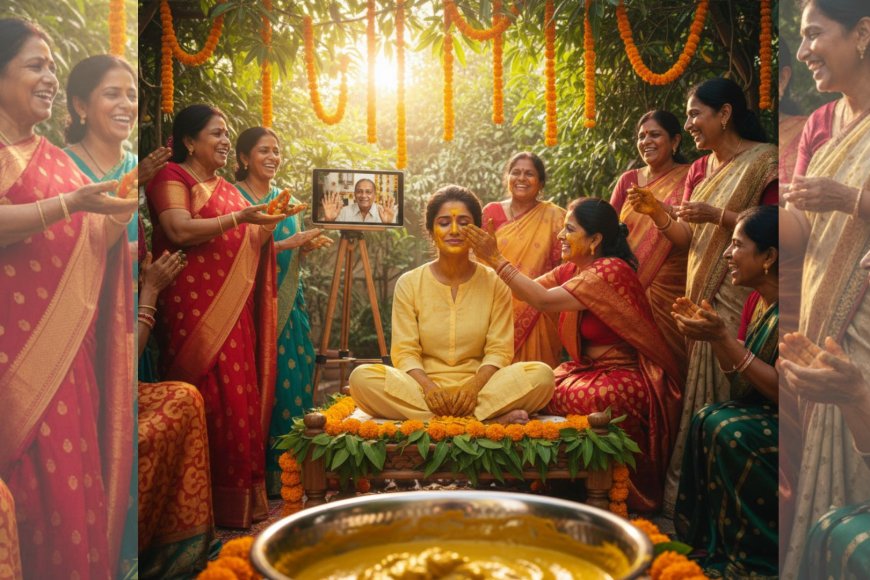
Practically, the ceremony unfolds in a warm, intimate setting — typically the family home or a garden — with the bride or groom seated on a low wooden peetha [stool or platform] covered in marigolds and mango leaves. Family members take turns applying the turmeric paste, beginning with the eldest members of the family and proceeding through generations. In many traditions, the paste applied to the bride is then sent to the groom's home to be applied to him as well — a physical connection between two households in the hours before they formally unite.
The atmosphere of a Haldi is unlike any other wedding ceremony. It is not formal. It is not choreographed. It is loud, joyful, frequently tearful, and invariably chaotic in the most beautiful way. Women sing geet [folk songs] specific to the wedding tradition of their region. Children smear turmeric on anyone within reach. Mothers weep quietly while pretending they are not. And the person at the centre sits in the yellow light of it all, being loved into their new life one palmful of turmeric at a time.
Community Comparison Table
| Community/State | Local Name | Key Tradition | How NRIs Abroad Adapt It |
|---|---|---|---|
| Punjabi | Vatna / Haldi | Vatna paste (turmeric, mustard oil, flour) applied by women; giddha singing; chadar (cloth) held over bride | Giddha songs played via speaker or sung by family; chadar ceremony maintained; vatna ingredients sourced from Indian stores |
| Rajasthani | Peethi / Ubtan | Ubtan paste (turmeric, sandalwood, gram flour, rose water) applied over multiple days; very elaborate | Single-day ceremony adapted abroad; Rajasthani folk music played; marigold decoration sourced locally |
| Bengali | Gaye Holud | Literally "yellow on the body"; elaborate two-ceremony tradition — one at bride's home, one at groom's; fish and sweets exchanged between families | Both ceremonies maintained where possible; fish gifting adapted to local Indian fishmongers; yellow sarees and mustard flowers used for decoration |
| Gujarati | Pithi / Mandvo | Pithi paste (turmeric, sandalwood, chickpea flour) applied over several pre-wedding days; Mandvo ceremony includes this | Condensed to single ceremony; pithi ingredients sourced from local Indian stores; Garba music played during ceremony |
| Marathi | Halad | Turmeric applied on specific pre-wedding days; halad ceremony is family-intimate with specific elder roles | Home ceremony maintained; elder roles preserved; Marathi wedding songs sung or played |
| Tamil (Hindu) | Nalungu | Pre-wedding ritual includes turmeric application; playful games between bride and groom's sides | Games adapted for diaspora setting; turmeric and gingelly oil sourced from Tamil grocery stores; streamed for Chennai family |
| Telugu | Pellikuturu / Haldi | Turmeric application combined with elaborate pre-wedding rituals; bride adorned with specific jewellery during ceremony | Ceremony maintained at home; Telugu community women participate; jewellery ordered from Indian jewellers abroad |
| Kashmiri Pandit | Livun / Mantarazvun | Purification ritual using mustard oil and turmeric; specific Kashmiri mantras recited; walnuts offered | Mustard oil and turmeric sourced from Indian stores; Kashmiri pandit engaged for mantras; walnuts included in ritual |
| Himachali / Garhwali | Ubtan / Haldi | Community women apply paste; local folk songs sung; mustard and turmeric paste specific to mountain tradition | Folk songs played via recording; community Pahadi women in diaspora city invited to participate |
| Sindhi | Lada / Haldi | Turmeric applied with coconut oil; women sing Sindhi wedding songs; ceremony is community-celebrated | Sindhi community women invited; coconut oil and turmeric sourced locally; Sindhi songs played |
The Meaning Behind the Ritual
In the Vedic understanding, the human body is not merely physical — it is the vessel through which the soul participates in the world, and any sacred transition requires that this vessel be deliberately prepared. The Haldi is that preparation.
Turmeric in Sanskrit literature is Haridra — the golden one — and its golden colour is not incidental. Gold is the colour of Surya [the sun deity], of Lakshmi [the goddess of prosperity], of Agni [the sacred fire]. To cover someone in turmeric is to bathe them in concentrated symbolic light — to mark them as auspicious, protected, and set apart for something sacred.
The act of application is equally significant. The paste is not purchased and applied by professionals. It is made by hands that know you — your mother's hands, your grandmother's hands, the hands of women who have watched you grow. This is deliberate. The Haldi is not something done to you. It is something done for you, by love, in preparation for the most significant crossing of your life.
The ubtan [paste] also symbolises the shedding of the old self. As it dries and is washed away, it takes with it the identity of the unmarried person — their former name-within-the-family, their particular place in the household — and prepares the skin, literally and metaphorically, to receive what comes next.
The Haldi says: you are loved enough that we will prepare you with our own hands for the life you are about to enter.
Doing the Haldi Abroad: The Practical Reality
The Haldi is one of the most adaptable of all Indian wedding ceremonies for diaspora settings — and also the one most likely to be underestimated. Here is what you actually need to know.
Making the Haldi paste is the first consideration. The traditional paste is made from raw turmeric, chickpea flour, sandalwood powder, and either rose water, mustard oil, or coconut oil depending on your regional tradition. Raw turmeric root — not just turmeric powder — gives the deepest colour and most authentic texture. In London, Wembley's Ealing Road and Tooting's Upper Tooting Road carry fresh turmeric root throughout the year, with supply increasing in wedding season. In Toronto, Gerrard Street East and the South Asian grocery stores along Dixie Road in Bramptonstock fresh turmeric root reliably. In Houston, Hillcroft Avenue is your destination for both fresh root and turmeric powder in bulk. In Sydney, Harris Park in Parramatta carries fresh root through most of the year. In Dubai, Meena Bazaar stocks everything needed. Order online from specialist South Asian grocery suppliers if your local options are limited — order at least three weeks before.
The venue question for a Haldi is less complicated than for other rituals, precisely because the Haldi belongs at home. A garden, a patio, or a large living room with the furniture moved back is genuinely the ideal setting — not a hotel ballroom. Many NRI families hire a marquee or garden tent for the Haldi if the home space is limited, which creates a beautiful setting while keeping the intimate atmosphere. If you must use an event venue, choose one that allows you to bring your own decor and where you can set up a floral floor space around the central peetha. The Haldi's magic lives in its closeness — preserve that above all.
Turmeric staining is real and must be addressed in advance with your venue. Turmeric stains skin, clothing, floors, and furnishings. If you are using a rented venue or your landlord's property, lay down waterproof sheeting under the ceremony area. Ask guests to wear yellow, white, or old clothing they do not mind staining — this is standard Haldi etiquette and most guests will appreciate the guidance. The bride and groom should wear old or specifically purchased Haldi outfits — yellow cotton is traditional and widely available from Indian clothing stores in all diaspora cities.
A pandit is generally not required for the Haldi — it is family-led in the vast majority of traditions. However, some families from specific communities (particularly Kashmiri Pandit and certain South Indian traditions) include a brief prayer or mantra recitation at the opening of the ceremony. If yours is one of these, NRI.Wedding's regional pandit directory will connect you to the right priest.
For coordinating with India via video call, set up a dedicated screen positioned so that your India family can see the person receiving the Haldi clearly. The most important moments to share in real time are the first application by the eldest family member and the moment when the ceremony's emotion peaks — which experienced Haldi photographers and videographers will recognise and capture. If your ceremony is in the morning in Toronto (EST), your India family in Mumbai or Delhi can join comfortably in the evening IST. If you are in Sydney (AEST), a 10:00 a.m. Haldi translates to approximately 4:30 a.m. IST — consider whether a slightly later ceremony time works better for all parties.
Doing the Haldi as a Destination Wedding in India
For NRI couples returning to India for their wedding, the Haldi as a destination ceremony offers an experience that no diaspora setting can fully replicate — and the choice of location makes an enormous difference.
For North Indian families, a haveli [traditional mansion] setting in Jaipur, Jodhpur, or Udaipur creates an extraordinary visual and atmospheric backdrop for the Haldi, with courtyards naturally suited to the ceremony's outdoor, daylit character. Delhi and Agra both have established wedding venues with dedicated Haldi spaces. For Bengali families, the Gaye Holud in Kolkata — with the city's extraordinary flower markets supplying marigold and mustard blossom in abundance — is an experience entirely its own. For Gujarati families, Ahmedabad and Surat both have venues experienced in multi-day pre-wedding ritual sequences including Pithi ceremonies.
When briefing local vendors and family members in India as an NRI family, be explicit about which specific elements of the Haldi matter most to you — the particular paste recipe your family uses, the songs your grandmother always sang, whether you want a formal photographer or a more candid documentary approach. Local Indian wedding photographers understand the Haldi's visual language deeply, but NRI returnee families sometimes have specific aesthetic preferences shaped by diaspora-influenced wedding photography styles that are worth communicating in advance.
What You Need: Haldi Checklist
Ritual Items Fresh turmeric root (minimum 500g for a full ceremony), chickpea flour, sandalwood powder, rose water or mustard oil or coconut oil (per your regional tradition), a large mixing bowl for the paste, a wooden or decorated peetha[low stool] for the bride or groom to sit on, marigold flowers for decoration (fresh, in quantity), mango leaves for the ceremonial space, yellow or marigold-coloured fabric for the backdrop, waterproof sheeting for the floor, yellow outfits for the bride or groom, a small diya, and fresh flower petals for scattering.
People Required The eldest family members from both sides to perform the first application, the mother and close female relatives of the bride or groom, close friends (the Haldi is one ceremony where the friend group plays a central role), a designated family member or professional to manage the video call for India relatives, and a photographer who has experience shooting Haldi ceremonies — the light and colour require a specific skill set.
Preparation Steps Prepare the turmeric paste the evening before — it deepens in colour overnight. Lay waterproof sheeting under the ceremony space the morning of. Set up the peetha and floral decoration two hours before. Brief all family members on the sequence — who applies first, which elders have specific roles in your tradition. Prepare a yellow outfit change for guests if you are providing them. Set up the dedicated video call device and test the connection the day before. Have towels and a change of clothes ready for the bride or groom for immediately after.
NRI.Wedding's Haldi vendor directory, regional pandit network for communities that include prayer, and NRI wedding photographer listings — all specialists in diaspora wedding ceremonies — are available across the UK, US, Canada, UAE, and Australia.
5 Questions NRI Couples Always Ask About the Haldi
Can the bride and groom have their Haldi together instead of separately?
Traditionally, the Haldi is performed separately — at the bride's home for the bride, at the groom's home for the groom — often simultaneously or in sequence. The separation is intentional: it is the last ceremony each person experiences within their own family before the wedding unites the two families. However, many modern NRI couples choose to hold a combined Haldi, particularly when both families are travelling from abroad and a single gathering is more logistically practical. A combined Haldi is increasingly common in diaspora weddings and carries its own beauty — though if your family's tradition holds the separation as significant, it is worth finding a creative way to honour that, even if the two ceremonies happen in different rooms of the same venue.
How do we handle the turmeric staining at a rented venue?
This requires advance planning and honest communication with your venue. Lay waterproof sheeting — the kind used for painting — across the entire ceremony floor area, extending at least a metre beyond the seating. Request that guests wear yellow or white clothing they are comfortable having stained. Ask your caterer or venue manager about surface materials in the ceremony space — turmeric on certain floor types can be very difficult to remove. Some NRI families choose to hold the Haldi outdoors or in a garden tent specifically to avoid venue conflict, which is often the simplest and most beautiful solution.
My non-Indian partner wants to participate in the Haldi. How do we include them?
The Haldi is one of the most welcoming ceremonies for non-Indian partners because its language — being cared for by hands that love you — is universal. Your partner does not need to understand Sanskrit or know the regional folk songs to feel the meaning of the moment. Seat them beside you or give them their own small Haldi moment within the ceremony. Brief your family to include them naturally — a palmful of turmeric paste applied by a future mother-in-law, whatever her cultural background, is one of the most quietly moving moments in an intercultural wedding. Many non-Indian partners describe the Haldi as the ceremony that made them truly feel welcomed into an Indian family.
What is the correct way to dispose of the turmeric paste after the ceremony?
In traditional practice, the used turmeric paste is considered sacred and auspicious — it is not simply discarded. Many families bury it in the earth (in the garden or in a pot of soil), return it to a body of moving water, or offer it to the roots of a living tree. In diaspora settings where these options may be limited, burying the paste in a pot of garden soil is the most widely adopted adaptation, and is considered entirely appropriate. The underlying principle is that something consecrated should be returned to the earth rather than thrown in the bin — a small but spiritually significant gesture that takes thirty seconds and means a great deal.
We are doing the Haldi the day before the wedding rather than the morning of. Is this correct?
Both timings are practised across different Indian communities and both are considered correct within their respective traditions. In many North Indian communities, the Haldi happens the morning of the wedding. In Bengali tradition, the Gaye Holud is typically a separate evening event one or two days before. In South Indian communities, the pre-wedding rituals including turmeric application are spread across several days. The most important thing is to align the timing with your specific community tradition — and if your family's practice has always been one way, honour that consistency. If you are establishing a new family tradition as an NRI couple, choose the timing that allows the most family members to be fully present and unhurried.
The Emotional Angle
The thing nobody prepares you for about the Haldi is the silence inside it. Not literal silence — the room is full of voices and laughter and someone's phone playing the same wedding playlist on repeat. But inside the person sitting on that decorated stool, receiving the hands of every person who has ever loved them, there is a particular stillness that arrives without warning.
It arrives when your mother's hand cups your face to apply the turmeric, and you realise this is one of the last times she will touch you as her unmarried child. It arrives when your grandmother — who flew from Lucknow or Chennai or Ahmedabad specifically for this week — leans forward and says something in your mother tongue that you understand completely even though you grew up speaking English at school. It arrives in the space between the laughter and the tears, when the person you have always been and the person you are about to become exist in the same moment, covered in gold.
For NRI families, this moment carries a weight that is hard to articulate. Because the Haldi was sourced deliberately. The fresh turmeric was found after three phone calls to different shops. The women singing are doing so from memory, and some of them are slightly off-key, and it is the most beautiful sound you have ever heard. Your cousins flew in from three cities. Your aunt who you only see at weddings is here, and she is crying, and she does not explain why, and she does not need to.
You are being prepared. By love. By hands. By a tradition that crossed an ocean to reach this morning.
That is not a small thing. That is everything that matters.
A Moment to Smile
At a Haldi in Southall last spring, the bride's family had prepared what her mother described as "a modest amount" of turmeric paste — approximately three kilograms of it, stored in a large steel bowl that had previously been used for making biryani for forty people.
The ceremony was beautiful and moving right up until the moment the bride's seven-year-old brother, tasked with carrying the bowl from the kitchen to the ceremony area, tripped on the edge of the waterproof sheeting and deposited roughly half of the paste directly onto the groom's white kurta, which he had been specifically told was not to be worn until the wedding the following day.
There was a single second of absolute silence. Then the grandmother said, "This is very auspicious. The groom is now fully blessed." The room erupted. The groom, to his enormous credit, sat down in his ruined kurta and held out his hands for more paste. A replacement kurta was located by 6 p.m. The story was told at every subsequent family gathering for the rest of the year.
Some accidents are just ceremonies in disguise.
Quotes From the Diaspora
"I did my Haldi in my parents' garden in Mississauga in June. My mother made the paste from a recipe my nani dictated over the phone from Chandigarh — she called twice to make sure we had used enough mustard oil. When my mother applied the first palmful to my face, I couldn't speak for about thirty seconds. I just sat there in the sunshine, yellow, and completely undone. My photographer told me later it was the best photograph she had ever taken. I believe her." — Simran Dhaliwal, Punjabi bride, originally from Chandigarh, now in Mississauga
"My daughter-in-law is from New Zealand. Her mother had never seen a Haldi before. I was nervous about how she would feel — whether she would understand. But when it was her daughter's turn to receive the paste, she leaned forward and applied it herself, very carefully, the way you touch something precious. Afterwards she told me it was the most meaningful thing she had ever participated in at a wedding. I cried for the second time that morning." — Meena Verma, North Indian mother of the groom, originally from Delhi, now in Birmingham
"We did a combined Haldi — my family's Bengali Gaye Holud tradition and my husband's Gujarati Pithi — in one ceremony in our garden in Melbourne. Two pastes, two sets of family songs, one very yellow afternoon. My Bengali aunts and his Gujarati maasis ended up in a cheerful argument about which paste was better for the skin. Nobody won. Both pastes were applied. We were the most thoroughly turmeric-covered couple in the history of Victoria." — Priya Chakraborty-Shah, Bengali-Gujarati bride, originally from Kolkata, now in Melbourne
Your Gold Travels With You
The Haldi is where the wedding truly begins — not at the mandap, not at the registry office, but in the morning light with turmeric on your hands and your family around you. For NRI couples, bringing this ceremony into a home in Houston or a garden in Harrow is an act of profound cultural faithfulness — a decision that says: we will not abbreviate this. We will not skip the sacred because the sacred is inconvenient across oceans.
NRI.Wedding supports families across the UK, US, Canada, UAE, and Australia with Haldi vendor directories, regional pandit connections for traditions that include formal prayer, specialist NRI wedding photographers who understand the ceremony's visual and emotional language, and planning checklists built specifically for diaspora families. You deserve to do this properly, with the right support around you.
Sit on your decorated stool. Let the people who love you prepare you. Let the turmeric do what it has always done — mark you as someone worth protecting, someone about to begin something sacred.
You are golden. You always were.
This article explores the Haldi ceremony — the sacred turmeric pre-wedding ritual — across Indian communities including Punjabi Vatna, Bengali Gaye Holud, Gujarati Pithi, Rajasthani Ubtan, and Tamil Nalungu, with practical guidance for NRI families in the US, UK, Canada, UAE, and Australia.
0 comments
Real names and courtesy, please. Every comment is read by a person before it appears.
Nothing yet. Start it off.
Comments are closed on this article.