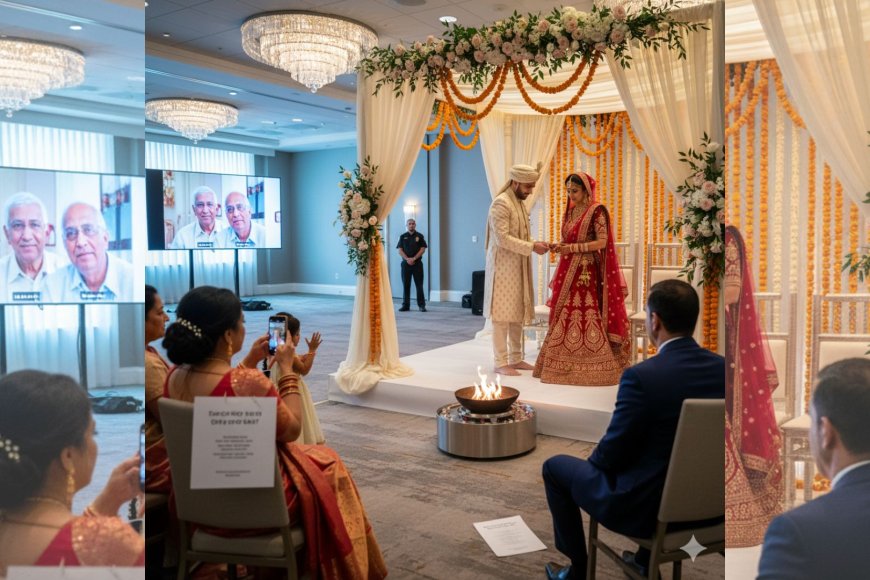
Indian wedding customs have never been static — they have always breathed, shifted, and adapted with each generation. But today, something more profound is happening: NRI couples across five continents are not simply borrowing from tradition, they are in active, loving conversation with it — keeping what is sacred, reimagining what is symbolic, and building something entirely their own.
You grew up watching your maasi's wedding video on a grainy VHS tape — the marigold garlands, the dhol that vibrated through the walls, your grandmother ululating at the moment the sindoor was applied. That wedding happened in Ludhiana or Lucknow or Thiruvananthapuram. It was rooted in a neighbourhood, a season, a specific kind of afternoon light. And now you are here — in Mississauga or Melbourne or Manchester — planning your own, and the question that sits heavy at 1 a.m. is not which caterer or which venue. It is something far more tender: How much of that world can I carry into mine?
The answer, it turns out, is more than you think. And less than you feared you'd lose.
🌟 DID YOU KNOW?
According to a 2023 survey by the Confederation of Indian Industry's cultural diaspora division, over 68% of NRI couples marrying outside India now incorporate at least five traditional rituals into their wedding ceremonies — up from 41% a decade ago.
The global Indian wedding industry is estimated to be worth over $50 billion USD annually, with the NRI segment growing at nearly 15% year-on-year as second-generation Indians come of age and choose culturally anchored celebrations over purely Western ones.
Linguists and cultural anthropologists at SOAS University of London have noted that wedding rituals are the single most preserved cultural practice in diaspora communities — more so than language, cuisine, or religious observance — because they are tied to once-in-a-lifetime emotional memory.
What Does "Evolving" Actually Mean for Indian Wedding Traditions?
To understand how Indian wedding customs are changing, it helps to understand what made them so enduring in the first place. Indian weddings are not simply parties with ritual attached. They are, in their truest form, a complete cosmological event. The vivah [Sanskrit: marriage, derived from the root meaning "to carry across"] is described in ancient texts as one of the sixteen samskaras [sacred life-passage rites], a moment when two souls, two families, and two lineages make a covenant that extends beyond the material world.
The rituals that surround a vivah — the haldi [turmeric ceremony], the mehendi [henna application], the saptapadi[seven steps around the sacred fire], the kanyadaan [the gift of the daughter by her father], the vidaai [the bride's farewell] — were never arbitrary. Each one mapped onto a belief about purity, transition, fertility, cosmic alignment, and the responsibilities of marriage. They were also deeply community-specific. A Kashmiri Pandit wedding looks nothing like a Tamil Brahmin wedding. A Garhwali ceremony carries mountain gods that a Rajasthani ceremony has never heard of.
What is evolving today is not the abandonment of this depth. It is the negotiation of it — sometimes joyful, sometimes painful — by people who hold genuine reverence for the tradition but live inside circumstances the tradition never imagined. An NRI couple in Sydney planning a wedding with a Serbian-Australian partner, a gay Indian couple in Toronto finding pandits willing to solemnise their union, a bride in Houston who has no female elders in the country to perform her godh bharai [baby-shower-equivalent pre-wedding blessing] — these are not people rejecting tradition. They are people trying to honour it under conditions of genuine constraint.
Community Comparison: How Different Indian Communities Are Adapting Their Wedding Traditions
| Community/State | Traditional Anchor Ritual | Local Name | Core Symbolic Meaning | How NRIs Abroad Are Adapting It |
|---|---|---|---|---|
| Himachali | Groom's processional welcome by women of the bride's village | Swagatceremony | Community's collective blessing of the union | Women of the local Indian association perform the welcome; UK-based families use Zoom-linked village elders to offer blessings in real time |
| Garhwali | Worship of the kul devta[ancestral deity] before the wedding | Devta Puja | Seeking permission and protection from the family's mountain deity | A framed photograph of the deity is placed on the mandap; priests in Dehradun perform the puja simultaneously via video call |
| Kumaoni | The singing of mangal geet [auspicious wedding songs] by elder women through the night | Jaag(vigil) | Keeping the spiritual space awake and protected | Kumaoni cultural groups in cities like Toronto record traditional songs and stream them live; younger cousins learn three or four songs to perform live |
| Ladakhi | Ceremonial offering of chang [local barley beer] to the household deity before departure | Lhamoblessing | Seeking divine permission for the bride's transition | Chang is sometimes replaced with barley water; the family's Buddhist monk conducts blessings via video from Leh |
| Kashmiri Pandit | Lagan Lagnun — the formal reading of the marriage horoscope with a walnut | Lagan ceremony | Cosmic confirmation of the match | Walnut is sourced from Indian grocery stores; the shlokas [sacred verses] are performed by Kashmiri Pandit sabhas in London or New Jersey |
| Punjabi | Anand Karaj — the four rounds of the Guru Granth Sahib | Laavan | The soul's journey toward God through marriage | Most Gurdwaras in UK, Canada, and Australia perform full Anand Karaj; couples often combine with a civil ceremony the day before |
| Marathi | Antarpat — a silk cloth held between bride and groom until the auspicious moment | Muhurta ceremony | The suspense and sacredness of the first marital moment | White bedsheets or silk scarves used when original antarpat cloth is unavailable; Maharashtrian mandals in Melbourne source the cloth communally |
| Tamil | Oonjal — bride and groom swinging together on a flower-draped swing | Oonjal | The playful, graceful beginning of shared life | Portable swings are hired from Indian event companies in Houston and Mississauga; the ritual songs are played via curated Spotify playlists if live singers aren't available |
| Bengali | Shubho Drishti — the first sacred exchange of gaze between bride and groom | Drishti exchange | The universe witnessed in the beloved's eyes | Performed with betel leaves as per tradition; Bengali families in London's Whitechapel community often source everything needed from Brick Lane within walking distance |
| Rajasthani | Pehravani — the ceremonial gifting of clothes to all relatives | Pehravani | Abundance, generosity, the inclusion of the entire family in the joy | Families ship gifted clothing from Jaipur to the wedding city in advance; WhatsApp groups coordinate sizing across time zones weeks before |
The Meaning Behind the Evolution
There is a spiritual idea embedded in all of these traditions that is worth naming plainly: Indian wedding rituals were never meant to be museum pieces. The rishis [ancient sages] who codified the samskaras understood that form must serve meaning — and that meaning must breathe inside the conditions of the living. The agni [sacred fire] at the centre of the Hindu wedding is not a fire because fire is nostalgic. It is a fire because fire transforms. It takes what is separate and makes it one thing. It witnesses. It purifies.
When an NRI family lights that fire in a marquee in Melbourne and the smoke alarm goes off and someone fans it with a program brochure while the pandit calmly continues his recitation — that fire is still doing exactly what it was always meant to do. It is still transforming. The transformation just looks a little different than it did in a village in Uttarakhand in 1974.
What is changing is the container. What is remaining is the intention. And perhaps no generation of Indians has ever had to be more intentional about their traditions than the diaspora — which means no generation has ever understood them more consciously, or loved them more deliberately.
For any partner who hasn't grown up with these rituals: the simplest way to explain them is this — every tradition in an Indian wedding is a way of saying, "We do not take this moment lightly."
Doing an Evolving Indian Wedding Abroad: The Practical Reality
The single biggest challenge NRI couples face is not emotional — it is logistical. And the gap between wanting a culturally complete wedding and executing one abroad is closed, almost entirely, by preparation and community knowledge.
Take the question of the pandit [Hindu priest]. For a Himachali family in Houston, finding a priest who knows the specific Pahari dialect of their wedding shlokas is genuinely difficult. The Pandit Directory maintained by the Hindu Swayamsevak Sangh and regional Indian associations can help, but the most reliable route is asking your family temple — even if it is a Tamil-majority temple — whether they know of any regional priests in the city. The network is tighter than it looks. Alternatively, NRI.Wedding's verified pandit network includes region-specific priests for over twenty Indian communities across the US, UK, Australia, UAE, and Canada.
For ritual items, the geography of diaspora grocery streets is your lifeline. In London, Ealing Road in Wembley and Southall's Broadway carry everything from supari [betel nut] to ghee [clarified butter] to specific regional flowers. In Toronto, Gerrard Street East and Mississauga's Dixie Road area are your best anchors. In Sydney, Harris Park in Parramatta is essentially a small Subcontinent. In Houston, Hillcroft Avenue's Indian strip has specialty stores that stock ritual items by regional community. In Dubai, Meena Bazaar in Bur Dubai has carried Indian wedding materials for generations of Gulf NRIs.
Fire and smoke is the one restriction that changes everything. Most Western venues have zero-smoke policies, which means the sacred havan [fire ritual] requires careful planning. Solutions include: booking outdoor garden venues with open-air mandap options, negotiating with hotel banquet managers for a temporary smoke allowance with fire wardens on standby, using ethanol-based ceremonial flames for indoor mandaps, or relocating the havan component to a nearby Gurdwara or temple space even if the main reception is held elsewhere.
For relatives in India, time zone management is everything. A morning wedding in Melbourne is late afternoon in Mumbai. An afternoon ceremony in Toronto is the middle of the night in Delhi — which means you need to think carefully about which moments of the ceremony you want beamed home, and whether you can shift the schedule by even one hour to catch families at a decent time. WhatsApp Live and YouTube Unlisted streams have become the standard; assign one reliable family member — not the bride's mother, she has enough to do — to manage the camera and the commentary for those watching from the other side of the world.
Doing This as a Destination Wedding in India
For NRI couples who choose to marry in India — and the numbers are rising — the destination wedding is an opportunity to let the tradition do what it was always meant to do: take place inside the landscape that shaped it. A Kashmiri Pandit wedding in Srinagar, a Rajasthani baraat rolling into a haveli in Jaisalmer, a Kumaoni ceremony with Himalayan peaks framing the mandap — these experiences are increasingly available to diaspora couples through specialist India-based planners who understand both the ritual requirements and the international guest experience.
The practical key is the briefing document. Before you arrive, send your India-based pandit a detailed note — in Hindi or their regional language if possible — outlining your family's specific community, your gotra [ancestral lineage clan], any customs your grandparents have specified, and any adaptations you need (for example, a shortened ceremony for non-Indian guests, or English explanations woven in). Good pandits in India's major destination wedding cities — Udaipur, Rishikesh, Coorg, Goa — are increasingly experienced with NRI briefs. Ask your planner specifically for a priest who has worked with diaspora families before.
For non-Indian guests, a one-page ceremony guide printed on beautiful card stock goes further than any amount of explanation. It tells them when to sit, when to stand, what each moment means, and why it is beautiful.
What You Need: The Modern NRI Wedding Ritual Checklist
Ritual Items to Source in Advance The core items for most Hindu wedding rituals include: ghee, rice, flowers (marigold, rose, and specific regional blooms), betel leaves and supari, coconut, turmeric, kumkum [vermillion powder], a clay or copper pot for the kalash [sacred vessel], sacred thread, specific regional items per community (walnut for Kashmiri Pandits; mango leaves for South Indian ceremonies; til [sesame] for Bengali rituals).
People Required At minimum: a verified pandit familiar with your community's customs, a family elder who knows the ritual sequence, a designated coordinator who is not emotionally central to the ceremony, and someone whose only job is to manage the video feed for India-based family.
Preparation Steps Connect with NRI.Wedding's pandit network at least four months in advance. Source your ritual items from local Indian grocers and order any community-specific items from India with six weeks shipping buffer. Confirm your venue's fire and smoke policy in writing. Prepare a ceremony guide for non-Indian guests. Set up your India video link two days before the ceremony and do a full test run. And please — assign the program brochure fanning job to someone before the ceremony, not during.
NRI.Wedding's vendor network, pandit directory, and region-specific planning checklists are designed exactly for this: to make sure nothing falls through the gap between intention and execution.
5 Questions NRI Couples Always Ask
Can we do the havan ritual indoors at a hotel ballroom?
Yes, but it requires advance negotiation. Contact your venue's events manager at least three months before the wedding and ask specifically about fire and smoke allowances. Many five-star hotels in diaspora cities now have established protocols for Indian wedding ceremonies, including portable fire suppression systems and ventilation arrangements. Alternatively, you can speak with your pandit about a symbolic agni — a clay lamp with ghee — as a stand-in, with the understanding that the intention of the ritual remains intact even when the form is adapted.
My partner is not Indian. How do we make the ceremony feel inclusive without diluting it?
The most successful intercultural Indian weddings are the ones where the non-Indian partner is given a role, not just a position. Ask your pandit to weave English explanations into the ceremony itself. Seat the non-Indian partner's family near a bilingual family member who can narrate quietly. And consider a pre-wedding evening — a simple dinner — where the rituals are explained informally, so that by the time the wedding happens, nothing feels foreign. Many non-Indian partners find that once they understand what each ritual means, they want more of them, not fewer.
How do I find a pandit who knows our specific regional customs?
Start with your family's temple in your city, even if it doesn't represent your exact community. Temple networks in diaspora cities are surprisingly interconnected, and a Tamil temple priest in Toronto almost certainly knows a Garhwali or Himachali pandit in the Greater Toronto Area. NRI.Wedding's verified pandit directory filters by community and current city of residence. When you make contact, send a written brief — your gotra, your community, your family's specific customs — before the first call. A good pandit will ask questions. A great one will ask questions you hadn't thought of yet.
How do we include relatives in India who cannot travel?
The technology now exists to make this genuinely beautiful rather than merely functional. Set up a dedicated screen at the mandap — not a laptop propped on a chair, but an actual display, framed and positioned as part of the decor — so that family joining from India feel present rather than watched. Assign a human host at the India end who can manage the group watching the stream, cue reactions, and brief family on when key moments are coming. Many NRI couples now schedule a separate virtual aarti [lamp ceremony] the morning after the wedding specifically for the India-side family to feel they had their own moment.
Should we do the civil ceremony before or after the religious ceremony?
In most countries, the civil ceremony must legally precede the religious one, or be conducted separately. NRI couples typically register civilly the week before the wedding — quietly, with just a witness — and treat the religious ceremony as the real wedding in every emotional sense. This is increasingly common and entirely in keeping with how families in India also navigate the legal-religious distinction. The civil ceremony is the paperwork. The vivah is the wedding.
The Emotional Angle
There is a kind of grief that has no name in English. The Japanese call a similar feeling mono no aware — the ache of beautiful, passing things. NRI families feel it most acutely at weddings. It is the grief of the mother who learned the vidaai songs at her own wedding in Shimla and is now trying to teach them to her daughter in a kitchen in Scarborough. It is the grief of the father who walks his daughter to a mandap in a rented banquet hall in Wembley and thinks of the courtyard in his parents' house where he always imagined this would happen. It is the grief of the bride who searches YouTube for the right version of the right song because there is no maasi nearby to sing it.
But here is what that grief does, when it meets love and determination: it transforms. The mother in Scarborough teaches her daughter not just the song but the story behind it, the name of the grandmother who first sang it, the occasion on which it is sung and why. The father in Wembley looks at that rented hall and sees, somehow, the same light. The bride finds the YouTube video and then finds, through the comments section, three other NRI brides who are looking for the same thing — and they become friends.
The tradition carries forward not despite the distance. Sometimes, it carries forward because of it.
A Moment to Smile
At a Punjabi-Marathi wedding in Mississauga in the autumn of 2022, the antarpat ceremony was going beautifully — the silk cloth held between the bride and groom, the priest mid-chant, the families watching in prickling silence — until the couple's golden retriever, who had been dressed in a tiny floral collar for the occasion, escaped from the designated dog-sitting cousin and made a joyful beeline for the mandap. He did not disrupt the ceremony so much as join it, settling peacefully at the couple's feet and refusing to leave.
The pandit paused, looked down, looked at the families, and continued his recitation without missing a beat. Someone later said it was the most auspicious thing that could have happened. "In our village," the Punjabi grandmother announced loudly, "a dog entering the ceremony means the house will always be full."
She may have made that up entirely. It does not matter. Nobody will ever forget that wedding.
Quotes From the Diaspora
"My mother-in-law was worried we'd do a 'half-half' wedding — half Indian, half Western, whole disaster. But when the saptapadi was happening and my husband was crying before we even finished the first round, she stopped worrying. Some things just don't need translating." — Priya Mehta, Marathi-Gujarati background, currently based in Melbourne
"We couldn't get a Garhwali pandit in London, so we had our family pandit in Pauri conduct the devta puja at 5 a.m. India time while we held ours at midnight here. My husband's father watched both ceremonies on his phone, one in each hand. He said it was the proudest he'd ever been." — Sunita Rawat-Singh, Garhwali background, currently based in Southall, London
"My American fiancé asked me what kanyadaan meant — the giving away of the daughter. I told him it meant my parents were entrusting him with the most precious thing they had ever made. He didn't say anything for a while. Then he said he hoped he was worthy of it. That's when I knew he understood us." — Deepika Nair, Tamil Brahmin background, currently based in Houston, Texas
Your Roots Travel With You
Indian wedding traditions are not fragile. They have survived centuries of invasion, migration, colonialism, and rupture. They have crossed the Kala Pani — the dark waters — that Indian tradition once said could not be crossed without losing one's culture. They are crossing oceans again now, in carry-on luggage and in memory and in the muscle-memory of rituals performed by women who learned them from women who learned them from women who had no idea their granddaughters would one day be recreating them in a banquet hall in Brisbane.
NRI.Wedding exists because this work — of carrying culture, of translating it, of keeping it alive and luminous — deserves support. Our pandit network, our vendor directory, our community-specific planning guides, and our photographer partners are all built around one belief: that where you live should never limit what your wedding can be.
Your roots travel with you. Make sure they bloom.
This article explores how Indian wedding traditions are evolving among NRI communities, covering rituals including the vivah, haldi, saptapadi, kanyadaan, and vidaai across Punjabi, Marathi, Tamil, Bengali, Kashmiri Pandit, Garhwali, Kumaoni, Himachali, Rajasthani, and Ladakhi communities, with practical guidance for NRI couples in Mississauga, London, Melbourne, Houston, Dubai, and beyond.
0 comments
Real names and courtesy, please. Every comment is read by a person before it appears.
Nothing yet. Start it off.
Comments are closed on this article.