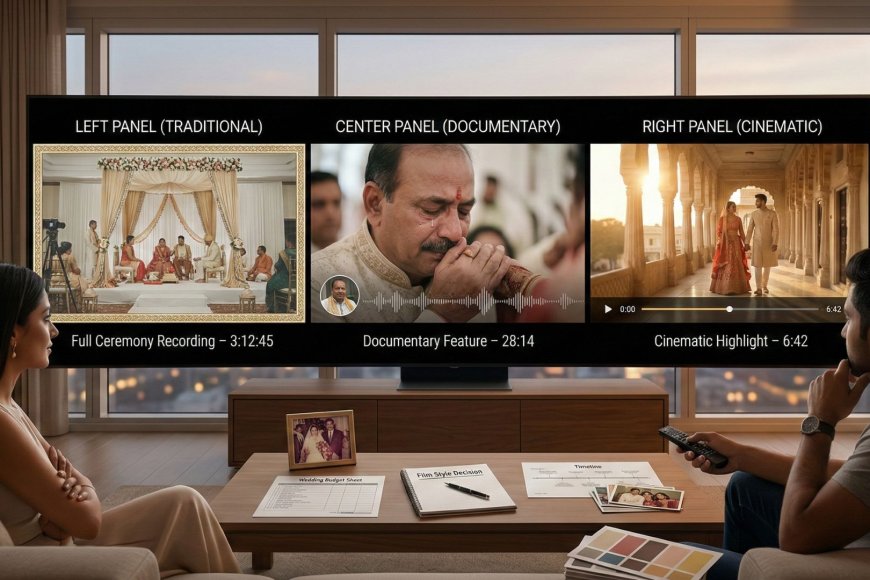
Cinematography Styles: Traditional vs. Documentary vs. Cinematic
There is a wedding film sitting on a hard drive somewhere that you will never watch again. You know the one. It arrived six months after the wedding, burned onto a DVD that you played once on a laptop, and what you remember of it is a static wide shot of the mandap, a zoom that moves too slowly across the pheras, and a soundtrack of synthesised music that bears no relationship to anything that was actually played at your celebration. The editing is competent. The footage is complete. And it has been unwatched for eleven years because watching it feels like reading a legal transcript of something that was supposed to be alive.
This is the traditional Indian wedding film in its most common form, and it represents a specific failure: the confusion of documentation with filmmaking. The camera was present. Everything was recorded. And somehow, in the act of recording, the life of the day was drained out of it rather than preserved.
The Indian wedding film market has transformed dramatically in the past decade, and NRI couples planning weddings today have access to filmmakers who are producing work of genuine cinematic quality — films that you return to not out of obligation but out of desire, because they make you feel something every time you watch them. But that market also still contains an enormous volume of work that looks exactly like the DVD on your hard drive.
Understanding the difference between cinematography styles — what they are, what they require, what they produce, and which one is right for your specific wedding and sensibility — is the knowledge that separates a good videography decision from a great one. This guide is built to give you that understanding in full.
Why Cinematography Style Matters More Than You Think
Most couples approach videography as a lesser priority than photography. This is understandable — still images are more immediately shareable, more easily displayed, and more culturally established as the primary visual document of an Indian wedding. But there is something that a film can do that a photograph structurally cannot: it can return you to the experience of being there.
A photograph of the pheras is a beautiful object. A film of the pheras, made well, puts you back inside that moment — the priest's voice, the sound of the fire, your partner's breathing, the weight of the garland around your neck, the knowledge of what was happening. Twenty years from now, your children will not understand what your wedding felt like from photographs alone. A good film will show them.
The style in which that film is made determines almost everything about what it can and cannot do. A traditional film can document. A documentary film can capture. A cinematic film can move. These are not the same things, and knowing the difference before you book your videographer is the most important piece of knowledge you can bring to that decision.
Traditional Videography: What It Is and When It Makes Sense
Defining Traditional
Traditional Indian wedding videography is the oldest and most widespread style in the market — the style that produced the DVD on your hard drive and that still dominates the domestic Indian wedding market at most price points. Its defining characteristics are straightforward.
Fixed or minimally moving camera positions. The camera is typically placed on a tripod at a position that provides full coverage of the ceremony area. It records continuously from that position, with occasional repositioning between events. The coverage is comprehensive in the sense that everything is visible in the frame — but the frame itself rarely changes to find a more interesting or more emotionally revealing angle.
Chronological structure. The edit follows the programme in sequence: the mehendi, then the haldi, then the sangeet, then the ceremony, then the reception. There is minimal narrative construction — the film is an edited record of events in the order they happened rather than a story shaped around emotional peaks and valleys.
On-screen graphics and titles. Traditional Indian wedding films frequently include text overlays — the couple's names, the event name, the date — as well as decorative borders, transitions, and graphic elements that reflect the aesthetic conventions of the domestic market.
Synchronised music. The music track is typically added in post-production, often drawn from popular Bollywood songs or synthesised instrumental tracks, layered over or replacing the original audio from the wedding.
Long duration. Traditional films are often long — sometimes several hours across multiple DVDs or files — because the priority is completeness of documentation rather than narrative economy.
The Honest Assessment of Traditional Videography
Traditional videography serves a specific purpose well: it creates a comprehensive record of what happened. If your primary concern is documentation — having footage of every ritual, every speech, every moment in the programme — traditional coverage achieves this reliably and usually at a lower price point than the other styles.
Its limitations are equally specific. It records but it doesn't illuminate. The camera sees what happened; it doesn't necessarily reveal what it felt like. The static angles, the chronological structure, and the post-production music choices that replace the original audio of the day all work against the film's ability to return you to the lived experience of being there.
For NRI couples with parents who value documentation above storytelling — who want to be able to show relatives a complete record of every ritual in sequence — traditional coverage meets that requirement. It is honest about what it is, and what it is is a record.
Traditional videography is also the style most common at lower price points in the Indian market, and because of this, it is sometimes presented as something more sophisticated than it is by vendors who have adopted superficial elements of newer styles — a drone shot here, a slow-motion clip there — without the underlying filmmaking philosophy that makes documentary or cinematic work genuinely different.
Documentary Videography: The Style That Changed Everything
Defining Documentary
Documentary wedding filmmaking emerged in the Indian market as photographers and filmmakers trained in photojournalism and documentary traditions began applying those principles to wedding coverage. Its defining characteristics are the opposite of traditional in almost every dimension.
The camera moves to find the story. Rather than occupying a fixed position, the documentary videographer is constantly repositioning — looking for angles that reveal emotion, context, and human connection that the fixed wide shot cannot see. They are moving through the crowd, finding the grandmother in the second row, catching the groom's father in the moment he thinks nobody is watching him cry.
Authentic audio is central. Documentary films preserve and prioritise the actual sounds of the wedding — the priest's voice, the wedding vows, the laughter at the sangeet, the ambient noise of the baraat procession, the whispered exchange between the couple during a quiet moment in the ceremony. This audio is not replaced with post-production music. It is the sonic texture of the film, and it is what makes the documentary style uniquely capable of returning you to the experience of being there.
Observational and non-interventionist. The documentary filmmaker is a witness, not a director. They do not stage shots, direct the couple into positions, or ask for moments to be repeated. They wait, watch, and capture what is actually happening. The footage is imperfect in the way that real life is imperfect — and that imperfection is the source of its authenticity.
Narrative structure. The documentary edit is not necessarily chronological. The editor looks for the emotional architecture of the wedding — the through-lines, the peaks, the quiet moments that provide contrast — and structures the film around those elements rather than the programme sequence. The result is a film that has the shape of a story rather than a record.
Shorter, more intentional films. Documentary films are typically shorter than traditional coverage — often fifteen to forty minutes for a full feature film, sometimes shorter for highlight cuts — because the edit is selective rather than comprehensive.
Why Documentary Style Resonates Particularly with NRI Couples
The documentary style has found its most enthusiastic market in NRI couples, and the reasons are not hard to understand. NRI weddings are, in a structural sense, documentary subjects — they involve the coming together of dispersed families, the navigation of multiple cultural contexts, the reunion of people who rarely share the same physical space. The human story of an NRI wedding is richer and more specific than most domestic Indian weddings simply because the circumstances are more complex.
A documentary filmmaker at an NRI wedding in Udaipur is not just filming a ceremony. They are filming a London-based bride's relationship with a grandmother she sees once every three years. They are filming a groom's Australian friends encountering Rajasthan for the first time. They are filming the reunion of cousins scattered across four continents, finding each other again in a heritage haveli courtyard. These are documentary subjects of genuine depth, and a filmmaker with a documentary sensibility will find them.
The style also aligns naturally with the aesthetic sensibility of most NRI couples. Raised on quality international cinema, comfortable with non-linear narrative, and more likely to value emotional authenticity over choreographed perfection — the NRI couple is the natural audience for documentary wedding filmmaking in ways that the domestic Indian market has historically been less so.
The Limitations of Documentary Style
Documentary filmmaking's strengths are also, in specific circumstances, its constraints.
You cannot control what happens. A documentary filmmaker captures what is there. If the lighting is difficult, if the priest speaks too quietly for the audio to be usable, if the key emotional moment happens in a corner of the room the filmmaker couldn't reach in time — the film reflects those realities. There are no retakes, no staging, no directorial intervention.
Some ceremonies are harder to film observationally than others. The pheras, for instance, require close coverage of ritual moments that happen in a specific sequence. A purely observational approach can miss the close-up detail of the sindoor application or the mangalsutra tying if the filmmaker is positioned to capture the wider emotional context. Good documentary filmmakers manage this through multiple camera positions and skilled anticipation. Less experienced ones sometimes miss moments that cannot be recovered.
The edit requires genuine skill. The raw footage from a documentary shoot is not a film — it is hours of observational material from which a film must be constructed. The quality of the final film depends not just on the shooting but on the editorial intelligence of the person who shapes the footage into a story. A documentary shooter with a weak editor produces a very different result from a documentary shooter with a gifted one. Ask to see full-length films, not just highlight reels, when evaluating documentary filmmakers.
Cinematic Videography: The Style That Divides Opinion
Defining Cinematic
Cinematic wedding filmmaking is the style that dominates the premium end of the Indian wedding video market and that has inspired the most imitation, the most aspiration, and the most honest debate about what wedding films are actually for.
Its defining characteristics borrow from narrative cinema rather than documentary or traditional television production.
Deliberate visual composition. Every shot in a cinematic film is composed with the same intentionality that a narrative film director brings to a feature. Depth of field is controlled to create separation between subject and background. Light is used directionally to create mood. Colour grading in post-production gives the film a specific visual palette — often warm and slightly desaturated, or high contrast and moody, or soft and luminous depending on the aesthetic chosen. The image itself is a conscious artistic creation rather than a capture of what was there.
Active direction. Unlike documentary filmmakers, cinematic videographers will direct the couple — asking them to walk, to hold each other, to look at each other in specific ways — to create visual material that serves the film's aesthetic vision. This direction can happen during dedicated portrait sessions or, more intrusively, during the wedding events themselves.
Original music scores or curated licensed tracks. The cinematic film's soundtrack is typically a carefully chosen piece of music — original composition, licensed tracks from known artists, or both — that is as important to the emotional effect of the film as the visuals. This music drives the edit: the pacing of cuts, the rhythm of the film, the emotional arc. The original audio of the wedding may appear as fragments within this musical structure, but it does not dominate.
The highlight film as the primary deliverable. The cinematic style typically produces a short highlight film — three to eight minutes — as its signature deliverable. This is the format optimised for emotional impact, for repeat viewing, and for sharing. The highlight film is not a record of what happened. It is a distillation of the feeling of what happened, crafted for maximum emotional resonance in minimum running time.
High production value. Cinematic filmmakers typically use higher-specification camera systems, more extensive lens collections, dedicated lighting setups for specific shots, drone footage, and in some cases specialised equipment like gimbals, sliders, and steadicam rigs. The production ambition is correspondingly higher and so is the cost.
The Honest Assessment of Cinematic Style
Cinematic wedding films, at their best, are genuinely beautiful. A seven-minute highlight film made by a gifted cinematic filmmaker, with the right music, the right footage, and a skilled edit, can be a genuinely moving piece of work — something you watch on your anniversary and feel something real.
The style's weaknesses are equally real and worth naming.
The highlight film format sacrifices completeness for impact. A seven-minute cinematic film does not document your wedding. It creates an impression of your wedding. The pheras that took forty-five minutes are represented by three seconds of beautiful footage. The speech that made your parents cry is not in the film at all. The baraat that lasted an hour is a twenty-second montage. If documentation matters to you — if you want to be able to revisit specific moments of your ceremony in their actual duration — the cinematic highlight film will disappoint you.
Active direction can feel intrusive. At NRI weddings where the events are emotionally charged and the time is precious, a videographer who is directing the couple between rituals, asking for posed shots in specific locations, or creating setups that require significant time from the couple and their families can create friction that affects the day's flow. This is worth understanding before you book.
Aesthetic trends date quickly. The warm, slightly desaturated colour grade that defined the cinematic wedding film look of 2019 already feels identifiably of its era. Cinematic films are aesthetic objects, and aesthetics age. A documentary film, by contrast, ages less — because authentic footage of real people in real moments has a durability that trendy colour grades don't.
The gap between aspirational marketing and actual delivery is widest in this style. Because the cinematic style is the most aesthetically aspirational — and therefore the most marketable — it has attracted the most vendors who have adopted the visual language of the style without the underlying filmmaking skill. A beautifully colour-graded highlight film with drone footage and a popular music track can look impressive on Instagram while representing genuinely thin filmmaking underneath. Evaluate the full body of work, not the showreel.
Hybrid Approaches: Where the Market Is Actually Moving
The most interesting wedding filmmakers working in India today are not operating purely within any single style. They are developing hybrid approaches that combine the observational authenticity of documentary with the visual intentionality of cinematic filmmaking — and occasionally the completeness of traditional coverage for specific family deliverables.
The Documentary-Cinematic Hybrid
The most common and most sophisticated hybrid approach combines documentary coverage of the wedding eventswith cinematic portrait and beauty work during dedicated filming sessions. The ceremony is filmed observationally — the camera moves through the crowd, the audio is captured authentically, the filmmaker is a witness rather than a director. The pre-wedding portrait session, or the time between ceremony and reception, is filmed with cinematic intentionality — controlled light, deliberate composition, the couple directed into beautiful frames.
The edit synthesises these two modes: the emotional authenticity of the observational footage grounds the film in reality, while the cinematic portrait material gives it visual beauty and compositional polish. The result is more honest than pure cinematic work and more beautiful than pure documentary — and it is the approach that the most accomplished Indian wedding filmmakers are increasingly working in.
Full Coverage Plus Highlight Film
Many premium filmmakers now offer a tiered deliverable structure: a short cinematic highlight film as the primary emotional deliverable, alongside a longer documentary or traditional cut of the full ceremony for archival and family purposes. This structure acknowledges that the highlight film and the documentary record are not competing products — they serve different needs, and both needs are legitimate.
For NRI couples with parents who want a complete record and for themselves who want a beautiful film they'll actually watch, this tiered approach is worth asking about specifically when speaking to potential filmmakers.
How to Evaluate a Filmmaker's Style From Their Portfolio
Understanding the style categories is the foundation. Evaluating specific filmmakers against those categories — from abroad, through a screen, without meeting them — is the applied skill.
Watch Full Films, Not Showreels
A showreel is a filmmaker's best thirty seconds of footage from their best weddings, cut to music chosen to make everything look beautiful. It tells you almost nothing about the style, the storytelling intelligence, or the consistency of a filmmaker's work. Ask specifically for full-length films — the fifteen-minute feature, the forty-minute documentary cut, the complete ceremony coverage. This is what you are actually buying, and it is the only format that reveals the filmmaker's true capabilities.
Watch at least two or three full films from different weddings. Look for consistency of quality across events and across lighting conditions. A filmmaker who produces extraordinary work in beautiful golden-hour light and flat, uninspiring footage in a dark indoor ceremony has a skill set that is more limited than their showreel suggests.
Listen to the Audio
In documentary and hybrid films, the original audio of the wedding is a primary creative element. Listen critically to how the audio sounds in a filmmaker's films. Is it clear and usable? Can you hear the priest, the vows, the ambient sounds of the baraat? Or is it muffled, distorted, or so heavily mixed under music that it's barely present? Audio quality requires dedicated recording equipment — separate microphones, sound recording discipline, post-production audio work — and it is a significant differentiator between filmmakers who understand their craft and those who don't.
Look at Their Edit Structure
How does the film begin? The opening sequence of a wedding film reveals the filmmaker's storytelling instincts immediately. A film that opens with a beautiful image but no narrative hook is different from one that opens with a line of dialogue, or a specific moment, or a structural choice that immediately creates forward momentum.
How does the film handle quiet moments? Any filmmaker can make a baraat look exciting. The mark of a genuinely skilled wedding filmmaker is what they do with a quiet moment — the bride sitting alone before the ceremony, the father standing at the edge of the celebration looking at his daughter, the couple in a moment of private conversation amid the noise. These moments require editorial courage to include and the craft to make them work. Their presence in a filmmaker's portfolio is a strong positive signal.
Assess the Music Choices
For cinematic and hybrid films, the music choices are an important proxy for the filmmaker's taste and their understanding of emotional pacing. Music that overwhelms the footage, or that is chosen for trend rather than fit, is a signal. Music that feels inevitable — that you couldn't imagine being different — is a signal of a different kind.
Matching Style to Your Wedding's Specific Character
The right cinematography style for your wedding is not the most expensive style, or the trendiest, or the one with the most beautiful showreel. It is the style that best serves the specific character of your wedding and your own genuine viewing preferences.
Questions to Ask Yourself
How do you watch films? If you are someone who genuinely watches films repeatedly — who has favourite scenes, who notices the craft of editing and composition — you are a natural audience for cinematic or documentary work. If you watch films infrequently and your primary concern is having a record, traditional or documentary coverage serves your actual needs better than an aspirational cinematic package.
What do you most want to be able to return to? The specific ritual moments of your ceremony, captured in full? The emotional atmosphere of the day? The relationships between the people you love? The answers to these questions map differently onto the three style families.
How important is completeness versus impact? A seven-minute cinematic highlight film has maximum impact and minimum completeness. A documentary film of an hour has less stylistic impact and significantly more completeness. Traditional coverage of three hours has maximum completeness and minimum impact. Know where you sit on this spectrum.
What does your family need from the film? Your parents' requirements may differ from your own. NRI families frequently include older relatives for whom a complete record of the rituals — in traditional format, in full duration — matters enormously, alongside the couple themselves who want a beautiful contemporary film. Both needs are legitimate and can be served by a filmmaker whose deliverable package includes both formats.
The Budget Reality
Cinematography style and price are related but not as tightly correlated as you might assume.
Traditional videography occupies the widest price range in the market — from very affordable domestic operators to mid-tier videographers who produce technically competent traditional coverage. The ceiling is lower than the other styles because the production ambition is lower.
Documentary filmmaking ranges from genuinely affordable practitioners at the beginning of their careers to established names whose work is internationally recognised and priced accordingly. The documentary style is not inherently more expensive than traditional — it requires more filmmaking skill but often less equipment investment than cinematic work.
Cinematic filmmaking tends to occupy the highest price brackets in the Indian market because the production costs are genuinely higher — the equipment is more extensive, the post-production is more intensive, and the brand premium for sought-after cinematic filmmakers is significant. Premium cinematic filmmakers at destination wedding venues in Rajasthan can command fees that rival or exceed top photographers.
The most important budget principle: within any style, the difference in quality between a skilled practitioner and a mediocre one is vast — and the skill difference is not always reflected in the price difference. A documentary filmmaker charging a mid-range fee whose full films are extraordinary is a better investment than a cinematic filmmaker charging a premium fee whose work doesn't hold up under scrutiny. Evaluate the work, not the price tier.
Common Mistakes NRI Couples Make with Cinematography Decisions
Booking a videographer based on their highlight reel without watching a full film. The reel shows you their best thirty seconds. The full film shows you what you're actually buying.
Choosing cinematic style because it looks most impressive on Instagram without considering whether they'll actually watch the film. A beautiful seven-minute film that lives on a hard drive unwatched is a less valuable investment than a forty-minute documentary film that gets watched every anniversary.
Not asking about the audio recording setup. If the original audio of your ceremonies matters to you — and it should — ask specifically how the filmmaker records audio. Multiple dedicated microphones, a separate sound recorder, and a clear approach to capturing the priest's voice and the ambient sounds of the wedding are what you're looking for.
Assuming that more cameras means better coverage. Some traditional operators deploy four or five cameras and produce inferior coverage to a skilled one-camera documentary filmmaker. Camera count is not a proxy for quality.
Not asking who specifically will be filming your wedding. Production companies sometimes send junior filmmakers to weddings that were sold by senior creatives whose showreel you evaluated. Get the specific filmmaker's name and ask to see their personal work.
Treating videography as a lower priority than photography and allocating budget accordingly. If you plan to watch your wedding film for the rest of your life — and you should — it deserves the same quality of investment as the photography.
Not discussing deliverables specifically. A highlight film, a documentary cut, a raw footage archive — what exactly are you receiving? In what format? With what delivery timeline? Get this in writing before you sign anything.
Choosing style based on trend rather than personal resonance. The most popular cinematography style in the NRI market right now is not necessarily the right style for your wedding. Watch films, understand what moves you, and choose accordingly.
Forty years from now, someone will sit down to watch the film of your wedding. Maybe it will be you, on an anniversary that feels impossibly distant from where you are today. Maybe it will be your children, trying to understand something about who you were before they existed. Maybe it will be someone not yet born, watching footage of people they never knew — finding something in it that connects them to a history they can feel but not quite touch.
What they find in that film — whether it moves them, whether it returns them to something real, whether it makes the day live again in some form — will depend almost entirely on a decision you are making now: who films it, and in what style.
That decision deserves the same careful thought you've brought to every other significant choice in this process. Because the flowers will fade and the food will be eaten and the decorations will be packed away. The film is what remains.
Make sure it's worth watching.
0 comments
Real names and courtesy, please. Every comment is read by a person before it appears.
Nothing yet. Start it off.
Comments are closed on this article.