ITC Rajputana Jaipur — A Fortress Wedding with 10 Lawns in the Heart of the Pink City: NRI Guide — The Complete NRI Wedding Planning Guide
Preethi had eliminated Jaipur twice before she came back to it.
The first elimination had been practical. She was planning from Toronto, her fiancé Vivek was in Dubai, and the venues that kept appearing on their shortlist were the island palaces and the remote fort properties that required their two hundred and twenty guests to navigate complex domestic connections and long road transfers. Jaipur, with its direct international connections from Dubai and its domestic accessibility from every major Indian city, had seemed too easy — the obvious answer, the default, the city that appeared at the top of every destination wedding list not because it was the best choice but because it was the most legible one.
The second elimination had been aesthetic. The Jaipur palace venues she had looked at in the first round of research — the larger properties with their managed event spaces and their polished, frequently photographed interiors — had felt to her like venues that were performing their Jaipur-ness rather than being it. The frescoes photographed well. The courtyards had the right proportions. The rooftop views showed the city in the background. But something was missing and she had not been able to name it precisely until Vivek, on one of their planning calls, had said: they feel like hotels dressed as palaces.
She had looked at everything else after that. The island venues in Udaipur. The desert forts of Nagaur and Jaisalmer. The intimate properties of Samode and Chomu. All extraordinary, each with its own specific quality and its own specific challenges.
Then her cousin Rekha, who had attended seventeen destination weddings in ten years and who had strong and well-evidenced opinions about all of them, said on a call from London: have you looked at the ITC Rajputana?
Preethi said: the ITC? Isn't that a business hotel?
Rekha said: it was designed by an architect who spent three years studying Rajput fortress architecture before drawing a single line. It has ten lawns. It looks like a fortress from the outside and like a series of connected palace courtyards from the inside. It is in the middle of Jaipur, which means your two hundred and twenty guests can get there from anywhere. And it does not feel like a hotel dressed as a palace. It feels like a fortress dressed as a hotel.
Preethi said: that is a different thing entirely.
Rekha said: it is a completely different thing.
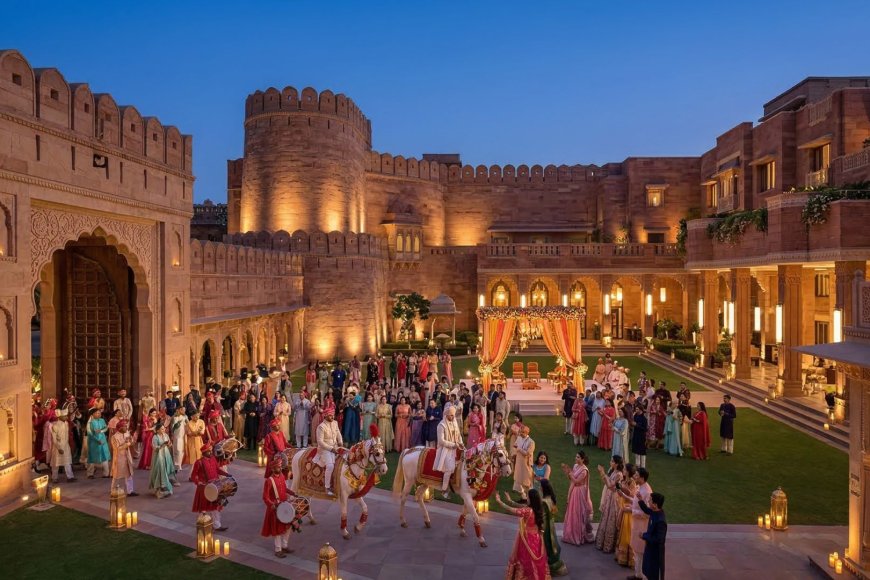
Preethi opened the ITC Rajputana website while Rekha was still on the line. She looked at the fortress facade — the massive sandstone walls, the towers, the battlements, the specific quality of a perimeter that communicated defence and authority simultaneously — and then at the interior photographs: the carved stone courtyards, the pillared corridors, the lawns extending at different levels and in different configurations, each with its own character and its own relationship to the fortress architecture surrounding it.
She said: how does a hotel have ten lawns?
Rekha said: when the architect designed the building as a series of connected fortified enclosures rather than a hotel with a garden attached.
Preethi put Jaipur back on the list. This time it stayed.
This guide is for every NRI couple who eliminated Jaipur too quickly and for every couple who has been looking for the Jaipur wedding that does not feel like every other Jaipur wedding — for Preethi in Toronto and every couple who deserves the complete framework for the fortress wedding with ten lawns in the heart of the Pink City.
Understanding ITC Rajputana: The Architecture of Serious Intent
The ITC Rajputana opened in 1986, and the story of its design is the story that distinguishes it from every other large hotel property in Jaipur — the story that Rekha was referring to when she said the architect had spent three years studying Rajput fortress architecture before drawing a single line.
The architect responsible for the ITC Rajputana was Vast Shilpa Consultants, working with a brief from ITC Hotels that was specific and serious: design a hotel in Jaipur that is not a superficial application of Rajput decorative motifs to a standard hotel structure but a genuine engagement with the principles of Rajput fortress and palace architecture — the planning principles, the spatial organisation, the relationship between public and private space, the use of the courtyard as the organising element, the way that Rajput architecture creates enclosure and security while simultaneously creating beauty and grandeur.
The design response was the decision to organise the entire hotel as a series of connected fortified enclosures — the massive perimeter wall and the towers and battlements of the exterior, which communicate the fortress character from the street with genuine conviction, enclosing a series of internal courtyards and gardens that are connected to each other through the corridors and gateways of a fortified complex rather than the lobbies and corridors of a conventional hotel. The result is a property that has no equivalent among the large luxury hotels of Jaipur: the exterior of a Rajput fortress, the interior of a connected series of palace courtyards, and between the exterior and the interior a spatial complexity that rewards exploration and that gives the wedding guest the specific quality of discovery — the gate that opens onto an unexpected garden, the corridor that leads to a courtyard larger than expected — that characterises the finest Rajput fort-palace complexes.
The ten lawns are the most immediate evidence of this spatial philosophy. A conventional luxury hotel of the ITC Rajputana's size — two hundred and sixteen rooms, five dining venues, multiple ballrooms and banquet spaces — would typically have one or two outdoor event spaces appended to the main building. The ITC Rajputana has ten distinct lawn areas of different sizes and characters, distributed across the fortress complex at different levels and in different orientations, each enclosed by a different portion of the fortress architecture and each with its own specific atmosphere. This is not the consequence of generous land allocation. It is the consequence of designing the building as a fortress — a complex of connected enclosures — rather than as a monolith with outdoor spaces around the edges.
The sandstone used throughout the construction is the Dholpur sandstone — a warm pink-beige stone that is specific to the Dholpur region of Rajasthan and that has been the primary building material of Jaipur's finest historic architecture since the city's founding. The ITC Rajputana's use of this stone throughout the exterior and interior surfaces connects the property to the city's architectural tradition in a material sense: the building is made of the same stone as the Hawa Mahal, the Amber Fort, and the City Palace of Jaipur, and the specific warmth of the Dholpur sandstone in the Jaipur light is the same warmth that has defined the Pink City's visual identity since the eighteenth century.
Jaipur as Wedding City: Why the Pink City Infrastructure Changes the Calculation
The practical case for Jaipur as a destination wedding city is more compelling than any other destination in Rajasthan, and it deserves direct statement rather than the apologetic treatment it sometimes receives from couples who feel that choosing Jaipur is the conventional choice.
Jaipur's Sanganer Airport has more direct international connections than any other Rajasthan city — direct flights from Dubai, Abu Dhabi, Sharjah, Singapore, Kuala Lumpur, and other hubs with significant Indian diaspora populations, in addition to the most extensive domestic connection network of any Rajasthan airport. The international guest flying from London, Toronto, or Sydney arrives via Delhi or another major hub and connects to Jaipur on a domestic service that runs multiple times daily from all major Indian cities. The domestic flight from Delhi to Jaipur is forty-five minutes. The entire international journey from London to the ITC Rajputana, including the Delhi connection, is under twenty hours for most routing options.
The ITC Rajputana's location in the heart of Jaipur — on Statue Circle, the central roundabout that is the geographic and civic heart of the modern city — means that the hotel is fifteen to twenty minutes from the airport, five minutes from the major shopping areas, and immediately adjacent to the city's cultural and culinary life. The wedding guest who wants to visit the Amber Fort, the Hawa Mahal, or the bazaars of the old city can do so from the ITC Rajputana without the long road transfers that the remote destination venues require.
For the NRI couple with a guest list of two hundred or more — the large Indian wedding that is the norm for many NRI families — Jaipur is the only Rajasthan destination that can absorb the accommodation requirement without the overflow accommodation crisis that the smaller destination cities produce. Jaipur has sufficient five-star, four-star, and three-star accommodation to house a guest list of any realistic size within a twenty-minute radius of the ITC Rajputana, and the ITC's own two hundred and sixteen rooms provide the core accommodation for the wedding party without the capacity constraints that the smaller heritage properties produce.
The Ten Lawns: A Complete Guide to the Event Spaces
The Rajwada Lawn: The Grand Ceremony Space
The Rajwada Lawn is the largest and most formally configured of the ITC Rajputana's ten lawn spaces — a grand outdoor area enclosed by the fortress's main courtyard architecture, with the carved stone facades of the hotel's primary building providing the enclosure on the principal sides and the open sky above. The Rajwada Lawn accommodates up to one thousand guests for a standing reception and up to seven hundred for a seated dinner, making it the largest single outdoor event space available at any Jaipur wedding venue and the natural choice for the main wedding reception.
The scale of the Rajwada Lawn is the element that most immediately distinguishes the ITC Rajputana from the smaller heritage properties — the capacity to accommodate a large NRI wedding without the capacity management compromises that the boutique venues require. The mandap at the centre of the Rajwada Lawn, with the fortress architecture rising on three sides and the Jaipur sky above, is a ceremony setting of genuine grandeur at a scale that accommodates the full guest list without the sense of crowding.
The Sheesh Mahal Lawn: The Intimate Ceremony Alternative
The Sheesh Mahal Lawn — a smaller enclosed garden space with the hotel's decorated interior facade on one side and the carved stone corridor of the connecting wing on the other — is the intimate ceremony alternative for the couple whose ceremony guest list is smaller than the full wedding population. The space accommodates up to two hundred guests for a seated ceremony and up to three hundred for a standing reception, and its enclosure produces a quality of concentration and intimacy that the grander Rajwada Lawn cannot provide.
The evening event in the Sheesh Mahal Lawn — candlelit, with the carved stone facade illuminated and the space enclosed on three sides — produces the specific quality of an intimate palace courtyard event that is the aesthetic ambition of the boutique heritage venues, delivered within a property that also provides the full-scale event infrastructure for the larger events of the wedding program.
The Pool Lawn: The Social Gathering Space
The Pool Lawn — the outdoor space surrounding the hotel's main swimming pool — is the social heart of the wedding stay and the space where the wedding's informal time is spent. The pool area accommodates up to two hundred guests for a standing reception and is the natural setting for the mehendi ceremony, the post-ceremony gathering, and the informal connections between events that the destination wedding's multi-day format makes possible.
The Pool Lawn's specific quality is its combination of relaxation and visual grandeur — the fortress walls visible above the poolside planting, the Dholpur sandstone warm in the Jaipur sun, the specific quality of a swimming pool that is enclosed by fortress architecture rather than by the generic landscaping of a conventional hotel garden.
The Rajput Courtyard: The Ceremonial Interior Transition Space
The Rajput Courtyard — one of the internal courtyard spaces within the fortress complex, accessible from the main entrance and connecting the primary event zones — is the transition space that the multi-event wedding program uses for the cocktail reception, the arrival gathering, and the movement of guests between the different lawn areas. The courtyard accommodates up to one hundred and fifty guests for a standing reception and produces the specific quality of the Rajput courtyard experience — the carved stone enclosure, the pillared corridor on one or more sides, the fountain or water feature at the centre — that the hotel's architectural concept promises and delivers.
The Ballroom: The Indoor Centrepiece
The ITC Rajputana's primary ballroom — a large, formally configured indoor event space with the capacity to accommodate up to six hundred guests for a seated dinner and up to one thousand for a standing reception — is the indoor centrepiece of the property's event infrastructure and the space that most clearly demonstrates the ITC Rajputana's advantage over the boutique heritage venues in the context of the large NRI wedding.
The ballroom's technical infrastructure — the sound system, the lighting grid, the air conditioning, the staging options, the kitchen adjacency — is the contemporary standard of a major luxury hotel, and for the events where production quality and technical reliability matter most, the ballroom provides a level of infrastructure assurance that the converted heritage spaces cannot always match. The large sangeet, the formal dinner for three hundred and fifty seated guests, the wedding event that requires sophisticated technical production — these are the events that the ballroom is designed for and that it delivers with the operational reliability of a property built for large-scale event management.
The Remaining Six Lawns: The Multi-Event Distribution Network
The six remaining lawn areas — each with its own character, its own enclosure, its own portion of the fortress architecture as its frame — provide the ITC Rajputana's most distinctive multi-event planning advantage. The multi-day NRI wedding program that requires a different outdoor setting for each event — the mehendi in one garden, the haldi in another, the cocktail reception in a third, the baraat arrival through a fourth — can use a different lawn for each event without repetition, without the sense of the wedding returning to the same space in different decoration, without the aesthetic and experiential fatigue that the single-outdoor-space venue produces across a three-day program.
The six smaller lawns range in capacity from approximately eighty to two hundred and fifty guests for seated events. Each has its own specific character — one more enclosed and intimate, another more open to the sky, a third adjacent to the pillared corridor that provides an architectural backdrop — and the wedding planner with ITC Rajputana experience will know which lawn is right for which event and which atmospheric quality.
Comprehensive Pricing and Planning Reference
| Event Space | Seated Capacity | Standing Capacity | Approximate Venue Hire Per Event | Best Suited For |
|---|---|---|---|---|
| Rajwada Lawn (main) | Up to 700 | Up to 1,000 | ₹10,00,000–₹20,00,000 | Grand reception, large ceremony, baraat arrival |
| Sheesh Mahal Lawn | Up to 200 | Up to 300 | ₹5,00,000–₹10,00,000 | Intimate ceremony, evening dinner |
| Pool Lawn | Up to 150 | Up to 200 | ₹3,50,000–₹7,00,000 | Mehendi, haldi, cocktail reception |
| Rajput Courtyard | Up to 100 | Up to 150 | ₹2,50,000–₹5,00,000 | Arrival gathering, cocktail transition |
| Primary Ballroom | Up to 600 | Up to 1,000 | ₹12,00,000–₹22,00,000 | Large sangeet, formal dinner, ceremony |
| Smaller Lawns (each) | Up to 80–250 | Up to 120–350 | ₹2,00,000–₹6,00,000 | Individual event days; mehendi to cocktails |
| Full Property Buyout | All spaces combined | All spaces combined | ₹35,00,000–₹65,00,000 per day | Complete exclusive use; large weddings |
| Budget Category | Approximate Range | Notes |
|---|---|---|
| Accommodation — Superior Room per night | ₹12,000–₹20,000 | Fortress views; Dholpur sandstone throughout |
| Accommodation — Deluxe Room per night | ₹18,000–₹28,000 | Enhanced position; courtyard or garden facing |
| Accommodation — Suite per night | ₹35,000–₹70,000 | Palace suites; multi-room configurations |
| Accommodation — ITC One Suite per night | ₹80,000–₹1,50,000 | Flagship suites; full service |
| Catering per cover — multi-course dinner | ₹3,500–₹6,000 | ITC culinary team; extensive menu range |
| Catering per cover — lunch or daytime | ₹2,000–₹3,500 | Full service; lawn and courtyard options |
| Décor and florals per event | ₹5,00,000–₹20,00,000 | Pink sandstone palette; Rajput vocabulary |
| Photography and videography | ₹2,50,000–₹9,00,000 | Multiple lawn locations; varied light |
| Sound and lighting per event | ₹2,00,000–₹6,00,000 | Full ballroom AV; outdoor lawn systems |
| Wedding planner fee | ₹5,00,000–₹12,00,000 | ITC Rajputana experience preferred |
| Transport — Jaipur airport to ITC Rajputana | ₹800–₹1,500 | 15–20 minutes; central Jaipur location |
| Total three-day wedding (150 guests) | ₹80,00,000–₹1,50,00,000 | Full program; without full buyout |
| Total three-day wedding (250 guests) | ₹1,20,00,000–₹2,20,00,000 | Full program; peak season premium applies |
| Total three-day wedding (300+ guests, buyout) | ₹1,80,00,000–₹3,50,00,000+ | Full property; comprehensive program |
The Large NRI Wedding: Why ITC Rajputana Solves the Scale Problem
The NRI wedding in India is frequently larger than the NRI couple anticipates when they begin the planning process. The guest list that begins at one hundred and twenty acquires the parents' extended networks, the family connections across multiple cities, the professional relationships that cannot be excluded, and the specific social arithmetic of the Indian wedding invitation that means that the definitive guest list is almost always larger than the first estimate.
The scale problem — the gap between the intimacy that the boutique heritage venues provide and the capacity that the large NRI wedding requires — is the specific problem that the ITC Rajputana solves in a way that no boutique property can. The venue that can accommodate three hundred seated guests at dinner, that can stage a baraat arrival for a procession of fifty family members across a lawn of sufficient size to contain them with ceremony, that can distribute a three-day multi-event program across ten different outdoor spaces without repetition — that venue is the ITC Rajputana.
The NRI couple who wants the heritage experience and the large guest list simultaneously has, in most destination wedding venues, been asked to choose between them. The boutique property provides the heritage experience but cannot accommodate the full guest list. The conventional large hotel accommodates the guest list but does not provide the heritage experience. The ITC Rajputana, with its fortress architecture and its ten lawns, provides both simultaneously — the genuine Rajput spatial vocabulary at the scale required for the large NRI wedding.
The Jaipur Cultural Integration: Using the Pink City
The ITC Rajputana's central Jaipur location is the most significant practical advantage for the integration of the city's cultural resources into the wedding program. The venues discussed in earlier parts of this series — the remote forts and the lake island palaces — provide extraordinary settings but require the transport of the city's cultural resources to the venue. The ITC Rajputana is already in the city. The city's cultural resources are already there.
The Amber Fort is twenty-five minutes from Statue Circle. The group visit for the wedding party — the morning before the wedding events begin, the coaches departing from the hotel at nine and returning for lunch — is straightforwardly manageable from the ITC Rajputana's location. The Hawa Mahal is ten minutes. The old city's bazaars — the jewellery of Johari Bazaar, the textiles of Bapu Bazaar, the block printing workshops of Sanganer that are accessible as a half-day experience for interested guests — are all within the city that the hotel sits at the centre of.
The cultural evening event that brings Jaipur's performing arts to the wedding — the Kathak performance, the folk music of the Manganiyar tradition, the puppet theatre of the Rajasthani heritage — is straightforwardly deliverable at the ITC Rajputana because the performers are in the same city as the venue. The remote destination venues must manage the travel and accommodation of performers who are being brought from Jaipur to the fort or the island. The ITC Rajputana simply opens its gates.
Décor at ITC Rajputana: The Fortress Palette
The décor philosophy at the ITC Rajputana is shaped by the Dholpur sandstone — the warm pink-beige of the building's primary material — and by the specific vocabulary of Rajput fortress architecture that the building's design embodies.
The sandstone palette demands warm tones in the décor. The deep marigold, the saffron, the rose pink, the specific warm red of the Rajasthani ceremonial flower — these are the colours that belong against the Dholpur stone and that the Jaipur light amplifies into the rich, warm palette that defines the finest Jaipur wedding aesthetic. The cool whites and pale pastels that work against the marble of the Udaipur venues are visually insufficient against the warmth of the ITC Rajputana's stone.
The fortress architecture creates specific opportunities for the lighting design that the flat-facade hotel does not provide. The battlements and towers of the exterior, lit from below, produce a dramatic silhouette against the Jaipur night sky. The carved corridors, lit by a combination of wall-mounted and concealed sources, produce the quality of a torchlit fortress passage. The lawn events, enclosed by the fortress walls on multiple sides, are lit in the specific way of an interior courtyard — the light contained within the enclosure, the enclosing walls reflecting the warm tones back into the event space — rather than the exposed-edge quality of a conventional hotel garden event.
The ten lawns allow the decorator to use a different palette in each space — a different colour story for each event — without the decorative exhaustion of seeing the same space redressed multiple times. This freedom, which is unique to the ITC Rajputana among the major Jaipur wedding venues, allows the multi-day wedding program to have genuine visual variety across its events.
Common Mistakes NRI Couples Make With the ITC Rajputana Wedding
The first mistake is treating the ITC brand as a reason for caution rather than as a quality assurance. The ITC Hotels group is among the most consistently excellent luxury hospitality operators in India, and the ITC Rajputana benefits from the group's operational systems, culinary standards, and event management experience in ways that the independently managed heritage properties cannot always match. The couple who hesitates at the ITC brand because they want a family-owned property is making a category error: the architecture and the spatial quality of the ITC Rajputana are as specific and as authentic as any family-owned heritage hotel in Jaipur, and the operational reliability that the ITC group delivers is an advantage rather than a compromise.
The second mistake is not using all ten lawns across the wedding program. The couple who books the ITC Rajputana for its ten lawns and then concentrates all three days of events on two or three of them is not using the venue's primary advantage. Build the event program explicitly around the lawn variety. Assign a different lawn to each event. Brief the wedding planner and the decorator on the intention to give each event a distinct spatial character. The ten lawns are the venue's most specific and most valuable asset — use them.
The third mistake is not using the Jaipur city context in the guest program. The ITC Rajputana's central location makes the city's extraordinary cultural resources immediately accessible. The wedding program that does not include a guided Amber Fort visit, a bazaar walk, or a cultural performance sourced from the city's performing arts community is not using the location's most significant advantage. Build the city into the program from the first planning conversation.
The fourth mistake is not distinguishing between the ITC Rajputana's event spaces in the photography brief. The ten lawns, the courtyard, the ballroom, and the fortress facades each offer different photographic opportunities and require different approaches from the photographer. The photographer who is given a generic brief — capture the wedding events — will not systematically use all of the property's photographic variety. Give the photographer a location brief that identifies the specific compositional opportunities at each lawn, the best light windows for the fortress facade, and the specific architectural details that define the ITC Rajputana's visual identity. The property is photographically rich. Use it all.
The fifth mistake is not having the scale conversation honestly with the family before the venue is booked. The ITC Rajputana can accommodate a very large wedding. The NRI couple who books the venue and then allows the guest list to grow to five hundred on the assumption that the venue can absorb any number is not planning — they are deferring a conversation that will eventually force itself. Have the guest count conversation before the venue is contracted. Agree the maximum guest count. Build the event program and the budget around that agreed number. The venue can handle the scale. The budget may not be able to, and the planning conversation should establish that before the deposit is paid.
Preethi's wedding was in February, across three days and six of the ten lawns. The baraat arrived at the main gate of the fortress at seven in the evening on the second day, in the specific Jaipur winter dark that falls early and completely, and the fortress walls above the procession were lit with the warm uplighting that the Dholpur sandstone receives and deepens. The procession moved through the gate into the Rajwada Lawn, where two hundred and twenty guests were waiting in the warm light of the January evening, and the quality of the arrival — the fortress above, the carved stone facade ahead, the guests visible across the lawn in the enclosure of the Rajput courtyard — was the quality that Rekha had been trying to describe on the call from London.
Not a hotel dressed as a palace. A fortress dressed as a hotel. The difference, experienced from the inside, was everything.
Use all ten lawns across the program. Build the Jaipur city experience into the guest schedule. Brief the photographer on the full property's photographic variety. Have the guest count conversation before the venue is contracted. Come back to Jaipur if you eliminated it too quickly.
The fortress has been in the middle of the Pink City since 1986. It has been waiting for the couple who wants what it specifically provides. Some couples look for it directly. Some arrive at it, like Preethi, after eliminating everything else first. Both routes lead to the same place.
The gates are open. Walk through them.
Published by NRIWedding.com — The Premium Global Platform for Non-Resident Indians Planning Indian Weddings From Abroad.
0 comments
Real names and courtesy, please. Every comment is read by a person before it appears.
Nothing yet. Start it off.
Comments are closed on this article.