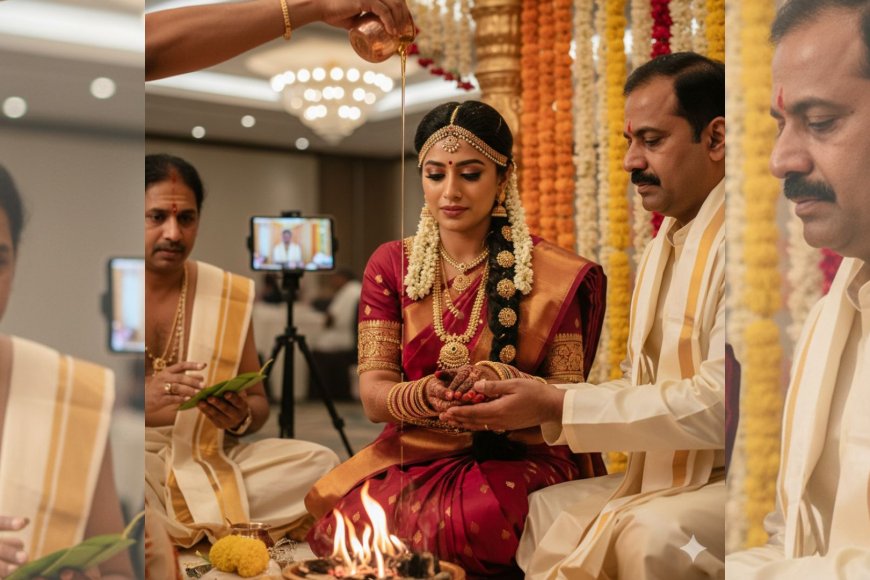
Of all the rituals that unfold across the elaborate tapestry of a Telugu Hindu wedding, none carries the emotional and spiritual weight of Kanyadanam — the sacred giving of a daughter by her father into the hands of the man who will share her life. This is not a transaction, not a formality, and not merely tradition. It is the moment a father places his child's hand in another's and asks the universe to witness his trust. For Telugu NRIs from Hyderabad to Houston, from Vizag to Vancouver, this is the ritual that breaks every father open — and puts him back together again.
You have watched your father be many things. Practical. Stern sometimes. Quietly proud at your graduation. Loudly proud at everything else. But you have never seen him the way he looks at the moment of Kanyadanam — the way his hands tremble slightly when they cup yours, the way his voice drops when he speaks the words the priest gives him, the way he cannot quite meet your eyes because if he does he will not be able to finish.
You are in a mandapam in Hyderabad, or in a banquet hall in Mississauga, or in a hired venue in Southall, and the details of the room have dissolved completely. There is only this: your father's hands. The water being poured. The priest's voice. And the understanding, arriving fully formed and devastating, that this moment has been building since the day you were born.
This is Kanyadanam. And it is the reason Telugu fathers start crying three days before the wedding.
🌟 DID YOU KNOW?
- Kanyadanam is considered the highest form of dana (sacred giving) in Hindu dharmic tradition — ranked above the gifting of gold, land, or cattle in ancient Dharmashastra (texts on righteous conduct). The Manusmriti and Parasara Smriti both describe Kanyadanam as a Mahadan (great gift), the performance of which is said to absolve the giver of accumulated karmic debt across multiple lifetimes.
- The ritual involves the pouring of Panchamrut (a sacred mixture of five substances — milk, honey, ghee, curd, and sugar) over the joined hands of father, daughter, and groom simultaneously, a practice documented in Telugu wedding traditions as far back as the Vijayanagara Empire of the 14th to 17th centuries, when elaborate wedding manuals were commissioned by royal courts.
- A survey conducted among Telugu NRI communities across the United States found that Kanyadanam was the ritual at which fathers were most likely to visibly weep — cited by over 84% of respondents as the single most emotionally overwhelming moment of the entire wedding, surpassing even the final farewell of Vidaai (the bride's departure from her family home).
What Is Kanyadanam?
Kanyadanam — from the Sanskrit kanya (virgin daughter, or more broadly, a young woman of marriageable age) and danam (the act of sacred giving or gifting) — is the ritual at the absolute moral and emotional centre of a Telugu Hindu wedding. It occurs early in the formal ceremony sequence, typically after the Swagatanam (the welcoming of the groom) and the Madhuparkam (the ritual honouring of the groom with a sacred mixture), and before the Jeelakarra Bellam and Mangalyadharanam. It is, in the architecture of the wedding, the foundational act upon which everything else rests.
What physically unfolds is precise and layered. The bride's father — or in his absence, her maternal uncle or the senior-most male guardian of her family — seats himself beside the bride, facing the groom who sits across from them. The priest establishes the ritual space through the chanting of Sankalpa (sacred intention-setting verses) in which the father announces his name, his gotra (ancestral lineage), the astrological moment, and his intention to perform the gift. A Panchamrut mixture is prepared — milk, honey, ghee, curd, and sugar combined in a copper or silver vessel. The bride places her right hand in her father's cupped hands. The groom extends his hands beneath. The father then pours the Panchamrut over the joined hands while the priest chants the Kanyadanam Mantras — specific Vedic verses that consecrate the giving, invoke the divine witnesses, and bind the groom to a series of sacred promises regarding the care, honour, and protection of his wife.
The groom responds to the priest's prompts with the words "Dharmecha, Arthecha, Kamecha Naticharami" — I will not transgress against you in matters of dharma (righteousness), artha (prosperity), or kama (love). He says this three times. The father listens to each repetition. The water and Panchamrut flow over their joined hands. And then the father releases his daughter's hand into the groom's.
It is the most consequential release of his life.
Community Comparison Table
| Community / State | Local Name | Key Tradition | How NRIs Abroad Adapt It |
|---|---|---|---|
| Telugu (Andhra & Telangana) | Kanyadanam | Father pours Panchamrut over joined hands; groom recites Naticharami vow three times | Panchamrut prepared fresh morning of ceremony; copper vessel sourced from Indian stores; full ritual preserved |
| Himachali | Kanyadan | Father places daughter's hand in groom's amid sacred fire; barley grains scattered | Barley sourced from health food stores; havan kund arranged outdoors if venue permits |
| Garhwali | Kanyadan | Maternal uncle plays central role alongside father; sacred thread tied around joined hands | Maama given formal ceremonial role; thread prepared by family priest night before |
| Kumaoni | Kanyadan | Gangajal (Ganges water) poured over joined hands; emphasis on ancestral gotra declaration | Gangajal ordered online or carried from India; gotra declaration prepared in advance with pandit |
| Ladakhi | Bumo Tangwa | Daughter formally entrusted to groom's family through exchange of ceremonial scarves (khata) | White khata scarves sourced from Tibetan or Himalayan stores in diaspora cities |
| Kashmiri Pandit | Lagan Kanyadaan | Performed under the Lagan Thal (ceremonial threshold); mustard oil and walnuts presented | Walnuts and mustard oil universally available; threshold recreated with decorated fabric arch |
| Punjabi (Hindu) | Kanyadan | Father places daughter's hand in groom's during Saptapadi; Vedic fire as witness | Temple ceremony or hired pandit; havan kund negotiations with venue handled in advance |
| Marathi | Kanyadan | Performed behind the Antarpat (silk curtain) with coconut and betel leaves; curtain lowered at auspicious moment | Silk curtain recreated with dupatta; coconut and betel universally available in Indian stores |
| Tamil | Kanyadanam | Father ties a sacred thread (Kannikadanam) around daughter's wrist before giving her hand | Thread prepared by family priest; ritual sequencing briefed to pandit in advance |
| Bengali | Sampradaan | Father places daughter's hand in groom's while priest chants; conch shells blown by women | Conch shells sourced from Bengali grocery stores in Jackson Heights NY or Green Street London |
| Rajasthani | Kanyadan | Performed during Saat Phere (seven circumambulations); father walks partial circle with couple | Portable havan kund used; father's participation in circumambulation briefed to pandit |
The Meaning Behind the Ritual
In the philosophical framework of Sanatana Dharma (the eternal order upon which Hindu thought rests), dana — the act of giving — is not generosity in the modern sense. It is not about surplus. It is about the deliberate, conscious, irreversible release of something precious for the greater good of the cosmos. The highest forms of dana are those that cost the giver the most — not in material terms, but in the currency of love.
This is why Kanyadanam is ranked above the giving of gold or land in the Dharmashastra texts. Gold can be replaced. Land can be reclaimed. A daughter, given with full heart and open hands to her life's companion, represents a giving that has no reversal and no return. The father who performs Kanyadanam is not diminished by the giving — he is, in the Vedic understanding, elevated by it. He has performed the highest act of tyaga (sacred renunciation) available to a householder.
The groom's triple repetition of "Dharmecha, Arthecha, Kamecha Naticharami" is equally significant. He is not making a promise to the father. He is making a promise to the cosmos, witnessed by the assembled family, the sacred fire, and the divine. He is saying: in every domain of life — righteousness, prosperity, and love — I will not fail her.
The Panchamrut flowing over their joined hands seals this covenant with the five sacred substances of abundance, purity, and sweetness.
For a non-Indian partner or family member searching for the simplest truth: this is a father trusting another person with the most important thing in his life, and that person swearing to the universe that the trust is warranted.
Doing Kanyadanam Abroad: The Practical Reality
The first thing to understand about performing Kanyadanam abroad is that its emotional power is entirely portable. The ritual does not need a mandapam in Hyderabad or a river in Andhra Pradesh to be real. What it needs is the right priest, the right items, and a father who has had a few quiet minutes alone before the ceremony begins.
Sourcing the Panchamrut ingredients is the easiest part of this ritual to manage abroad, and it is worth saying that clearly because many families worry unnecessarily. Milk, honey, ghee, curd, and sugar are available in every city in the world. What matters is the quality and intentionality of the preparation. The ghee should ideally be desi ghee (clarified butter made from cow's milk) rather than vegetable ghee — find it at Patel Brothers in Houston, at any Indian grocery on Southall Broadway in London, at the Indian stores in Gerrard Street East or Brampton in Toronto, at Harris Park in Parramatta in Sydney, or at the Indian grocery stores in Meena Bazaar in Dubai. The vessel for mixing and pouring should be copper or silver — small copper kalash (sacred pots) are available at most Indian grocery stores and Hindu temple shops in diaspora cities. If you cannot find one, a silver or steel vessel is an acceptable alternative; discuss with your pandit in advance.
The Gangajal question comes up for many Telugu families who traditionally add a small amount of sacred Ganges water to the pouring vessel. Gangajal is available in sealed bottles at most Indian grocery stores in the UK, US, Canada, and Australia — it is specifically stocked for ritual purposes and easy to find. Several families also ask relatives travelling from India to carry a small sealed bottle, which adds a layer of meaning beyond the practical.
Finding a Telugu pandit who knows the full Kanyadanam Mantra sequence is the most important preparation task for this ritual. The Kanyadanam mantras in Telugu tradition are specific, lengthy, and sequenced differently from North Indian or South Indian Brahmin variants — the Sankalpa declaration, the gotra announcement, and the three repetitions of the Naticharami vow must all occur in the correct order with the correct accompanying shlokas. When interviewing a pandit, ask explicitly: "Are you familiar with the full Kanyadanam sequence as practiced in Andhra and Telangana, including the Naticharami vow and the Panchamrut pouring?" A knowledgeable priest will engage immediately and may ask which community your family belongs to. NRI.Wedding's pandit directory lists Telugu-speaking priests in the US, UK, Canada, UAE, and Australia who are specifically experienced in regional Telugu ceremony sequences.
Fire and smoke are not central to Kanyadanam itself — the ritual is primarily one of water, Panchamrut, and joined hands. The challenge arises when Kanyadanam is embedded within a larger ceremony that includes a havan (sacred fire). In that case, speak to your venue about outdoor fire arrangements or approved electric havan alternatives. Many NRI couples successfully negotiate a small, contained outdoor havan with venue management by clearly describing the brief duration and small scale of the fire element.
For the India video call, Kanyadanam is a particularly intimate moment to stream — its power comes from the quiet, the priest's chanting, and the father's face. Position your camera to capture both the joined hands and the expressions of the immediate family. Ask the India-side family to mute their microphones during the ritual so the priest's voice carries clearly. If your wedding is at 3pm in Toronto (EST), your family in Hyderabad will be joining at 1:30am — confirm this the night before and ensure your India-side video call coordinator has set an alarm. Some families ask the senior-most grandfather or grandmother watching from India to also pour a small amount of water or Panchamrut at their end, as a simultaneous act of blessing across the distance.
Doing Kanyadanam as a Destination Wedding in India
To perform Kanyadanam in India — in the city your family is from, in the hall where your parents were married, in front of the faces that have known you your whole life — is to understand why the ritual was designed the way it was. The room already knows the weight of what is happening. The women who wipe their eyes have wiped their eyes at this moment before, for other daughters, other fathers.
The best locations for a full traditional Telugu Kanyadanam are the heritage kalyana mandapams of Hyderabad's old city and Banjara Hills, the grand riverside venues along the Godavari in Rajahmundry and the Krishna in Vijayawada, and the open-air ceremony spaces of the heritage resorts outside Visakhapatnam. For families with Vaishnava traditions, venues near Tirupati carry a spiritual resonance that no destination abroad can replicate.
When briefing local pandits in India, come prepared with a written note specifying your family's community, your gotra, and any specific mantra sequences your family has traditionally used. If your family has a hereditary kula purohit (family priest) — a priest who has served your family across generations — make every effort to involve them. Their knowledge of your family's specific ritual tradition is irreplaceable.
For non-Indian guests attending a destination wedding in India, a bilingual ceremony booklet with a specific explanation of Kanyadanam — its meaning, its sequence, the significance of the joined hands — transforms them from confused observers into moved witnesses. Many non-Indian guests later say that understanding Kanyadanam changed how they thought about commitment, family, and what it means to truly give something away.
What You Need: The Kanyadanam Ritual Checklist
Ritual Items A copper or silver kalash (vessel) for the Panchamrut, full-fat cow's milk, pure honey, desi ghee (clarified butter), plain curd, unrefined sugar or jaggery, Gangajal (sacred Ganges water — available in bottles at Indian grocery stores), fresh flowers for the ceremonial tray, akshata (turmeric-dusted rice) for scattering, a clean white cloth for the couple and father to sit upon, banana leaf lining for the ritual tray, darba grass (sacred ritual grass used in Telugu ceremonies — available at Indian grocery stores or temple shops), and a small silver or brass panchapatra (ritual ladle) for pouring.
People Required The officiant pandit with full knowledge of Telugu Kanyadanam mantras, the bride's father (or designated guardian — maternal uncle if father is absent), the bride, the groom, both mothers of bride and groom, senior family elders to witness, and your wedding photographer and videographer briefed to treat this moment as a priority capture.
Preparation Steps Prepare the Panchamrut mixture one hour before the ceremony. Confirm the gotra declaration and Sankalpa details with your pandit the evening before — have your family's gotra names written on a slip of paper the priest can reference. Brief the father privately on the sequence so he is not surprised by any moment. Set up and test the India video call connection thirty minutes before the ceremony begins. Ensure the ritual tray is arranged and ready at least fifteen minutes before the Kanyadanam sequence begins.
NRI.Wedding connects Telugu families abroad with verified regional pandits, ritual item vendors, and experienced wedding photographers who understand the gravity of Kanyadanam and how to honour it. Begin your planning at NRI.Wedding.
5 Questions NRI Couples Always Ask
My father passed away. Who performs Kanyadanam in his place, and is it equally valid?
This question deserves a direct and reassuring answer: yes, it is fully and equally valid. The Hindu dharmic texts that establish Kanyadanam also specify that in the father's absence, the ritual is performed by the bride's maternal uncle (her mother's brother), her paternal uncle, her elder brother, or the senior-most male guardian of her family. The priest will adjust the Sankalpa declaration accordingly, substituting the guardian's name and relationship. Many NRI families also include the mother in a more central role during this moment — while traditional texts assign the primary ritual role to a male guardian, many contemporary pandits, particularly those experienced with NRI families, accommodate a mother's full participation. If this matters to your family, discuss it with your pandit in advance. The love and intention behind Kanyadanam are not diminished by the absence of one person. They are carried by whoever steps forward.
My partner is not Hindu. Can we incorporate Kanyadanam meaningfully into a mixed-faith or civil ceremony?
Many NRI couples in exactly this situation have found beautiful ways to honour the spirit of Kanyadanam even within a hybrid ceremony. The ritual's core — a parent entrusting their child to their partner with witnesses, intention, and sacred words — is universal enough to be understood and felt across any faith tradition. Some families perform a simplified version with the Panchamrut pouring and the joined hands, without the full Sanskrit mantra sequence, guided by a pandit who can give a bilingual explanation. Others incorporate a separate, private Kanyadanam moment with immediate family before or after the main ceremony. The most important thing is that the father has his moment — whatever form it takes. Talk to your pandit about what is possible. Most experienced priests have navigated this before and will guide you thoughtfully.
How do I find a Telugu pandit in the UK who knows the specific Kanyadanam mantras?
The Telugu Association of UK and the Balaji Temple in Tividale, West Midlands, are good starting points for referrals. When contacting potential priests, ask specifically about the Naticharami vow sequence and the Sankalpa declaration — these specifics will immediately indicate whether the priest knows the Telugu tradition or only a generic Vedic version. NRI.Wedding's UK pandit directory filters by regional tradition and community, significantly shortening your search. Book your pandit at least three months before the wedding — Telugu priests in the UK who specialise in regional ceremony traditions are in high demand during peak wedding season.
We want to stream Kanyadanam live for grandparents in India who cannot travel. How do we make it feel real for them?
Position your camera to capture the joined hands and the father's face — these are the two visual anchors of the ritual. Ensure the priest's chanting is audible through the stream by placing the microphone or phone close to the ritual space. Begin the stream at least ten minutes before the Kanyadanam sequence so your India-side family is settled and connected before the moment begins. At the start of the Sankalpa, ask your pandit to acknowledge the family watching from India by name and city — this inclusion, small as it seems, transforms your grandparents from audience to witnesses. Several NRI families also ask the grandfather or grandmother in India to pour a small amount of water or Panchamrut at their end simultaneously — a gesture that bridges the physical distance with a shared act.
We are doing the civil registration before the religious ceremony. Does this affect the sanctity of Kanyadanam?
Not in the eyes of the tradition. Kanyadanam in Telugu Hindu practice is a religious and spiritual act that stands on its own terms, entirely independent of civil documentation. Your pandit will approach the religious ceremony as the complete and sacred event, regardless of what legal registration preceded it. Many NRI couples find that separating the civil and religious ceremonies actually deepens each one — the civil registration handles the legal reality, and the religious ceremony, including Kanyadanam, handles the truth that no registry can document: the moment a father gives his daughter, and a man swears to the universe to be worthy of the gift.
The Emotional Angle
Nobody tells fathers how to prepare for Kanyadanam. Nobody sits them down and says: here is what will happen to you when the priest begins to chant, when the water starts to flow, when your daughter's hand — the hand you held crossing roads, the hand you bandaged after bicycle falls, the hand you waved at through glass on the first day of school — is placed in yours one final time before you give it to someone else.
Telugu fathers are not, as a rule, men who discuss their feelings at length. They express love through school fees paid on time, through apartments found in foreign cities before their children arrived, through WhatsApp forwards at 6am, through the particular way they say nothing when they are most proud. They came to Canada or the UK or the UAE and worked in ways that left no room for sentiment, because sentiment was a luxury and their children's futures were not.
And then Kanyadanam comes. And every wall they built — every practical, capable, stoic wall — comes down. Not because they are sad. Because they are being asked, in the most public and sacred way possible, to acknowledge what their child has meant to them. To say it with their hands. To pour it in Panchamrut over joined fingers while a priest gives them the words they never knew they needed.
The Telugu NRI father who weeps at Kanyadanam is not weeping for what he is losing. He is weeping because he was given something so extraordinary — a child who crossed oceans with him, who carried the culture forward, who stood in a foreign banquet hall in silk and gold and asked for the old ritual anyway — and he is only now, in this moment, fully feeling the weight of the gift he was given, all those years ago, when she was born.
A Moment to Smile
At a Telugu wedding in Southall, west London, in the summer of 2019, the Kanyadanam was proceeding with great solemnity when the bride's father — a man who had immigrated from Nellore twenty-three years earlier and had spent those years being thoroughly undemonstrative about everything — began to cry approximately forty-five seconds into the priest's Sankalpa chanting. This was, by everyone's estimate, significantly earlier than expected.
His wife, seated beside him, handed him a tissue. He waved it away. She handed him another. He took it, used it, and then looked up to find his daughter watching him with enormous eyes.
"Nanna," she whispered, which is Telugu for father. "We haven't even started the main part yet."
He laughed. She laughed. The priest, a man of considerable experience, paused briefly and then continued chanting as if nothing had happened, which is the mark of a truly excellent priest.
The tissue box went around the family three times before Kanyadanam was over.
Nobody minded at all.
Quotes from the Diaspora
"I have been to maybe thirty Telugu weddings in my life. I have watched Kanyadanam thirty times. I thought I understood it. Then it was my daughter's wedding in Dallas and my hands were shaking so badly I could not hold the kalash properly and my son-in-law had to steady it from below. I understood nothing before that moment. Now I understand everything."— Suryanarayana Rao Dasari, Kamma community, father of the bride, Dallas, Texas
"My husband is from Ireland. He learned the Naticharami words phonetically — he practiced them for two weeks. When he said them the third time, in front of my father, in front of my whole family watching on a screen from Rajahmundry — I saw my father's face change. He had been uncertain about everything until that moment. After that moment, he was not uncertain about anything." — Swapna Yellamanchili, Brahmin (Niyogi) community, Toronto, Canada
"The hardest part was not the ritual itself. The hardest part was the night before, when my father called me to his room in the hotel and said he wanted to practice the words the priest would give him, so he would not stumble. He practiced them four times. He stumbled at Kanyadanam anyway, but it did not matter. Nothing that happens with that much love ever really goes wrong." — Ananya Konduru, Reddy community, Melbourne, Australia
Your Roots Travel With You
Your father practiced the words alone in a hotel room in Mississauga the night before your wedding. He sourced the desi ghee from a store in Brampton that smelled exactly like the one near your grandmother's house in Guntur. He called the pandit twice to confirm the sequence. He did not tell you any of this because it was not the kind of thing he knew how to say.
But when his hands cupped yours, and the Panchamrut flowed, and the priest gave him the words — he said them without stumbling. Because he had been preparing for this moment since the day you were born. Not with practice. With everything he did for you, every single day, in a country that was not his, for a future he could not fully imagine but worked toward anyway.
NRI.Wedding is here for every part of that journey — from finding your pandit to sourcing your ritual items, from building your ceremony checklist to connecting you with photographers who know that the most important frame of the whole wedding is a father's hands.
Your roots traveled with you. And today, they hold you one last time before letting you fly.
This article explores Kanyadanam, the sacred ritual of giving a daughter in Telugu Hindu weddings, including its Vedic origins, regional community variations, Naticharami mantra significance, and a complete practical guide for Telugu NRI families performing the ritual in the US, UK, Canada, UAE, Australia, and as a destination wedding in India.
0 comments
Real names and courtesy, please. Every comment is read by a person before it appears.
Nothing yet. Start it off.
Comments are closed on this article.