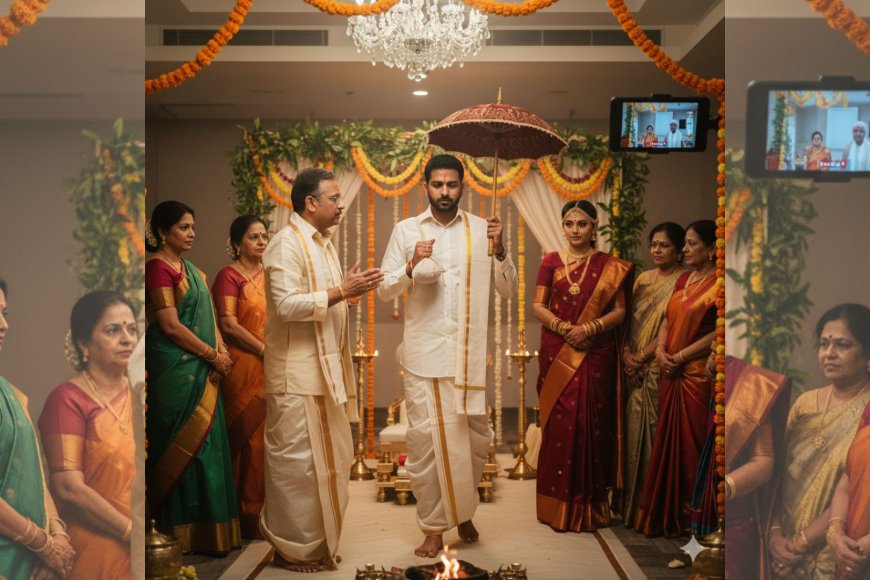
In the Kannada Brahmin wedding tradition, there is a moment — scripted, sacred, and utterly theatrical — when the groom picks up an umbrella, a walking stick, and a bundle of belongings, and announces he is leaving for Kashi. He is not joking. His father-in-law has to stop him. What unfolds in the next few minutes is one of the most philosophically rich and emotionally layered rituals in all of Indian wedding culture — and for Kannada NRI families from Bengaluru, Mysuru, and Udupi now living in Houston, Melbourne, Auckland, and Toronto, it is the moment that makes every guest — Indian or not — lean forward in their seat.
You have been to enough Indian weddings to think you know what to expect. The flowers, the fire, the chanting, the photographer circling like a satellite. And then, without warning, the groom stands up, adjusts something on his shoulder, and begins walking away from the mandap.
The room shifts. Someone laughs — not because it is funny, but because it is surprising, and surprising things make us laugh before we understand them. Your grandmother, who has been waiting for exactly this moment for the past hour, sits up a little straighter. She knows what is coming. She has seen it since she was a child. She has watched it happen at her own wedding, her children's weddings, and now here — in this banquet hall in Mississauga or this hotel ballroom in Fremont — she is watching it again.
The groom is going to Kashi. Someone has to stop him. And the stopping, it turns out, is the entire point.
🌟 DID YOU KNOW?
- Kashi Yatra as a wedding ritual is specifically preserved in Kannada Brahmin communities — particularly Smartha and Madhwa traditions — and represents one of the few wedding rituals in India that is performed almost entirely by the groom alone, making it structurally unique among Hindu wedding ceremonies where most rituals involve both families simultaneously.
- The ritual references Kashi [Varanasi, the sacred city on the Ganges], which in Vedic tradition is not merely a geographical destination but a symbolic state of vairagya [renunciation, detachment from worldly life] — the groom is enacting the ancient Brahmin ideal that a man of knowledge should pursue spiritual liberation rather than householder life.
- In classical Vedic society, young Brahmin men completed brahmacharya [the student phase of life] before marriage — Kashi Yatra re-enacts the moment of transition between brahmacharya and grihastha [the householder phase], making it a ritual reenactment of one of the four stages of life described in the ancient Chaturashrama system.
What Is Kashi Yatra?
Kashi Yatra [literally "the journey to Kashi"] is the dramatic pre-wedding ritual performed by the groom in Kannada Brahmin weddings — most commonly in Smartha and Madhwa traditions — in which he symbolically announces his intention to renounce worldly life, leave for the sacred city of Varanasi, and pursue moksha [spiritual liberation] rather than marriage. It is performed after the groom has bathed and dressed in the white ritual clothes of a renunciant, and just before the main wedding ceremony is set to begin.
The groom carries three specific items: a chattri [umbrella, symbolising the shelter a renunciant seeks from the world's elements], a walking staff or bamboo stick [representing the wandering life of an ascetic], and a small potli [bundle of belongings tied in cloth — containing a coconut, betel leaves, rice, and sometimes a token of personal significance]. In many families, he also holds a hand fan made of palm leaf. He is dressed not in the magnificent wedding sherwani or dhoti of a bridegroom but in the simple, understated clothing of a man about to leave everything behind.
He walks. He walks with genuine intention — toward the door, toward the exit, away from the wedding mandap and everyone assembled within it. In a home ceremony, he walks toward the front door. In a banquet hall, he walks toward the main entrance. The direction is always outward.
It is at this moment that the bride's father — the varadakshina karta [the one who gives the gift of a daughter] — intercepts him. He stands before the groom, physically blocking his path, and makes his case. He speaks of his daughter's virtues. He speaks of the honour of the grihastha ashrama [the householder life, the second of the four Vedic life stages]. He argues, with genuine rhetorical effort, that the life of a householder — lived righteously, with love, family, and dharma — is itself a path to liberation. That Kashi is not the only road to God.
And then — and this is the hinge of the entire ritual — the bride's father formally requests the groom to marry his daughter. He offers the groom the gift of his daughter's hand not from desperation but from spiritual argument. The groom, persuaded by both the father's words and his own viveka [discernment, wisdom], agrees to turn back.
He returns to the mandap. He agrees to become a husband. The wedding can begin.
The whole sequence lasts between five and fifteen minutes depending on the family's enthusiasm for the theatrical elements — and it is almost always accompanied by laughter, commentary from the assembled relatives, and at least one uncle who provides running audio commentary that nobody asked for.
Community Comparison: How Different Indian Communities Mark the Groom's Ritual Transition
| Community / State | Local Name | Key Tradition | How NRIs Abroad Adapt It |
|---|---|---|---|
| Kannada Brahmin (Smartha) | Kashi Yatra | Groom walks toward exit with umbrella, staff, potli; bride's father intercepts and persuades; full theatrical enactment | Performed in banquet hall or home; groom walks to venue entrance; relatives encouraged to react theatrically |
| Kannada Brahmin (Madhwa) | Kashi Yatra | Similar structure with Vishnu invocation emphasis; groom may chant specific Madhwa shlokas during the walk | Madhwa pandits in UK/US/Australia guide the shloka recitation; ceremony preserved fully |
| Tamil Brahmin (Iyer) | Kashi Yatra | Nearly identical ritual — one of the most dramatic moments in Tamil Brahmin weddings; bride's father ties Kashi pattam [ritual cloth] | Extremely well-preserved in Tamil diaspora; performed with high enthusiasm in Markham, Harrow, Sydney |
| Telugu Brahmin | Kashi Yatra | Similar enactment; bride's father's speech is more elaborate in some Telugu Brahmin families | Telugu pandits in Houston, London, Melbourne conduct full ritual |
| Himachali | No direct equivalent | Groom's departure rituals involve community procession rather than renunciation enactment | Adapted as symbolic farewell from groom's home community |
| Garhwali | No direct equivalent | Groom's transition marked by community blessing ceremonies before the baraat | Community elders perform blessing rituals at diaspora gatherings |
| Kumaoni | No direct equivalent | Ritual focus on groom's preparation and community send-off rather than renunciation drama | Maintained as community gathering with elder blessings |
| Kashmiri Pandit | No direct equivalent | Groom's pre-wedding rituals focus on Devgunpurification rather than renunciation enactment | Kashmiri Pandit sabhas in New Jersey and London preserve community-specific pre-wedding customs |
| Punjabi | No direct equivalent | Groom's departure marked by Ghodi [mare procession] and family farewells | Ghodi ceremony very well-preserved in Brampton, Southall diaspora communities |
| Marathi Brahmin | No direct equivalent | Groom's transition rituals centre on Munj [sacred thread ceremony] completed earlier in life | Maharashtra Mandals assist with pre-wedding ritual coordination |
| Bengali Brahmin | No direct equivalent | Aiburo Bhat [bachelor's last meal] marks groom's transition from single to married life | Bengali community centres in Toronto and London support this tradition |
| Rajasthani | No direct equivalent | Groom's departure rituals involve Sehra [floral face veil] ceremony and community procession | Rajasthani Samaj networks in UAE and UK coordinate groom's departure traditions |
The Meaning Behind the Ritual
The Kashi Yatra is one of the most philosophically honest moments in any wedding tradition anywhere in the world. It refuses to pretend that marriage is a simple or uncomplicated choice. It acknowledges — out loud, in sacred space, with the full community watching — that the man standing at the centre of this ceremony is giving something up. That the choice to build a life with another person, to take on the responsibilities of grihastha [householder life], is a genuine sacrifice of other possible selves.
In the Chaturashrama [the Vedic four-stage life system — brahmacharya, grihastha, vanaprastha, sannyasa], the renunciant's path and the householder's path are both considered valid routes to liberation. The Kashi Yatra dramatises this fork in the road. The groom is not performing ignorance of the renunciant's path — he is acknowledging it, honouring it, and then consciously choosing otherwise. His turning back is not weakness. It is wisdom — the wisdom to recognise that love, family, and righteous householder life are themselves sacred.
The bride's father's role is equally profound. He is not bribing the groom or tricking him. He is making a genuine spiritual argument: that his daughter is not an obstacle to liberation but a companion on the path toward it. In Shakta and Shaivaphilosophical traditions, the feminine principle is not separate from the divine — she is an expression of it. The father is saying: turn back, because what you are walking toward is also God.
For a non-Indian partner or family member: "It is the moment the groom admits that marriage is a choice, not a given — and chooses it anyway, in front of everyone."
Doing Kashi Yatra Abroad: The Practical Reality
The beautiful thing about Kashi Yatra, from a purely logistical NRI perspective, is that it requires almost no specialist equipment. The chattri [umbrella] can be any umbrella — though families with a sense of theatre will find an old-fashioned wooden-handled one. The walking staff can be a bamboo cane purchased from any garden centre or Asian grocery. The potli is a cloth bundle any family can assemble at home the night before. The ritual items inside — coconut, betel leaves, rice — are available at every South Indian grocery store in every diaspora city.
This is a ritual whose power comes entirely from the performance, the community, and the meaning — not from specialist ingredients. Which means it travels extraordinarily well.
The primary consideration abroad is space and layout. The Kashi Yatra requires the groom to actually walk toward an exit — so when briefing your venue, confirm that there is a clear path from the wedding mandap to the main entrance of the room, unobstructed by buffet tables, photographer equipment, or well-meaning relatives who do not know to step aside. Share the ceremony sequence with your venue coordinator at least a month before the wedding so they can keep this path clear. In a home ceremony, identify which door will serve as the Kashi exit and ensure it is accessible.
For the pandit: the Kashi Yatra mantras and the specific shlokas chanted during the groom's walk differ between Smartha and Madhwa traditions. A Smartha pandit conducting a Madhwa Kashi Yatra will get the broad strokes right but may miss community-specific details that elder relatives will notice. NRI.Wedding's pandit directory lists Kannada Brahmin priests by sub-tradition. In London, the Shree Ganapathy Temple in Wimbledon and the Swaminarayan complex in Neasden both have South Indian Brahmin community connections. In Toronto, the Ganesha Temple in Scarborough and the Hindu Sabha temple in Brampton maintain pandit networks. In Houston, the Meenakshi temple on Westheimer Road has Brahmin priest connections. In Sydney, the Parramatta temple community and the Sri Venkateswara Temple in Helensburgh serve South Indian Brahmin families. In Dubai, the Shiva and Krishna temples in Bur Dubai maintain Brahmin priest networks.
Photographically, the Kashi Yatra is one of the most cinematic moments in any Indian wedding — the groom walking away, the father's interception, the theatrical negotiation, the return. Brief your photographer specifically on this sequence. It unfolds quickly, often with overlapping movement and crowd reaction, and requires a second shooter positioned near the venue entrance to capture the groom's walk from the front while the primary photographer covers the room's reaction. The moment the groom turns back is, in many wedding albums, the single most emotionally resonant photograph of the entire day.
For relatives watching from India via video call: position the streaming device at the mandap-facing angle so India relatives can see both the groom's departure and the father's interception. A 10 AM ceremony in London is 3:30 PM IST — comfortable for Bengaluru relatives. An 11 AM ceremony in Toronto is 9:30 PM IST — manageable with advance notice.
Doing Kashi Yatra as a Destination Wedding in India
In Bengaluru, Mysuru, and Udupi — the heartland cities of Kannada Brahmin wedding culture — the Kashi Yatra is performed with a naturalness that comes from deep community familiarity. The pandit knows the sequence. The guests know when to laugh and when to fall silent. The bride's father has often seen his own father perform this role, and he carries that memory into the moment.
For NRI families returning to Karnataka for their wedding, the destination advantage is the availability of Smartha and Madhwa pandits who know Kashi Yatra in its complete, unabbreviated form — including the full shloka recitation, the specific dialogue between groom and father-in-law, and the community-specific variations that diaspora pandits sometimes simplify. Brief your chosen pandit in advance about your family's specific tradition and gotra, as even within Smartha and Madhwa communities, there are family-level variations that an experienced local pandit will want to honour.
Heritage properties in Mysuru — particularly those in the old civil lines area and around the Mysuru Palace periphery — provide the architectural gravitas that makes a Kashi Yatra genuinely cinematic. The groom walking away down a columned corridor or across a garden courtyard, umbrella raised, bundle on shoulder, is a photographer's gift. Temple complexes in Udupi, particularly those associated with the eight Madhwa mathas [monastic institutions], provide the deepest spiritual context for Madhwa families.
For non-Indian guests, the Kashi Yatra is the ritual that requires the least explanation and generates the most spontaneous engagement — because it is immediately legible as drama. Everyone understands a man walking away and being persuaded to return. The culture does the translation for you.
What You Need: Ritual Checklist
Ritual Items — one chattri [umbrella, ideally with a wooden or traditional handle]; one walking staff or bamboo cane; one potli [cloth bundle] containing a coconut, betel leaves and arecanut, raw rice, and a small personal token; white or cream simple dhoti and angavastram [upper cloth] for the groom to wear during the ritual; fresh flowers for the mandap; a brass or copper vessel of water for the pandit's ritual use; agarbatti [incense]; camphor; akshata [turmeric-mixed rice for blessing].
People Required — the groom; the bride's father (the central interlocutor — he must know his lines, or at minimum the spirit of what he is to say); the officiating pandit (sub-community specific — Smartha or Madhwa); the assembled family and community as witnesses; a designated family member to guide the groom's path to the exit and ensure it is clear; the photographer and second shooter briefed on the sequence.
Preparation Steps — rehearse the exit path with the groom and the venue coordinator at least the day before. Confirm the bride's father is comfortable with his speaking role — some families prepare a short script in Kannada and English. Assemble the potli the evening before. Brief the photographer on the Kashi Yatra sequence explicitly. Confirm the pandit's familiarity with your sub-community's version of the ritual. Ensure the streaming device for India relatives is positioned correctly before the ceremony begins.
NRI.Wedding connects Kannada Brahmin families with verified Smartha and Madhwa pandits abroad, experienced ceremony photographers, and planning support for overseas Kashi Yatra logistics. Begin at NRI.Wedding.
5 Questions NRI Couples Always Ask
Our venue is a small hall with no clear path to the exit — can we adapt the Kashi Yatra to the space?
Absolutely, and many NRI families do this creatively. The ritual requires symbolic departure, not a specific distance. If the venue is compact, the groom can walk to the edge of the mandap area and turn toward the main door — even a symbolic ten to fifteen steps in the direction of the exit carries the full meaning of the ritual. What matters is the intention, the interception, and the persuasion. The physical distance is secondary. Work with your pandit to identify the most natural exit direction within your venue and build the staging around that.
My father-in-law is not a confident public speaker — how scripted does his role need to be?
The bride's father's speech can range from a full traditional recitation of the grihastha ashrama's spiritual merits to a warm, personal, heartfelt few sentences in Kannada or English. Many contemporary NRI families find that a brief, genuine personal statement — "I offer you my daughter not as an end to your journey but as a companion on it" — carries more emotional weight than a memorised Sanskrit recitation. Discuss with your pandit what level of formality your family tradition expects, and prepare the father accordingly. The most moving Kashi Yatra intercessions are always the ones that feel true, not rehearsed.
Can we do Kashi Yatra if the groom is not from a Brahmin background?
The Kashi Yatra is a Brahmin-specific ritual rooted in the brahmacharya to grihastha transition of Vedic life. In interfaith or intercommunity weddings, some families choose to include it as a cultural element — explaining its meaning to the non-Brahmin partner's family in advance — while others choose to omit it and focus on rituals that speak to both families' backgrounds equally. There is no universally correct answer. Your pandit and your families together are the right people to make this decision.
How long does Kashi Yatra take, and where does it fit in the ceremony sequence?
The Kashi Yatra typically occurs after the groom's pre-wedding purification rituals and before the vara pooja [welcoming of the groom by the bride's family]. In total, including the walk, the interception, the persuasion dialogue, and the return to the mandap, it takes between five and fifteen minutes. Factor this into your ceremony timeline when briefing your venue. It should never be rushed — the theatrical pacing is part of its power.
Can we live-stream the Kashi Yatra specifically for relatives in India who cannot attend?
Not only can you — you should. The Kashi Yatra is the single most visually dramatic and emotionally legible moment of a Kannada Brahmin wedding for viewers who are not physically present. Position your streaming device near the mandap entrance, angled to capture both the groom's departure direction and the bride's father's interception. Assign one family member specifically to hold or manage the streaming device during this sequence — it is too important to leave to an automated setup.
The Emotional Angle
Nobody tells you, when you agree to be the bride's father at a Kashi Yatra in a foreign city, how completely it will undo you.
You have been practical all week. You organised the catering and confirmed the pandit and drove relatives from the airport at midnight. You have been the logistics person, the calm one, the one who does not cry. And then you are standing in a hotel corridor in Melbourne or a banquet hall in New Jersey, blocking the path of a young man you have come to love, and you are supposed to argue him out of going to Kashi.
You find the words. You always find the words, because the words have been waiting inside you since you watched your own father-in-law say them at your wedding, in the village in Karnataka, when you were the groom and you were the one walking away. You remember what it felt like to be stopped. You remember what it felt like to be argued back into love.
And so you stand there, in a suit you bought in this foreign city, and you tell this young man that your daughter is worth turning back for. That the life he is about to begin is not a lesser life. That Kashi is everywhere a righteous home is kept. You say the words in Kannada because they do not sound the same in any other language.
He turns back. He always turns back. But you are the one who has to hold it together for the rest of the ceremony, because something has just passed through you that you do not have a name for in any language.
A Moment to Smile
At a Kannada Brahmin wedding in Houston two summers ago, the groom — a software engineer from Bengaluru who had been living in Texas for six years — took the Kashi Yatra brief perhaps a little too seriously. He had practised his walk. He had found a beautiful vintage umbrella at an antique market. He had prepared an expression of spiritual resolve that his groomsmen described as "genuinely alarming."
What nobody had briefed him on was that his three-year-old niece, spotting him walk away with a bundle and a stick, decided he needed company and toddled determinedly after him across the venue floor, calling "Chikkappa! Chikkappa!" [paternal uncle].
The bride's father, approaching to intercept the groom, nearly collided with the toddler. The groom looked down. The niece looked up. The assembled guests were no longer able to maintain any ceremonial composure whatsoever.
The pandit waited. The niece was collected by her mother. The groom rearranged his expression of spiritual resolve. The Kashi Yatra resumed and concluded beautifully — and the couple has a photograph of the groom, umbrella raised, walking away, with a determined toddler three steps behind him, that will hang in their home for the rest of their lives.
Quotes from the Diaspora
"My husband told me afterward that when he was actually walking toward the door, umbrella in hand, he had one genuine second of thinking — what if I just kept going? Not because he wanted to leave. But because the ritual made him understand, for the first time, that he was choosing to stay. He said that one second of understanding changed how he felt about the whole marriage." — Shruthi Iyengar, Smartha Kannada Brahmin community, Fremont, California
"I was the bride's father. I had been nervous about my speech for weeks. My wife had written notes for me on a small card. In the moment, I put the card away. I just looked at this boy who loves my daughter and I said what I actually felt — in Kannada, then in English, because his parents were there too. I don't remember exactly what I said. But it was true. That's all it needed to be." — Prasanna Kulkarni, Madhwa Kannada Brahmin community, Toronto, Canada
"The non-Indian guests at our wedding — my husband's colleagues and his family from County Cork — they laughed at first when he started walking away. Then they went quiet. Then, when my father stopped him and spoke, one of my husband's aunties started crying. She didn't know why. She said afterward she didn't understand the words but she understood everything. That is what I love about this ritual. It doesn't need translation." — Nandita Bhat, Kannada Brahmin Smartha community, Auckland, New Zealand
Your Roots Travel With You
The Kashi Yatra is the ritual that proves Indian wedding tradition is not merely ceremonial — it is philosophical. It is a piece of living thought, performed at the moment of maximum relevance, in the room where it matters most. The groom's walk is a question the tradition has been asking for thousands of years: Do you choose this? The return is the only answer that matters.
NRI.Wedding exists to ensure that Kannada Brahmin families across the diaspora — in Houston, Auckland, Toronto, Melbourne, and London — never have to abbreviate or apologise for the rituals that make their weddings what they are. Our Smartha and Madhwa pandit directory, venue-briefing templates, ceremony photographer network, and Kashi Yatra planning checklists are built for families who refuse to leave their culture at the departure gate.
He turned back. He always turns back. Let him turn back properly.
This article explores the Kashi Yatra ritual in Karnataka's Kannada Brahmin wedding tradition — across Smartha and Madhwa communities — and its practice among the Karnataka NRI diaspora in the US, UK, Canada, UAE, and Australia, including cities such as Houston, Toronto, Melbourne, Auckland, and London.
0 comments
Real names and courtesy, please. Every comment is read by a person before it appears.
Nothing yet. Start it off.
Comments are closed on this article.