The Khyber Himalayan Resort Gulmarg — A Snow-Covered Kashmir Wedding at India's Only 5-Star Ski Resort: NRI Guide — The Complete NRI Wedding Planning Guide
Farhaan had a photograph on his phone that he had been carrying for three years.
He had taken it himself, on a solo trip to Gulmarg in January before the pandemic had made solo trips temporarily impossible — a trip he had taken specifically to ski, having learned to ski in Colorado during his MBA and having been told by a friend who had skied both Colorado and Kashmir that the Kashmir powder was different in a way that was difficult to describe but that, once experienced, made every other powder feel like a concession. He had gone to find out if this was true.
It was true.
But the photograph he had been carrying was not of the skiing. It was of the morning he had woken at six and walked to the window of his room at The Khyber and looked out at the Pir Panjal range. The mountains were covered in fresh snow from the overnight fall. The pine forest on the slopes below his window was white. The valley of Gulmarg was white. The specific quality of the Gulmarg winter morning — the silence before the resort came to life, the cold air visible through the double glazing, the mountains in the specific blue-white tone of the high Himalayan winter — was something he had taken one photograph of and had been unable to adequately photograph since because the photograph could not contain the quality of the silence.
He had been engaged to Nadia for four months when he showed her the photograph. They were in their flat in Manchester on a Sunday evening in the middle of the venue research that was, at that point, producing the standard shortlist: the Udaipur lake palaces, the Jaipur heritage properties, the Goa beaches. He had been looking at the shortlist with the specific unease of someone who recognises that the options being presented are excellent and are not quite right. He could not have explained what was not quite right until he thought of the photograph.
He showed it to Nadia. She looked at it for a long time. She said: where is this? He said: Gulmarg. Kashmir. The only five-star ski resort in India. She said: it is covered in snow. He said: yes. She said: in January? He said: December through March. Possibly April. She said: can you get married there? He said: I have no idea. I wanted to show you the photograph first. She said: find out if you can get married there. He said: you want a snow wedding? She said: I want whatever this is. Whatever this silence is.
He found out. You could get married there. The Khyber Himalayan Resort and Spa Gulmarg, the only five-star hotel in Gulmarg, had an event program that included weddings — small weddings, intimate weddings, the weddings that were appropriate to the scale of the property and the scale of the mountain landscape in which it sat. The weddings that were appropriate to the silence that Nadia had identified in the photograph.
He called the hotel. He called the wedding planner his cousin had used in Jaipur, who had never managed a Gulmarg wedding but who knew someone who had. He began to understand the specific nature of what a Kashmiri winter wedding at a Himalayan ski resort required. He continued, through the understanding of all the requirements, to want it more rather than less.
This guide is for every NRI couple who has seen the Gulmarg winter and understood that the standard destination wedding shortlist was missing the most extraordinary option — for Farhaan and Nadia in Manchester and every couple who deserves the complete framework for the snow-covered Kashmir wedding at India's only five-star ski resort.
Understanding The Khyber: India's Only Five-Star Ski Resort
The Khyber Himalayan Resort and Spa Gulmarg is the only five-star hotel in Gulmarg, Jammu and Kashmir — a hotel that occupies a position on the slopes of the Pir Panjal range at an altitude of approximately 2,650 metres above sea level, on the edge of the Gulmarg valley that is the highest altitude ski destination in India and one of the highest in Asia.
The hotel was designed with the specific architectural vocabulary of the Kashmiri mountain lodge tradition — the wood and stone construction, the steeply pitched roofs designed to shed the heavy Himalayan snowfall, the warm, heavy interior of the mountain hotel that provides its insulation against the Gulmarg winter as a function of the architecture rather than merely of the heating system. The Khyber's architecture is the Kashmir mountain vernacular interpreted at the luxury hotel scale — the dark wood panelling, the stone fireplaces, the heavy textiles of the Kashmiri craft tradition, the specific quality of warmth that the mountain lodge produces when the temperature outside is minus fifteen Celsius and the snow is falling.
The property has approximately eighty-five rooms and suites — a room count that is appropriate to the intimate scale of the Gulmarg winter wedding and that makes the exclusive buyout a genuinely feasible option for the wedding of forty to sixty guests whose overnight accommodation at the hotel represents the total room commitment. The size of the property is one of its most significant advantages for the wedding couple: at eighty-five rooms, the hotel is large enough to provide the full luxury resort infrastructure — the multiple restaurants, the spa, the fitness facilities, the ski concierge — and small enough to be genuinely possessed by the wedding party in an exclusive buyout.
The Khyber is managed by a professional hospitality group that maintains the property to the five-star standard across all seasons but that has the winter wedding as one of its specific offerings — the hotels that have managed winter weddings in a mountain environment before know the specific operational requirements of the snow event: the temperature management, the footwear and clothing requirements for outdoor events, the logistics of the heated outdoor event structure, the specific safety protocols of the mountain environment. The Khyber's event team has this knowledge. It is the foundation on which the Gulmarg wedding is built.
Why Gulmarg: The Case for the Kashmir Winter Wedding
The case for the Gulmarg winter wedding is not primarily a practical case. It is an aesthetic case, a sensory case, a case made by the specific quality of the Gulmarg winter landscape — the snow-covered valley, the Pir Panjal range, the pine forest, the silence — that cannot be reproduced at any other Indian wedding destination and that provides the couple who chooses it with the most specific and most extraordinary wedding setting available in the subcontinent.
Snow changes everything. This is the fundamental truth of the Gulmarg winter wedding and the truth that is most difficult to communicate to the NRI couple who has not experienced the Himalayan winter and who is evaluating the destination against the warm-weather alternatives of Rajasthan and Goa from the abstract distance of a planning spreadsheet. The snow does not merely change the appearance of the landscape — though it does this most dramatically, the white covering everything uniformly so that the familiar categories of ground and sky and vegetation and rock are replaced by a single, continuous field of white from which the specific elements emerge as exceptions. The snow changes the acoustic environment. The Gulmarg winter is the quietest place that most people who have been there have ever been, the snow absorbing the sound that the summer landscape reflects, producing a silence that is not the absence of sound but the presence of something that the urban and suburban environments of Manchester and Toronto and Singapore cannot produce.
The snow changes the pace. The Gulmarg winter operates at a pace that is slower than the warm-weather destination — the activities are the activities of the mountain winter rather than the activities of the beach resort, and the pace of those activities is the pace of the snow: the ski run that takes twenty minutes, the snow walk that takes an hour, the morning at the window watching the valley wake from overnight snowfall. The wedding at Gulmarg is a wedding at this pace, and the quality of the three days at this pace is different from the quality of three days at the beach resort or the palace hotel.
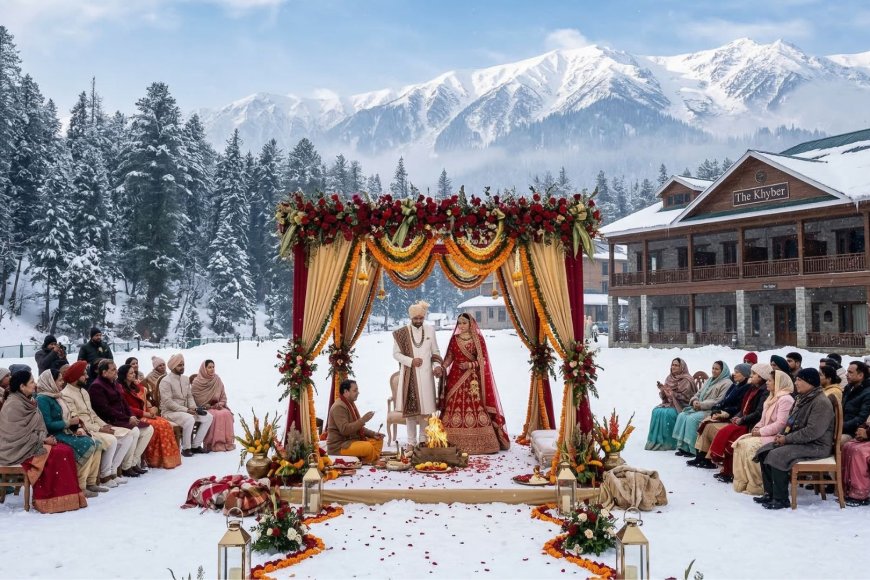
The snow changes the ceremony. The pheras in the snow — the mandap on the white ground, the Pir Panjal range above, the pine forest on the slopes below, the snow falling lightly or lying still depending on the day — is the ceremony in a setting that no decorator can produce and that no other Indian destination provides. The couple taking the seven steps with the Himalayas above them and the Kashmir valley covered in white below is the couple inside the most extraordinary natural setting available for a wedding on the Indian subcontinent.
The Security and Travel Context: The Complete Honest Assessment
The guide that recommends a Kashmir wedding without addressing the security and travel context directly is not serving the NRI couple who needs to make this decision with complete information. This guide will address it directly.
Kashmir — the broader region of Jammu and Kashmir — has experienced periods of civil unrest, security challenges, and travel advisories from multiple governments across several decades. The NRI couple considering a Gulmarg wedding must research the current security situation at the time of their planning, because the situation changes and because this guide, written at a specific point in time, cannot guarantee that the situation at the time of reading is the same as at the time of writing.
Gulmarg specifically — the ski resort town in the Baramulla district of the Kashmir Valley — has historically been one of the more stable and more consistently accessible destinations within the Kashmir Valley. The tourism infrastructure of Gulmarg has operated through periods when other parts of the valley were less accessible, and the presence of the Gulmarg Gondola, the ski resort infrastructure, and the international tourist community has created a specific character for the town that is different from the broader valley's more complex security environment.
The practical steps for the NRI couple considering a Gulmarg wedding are the following: consult the current travel advisories of your country of residence before the venue is confirmed. Research the current security situation in Gulmarg specifically — not in Kashmir generally, which is a larger and more diverse region. Consult with the Khyber's event team directly about the current operational situation and the wedding program's recent history. Speak with couples who have married at The Khyber in recent seasons. Ensure that the wedding's international guests' travel insurance covers the Kashmir destination. Have a contingency plan — not because the contingency will necessarily be needed but because the responsible planning for any destination with a complex security context requires it.
The guide's position on this question is honest: the Gulmarg winter wedding at The Khyber is, in the conditions that prevail when the resort is operating normally, one of the most extraordinary wedding experiences available in India. The conditions that allow it to be this must be verified at the time of planning. Do the verification. Make the decision with complete information.
The Winter Season: Understanding the Weather and the Timing
The Gulmarg winter wedding season runs from December through March — the period when the valley is reliably snow-covered and when the specific quality of the Gulmarg winter landscape that Farhaan had been carrying in his photograph is consistently present.
Within this window, the different months have different characters that the couple should understand when selecting the wedding date. December is the early season — the snow typically arrives in earnest in December and the valley is transitioning from the autumn into the winter. The snowfall can be less reliable in early December than in January and February, and the couple who wants the guarantee of snow coverage should consider the later months. January is the peak winter month — the deepest snow, the most reliable powder for skiing, the most complete winter landscape. February is the ski season's peak month — the longest days of reliable snow, the most visitors to the resort, the highest demand for accommodation. March is the late season — the snow is still present but beginning to melt on the lower slopes, the days are longer and slightly warmer, the spring beginning to assert itself at the valley's edges.
The outdoor ceremony in the Gulmarg winter requires specific temperature management — the ceremony that takes place at minus five or minus ten Celsius requires the heated outdoor structure or the ceremony duration that is short enough to be managed in the cold without the guests' comfort becoming the primary operational challenge. The ceremony that is twenty minutes long, followed immediately by the transition to the heated indoor reception, is the ceremony format that the Gulmarg temperature permits. The ceremony that is designed for the warm-weather duration — the forty-five minute pheras with the full ritual at full length — requires the heated outdoor structure that the event team can provide but that must be specifically planned and specifically budgeted.
The snowfall during the wedding is both the greatest gift and the greatest operational challenge of the Gulmarg winter event. The light snowfall during the ceremony — the snow falling gently on the mandap and the guests and the couple — is the magical element that the Gulmarg wedding uniquely provides and that the guests who experience it describe as the most extraordinary single moment of any wedding they have attended. The heavy snowfall during the ceremony is the operational challenge — the visibility reduced, the ground management required, the ceremony shortened to the elements that can be completed in the cold. Brief the event team on the snowfall contingency. Understand the trigger conditions for moving the ceremony indoors. Design the indoor ceremony space to have the same quality as the outdoor ceremony so that the contingency is not a diminishment.
The Event Spaces: Mountain Luxury at Himalayan Scale
The Snow Lawn: The Outdoor Ceremony Space
The Snow Lawn — the outdoor event space at The Khyber, a flat, open area adjacent to the main hotel building with the Pir Panjal range visible above and the pine forest on the slopes surrounding the valley — is the primary outdoor ceremony space and the space that most directly delivers the Gulmarg winter wedding experience.
The Snow Lawn in winter is literally a snow lawn — the grass beneath the accumulated snowfall, the flat white surface on which the mandap is erected and the ceremony takes place. The ceremony on the Snow Lawn — the mandap on the white ground, the mountains above, the pine forest on the surrounding slopes, the specific quality of the Gulmarg winter light that is different from any other light in India — is the ceremony setting that no other Indian venue provides.
The Snow Lawn accommodates up to seventy-five guests for a seated outdoor ceremony and up to one hundred for a standing ceremony in the heated outdoor structure. The small scale of the outdoor ceremony — the intimacy enforced by the mountain environment — is one of the specific qualities of the Gulmarg winter wedding and the quality that produces the specific depth of the experience: the fifty guests who are present at the pheras in the snow are fifty people who are fully and completely in the most extraordinary setting available, without the dilution of scale that the larger venue produces.
The Grand Ballroom: The Heated Indoor Ceremonial Space
The Grand Ballroom of The Khyber — the primary indoor event space — provides the heated, weather-protected alternative for the ceremony and the formal dinner. The ballroom accommodates up to one hundred and fifty guests for a standing reception and up to one hundred for a seated dinner.
The Grand Ballroom's interior — the dark wood panelling, the stone fireplace, the heavy textiles of the Kashmiri craft tradition, the specific warmth of the mountain lodge interior — is the setting for the reception dinner and the sangeet, the events that benefit from the warmth and the intimacy of the hotel's interior rather than the outdoor cold. The dinner in the Grand Ballroom — the fire lit, the Kashmiri craft objects providing the decorative vocabulary, the snow visible through the windows in the dark — is the dinner that most completely communicates the quality of being inside the Himalayan winter rather than merely near it.
The Spa and Wellness Centre: The Pre-Wedding Preparation
The Khyber's spa — one of the finest mountain spa operations in India — provides the pre-wedding preparation infrastructure for the wedding party. The Ayurvedic and Kashmiri-influenced treatments, the hammam, the specific therapies of the mountain spa tradition — these are the preparation experiences that give the wedding party the quality of physical and emotional readiness that the mountain environment and the cold weather demand.
The Kashmiri bath ritual — the hammam preparation that is specific to the region's spa tradition — is the pre-wedding preparation experience that is most specifically of the place. The bridal preparation at The Khyber's spa should include this tradition as its centrepiece rather than the standard beauty treatment sequence of the conventional luxury hotel spa.
The Restaurants: The Kashmiri Culinary Experience
The Khyber's restaurants — the primary dining venues within the hotel — provide the wedding program's culinary infrastructure and the opportunity to integrate the extraordinary Kashmiri culinary tradition into the wedding experience.
The Wazwan — the traditional Kashmiri feast that is among the most extraordinary culinary traditions in India — is the wedding dinner option that most specifically uses the cultural heritage of the Gulmarg location. The Wazwan, which traditionally comprises thirty-six dishes prepared by the Waza — the hereditary cooks of the Kashmir Valley — is the multi-course meal that the Kashmiri wedding has always been organised around, and its presence at the NRI wedding dinner in Gulmarg is the culinary gift that the Kashmir destination provides and that no other Indian wedding destination can offer in the same form.
The rogan josh, the yakhni, the gushtaba — the specific dishes of the Kashmiri Wazwan tradition — prepared by The Khyber's kitchen team in the forms that the tradition demands and served at the wedding dinner alongside the contemporary dishes that the broader guest list requires, is the wedding dinner that is specifically and irrevocably of Kashmir.
Comprehensive Pricing and Planning Reference
| Category | Detail | Approximate Range | Notes |
|---|---|---|---|
| Snow Lawn outdoor ceremony | Up to 75 seated / 100 standing | ₹3,00,000–₹6,00,000 per event | Snow ceremony; heated structure option |
| Grand Ballroom | Up to 100 seated / 150 standing | ₹5,00,000–₹10,00,000 per event | Heated indoor; fire and mountain aesthetic |
| Restaurant private dining | Up to 40 seated | ₹1,50,000–₹3,00,000 per event | Wazwan dinner; intimate family gathering |
| Full Hotel Exclusive Buyout | All spaces combined | ₹20,00,000–₹38,00,000 per day | Complete Himalayan resort exclusivity |
| Accommodation — Deluxe Room per night | Standard rooms | ₹18,000–₹28,000 | Mountain lodge aesthetic; valley views |
| Accommodation — Premium Room per night | Superior position | ₹25,000–₹40,000 | Enhanced valley and mountain views |
| Accommodation — Suite per night | Full suite | ₹45,000–₹80,000 | Mountain suites; panoramic Himalayan views |
| Accommodation — Presidential Suite per night | Flagship | ₹1,00,000–₹1,80,000+ | Full butler service; complete mountain panorama |
| Accommodation — Full Hotel Buyout per night | All rooms | ₹15,00,000–₹28,00,000 | All 85 rooms; complete resort exclusivity |
| Catering per cover — Wazwan wedding dinner | Full Wazwan | ₹4,000–₹7,000 | Traditional Kashmiri feast; Waza preparation |
| Catering per cover — contemporary dinner | Standard wedding | ₹3,000–₹5,500 | Mixed menu; Kashmiri and pan-Indian |
| Catering per cover — daytime event | Lunch or breakfast | ₹2,000–₹3,500 | Mountain breakfast; full service |
| Ski experience — group lessons | Per person per day | ₹3,000–₹6,000 | Certified instructors; equipment rental |
| Gondola experience — group booking | Per person | ₹1,500–₹3,000 | Phase 1 and Phase 2 gondola |
| Heated outdoor structure | Per ceremony | ₹2,00,000–₹4,00,000 | Weather contingency; temperature management |
| Décor and florals per event | Wedding decoration | ₹3,00,000–₹9,00,000 | Winter palette; Kashmiri craft vocabulary |
| Photography and videography | Full wedding | ₹3,00,000–₹10,00,000 | Snow and mountain specialists essential |
| Sound and lighting per event | Indoor and outdoor | ₹1,50,000–₹4,00,000 | Cold weather equipment; mountain conditions |
| Wedding planner fee | Full service | ₹4,00,000–₹10,00,000 | Gulmarg winter wedding experience essential |
| Transport — Srinagar Airport to Gulmarg | Per vehicle | ₹2,500–₹4,000 | 50 minutes; mountain road |
| Total three-day wedding — 50 guests | Without buyout | ₹50,00,000–₹90,00,000 | Intimate mountain wedding |
| Total three-day wedding — 75 guests | Full buyout | ₹75,00,000–₹1,30,00,000 | Complete Himalayan resort wedding |
| Total three-day wedding — 100 guests, buyout | Full resort | ₹1,00,00,000–₹1,80,00,000+ | Peak season; full snow wedding |
The Ski Experience: Designing the Guest Program
The ski experience at Gulmarg is not merely an amenity available between wedding events. It is the primary cultural offering of the destination — the activity that gives the Gulmarg wedding its specific character as a mountain destination event rather than a snow-covered version of the standard resort wedding.
The Gulmarg Gondola — the two-phase cable car system that ascends from the town to the Apharwat peak at approximately four thousand metres — is one of the highest cable car systems in the world and the primary access point for the Gulmarg ski terrain. The gondola experience — the ascent from the valley floor through the treeline to the high alpine zone, the view of the Kashmir Valley from the Apharwat summit, the specific quality of standing at four thousand metres above sea level with the Himalayan panorama in every direction — is an experience that the guests of the Gulmarg wedding will describe as among the most extraordinary of their lives regardless of whether they ski.
The ski experience for the wedding party should be designed across three categories of participant. The experienced skiers — the guests who can navigate the Gulmarg terrain without instruction — should be given the specific information about the mountain's best runs and the specific conditions that make the Gulmarg skiing what it is. The beginner skiers — the guests who have never skied or who have skied only once or twice — should be given certified ski instruction through The Khyber's ski concierge, with the instruction designed for the enjoyment of the experience rather than the rapid acquisition of technical skill. The non-skiers — the guests for whom the ski experience is not appealing — should be given the snowshoeing, the horse sledge, and the gondola experience as alternatives that provide the mountain engagement without the skiing.
The wedding photography session at the top of the gondola — the couple at the Apharwat summit with the Kashmir Valley and the Himalayan range visible in every direction — is the most extraordinary landscape photograph available at any wedding venue in this series. Brief the photographer on the gondola photography session. Obtain the necessary permits for the photography at the summit level. Schedule the session for the mid-morning when the light is at its best on the high alpine terrain.
The Wazwan: The Kashmiri Wedding Feast
The Wazwan is the traditional Kashmiri feast — the elaborate multi-course meal that has been the centrepiece of the Kashmiri wedding celebration for centuries and that is the most specific and the most culturally resonant culinary element of the Gulmarg wedding.
The traditional Wazwan comprises up to thirty-six dishes, prepared by the Waza — the hereditary cooks whose mastery of the Kashmiri culinary tradition has been passed from father to son across generations — and served in the specific sequence and the specific manner that the tradition demands. The dishes are the specific preparations of the Kashmiri culinary vocabulary: the rogan josh in its deep, aromatic form that the Kashmiri kitchen produces from the specific spices and the specific quality of the Kashmiri lamb; the yakhni in the yoghurt-based sauce of the pale, aromatic tradition; the gushtaba — the minced lamb dumpling in the yoghurt sauce that is the Wazwan's most technically demanding preparation; the tabak maaz — the ribs in the crispy, milk-fried form of the traditional preparation; the seekh kabab in the charcoal-smoked form of the Kashmiri barbecue tradition.
The Wazwan at the Gulmarg wedding dinner is the gift that the Kashmir destination provides and that no other Indian wedding venue in this series can offer. The couple who commissions the Wazwan — who works with The Khyber's kitchen team to include the traditional preparations alongside the contemporary dishes that the broader guest list requires — is giving their guests the encounter with one of the most extraordinary culinary traditions in India. Brief the kitchen team on the Wazwan request from the first menu planning conversation. Ensure that the Waza tradition is represented by practitioners who know the tradition from the inside rather than kitchen staff who have learned the dishes from recipes.
The Kashmiri Craft Wedding: Décor from the Valley's Hands
The Kashmiri craft tradition — the specific material culture of the Kashmir Valley that includes the pashmina, the sozni embroidery, the kani weave, the papier-mâché work, the walnut wood carving — is the décor vocabulary that belongs at The Khyber Gulmarg wedding in the same way that the Rajasthani craft vocabulary belongs at Rajasthali and the Goan fishing village aesthetic belongs at the Zuri White Sands.
The pashmina — the specific fine wool of the Changthangi goat of the Ladakh plateau, woven in the Kashmir Valley into the shawls and wraps that are among the most celebrated textiles in the world — is the wedding favour that is specifically of Kashmir and that cannot be sourced with the same provenance from any other place. The genuine Kashmiri pashmina, produced by the weavers of Srinagar in the traditional kani or sozni weave, is the favour that the guests will keep for decades and that communicates the specific cultural heritage of the destination with every use.
The sozni embroidery — the fine needlework of the Kashmir Valley, the specific stitching tradition that has been producing the embroidered shawls and textiles of the region for centuries — is the decorative textile vocabulary of the wedding décor. The tablecloths embroidered with the sozni motifs, the ceremony draping in the specific colour palette of the Kashmiri textile tradition, the mandap textiles produced by the valley's embroiderers — these are the décor elements that are specifically of this place.
The papier-mâché work — the lacquered decorative objects of the Kashmir craft tradition, painted with the specific floral and paisley motifs of the Kashmir design vocabulary — is the table decoration vocabulary. The papier-mâché bowls and boxes and vases, produced by the craftspeople of Srinagar, placed on the dinner tables of the wedding feast as the décor that is also an object of genuine craft value — these are the décor elements that survive the wedding and go home with the guests as the evidence of the place they have been.
Common Mistakes NRI Couples Make With the Gulmarg Wedding
The first mistake is not researching the current security and travel situation before confirming the venue. Kashmir's security situation has a history of variability, and the couple who books The Khyber on the basis of this guide without independently verifying the current situation at the time of their planning is not being appropriately responsible. Verify the current travel advisories. Speak with The Khyber's event team about the current operational situation. Make the decision with current information.
The second mistake is inviting too many guests for the venue's intimate scale. The Gulmarg winter wedding is an intimate event — the mountain environment, the hotel's eighty-five room capacity, the outdoor ceremony's constraint of seventy-five seated guests, all of these set a natural scale for the event that is different from the large-format wedding. The couple who tries to bring three hundred guests to Gulmarg will find that the venue's intimate scale cannot accommodate the expectation. The Gulmarg wedding is the wedding for fifty to eighty guests. Design the guest list around this scale rather than trying to manage the venue's constraints at a larger number.
The third mistake is not designing the heated outdoor ceremony structure for the contingency. The outdoor ceremony in the Gulmarg winter is the most extraordinary experience the venue provides, and the couple who has not provided for the heated structure contingency — who has planned the outdoor ceremony without the infrastructure for the temperature management that minus ten Celsius requires — is the couple who will be managing cold and uncomfortable guests rather than experiencing the ceremony. Design the heated structure. It is available. Use it as the primary ceremony infrastructure rather than as the fallback.
The fourth mistake is not commissioning the Wazwan for the wedding dinner. The Wazwan is the culinary gift of the Kashmir destination — the most specific and the most culturally resonant element of the Gulmarg culinary experience — and the couple who does not commission it for the wedding dinner is having a wedding in Kashmir without the food that Kashmir has been producing for its most important occasions for centuries. Commission the Wazwan. Brief the kitchen team on the traditional preparation. Give the guests the feast.
The fifth mistake is not briefing the photographer on the gondola summit photography session. The photograph of the couple at the Apharwat summit — the Kashmir Valley below, the Himalayan range in every direction, the specific quality of the high alpine light at four thousand metres — is the most extraordinary landscape photograph available at any wedding venue in this series and the photograph that most immediately communicates the specific magnitude of the Gulmarg choice. Brief the photographer on the gondola session as the non-negotiable must-capture. Obtain the necessary permits. Schedule the session for the correct light.
Farhaan's wedding was in January, on a day when the Gulmarg valley had received forty-eight hours of snowfall that had ended at four in the morning and left the valley in the specific condition of fresh snow — the silence absolute, the white unbroken, the Pir Panjal range visible in the specific crystal clarity that the post-snowfall Gulmarg morning produces.
The ceremony was on the Snow Lawn at eleven in the morning. The heated structure had been erected and the outdoor temperature was minus eight. The fifty-three guests were in their warmest formal clothes — the specific wardrobe that the guest information package had specified — and the ceremony was twenty-two minutes long, the pandit condensing the pheras to the essential ritual without losing the weight of the tradition.
When the ceremony ended and the couple turned to the guests, the valley was behind them in the specific winter light of the Gulmarg January morning. The mountains. The pine forest. The white that covered everything uniformly. The silence that the snow produced.
Nadia said afterward, when people asked her to describe it: you know in that photograph, the one Farhaan took three years ago? She said: the ceremony was inside that photograph. The guests were inside it. We all were.
Farhaan said: I tried to tell you.
She said: you couldn't. Nobody could. You have to be there.
Research the current security and travel situation before confirming the venue. Design the guest list for the intimate scale. Plan the heated outdoor structure as the primary ceremony infrastructure. Commission the Wazwan. Brief the photographer on the gondola summit session.
The snow will be there in January. The mountains will be there. The silence will be there.
You have to be there to be inside it.
Published by NRIWedding.com — The Premium Global Platform for Non-Resident Indians Planning Indian Weddings From Abroad.
0 comments
Real names and courtesy, please. Every comment is read by a person before it appears.
Nothing yet. Start it off.
Comments are closed on this article.