Kumarakom Lake Resort — A Houseboat Mandap on Vembanad Lake: The Most Kerala Wedding Possible for NRIs
The Kettuvallam
The bride's grandmother had been on a kettuvallam once.
Not the tourist kettuvallam — not the air-conditioned, generator-powered, GPS-tracked houseboat whose conversion from the rice-transport vessel to the luxury backwater accommodation is the conversion that the Kerala tourism industry performed across the nineteen-nineties and that has given the international traveller the specific, celebrated, extensively photographed experience of the overnight stay on the backwater in the vessel that was once the agricultural infrastructure of the coastal economy.
The grandmother had been on the original kettuvallam — the working rice boat of the nineteen-fifties whose specific, functional, unadorned form was the form of the transport rather than the accommodation, the vessel whose crew were the crew of the working boat rather than the hospitality staff and whose cargo had been the rice of the Kuttanad fields rather than the tourist's luggage.
She had been twelve years old. The year had been 1958. The boat had been moving through the Vembanad Lake's backwater channels in the specific, unhurried, sail-and-pole movement of the traditional vessel whose pace was the pace of the wind and the current rather than the engine.
She had been sitting in the bow.
She had been watching the water hyacinth at the lake's edge, the coconut palms on the bank, the specific, flat, waterlogged, endlessly watered landscape of the Kuttanad whose specific, visual character — the paddy at or below the sea level, the bund walls, the water everywhere, the specific, green, reflective, water-dominated landscape of the lowest agricultural land in India — was the landscape of her childhood.
When the bride had said: we are considering Kumarakom for the wedding, the grandmother had said: on the lake?
The bride had said: on the lake. The Kumarakom Lake Resort. The ceremony on a houseboat on the Vembanad.
The grandmother had been quiet for a moment.
Then she had said: I was on a kettuvallam in 1958. I was twelve. We were carrying rice from Kuttanad. I sat in the bow and watched the water hyacinth and the coconut palms.
She had paused.
Then she had said: I did not know then that one day my granddaughter would get married on that lake.
The kettuvallam is the Kerala wedding's most specific symbol — the vessel whose history is the history of the Kuttanad, the vessel whose water is the water of the Vembanad, the vessel whose specific, arched, knotted-bamboo-and-coir-rope construction is the construction of the tradition that the backwater landscape produced and that the backwater landscape still supports.
The Kumarakom Lake Resort — the luxury property on the eastern shore of the Vembanad Lake in the Kottayam district of Kerala whose specific, traditional-Kerala-architectural character, whose lake frontage, and whose kettuvallam mandap ceremony option make it the wedding venue whose credential is the credential of the most Kerala wedding possible — is the property whose occasion is the grandmother's 1958 memory and the bride's 2024 ceremony on the same water.
This guide is for the NRI couple who wants the most Kerala wedding possible. The kettuvallam. The Vembanad. The coconut palms. The backwater. The ceremony on the water that has been there since before the grandmother's 1958 boat and that will be there after the wedding is over.
The most Kerala wedding possible.
This is the complete knowledge of how.
The Place: Vembanad Lake and the Kerala Backwaters
Vembanad: The Largest Lake in Kerala
The Vembanad Lake — the Vembanad Kayal, the largest lake in Kerala and the longest lake in India, the specific, shallow, backwater-and-estuary system whose fourteen-kilometre width at its broadest and whose two-hundred-kilometre length extending from Alappuzha in the south to Kodungallur in the north makes it the defining geographical feature of the Kerala coast's central stretch — is the lake whose specific, ecological, cultural, and historical character is the character of the most specifically Kerala landscape.
The backwater ecosystem: the Vembanad's specific, backwater ecosystem — the combination of the freshwater inputs from the fourteen rivers that drain into the lake and the saltwater influence of the Arabian Sea whose tidal exchange enters through the narrow connection at the coast — produces the specific, brackish, biologically productive ecosystem whose specific, bird and fish and plant community is the community of the backwater: the migratory birds, the Chinese fishing nets, the water hyacinth, the specific, flat, reflective, water-dominated visual character of the landscape that the grandmother had watched from the bow of the 1958 kettuvallam.
The Kuttanad: the Kuttanad — the specific, agricultural region of the Alappuzha district whose paddy fields are cultivated at or below the sea level, the specific, hydraulically managed, bund-enclosed agricultural landscape whose rice production has been the rice production of the Kerala lowland for the centuries before the tourist discovered the backwater — is the agricultural landscape that the Vembanad's eastern and southern shores most directly serve and whose specific, visual character is the paddy-and-bund-and-water character of the lowest cultivated land in India.
The Kettuvallam
The kettuvallam — the Kerala rice boat whose name translates as the boat tied with ropes, the specific, bamboo-ribbed, coir-rope-bound, palm-thatch-covered traditional vessel whose form is the form of the function — is the most specific, the most visually identifying, the most culturally resonant element of the Kerala backwater experience.
The construction: the kettuvallam's construction — the bamboo ribs whose arching creates the specific, boat-shaped form, the coir rope whose knotting holds the bamboo and the planks without the nail whose metal the traditional construction avoids, the palm thatch whose covering creates the specific, pitched, natural-material roof of the traditional vessel — is the construction whose specific, material, handcraft character is the character of the tradition whose knowledge is the accumulated knowledge of the Kerala backwater carpenter whose family has been building these boats for the generations.
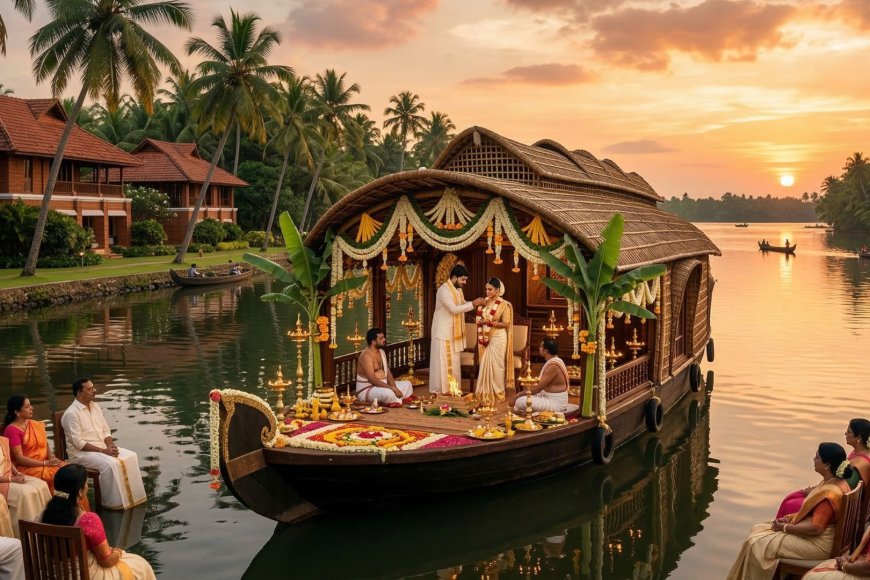
The kettuvallam as the mandap: the ceremony mandap on the kettuvallam — the specific, flower-decorated, tradition-adorned platform of the floating vessel whose deck becomes the ceremony space with the Vembanad Lake as the visual horizon and the backwater's water as the ambient, continuous, living presence beneath the ceremony — is the ceremony setting that the most Kerala wedding most completely produces. The pheras on the water. The priest's recitation with the lake behind. The guests on the shore or on the adjacent boats watching the ceremony that is happening on the water where the grandmother's 1958 boat moved through the water hyacinth and the coconut palms.
The Kumarakom Village
Kumarakom — the specific, quiet, backwater village on the eastern shore of the Vembanad Lake in the Kottayam district whose specific, Kerala-Christian, rice-and-coconut, water-and-land character is the character of the central Kerala lowland — is the village whose specific, ambient quality of the lived backwater landscape gives the Kumarakom Lake Resort its specific, only-in-Kerala character.
The Kerala Christian heritage: the Kumarakom area's specific, Kerala Christian heritage — the Syrian Christian community whose presence in Kerala dates to the first century AD and whose specific, liturgical, architectural, and cultural tradition is the tradition of the oldest Christian community in India outside the Middle East — gives the Kumarakom destination the specific, cultural depth of the place that has been simultaneously Hindu and Christian for twenty centuries and whose specific, syncretic, naturally tolerant character is the character of the central Kerala community.
The bird sanctuary: the Kumarakom Bird Sanctuary — the specific, protected wetland adjacent to the Kumarakom Lake Resort whose migratory and resident bird population includes the egrets, the herons, the kingfishers, the cormorants, and the specific, diverse avian community of the Vembanad backwater ecosystem — is the bird programme's primary destination and the specific, ecological dimension of the Kumarakom destination that the resort's lake-edge position most directly provides.
The Property: Kumarakom Lake Resort
The Traditional Kerala Architecture
The Kumarakom Lake Resort's architecture — the traditional Kerala architectural vocabulary whose teak and rosewood and laterite and the specific, Nalukettu courtyard organisation and whose sloping, clay-tiled roofs and whose carved wooden details are the details of the authentic Kerala heritage residential tradition — is the architecture of the property that has looked at the Kerala landscape it sits in and has built in the language of that landscape rather than the language of the international hotel.
The Nalukettu: the Nalukettu — the traditional Kerala rectangular house whose four wings are organised around the central open courtyard whose specific, spatial, social, and spiritual functions are the functions of the traditional household's centre — is the architectural form whose specific, enclosed courtyard quality gives the Kumarakom Lake Resort's central spaces the intimate, heritage, traditionally Kerala character that the resort's outdoor lakefront spaces most powerfully complement.
The teak and the rosewood: the specific, dark-wood, carved-detail, Kerala-craftsman vocabulary of the resort's interior spaces — the teak pillars, the rosewood panels, the carved wooden screens whose geometric and natural-motif patterns are the patterns of the Kerala wood-carving tradition — is the interior language whose warmth and whose specific, material quality most completely expresses the Kerala heritage resort's authentic character.
The Vembanad frontage: the Kumarakom Lake Resort's direct Vembanad Lake frontage — the specific, unobstructed access to the lake whose water is the water of the Kuttanad's rice and the grandmother's 1958 kettuvallam and the bride's 2024 ceremony — is the property's defining natural asset and the most directly, completely, specifically Kerala element of the venue.
The Award Recognition
The Kumarakom Lake Resort — the property whose specific, traditional-architecture, lake-fronted, backwater-heritage character has produced the specific, sustained recognition of the international luxury travel press whose standards for the authentic heritage resort are the standards of the institution that distinguishes the genuinely traditional from the tradition-themed — is the property whose awards reflect the genuine, not the marketed.
The Condé Nast Traveller recognition, the Travel + Leisure recognition, the specific, sustained, credible assessments of the international luxury and heritage travel community whose standards most directly distinguish the Kumarakom Lake Resort's authentic Kerala character from the international hotel's Kerala-adjacent compromise — these recognitions are the recognitions of the genuine.
The Ayurvedic Heritage
The Kumarakom Lake Resort's Ayurvedic programme — the specific, Kerala, Vaidya-tradition Ayurvedic treatments whose quality at the resort is the quality of the tradition that Kerala has preserved and practiced in the unbroken continuity of the family Vaidya system for the centuries before the wellness industry discovered what the Kerala backwater had always known — is the wellness dimension of the Kumarakom wedding whose engagement most directly provides the pre-wedding restoration that the demanding weeks before the ceremony most specifically require.
The Kerala Ayurveda distinction: the Kerala Ayurveda — the specific, regional expression of the Ayurvedic tradition whose specific, monsoon-and-oil-and-massage emphasis is the emphasis of the tradition that the Kerala climate and the Kerala Vaidya family's accumulated knowledge have most specifically developed — is the Ayurveda whose quality is the quality of the source rather than the approximation. The Ayurvedic treatment at the Kumarakom Lake Resort is the treatment in Kerala, in the backwater, with the Vaidya tradition that the Kerala landscape has been practicing since before the wellness resort existed.
The Wedding Spaces
The Kettuvallam Ceremony
The kettuvallam ceremony — the mandap on the decorated houseboat on the Vembanad Lake, the pheras on the water, the priest's recitation with the lake's surface and the coconut palms and the backwater's flat, reflective horizon as the ceremony's ambient setting — is the Kumarakom Lake Resort wedding's most specific, most irreplaceable, most only-in-Kerala dimension.
The logistics of the floating mandap: the kettuvallam mandap requires the specific, managed logistics of the floating ceremony space — the boat's positioning on the lake, the stability management for the ritual's requirements, the specific, safe, beautiful arrangement of the mandap on the vessel's deck whose preparation the resort's experienced team manages with the specific knowledge of the tradition and the practical requirement combined.
The guests attend the kettuvallam ceremony from the shore — the resort's lake-fronted lawn whose gentle bank gives every guest the unobstructed view of the vessel on the water — or from adjacent boats whose arrangement creates the specific, floating audience of the ceremony that happens on the lake.
The kettuvallam ceremony accommodates the couple, the priest, and the immediate family on the vessel — the intimate scale of the floating ceremony whose specific, physically constrained space is the space of the traditional boat and whose specific, intimate quality is the quality of the ceremony that happens on the water with the wider gathering on the shore watching.
The ceremony photograph: the photograph of the ceremony on the kettuvallam — the decorated vessel on the Vembanad, the mandap's flowers against the lake's silver surface, the coconut palms on the distant shore, the Kuttanad sky above — is the wedding photograph that is most specifically, unmistakably, irreducibly Kerala. No other Indian destination produces this photograph. Only the Vembanad. Only the kettuvallam.
The Lake-Fronted Lawns
The Kumarakom Lake Resort's lake-fronted lawns — the manicured outdoor spaces whose direct Vembanad Lake frontage gives every guest the specific, lake-and-coconut-palm visual context of the Kerala backwater destination at its most naturally beautiful — are the primary wedding event spaces for the reception, the sangeet, the welcome dinner, and the outdoor occasion whose character the Kerala winter season's specific, warm, clear evenings most beautifully support.
The lake-fronted lawns accommodate up to two hundred and fifty guests for the standing reception and up to two hundred for the seated dinner — the moderate to substantial scale that the Kumarakom Lake Resort's outdoor grounds most generously provide and that the large NRI wedding whose Kerala family network fills most naturally.
The sunset reception on the lakefront: the reception dinner on the Kumarakom Lake Resort's lawn at the Vembanad sunset — the lake's surface in the specific, gold-and-pink quality of the Kerala winter evening, the coconut palms silhouetted against the coloured sky, the kettuvallam visible on the water — is the reception whose setting is the most completely, specifically Kerala visual experience the destination wedding landscape provides.
The Nalukettu Courtyard
The resort's Nalukettu courtyard — the traditional Kerala house's central open space whose enclosed, intimate, architecturally specific character gives the indoor-outdoor wedding function the specific, heritage setting of the Kerala residential tradition — is the space for the intimate pre-wedding functions: the mehendi in the traditional courtyard, the family gathering in the Nalukettu's specific, warm, teak-and-rosewood enclosed space, the sangeet whose intimate scale the courtyard most naturally contains.
The Nalukettu courtyard accommodates up to one hundred guests for the standing reception and up to seventy for the seated dinner — the intimate scale whose specific, enclosed, heritage character most powerfully produces the most-Kerala dimension of the occasion's indoor spaces.
The Nalukettu sangeet: the sangeet in the Nalukettu courtyard — the traditional Kerala house's central space transformed into the celebration space, the carved wooden screens and the teak pillars and the specific, dark-wood, lamp-lit quality of the traditional interior — is the sangeet whose setting is the interior Kerala rather than the exterior, the lakefront Kerala rather than the courtyard Kerala, and whose specific, enclosed, intimate quality is the quality of the celebration in the house rather than the celebration on the lawn.
The Pool and the Ayurvedic Pavilions
The Kumarakom Lake Resort's pool — the resort pool whose position within the property creates the specific, lakeside recreational space — and the Ayurvedic treatment pavilions are the pre-wedding wellness spaces whose engagement most directly provides the pre-ceremony restoration.
The Kerala massage at the lake: the Ayurvedic massage in the Kumarakom Lake Resort's treatment pavilion — the treatment room whose proximity to the Vembanad creates the specific, ambient, backwater quality of the therapy in the landscape of the tradition — is the treatment whose setting is the Kerala setting: the backwater, the teak, the coconut oil, the Vaidya tradition's specific knowledge applied in the place where the tradition was developed.
The Restaurant and Private Dining
The Kumarakom Lake Resort's restaurant — the lake-facing dining space whose specific, traditional-Kerala, Vembanad-fronted character is the character of the dining room designed for the backwater meal — and the private dining option are the spaces for the family dinner, the rehearsal dinner, the post-wedding morning breakfast whose character the lake-view dining most warmly provides.
The Kerala sadya: the Kerala sadya — the specific, ceremonial feast served on the banana leaf whose twenty-eight-plus dishes are the dishes of the Kerala culinary tradition's most complete expression, the specific, vegetarian, coconut-and-curry-leaf vocabulary of the feast that the Kerala occasion most specifically requires — is the wedding catering's primary cultural statement whose engagement at the Kumarakom Lake Resort gives the occasion the most specifically Kerala culinary identity.
The Kerala Experience: The Guest Programme
The Backwater Canoe and the Chinese Fishing Nets
The backwater canoe — the small, single-paddled boat whose movement through the Vembanad's narrower channels and whose specific, intimate, low-water-level perspective on the backwater landscape gives the guest the experience of the water from the inside rather than the shore — is the guest programme's primary activity whose combination of the physical engagement and the specific, only-in-Kerala visual experience most completely gives the international guest the backwater in its most direct form.
The Chinese fishing nets: the Chinese fishing nets — the specific, cantilever-mounted fishing nets whose counterweighted mechanism the fisherman operates from the shore and whose specific, silhouetted, deeply photogenic quality against the Kerala sunset has made them the most immediately recognisable visual symbol of the Alappuzha and the Kochi waterfront — are the guest programme's primary visual heritage experience whose proximity to the Kumarakom area gives the evening boat trip the specific, iconic, only-in-Kerala image.
The Kottayam Heritage
The Kottayam district — the specific, Kerala Christian heartland whose Syrian Christian community's two-thousand-year heritage is expressed in the specific, ancient churches, the colonial-era educational institutions, and the specific, cultural, literary, and social traditions of the community that gave Kerala its highest literacy rate and its specific, intellectually vibrant civil society — is the cultural heritage programme whose depth the Kumarakom area's Kottayam proximity most directly provides.
The Ettumanoor Mahadeva Temple: the Ettumanoor Mahadeva Temple — the specific, sixteenth-century temple whose extraordinary mural paintings are among the finest examples of the Kerala mural tradition and whose gold elephant and whose specific, annually celebrated Ettumanoor Ezharaponnana festival make it one of the most culturally significant temples in central Kerala — is the guest programme's primary Hindu heritage destination whose quality as the art-historical and the devotional heritage experience the international guest most specifically values.
The Alleppey Day Excursion
Alleppey — Alappuzha, the Venice of the East, the specific, canal-laced, backwater-centred town whose houseboat festival and whose specific, water-and-land infrastructure are the infrastructure of the most celebrated backwater destination in Kerala — is the forty-five-minute boat journey from the Kumarakom Lake Resort and the guest programme's most specifically, completely backwater experience.
The boat journey to Alleppey: the boat from Kumarakom to Alleppey — the specific, backwater-channel route through the Vembanad's narrower passages and the Kuttanad's paddy-field margins and the specific, changing, endlessly interesting backwater landscape of the journey from the lake to the canal town — is the guest programme element whose quality as the Kerala destination experience is the quality of the journey itself rather than only the destination.
The Kerala Kathakali and the Kalaripayattu
The Kerala performing arts — the Kathakali, the specific, face-painted, elaborately costumed, classical dance-drama whose specific, Kerala, mythology-based, gesture-and-expression vocabulary is among the most visually extraordinary classical performance traditions in India, and the Kalaripayattu, the ancient Kerala martial art whose specific, acrobatic, weapons-and-body technique is the technique that some historians identify as the antecedent of the Asian martial arts tradition — are the wedding programme's cultural performance elements whose engagement gives the occasion the specific, performing-arts dimension of the Kerala heritage.
The Kathakali make-up demonstration: the Kathakali make-up demonstration — the specific, two-to-three-hour process of the face-painting whose result is the specific, mask-like, elaborately coded face of the Kathakali character whose colours and whose patterns communicate the character type to the audience who knows the code — is the guest programme element whose combination of the artistic skill and the intimate access to the tradition's backstage gives the international guest the specific, deeply engaging cultural experience that the performance alone does not provide.
The Season: When to Marry at Kumarakom
The Kerala Wedding Calendar
The Kumarakom wedding season is the Kerala winter — the specific, post-monsoon, dry-season window whose combination of the manageable humidity, the clear sky, and the specific quality of the Kerala winter's light on the Vembanad gives the outdoor wedding the setting it most requires.
October through February: the optimal window — the post-monsoon season whose departure has left the backwater at its fullest and its most visually extraordinary, the vegetation at its greenest, the air at its specific, warm-but-not-oppressive quality of the Kerala winter. The November and December wedding — the specific, clear, water-hyacinth-visible, coconut-palm-clear-against-the-sky quality of the central Kerala winter — is the wedding whose outdoor occasions the season most completely supports.
March and April: the warming season — the pre-summer warmth whose temperatures in the Kottayam area begin the specific, incremental approach to the pre-monsoon heat. The outdoor evening occasion remains comfortable but the daytime heat requires the managed shade and the climate-controlled alternative.
June through September: the monsoon — the specific, extraordinary, visually dramatic Kerala monsoon whose rainfall is among the heaviest in India and whose specific, green, rain-washed, dramatically sky-filled quality is the quality of the backwater at its most visually intense but its most logistically challenging. The monsoon wedding at Kumarakom is the specific, bold, dramatic choice whose outdoor programme requires the comprehensive indoor contingency whose management the experienced planner most specifically addresses.
The Complete Planning and Pricing Table
Comprehensive Wedding Planning Table: All Spaces, Costs, Accommodation, and Budget
| Category | Detail | Capacity / Scope | Approx. Cost (INR) | Approx. Cost (USD) | Notes |
|---|---|---|---|---|---|
| WEDDING SPACES AND VENUE COSTS | |||||
| Kettuvallam – Ceremony (Mandap) | Floating mandap, Vembanad | Couple, priest, family on vessel | ₹8,00,000 – ₹18,00,000 | $9,600 – $21,600 | Most Kerala ceremony possible |
| Lake-Fronted Lawn – Reception Dinner | Vembanad sunset dinner | Up to 200 seated / 250 standing | ₹20,00,000 – ₹38,00,000 | $24,000 – $45,600 | Kerala lakefront reception |
| Lake-Fronted Lawn – Welcome Dinner | Arrival evening, backwater | Up to 180 seated / 230 standing | ₹15,00,000 – ₹28,00,000 | $18,000 – $33,600 | First evening, Vembanad |
| Nalukettu Courtyard – Sangeet | Traditional Kerala house | Up to 70 seated / 100 standing | ₹12,00,000 – ₹22,00,000 | $14,400 – $26,400 | Heritage interior sangeet |
| Lake-Fronted Lawn – Sangeet | Large outdoor sangeet | Up to 200 seated / 250 standing | ₹18,00,000 – ₹32,00,000 | $21,600 – $38,400 | Lakefront large sangeet |
| Nalukettu Courtyard – Mehendi | Traditional space, intimate | Up to 60 seated / 80 standing | ₹5,00,000 – ₹10,00,000 | $6,000 – $12,000 | Pre-wedding Kerala function |
| Pool Area – Haldi | Lakeside morning ritual | Up to 40 seated / 60 standing | ₹3,50,000 – ₹7,00,000 | $4,200 – $8,400 | Inner circle, backwater dawn |
| Restaurant – Private Family Dinner | Lake view, traditional | Up to 30 seated | ₹3,00,000 – ₹7,00,000 | $3,600 – $8,400 | Rehearsal or family dinner |
| Lakefront – Cocktail Reception | Vembanad sunset cocktails | Up to 150 seated / 200 standing | ₹8,00,000 – ₹15,00,000 | $9,600 – $18,000 | Pre-dinner lake cocktails |
| Kettuvallam – Pre-Wedding Photos | Vessel and lake session | Couple and party | ₹1,00,000 – ₹3,00,000 | $1,200 – $3,600 | Most Kerala photograph |
| Property Approach – Vallamkali | Bride's boat arrival | Couple and family | ₹2,00,000 – ₹5,00,000 | $2,400 – $6,000 | Traditional boat arrival |
| Full Property – Exclusive Buyout | All spaces, full resort | Per day | ₹1,20,00,000 – ₹2,20,00,000 | $1,44,000 – $2,64,000 | Complete resort exclusive |
| Full 3-Day Wedding Package | All functions, full prog | 100–200 guests | ₹1,20,00,000 – ₹2,50,00,000 | $1,44,000 – $3,00,000 | Most Kerala wedding possible |
| GUEST PROGRAMME COSTS | |||||
| Backwater Canoe Tour | Vembanad channels, guided | Up to 20 per group | ₹50,000 – ₹1,50,000 | $600 – $1,800 | Intimate backwater access |
| Chinese Fishing Net Sunset | Evening boat, nets | Up to 40 guests | ₹80,000 – ₹2,50,000 | $960 – $3,000 | Iconic Kerala image |
| Alleppey Boat Journey | Backwater route, full day | Up to 100 guests | ₹2,00,000 – ₹5,00,000 | $2,400 – $6,000 | Venice of East excursion |
| Kathakali Performance | Classical dance-drama | Up to 100 guests | ₹1,50,000 – ₹4,00,000 | $1,800 – $4,800 | Kerala classical arts |
| Kathakali Make-Up Demo | Behind the scenes, intimate | Up to 20 guests | ₹50,000 – ₹1,50,000 | $600 – $1,800 | Most engaging cultural exp |
| Kalaripayattu Demonstration | Ancient Kerala martial art | Up to 80 guests | ₹1,00,000 – ₹3,00,000 | $1,200 – $3,600 | Kerala heritage performance |
| Kumarakom Bird Sanctuary | Morning birds, specialist | Up to 20 per group | ₹30,000 – ₹1,00,000 | $360 – $1,200 | Wetland birds, dawn walk |
| Ettumanoor Temple Visit | Mural heritage, guided | Up to 60 guests | ₹80,000 – ₹2,50,000 | $960 – $3,000 | Kerala mural tradition |
| Kerala Cooking Class | Sadya and fish curry | Up to 20 per group | ₹50,000 – ₹1,50,000 | $600 – $1,800 | Culinary heritage |
| CATERING PER HEAD | |||||
| Welcome Cocktails | Kerala snacks, coconut | Per head | ₹2,500 – ₹4,500 per head | $30 – $54 per head | Backwater welcome standard |
| Kerala Sadya | Banana leaf, 28+ dishes | Per head | ₹3,000 – ₹6,000 per head | $36 – $72 per head | Most Kerala meal possible |
| Buffet Dinner | Kerala and continental | Per head | ₹6,000 – ₹10,000 per head | $72 – $120 per head | Backwater culinary quality |
| Seated Dinner | Formal full service | Per head | ₹9,000 – ₹15,000 per head | $108 – $180 per head | Vembanad lakefront formal |
| ACCOMMODATION | |||||
| Heritage Villa | Traditional Kerala style | Per night | ₹20,000 – ₹35,000 per night | $240 – $420 per night | Entry level, teak and rosewood |
| Premium Heritage Villa | Lake-facing, enhanced | Per night | ₹32,000 – ₹50,000 per night | $384 – $600 per night | Lake view, upgraded |
| Pool Villa | Private pool, lake proximity | Per night | ₹50,000 – ₹80,000 per night | $600 – $960 per night | Key family, senior guests |
| Lake Villa | Direct Vembanad frontage | Per night | ₹80,000 – ₹1,20,000 per night | $960 – $1,440 per night | VIP family, close relatives |
| Presidential Villa | Finest villa, lake panorama | Per night | ₹1,30,000 – ₹2,00,000 per night | $1,560 – $2,400 per night | Wedding couple, finest villa |
| Kettuvallam Villa | Houseboat villa, on water | Per night | ₹1,50,000 – ₹2,50,000 per night | $1,800 – $3,000 per night | Most Kerala accommodation |
| Total Rooms Available | Heritage resort scale | ~50–65 villas | Full buyout recommended | Group rate negotiated | Boutique, full buyout ideal |
| OVERFLOW ACCOMMODATION | |||||
| Kumarakom area resorts | Vembanad proximity | Per night | ₹8,000 – ₹30,000 per night | $96 – $360 per night | Lake proximity overflow |
| Kottayam city hotels | District capital, 15 min | Per night | ₹4,000 – ₹15,000 per night | $48 – $180 per night | City overflow option |
| Alleppey houseboat stays | Overnight backwater | Per night | ₹8,000 – ₹25,000 per night | $96 – $300 per night | Backwater character overflow |
| COMPREHENSIVE BUDGET SUMMARY | |||||
| Venue hire – all functions (3 days) | All spaces, full programme | All events | ₹65,00,000 – ₹1,25,00,000 | $78,000 – $1,50,000 | Heritage resort Kerala |
| Catering – all functions (150 guests) | In-house, all meals | Three events | ₹55,00,000 – ₹1,00,00,000 | $66,000 – $1,20,000 | Sadya as primary element |
| Accommodation – full resort (3 nights) | All villas, group rate | Full buyout | ₹30,00,000 – ₹65,00,000 | $36,000 – $78,000 | Heritage villa rate |
| Kettuvallam ceremony logistics | Boat prep, mandap, florist | Ceremony | ₹8,00,000 – ₹18,00,000 | $9,600 – $21,600 | Floating mandap management |
| Decoration and florals | Kerala and backwater design | Full programme | ₹25,00,000 – ₹50,00,000 | $30,000 – $60,000 | Banana flower and jasmine |
| Photography and videography | Backwater and water specialist | Full programme | ₹12,00,000 – ₹28,00,000 | $14,400 – $33,600 | Kettuvallam specialist |
| Entertainment | Kathakali, Kalaripayattu, DJ | Full programme | ₹12,00,000 – ₹25,00,000 | $14,400 – $30,000 | Kerala classical and modern |
| Destination wedding planner | Kerala backwater specialist | Full service | ₹7,00,000 – ₹16,00,000 | $8,400 – $19,200 | Kettuvallam expertise req |
| Ayurvedic wellness programme | Pre-wedding Kerala Ayurveda | Couple and party | ₹3,00,000 – ₹8,00,000 | $3,600 – $9,600 | Vaidya tradition programme |
| Guest programme | Backwater, Alleppey, arts | All days | ₹5,00,000 – ₹14,00,000 | $6,000 – $16,800 | Complete Kerala programme |
| Bridal and groom's clothing | Kerala silk, kasavu | Personal | ₹8,00,000 – ₹25,00,000 | $9,600 – $30,000 | Kasavu saree imperative |
| Hair and makeup | Kerala bridal specialist | On-site | ₹2,50,000 – ₹7,00,000 | $3,000 – $8,400 | Kerala bridal tradition |
| Guest transport | Cochin airport, backwater | All guests | ₹4,00,000 – ₹10,00,000 | $4,800 – $12,000 | 75-minute from Cochin |
| Invitations and stationery | Kettuvallam and lotus design | Full suite | ₹1,50,000 – ₹4,00,000 | $1,800 – $4,800 | Backwater Kerala aesthetic |
| Priest and religious requirements | Kerala tradition, ceremony | Ceremony | ₹1,00,000 – ₹3,00,000 | $1,200 – $3,600 | Floating ceremony protocol |
| Miscellaneous and contingency (10%) | Backwater and boat variance | Standard | ₹8,00,000 – ₹18,00,000 | $9,600 – $21,600 | Water logistics premium |
| TOTAL ESTIMATED RANGE | 150 guests, 3-day wedding | Full buyout | ₹2,47,00,000 – ₹5,16,00,000 | $2,96,000 – $6,19,000 | Most Kerala wedding possible |
| PLANNING TIMELINE | |||||
| Initial inquiry | Kumarakom Lake Resort team | 15–18 months | 15–18 months before | Peak dates fill ahead | |
| Full buyout confirmed | Boutique scale essential | 12–15 months | 12–15 months before | Full buyout contract | |
| Destination planner engaged | Kerala backwater specialist | 12 months | 12 months before | Kettuvallam expertise req | |
| Kettuvallam logistics confirmed | Boat, mandap, florist | 10 months | 10 months before | Floating ceremony planning | |
| Kerala traditions specialist | Kasavu, sadya, Kathakali | 10 months | 10 months before | Authentic Kerala consultant | |
| Photography confirmed | Water and backwater specialist | 10–12 months | 10–12 months before | Kettuvallam experience req | |
| Kathakali and Kalaripayattu | Performers confirmed | 8 months | 8 months before | Classic arts booking | |
| Sadya catering confirmed | Banana leaf specialist | 8 months | 8 months before | 28-dish programme planning | |
| Guest programme confirmed | Backwater, Alleppey, arts | 6 months | 6 months before | Boat permits and guides | |
| Kasavu saree consultant | Bride's Kerala dress | 8–10 months | 8–10 months before | Kerala silk tradition | |
| Guest communications | Invitation, backwater guide | 6 months | 6 months before | Include Kerala tradition note | |
| Final guest count | Confirmed to resort team | 6–8 weeks | 6–8 weeks before | Floating ceremony precision | |
| Final payments | All vendors and venue | 4 weeks | 4 weeks before | Confirm in writing |
The Kumarakom Lake Resort's total budget range sits at the guide series' mid-range — the traditional Kerala heritage resort whose authentic backwater character, whose kettuvallam ceremony option, and whose Vembanad Lake frontage are the credentials that most completely justify the investment for the NRI couple whose wedding vision is the most Kerala wedding possible. The couple whose one hundred to one hundred and fifty guest count and whose Kerala heritage wedding vision most naturally fit the property will find the Kumarakom Lake Resort the most specifically, irreducibly, completely Kerala wedding destination in this guide series.
The Honest Assessment
What the Kumarakom Lake Resort Offers That No Other Property Does
The Kumarakom Lake Resort's specific credential — the kettuvallam mandap on the Vembanad Lake, the Nalukettu courtyard, the traditional Kerala architecture, the Ayurvedic tradition, the Kerala sadya on the banana leaf, and the specific, only-at-Vembanad wedding photograph — is the credential of the most Kerala wedding possible.
Not the Kerala-themed wedding. The Kerala wedding — the specific, authentic, traditionally rooted, backwater-and-water-and-coconut-and-heritage wedding whose character is the character of the grandmother's 1958 kettuvallam and the bride's 2024 ceremony on the same water.
No other property in this guide series makes this claim because no other property in this guide series is on the Vembanad Lake with the kettuvallam.
The Kerala NRI's Specific Case
The NRI couple whose Kerala heritage is the heritage of the Kottayam Syrian Christian family or the Thiruvananthapuram Nair family or the Thrissur community or the specific, diverse, Kerala diaspora whose members are in the Gulf and the UK and the US and the Australia and whose connection to the Kerala homeland is the connection of the person who was born here or whose parents were born here — this is the couple for whom the Kumarakom Lake Resort wedding is not the destination wedding in the exotic sense but the homecoming wedding in the specific, deeply personal sense.
The Kerala NRI's homecoming wedding: the wedding at the Kumarakom Lake Resort for the Kerala NRI couple is the wedding that says: this is where we are from. The Vembanad is our lake. The kettuvallam is our vessel. The sadya on the banana leaf is our feast. The Kathakali is our tradition.
The international guest's first Kerala: the international guest — the colleague from the London firm, the friend from the Toronto circle — who attends the Kumarakom Lake Resort wedding has the specific, only-at-this-wedding experience of the Kerala that no other destination wedding provides: the backwater, the kettuvallam, the Kathakali make-up demonstration, the sadya on the banana leaf, the Vembanad sunset, the morning canoe through the water hyacinth.
Common Mistakes NRI Couples Make When Planning the Kumarakom Lake Resort Wedding
The first mistake is not engaging the kettuvallam logistics specialist as the most important single planning appointment after the venue is confirmed. The floating mandap — the decorated vessel whose positioning on the Vembanad, whose stability management for the ritual's requirements, whose specific, safe, beautiful arrangement of the ceremony space on the water — is the ceremony logistics whose specific, practical, only-in-Kerala complexity requires the professional whose specific expertise is the expertise of the Kerala backwater ceremony rather than the land-based ceremony whose adaptation to the water the general wedding planner most commonly underestimates. The kettuvallam ceremony's specific logistics — the priest's comfort on the water, the ritual fire's management on the floating vessel, the stability of the mandap's decorative elements in the lake breeze, the guests' viewing from the shore — are the logistics whose prior, detailed planning most directly determines whether the floating ceremony is the ceremony that the grandmother's memory deserves. Engage the kettuvallam specialist at ten months.
The second mistake is not including the Kerala sadya as the wedding's primary meal rather than as the cultural addition to the standard wedding banquet. The Kerala sadya — the specific, ceremonial, banana-leaf-served, twenty-eight-plus-dish feast whose specific, regional, coconut-and-curry-leaf vocabulary is the vocabulary of the Kerala culinary tradition's most complete expression — is the wedding meal that most completely expresses the Kumarakom destination's cultural identity and that the international guest most specifically remembers as the Kerala experience. The wedding whose catering menu places the sadya as the welcome lunch and the standard Indian wedding banquet as the reception dinner has inverted the cultural hierarchy. The sadya should be the reception's primary statement. The banana leaf is the tablecloth. The twenty-eight dishes are the conversation. The feast is the Kerala heritage on the plate. Make it the primary meal.
The third mistake is not engaging the Kerala bridal tradition — the kasavu saree, the specific, gold-bordered Kerala silk whose creamy-white and whose specific, traditional, Kerala-bridal character is the character of the bride who is getting married in her heritage rather than in the generic Indian bridal aesthetic — as the bride's primary wedding dress consultation. The NRI bride at the Kumarakom Lake Resort wedding whose bridal outfit is the North Indian lehenga has made the choice of the generic over the specific — the choice that is absolutely valid as the personal preference and that the guide does not prescribe against. But the bride who has considered the kasavu and whose wedding at the Vembanad is the most Kerala wedding possible will find the kasavu's specific, traditional, gold-and-white, Vembanad-appropriate character the outfit whose expression of the occasion's specific, cultural identity is the most complete. Consult the kasavu specialist at eight to ten months alongside the standard bridal outfit consultation.
The fourth mistake is not managing the monsoon contingency with the specific, detailed, operational protocol that the backwater wedding most urgently requires. The Kerala monsoon — among the heaviest in India, the specific, dramatic, June-through-September rainfall whose intensity can transform the outdoor occasion from the beautiful to the impractical within the specific, short warning that the Kerala coast's weather pattern most commonly provides — is the weather condition whose contingency the outdoor backwater wedding most specifically requires. Not merely the indoor backup but the specific, operational protocol: the waterproofing of the Vembanad lawn's event infrastructure, the kettuvallam's stability management in the monsoon's lake conditions, the specific, rapid-deployment indoor contingency whose transition from the outdoor to the indoor can be executed in the twenty minutes that the Kerala rain's arrival most commonly provides. The couple whose wedding is in the October through February optimal window has the lowest monsoon risk. The couple whose date falls in the shoulder season should confirm the contingency protocol in specific, operational detail with the resort's events team and the planner at eight months.
The fifth mistake is not briefing every international guest about the Kerala sadya's specific, cultural protocol before the feast is served. The Kerala sadya on the banana leaf is the feast whose specific, cultural protocol — the banana leaf's orientation, the specific order of the courses, the specific, hand-eaten, right-hand-only tradition of the traditional feast whose eating protocol the international guest who has not been told most commonly observes with the apologetic request for the fork — is the protocol whose prior communication most directly gives the international guest the confidence to participate in the tradition with the specific, cultural fluency of the person who has been prepared rather than the tentative observation of the person who is discovering the protocol in public. Include in the welcome letter the specific, warm, informative guide to the Kerala sadya: the banana leaf's placement, the courses' sequence, the hand-eating tradition, and the specific, joyful permission to attempt the traditional form. The international guest who eats the sadya on the banana leaf with the right hand at the Vembanad lakefront has had the most specifically Kerala meal experience of any international guest at any Indian wedding. Give them the knowledge to have it fully.
The Same Water
The grandmother had been on a kettuvallam in 1958.
She had been twelve. The year had been the year before the state of Kerala was formed. The boat had been moving through the Vembanad's channels carrying rice from the Kuttanad fields. She had been sitting in the bow watching the water hyacinth and the coconut palms and the specific, flat, waterlogged, endlessly watered landscape of her childhood.
She had not known then that one day her granddaughter would get married on that lake.
The bride had gotten married on that lake.
The kettuvallam had been decorated with the jasmine and the banana flower and the specific, white-and-gold florals of the Kerala wedding tradition whose colours are the colours of the kasavu saree and the Vembanad's silver surface and the coconut palm's specific, tropical against-the-sky quality.
The priest had recited the mantras on the floating deck.
The lake had been behind the couple — the Vembanad, the largest lake in Kerala, the lake that the grandmother had crossed in 1958 in the working rice boat and that the granddaughter was crossing in the ceremonial wedding boat in the same water.
The same water.
Not metaphorically. Literally. The Vembanad. The water that the grandmother had watched from the bow in 1958 was the water beneath the mandap in 2024.
Sixty-six years of the same water.
The Kumarakom Lake Resort is the most Kerala wedding possible — not because it is the most famous or the most expensive or the most internationally recognised or the most architecturally dramatic or the most historically significant of the properties in this guide series.
Because it is on the Vembanad.
Because the kettuvallam is on the water that the grandmother's 1958 boat crossed.
Because the banana leaf sadya is the sadya of the Kerala feast.
Because the Kathakali make-up is the make-up of the tradition.
Because the kasavu is the saree of the bride who is getting married in her heritage.
Because no other wedding venue in this guide series puts the ceremony on the water that the grandmother remembers.
Contact the Kumarakom Lake Resort events team at fifteen months.
Book the full resort buyout from the first conversation.
Engage the kettuvallam logistics specialist at ten months.
Make the sadya the primary meal.
Consult the kasavu specialist alongside the standard bridal consultation.
Confirm the monsoon contingency protocol at eight months.
Brief the international guests about the sadya's protocol in the welcome letter.
And tell the grandmother — who was twelve in 1958, who sat in the bow and watched the water hyacinth and the coconut palms and did not know — that her granddaughter is getting married on the same water.
She will say: I know.
She has been waiting sixty-six years for the boat to come back to the same lake.
The most Kerala wedding possible.
The same water.
That is enough.
Published by NRIWedding.com — The Premium Global Platform for Non-Resident Indians Planning Indian Weddings From Abroad.
0 comments
Real names and courtesy, please. Every comment is read by a person before it appears.
Nothing yet. Start it off.
Comments are closed on this article.