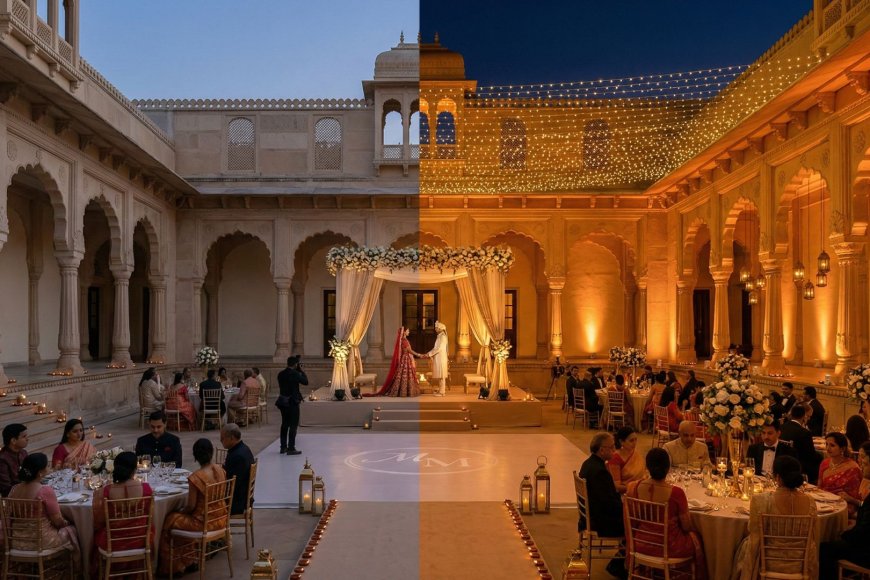
The Moment the Lights Changed Everything
You've seen it happen in real time.
A wedding venue that looked ordinary — even slightly underwhelming — during the afternoon walkthrough. Plain walls, standard ceiling height, nothing particularly remarkable about the architecture. You stood there during the site visit wondering if you'd made the right call.
And then the evening arrived. The sun dropped. The lighting team finished their setup. Someone dimmed the overhead whites and the warm amber wash came on. The uplighting hit the walls. The canopy of fairy lights above the dance floor flickered to life. The floral centerpieces, previously just flowers on tables, suddenly glowed.
The room transformed completely. Not gradually — instantly. Within seconds, the same space that felt forgettable at 4 PM became genuinely breathtaking at 7 PM.
That is the power of wedding lighting design. And it remains one of the most underestimated, under-budgeted, and under-discussed elements of Indian wedding planning — particularly for NRI couples managing everything from abroad.
Most couples spend months agonizing over florals, outfits, catering menus, and invitation design. Lighting gets a line item in the budget and a brief conversation with a vendor two months before the wedding. And then they wonder why their professionally photographed wedding doesn't quite look the way they imagined it would.
Here's the truth: lighting is not a support element. It is not background. It is not something you sort out after everything else is decided. Lighting is the single most transformative design tool available to you — more impactful per rupee spent than almost any other décor decision — and understanding how to use it intelligently is the difference between a beautiful wedding and an unforgettable one.
For NRI couples planning Indian weddings from abroad, lighting design carries an additional layer of complexity. You cannot walk the venue at dusk and feel the light. You cannot stand in the mandap area and assess how the ambient warmth hits. You are making decisions based on photographs, videos, and vendor conversations — which means you need to understand lighting deeply enough to brief, evaluate, and approve it remotely.
This guide gives you exactly that. A complete, practical, culturally intelligent education in wedding lighting design — built specifically for the NRI couple who wants their venue to look extraordinary.
The Core Reality: Why Lighting Is the Most Undervalued Element of Indian Wedding Decor
Walk into any conversation with an Indian wedding décor vendor and the discussion will naturally gravitate toward flowers, fabric, and furniture. Lighting, if it comes up at all, is often treated as a technical requirement rather than a creative one. You need lights so people can see. Beyond that, the assumption goes, it's fairly standard.
This attitude is costing couples thousands of dollars in missed opportunity.
Lighting design in the context of weddings is not about visibility. It is about atmosphere, emotion, dimension, and visual storytelling. It determines how your skin looks in photographs. It controls how your guests feel within the space — energized, romantic, celebratory, or intimate. It shapes the perceived size, warmth, and character of the venue. It directs attention — toward the mandap, toward the couple, toward the dance floor — in the same way a film director uses light to guide an audience's gaze.
The gap between a venue that looks "nice" and a venue that looks "cinematic" is almost always lighting.
For Indian weddings specifically, this matters even more because the celebration spans multiple functions — mehendi, sangeet, haldi, ceremony, reception — each of which has a distinct emotional register and therefore requires a distinct lighting approach. A single lighting setup that works for a sangeet will kill the intimacy of a morning haldi. Understanding this is fundamental.
NRI couples face an additional challenge: the Indian wedding lighting vendor market varies enormously in quality, sophistication, and creative vocabulary. In major metros and destination wedding hubs — Mumbai, Delhi, Jaipur, Udaipur, Goa — there are genuinely world-class lighting designers who work with international-standard equipment and creative sensibility. In smaller markets, you may encounter vendors whose lighting vocabulary begins and ends with colored LED washes and fairy lights. Knowing the difference, and knowing how to brief either, is essential.
The Strategic Framework: Building Your Wedding Lighting Design from the Ground Up
Phase 1 — Understand Your Venue Before You Design Your Light
Lighting design does not happen in the abstract. It responds to architecture, and every venue has a different set of opportunities and constraints.
Ceiling height matters enormously A venue with six-meter ceilings allows for dramatic hanging installations — chandeliers, floral canopies with integrated lighting, suspended lantern clusters. A venue with three-meter ceilings requires a completely different approach, working horizontally rather than vertically.
Wall texture and color affect light behavior A warm stone wall in a Rajasthani haveli absorbs and reflects amber light beautifully. A white-painted modern ballroom reflects light flatly and requires more layering to create depth. A mirrored surface multiplies light in ways that can be spectacular or overwhelming depending on how they're managed.
Outdoor vs indoor lighting is a fundamentally different discipline Outdoor spaces require weather-resistant equipment, stronger light sources to compete with ambient light at dusk, and careful management of the transition as the sky darkens through the evening. Indoor spaces offer more control but require more attention to avoiding harsh overhead lighting that flattens faces and kills atmosphere.
Power infrastructure Before designing any lighting setup, confirm the venue's power capacity and generator backup. An ambitious lighting design that trips the venue's power supply halfway through the reception is a disaster. Always have this technical conversation before any creative one.
Phase 2 — Learn the Vocabulary of Wedding Lighting
To brief a lighting vendor intelligently and evaluate their proposals accurately, you need to understand the core categories of wedding lighting design.
Ambient Lighting is the foundational layer — the general illumination that allows guests to see and move comfortably through the space. This should never be harsh or clinical. Warm white or soft golden ambient light sets the baseline temperature of the entire event.
Uplighting involves placing light sources at ground level and directing them upward along walls, columns, or architectural features. It is one of the most cost-effective and dramatically transformative tools available. A venue with plain walls can be completely reimagined through uplighting — color-washed in deep amber, soft blush, or cool blue depending on the event's mood.
Wash Lighting floods a large surface — a wall, a ceiling, a stage — with a broad, even spread of color or white light. Used to set the overall color temperature of a space and create visual cohesion.
Pin Spotting uses narrow, focused beams of light directed at specific elements — typically centerpieces, the cake, or floral arrangements. Pin spotting makes individual décor elements literally glow and dramatically elevates how they photograph.
Gobo Lighting projects patterns — geometric shapes, floral motifs, the couple's monogram, or custom designs — onto walls, floors, or ceilings. A gobo projecting the couple's initials onto the dance floor or a geometric pattern onto a plain wall adds a layer of personalization that requires no physical installation.
String Lights and Fairy Lights are the most universally loved lighting element across Indian wedding aesthetics — and for good reason. A canopy of warm white fairy lights above a dining area or dance floor creates an instantly magical atmosphere. The key is density and warmth — sparse fairy lights look thin and incomplete; a dense, layered canopy is transformative.
Candle and Diya Lighting is the most culturally rooted and emotionally resonant form of wedding lighting. Hundreds of clay diyas arranged across a heritage property, or clusters of pillar candles in brass holders along a table, create warmth and intimacy that no electric lighting system can fully replicate. This is also the most sustainable lighting choice available — and the most photogenic.
Stage and Mandap Lighting requires its own specialist attention. The mandap is the visual focal point of the ceremony — it needs to be lit in a way that makes the couple look extraordinary on camera while maintaining cultural and emotional authenticity. Avoid harsh front lighting that washes out detail. Work with warm side lighting and soft overhead fills that create dimension and depth.
Phase 3 — Design by Function, Not by Venue
One of the most important and most commonly overlooked principles of Indian wedding lighting design is this: each function requires its own lighting identity.
Haldi: Morning function, often outdoor. Natural light is your primary tool. Supplement with soft, warm fill lighting if needed for shaded areas. Keep it bright, joyful, and airy. Avoid dramatic or moody lighting that conflicts with the celebration's energy.
Mehendi: Afternoon to early evening. A transitional function that moves from natural to artificial light as the event progresses. Layer string lights and lanterns that become more prominent as the sun sets. Keep color temperature warm — golden and amber tones complement the mehendi aesthetic perfectly.
Sangeet: This is your most dramatic lighting moment. The sangeet is a performance — it deserves theatrical lighting. Dynamic color changes, dance floor pin spots, stage wash lighting for performances, and a dense fairy light canopy above the dining area all come together to create an evening that feels genuinely produced.
Wedding Ceremony: Intimate, reverent, and focused. All attention should be directed toward the mandap. Use warm, soft lighting throughout the ceremony space. The mandap itself should be lit beautifully but without harshness. If the ceremony is outdoors at dusk, the transition from natural to artificial light needs to be carefully managed so the shift is seamless.
Reception: Celebratory, warm, and social. The reception lighting should feel welcoming and festive without the theatrical intensity of the sangeet. Uplighting, pin spotting on centerpieces, a warm ambient wash, and focused lighting on the couple's table and dance floor create a balanced, beautiful reception environment.
Phase 4 — Photography and Lighting Are Inseparable
Every lighting decision you make directly impacts how your wedding photographs. This is not a secondary consideration — it should be central to every creative discussion.
Brief your photographer and your lighting designer together, or at minimum share each vendor's plans with the other. A lighting setup that looks spectacular to the naked eye may create impossible conditions for your camera — blown-out highlights, deep unflattering shadows, or color temperature conflicts that make skin tones look unnatural.
Warm white and amber lighting almost always photographs beautifully. Colored washes — particularly deep reds, greens, and blues — can be stunning in person but create significant color-correction challenges in photographs. Use colored lighting strategically and confirm with your photographer that they can manage it technically.
Pin spotting on centerpieces is one of the most photographer-friendly lighting choices you can make. It creates natural focal points, adds depth, and makes table arrangements look dramatically more polished in photographs than they would under flat ambient light alone.
Common Lighting Mistakes NRI Couples Make
Allocating Insufficient Budget Lighting is consistently under-budgeted at Indian weddings. Couples spend significantly on florals and then try to cut lighting costs, not realizing that good lighting will make modest florals look extraordinary while poor lighting will make expensive florals look flat. Allocate at minimum 10 to 15 percent of your total décor budget to lighting.
Hiring a General AV Vendor Instead of a Specialist Lighting Designer Audio-visual vendors handle sound, screens, and basic lighting as a package. Specialist lighting designers think creatively about atmosphere, architecture, and emotion. For a premium wedding, these are different skill sets. Hire a dedicated lighting designer for your primary functions.
Approving Lighting Designs Without Requesting a Site Test Never approve a lighting design from a mood board alone. Request that your local planner or a trusted family member attend a venue lighting test — where the vendor sets up a portion of the lighting design in the actual space — before you give final approval remotely.
Using the Same Setup Across All Functions Every function has a different emotional character. A lighting setup that works for the sangeet is wrong for the ceremony. Brief your vendor on the distinct requirements of each function and ensure they have separate plans for each.
Ignoring the Transition Moments The moments between functions — when guests move from the ceremony space to the reception, or from the mehendi garden to the dining area — are lighting opportunities that most couples ignore. A beautifully lit pathway, a lantern-lined corridor, or a dramatically lit entrance to the reception hall creates a transition moment that guests remember and photograph.
Emotional and Cultural Insight: Light as a Language of Celebration
Light has always been central to Indian celebration in ways that go far beyond the decorative.
The diya is one of the oldest and most spiritually loaded symbols in Indian culture — light as the triumph of knowledge over ignorance, of presence over absence, of warmth over cold. When you line your wedding mandap with clay diyas, you are not making a décor choice. You are participating in a visual language that stretches back thousands of years.
For NRI couples, there is something deeply grounding about bringing this material back to the center of the wedding aesthetic. You have spent years navigating the tension between Indian cultural identity and global lifestyle. Your wedding is an opportunity to demonstrate that these identities are not in conflict — that the most ancient Indian aesthetic choices are also the most contemporary, the most sustainable, and the most beautiful.
A wedding lit by diyas, brass lanterns, warm fairy lights, and thoughtfully designed uplighting is not a compromise between tradition and modernity. It is both, simultaneously and completely.
Wedding Lighting Checklist for NRI Couples
Pre-Planning
- Confirm venue ceiling height, wall texture, and power capacity
- Establish separate lighting briefs for each wedding function
- Share lighting plans with your photographer before finalizing
- Request a live video walkthrough of the venue at evening light conditions
Vendor Selection
- Hire a dedicated lighting designer separate from your AV vendor
- Request portfolios from previous weddings at similar venue types
- Ask for references from couples who planned their weddings remotely
- Confirm all equipment is weather-rated if any functions are outdoors
Design Decisions
- Choose warm white or amber as your base ambient temperature
- Layer uplighting, pin spotting, and string lights for depth
- Design mandap lighting in collaboration with your photographer
- Plan gobo or monogram lighting for personalization without physical installation
- Integrate diyas and candles for cultural resonance and sustainable warmth
Function-Specific Planning
- Haldi: Natural light primary, soft warm fill secondary
- Mehendi: Transitional layering from natural to string light and lantern
- Sangeet: Theatrical, dynamic, performance-ready
- Ceremony: Intimate, mandap-focused, warm and soft
- Reception: Welcoming, festive, pin-spotted centerpieces and dance floor focus
Post-Planning
- Confirm generator backup for all lighting systems
- Plan for diya and candle waste disposal responsibly
- Arrange a lighting run-through the evening before the first function
Your Venue Is a Canvas — Light Is the Medium
Every wedding venue, regardless of its baseline architecture, has the potential to be extraordinary. The difference between ordinary and extraordinary is almost always the quality, intention, and intelligence of the lighting design.
As an NRI couple planning your wedding from thousands of kilometers away, you cannot control everything. But you can control your understanding of what great lighting does, what it requires, and how to brief the people responsible for delivering it.
Invest in a specialist. Allocate the budget properly. Design each function separately. Brief your photographer and lighting designer together. And trust that when the sun goes down on your wedding evening and the lights come on — the room you chose, the room your family gathered in, the room where you will exchange vows or dance until midnight — will look exactly the way you always imagined it would.
Because with the right lighting, it always does.
0 comments
Real names and courtesy, please. Every comment is read by a person before it appears.
Nothing yet. Start it off.
Comments are closed on this article.