Managing Grandparents' Expectations and Special Needs at Your Indian Wedding
The NRI couple's thoughtful guide to the family members whose presence at the wedding is among its most meaningful elements — understanding what grandparents need from the occasion, how to design for their genuine comfort, and how to hold their expectations with the specific combination of love and honesty that the relationship deserves
The Guest Who Had Been Waiting the Longest
The bride's grandmother had been talking about this wedding for six years.
Not this specific wedding — the bride had not been engaged six years ago, had not met the groom six years ago, had in fact been in a different relationship six years ago whose ending her grandmother had received with the specific philosophical equanimity of someone who had always known it was not the right one. She had been talking about the wedding in the abstract — the wedding that was coming, that was inevitable, that she was going to be at, that she had things to say at, that she had a sari already chosen for.
She was eighty-one. She had moderate hearing loss in both ears, managed with hearing aids whose battery she replaced with a frequency that did not always correspond to the battery's actual depletion. She had arthritis in both knees that made stairs difficult and standing for extended periods painful. She had the specific energy pattern of the elderly — vivid and engaged in the mornings, fatigued by the early afternoon, restored somewhat by an evening rest, but not to the morning's level.
She had opinions. About the ceremony's ritual completeness. About the specific dishes that must be at the wedding meal. About the specific moment in the ceremony when the bride's maternal grandmother — which was her — had a specific role that she had been mentally rehearsing for six years and that she expected to be given.
She had traveled from Kolkata to Jaipur for the wedding — a journey that had required specific planning, a specific companion for the journey, and the specific logistics of managing the travel with the mobility limitation and the hearing limitation that made the journey more complex than it had been twenty years ago.
She was the guest the bride most wanted to be there. She was also, in the specific honest assessment of the planning that the bride and groom had done together, the guest whose experience of the wedding required the most specific planning attention of any single person on the guest list.
Both things were true simultaneously. The planning had to hold both.
This guide is built on what that planning required.
Understanding What Grandparents Need From the Wedding
The Emotional Significance
The grandparent's relationship to the grandchild's wedding is not the parent's relationship and not the friend's relationship. It is its own specific thing — the relationship of someone who has loved this person since before the person was fully a person, who has watched the entire arc of the grandchild's becoming, and who experiences the wedding as the culmination of something they have been witnessing for decades.
The grandparent at the wedding is attending the occasion that confirms that the grandchild has reached the life stage that the grandparent has been hoping to see. For the grandparent whose health is uncertain — whose awareness that time is finite is more present than it is for the younger guests — the wedding is the occasion that they have specifically hoped to live to see. The emotional weight of their presence is not the weight of a guest whose attendance is one among many. It is the weight of someone for whom this specific occasion has specific, irreplaceable meaning.
The planning that understands this emotional significance — that designs for the grandparent's experience with the same specificity that it designs for the couple's — is the planning that honors the relationship rather than merely accommodating the logistics.
The Physical Reality
The grandparent's physical reality at the wedding is the planning variable that the couple is most likely to underestimate — not from lack of care but from the specific difficulty of imagining, from the couple's physical position, what the wedding's demands feel like from an eighty-one-year-old body with arthritic knees and a hearing aid whose battery is uncertain.
The mobility consideration:
The Indian wedding's venues — the heritage havelis, the garden properties, the multi-level spaces — are frequently not designed with mobility limitations in mind. The cobblestone courtyard that is picturesque is the cobblestone courtyard that is treacherous for someone with an unsteady gait. The ceremony mandap reached by three steps is the ceremony mandap that excludes the grandparent who cannot manage steps without assistance. The garden wedding whose grass is uneven is the garden wedding that requires a walker or a wheelchair user to have a specific path rather than the ambient access that the other guests take for granted.
The planning that accounts for the grandparent's mobility limitation should begin with the venue assessment — the specific walk-through of the venue from the perspective of a guest with limited mobility, identifying the specific obstacles and the specific accommodations required.
The hearing consideration:
The Indian wedding's acoustic environment — the ceremony in a large space, the reception in a hall with competing sound sources, the sangeet with amplified music — is an environment that is specifically challenging for guests with hearing loss. The grandparent with hearing aids is not managing the acoustic environment that the other guests are managing. They are managing a processed version of it whose quality depends on the specific acoustic conditions, the specific distance from the sound source, and the specific configuration of their hearing technology.
The grandparent who cannot hear the ceremony — who sits through the ritual that they have been looking forward to for years and whose words reach them as an undifferentiated murmur — has been failed by the planning in a specific and irreversible way. The accommodation that allows the grandparent to hear the ceremony is not a luxury addition to the planning. It is the minimum that the occasion requires.
The energy consideration:
The Indian wedding's multi-day, multi-event programme is an endurance event for the young and healthy guests who attend it. For the elderly grandparent, the endurance is real and the programme must be designed with their energy reality in mind — the morning events that catch them at their best, the rest provision that allows them to recover between events, the specific permission to withdraw from events without the social cost of the withdrawal.
The temperature and environment consideration:
The outdoor events, the evening events, the events in venues whose temperature is not fully controlled — all of these are environments whose management is more demanding for the elderly guest. The grandparent who is cold, who is too warm, who is sitting in direct sunlight during the outdoor ceremony, whose physical comfort is not being managed — this grandparent's experience of the wedding is being shaped by physical discomfort rather than by the occasion's meaning.
The Cultural and Ceremonial Expectation
The grandparent's expectations about the ceremony are frequently rooted in a relationship to the tradition that is older, deeper, and more specific than the couple's — and that may differ from the ceremony the couple has planned.
The grandmother who has a specific role in mind — the specific ritual moment that in her experience of weddings belongs to the maternal grandmother, the specific blessing she has prepared, the specific participation she has been anticipating — is the grandmother whose expectation must be understood before the ceremony is finalised rather than managed during it.
The ceremony design conversation with the grandparents — the specific, unhurried conversation about what they are expecting from the ceremony, what they hope to participate in, what they consider essential — is the conversation that surfaces the expectations before they become the source of the specific disappointment of the elderly family member who sat through the ceremony waiting for a moment that did not come.
The Physical Accommodations: What the Planning Must Provide
The Venue Assessment
Every venue being considered for the wedding should be specifically assessed for grandparent accessibility before the booking is confirmed. The assessment questions:
Is the primary ceremony and reception space accessible without stairs? If stairs are unavoidable, is there a ramp or lift alternative?
Is the surface between the car drop-off point and the ceremony space manageable for someone with limited mobility — no cobblestones, no uneven grass, no loose gravel?
Are there seating options — chairs with arms, chairs at the right height — available throughout the venue for guests who cannot stand for extended periods?
Are the restroom facilities accessible and proximate to the main event spaces?
Is there a quiet room — a space away from the main event — where an elderly guest can rest without withdrawing from the venue entirely?
The venue that cannot answer these questions satisfactorily requires specific accommodations to be arranged — the hired wheelchair for the cobblestone courtyard, the temporary ramp for the ceremony space steps, the chair with arms placed at the specific point where the grandparent will stand during the ceremony.
The Seating
The grandparent's seating at every event — the ceremony, the sangeet, the reception dinner — requires specific attention beyond the general seating plan.
The ceremony seating:
The grandparent should be seated as close to the ceremony space as their specific hearing and mobility needs require — not at the family's conventional position in the room but at the position that allows them to see and hear the ceremony most fully. The conventional front row that requires navigating past other seated guests to reach may not be the most accessible front row. The seat at the aisle end, with clear sightlines and proximity to the exit, is more likely to serve the grandparent's needs.
The proximity to facilities:
The grandparent's seat at every event should be selected with the proximity to the restroom as a specific consideration — not the only consideration but one whose importance increases with age and with the length of the event.
The chair provision:
The chair that is right for the grandparent — the chair with arms that allows them to sit and rise without assistance, at the height that is comfortable for their specific mobility limitation — should be specifically arranged rather than assumed to be available in the venue's standard furniture. Bring a specific chair if necessary. The grandparent who spends the reception dinner in a chair that is wrong for their body is spending the reception dinner managing physical discomfort.
The Hearing Accommodation
The grandparent with hearing loss needs the ceremony's audio to reach them at a level and a quality that their hearing technology can process. The practical accommodations:
The seating position:
Closer to the sound source — the Pandit's microphone, the couple's position — is the seating position that helps the hearing-impaired guest most. The grandparent seated at the ceremony's optimal acoustic position hears more than the grandparent seated at the family's conventional position.
The sound system briefing:
The sound engineer should be briefed on the presence of guests with hearing limitations and should be asked to ensure that the ceremony's audio coverage reaches the grandparent's specific seating position adequately. The sound system that covers the ceremony space generally may have dead spots or areas of lower coverage that a specific briefing can address.
The hearing loop provision:
For venues with the technical capability, an induction hearing loop — the technology that transmits audio directly to hearing aids equipped with a T-coil — provides the highest-quality audio experience for the hearing-impaired guest. The venue whose audio system is hearing loop compatible, whose grandparent's hearing aids have T-coil capability, and whose event has been set up with the loop active has provided the grandparent with the closest available approximation of normal hearing at the ceremony.
The personal FM system:
For the grandparent whose hearing loss is significant and whose hearing aid alone is insufficient in the wedding's acoustic environment, a personal FM system — a transmitter at the sound source and a receiver worn by the grandparent — provides the specific, directed audio that the ambient sound system cannot.
The ceremony handout:
The printed ceremony programme — the specific text of the ritual, the translation of the Sanskrit or the regional language, the sequence of events — is the accommodation that allows the grandparent who cannot hear everything to follow what is happening. The ceremony handout designed for the grandparent should be in a font size they can read without assistance.
The Travel and Logistics Accommodation
The grandparent who is traveling to the wedding — particularly the grandparent traveling from another city in India or from another country — requires specific logistics support that the younger, more mobile guests do not.
The companion:
The elderly grandparent should not travel alone to the wedding if their mobility limitation or health status makes solo travel inadvisable. The companion — a family member, a trusted family friend, a professional care attendant — whose specific responsibility is the grandparent's travel and comfort is the provision that allows the grandparent to attend without the specific risk of the unsupported journey.
The accommodation:
The grandparent's accommodation should be the accommodation closest to the primary event venue — not the accommodation that is available and affordable, but the accommodation whose specific proximity to the wedding events minimises the travel the grandparent must undertake between events.
The accommodation's physical accessibility — the room without stairs, the bathroom with grab rails, the bed at the right height — should be specifically confirmed before the booking is made rather than assumed.
The transport:
The transport between the accommodation and the event venues should be door-to-door for the grandparent — not the shared bus that requires a walk from the collection point, but the specific vehicle that collects from and delivers to the door. The transport schedule should be coordinated with the grandparent's energy pattern — the departure that is early enough for the grandparent to be seated comfortably before the event's chaos, the return that does not require the grandparent to wait after they are tired.
The Ceremonial Role: Giving the Grandparent Their Moment
The Expectation Conversation
The conversation with each grandparent about their expected role in the ceremony should happen early in the planning — not in the week before the wedding when the ceremony has been finalised, but in the months when the ceremony structure is still being designed.
The conversation's questions: Is there a specific moment in the ceremony that you are hoping to participate in? Is there a specific blessing or a specific ritual that in your experience of weddings belongs to the grandparents? Is there anything you have prepared that you would like to offer at the ceremony?
The answers to these questions either confirm that the ceremony as planned includes the moment the grandparent is expecting, or they reveal the expectation that the ceremony as planned does not include and that must now be considered.
The conversation should be had with each grandparent individually — not collectively, because the collective conversation produces the family dynamic of competing expectations rather than the individual's honest sharing of what they are hoping for.
The Specific Role
The grandparent who is given a specific role in the ceremony — the specific moment that is theirs, that has been designed for them and that they have been told about in advance — is the grandparent who arrives at the ceremony with a sense of their place in the occasion rather than the anxiety of the undefined role.
The role should be: genuine rather than invented, meaningful rather than merely ceremonial, calibrated to the grandparent's physical capability on the day, and briefed in advance so the grandparent knows what to do and when without needing instruction in the moment.
The Indian ceremony's specific grandparent roles:
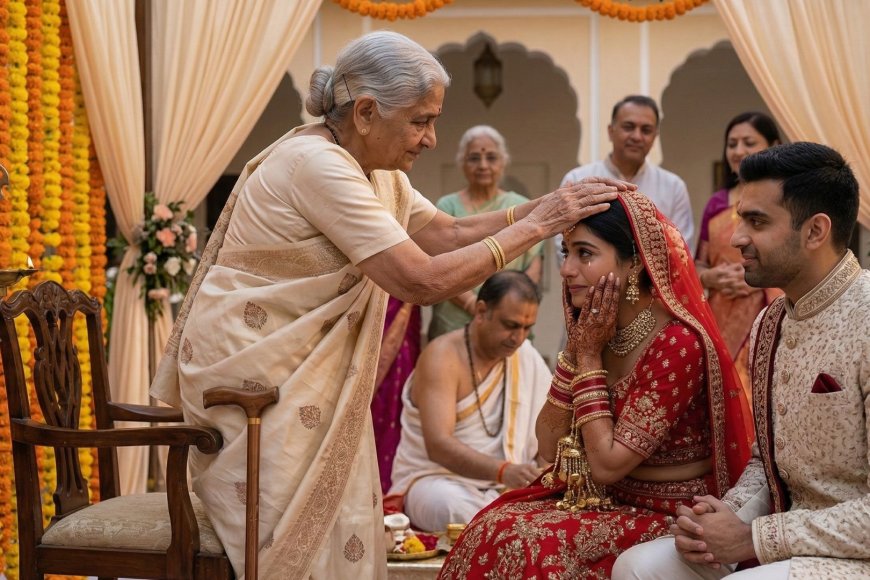
The aashirwad — the blessing of the couple — is the moment most naturally associated with the grandparents' participation. The specific moment when the grandparents are invited to place their hands on the couple's heads, or to speak a specific blessing that is theirs alone to give, is the moment that carries the specific weight of the grandparent's relationship to the grandchild and to the occasion.
The aashirwad moment can be designed into the ceremony structure — as a specific, named, acknowledged moment rather than as the general circulation of elders that happens informally — giving the grandparents' blessing the specific significance it deserves.
The physical accommodation of the role:
The grandparent whose role requires them to stand, to bend, to move through the ceremony space must be able to perform the role given their specific physical capability. The role designed without reference to the grandparent's physical reality is the role that produces the specific painful moment of the grandparent who cannot perform what they have been asked to do.
The ceremony choreography should be reviewed with the grandparent's specific capability in mind — the role that requires standing for the duration should have a chair available, the role that requires movement should have the path cleared and the assistance available, the role that requires speaking should be close enough to the microphone.
The Photograph
The photograph with the grandparent — the specific, priority photograph of the couple with each grandparent — should be a named item in the photography brief, scheduled early in the photograph session when the grandparent's energy is highest and when the session's management has not yet produced the fatigue that arrives later.
The photograph session with the grandparent should be: brief, warm, unhurried within its brief duration, and conducted with the specific attention to the grandparent's physical comfort that the session's length requires. Not the photograph session where the grandparent stands for forty-five minutes while the photographer works through the full family configuration. The grandparent's photographs, taken first, with the grandparent then seated comfortably for the remainder.
The priority of the grandparent photograph is not only aesthetic. It is the acknowledgment that this photograph — the couple with the grandparent who traveled for six years in anticipation of this day — is among the most significant photographs the wedding will produce.
Managing the Expectations: The Honest Navigation
The Expectation That Cannot Be Met
Not every expectation that the grandparent holds can be met — and the couple who attempts to meet every expectation discovers that the attempt has produced a ceremony that is not coherent, a programme that is not manageable, and the specific exhaustion of trying to give everyone exactly what they are hoping for.
The expectation that cannot be met requires the honest, early, loving conversation — the conversation that acknowledges the expectation, explains why it cannot be met in the form the grandparent is hoping for, and offers what can be offered instead.
The conversation should be: had by the grandchild, not delegated to a parent or a planner. Held in person or by video call, not in a WhatsApp message. Warm and specific rather than general and apologetic. And concluded with the specific alternative that the couple is genuinely offering — not the vague assurance that "we will make sure you are included" but the specific role, the specific moment, the specific acknowledgment that is available.
The example:
The grandmother who expects the kanyadaan to be performed by her son — the bride's father — and who is distressed to learn that the bride's parents are divorced and that the couple has chosen a different family member for the role. The conversation that acknowledges the grandmother's expectation, explains the couple's decision, and offers the specific alternative — "we would love for you to be the one who places the bride's hand in the groom's hand at the moment of the kanyadaan" — is the conversation that serves both the grandmother's need for a meaningful role and the couple's need for the ceremony to reflect their actual family.
The Expectation That Reveals the Underlying Need
The grandparent's expressed expectation is sometimes the surface of a deeper need — the need to feel that their relationship with the grandchild is being honored, that their presence at the wedding is significant rather than merely accommodated, that the wedding acknowledges the specific and irreplaceable quality of the grandparent-grandchild relationship.
The expectation about the specific ritual role may be the expression of the need to feel central rather than peripheral. The expectation about the specific dish at the wedding meal may be the expression of the need to feel that the family's tradition is being honored. The expectation about the specific ceremony's observance may be the expression of the need to feel that the grandchild's wedding is connected to the family's history rather than disconnected from it.
When the grandparent's expectation cannot be met literally, the question is whether the underlying need can be met differently — the alternative that addresses the need rather than the expectation's specific form.
The Wedding Day: Making It Wonderful for Them
The Designated Companion
The grandparent's experience of the wedding day should be managed by a specific, designated companion — the family member or trusted individual whose primary responsibility for the day is the grandparent's comfort, experience, and needs.
The companion is not the grandparent's carer in the clinical sense. They are the person whose attention is specifically on the grandparent — who ensures they are seated comfortably, who manages the hearing aid battery, who anticipates the need for food and water and rest before the need becomes distress, who guides the grandparent through the day's transitions and who is physically present at the moments that require assistance.
The companion's briefing: the grandparent's specific physical needs, the medication schedule if relevant, the specific moments in the programme when the grandparent has a role, the rest provision plan, the specific contact for reaching the couple or the family in an emergency.
The Rest Provision
The wedding's programme should include a specific rest provision for the grandparent — not the general provision of a quiet space that is available if needed, but the specific scheduled rest that is planned into the grandparent's day.
The rest after the ceremony, before the reception. The specific room that is the grandparent's rest space, with the comfortable furniture and the specific comfort provisions — the shawl, the light meal, the specific quiet — that allow the grandparent to restore their energy for the evening.
The rest provision is not a diminishment of the grandparent's participation. It is the provision that makes full participation possible — the grandparent who has rested after the ceremony is the grandparent who is present and engaged at the reception rather than the grandparent who is visibly exhausted by the evening.
The Special Moments
The wedding day should include specific, private moments with each grandparent — the brief, unhurried time with the grandchild that is not the managed ceremony or the managed photograph session but the genuine, personal encounter between two people who love each other.
The five minutes before the ceremony when the bride sits with her grandmother and holds her hand. The moment after the ceremony when the groom finds his grandfather in the crowd and speaks to him specifically, privately, about what the day means. The specific, unhurried gratitude that is not the general gratitude of the speech but the personal gratitude of the grandchild to the person who has been waiting the longest.
These moments cannot be scheduled into the programme. They can be protected — by the couple's specific intention to create them and by the trusted companion who manages the grandparent's day in a way that makes the moments possible.
The Grandparent Who Cannot Attend
The Distance and the Health
Some grandparents cannot attend the wedding — the grandparent whose health does not permit the journey, whose distance makes the travel genuinely impossible, whose age or condition means that the risk of the journey outweighs the benefit of the attendance.
The grandparent who cannot attend is the grandparent whose inclusion in the occasion requires specific, creative planning — the provision that allows them to be part of the wedding even from the distance.
The Virtual Inclusion
The live-streamed ceremony — the high-quality video feed that allows the grandparent who cannot attend to watch the ceremony in real time — is the provision that most directly addresses the absent grandparent's experience. The live stream that is high quality, that is set up in the grandparent's home or care facility by someone who ensures it is working before the ceremony begins, and that is watched by the grandparent with the specific support they need to engage with it — this is the provision that gives the absent grandparent genuine access to the occasion.
The video call before the ceremony — the specific, unhurried conversation between the couple and the absent grandparent on the morning of the wedding — is the provision that gives the grandparent the personal connection to the occasion that the live stream cannot fully provide.
The Recording and the Afterward
The wedding recording — specifically edited and sent to the grandparent who could not attend — is the provision that allows the grandparent to see the occasion in its full rather than in the compressed form of the live stream.
The visit after the wedding — the couple's specific visit to the grandparent who could not attend, bringing the wedding to them in person — is the provision that completes the grandparent's experience of the occasion and that communicates the specific message that their absence did not diminish their place in the occasion's meaning.
The Grandmother's Moment
At the ceremony, when the aashirwad moment came — the specific moment designed into the programme for the grandparents' blessing — the bride's grandmother rose from her chair with the help of the companion who had been beside her through the day.
She walked to the mandap with the specific deliberateness of someone who has been walking toward this moment for six years.
She placed her hands on her granddaughter's head.
She spoke the blessing she had been preparing — in Bengali, in the specific words of the tradition she had learned from her own grandmother sixty years before, in the form that had been passed through the women of the family for as long as anyone could trace it.
The bride wept.
The grandmother, who had moderate hearing loss and arthritic knees and the specific energy pattern of the eighty-one-year-old who is vivid in the mornings, said afterward that it was the best day of her life.
The planning that had designed for her experience — the companion, the chair with arms, the aisle seat, the aashirwad moment designed into the programme, the photographer briefed to capture it — had not manufactured this moment.
It had protected the space for it to happen.
That is what the planning is for.
NRIWedding.com — Expert guidance for Indian weddings planned across borders.
0 comments
Real names and courtesy, please. Every comment is read by a person before it appears.
Nothing yet. Start it off.
Comments are closed on this article.