Mundota Palace Jaipur — India's Most Private Palace Wedding: Only 20 Suites and No Other Guests: NRI Guide — The Complete NRI Wedding Planning Guide
Tara had a word for what she wanted and the word was private.
Not intimate, which was a word she had seen in every heritage hotel brochure she had read in the seven months of venue research she had conducted from her flat in Sydney, and which had come to mean, in the specific vocabulary of the destination wedding marketing industry, anything from a boutique property with forty rooms to a small courtyard within a large palace that had been designated the intimate space for the purposes of the sales conversation. Not exclusive, which had a similar problem — a word whose meaning had been diluted by overuse until it communicated nothing more specific than expensive. Not boutique, not curated, not personalised.
Private. The specific, simple, irreducible quality of a place where there were no other people except the people she had invited.
She had been unable to find this quality at any of the venues she had researched. The heritage properties had their own guests. The palace hotels had their conference delegates and their leisure travellers and their other wedding parties in adjacent ballrooms. Even the venues that offered exclusive buyouts had, in most cases, staff who answered to the hotel management and operational systems that continued to serve the hotel's broader commercial requirements regardless of who had bought out the rooms for the weekend.
She had almost given up on the private requirement. She had been telling herself, in the practical tone of someone who has been planning a wedding for seven months and has been forced to compromise on requirements that turned out to be impractical, that the private requirement was an ideal rather than an achievable standard and that she should revise her criteria.
Then her colleague Lakshmi, who had married in Rajasthan four years earlier and who had the specific knowledge that comes from having done the research rather than merely the knowledge that comes from having attended the wedding, said on a Friday afternoon in the office: have you looked at Mundota?
Tara said: what is Mundota? Lakshmi said: it is a palace outside Jaipur. The family lives there. There are twenty suites. When you book the palace for a wedding, you are the only guests. Not the only wedding party. The only people. The family closes the palace to everyone else and it is yours for the duration.
Tara said: twenty suites. Lakshmi said: twenty suites. Tara said: for the entire wedding? Lakshmi said: for the entire wedding. Tara said: no other hotel guests? Lakshmi said: no other guests of any kind. You, your wedding party, and the family who owns the palace and who hosts you as their personal guests.
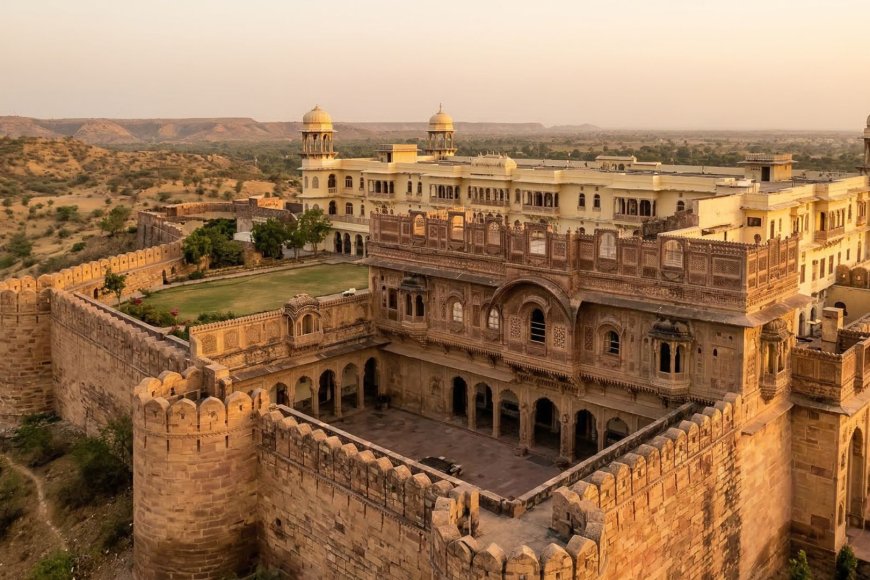
Tara opened her laptop while Lakshmi was still speaking. She found the website. She found the photographs: a fort-palace on a ridge outside Jaipur, built by the Mertia Rathores in the sixteenth century, set in a landscape of the Aravalli foothills that was different in character from the more visited Rajasthani landscapes — quieter, less trafficked, more specifically of the agricultural and semi-arid terrain that occupies the district between Jaipur and the Shekhawati region to the north. The palace architecture was the specific Rajput vocabulary of the sixteenth and seventeenth centuries — the massive defensive walls of the outer fort giving way to the more refined residential architecture of the inner palace, the carved stone screens, the painted chambers, the terraces with their views across the Aravalli terrain.
And twenty suites. Not twenty rooms. Twenty suites, each different from the others, each occupying a specific portion of the palace's historic fabric, each maintained with the specific commitment to original character that the family's continued occupation of the property produced rather than the commitment of a hotel management company to a heritage product.
She called her fiancé Vikram in London. She said: I found private. He said: where? She said: outside Jaipur. A sixteenth century palace. Twenty suites. No other guests ever. He said: how many guests can we invite? She said: the suites accommodate the immediate family and the closest friends. The day guests can be more. He said: so the people who stay at the palace are the inner circle. She said: exactly. He said: that is exactly right. She said: I know. He said: book the site visit.
This guide is for every NRI couple for whom private is not a preference but a requirement — for Tara in Sydney and every couple who deserves the complete framework for the most genuinely private palace wedding available in India.
Understanding Mundota Fort and Palace: Five Centuries of Mertia Rathore Occupation
Mundota Fort and Palace — to give the property its complete name — was built in the sixteenth century by the Mertia Rathore family, a branch of the Jodhpur royal house that was granted the Mundota thikana as a feudal estate within the Jaipur state. The family has occupied the property without interruption since its construction — five centuries of continuous habitation that has produced the specific quality of inhabited historical accumulation that distinguishes Mundota from every other heritage property in the Jaipur region.
The fort was built on a ridge of the Aravalli foothills approximately twenty-five kilometres from Jaipur, in the specific landscape of semi-arid scrub and rocky terrain that occupies the district between the city and the Shekhawati plains to the north. The position was chosen with the strategic logic of a family that needed a defensible position within easy reach of the Jaipur court — close enough to maintain the political connections that the thikana required, far enough from the city to maintain the independence that the feudal estate represented.
The construction reflects the specific character of the Mertia Rathore position — a significant noble family with the means and the ambition for substantial architectural achievement but not the unlimited resources of the royal house. The outer fort walls are massive and functional, built for defence rather than display. The inner palace, which grew across successive generations of family occupation, is more refined — the carved stone screens, the painted chambers, the jharokha windows and the interior courtyards that constitute the vocabulary of the Rajput noble residence at its most developed expression.
The current generation of the Mertia Rathore family — represented by the thikana's current head and his family — manages Mundota as a heritage property with the specific approach that makes it different from every other heritage hotel in Rajasthan: the family lives in the palace. Not in a separate wing or a separate building on the property. In the palace itself, in the rooms adjacent to the guest suites, sharing the courtyards and the terraces and the dining spaces with the guests who come to stay. This is not a managed heritage hotel. It is a family home that accepts guests — at most twenty of them at any one time, in the twenty suites that have been prepared for habitation while the family occupies the remainder of the palace.
The wedding at Mundota is not, therefore, a wedding at a heritage hotel that happens to be owned by a Rajput family. It is a wedding at a Rajput family's home, to which the family has invited the couple and their inner circle as personal guests for the duration. The distinction is not semantic. It is the quality of the entire experience — the breakfast that the family shares with the wedding guests, the conversations across the courtyard in the evening, the specific knowledge of the palace that only the people who have lived in it for five centuries possess and that they share with the guests who come to know it for three days. This is what private actually means at Mundota. Not merely the absence of other hotel guests. The presence of the family.
The Twenty Suites: What They Are and How They Work
The twenty suites of Mundota Fort and Palace are not hotel rooms in the conventional sense. They are the historic chambers of the palace, adapted for comfortable habitation while retaining the original character of the rooms as they have existed across the centuries of the family's occupation.
Each suite is different — different in size, in position within the palace, in the specific character of its decoration and its view. The suite in the tower has the views across the Aravalli foothills that the tower's height provides. The suite in the painted chamber has the original Rajput fresco decoration of the chamber's walls, maintained across generations, and the specific quality of sleeping inside a painted room. The suite with the courtyard access has the private outdoor space of the courtyard adjacent to it, available for the early morning tea and the late evening conversation. The suite at the highest level of the inner palace has both the fort view and the specific quality of elevation — of being at the summit of the historic structure, with the Aravalli landscape visible in every direction.
The allocation of the twenty suites to the wedding guests is one of the most specific and most meaningful design decisions of the Mundota wedding planning. The couple's parents in the suites with the most comfortable access to the main ceremony spaces. The grandparents in the ground-level suites that require the minimum of steps. The closest friends in the suites with the best fort views and the most extraordinary painted decoration. The couple themselves in the premium suite that the palace reserves for its most honoured guests — the room that has the complete Aravalli panorama and the carved stone screen through which the morning light enters in the specific pattern of the screen's geometric design.
The twenty-suite constraint is simultaneously the property's most significant limitation and its most specific advantage. The limitation is obvious: twenty suites means that the wedding guests who stay at the palace are a maximum of forty people, assuming double occupancy in most suites. The remaining guests — the day guests who attend the ceremonies and the receptions — must be accommodated elsewhere and transported to Mundota for each event. This is the operational reality of the Mundota wedding that the planning must address.
The advantage is less obvious but more profound: twenty suites means that the palace belongs entirely to forty people. Not to four hundred. Not to two hundred. To forty — the inner circle, the people for whom the wedding is most intimate and most personal, the people whose three days at the palace will be among the most specific and most memorable experiences of their lives. The day guests who attend the ceremonies and the receptions have the extraordinary experience of arriving at a private palace for an event. The people in the twenty suites have the extraordinary experience of living in a private palace for three days. The distinction is the difference between attending something extraordinary and inhabiting it.
The Event Spaces: A Historic Palace as the Wedding Frame
The Fort Courtyard: The Grand Outdoor Ceremony Space
The main courtyard of Mundota Fort — the large outdoor space within the fort's defensive walls, enclosed on all sides by the fort's historic architecture and open to the sky above — is the primary outdoor ceremony and reception space. The courtyard's character is the specific quality of the Rajput military-residential hybrid — the massive walls of the defensive structure enclosing the more refined architecture of the residential buildings, the scale of the enclosure producing a specific quality of grandeur that is different from the courtyard grandeur of the more elaborately decorated palace venues.
The fort courtyard accommodates up to two hundred guests for a seated ceremony and up to three hundred for a standing reception — the scale that allows the day guests to join the palace residents for the main ceremonial events without the scale becoming incompatible with the intimate character of the property. The ceremony in the fort courtyard — the mandap at the centre of the historic enclosure, the fort walls rising on all sides, the Aravalli sky above — is a ceremony setting of specific and unhurried grandeur that communicates the five-century occupation of the property in every stone around it.
The Palace Terrace: The Aravalli View Event Space
The terrace of the inner palace — the outdoor space at the summit of the residential portion of the property, with the Aravalli foothills visible in every direction and the fort walls providing the enclosure below — is the view event space: the sundowner, the intimate dinner, the morning gathering that uses the landscape as its primary element.
The terrace accommodates up to sixty guests for a standing reception and up to forty for a seated dinner. Its specific quality is the 360-degree Aravalli view — the landscape of the Jaipur region visible in every direction from the elevation of the palace ridge, the specific semi-arid beauty of the foothills terrain that is less visited and less known than the more famous Rajasthan landscapes and that has its own specific and extraordinary character.
The sundowner on the palace terrace — the pre-dinner gathering as the sun descends behind the Aravalli ridge and the sky performs its evening sequence over the fort and the landscape below — is the event that most consistently produces in the Mundota guests the specific quality of understanding where they are: the private palace on the ridge, the family around them, the forty people who have the entire property to themselves, the landscape of Rajasthan in every direction, the specific quality of an evening that belongs to no one else.
The Painted Chambers: The Intimate Dinner Spaces
The painted chambers of the inner palace — the historic rooms whose walls carry the original Rajput fresco decoration of the family's residential tradition — are available for the intimate dinner events of the wedding program. The dinner for twenty guests in a painted chamber, at a long table set within the historic room, with the fresco decoration visible on every wall and the carved stone ceiling above, is the most intimate indoor dining experience available at any venue in this entire series.
The painted chambers collectively accommodate up to twenty-five guests for a seated dinner in the most intimate configuration. The mehendi ceremony in the painted chamber — the mehndi artist working in a room whose walls have been painted for centuries — is the event that most directly communicates the specific historical depth of Mundota to the people within it.
The Garden and Orchard: The Daytime Event Space
The property's garden and orchard — the outdoor spaces at the base of the palace ridge, within the fort's outer walls — provide the daytime event space for the informal gatherings of the wedding program. The haldi in the orchard, the morning breakfast under the trees, the afternoon gathering in the garden shade — these are the events that the garden and orchard accommodate with the specific quality of a working agricultural landscape within a historic fort complex.
The orchard is not a decorative garden. It is a working orchard — the family's agricultural production, the fruit trees and the vegetable garden that have been part of the property's economy since its construction. The wedding catering that uses the orchard's produce — the fresh fruit at breakfast, the vegetables from the kitchen garden in the dinner menu — is producing a menu of genuine local provenance that the destination wedding catering rarely achieves with such specificity.
The Diwan Hall: The Formal Indoor Space
The Diwan Hall of Mundota Palace — the formal reception room of the historic residence — is the primary indoor event space, available for the ceremony that requires weather protection or the intimate dinner that benefits from the enclosed grandeur of the historic interior. The hall accommodates up to sixty guests for a seated ceremony and up to ninety for a standing reception. Its character is the formal domestic space of the Rajput noble residence — the room designed for the formal occasions of the family's public life, maintained across centuries in the specific quality of a room that knows its function and its character.
Comprehensive Pricing and Planning Reference
| Event Space | Seated Capacity | Standing Capacity | Approximate Venue Hire Per Event | Best Suited For |
|---|---|---|---|---|
| Fort Courtyard | Up to 200 | Up to 300 | ₹3,00,000–₹6,00,000 | Grand ceremony, main reception, baraat arrival |
| Palace Terrace | Up to 40 | Up to 60 | ₹1,50,000–₹3,00,000 | Sundowner, intimate dinner, morning gathering |
| Painted Chambers | Up to 25 | Up to 35 | ₹1,00,000–₹2,50,000 | Intimate dinner, mehendi, family gathering |
| Garden and Orchard | Up to 80 | Up to 120 | ₹1,00,000–₹2,50,000 | Haldi, daytime events, informal gathering |
| Diwan Hall | Up to 60 | Up to 90 | ₹1,50,000–₹3,00,000 | Indoor ceremony, formal dinner |
| Full Palace Exclusive Buyout | All spaces combined | All spaces combined | ₹5,00,000–₹10,00,000 per day | Complete exclusive use; the only option |
| Budget Category | Approximate Range | Notes |
|---|---|---|
| Accommodation — Heritage Suite per night | ₹12,000–₹20,000 | Historic chambers; each unique in character |
| Accommodation — Deluxe Suite per night | ₹18,000–₹28,000 | Superior position; fort or Aravalli views |
| Accommodation — Premium Suite per night | ₹28,000–₹45,000 | Best position; painted chambers or tower |
| Accommodation — Bridal Suite per night | ₹40,000–₹65,000 | Finest room; complete Aravalli panorama |
| Accommodation — Full Palace Buyout per night | ₹2,00,000–₹4,00,000 | All twenty suites; complete private possession |
| Catering per cover — multi-course dinner | ₹1,800–₹3,200 | Family kitchen; orchard produce incorporated |
| Catering per cover — lunch or daytime | ₹1,000–₹2,000 | Full service; garden and terrace options |
| Décor and florals per event | ₹1,50,000–₹6,00,000 | Restrained; historic fabric as primary element |
| Photography and videography | ₹2,00,000–₹7,00,000 | Palace character specialists essential |
| Sound and lighting per event | ₹60,000–₹2,00,000 | Sensitive to historic fabric; minimal footprint |
| Wedding planner fee | ₹2,50,000–₹6,00,000 | Mundota-experienced planner strongly preferred |
| Transport — Jaipur airport to Mundota | ₹1,500–₹2,500 | 45 minutes; Aravalli foothills road |
| Transport — Jaipur city to Mundota per vehicle | ₹800–₹1,500 | 25 kilometres; day guest transfers |
| Total three-day wedding (40 resident guests plus 100 day guests) | ₹25,00,000–₹50,00,000 | Most private option in entire series |
| Total three-day wedding (40 resident plus 150 day guests) | ₹35,00,000–₹65,00,000 | Full program; peak season premium applies |
The Family: What It Means to Be Hosted Rather Than Accommodated
The presence of the Mertia Rathore family in the palace during the wedding is the element that most distinguishes the Mundota experience from every other venue in this series, and it requires specific planning attention rather than being treated as a pleasant background detail.
The family's role at the Mundota wedding is not the role of a venue manager or a hotel host. It is the role of the family that owns the home in which the wedding is taking place — the host in the oldest and most complete sense of the word. The family knows the palace in the way that only five centuries of occupation produces. They know which room catches the morning light in the specific quality that makes the early riser's tea an extraordinary experience. They know which courtyard has the acoustic character that makes a small musical performance sound different from a musical performance anywhere else. They know the history of the painted chambers — which generation of the family commissioned which fresco, which event in the family's history the specific painted narrative refers to, what the formal vocabulary of the decoration is saying about the family that put it there.
This knowledge, shared across the three days of the wedding through the specific medium of the family's presence and conversation, is the dimension of the Mundota experience that no amount of historical briefing in a guest information package can replicate. The Mundota wedding guest who has breakfasted with the family, who has heard the specific stories of the palace's history from the people whose history it is, who has been shown the painted chamber's narrative by the family member who can read it — that guest inhabits the palace in a way that the guest at a managed heritage hotel, however well briefed, does not.
The planning of the Mundota wedding must include specific coordination with the family about their role during the wedding events. The family's participation in the events — their presence at the ceremony as hosts, their sharing of meals with the wedding party, their specific contributions to the cultural program — should be designed and agreed in advance rather than assumed. The family who understands what the couple wants from the three days, who has been briefed on the couple's specific interests and the international guests' specific curiosity, can calibrate their participation to produce the most specific and most meaningful experience for the guests. This conversation should happen early in the planning process and should be treated as one of the most important planning conversations of the entire wedding.
The Day Guest Management: Bringing the Ceremony to the Private Palace
The forty resident guests — the inner circle in the twenty suites — are the constant of the Mundota wedding. The day guests — the extended family and friends who attend the ceremony and the reception but who are not part of the palace residency — are the variable, and their management is the specific logistical challenge that the Mundota wedding requires planning attention.
The day guest experience at Mundota should be designed as a specific arrival experience — the journey from Jaipur to the palace, the approach along the Aravalli foothills road, the first view of the fort on the ridge, the arrival at the palace gates — that communicates to the day guests that they are arriving somewhere specific and extraordinary rather than pulling into a hotel car park. The coordinated convoy departure from Jaipur — the coaches or the car fleet departing simultaneously, the arrival at the palace gates in the late afternoon light — is the arrival design that produces the specific quality of collective discovery that the Mundota location makes available.
The day guests who arrive at the fort courtyard for the ceremony, who are within the private palace for the duration of the event, who understand that the forty people who have been living in the palace for three days are the inner circle of the wedding — these guests have a different relationship to the event than the day guests at the managed palace hotel. They are arriving at someone's private home for the most important occasion of that home's recent history. The quality of that arrival, and the quality of the event that takes place within the private palace, is different from the quality of arriving at a venue.
The day guest transport must be coordinated from Jaipur with the precision that any significant logistics operation requires. The coaches must be timed to the ceremony's needs rather than to the guests' convenience. The return transport must be coordinated to allow the day guests to depart after the reception without the chaos that the uncoordinated departure from a remote venue produces. The wedding planner's management of the day guest transport is one of the most critical operational responsibilities of the Mundota wedding planning.
Décor at Mundota: The Historic Fabric as the Primary Element
The décor philosophy at Mundota Fort and Palace is shaped by a single requirement that is more absolute than at any other venue in this series: do not cover the historic fabric. The painted chambers, the carved stone, the original plasterwork of the five-century-old palace — these are the decorative achievement of the building and they must not be obscured, competed with, or diminished by the wedding decorator's installation.
The Mundota decorator's brief is restraint. The flowers that enhance the courtyards without overwhelming them. The lighting that illuminates the historic surfaces rather than replacing them with event lighting. The table decoration at the painted chamber dinner that is modest enough to leave the painted walls as the primary visual experience rather than competing with them. The mandap in the fort courtyard that frames the historic architecture rather than obstructing it.
The specific material vocabulary that works at Mundota is the material vocabulary of the Rajput craft tradition — the handwoven textiles of the Shekhawati region, the hand-block-printed fabrics of the Jaipur tradition, the terracotta and the brass and the carved stone objects of the local craft heritage. These materials belong to the landscape and the cultural tradition that the palace itself belongs to, and they communicate a continuity between the historic fabric and the contemporary wedding that the imported luxury materials of the standard destination wedding production do not.
The colour palette that works against Mundota's warm sandstone and ochre plasterwork is the deep, muted palette of natural dyes — the indigo, the madder, the turmeric, the myrobalan — that the Rajasthani textile tradition has produced for centuries in exactly this landscape. These colours against the palace's historic surfaces produce a visual coherence that is immediately of the place, and the decorator who works from this palette rather than from the contemporary wedding colour trend is the decorator who will produce work that belongs at Mundota.
Common Mistakes NRI Couples Make With the Mundota Wedding
The first mistake is inviting too many day guests for the site to manage gracefully. Mundota's intimate character — the twenty-suite palace, the forty resident guests, the historic spaces that are proportioned for noble family habitation rather than large-scale event hosting — has a specific scale at which it works most completely. The day guest list that pushes the fort courtyard to its maximum capacity of three hundred standing guests is the day guest list that tests the property's character rather than celebrating it. The Mundota wedding that is most extraordinary is the wedding whose day guest list is sized for the property — up to one hundred and fifty day guests is the maximum at which the Mundota character is preserved and the intimate quality of the private palace is felt by everyone present.
The second mistake is not having the detailed conversation with the family before booking. The Mertia Rathore family's role in the wedding — their participation, their sharing of the palace history, their calibration of their presence to the couple's specific requirements — is not a detail to be arranged after the booking is confirmed. It is the most important planning conversation of the entire Mundota wedding and it should be the first substantive conversation after the initial enquiry. Understand what the family offers, what they enjoy sharing, what they prefer not to manage directly. Design the family's role in the wedding from this understanding.
The third mistake is over-decorating. The painted chambers and the carved stone courtyards of Mundota are the most concentrated expression of the Rajput decorative tradition available at any venue in this series. The decorator who installs a full event production over these historic surfaces is obscuring the most extraordinary thing in the space. Brief the decorator with the specific instruction: the historic fabric is the decoration. Your role is to enhance it, not to replace it.
The fourth mistake is not designing the day guest arrival as a specific experience. The day guests who arrive at Mundota in individual cars, at different times, navigating the Aravalli foothills road without coordination, who pull into the fort gates in the disorganised manner of a hotel event — these guests do not have the arrival experience that the property provides when the arrival is designed. Coordinate the day guest departure from Jaipur. Design the convoy. Time the arrival for the late afternoon light. Give every day guest the experience of arriving at a private palace as a deliberate event rather than as a logistics solution.
The fifth mistake is not using the family's knowledge of the palace in the photography brief. The Mertia Rathore family knows every extraordinary photographic position within the palace — the specific angle from the tower room that frames the Aravalli landscape in the window opening, the courtyard position at a specific time of morning when the light enters through the carved stone screen and produces the specific shadow pattern on the floor, the terrace position at sunset where the fort walls and the landscape and the sky are simultaneously in the frame. This knowledge is not available in any brochure or any portfolio. Ask the family. Before the photographer arrives, ask the family where the extraordinary positions are. They have been looking at the palace for five centuries. They know.
Tara's wedding was in October, across three days in which the forty resident guests of the twenty suites became, in the specific way that shared extraordinary spaces produce community, a group of people who had come as separate parts of two families and who left as something more unified than they had arrived. The fort courtyard ceremony on the second day, for the forty residents and the hundred and twelve day guests who had made the convoy journey from Jaipur in the late afternoon, was a ceremony that took place within five centuries of family history and that felt, to the people within it, appropriately weighted by that history.
After the ceremony, after the day guests had departed in their coordinated return convoy and the fort gates had closed, the forty resident guests sat in the fort courtyard in the specific quality of the October evening that the Aravalli foothills produce — cool, clear, the stars visible above the fort walls in the specific density that only dark-sky landscapes produce — and the family joined them.
The family's eldest member, who had been born in the palace and who had lived in it for seventy-eight years, said to Tara across the courtyard: how did you find us?
Tara said: a colleague told me. The eldest member said: people usually don't know we are here. Tara said: I know. That is why I came.
He nodded. He looked around the courtyard — the forty guests, the fort walls, the October sky — and said: it is a good reason.
Have the family conversation before any other planning decision. Invite the number of day guests that the property's character can accommodate without being overwhelmed. Brief the decorator with the instruction that the historic fabric is the decoration. Design the day guest arrival as a specific event. Ask the family where the extraordinary photographic positions are.
The palace has been private for five centuries. It will be private for your wedding. There will be no other guests. Only you, your forty, and the family who has been here since the beginning.
That is what private actually means.
Published by NRIWedding.com — The Premium Global Platform for Non-Resident Indians Planning Indian Weddings From Abroad.
0 comments
Real names and courtesy, please. Every comment is read by a person before it appears.
Nothing yet. Start it off.
Comments are closed on this article.