The State That Defined the Indian Destination Wedding
There is a reason that when NRI couples anywhere in the world begin imagining an Indian wedding, the images that surface most consistently are from Rajasthan.
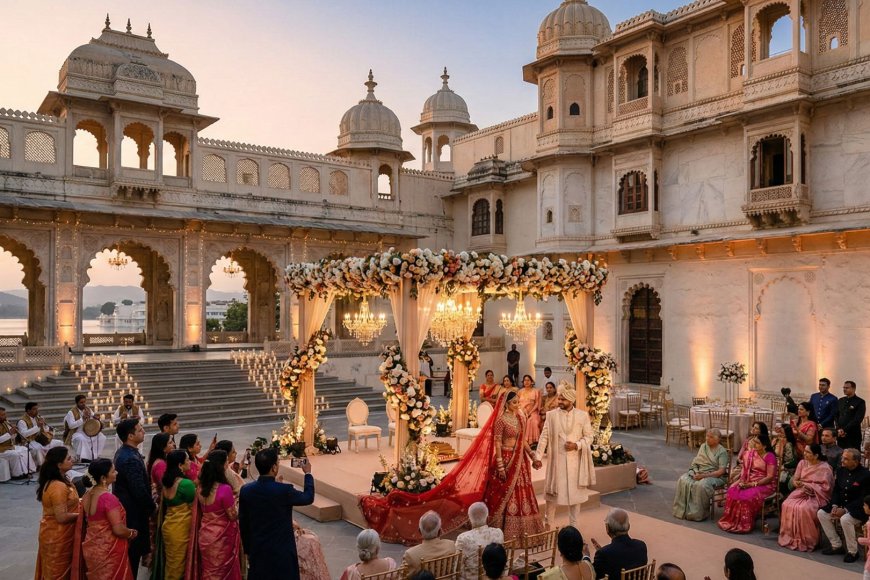
The sandstone courtyards glowing amber in the late afternoon light. The ornate jharokha windows overlooking manicured gardens. The white marble pavilions reflected in still lake water. The carved arches framing a ceremony space that has hosted celebrations for two or three hundred years. The silhouette of a hilltop fort against a desert sky at dusk.
Rajasthan did not become the default setting for the aspirational Indian destination wedding by accident. It became that setting because it has something that no other Indian state — and no other country — can replicate: a concentration of genuinely extraordinary historic palace and fort architecture, converted to world-class hospitality, in a state with good international air connectivity, a well-developed luxury tourism infrastructure, and a climate that produces reliably beautiful wedding weather across the peak season months.
For NRI couples, Rajasthan represents both the most exciting venue option in India and the most complex to navigate. The number of palace venues across Jaipur, Udaipur, Jodhpur, Jaisalmer, Ranthambore, and the smaller princely towns of the Aravalli range is vast. The quality variation between properties — in operational standards, hospitality infrastructure, event management capability, and the specific character of the architecture — is equally vast. The most iconic properties are booked eighteen months or more in advance. The less well-known properties offer extraordinary value but require more thorough independent verification.
This article is the complete comparison guide to palace venues in Rajasthan for NRI weddings. It covers the major venue categories, the city-by-city landscape, the specific properties that consistently deliver exceptional NRI wedding experiences, the operational considerations specific to palace venues, the pricing landscape, and the framework for choosing between properties when every option looks extraordinary in the portfolio.
Understanding the Rajasthan Palace Venue Landscape
Before comparing specific properties, understanding the categories of palace venue in Rajasthan helps you navigate the landscape with a clearer framework.
Category One: Iconic Operated Palaces — International Hotel Groups
The top tier of Rajasthan palace venues are historic palace and fort properties that have been taken over and operated by major Indian and international luxury hotel groups — Taj Hotels, Oberoi Hotels, AMRUT Hospitality, Leela, and others.
These properties combine authentic, extraordinary historic architecture with the service standards, infrastructure investment, and operational systems of a professionally managed luxury hotel group. They represent the most reliably excellent option in the Rajasthan palace venue market — the properties where the gap between portfolio aspiration and physical reality is smallest, where the event management infrastructure is most developed, and where the hospitality standards are most consistent.
They are also the most expensive and the most heavily booked. Peak season weekends at the top properties in this category are committed twelve to twenty-four months in advance. The price point — venue hire, catering, accommodation — reflects both the extraordinary character of the properties and their commercial power in the destination wedding market.
Examples in this category: The Taj Lake Palace in Udaipur, The Oberoi Udaivilas, The Leela Palace Jaipur, The Oberoi Rajvilas Jaipur, RAAS Jodhpur, and similar properties operated by recognised luxury hotel groups.
Category Two: Royal Family Properties — Direct Family Operations
A significant number of Rajasthan's most historically significant palace and fort properties remain in the ownership of the former royal families of the Rajput princely states — the descendants of the maharajas, raos, and thakurs who built them. Many of these families have converted their ancestral properties into boutique hotels and event venues, managed either by the family directly or through small professional management teams.
These properties offer something that the internationally operated palaces cannot fully replicate: the living connection to the family whose history permeates the building. A wedding at a family-operated palace may include the opportunity to interact with family members who are genuinely connected to the history of the space, who can share stories and context that no professional hotel staff member can provide, and who bring a personal warmth and cultural authenticity to the hosting relationship.
The operational standards at family-operated properties vary more widely than at professionally managed hotel group properties. The best family operations maintain hospitality standards that genuinely compete with professional luxury hotels. Others are more variable — strong on charm and character, less consistent on service infrastructure.
Due diligence requirement: For family-operated properties, the planner's physical site visit and honest operational assessment is more important than for any other category. The character is often extraordinary. The operational infrastructure requires independent verification.
Category Three: Converted Havelis and Smaller Palace Properties
Below the iconic palaces and the major royal family properties, Rajasthan has an extensive layer of converted havelis — merchant mansions, minor nobility residences, and smaller palace complexes — that have been converted to boutique hotels and event venues.
These properties offer architectural character and cultural atmosphere at significantly lower price points than the top-tier palaces. They are particularly well-suited to smaller, more intimate NRI weddings — events of 50 to 150 guests where the scale of the event matches the scale of the intimate spaces that smaller havelis provide.
The operational infrastructure at converted havelis is often more limited than at larger palace properties — the kitchen capacity, the accommodation block size, the bathroom provision, and the event management support may all require supplementing with external vendors and logistics arrangements.
Category Four: Heritage-Style Modern Properties
As discussed in the previous article, Rajasthan has a well-developed market of purpose-built modern properties designed in heritage architectural vocabulary — properties that evoke the language of Rajasthani palace architecture in contemporary construction.
These properties offer heritage aesthetics with modern infrastructure reliability. They typically offer more accommodation rooms than smaller historic properties, more purpose-built event spaces, and more consistent service standards.
City-by-City Comparison: Rajasthan's Major Wedding Destinations
Udaipur: The Lake City
Udaipur is widely considered the most romantic wedding destination in India — and one of the most romantic destination wedding locations in the world. The combination of the lake system, the Aravalli hills, the white marble architecture of the old city, and the particular quality of light over water at sunset creates an aesthetic environment that is essentially unrivalled for wedding photography and atmosphere.
The Venue Landscape
Udaipur's palace venue market is dominated by properties on or overlooking the lake system — Lake Pichola and Lake Fateh Sagar. The most iconic properties are island or lakeside locations where the water provides a defining element of the wedding aesthetic.
The Taj Lake Palace
Arguably the most iconic wedding venue in India — a white marble palace built in the mid-eighteenth century that occupies an entire island in Lake Pichola. The approach by boat is one of the most dramatic venue arrival experiences available anywhere in the world. The palace interior — white marble, coloured glass, carved arches — provides a backdrop of extraordinary beauty.
The practical reality: The island location means that all vendors, all equipment, all guests, and all logistics arrive by boat. The operational complexity of this is significant. The venue's professional management — it is operated by the Taj Hotels group — means that this complexity is professionally managed, but it adds an operational layer that lakeside or mainland properties do not have. The property has limited accommodation — guests who are not staying in the palace must be accommodated at hotels in the city and transported by boat. The scale of events that can be hosted is constrained by the island footprint.
Best for: NRI couples for whom the iconic, irreplaceable quality of the Lake Palace experience is the primary priority — couples who are prepared to manage the logistical complexity in exchange for a wedding at one of the world's most extraordinary venues.
The Oberoi Udaivilas
A purpose-built luxury resort on the banks of Lake Pichola — designed in the architectural vocabulary of a Mewar palace but built to modern luxury resort standards. The Udaivilas offers the visual language of Rajasthani palace architecture with the operational infrastructure of an Oberoi property — one of the most reliably excellent luxury hotel groups in India.
The practical reality: Not a historic palace — a modern property built to heritage specifications. For couples for whom authentic heritage history is paramount, the Udaivilas is in the hybrid category rather than the genuine heritage category. For couples who want the visual aesthetic of Udaipur palace architecture with the operational reliability of a professionally managed modern resort, it is one of the best options available in India.
Best for: NRI couples who want the Udaipur palace aesthetic with minimal operational uncertainty and maximum service reliability.
Fateh Prakash Palace and Shiv Niwas Palace
These properties — operated by the HRH Group, the hotel management arm of the Mewar royal family — occupy the City Palace complex directly on Lake Pichola. The connection to the living Mewar royal family, the extraordinary City Palace setting, and the authentic heritage architecture make these properties genuinely distinctive.
The practical reality: The HRH Group operates these properties professionally, but the family-operated character means more variation in operational consistency than at an Oberoi or Taj property. The City Palace complex setting — with its proximity to the active public areas of the palace — means that the event experience is slightly less private and exclusive than at fully buyout properties. The authentic royal connection is, however, genuinely compelling.
Best for: NRI couples for whom the authentic royal connection and the City Palace setting are primary priorities, and who are prepared for the somewhat less predictable operational experience that family-operated properties can involve.
Practical Udaipur Considerations for NRI Couples
- Air connectivity: Udaipur's airport handles domestic connections but limited direct international flights. Most international guests will connect through Mumbai or Delhi. Factor the connection journey into the guest travel plan.
- Peak season booking: Udaipur is the most heavily booked destination wedding market in India. November through February peak season weekends at top properties require booking 18 to 24 months in advance.
- Guest accommodation: Udaipur's luxury hotel market has grown but remains limited relative to the demand generated by destination weddings. Block guest accommodation well in advance — ideally at the time of the venue booking.
- Transportation: The old city's narrow lanes are not navigable by large vehicles. Guest transportation logistics require specific planning.
Jaipur: The Pink City
Jaipur offers a different kind of Rajasthan palace wedding experience — more urban, more accessible, and with a venue landscape that spans the iconic to the intimate. As the capital of Rajasthan with a major international airport and well-developed luxury hotel infrastructure, Jaipur is the most logistically straightforward of Rajasthan's major destination wedding cities.
The Venue Landscape
Jaipur's palace venue market ranges from the grand hotel palaces that anchor the luxury end of the market to a large number of smaller havelis and palace properties distributed through the old city and its surroundings.
The Rambagh Palace — Taj Hotels
The most iconic Jaipur palace wedding venue — a former maharaja's residence converted to a luxury hotel by the Taj group. The Rambagh's grounds, architecture, and Taj service standards make it one of the premier palace wedding venues in India.
The practical reality: The Rambagh is a full-scale luxury hotel with extensive grounds and multiple event spaces capable of handling large NRI weddings. The Taj group's event management expertise and service infrastructure are reliably excellent. The property books heavily for peak season — commitment well in advance is essential.
Best for: NRI couples planning a large-scale, high-production Jaipur wedding who want the combination of iconic palace architecture and reliable luxury hotel group operational standards.
The Leela Palace Jaipur
A heritage-style modern property — not a historic palace, but designed in the Rajasthani architectural vocabulary with modern construction and international luxury hotel standards. The Leela Palace Jaipur offers a genuinely excellent wedding venue experience with the operational infrastructure of a world-class luxury hotel.
The practical reality: For NRI couples who want the Jaipur palace aesthetic with the absolute consistency of a globally managed luxury brand, the Leela Palace is one of the most reliably excellent options in the city. The fact that it is not a historic palace will matter to some couples and not at all to others.
Best for: NRI couples prioritising operational reliability and international service standards in a Rajasthani palace aesthetic setting.
Samode Palace
Located approximately 45 minutes from Jaipur city, Samode Palace is a genuine Rajput-era palace complex operated by the Samode family — one of the best examples of a privately operated heritage property that achieves both authentic heritage character and genuinely excellent hospitality standards.
The practical reality: Samode's location outside Jaipur city requires guest transportation planning — most guests will be accommodated in Jaipur and transported to the venue. The distance also means that the property can be taken over exclusively more readily than urban Jaipur properties, creating a genuine destination feel for wedding guests. The family operation means a personal, culturally immersive experience that a hotel group cannot replicate.
Best for: NRI couples who want an intimate, culturally authentic palace experience with genuine family hospitality, and who are comfortable managing the transportation logistics of a property 45 minutes from the city.
Practical Jaipur Considerations for NRI Couples
- Air connectivity: Jaipur International Airport handles direct international flights from several Gulf destinations and connections through Delhi and Mumbai. The best-connected of Rajasthan's major wedding cities for international guests.
- Guest accommodation: Jaipur has a well-developed luxury hotel market with multiple excellent options near the main palace venues. Guest accommodation planning is more straightforward than in Udaipur.
- Season: Jaipur December evenings can be cold — specifically, cold enough to be uncomfortable for guests in outdoor evening ceremonies without adequate heating provision. Factor evening temperature into function planning.
Jodhpur: The Blue City
Jodhpur occupies a distinct position in the Rajasthan palace venue landscape — dominated by the extraordinary Mehrangarh Fort, one of the most impressive fort complexes in India, which rises dramatically above the blue-painted houses of the old city.
The Venue Landscape
RAAS Jodhpur
A beautifully designed boutique luxury hotel built within the historic walls of the old city with views of Mehrangarh Fort. RAAS offers a sophisticated, architecturally distinctive venue experience — contemporary design within a historic setting — with excellent service standards.
The practical reality: RAAS is a smaller property — well-suited to intimate NRI weddings of up to approximately 150 guests. Larger events require a different venue configuration. The fort view is extraordinary and produces distinctive photography. The boutique scale means a more personal experience than the larger palace hotels.
Best for: NRI couples planning intimate to medium-scale weddings who value architectural sophistication and the extraordinary fort backdrop.
Mehrangarh Fort — Event Spaces
The fort itself — one of the most impressive historic structures in India — is available for private events through the Mehrangarh Museum Trust. A wedding with Mehrangarh Fort as the setting is a genuinely once-in-a-generation experience.
The practical reality: Fort events involve the operational complexity of a non-hotel venue — all catering, décor, infrastructure, and logistics must be brought in. The venue hire and the logistics cost make this option appropriate primarily for high-budget weddings where the extraordinary setting justifies the additional operational complexity.
Best for: NRI couples with significant budgets who want a genuinely iconic, irreplaceable setting and who have a planner experienced in managing logistics at non-hotel venues.
Umaid Bhawan Palace — Taj Hotels
One of the largest private residences in the world, a portion of which is operated as a luxury hotel by the Taj group while still serving as the residence of the Jodhpur royal family. The combination of the extraordinary architecture — art deco meets Rajput — and the living royal connection makes Umaid Bhawan a unique venue proposition.
The practical reality: Umaid Bhawan is one of the most prestigious and expensive palace wedding venues in India. The Taj group's management ensures operational excellence. The scale of the property is extraordinary — capable of hosting large events across multiple spectacular spaces.
Best for: High-budget NRI weddings where the prestige, scale, and extraordinary architecture of Umaid Bhawan are the primary priorities.
Practical Jodhpur Considerations for NRI Couples
- Air connectivity: Jodhpur has domestic connections but limited direct international flights. International guests will connect through Delhi or Mumbai.
- Guest accommodation: Jodhpur's luxury hotel market is more limited than Jaipur. For large guest counts, accommodation planning requires attention.
- The blue city: The blue-painted old city of Jodhpur is one of India's most visually distinctive urban environments. Incorporating excursions and experiences in the old city into the wedding week programme enhances the guest experience significantly.
Jaisalmer: The Desert City
Jaisalmer occupies a unique and niche position in the Rajasthan palace venue landscape — a desert city whose golden sandstone fort and surrounding dunes create an aesthetic that is unlike anywhere else in India.
The Venue Landscape
Jaisalmer's venue market is smaller and less developed than Jaipur, Udaipur, or Jodhpur. The most distinctive wedding experiences in Jaisalmer are at desert camp venues outside the city — luxury tented camps set among the sand dunes of the Thar Desert — rather than at traditional palace hotel venues.
Desert Camp Weddings
A desert camp wedding in Jaisalmer — a private, luxury tented setup among the dunes, with the ceremony, dinner, and entertainment under the desert sky — is one of the most distinctive and memorable wedding experiences available anywhere in the Rajasthan portfolio.
The practical reality: The logistics of a desert camp wedding are genuinely complex — everything must be transported to the site, weather is a real variable, and the infrastructure of a luxury camp, however well-executed, is different from that of a palace hotel. For NRI couples with adventurous guests who value the unique and memorable over the predictable and comfortable, the Jaisalmer desert camp experience delivers something irreplaceable.
Best for: NRI couples planning intimate destination events — typically 50 to 100 guests — where the extraordinary, once-in-a-lifetime character of the desert setting is the primary priority.
Smaller Princely Towns: The Hidden Gems
Beyond the major cities, Rajasthan has dozens of smaller princely towns — Alwar, Bikaner, Bundi, Bharatpur, Dundlod, Mandawa, Kishangarh — each with its own palace complexes, havelis, and heritage properties.
These smaller town venues offer qualities that the major destination cities cannot: genuine exclusivity, lower competition for dates, often extraordinary architectural character, and — in many cases — the most authentic expression of living Rajput heritage.
The operational caveat: Smaller town venues require thorough due diligence. The distance from major airports, the limited supporting infrastructure — guest accommodation, transportation, vendor access — and the less developed professional event management ecosystem mean that the planner's role is even more critical in these locations.
For NRI couples whose planner has deep Rajasthan experience and can manage the logistics of a smaller town wedding, these hidden gem venues can produce some of the most extraordinary and distinctive wedding experiences in the country.
The Operational Considerations That Apply Across All Rajasthan Palace Venues
The Generator Situation
Power reliability varies across Rajasthan — both in urban locations and particularly in smaller towns and rural heritage properties. Every palace venue should be asked specifically about their generator capacity and backup power provision. A generator that covers lighting but not air conditioning is not adequate for a summer or monsoon event. A generator that covers the event spaces but not the accommodation block creates problems for guests after the functions end.
Ask specifically: What is the total generator capacity in KVA? Does the backup power cover all event spaces, all accommodation, and all kitchen equipment simultaneously? What is the changeover time from main power to generator?
The Sound Restrictions
Many heritage palace properties — particularly those in urban or semi-urban locations, and particularly those that are part of conservation or UNESCO World Heritage contexts — have specific restrictions on sound levels and on the hours during which music can be played.
For NRI couples planning late-night celebrations with live music or DJs, the sound restrictions at a specific venue are a critical booking consideration. A reception that must end at 10pm because of municipal noise regulations, or a sangeet where the DJ cannot exceed a specific decibel level, significantly affects the event experience.
Ask specifically: What are the permitted sound levels and the cut-off time for music? Are there seasonal or date-specific variations? Have there been complaints from neighbours that have further restricted permissions?
The Accommodation Block Reality
Many Rajasthan palace venues — particularly smaller heritage properties — have limited on-site accommodation. A beautiful palace that accommodates 40 guests on-site but is hosting a 200-person wedding requires a satellite accommodation plan — guest hotels in the nearest city, transportation between accommodation and venue, and the management of a distributed guest experience.
For NRI couples for whom the immersive, all-in-one property experience — everyone together in the same stunning heritage setting — is important, the accommodation block size is a primary venue selection criterion.
Ask specifically: How many rooms and suites are available on-site? What is the quality of the accommodation relative to the event spaces? What is the venue's experience managing satellite accommodation arrangements for guests who cannot stay on-site?
The Monsoon Question
Rajasthan's wedding season is primarily October through February — the period after the monsoon and before the summer heat. The monsoon itself — June through September — is not typically a wedding season in Rajasthan, both because of the weather and because of the auspicious calendar.
However, the transition months — September and March — can produce weather variability that affects outdoor events. And even within the October-February peak season, cold December and January evenings require heating provision for outdoor ceremonies.
The specific questions: What is the average temperature at the time of your wedding? What outdoor heating or cooling provision does the venue have? What is the venue's rain contingency plan and what indoor backup exists for all outdoor functions?
The Pricing Landscape
Rajasthan palace venue pricing spans an extraordinary range — from smaller haveli properties that can be hired for a weekend at relatively accessible rates to the most iconic properties where a full weekend buyout can represent one of the largest single line items in any wedding budget.
Understanding the pricing structure helps set realistic expectations before the shortlisting process begins.
What Palace Venue Pricing Typically Includes
Most Rajasthan palace venue pricing is structured around some combination of:
Venue hire: The cost of using the event spaces for the contracted functions. This may be quoted per event space, per function, or as a package for the full wedding programme.
Accommodation: Room rates for the on-site accommodation block. These are typically quoted per room per night and are a separate billing line from venue hire.
Catering: Per-plate costs for food and beverage service across all functions. Some properties include catering in a per-head package rate. Others quote separately.
Minimum spend commitments: Many premium palace properties — particularly internationally operated ones — have minimum spend commitments for wedding buyouts. These commitments combine room revenue, venue hire, and catering into a total minimum that the couple commits to spending at the property.
The True Total Cost Calculation
The headline venue hire quote is rarely the total cost of a palace wedding. Add:
- GST at applicable rates across all service categories
- Vendor access fees for external vendors working at the property
- Transportation costs for guest transfers if accommodation is off-site
- Additional décor infrastructure costs specific to the heritage space — outdoor lighting, flooring protection, structural elements the décor team needs to work around
- The cost of supplementing the venue's infrastructure — additional generators, additional bathroom facilities, additional catering support for very large events
How to Choose Between Rajasthan's Palace Venues
When every venue on your shortlist looks extraordinary, the decision framework needs to go beyond the portfolio.
Prioritise Operational Verification Over Aesthetic Appeal
The most beautiful palace in your portfolio is not necessarily the right venue for your wedding. Prioritise the venues where your planner's physical assessment confirms that the operational infrastructure matches the aesthetic aspiration. A palace that photographs magnificently but has infrastructure challenges that your planner has flagged is a higher-risk choice than a slightly less dramatic palace with excellent operational foundations.
Match the Venue Scale to Your Wedding Scale
The most intimate havelis and smaller palace properties produce the most immersive, exclusive guest experiences — but only at guest counts that the property can accommodate without feeling crowded. The grandest palaces are extraordinary at large scale but can feel underpopulated with a small intimate guest count. Match the scale of the venue to the scale of your wedding rather than simply choosing the most impressive property regardless of fit.
Consider the Full Guest Journey
The venue is not just the event spaces. It is the arrival experience, the accommodation, the journey between functions, the morning-after breakfast setting. Choose a venue where the full guest journey — from arrival to departure — is as considered and as excellent as the event spaces themselves.
Think About What the Photographs Will Say
Different Rajasthan palace venues produce photographs with different characters. Udaipur lake palaces produce photographs that say lake, water, marble, romance. Jodhpur fort venues produce photographs that say dramatic stone, desert landscape, ancient grandeur. Jaipur palace hotels produce photographs that say Rajput splendour, pink stone, ornate detail. Think about what you want the photographs of your wedding to communicate and choose the venue whose character aligns.
The Right Rajasthan Palace Is the One That Is Right for Your Wedding
Rajasthan's palace venues represent the pinnacle of what Indian destination wedding settings can offer. No other region in the world concentrates so much extraordinary historic architecture — so many genuinely ancient, genuinely beautiful, genuinely culturally significant buildings — in such a well-developed, well-connected, well-resourced destination wedding market.
The challenge is not finding an extraordinary venue. The challenge is finding the extraordinary venue that is right for your specific wedding. Right for your guest count. Right for your operational requirements. Right for your décor vision. Right for your budget. Right for the guest experience you want to create. Right for the photographs you want to take home.
The framework is clear: Understand the categories. Research the city landscapes. Verify the operational reality through professional physical assessment. Match the venue scale to your wedding scale. Consider the full guest journey. Think about what the photographs will communicate.
And then commit — with the confidence that comes from a decision made with complete information rather than with the portfolio-induced rapture that every extraordinary Rajasthan palace photograph is specifically designed to produce.
The palace that is right for your wedding is waiting. The process described here is the one that finds it.
0 comments
Real names and courtesy, please. Every comment is read by a person before it appears.
Nothing yet. Start it off.
Comments are closed on this article.