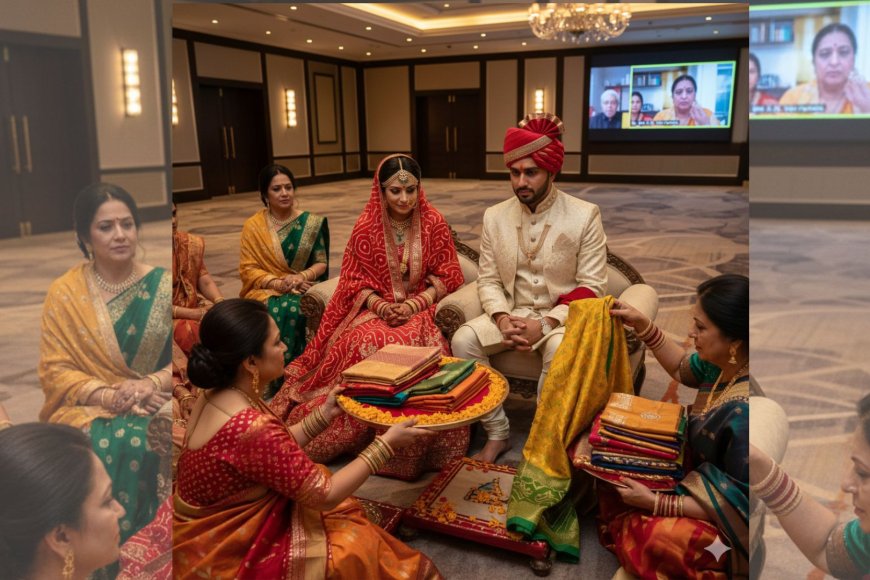
In Rajasthani weddings, the gift of a garment is never just fabric — it is a family's way of saying: you belong to us now. The Pehravni ceremony, a deeply rooted tradition of gifting clothes and textiles to the bride, groom, and their families, is one of the most visually magnificent and emotionally loaded rituals in all of Indian matrimonial culture. For NRIs planning weddings far from the golden sands of Rajasthan, Pehravni is both a logistical puzzle and an irreplaceable act of cultural love — one worth every effort to preserve.
You grew up watching your nani fold sarees the way other women fold secrets — carefully, with both hands, with reverence. You watched your mother pull out a trunk every Diwali that smelled of sandalwood and camphor, lifting out lehengas wrapped in muslin cloth as if they were sleeping children. Nobody told you what those garments meant. Nobody had to.
Now you're sitting in your apartment in Dallas or Brampton or Birmingham, a few months from your own wedding, and you're trying to explain to your venue coordinator why you need a ceremony where your future in-laws bring suitcases full of clothes as gifts — and why it has to happen before the baraat, and why the fabrics matter more than the price tags, and why no, it cannot be replaced by an Amazon wishlist.
This is Pehravni. And if you are Rajasthani, or marrying into a Rajasthani family, this is the ceremony that will make your mother-in-law cry in the best possible way.
🌟 DID YOU KNOW?
- Rajasthan's textile tradition is among the oldest in Asia — Bandhani (tie-dye) fabric from this region dates back over 5,000 years and is documented in the Indus Valley Civilisation. The garments gifted in Pehravni often carry these ancient dyeing traditions.
- In traditional Rajput households, the number of garments gifted during Pehravni was a direct signal of a family's social standing — some royal families gifted 108 outfits, a number sacred in Hindu cosmology.
- According to diaspora wedding surveys, over 67% of Rajasthani NRI families in the UK and Canada report simplifying or combining Pehravni with the Chunri ceremony due to venue time constraints — yet rate it as among the top three rituals they most wanted to preserve in full.
What Is Pehravni?
Pehravni (from the Hindi/Rajasthani root pehenna, meaning "to wear") is a pre-wedding gifting ceremony rooted deep in Rajasthani and broader North Indian wedding tradition, in which the bride's family presents curated sets of clothing — and sometimes jewellery and accessories — to the groom and his family, and the groom's family reciprocates with elaborate gifts for the bride. The exchange is rarely equal in a mathematical sense, but it is always intentional. Every garment is chosen with meaning.
The ceremony typically takes place a day or two before the main wedding, often the evening before the baraat (groom's wedding procession). In the bride's home or a ceremonial gathering space, the women of both families assemble together. The bride's mother leads the presentation, bringing forward folded garments on trays called thals, often covered in marigold petals or chunri fabric. The groom is dressed by the women of his soon-to-be wife's family — a profound act of adoption. His mother, sisters, and female relatives are gifted sarees, salwar suits, and dupattas selected specifically for each person.
What makes Pehravni spiritually and emotionally distinct is its directionality. Unlike a simple exchange of gifts, this ceremony is about the bride's family actively clothing the people she is about to join. It is an act of welcome in reverse — the family she is leaving behind dressing the family she is walking toward. The shagun (auspicious blessing) embedded in every garment means that the cloth is not just decorative. It is protective. It carries prayers in every thread.
Community Comparison Table
| Community / State | Local Name | Key Tradition | How NRIs Abroad Adapt It |
|---|---|---|---|
| Rajasthani (Marwari) | Pehravni / Poshak | Bride's family gifts full sets of clothes to groom and all his relatives; groom dressed by bride's maternal family | Ceremony held at hotel or community hall; garments sourced from India or speciality stores in Southall / Devon Ave Chicago |
| Rajasthani (Rajput) | Poshak Ceremony | Emphasis on royal fabrics — silk brocades, zari-bordered dupattas; 5 to 11 sets gifted minimum | Families ship handpicked outfits from Jaipur via courier; combined with Tilak ceremony to save time |
| Himachali | Shagun da Kapda | Woollen shawls and Kullu-weave fabrics gifted at betrothal; function more as betrothal sealing than full exchange | Himachali shawls brought in luggage from India; ceremony done morning-of in family home |
| Garhwali | Bhaat Ceremony | Brothers of the bride bring fabrics and sarees as part of Bhaat gifting, separate from main wedding day | Garhwali diaspora in Toronto hold Bhaat and Pehravni-equivalent on same afternoon to combine rituals |
| Kumaoni | Maiti ka Bhaat | Maternal family's fabric gift is considered sacred; specific saree colours tied to community customs | Fabric gifted symbolically — one saree instead of full sets, with letter explaining full tradition to non-Indian family |
| Kashmiri Pandit | Wanvun (ceremonial) / Dejhoor gifting | Kashmiri silver jewellery and phiran cloth gifted; garment exchange during Lagan ceremony | Phiran fabric ordered from Srinagar artisans and shipped; community pandits in Mississauga guide the sequence |
| Punjabi | Rokna / Chunni Ceremony garment gifting | Groom's family drapes chunni over bride; garments gifted during Rokna and Anand Karaj prep | Combined with Roka and held in living room; garments bought from Southall Broadway or Gerrard St East Toronto |
| Marathi | Sakhar Puda / Saree gifting | Green saree gifted by groom's family to bride at engagement; first wearing is ceremonial | Green Paithani saree sourced from Pune shops online; ceremony held separately from main mehndi evening |
| Tamil | Nalangu / Seer (dowry gifting) | Elaborate Seer tray presentation with sarees, jewellery, and household items; highly public and photographed | Seer trays ordered through Tamil wedding vendors in Markham, Ontario or Harrow, London |
| Bengali | Tattwa | Decorated trays carrying sarees, sweets, fish, and auspicious items sent from groom's family to bride | Tattwa trays assembled in Melbourne or Houston with bought items and photographed for relatives in Kolkata via video |
| Rajasthani (Jain) | Pehravni with Jain modifications | Same structure but without fire rituals; Jain priests recite verses; only vegetable-dyed fabrics preferred by some families | Jain centres in Leicester and Wembley provide priests; organic/natural fabric shops in East London sourced for dye-conscious families |
The Meaning Behind the Ritual
In the Rajasthani worldview, a home is not made of walls — it is made of relationships, and relationships are made visible through acts of care. Clothing someone is among the most intimate acts one human being can offer another. To dress a person is to acknowledge them fully: their body, their presence, their place in your life.
The Pehravni embodies a philosophy found throughout Indian spiritual thought — that the material world, when offered with bhavna (intention and devotion), becomes sacred. The fabrics presented are not objects. They are prayers with weight. The groom, dressed by his bride's family, undergoes a symbolic transformation. He is no longer only his mother's son. He becomes part of a new web of belonging.
The shagun embedded in the gifting is connected to Lakshmi, the goddess of abundance and prosperity, whose blessings are invoked at thresholds of change. A wedding is the ultimate threshold. And in Rajasthani culture — shaped by desert resilience, Rajput honour, and centuries of trade along ancient routes — the act of gifting fine fabric to another family is also a statement: we are not sending our daughter empty-handed into your world. We are dressing it with our love.
For a non-Indian partner or family member trying to understand this: Pehravni is the moment one family says to another, you are ours now — and we will clothe you in that truth.
Doing Pehravni Abroad: The Practical Reality
You are in Sydney or Scarborough, and you've just committed to doing a full Pehravni. Your family is thrilled. The practical details, however, are yours to navigate — and they are real.
The garments are the centrepiece, and sourcing them abroad requires planning at least three to four months ahead. Families with contacts in Jaipur, Jodhpur, or Bikaner will often have a trusted cloth merchant coordinate the full set — bandhani sarees, silk dupattas, brocade kurtas — and ship in a single large parcel. For families without that direct line, the Wembley High Road in London is home to multiple Rajasthani and Gujarati fabric shops where bandhani and leheriya (wave-pattern dyed) fabric can be found in good supply. In Toronto, Gerrard Street East and Markham's Ninth Line corridor have Indian fabric shops that carry North Indian bridal stock. In Houston, Hillcroft Avenue is your destination. In Sydney, the Parramatta Road shops in Auburn carry a solid range of subcontinental fabrics, and it is worth calling ahead to ask specifically for Rajasthani stock.
The pandit question is always delicate. Pehravni can be conducted with or without a pandit's formal presence — in some Rajasthani families it is entirely a women-led ceremony — but if your family wishes for Sanskrit shlokas and a proper mangalachar (auspicious recitation), you will need a pandit familiar with Rajasthani customs specifically, not a generalised North Indian priest. NRI.Wedding maintains a vetted directory of region-specific pandits across diaspora cities. Book early — Rajasthani-tradition pandits are in high demand during wedding season.
Venue logistics can be tricky. Many UK and Australian venues have strict restrictions on open flames. The good news is that Pehravni itself does not require a fire ritual — the havan (sacred fire) belongs to other ceremonies. Pehravni is fundamentally a gathering, a presentation, and a dressing. A community hall or large hotel function room works beautifully, especially if decorated with marigold strings and thals on low tables covered in red cloth.
For coordinating with relatives in India, especially grandparents or elders who cannot travel, set up a dedicated video call on a large screen or TV monitor during the ceremony. If your family is in Rajasthan (IST), the best overlap windows are 6:00–8:00 PM IST, which aligns with early morning in Toronto (8:00–10:00 AM) and mid-morning in London (12:30–2:30 PM). A designated family member should hold the tablet and walk it through each gifting moment so elders can give their aashirwad (blessings) in real time.
Doing Pehravni as a Destination Wedding in India
If your wedding is taking place in India, Pehravni comes alive in ways that are difficult to replicate abroad — and Rajasthan offers some of the most spectacular backdrops in the world for this ceremony.
Jaipur remains the gold standard, with its centuries-old bazaars where every fabric shop on Johari Bazaar and Bapu Bazaar can supply garments that are made for exactly this moment. Jodhpur offers fort venues like Mehrangarh or Umaid Bhawan Palace where the ceremony takes on an almost cinematic quality. Udaipur's lake palaces are increasingly popular for NRI destination weddings, and local coordinators there are well-versed in managing Pehravni protocol.
When briefing local pandits, provide them with your specific family's regional customs — Marwari, Rajput, Shekhawati — as variations exist even within Rajasthan. A one-page written note (which NRI.Wedding can help you draft) outlining your family's sequence, the specific garments to be presented, and the order of blessing works far better than a phone call on the day.
For non-Indian guests attending, assign a bilingual family member or hire a cultural narrator who can explain each step in English as it unfolds — it transforms Pehravni from a confusing colourful event into an experience your guests remember for years.
What You Need: Ritual Checklist
Ritual Items Folded garments for groom (minimum one full set: kurta, dhoti or churidar, stole), individual sarees or salwar suits for each female member of the groom's immediate family, a matching dupatta for the groom's mother, decorated thals (presentation trays) lined with red cloth or flower petals, supari (betel nut) and mishri (rock candy) as auspicious accompaniments, sindoor and kumkum in small bowls, marigold garlands for the space, and a gift envelope with shagun amount for the groom.
People Required The bride's mother leads the ceremony. The bride's maternal aunts and elder female relatives assist in dressing. Female members of the groom's family receive gifts in order of seniority — mother-in-law first, then sisters, then other relatives. A pandit is optional but welcomed. A designated photographer or videographer should be present as this is among the most photogenic moments of the entire wedding.
Preparation Steps Confirm the full list of groom's female relatives and their approximate sizes at least six weeks before. Source or order garments eight to twelve weeks ahead. Organise thals one week before. Brief the groom's family on the sequence and timing. Prepare a video call link for India-based relatives. Set up the ceremony space two hours before start time.
NRI.Wedding connects couples with verified Rajasthani vendors, experienced pandits, and photographers who understand the poetry of this ceremony — find them all in our vendor directory.
5 Questions NRI Couples Always Ask
Can we do Pehravni in a rented banquet hall that doesn't have a designated ceremony space?
Absolutely — and many NRI families do exactly this. Pehravni requires no altar, no fire, and no outdoor space. A cleared section of a banquet hall with low tables, a few rows of seating for both families facing each other, and some warm lighting is entirely sufficient. Ask your venue to remove unnecessary furniture from one corner; bring your own red tablecloths and marigold strings. The ceremony creates its own sacred space through the intent of the people in it.
My partner is not Indian. How do I include them meaningfully in Pehravni without it feeling like a performance for them?
The most beautiful thing about Pehravni is that it is already about inclusion — the entire ceremony is your family dressing and welcoming someone new. Seat your partner beside you during the gifting and have a family elder address them briefly in English, explaining that the garment being placed before them is your family's way of saying: you belong to us now. Many non-Indian partners describe this as the most moving moment of the entire wedding.
How do I find a Rajasthani pandit specifically in the UK or Canada?
General Hindu pandits can perform many Indian ceremonies but may be unfamiliar with specifically Rajasthani mangalachar verses and customs. NRI.Wedding's pandit directory filters by regional tradition. Alternatively, contact Marwari community associations in Leicester, Wembley, or Mississauga — they often maintain lists of visiting priests who come seasonally from Rajasthan.
Our relatives in Jaipur cannot travel. How do we make the video call feel real and not like an afterthought?
Use a large monitor or smart TV rather than a tablet propped against a vase. Assign one family member as the dedicated "guide" who carries the camera through each moment — not just a static wide shot. Before the ceremony begins, call in and let elders see the setup, the thals, the garments. Let them give their blessing before the first gift is presented. They will feel present, not observing.
We've already had a civil ceremony in the UK. Does the order of religious and civil ceremonies matter for Pehravni?
Pehravni is a pre-wedding gifting ritual and has no bearing on legal marital status. It can happen before or after your civil registry, and many NRI couples do their civil ceremony months before the religious wedding. The only timing that matters is that Pehravni happens before the main religious ceremony — it is a preparation, a welcoming, a dressing before the sacred vows.
The Emotional Angle
There is a particular kind of grief that Rajasthani mothers carry to weddings abroad — not the grief of loss, but the grief of distance. When a mother in Mississauga opens a trunk she brought on the plane from Jaipur, packed with sarees she chose herself, held against her cheek in the shop to check the colour, argued over the price of — that trunk is not luggage. It is everything she could not say on the flight over.
She watched the city from the airplane window and thought: my daughter is getting married here. In the cold. In a building that smells of carpet and catering. And yet.
And yet she opens the trunk. She lifts the first saree — red and gold, bandhani-printed, the same pattern her own mother-in-law gifted her decades ago in a village in Shekhawati that her grandchildren will probably never see. She holds it out to her son's bride's mother across a banquet hall in Ontario.
This is Pehravni. This is what it looks like when culture refuses to die. When a woman decides that no amount of distance will make her show up empty-handed to the most important day of her child's life.
The tears at Pehravni are not for what is lost. They are for what survived the journey.
A Moment to Smile
At a Pehravni held in a community hall in Mississauga last spring, everything was going beautifully — until the groom's eldest maasi (maternal aunt) discovered that the salwar suit chosen for her was two sizes too small. The bride's mother, who had not quite believed her daughter's warning that "Maasi has changed a lot since your last visit," went a particular shade of pale.
What followed was a twenty-minute impromptu trip to the nearest Indian clothing store by three aunties in full jewellery, returning victorious with a mustard yellow suit that was not the plan but was, as the groom's grandmother announced loudly, "actually much nicer than the pink one." The original suit was gifted to the bride's teenage cousin, who was delighted.
The Pehravni continued, forty minutes delayed, with a groom who had tears in his eyes from trying not to laugh. The mustard suit has since become the most-photographed garment in the wedding album.
Quotes from the Diaspora
"My mother-in-law flew in from Bikaner with a suitcase that was entirely garments for Pehravni. Not one personal item. When I asked her why she hadn't packed anything for herself, she said: these are for myself. This is who I am. I think about that every time I open my wardrobe." — Divya Rathore, Rajput community, Calgary
"My son married a girl from Gurgaon and we were in Houston. I didn't know any vendors, I didn't know the hall, I barely knew the road. But I knew exactly which sarees to give and in what order because my mother taught me and her mother taught her. That knowledge doesn't need a passport." — Sunita Singhvi, Marwari community, Houston
"Nobody warned me that I would cry during Pehravni. I thought I would cry during the vows. But when my future mother-in-law draped a chunri over my head with her own hands and said 'you are my daughter now' — I just completely fell apart. In the most beautiful way." — Priya Bhandari, Rajasthani-Punjabi family, Melbourne
Your Roots Travel With You
Pehravni is one of those rituals that seems, on the surface, to be about clothes. But spend five minutes in a room where it is happening and you understand immediately: this is about love made tangible. About families reaching across a threshold and saying, with silk and cotton and bandhani and gold thread, we see you, we welcome you, we dress you in our belonging.
NRI.Wedding exists precisely for moments like this — to make sure that no family has to compromise the depth of their culture because of a postcode. From verified Rajasthani pandits in London, Toronto, Houston, and Melbourne, to fabric vendors who know the difference between a Marwari leheriya and a Shekhawati print, to photographers who understand the light that falls on a Pehravni thal — we are here to help you do this right.
Your roots travel with you. Let them dress the ones you love.
0 comments
Real names and courtesy, please. Every comment is read by a person before it appears.
Nothing yet. Start it off.
Comments are closed on this article.