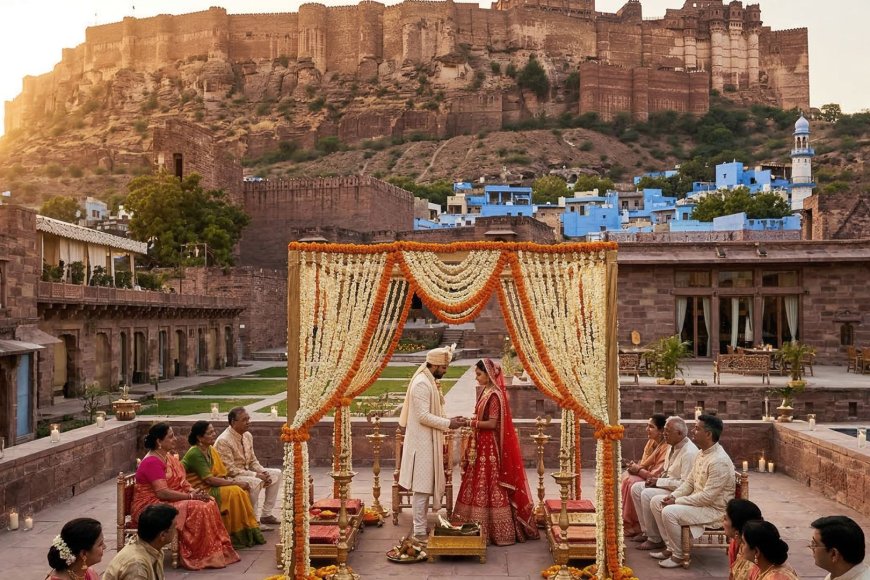
RAAS Jodhpur — A Wedding in a 15th-Century Haveli with Mehrangarh Fort Rising Above You: The NRI Guide
The Fort at Dawn
The bride had woken at five thirty.
Not the anxious waking of the wedding morning — not the specific, adrenaline-edged consciousness of the person whose mind has registered the significance of the day before the eyes have fully opened. The peaceful waking. The waking whose cause was the specific quality of the light that the Jodhpur dawn was producing outside the haveli room's window and whose effect was the quiet alertness of the person who understands, without quite knowing how, that something worth seeing is happening outside.
She had gone to the window.
The Mehrangarh Fort was there.
Not visible in the way that the landmark is visible from the hotel room whose promotional photograph has prepared the guest for the view — the composed, well-lit, distant impression of the famous structure. Visible in the way that the thing is visible when it is above you — the specific, vertical, overwhelming presence of the structure that rises from the rock whose cliff face is the fort's southern wall, the rock that is the fort's foundation and the fort's defence and the fort's specific, geological claim to the sky.
The Mehrangarh Fort at the Jodhpur dawn is not the view. It is the presence. The hundred-and-twenty-metre cliff whose sandstone the first light finds in the specific, warm, deeply orange quality of the Rajasthan sunrise applied to the Jodhpur blue sandstone — the specific stone that is not quite the Jaisalmer yellow and not quite the Bikaner red but the specific, warm, dawn-orange Jodhpur stone that the fort's builders quarried from the rock on which the fort stands and used to build the structure above it.
The bride had stood at the window for a long time.
She had not called the groom. The groom was asleep in the room adjacent. She had stood at the window of the fifteenth-century haveli and looked at the fifteenth-century fort above it and had understood, in the specific, quiet way of the person who is alone with the understanding, what it meant to be here.
Not at the hotel. Not at the wedding venue. Not at the destination whose photographs she had been carrying on her phone for eight months.
Here. The specific place. The haveli whose stones were cut in the same century as the fort's stones. The courtyard below whose morning light was the morning light of the same five and a half centuries. The Blue City spread below the fort and around the haveli in the specific, dense, intimate arrangement of the city that has been living in the fort's shadow for as long as the fort has been standing.
And above it all, the Mehrangarh — the fort whose name means the Sun Fort, the specific Rajput stronghold that Rao Jodha built on the rock above the desert city in 1459 and that has not fallen, not been conquered, not been abandoned, standing above the city it named and the city it has defined for five and a half centuries.
She had understood what it meant to be here.
This guide is for the couple who needs to understand it too — before the booking, before the deposit, before the eight months of the planning that the understanding should precede.
The Haveli: What RAAS Jodhpur Is
The Fifteenth-Century Foundation
The RAAS Jodhpur — the boutique luxury hotel whose address is the Tunwarji ka Jhalra in the old city of Jodhpur, within the specific, dense, historically continuous neighbourhood whose relationship to the Mehrangarh Fort is the relationship of the city to the structure that has defined it — is built within a fifteenth-century haveli complex whose construction is contemporary with the fort above it.
Not adjacent to the heritage. Not within walking distance of the heritage. Within the heritage — the specific, physical, structural continuity of the old city neighbourhood whose buildings and whose lanes and whose spatial organisation are the spatial organisation of the Jodhpur that Rao Jodha's city became in the centuries after the fort's founding and that the RAAS's renovation has returned to the quality of the finest boutique hotel without removing from the historical fabric.
The haveli complex — the traditional Rajput nobleman's urban residence whose form is the form of the courtyard house, the multiple buildings organised around the central open space, the specific spatial vocabulary of the private residence that is also the social centre — was acquired and renovated by the RAAS Jodhpur's founders with the specific intention of the authentic heritage hotel: the renovation that preserves the historical structure, that restores rather than replaces, that uses the contemporary luxury standard to enhance the historical quality rather than to substitute for it.
The renovation's achievement: the RAAS Jodhpur is the property that the international luxury travel press has recognised with the specific, sustained acclaim of the institution that has done the heritage renovation correctly — the Small Luxury Hotels of the World membership, the Condé Nast Traveller recognition, the specific critical attention of the publications whose standards for the heritage hotel renovation are the standards of the institution that knows the difference between the preserved and the replicated. The RAAS has the preserved — the actual fifteenth-century fabric, the actual historical material, the actual spatial organisation of the traditional haveli — combined with the contemporary luxury standard that makes the authentic heritage liveable at the quality the modern guest requires.
The Mehrangarh Relationship
The RAAS Jodhpur's specific, defining characteristic — the quality that distinguishes it from every other boutique heritage property in this guide series and from every other heritage hotel in the Jodhpur market — is the relationship to the Mehrangarh Fort.
Not the view of the fort from the distance. The presence of the fort above the property — the specific, vertical, hundred-and-twenty-metre cliff whose face is visible from the RAAS's courtyards and whose scale is the scale of the structure that is not the landmark seen across the city but the companion whose presence is the ambient condition of the RAAS's specific location.
The Mehrangarh Fort at one hundred and twenty metres above the RAAS Jodhpur is not the background. It is the foreground of the sky — the structure that the guest looking upward from the RAAS's courtyard sees rising above the haveli's walls with the specific, vertiginous presence of the very large thing that is very close and very high. The fort does not sit on the horizon. It rises above the RAAS in the specific, direct, vertical relationship of the structure built on the rock above the city that it commands.
For the wedding: every outdoor occasion at the RAAS Jodhpur takes place in the specific, ambient presence of the Mehrangarh Fort above — the ceremony whose backdrop is the fort's cliff face and the fort's walls and the specific, dramatic sky-meeting of the Rajput stronghold and the Jodhpur sky, the sangeet whose evening illumination includes the fort's own nocturnal lighting whose gold against the night sky is the nocturnal presence of the most dramatically positioned fort in India.
The Blue City Context
The RAAS Jodhpur's location within the old city — the specific, historical, densely inhabited neighbourhood of the Blue City whose indigo-painted houses are the specific, chromatic tradition of the Brahmin quarter whose blue paint marked the caste distinction and whose visual effect, from the Mehrangarh Fort's ramparts above, is the effect of the city that appears to have been dipped in the sky — gives the wedding the specific, ambient cultural context of the living historical city rather than the managed heritage destination.
The Blue City's specific quality: the old city of Jodhpur that surrounds the RAAS is not the preserved museum neighbourhood. It is the living city — the city whose lanes are the lanes of the daily commerce, whose sounds are the sounds of the working craftsperson and the calling vendor and the specific, layered urban audio of the subcontinent's old city whose continuous occupation for five and a half centuries has produced the specific depth of the place that knows exactly what it is and has been knowing it for a very long time.
The wedding at the RAAS Jodhpur is the wedding in this city — the specific, continuous, five-and-a-half-century-old Blue City whose daily life surrounds the haveli and whose Mehrangarh Fort rises above it and whose specific, irreplaceable character is the character of the place that has not been arranged for the guest's comfort but that the guest is permitted, through the RAAS's specific location, to inhabit.
The Mehrangarh Fort: The Wedding's Silent Witness
The Fort's History
The Mehrangarh Fort — the Mehran Garh, the Sun Fort — was founded in 1459 by Rao Jodha, the Rathor Rajput chieftain whose establishment of the city of Jodhpur is the founding act of the Blue City's history. Rao Jodha chose the rock — the specific, massive, isolated rock whose natural cliff faces provided the defensive advantage that no built fortification could improve upon — and built the fort whose construction his successors continued across the centuries, each ruler adding the apartments and the palaces and the temples and the specific architectural accumulation of the Rajput stronghold that is also the royal residence.
The Mehrangarh is among the largest forts in India — the specific, accumulated scale of the construction that spans five and a half centuries and that includes within its walls the palaces whose specific, carved Rajput architecture is among the finest of any Indian fort complex. The Moti Mahal, the Phool Mahal, the Sheesh Mahal — the pearl palace, the flower palace, the mirror palace — are the specific interior spaces of the Mehrangarh whose quality the fort museum maintains and whose carved sandstone screens and whose painted ceilings are the specific, accumulated artistic achievement of the Jodhpur royal court across five centuries of patronage.
The view from the fort: the Mehrangarh Fort's ramparts provide the view of Jodhpur that the fort's position above the city most completely frames — the Blue City spread below in the specific, dense, chromatic arrangement of the indigo houses, the desert beyond, the Thar's horizon, and the specific, comprehensive visual geography of the Rajput city in the desert that the fort's height makes visible in the panoramic form that the city level cannot provide.
The Fort as the Wedding Backdrop
The Mehrangarh Fort's role in the RAAS Jodhpur wedding is the role of the backdrop that is not the backdrop — the structure whose presence is too close, too large, too vertical to be merely the background of the wedding photograph. The fort in the RAAS wedding photograph is the fort as the co-presence, the structure whose scale and whose proximity make it the visual partner of the occasion rather than its setting.
The wedding photograph with the Mehrangarh: the specific, extraordinary quality of the RAAS Jodhpur wedding photograph is the quality of the photograph that includes the Mehrangarh Fort at the close, vertical angle — the fort whose cliff face rises behind the mandap, whose walls are the walls visible above the haveli's roofline, whose specific, orange sandstone is the orange that the Jodhpur sunset light finds most dramatically. The wedding photograph taken at the RAAS Jodhpur with the Mehrangarh in the frame is the wedding photograph whose context is one of India's most dramatic landscapes in one of India's most dramatic cities in the presence of one of India's most imposing forts.
There is no staging this. The fort is there. The RAAS is below it. The wedding happens between them.
The Small Luxury Hotels Standard
What Small Luxury Hotels Means
The RAAS Jodhpur's membership in Small Luxury Hotels of the World — the collection whose curation criteria include the independence of ownership, the specific quality of the property's physical and service standard, and the authentic character of the destination experience — is the membership that communicates, to the NRI couple familiar with the SLH collection, the specific quality promise that the branded international hotel cannot make in the same terms.
The SLH property is not the Marriott or the Radisson or the ITC — the branded hotel whose quality is the quality of the institutional standard consistently applied across the portfolio. The SLH property is the specific, individual, owner-managed property whose quality is the quality of the proprietorial investment in the specific place rather than the brand's quality assurance system. The difference is the difference between the excellent and the excellent-and-irreplaceable — the RAAS Jodhpur is excellent in the specific, irreplaceable way of the property that is this haveli, in this location, with this fort above it, and nowhere else.
The Scale: Intimate by Design
The RAAS Jodhpur's accommodation count — the boutique scale of the property whose room number is the room number of the intimate rather than the large hotel — is the scale that the wedding couple should understand before the guest list is finalised.
The RAAS accommodates approximately forty to fifty guests within the property — the intimate scale that makes the RAAS the destination for the NRI wedding whose guest list is the inner circle rather than the comprehensive invitation, the intimate destination wedding whose one hundred to one hundred and fifty guests are the people whose presence at the occasion is the presence of the specifically chosen rather than the obligatorily included.
The full buyout: the RAAS Jodhpur's boutique scale makes the full property buyout — the exclusive possession of the haveli complex for the wedding's duration — the financially accessible option that the larger properties' room counts make prohibitively expensive. The couple who books the full RAAS buyout has the fifteenth-century haveli, the Mehrangarh Fort rising above, and the complete, intimate, exclusively possessed heritage property for the duration of the wedding programme — the experience that the large luxury hotel's full buyout costs multiple crores to achieve and that the RAAS's boutique scale makes a realistic rather than an extraordinary financial decision.
The Wedding Spaces
The Toorji Step Well Courtyard
The RAAS Jodhpur's primary courtyard — the haveli's central open space whose traditional courtyard form is the form of the Rajput urban residence's social centre — is the primary ceremony and reception space whose specific quality is the specific quality of the enclosed outdoor space within the fifteenth-century haveli with the Mehrangarh Fort visible above the roofline.
The courtyard ceremony at the RAAS — the mandap in the haveli's central space, the guests arranged around the ceremony within the courtyard's walls, the Mehrangarh Fort rising above the roofline in the specific, vertical, close presence of the structure one hundred and twenty metres above — is the ceremony whose setting is the specific, intimate, historically continuous enclosure of the traditional Rajput haveli with the fort as the ambient, overwhelming, sky-filling presence above it.
The courtyard accommodates up to one hundred and fifty guests for the seated ceremony and up to two hundred for the standing reception — the intimate scale that the boutique property's central space provides and that the intimate destination wedding most naturally fills.
The Rooftop — The Fort View Space
The RAAS Jodhpur's rooftop — the elevated outdoor space whose position above the haveli's main structure provides the specific, unobstructed view of the Mehrangarh Fort at the close, vertical angle — is the wedding space whose character is the character of the elevated proximity: the fort visible from the rooftop at the angle that the ground-level courtyard cannot provide, the specific, vertiginous, upward view of the cliff face and the fort walls and the sky above them.
The rooftop sangeet — the sangeet whose setting is the RAAS rooftop with the Mehrangarh Fort illuminated above in the specific, gold nocturnal lighting that the fort's night illumination provides — is the sangeet whose setting is the most dramatically positioned event space of any property in this guide series. The fort at night, illuminated in the gold that the Jodhpur dark sky makes most visible, rising above the rooftop where the sangeet is in progress — this is the setting that the sangeet photograph does not need the caption to identify.
The rooftop accommodates up to one hundred guests for the standing reception and up to seventy for the seated dinner — the intimate scale that the rooftop's dimensions provide and that the close fort view most powerfully serves.
The Step Well
The Toorji ka Jhalra — the step well adjacent to the RAAS Jodhpur whose restoration the RAAS's founders contributed to and whose specific, geometric, descending-staired form is the baoli whose presence adjacent to the haveli gives the RAAS the specific, ancient water-form architecture that the step well tradition produces — is the pre-wedding photography location and the specific heritage dimension of the RAAS's immediate neighbourhood.
The step well adjacent to the RAAS is the specific step well — the Toorji ka Jhalra — whose restoration has returned it to the visual quality of the baoli whose geometric descent is the visual depth that the wedding photograph most beautifully renders. The pre-wedding photography session at the Toorji step well — with the Mehrangarh Fort visible above at the angle that the step well's open-sky position provides — is the photography session that combines the two most visually extraordinary elements of the RAAS Jodhpur's immediate heritage environment in the single session.
The Haveli Interiors
The RAAS Jodhpur's interior spaces — the renovated haveli rooms whose restored arches, whose carved sandstone detail, whose specific spatial quality of the traditional Rajput interior applied to the contemporary luxury standard — are the spaces for the intimate pre-wedding functions: the mehendi in the haveli's interior courtyard, the haldi in the morning light of the restored room, the family gathering in the specific, enclosed warmth of the traditional private residential space.
The haveli interior's specific quality is the quality of the authentically restored — the carved sandstone detail that is the actual fifteenth-century carving rather than the reproduction, the arches whose proportions are the proportions of the traditional haveli rather than the design interpretation, the specific material presence of the historical fabric whose texture and whose warmth are the texture and the warmth of the actual stone of the actual century.
The Mehrangarh Fort — Pre-Wedding Photography
The Mehrangarh Fort — one hundred and twenty metres above the RAAS Jodhpur, accessible by the jeep road or the path that ascends the rock — is the pre-wedding photography location whose setting is the setting of the five-and-a-half-century-old royal fort whose interior spaces and whose ramparts and whose specific views of the Blue City below are the photography locations whose quality no purpose-built photography space can approach.
The Phool Mahal's carved interior, the Moti Mahal's colonnaded court, the fort ramparts whose view of the Blue City and the Thar Desert horizon is the view from above the city that the city cannot provide — these are the photography locations whose permit the RAAS's relationships with the fort management most directly facilitate and whose specific, extraordinary quality the pre-wedding session should be designed around.
The Jodhpur Experience: Beyond the Fort
The Blue City Walk
The RAAS Jodhpur's old city location gives the wedding's guest programme the access to the Blue City experience that no property outside the old city can provide — the specific, immersive, living-city experience of the walk through the indigo lanes, the craftsperson's workshop whose door opens onto the lane, the vendor's stall whose specific Jodhpur craft — the Bandhani tie-dye, the lacquer work, the specific blue pottery whose tradition is the tradition of the city that painted itself blue — is the craft of the neighbourhood that surrounds the RAAS.
The Blue City walking tour — the guided walk through the old city's lanes with the Mehrangarh Fort visible above at every open-sky moment, the specific craft workshops whose observation gives the international guest the living tradition rather than the museum display, the specific food of the Jodhpur street whose dal baati churma and whose mirchi vada are the specific, regional culinary tradition of the city — is the guest programme whose quality the RAAS's location provides and that no property outside the old city can arrange with the same immediacy and the same authenticity.
The Mehrangarh Museum
The Mehrangarh Fort's museum — the specific, museum-grade collection of the Jodhpur royal family's artefacts whose quality is the quality of the institution that has been accumulating the material culture of the Rathor Rajput court for five and a half centuries and whose display within the fort's own rooms is the display in the specific spaces for which the objects were made — is the guest programme excursion that the RAAS's proximity makes the morning outing whose return is the return to the haveli below before the afternoon programme begins.
The Mehrangarh Museum is not the generic Indian heritage museum. It is the specific, extraordinary collection of the Rathor court — the palanquins, the elephants' howdahs, the weapons, the miniature paintings, the specific material culture of the Jodhpur royal tradition — displayed within the fort whose own rooms are the historical context of the objects. The guest who visits the Mehrangarh Museum has visited the specific, irreplaceable collection in the specific, irreplaceable setting that the fort whose shadow falls on the RAAS provides.
The Complete Planning and Pricing Tables
Table One: Wedding Spaces, Events, and Costs
| Space / Event | Capacity (Seated) | Capacity (Standing) | Approx. Venue Cost (INR) | Approx. Venue Cost (USD) | Best For |
|---|---|---|---|---|---|
| Main Courtyard – Ceremony | Up to 120 | Up to 150 | ₹12,00,000 – ₹22,00,000 | $14,400 – $26,400 | Pheras, fort above roofline |
| Main Courtyard – Reception Dinner | Up to 120 | Up to 150 | ₹18,00,000 – ₹32,00,000 | $21,600 – $38,400 | Intimate dinner, haveli enclosure |
| Rooftop – Sangeet | Up to 70 | Up to 100 | ₹15,00,000 – ₹28,00,000 | $18,000 – $33,600 | Fort illuminated above, night sky |
| Rooftop – Cocktail Reception | Up to 70 | Up to 100 | ₹10,00,000 – ₹18,00,000 | $12,000 – $21,600 | Sunset fort view, intimate |
| Rooftop – Welcome Dinner | Up to 60 | Up to 80 | ₹12,00,000 – ₹20,00,000 | $14,400 – $24,000 | Arrival evening, fort presence |
| Haveli Interior – Mehendi | Up to 40 | Up to 60 | ₹4,00,000 – ₹8,00,000 | $4,800 – $9,600 | Pre-wedding intimate function |
| Haveli Interior – Haldi | Up to 30 | Up to 50 | ₹3,00,000 – ₹6,00,000 | $3,600 – $7,200 | Morning ritual, inner circle |
| Haveli Interior – Family Gathering | Up to 40 | Up to 60 | ₹3,00,000 – ₹7,00,000 | $3,600 – $8,400 | Small family occasion |
| Toorji Step Well – Pre-Wedding Photos | Couple and party | — | ₹50,000 – ₹1,50,000 | $600 – $1,800 | Baoli and fort combined session |
| Fort Approach – Baraat | Procession format | Up to 100 | ₹3,00,000 – ₹6,00,000 | $3,600 – $7,200 | Old city procession, blue lanes |
| Mehrangarh Fort – Pre-Wedding Session | Couple and party | — | ₹1,00,000 – ₹3,00,000 | $1,200 – $3,600 | Fort interior, rampart photography |
| Mehrangarh Fort – Guest Excursion | Up to 150 | — | ₹2,00,000 – ₹5,00,000 | $2,400 – $6,000 | Museum tour, guided fort visit |
| Blue City Walking Tour | Up to 50 per group | — | ₹1,00,000 – ₹3,00,000 | $1,200 – $3,600 | Craft lanes, immersive city walk |
| Full Property – Exclusive Buyout (per day) | All spaces | All spaces | ₹60,00,000 – ₹1,10,00,000 | $72,000 – $1,32,000 | Complete haveli exclusive use |
| Full 3-Day Wedding Package | 80–150 guests | — | ₹1,20,00,000 – ₹2,50,00,000 | $1,44,000 – $3,00,000 | All functions, full programme |
| Catering – Per Head (Welcome Cocktails) | — | — | ₹3,000 – ₹5,000 per head | $36 – $60 per head | Rajasthani and continental |
| Catering – Per Head (Buffet Dinner) | — | — | ₹7,000 – ₹12,000 per head | $84 – $144 per head | RAAS culinary standard |
| Catering – Per Head (Seated Dinner) | — | — | ₹10,000 – ₹16,000 per head | $120 – $192 per head | Formal dinner, intimate service |
All prices are indicative estimates. The RAAS Jodhpur provides the bespoke quotation through the dedicated events team whose engagement begins the planning. The full property exclusive buyout is the strongly recommended approach for the NRI wedding at the RAAS — the boutique scale makes the buyout financially realistic, and the complete private possession of the fifteenth-century haveli with the Mehrangarh Fort above is the experience that the partial booking most significantly diminishes.
Table Two: Accommodation, Full Budget, and Planning Essentials
| Category | Detail | Approx. Cost (INR) | Approx. Cost (USD) | Notes |
|---|---|---|---|---|
| RAAS JODHPUR ACCOMMODATION | ||||
| Haveli Room | Restored haveli room, courtyard | ₹18,000 – ₹28,000 per night | $216 – $336 per night | Entry level, authentic fabric |
| Premium Haveli Room | Enhanced position, fort view | ₹26,000 – ₹40,000 per night | $312 – $480 per night | Fort visibility, upgraded |
| Suite | Separate sitting, haveli wing | ₹40,000 – ₹65,000 per night | $480 – $780 per night | Key family, senior guests |
| Premium Suite | Premier suite, rooftop access | ₹65,000 – ₹1,00,000 per night | $780 – $1,200 per night | VIP family, close relatives |
| RAAS Suite | Finest suite, fort view terrace | ₹1,00,000 – ₹1,60,000 per night | $1,200 – $1,920 per night | Wedding couple, finest suite |
| Total Rooms Available | Approximately 40–50 rooms | Full buyout strongly recommended | Group rate negotiated | Intimate scale enables buyout |
| OVERFLOW ACCOMMODATION | ||||
| Umaid Bhawan Palace (Taj) | Heritage palace, Jodhpur | ₹45,000 – ₹4,50,000 per night | $540 – $5,400 per night | Premium overflow, iconic palace |
| Ajit Bhawan | Heritage property, Jodhpur | ₹12,000 – ₹35,000 per night | $144 – $420 per night | Boutique heritage overflow |
| Vivanta Jodhpur | Four-star, modern standard | ₹8,000 – ₹22,000 per night | $96 – $264 per night | Mid-range quality overflow |
| Standard Jodhpur hotels | Full city range available | ₹3,000 – ₹12,000 per night | $36 – $144 per night | Budget-conscious guest option |
| COMPREHENSIVE WEDDING BUDGET | ||||
| Venue hire – all functions (3 days) | Full property exclusive | ₹60,00,000 – ₹1,20,00,000 | $72,000 – $1,44,000 | Full buyout recommended |
| Catering – all functions (120 guests) | In-house, all meals, all events | ₹50,00,000 – ₹95,00,000 | $60,000 – $1,14,000 | Three events, three days |
| Accommodation – full property (3 nights) | All 40–50 rooms, wedding group | ₹25,00,000 – ₹55,00,000 | $30,000 – $66,000 | Full buyout, all guests on-site |
| Decoration and florals | Full installation, Jodhpur vendors | ₹30,00,000 – ₹60,00,000 | $36,000 – $72,000 | Fort-view mandap specialist |
| Photography and videography | Heritage and fort specialist | ₹14,00,000 – ₹30,00,000 | $16,800 – $36,000 | Fort, step well, Blue City |
| Entertainment | Rajasthani folk, sangeet, DJ | ₹12,00,000 – ₹25,00,000 | $14,400 – $30,000 | Jodhpur folk tradition |
| Destination wedding planner | RAAS experience essential | ₹8,00,000 – ₹18,00,000 | $9,600 – $21,600 | Old city logistics expertise |
| Mehrangarh Fort excursion | Museum tour, photography permit | ₹3,00,000 – ₹8,00,000 | $3,600 – $9,600 | Essential guest programme |
| Blue City walking tours | Craft lanes, guided programme | ₹1,00,000 – ₹3,00,000 | $1,200 – $3,600 | Immersive city experience |
| Bridal and groom's clothing | Full trousseau | ₹15,00,000 – ₹40,00,000 | $18,000 – $48,000 | Personal to couple |
| Hair and makeup | Jodhpur artists, on-site | ₹2,50,000 – ₹7,00,000 | $3,000 – $8,400 | Jodhpur beauty market |
| Guest transport | Jodhpur airport, old city transfers | ₹4,00,000 – ₹10,00,000 | $4,800 – $12,000 | Old city access coordination |
| Invitations and stationery | Mehrangarh and Blue City motif | ₹1,50,000 – ₹4,00,000 | $1,800 – $4,800 | Fort silhouette design language |
| Pandit and religious requirements | Jodhpur officiant pool | ₹80,000 – ₹2,00,000 | $960 – $2,400 | Courtyard ceremony protocol |
| Miscellaneous and contingency (10%) | Old city premium | ₹10,00,000 – ₹20,00,000 | $12,000 – $24,000 | Remote logistics premium |
| TOTAL ESTIMATED RANGE | 120 guests, 3-day wedding | ₹2,37,80,000 – ₹4,97,00,000 | $2,85,000 – $5,96,000 | Full buyout, complete programme |
| PLANNING TIMELINE | ||||
| Initial inquiry | RAAS events team directly | 18–20 months before | 18–20 months before | Limited dates, high demand |
| Contract and deposit | Full buyout confirmed | 15–18 months before | 15–18 months before | Full buyout contract standard |
| Destination planner engaged | Old city expertise essential | 15 months before | 15 months before | RAAS and old city experience |
| Mehrangarh photography permit | Fort management application | 10–12 months before | 10–12 months before | Permit required, apply early |
| Decorator confirmed | Fort-view mandap specialist | 12 months before | 12 months before | Boutique scale, limited vendors |
| Photographer confirmed | Heritage and fort specialist | 12–14 months before | 12–14 months before | RAAS and fort experience |
| Blue City tour guide engaged | Local craft specialist | 8 months before | 8 months before | Authentic guide relationship |
| Guest transport plan | Old city access confirmed | 6 months before | 6 months before | Lane width and access management |
| Guest communications | Invitation, old city guide, fort info | 6 months before | 6 months before | Include Blue City arrival guide |
| Overflow accommodation | Umaid Bhawan or Ajit Bhawan | 6 months before | 6 months before | For guests beyond 40–50 rooms |
| Final guest count | Confirmed to RAAS team | 6–8 weeks before | 6–8 weeks before | Intimate scale requires precision |
| Final payments | All vendors and venue | 4 weeks before | 4 weeks before | Confirm in writing |
The RAAS Jodhpur's total budget range sits at the guide series mid-range — the full buyout's cost more accessible than the Six Senses Fort Barwara and the Oberoi Udaivilas, more substantial than the Alsisar and the Deogarh, reflecting the boutique property's complete exclusive use and the Jodhpur old city's specific logistical requirements. The couple whose intimate guest count fits the RAAS's scale will find the per-head cost highly competitive with any property in the guide.
The RAAS Against the Guide Series: The Specific Position
What No Other Property in This Guide Offers
The RAAS Jodhpur's specific credential — the fifteenth-century haveli in the old city of Jodhpur with the Mehrangarh Fort one hundred and twenty metres directly above — is the credential that no other property in this guide series possesses in the same form because it is the credential that no other property's location makes possible.
The Lalgarh Palace has the museum-grade heritage. The Deogarh Mahal has the family hosting. The Fort Barwara has the living temple. The RAAS has the fort above it — not the fort in the distance, not the fort visible across the lake, not the fort whose silhouette is the horizon backdrop, but the fort that is directly, vertically, overwhelmingly above the courtyard where the wedding is happening.
This is the specific, irreplaceable credential of the RAAS Jodhpur: the wedding beneath the Mehrangarh. The ceremony in the fifteenth-century haveli with the fifteenth-century fort rising above it. The sangeet on the rooftop with the fort illuminated in the gold above. The wedding morning view that the bride woke to at five thirty and stood at the window looking at for the specific, long, quiet time of the person who is alone with the understanding of what it means to be here.
The Intimate Scale as the Feature
The RAAS Jodhpur's forty to fifty room count is not the limitation. It is the design — the boutique scale whose intimate character is the specific, intentional quality of the property that has chosen to remain small because the small is the correct scale for what the RAAS is.
The couple whose guest count is one hundred and twenty — whose invitation list is the inner circle, the people whose presence at the ceremony is the presence of the most important — has the RAAS's scale as the exactly appropriate scale. The couple whose guest count is three hundred and who is attracted to the RAAS because of the fort view and the haveli's character needs the honest advice: the RAAS's scale is not designed for three hundred guests and the accommodation of three hundred guests requires the overflow that the old city's boutique properties provide at the cost of the complete, enclosed, everyone-on-site quality that the full RAAS buyout produces.
The RAAS is for the intimate wedding. The intimate wedding is not the lesser wedding. It is the wedding whose specific quality — the closeness, the everyone-known-to-everyone, the ceremony whose every guest can see the couple's faces — is the quality that only the intimate scale provides and that the grand occasion's scale, however magnificently managed, cannot replicate.
Common Mistakes NRI Couples Make When Planning the RAAS Wedding
The first mistake is not booking the full property buyout from the initial conversation. The RAAS Jodhpur's forty to fifty rooms — the boutique scale that makes the full buyout the financially accessible option — is the scale that the partial booking most significantly diminishes. The RAAS whose rooms include the guests outside the wedding party is the RAAS that has lost the specific, complete, intimate possession of the fifteenth-century haveli that is the property's primary wedding offering. The stranger at the breakfast table in the courtyard where the bride's mehendi was conducted yesterday is the specific intrusion of the partial booking whose cost the full buyout eliminates. The RAAS is the property for the full buyout. If the full buyout's cost requires the guest list reduction, reduce the guest list. The RAAS's intimate scale is the feature, not the constraint.
The second mistake is not managing the old city access coordination before the guest arrival begins. The RAAS Jodhpur's location within the old city — the specific, dense, historically organised neighbourhood whose lanes are the lanes of the traditional city rather than the managed resort approach — is the access challenge that the destination planner with the old city experience manages and that the planner without it discovers on the guest arrival morning when the vehicle convoy cannot navigate the final approach. The old city's lanes are narrow. The larger vehicles cannot reach the RAAS's entrance. The guest transfer from the vehicle drop-off point to the haveli is the short walk whose management — the staff who meet the guests at the drop-off, the luggage transfer, the specific welcome that converts the logistical adjustment into the arrival experience — requires the prior planning and the experienced on-ground coordination. Confirm the arrival logistics with the RAAS team and the planner at six months.
The third mistake is not applying for the Mehrangarh Fort photography permit at ten to twelve months. The Mehrangarh Fort's photography permit — the specific approval required for the pre-wedding photography session in the fort's interior spaces, the Phool Mahal, the Moti Mahal, the ramparts — is the permit whose application to the fort management's specific process requires the lead time that the last-minute application cannot accommodate. The fort's photography permission is the permission of the institution that manages the access to the heritage site with the care and the process that the heritage site requires. Apply at ten months. Confirm the specific locations permitted. Brief the photographer on the permitted spaces before the session is designed.
The fourth mistake is not engaging the Jodhpur folk performance tradition as the sangeet's primary entertainment rather than the generic Bollywood programme. The Jodhpur cultural tradition — the Manganiyar musicians whose specific, extraordinarily rich musical tradition is the tradition of the Rajput court's professional musicians, the Kalbelia dancers whose serpentine performance is the performance of the desert nomad's specific tradition, the specific folk arts of the western Rajasthan whose quality is the quality of the living tradition rather than the tourist performance — is the sangeet entertainment whose engagement at the RAAS rooftop with the Mehrangarh Fort illuminated above gives the occasion the specific, authentic, deeply local cultural dimension that the Bollywood DJ set does not provide and that the rooftop's setting most powerfully amplifies. The Manganiyar musician on the RAAS rooftop with the fort above — the specific, ancient, continuous music of the Rajput court tradition performed in the sight of the fort that court served — is the sangeet entertainment whose quality is the quality of the irreplaceable.
The fifth mistake is not giving the international guest the Blue City context before the arrival. The old city of Jodhpur — the specific, dense, living city whose indigo lanes and whose craftsperson's workshops and whose street food and whose daily commerce are the daily life of the city that has been living in the Mehrangarh's shadow for five and a half centuries — is the destination experience whose quality the international guest most completely accesses when the prior knowledge prepares the attention for what the visit offers. The international guest who arrives at the RAAS without the knowledge of where the Blue City's colour tradition comes from, what the craftsperson in the lane is making, why the houses are painted indigo, what the Mehrangarh's founding means in the specific history of the Rajput desert kingdom — this guest has the sensory experience without the contextual understanding that transforms the sensory into the meaningful. Send the Blue City guide — the specific, readable, beautifully written introduction to the Jodhpur heritage — with the wedding invitation. Give every international guest the knowledge before the arrival. The RAAS's location within the living history most rewards the guest who arrives knowing what they are entering.
The Window
The bride had woken at five thirty.
She had gone to the window.
The Mehrangarh Fort had been there — the hundred-and-twenty-metre cliff, the first light finding the sandstone in the specific, warm, deeply orange quality of the Rajasthan sunrise, the fort that Rao Jodha built in 1459 on the rock above the city that bears his name.
She had stood at the window of the fifteenth-century haveli and looked at the fifteenth-century fort and understood what it meant to be here.
Not what it meant in the language of the destination wedding guide — the heritage depth, the boutique scale, the Small Luxury Hotels credential, the intimate guest count, the full buyout recommendation, the fort photography permit at ten months.
What it meant in the language of the five thirty window — the specific, quiet, alone understanding of the person who is in the place before the occasion begins, before the programme starts, before the guests arrive and the mandap is installed and the photographer begins and the wedding becomes the managed, planned, beautifully executed occasion that the eight months of the planning produces.
The moment before all of that. The window. The fort. The first light on the five-and-a-half-century-old stone. The understanding.
The RAAS Jodhpur is the property whose window produces this understanding — whose location, whose history, whose specific, vertical, overwhelming relationship to the Mehrangarh Fort gives the guest who wakes at five thirty the experience of the place that knows what it is and has been knowing it since 1459.
Contact the RAAS events team at eighteen months.
Book the full property buyout from the first conversation.
Apply for the Mehrangarh photography permit at ten months.
Manage the old city arrival logistics at six months.
Engage the Manganiyar musicians for the rooftop sangeet.
Send the Blue City guide with the invitations.
And on the wedding morning — before the programme begins, before the photographer arrives, before the mandap is installed in the courtyard below — go to the window.
The fort will be there.
It has been there since 1459.
It will be there for your wedding.
And the understanding it produces at five thirty in the morning, in the first light, alone at the window of the fifteenth-century haveli — that understanding is the reason the wedding is here.
That is enough.
That is everything.
Published by NRIWedding.com — The Premium Global Platform for Non-Resident Indians Planning Indian Weddings From Abroad.
0 comments
Real names and courtesy, please. Every comment is read by a person before it appears.
Nothing yet. Start it off.
Comments are closed on this article.