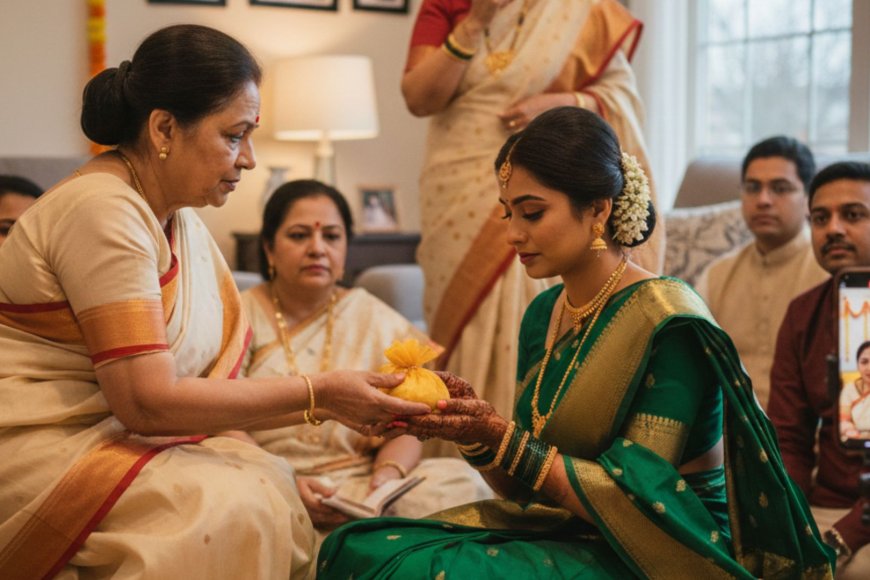
Before the fire, before the pheras, before the mangalsutra is tied — a Marathi bride receives a small cloth bundle filled with sugar. This is Sakharpuda: the ancient Marathi engagement ceremony whose name literally means "sugar bundle," and whose meaning runs far deeper than sweetness. For Maharashtrian NRI families from Pune, Nagpur, Mumbai, and Konkan now living in New Jersey, London, Toronto, Melbourne, and Dubai, Sakharpuda is the ritual that makes the future real — the moment a private understanding between two families becomes a public, sacred, and joyful fact.
You grew up in a Maharashtrian household where certain things were non-negotiable. The particular smell of toop [ghee] in rice. The sound of abhanga [devotional songs] on Sunday mornings. The way your mother treated every threshold crossing — every new beginning — as something that deserved to be marked properly, with the right words and the right offerings and, almost always, something sweet.
You are in New Jersey or Nagpur-via-Nottingham or a suburb of Melbourne, and your family has found someone. The conversations have happened. The horoscopes have been checked. The families have met over elaborate lunches that were technically casual and actually the most formal events of the year. And now it is time to make it real.
Someone says: Sakharpuda karayला hava. We should do the Sakharpuda.
And something settles in the room. The deciding is over. The celebrating is about to begin. And it will begin, as all the best things in Maharashtrian life begin — with sweetness, with community, and with a small bundle of sugar that carries the weight of everything good that is about to happen.
🌟 DID YOU KNOW?
- The word Sakharpuda combines sakhar [sugar in Marathi] and puda [a small bundle or packet tied in cloth] — making it literally "the sugar bundle," and the physical act of giving the bride a cloth bundle filled with sugar is not merely symbolic but historically practical: in pre-modern Maharashtra, sugar was a luxury item, and gifting it to the bride's family was a statement of the groom's family's prosperity and their intention to provide abundantly for the union.
- Sakharpuda is socially significant in Maharashtra — under the Hindu Marriage Act, engagement ceremonies like Sakharpuda are not legally binding contracts, but in Maharashtrian community practice, a completed Sakharpuda is considered a social and moral commitment of the highest order, and breaking an engagement after Sakharpuda is considered a serious breach of family honour requiring community mediation.
- The Maharashtrian diaspora in the United States — concentrated particularly in New Jersey, the San Francisco Bay Area, and Chicago — is estimated at over 200,000, with active Maharashtra Mandalchapters in over thirty American cities, most of which maintain annual cultural calendars that include support for traditional ceremonies like Sakharpuda, making the Maharashtrian NRI community one of the best-organised for ritual preservation abroad.
What Is Sakharpuda?
Sakharpuda [the sugar bundle ceremony] is the formal engagement ritual of Maharashtrian Hindu families — the ceremony in which the groom's family presents the bride with a sakhar puda [a small bundle of sugar wrapped in cloth], formally announcing and celebrating the families' decision to unite their children in marriage. It is Maharashtra's equivalent of the engagement party, but with a ritual structure, a sacred sequence, and a philosophical weight that distinguishes it entirely from a social celebration.
The ceremony traditionally takes place at the bride's family home, though in contemporary and NRI practice it may occur at a temple hall, a community centre, or a hired venue. It begins with Ganapathi Pooja [the invocation of Lord Ganesha, remover of obstacles and patron of new beginnings] — non-negotiable in virtually every Maharashtrian sacred ceremony. The family's purohit [priest] chants the sankalpam [formal Vedic declaration of intent] naming the date, the lunar position, the families, their gotras [ancestral clan lineages], and the nature of the commitment being made.
The central act — the giving of the sakhar puda — is performed by the groom's mother or the senior female elder of the groom's family. She presents the sugar bundle to the bride, who receives it in both hands as a gesture of acceptance. In most Maharashtrian families, the bundle is made of kesar [saffron] yellow or auspicious red cloth, tied with a gold or yellow thread, and contains pure white crystalline sugar. The sugar is not eaten at the ceremony — it is kept, distributed later as prasad [sacred offering] to family members, or used in the preparation of the first sweet dish served at the wedding.
Alongside the sakhar puda, the groom's family presents the bride with a complete shringar [adornment set] — typically including a saree [preferably Paithani or Nauvari in traditional families], gold ornaments, bangles, kumkum, kajal, flowers for the hair, and a blouse piece. This comprehensive gifting is not incidental — it is the groom's family's first act of caring for the bride's appearance and dignity, a promise made in objects.
The bride's family reciprocates with gifts for the groom — typically a dhoti and shirt, dry fruits, and in many families, a gold ring or watch. This reciprocal exchange ensures that both families are simultaneously giving and receiving, both simultaneously in the position of generosity.
The families then formally announce the vivaha muhurtham [the auspicious date and time for the wedding], which the purohit has calculated based on the janmakundalis [birth horoscopes] of both bride and groom. This announcement — the wedding date spoken aloud in sacred space for the first time — is typically met with the sound of shahnai [ceremonial wind instrument], the distribution of modak [sweet dumplings, sacred to Lord Ganesha] and pedha [milk-based sweets], and the general eruption of joy that has been quietly building in the room since the families arrived.
The ceremony concludes with aashirvad [the blessing of elders] — grandparents and senior relatives placing their hands on the heads of the bride and groom and offering prayers for their shared prosperity, health, and happiness.
Community Comparison: How Different Indian Communities Mark the Formal Engagement
| Community / State | Local Name | Key Tradition | How NRIs Abroad Adapt It |
|---|---|---|---|
| Maharashtrian Hindu | Sakharpuda | Sugar bundle given by groom's mother to bride; shringar gifting; Ganapathi Pooja; muhurtham announced | Home or community hall ceremony; Paithani saree sourced from Indian stores or ordered from Pune; Maharashtra Mandal coordinates |
| Himachali | Kurmai | Gift exchange witnessed by elders; local deity invoked | Adapted to family gathering; deity honoured symbolically |
| Garhwali | Sagai | Coconut and gift exchange; community witnesses | Garhwali community members in UK/Canada serve as witnesses |
| Kumaoni | Tilak / Sagai | Tilak applied to groom by bride's father; formal date-setting | Family pandit in Uttarakhand consulted via video call |
| Kashmiri Pandit | Misri ceremony | Exchange of sugar crystals and walnuts — note the shared centrality of sugar across traditions | Kashmiri Pandit sabhas in New Jersey, London assist |
| Kannada Brahmin | Nischitartha | Tambula exchange; Vedic sankalpam; Ganapathi Pooja | Pandits available in major diaspora cities |
| Tamil Brahmin | Nichayathartham | Tambula exchange; Lagna Patrika written; formal date announcement | Tamil Brahmin pandits in Markham, Harrow, Melbourne |
| Gujarati Hindu | Gol Dhana | Jaggery and coriander seeds distributed — another community where sweetness marks the formal commitment | Leicester, Edison Gujarati communities preserve with enthusiasm |
| Punjabi | Roka / Kurmai | Informal Roka followed by formal Kurmai with gifts and sweets | Very well-preserved in Brampton, Southall, Houston |
| Bengali | Ashirbad | Family meeting with sweets; elder blessing central | Bengali community centres in London, Toronto host ceremonies |
| Rajasthani | Sagai | Ring exchange combined with tilak; community gathering | Rajasthani Samaj networks in UAE and UK coordinate |
| Kerala Hindu | Nischayam | Vastram exchange; nirathalam lamp; muhurtham announced | Malayali Samajam networks in Gulf, UK, Canada support |
The Meaning Behind the Ritual
The Sakharpuda's central symbol — sugar — is one of the oldest and most universally understood metaphors in human culture. But in Maharashtrian ritual philosophy, its meaning is specific and layered. Sugar in its crystalline form is sakhar— white, pure, undissolved. When it enters the body, it transforms — it becomes energy, warmth, the fuel of life. The marriage that begins with the gift of sugar is being told, in the language of symbol: this union will take what is given and transform it into something sustaining.
In the Shakta tradition that runs through much of Maharashtra's folk religious culture, the domestic realm is understood as sacred — the home is a temple, the hearth is an altar, and the woman who manages both is an embodiment of Grihalakshmi [the goddess of the household]. The sakhar puda is the groom's family's first offering to this future goddess of their expanded household. To give her sugar is to acknowledge her power — to say, with sweetness, we know what you will do with this.
The Ganapathi who opens every Sakharpuda ceremony is not merely invoked out of habit. Ganesha is the Vighnaharta[remover of obstacles] and the Buddhidata [giver of wisdom] — his presence at the beginning of the engagement is a prayer that this union will be cleared of every obstacle that might prevent it from becoming what it is meant to be. In Maharashtra, where Ganesha is not merely a deity but a beloved community presence — the Ganesh Chaturthi festival being the state's most celebrated — his invocation at the Sakharpuda carries particular cultural resonance.
For a non-Indian partner or family member: "It is the groom's family arriving at the bride's door with sweetness in their hands, saying — this is how we intend to treat her."
Doing Sakharpuda Abroad: The Practical Reality
The Sakharpuda is, from a logistical standpoint, one of the most NRI-friendly engagement ceremonies in any Indian community's tradition. It requires no fire, no specialist outdoor space, no region-specific ingredients that cannot be sourced in diaspora cities. What it requires is the right people, the right items assembled with care, and the understanding that the ceremony's power comes from intention and community, not from scale or spectacle.
The sakhar puda itself must be prepared before the ceremony. Most Maharashtrian NRI families source the cloth and sugar locally and assemble it at home — the bundle is tied by the groom's mother or the senior female elder of the groom's family the morning of the ceremony, which is itself part of the ritual preparation. Pure crystalline white sugar is available everywhere. The cloth should be kesar [saffron yellow] or red, and the thread gold or yellow. If your family has a traditional colour for the bundle, maintain it — these details matter to family elders who will notice.
For the Paithani saree that is the traditional shringar gift: Paithani is Maharashtra's most celebrated silk weaving tradition, produced in Paithan near Aurangabad, characterised by its distinctive peacock and lotus motifs on a silk base with a pure gold zari border. In London, the South Asian saree stores on Ealing Road in Wembley and Tooting's Upper Tooting Road carry South Indian and Maharashtrian silks — call ahead specifically asking for Paithani. For the most authentic selection, many NRI families order Paithani directly from Pune or Aurangabad through trusted family contacts or established online Pune silk retailers, allowing six to eight weeks for shipping. In New Jersey, the Edison and Iselin corridor carries Maharashtrian silks. In Toronto, the Mississauga South Asian retail corridor and Gerrard Street East serve the community. In Melbourne, the Dandenong shopping precinct has South Indian and Maharashtrian textile options. In Dubai, the saree stores in Karama and Meena Bazaar carry the widest South Asian silk selection in the Gulf.
For the modak and pedha: fresh modak requires preparation — the steamed rice flour shells filled with coconut and jaggery are ideally made at home by a family member who knows the recipe. Many Maharashtrian NRI families designate this as the senior female relative's contribution — the grandmother or mother who makes the modak is performing a form of participation in the ceremony that matters as much as anything else. Pedha can be sourced from Indian sweet shops in most diaspora cities. In London, Ambala and Gifto's on Drummond Street carry pedha. In New Jersey, the Indian sweet shops on Oak Tree Road in Edison are comprehensive. In Toronto, sweet shops in Mississauga serve the community well.
The purohit question for Sakharpuda is worth careful attention. A Maharashtrian Brahmin purohit who knows the specific sankalpam wording for Sakharpuda and is familiar with Maharashtrian Rigveda or Yajurveda family traditions will conduct a ceremony that feels authentically rooted. Generalist pandits sometimes adapt Sakharpuda to a generic engagement ceremony that loses its specific Maharashtrian texture. NRI.Wedding's pandit directory lists Maharashtrian Brahmin priests by city. Maharashtra Mandal chapters in New Jersey, London, Toronto, and Melbourne are the best first point of contact — they maintain pandit lists and have often supported dozens of Sakharpuda ceremonies in their communities.
For relatives in India watching via video call: a Sakharpuda typically runs sixty to ninety minutes. The sakhar puda presentation, the shringar gifting, and the muhurtham announcement are the three core moments to ensure the streaming device captures. From London, a 10 AM ceremony is 3:30 PM IST — comfortable for Pune relatives. From New Jersey EST, an 11 AM ceremony is 9:30 PM IST — manageable. From Melbourne AEDT, a 10 AM ceremony is 4:30 AM IST — either start later or pre-record for India family.
Doing Sakharpuda as a Destination Ceremony in India
Maharashtra offers engagement ceremony settings of extraordinary cultural richness — from the heritage wadas[traditional Maharashtrian courtyard homes] of Pune's old city to the coastal venues of the Konkan, from the temple town of Nashik to the cosmopolitan elegance of Mumbai's heritage hotels.
Pune is the natural heartland of Maharashtrian Brahmin wedding tradition — the city's density of experienced purohits, traditional sweet makers, Paithani saree stores, and community members familiar with the full Sakharpuda sequence makes it the easiest destination for a complete, unabbreviated ceremony. The Peshwa-era wadas of Shaniwar Peth and Kasba Peth provide architectural settings that embed the ceremony in Maharashtra's cultural history.
For NRI families coordinating a destination Sakharpuda from abroad, Pune and Mumbai wedding planners who work with NRI clients are increasingly experienced with the specific requirements — the purohit briefing, the Paithani sourcing, the modak preparation, and the coordination of guests flying in from multiple countries. Brief your planner specifically on your family's gotra, your Vedic tradition, and your expectation of a complete Sakharpuda rather than an abbreviated or modernised version.
For non-Indian guests at a destination Sakharpuda in Maharashtra, the ceremony's visual warmth and relative accessibility make it one of the most welcoming Indian engagement traditions for international observers. The bright sarees, the modak distribution, the sound of abhanga or shehnai, and the central image of one woman handing another a small cloth bundle of sweetness are all immediately legible as gestures of care and celebration.
What You Need: Ritual Checklist
Ritual Items — sakhar puda [cloth bundle of crystalline sugar, tied in kesar or red cloth with gold thread]; Paithani or traditional Maharashtrian silk saree for the bride; gold ornaments, bangles, and complete shringar set; blouse piece; kumkum; kajal; fresh flowers for the bride's hair; dhoti and shirt for the groom; gold ring or watch for the groom; dry fruits for reciprocal gifting; modak [fresh, ideally homemade]; pedha and other Maharashtrian sweets; toop [ghee] for the Ganapathi Pooja lamp; agarbatti [incense]; camphor; panchamrit [five sacred substances for the pooja]; brass kalasha[ritual pot]; mango leaves; akshata [turmeric-blessed rice]; printed janmakundali documents for both bride and groom; written muhurtham document from the purohit.
People Required — the officiating Maharashtrian Brahmin purohit; the bride and groom; the groom's mother [who presents the sakhar puda]; both sets of parents; paternal and maternal grandparents; married female relatives to assist with shringar gifting; a family elder to make the formal verbal commitment statement; witnesses from both families; the photographer briefed on the sakhar puda presentation as the primary non-repeatable moment.
Preparation Steps — prepare the sakhar puda the morning of the ceremony. Confirm the purohit's familiarity with Maharashtrian Sakharpuda sequence at least two months before. Source the Paithani saree at least six weeks before, allowing for shipping from India if necessary. Prepare or source fresh modak. Confirm video call links and IST timings for India relatives. Brief the photographer on the sakhar puda presentation, shringar gifting, and muhurtham announcement as the three core moments. Prepare a short bilingual programme for non-Indian guests.
NRI.Wedding connects Maharashtrian families abroad with verified Maharashtrian Brahmin purohits, Paithani saree sourcing guidance, modak preparation resources, and ceremony photographers who understand the specific intimacy of a Sakharpuda. Begin at NRI.Wedding.
5 Questions NRI Couples Always Ask
Can we combine the Sakharpuda with a larger engagement party for friends who are not Maharashtrian?
Yes — and many NRI Maharashtrian families structure the day in two distinct phases: the Sakharpuda ritual in the morning or early afternoon, attended by family and close community, followed by a larger celebration in the evening that is more inclusive and socially oriented. The key is keeping the ritual phase protected and complete before the social phase begins. A Sakharpuda that is rushed because guests are arriving for the party is a Sakharpuda that has not been fully honoured.
My partner is not Maharashtrian — how do we incorporate their family's engagement tradition alongside Sakharpuda?
The most successful approach for intercommunity NRI couples is to structure the engagement with both families' traditions honoured in sequence — the Sakharpuda conducted first as the bride's family's tradition, followed by whatever equivalent ceremony the groom's community observes. A skilled purohit experienced in intercommunity ceremonies can often weave both traditions into a single ceremony that feels coherent rather than composite. The key is early conversation with both families and the purohit, ensuring no tradition is treated as secondary.
How do we find a Maharashtrian Brahmin purohit in Australia or Canada?
Maharashtra Mandal chapters in Melbourne, Sydney, Toronto, and Vancouver are your first contact point — they maintain lists of Maharashtrian Brahmin purohits in their cities and have coordinated Sakharpuda ceremonies for community members before. NRI.Wedding's pandit directory lists Maharashtrian priests by city and tradition. When contacting a purohit, specify whether your family follows Rigveda or Yajurveda tradition, as the sankalpam wording differs.
Does the Sakharpuda date need to be auspicious like the wedding muhurtham?
Most Maharashtrian families select the Sakharpuda date with reference to the panchang — avoiding inauspicious tithis and periods like Shraadh paksha [the fortnight of ancestral remembrance] and the Chaturmas [the four-month period of religious observance when auspicious ceremonies are traditionally avoided]. Your purohit will advise on appropriate dates. Some families are more flexible about the Sakharpuda date than the wedding muhurtham, but consulting the purohit before confirming any venue booking is always the right sequence.
Can the Sakharpuda be done via video call with the purohit in India if no Maharashtrian priest is available locally?
This has become increasingly accepted post-2020, particularly for smaller ceremonies. The purohit in Pune or Mumbai guides the ceremony via live video — chanting the sankalpam, directing the sakhar puda presentation, and offering the muhurtham announcement remotely — while a senior family elder conducts the physical ritual actions on the ground. What matters most is that the purohit and the family have had a thorough briefing conversation beforehand. NRI.Wedding can facilitate the connection between diaspora families and Pune-based purohits experienced in remote ceremony guidance.
The Emotional Angle
There is a moment during the Sakharpuda that nobody warns you about. It comes after the Ganapathi Pooja has settled the room into its ceremonial register, after the sankalpam has been chanted and the families have heard their names and their gotras spoken aloud in sacred space. It comes when the groom's mother stands up and walks toward the bride with the sakhar puda in her hands.
She has tied this bundle herself. This morning, in whatever kitchen was available to her — her own, a relative's, a hotel room's — she measured out the sugar, folded the cloth, tied the thread. Her hands knew what to do. Her mother's hands had done this. Her mother's mother's hands had done this.
She places it in the bride's hands.
And the bride — who has been composed, who has been graceful, who has been the calm centre of this ceremony — feels the weight of the bundle and understands, perhaps for the first time with her whole body rather than just her mind, that this is real. That this woman standing before her is going to be her family. That the sugar in the cloth is a promise the groom's family is making with their hands before they make it with words.
For NRI Maharashtrian families, this moment carries an additional layer — the groom's mother who has spent twenty years in New Jersey or London or Melbourne, who has kept the modak recipe in a notebook and the Paithani saree in a suitcase and the knowledge of how to tie the sakhar puda in her hands — this mother is not just giving sugar. She is giving everything she carried. Everything she kept. Everything she refused to let the distance dissolve.
A Moment to Smile
At a Sakharpuda in Melbourne two years ago, the ceremony had been planned and executed with great love and considerable organisational effort. The purohit had been confirmed, the Paithani saree had been ordered from Pune six weeks in advance, the modak had been made from scratch by the bride's grandmother who had flown in from Nagpur for this specific purpose.
The sakhar puda had been tied that morning by the groom's mother, who had brought the kesar cloth from her home in New Jersey specifically for this occasion.
The ceremony was moving and complete. The sankalpam was chanted. The sakhar puda was presented. The bride received it in both hands. The groom's mother was tearful. The bride's mother was tearful. The purohit was serene.
And then the bride's four-year-old nephew — who had been sitting quietly and had therefore been given unsupervised access to the modak tray — arrived at the centre of the ceremony with an expression of great satisfaction and the evidence of four consumed modaks on his face and shirt, to announce that the modak was very good and everyone should have some immediately.
The purohit agreed that this was an excellent assessment. The modak was distributed. The nephew was photographed. The bride's grandmother, who had made the modak, declared that this was the highest possible review.
The Sakharpuda concluded in the warmth of shared laughter, which is, after all, exactly how Maharashtra intended it.
Quotes from the Diaspora
"My mother-in-law brought the kesar cloth for the sakhar puda from Pune in her hand luggage. Not checked luggage. Hand luggage. When I asked her why, she said she didn't want to risk it. That is when I understood what kind of mother-in-law I was getting. The best kind." — Madhura Joshi, Maharashtrian Brahmin community, New Jersey, USA
"We did the Sakharpuda in our living room in Harrow. Twelve people. My mother made the modak. My father-in-law did the Ganapathi Pooja from memory because the purohit was running late. The purohit arrived for the sankalpam and said my father-in-law had done it perfectly. My father-in-law has not stopped mentioning this." — Priya Kulkarni, Maharashtrian community, London, UK
"My husband is from Karnataka. His family did their Nischitartha first, then we did our Sakharpuda. Two ceremonies, one day, two traditions, one very full room. At the end, both grandmothers were sitting next to each other sharing pedha and arguing about whose sweets were better. This is exactly what I wanted my engagement to look like." — Sneha Deshpande, Maharashtrian Brahmin community, Toronto, Canada
Your Roots Travel With You
The sakhar puda has been tied in kitchens in New Jersey and Nagpur and Nottingham and Nairobi and Melbourne. The cloth has been kesar yellow and sometimes red and occasionally whatever auspicious colour was available and right. The sugar has been crystalline white and pure, because some things do not change regardless of which country's grocery store supplied them.
The sweetness has always been the same. The intention behind it has always been the same.
NRI.Wedding supports Maharashtrian families across the diaspora with verified Maharashtrian Brahmin purohits, Paithani saree sourcing guidance, Maharashtra Mandal connections, modak preparation resources, and ceremony photographers who understand that the moment the sakhar puda passes from one woman's hands to another is the photograph the whole ceremony has been building toward. From New Jersey to London to Toronto to Melbourne to Dubai — wherever the bundle is tied, the ceremony can be complete.
Prepare the sugar. Fold the cloth. Tie the thread. Let the sweetness begin.
This article explores Sakharpuda — the Maharashtrian Hindu engagement ceremony centred on the sacred gift of a sugar bundle — and its practice among Maharashtrian NRI communities in the USA, UK, Canada, UAE, and Australia, including cities such as New Jersey, London, Toronto, Melbourne, and Dubai.
0 comments
Real names and courtesy, please. Every comment is read by a person before it appears.
Nothing yet. Start it off.
Comments are closed on this article.