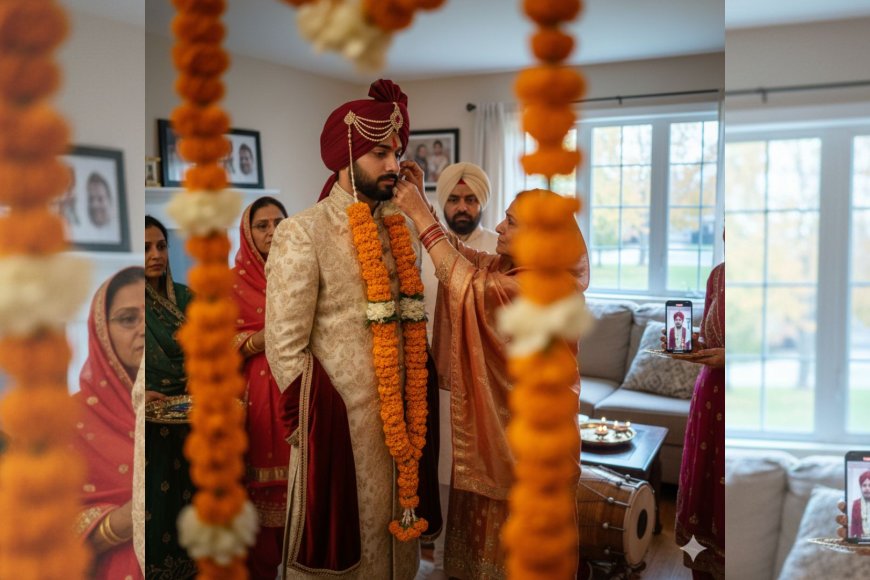
From Vedic ritual to royal courts to the steps of a banquet hall in Brampton, the sehra — the cascading veil of flowers, beads, or jewels that frames a groom's face — is one of Indian weddings' most visually arresting and spiritually layered traditions. For NRI grooms bridging two worlds, understanding what this headpiece actually carries is the difference between wearing it and truly owning it.
You have seen the photographs. The groom on the horse, or in the decorated car, or stepping out of the hotel elevator with his brothers around him, and there it is — that curtain of marigolds and roses and pearls falling across his face, turning him into something slightly otherworldly. Something between a man and a king. Between the person you grew up with and the person he is becoming.
If you are an NRI groom preparing for your wedding, someone has probably already told you that you will wear a sehra. Your mother has probably already begun discussing whether it should be flowers or pearls or crystal strings or some combination of all three. What nobody has perhaps told you is why. Not the surface answer — tradition, aesthetics, it looks good in photographs — but the real answer. The one that goes back centuries and carries the weight of everything a wedding is actually trying to do.
The sehra is not decoration. It is protection, transition, and ceremony compressed into a single ornate object. It is the Indian wedding's way of saying: this man is not quite himself today. He is something larger. Treat him accordingly.
🌟 DID YOU KNOW?
The word sehra derives from Sanskrit and literally means "head-garland" — placing it in a lineage of Vedic floral adornment that predates Mughal influence by centuries, though it was the Mughal and Rajput courts of the 17th and 18th centuries that elevated it into the ornate, jewelled form recognised today.
The sehra bandi [ritual of tying the sehra] ceremony is considered a separate and equally important ritual from the wedding itself — in many Punjabi and Rajasthani families, it is accompanied by specific folk songs called sehra geet [sehra songs] that have been passed down through generations and are sung exclusively at this moment.
In diaspora communities across the UK, Canada, and the UAE, NRI grooms are increasingly commissioning custom sehras that blend traditional floral elements with personalised details — family heirloom beads, specific flowers with cultural meaning, or colours coordinated with the bride's lehenga — making the sehra one of the most personalised elements of the modern Indian wedding.
What Is the Sehra?
The sehra [groom's ceremonial face veil] is a curtain of flowers, beads, pearls, crystals, or a combination of these elements, attached to the groom's pagri [turban] or safa [head cloth] and designed to cascade down across his face, partially or fully concealing it. It is worn during the baraat [groom's wedding procession] and through significant portions of the wedding ceremony, and is traditionally removed at a specific ritual moment — the first clear sight of the bride, or the jaimala [garland exchange] ceremony — creating one of the most emotionally charged reveals in all of Indian wedding tradition.
The sehra's origins are layered. According to scholarship on Vedic wedding practices, flowers and head ornaments were considered deeply mangalik [auspicious] in ancient South Asian ritual culture, believed to attract divine blessings and repel negative energies on days of significant spiritual transition. These folk and Vedic roots were later absorbed and elaborated by Mughal and Rajput royal court culture, where the groom's appearance was consciously modelled on raja[king] aesthetics — the idea that on his wedding day, every groom is a king, deserving of a king's ceremonial headgear.
By the 19th and 20th centuries, the sehra had crystallised into its contemporary form across North India — a blending of folk protection ritual, religious symbolism, and royal aesthetic expression. The word itself varies by region: sevrau in Rajasthan, mundavalya in Maharashtra, sehro in Gujarat — each reflecting localised customs while preserving the same essential function.
That function is threefold. The sehra protects: by partially concealing the groom's face, it is believed to shield him from the nazar [evil eye] on a day when he is at the height of public celebration and therefore most vulnerable to envious energies. It preserves ceremony: the concealment maintains a ritual separation between bride and groom before specific rites, making the moment of mutual vision a charged and meaningful event. And it marks transition: the man who enters the baraat partially veiled is not quite the same man who emerges after the ceremonies. The sehra holds the space of that transformation.
Community Comparison Table: The Sehra and Its Regional Equivalents
| Community / State | Local Name | Key Tradition | How NRIs Abroad Adapt It |
|---|---|---|---|
| Punjabi | Sehra | Long, dramatic floral fringe — marigolds, roses, jasmine — tied to the pagri; sehra bandi performed by mother and sisters with songs | NRI grooms in Toronto and London commission custom sehras from Indian florists on Gerrard Street or Southall Broadway; sehra bandi performed at home before the baraat |
| Rajasthani / Marwari | Sevrau | Integrated with ornate Rajasthani safa and pagri; often combines fresh flowers with gold and silver thread fringes; longer and more elaborate than Punjabi versions | NRI grooms from Rajasthani families in Houston and Melbourne source sehras from specialist Indian wedding accessory vendors; some families bring the sehra from India |
| Himachali | Sehra / local floral headgear | Mountain flowers — rhododendron, local blooms — traditionally used; simpler and more nature-connected than plains versions; tied by the mother with specific hill-region blessings | NRI Himachali families recreate using locally available flowers; white chrysanthemums and roses used as substitutes for mountain blooms |
| Garhwali | Floral sehra with regional pagri | White and yellow flowers preferred; the pagri style is distinctly Garhwali; sehra tying accompanied by mangal geet [auspicious folk songs] specific to the region | Garhwali NRI communities in Vancouver and Toronto coordinate with elders to ensure regional pagri style is preserved; sehras assembled by family members |
| Kumaoni | Sehra with Kumaoni mukut | Combined with a mukut [crown-like headpiece]; silver ornaments integrated into the floral sehra in some families; highly region-specific | Kumaoni NRIs in Sydney source silver ornaments from Indian jewellery stores; floral elements assembled locally with family involvement |
| Kashmiri Pandit | Dejhoor[traditional Kashmiri groom's headgear] with floral additions | The classical Kashmiri Pandit groom wears a dejhoor — a distinctive conical cap — often combined with floral garlands; the sehra concept is adapted rather than directly replicated | NRI Kashmiri Pandits in New Jersey and London source the dejhoor from specialist vendors or family in Kashmir; floral elements added locally |
| Ladakhi | Traditional Buddhist ceremonial headgear | Buddhist Ladakhi weddings use ceremonial headgear distinct from the Hindu sehra tradition; floral and brocade elements used in hybrid Hindu-Ladakhi ceremonies | NRI Ladakhi families with Hindu heritage in diaspora cities often adopt the Punjabi sehra for cross-community weddings |
| Punjabi Sikh | Sehra with Sikh pagri | The Sikh groom's sehra is tied to a specific Sikh-style pagri — often in the family's traditional colour — with crystal or pearl strings rather than heavy flowers to maintain the turban's dignity | NRI Sikh grooms in Mississauga and Southall work with pagri specialists who understand how to attach the sehra without disrupting the turban's integrity |
| Marathi | Mundavalya | Strings of pearls or white flowers worn across the forehead rather than cascading from a turban; simpler and more delicate than North Indian sehras; worn by both bride and groom | NRI Marathi grooms in Melbourne and Houston source mundavalya strings from Indian jewellery vendors; some families bring them from Pune or Mumbai |
| Rajasthani (Royal style) | Sevrau with kalgi | The most elaborate sehra tradition — combined with a kalgi [jewelled turban ornament] and full Rajasthani safa; gold and precious stone strings alongside fresh flowers | NRI grooms from royal or aristocratic Rajasthani families commission fully custom sehras from artisans in Jaipur, shipped internationally |
The Meaning Behind the Ritual
To understand the sehra, you must understand what Indian weddings believe about the groom's vulnerability. On his wedding day, a man is at the peak of his social visibility — celebrated, gazed upon, praised by hundreds. In Indian cosmological thinking, this peak visibility is also peak vulnerability. The same energy that draws blessings can draw nazar [the evil eye] — the envious or excessive gaze that ancient texts across Hindu, Ayurvedic, and folk traditions consider genuinely harmful.
The sehra is, at its foundation, a protective instrument. The veil between the groom's face and the world's gaze is not modesty in the Western sense — it is a ritual shield. The flowers themselves are not merely decorative; in Vedic tradition, certain flowers carry specific shakti [divine energy], and marigolds in particular are associated with Surya [the sun deity] and are believed to attract auspicious energy while repelling the malevolent.
But the sehra does something else that is philosophically profound. By partially concealing the groom's face, it creates the wedding's central dramatic tension — the moment of darshan [sacred seeing] when bride and groom truly see each other within the ritual context. The sehra makes the first clear sight of the groom a gift, not a given. It creates anticipation, which creates meaning. It is the Indian wedding's understanding that the most precious things should not be immediately, casually visible.
For anyone unfamiliar with this tradition, the simplest explanation is this: the sehra reminds everyone present that this man, today, is not just a man — he is a groom, which in Indian tradition means he is briefly, beautifully, something sacred.
Wearing the Sehra Abroad: The Practical Reality
The logistical challenge of the sehra for NRI grooms is almost entirely about sourcing — and it is more solvable than most people fear, provided you plan early.
The first question is materials. A traditional fresh-flower sehra — marigolds, roses, jasmine — requires a florist who understands the construction. This is not a floral arrangement in the Western sense; it is a structured cascade of flowers threaded and tied to attach securely to a pagri or safa. In London, the Indian florists along Southall Broadway and Ealing Road in Wembley have significant experience with wedding sehras and can execute both traditional and custom designs. In Toronto, florists in the Brampton area and along Gerrard Street East cater extensively to South Asian weddings. In Houston, the South Asian wedding vendor community on and around Hillcroft Avenue includes florists who work regularly with sehra designs. In Sydney, Harris Park in Parramatta has South Asian florists who can execute the work.
For crystal, pearl, or bead sehras — which have the significant practical advantage of being reusable, transportable, and unaffected by temperature — Indian wedding accessory vendors in all major diaspora cities carry ready-made options, or can custom-order. Many NRI families now order bead or pearl sehras from vendors in India and have them shipped, arriving weeks before the wedding. This is often the most practical solution for families who want specific traditional materials.
The sehra bandi ceremony itself requires only family — no venue, no pandit in most traditions. It is performed at the groom's home before the baraat departs. For NRI grooms whose mothers and sisters are in the same diaspora city, this is entirely replicable. For those whose key family members are joining from India, schedule the sehra bandi for the morning of the wedding day when the India contingent has arrived. If a key female relative — the mother, the eldest sister — cannot be present, a video call at the moment of tying carries genuine emotional weight and is increasingly common in diaspora weddings.
The pagri is the sehra's foundation, and it must be tied correctly for the sehra to hang properly. Ensure your pagri is tied by someone experienced — most South Asian wedding venues in diaspora cities have contacts for pagri specialists who can travel to your location. Book them well in advance, as demand spikes in wedding season.
Fire and smoke restrictions do not apply to the sehra ritual, which is a relief — but if your wedding venue has restrictions on outside vendors including florists, confirm their fresh-flower policy in advance.
Wearing the Sehra for a Destination Wedding in India
For NRI grooms choosing a destination wedding in India — Jaipur, Udaipur, Amritsar, Chandigarh, or any of the hundreds of extraordinary venues across the country — the sehra experience reaches its natural, fullest expression.
Rajasthan in particular offers the most spectacular sehra context: a groom in a full Rajasthani sevrau, mounted on a white horse, processing through a haveli courtyard at dusk. The local wedding vendors in Jaipur and Udaipur are extraordinarily skilled at producing both traditional and custom sehras, and NRI.Wedding's vendor network in these cities includes specialists who understand diaspora families' desire to blend regional authenticity with contemporary aesthetics.
Brief your local vendors in advance about your community's specific sehra style — a Punjabi sehra differs significantly from a Rajasthani sevrau, and a Sikh pagri requires a different attachment method than a Rajasthani safa. Send reference photographs. Arrange a fitting at least one day before the wedding. For non-Indian guests attending a destination wedding, the sehra and sehra bandi ceremony are among the most visually and emotionally compelling moments of the event — consider providing brief printed explanations of what they are witnessing, so that the significance translates.
What You Need: The Sehra Checklist
Ritual Items — the sehra itself [fresh flower, bead, pearl, or crystal], the pagri or safa to which it will be attached, pins or thread for secure attachment, a small diya [lamp] for the sehra bandi ceremony, and optionally rose water or attar[traditional perfume] to anoint the sehra before tying.
People Required — the groom, the mother [primary tier], sisters or sisters-in-law for the sehra bandi, a pagri specialist to tie the turban correctly before the sehra is attached, and a photographer positioned specifically for the sehra bandi moment, which is one of the most intimate and photogenic of the pre-wedding rituals.
Preparation Steps — commission or source the sehra at least four to six weeks before the wedding; confirm the pagri specialist and florist bookings; schedule the sehra bandi for the morning of the wedding before the baraat departs; brief the photographer on the sehra bandi so it is properly documented; and if key family members are joining via video call, test the connection the night before.
NRI.Wedding connects grooms with experienced pagri specialists, South Asian wedding florists, and sehra vendors across diaspora cities. Visit nri.wedding for a full vendor directory and personalised planning support.
5 Questions NRI Grooms Always Ask About the Sehra
Can I wear a bead or crystal sehra instead of fresh flowers? Is it considered less traditional?
Not at all — and in diaspora contexts, bead and crystal sehras are often the more practical and equally beautiful choice. Fresh-flower sehras wilt in warm venues and require same-day assembly, which adds logistical pressure. Pearl and crystal sehras can be sourced months in advance, transported, and worn with complete confidence. Many families in India itself have moved toward bead sehras for indoor weddings. The tradition is in the wearing and the tying — not exclusively in the material.
My partner is not Indian. Will the sehra make sense to their family?
It almost always does — and more than you might expect. The sehra is visually extraordinary, and its protective symbolism is intuitive across cultures. Brief your partner's family before the wedding with a short explanation: this is the groom's ceremonial veil, worn for protection and to mark the significance of the day, and it will be removed at a specific moment during the ceremony. Most non-Indian families find the reveal moment — the first clear sight of the groom — genuinely moving once they understand what it means.
Who performs the sehra bandi if my mother and sisters are not yet in the diaspora city?
If your immediate female family members are travelling from India and arrive the day before or morning of the wedding, the sehra bandi can be scheduled accordingly. If they genuinely cannot be present, a beloved aunt, a family friend who has been part of your life, or any senior female relative can perform the tying. The ritual's power lies in the love and blessing of the woman tying it — the relationship matters more than the specific title.
How do I find a pagri specialist in my city?
Start with your wedding venue's vendor recommendations, or ask your South Asian wedding photographer — they work with pagri specialists regularly and will have reliable contacts. NRI.Wedding's vendor directory includes pagri specialists in major diaspora cities including Toronto, London, Melbourne, Houston, and Dubai. Book at least two months in advance for peak wedding season dates.
Should the civil marriage happen before or after the religious ceremony that includes the sehra?
For most NRI couples, the civil registration happens either well before the religious wedding or immediately after. The sehra is worn during the religious ceremony — the baraat, the pheras, the jaimala — regardless of when the civil paperwork is signed. Your regional pandit can advise on the specific sequencing within your community's ritual structure, and NRI.Wedding's pandit network can connect you with someone familiar with your tradition.
The Emotional Angle
There is a moment before the baraat begins — after the pagri is tied and the sehra is in place and the family has gathered and the music is about to start — when the groom stands very still, and everyone around him goes slightly quiet.
It is the moment they see him through the sehra for the first time. Not the boy they know. The groom. The flowers frame his face like a painting. His mother's hands are still slightly trembling from the tying. His father is looking at him with an expression that has no name in any language.
For NRI grooms, this moment carries an additional weight that is hard to articulate without feeling it. You are standing in a country that did not exist in your grandparents' imagination. You are wearing something that your great-grandfather wore, in a village in Punjab or Rajasthan or Himachal, on the morning of his own wedding. The sehra connects you to him across a century and an ocean. It says: we carried this here. We carried it all this way. And today you wear it, and the chain holds.
The sehra will be removed later, and you will be a husband, and the ordinary beautiful life will begin. But in this moment, under the flowers and the pearls and the family's gaze, you are every groom your bloodline has ever produced. All of them looking through the same veil at the same beginning.
A Moment to Smile
In Mississauga, Ontario, two years ago, a Punjabi groom named Harjot was having his sehra tied by his mother, Gurpreet Kaur, in the living room of their home on the morning of his wedding. The sehra was a magnificent fresh-flower creation — marigolds and white roses — assembled that morning by the florist. Everything was perfect. The photographer was positioned. The sisters were singing. Gurpreet Kaur was crying and tying simultaneously.
What nobody had anticipated was the family's golden retriever, Shera, who had been locked in the bedroom but had learned — sometime in the previous year — how to open doors.
Shera entered the living room at full speed, assessed the magnificent floral cascade hanging at exactly his nose height, and made his professional opinion known before anyone could intervene.
The sehra survived. The florist received an emergency call. Three marigolds were replaced. Harjot's wedding photographs are extraordinary. And at every family gathering since, someone raises a glass to Shera, who remains unrepentant and was present at the reception.
Quotes from the Diaspora
"My son was embarrassed about wearing the sehra. He thought it would look strange in Canada, that his colleagues at the baraat — half of whom are not Indian — would not understand it. Then his best friend, who is Irish-Canadian, saw him in the sehra for the first time and said, 'Bro, you look like an actual king.' He wore it for four hours and didn't want to take it off." — Amarjit Kaur Sandhu, Punjabi, mother of groom, Brampton, Ontario
"I am from a Rajasthani family and my husband is Bengali. When we planned our wedding in London, I insisted on the sevrau — the full Rajasthani sehra with the safa. My husband had never seen one. When his mother saw him in it for the first time, she called me and said, 'I don't know what this is but my son has never looked more beautiful.' That is what a sehra does. It makes people see your groom the way you have always seen him." — Priyanka Rathore, Rajasthani, London, UK
"My husband and I did our sehra bandi on a video call with his mother in Amritsar. She talked us through every fold of the pagri, every pin in the sehra, from six thousand miles away. She was crying. I was crying. My husband was trying not to cry because the sehra was already tied and he didn't want to move. It was the most connected I have ever felt to a family I had only met twice in person." — Simran Mehta, Punjabi, Melbourne, Australia
Your Roots Travel With You
The sehra is, in the end, a very simple object doing a very profound thing. It frames a face. It marks a transition. It says to everyone present: look at this man, look carefully, because who he is today is different from who he was yesterday, and different again from who he will be tomorrow.
For NRI grooms carrying this tradition into diaspora cities — into banquet halls in Brampton and hotel ballrooms in Dubai and garden venues in Melbourne — the sehra is one of the most powerful statements available to them. It says: I know where I come from. I am proud of it. And I am beginning the most important chapter of my life wrapped in that knowledge.
NRI.Wedding's vendor network includes pagri specialists, sehra florists, wedding photographers who know exactly how to capture the sehra bandi moment, and regional pandits who can guide the full ceremony. Visit nri.wedding for your personalised planning checklist and vendor connections.
Wear the sehra. Let it frame everything you are about to become.
This article explores the cultural, spiritual, and practical significance of the sehra — the groom's ceremonial face veil — across Punjabi, Rajasthani, Himachali, Kashmiri Pandit, Marathi, and Bengali wedding traditions, with guidance for NRI grooms in Toronto, London, Melbourne, Houston, and Dubai.
0 comments
Real names and courtesy, please. Every comment is read by a person before it appears.
Nothing yet. Start it off.
Comments are closed on this article.