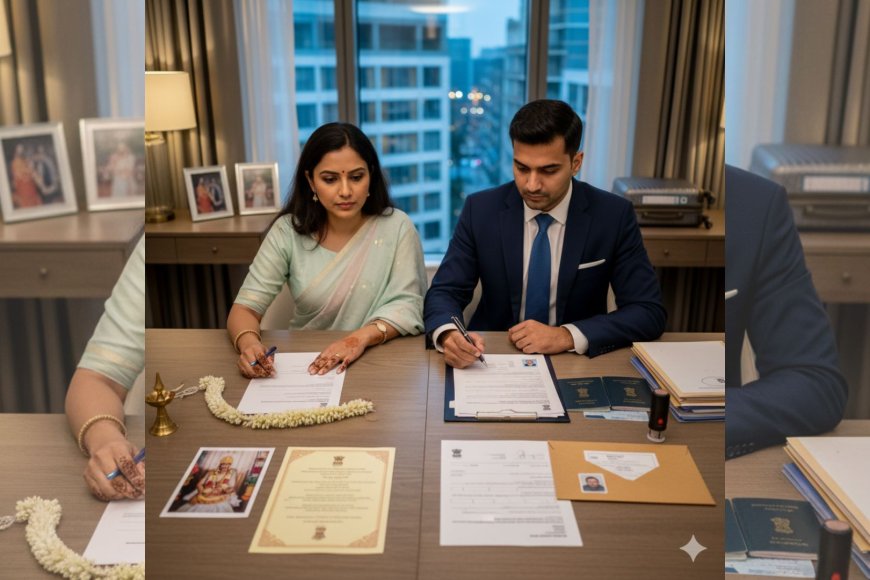
Two Ways to Be Married. Only One Way to Prove It Abroad.
You had the ceremony.
The fire was lit. The pandit chanted. The pheras were taken — seven of them, each one witnessed by the people who matter most in your life, each one carrying the weight of a tradition that has bound families together for thousands of years. Your mother cried at the right moment. Your father held himself together until the vidaai and then did not. The photographs are extraordinary.
By every measure that matters emotionally, spiritually, and culturally — you are married.
And then the letter arrives from the Home Office. Or the Canadian immigration portal requires a document upload. Or the HR department sends a form asking for proof of marriage for the dependent visa application. Or the bank needs documentation to add your spouse as joint account holder. Or the immigration lawyer — calm, experienced, having delivered this explanation many times before — explains that the ceremony, however beautiful and however genuine, does not by itself constitute marriage in the legal sense that the British government, or the American government, or the UAE residency authority, requires you to demonstrate.
The question they are asking is not whether you are married. They accept that you are. The question they are asking is: under which legal framework was your marriage constituted, and is that framework producing documentation that this authority recognises?
And this is where the distinction between a religious ceremony and a Special Marriage Act registration — a distinction that most NRI couples have never had to think about — becomes suddenly, urgently, consequentially relevant.
India has multiple legal frameworks for marriage. Each produces different documentation. Each carries different legal implications — in India and internationally. And the choice between them, or the absence of a deliberate choice, produces different outcomes in the specific administrative and legal contexts that NRI couples navigate most frequently.
This guide makes that distinction completely clear.
Not in legal textbook language. In the plain, specific, practical terms that NRI couples actually need — to understand what their religious ceremony did and did not legally establish, what the Special Marriage Act offers that religious acts do not, what the legal implications of each framework are in India and abroad, and how to make a deliberate, informed decision about which framework best serves the specific legal and administrative reality of their life.
Because the fire and the pheras are the marriage. But the legal framework is what protects it — in courts, in immigration offices, in hospitals, in banks, and in every other institution where your status as a married couple will be relevant for the rest of your life together.
Both matter. This guide helps you understand why.
The Core Reality: India's Marriage Legal Framework
The Plurality of Indian Marriage Law
India does not have a single, uniform marriage law. It has a system of personal laws — legal frameworks that apply to individuals based on their religion — alongside a secular civil law framework that applies to all citizens regardless of religion.
This plurality reflects India's constitutional commitment to religious freedom and the historical reality of a society in which different communities governed their own personal matters through their own legal and religious traditions for centuries before a unified national legal system existed.
For NRI couples, this plurality creates both options and complications. Options because multiple legal pathways to a recognised marriage exist. Complications because different frameworks produce different documentation, carry different legal implications, and are received differently by international authorities.
The Three Primary Frameworks
Framework 1: Religious Personal Laws
Each major religious community in India has its own personal law governing marriage — solemnisation, validity, and dissolution.
• The Hindu Marriage Act 1955 — applies to Hindus, Buddhists, Jains, and Sikhs
• The Muslim Personal Law (Shariat) Application Act 1937 — governs Muslim marriages through nikah
• The Indian Christian Marriage Act 1872 — governs Christian marriages
• The Anand Marriage Act 1909 — governs Sikh marriages specifically
• The Parsi Marriage and Divorce Act 1936 — governs Parsi marriages
Under each of these frameworks, a marriage that is solemnised according to the prescribed religious rites is legally valid — regardless of whether it is subsequently registered. Registration provides documentary proof of the marriage but does not constitute the marriage itself.
Framework 2: The Special Marriage Act 1954
A secular, civil marriage law that applies to all Indian citizens regardless of religion. Marriage under the Special Marriage Act is constituted by the civil act of registration — not by religious ceremony. It is the only marriage framework in India that is entirely independent of religious identity.
Framework 3: The Foreign Marriage Act 1969
Governs the registration in Indian records of marriages solemnised outside India. Relevant for NRI couples whose wedding ceremony took place in their country of residence rather than in India.
The Religious Ceremony: What It Legally Establishes and What It Does Not
What a Religious Ceremony Legally Constitutes
A marriage solemnised according to the rites and ceremonies of a recognised religious tradition — Hindu pheras, Muslim nikah, Christian church ceremony, Sikh Anand Karaj — is legally valid under the relevant personal law in India from the moment of its solemnisation.
This means:
• The parties are legally married under Indian personal law
• They acquire the rights and obligations of married persons under that personal law — inheritance rights, maintenance rights, succession rights
• The marriage is enforceable in Indian courts
• Children born of the marriage are legitimate
The legal validity of the marriage does not depend on registration. Under the Hindu Marriage Act, for example, an unregistered Hindu marriage is as legally valid as a registered one. Registration provides proof — it does not create validity.
What a Religious Ceremony Does Not Automatically Provide
It does not provide a universally recognised documentary proof of marriage.
A religious ceremony produces no standardised government documentation by itself. The pandit's certificate, the nikah nama, the church register entry — these are religious or community records. They are not government-issued documents bearing official seals that international authorities are trained to recognise and accept.
It does not automatically produce a certificate that meets international documentary standards.
International authorities — immigration departments, embassies, consulates, courts in other countries — are accustomed to seeing civil marriage certificates. Documents that clearly state the names of the parties, the date of marriage, the place of marriage, and bear the seal of a government authority. A religious ceremony certificate — even when a marriage is subsequently registered under the relevant personal law — produces documentation that varies in format and institutional recognition.
It does not resolve the legal framework question for interfaith couples.
Under Indian personal law, marriage between individuals of different religions is legally complex. The Hindu Marriage Act applies when both parties are Hindu. The Muslim Personal Law applies to Muslim marriages. A Hindu-Muslim marriage, a Hindu-Christian marriage, or any other interfaith combination cannot be solemnised under either party's personal law — creating a legal vacuum that only the Special Marriage Act resolves.
The Special Marriage Act: What It Offers That Religious Acts Do Not
A Secular Legal Foundation
The Special Marriage Act constitutes marriage as a civil act — independent of religion. Both parties can be of any religion, any community, or no religion. Their marriage under the Special Marriage Act is a relationship created by civil law, governed by civil law, and documented by civil authority.
This secular foundation has specific advantages for NRI couples:
• It is the most internationally portable marriage framework India offers — civil marriage certificates are what foreign governments most readily recognise
• It removes religious identity from the legal foundation of the marriage — which matters for interfaith couples and for couples whose country of residence does not recognise Indian personal law
• It produces documentation in a standardised civil format that is consistent with the marriage documentation formats used in most countries where NRI couples reside
The Certificate It Produces
Marriage registered under the Special Marriage Act produces a civil marriage certificate issued by the Marriage Officer of the relevant district. This certificate:
• Is issued by a government officer holding statutory authority
• States clearly the names, ages, addresses, and signatures of both parties and three witnesses
• Bears the official seal of the Marriage Officer and the government authority
• Is issued in a standardised format used across India
• Is designed specifically for legal and administrative use — not as a ceremonial keepsake
This is the certificate that most closely resembles the civil marriage certificates issued in the UK, USA, Canada, Australia, and most other countries. It is the certificate that foreign authorities most readily accept without requiring additional explanation or documentation of the marriage framework it was issued under.
Succession and Property Rights Under the Special Marriage Act
Marriage under the Special Marriage Act has a specific consequence regarding succession that is distinct from marriage under personal laws — and that NRI couples must understand.
Under Section 21A of the Special Marriage Act, if either party to a Special Marriage Act marriage is Hindu, Buddhist, Jain, or Sikh, the succession to their property is governed by the Indian Succession Act 1925 rather than by Hindu personal law succession rules.
What this means practically:
Hindu personal law succession — the Hindu Succession Act 1956 — provides for the specific distribution of a Hindu person's property among their heirs, including specific rights for parents, siblings, and other family members in certain circumstances.
The Indian Succession Act 1925 provides a different framework — generally more favourable to the surviving spouse and children, and less complex in the context of NRI couples whose estate may involve assets in multiple countries.
For most NRI couples, the Indian Succession Act framework is actually more aligned with how they think about their estate — as a couple-centred arrangement rather than a joint family property system. But this is a significant legal implication that should be understood before choosing to register under the Special Marriage Act, and ideally discussed with a lawyer who understands both Indian and international estate planning.
Divorce Under the Special Marriage Act
Divorce for couples married under the Special Marriage Act is governed by the Special Marriage Act itself — not by the personal law divorce frameworks of either party.
The grounds for divorce under the Special Marriage Act are similar to those under the Hindu Marriage Act but there are specific procedural differences. For NRI couples who may need to navigate divorce proceedings across jurisdictions — where one party is in India and the other is abroad, or where divorce is sought in the country of residence rather than in India — the civil framework of the Special Marriage Act is generally easier to interface with than the religious personal law framework.
This is not a consideration most couples focus on at the wedding planning stage. But it is a legally significant implication of the framework choice.
The Direct Comparison: Special Marriage Act vs. Religious Personal Law
International Recognition
Religious personal law certificate: Recognised in India. Recognised in countries that have bilateral legal recognition arrangements with India. May require additional documentation or explanation for some international authorities — particularly regarding what the specific personal law framework entails and what documentation it produces.
Special Marriage Act certificate: Recognised in India. Produced in a civil format that most international authorities readily recognise without requiring explanation of the underlying framework. The most internationally portable Indian marriage documentation option.
Verdict for NRI couples: Special Marriage Act produces more straightforwardly internationally recognised documentation.
Interfaith Marriage
Religious personal law: Cannot legally govern an interfaith marriage. A Hindu-Muslim marriage cannot be registered under the Hindu Marriage Act or under Muslim Personal Law. This creates genuine legal uncertainty for interfaith couples who have had a religious ceremony but have no personal law framework under which to register.
Special Marriage Act: The only legal framework available for interfaith marriages in India. Applies regardless of the religious identity of either party.
Verdict for interfaith NRI couples: Special Marriage Act is the only available option.
Processing Timeline
Religious personal law registration: Generally faster — can be completed relatively quickly after the ceremony, without a mandatory waiting period in most states.
Special Marriage Act: Requires a mandatory thirty-day notice period plus a thirty-day prior residency requirement. The complete process takes a minimum of sixty days from the commencement of residency — significantly longer than religious personal law registration.
Verdict for timeline: Religious personal law registration is faster.
Documentation Quality and Consistency
Religious personal law certificate: Format and quality vary by state, by registering authority, and by the specific personal law framework. Some states produce high-quality standardised certificates. Others produce documents that international authorities find unfamiliar.
Special Marriage Act certificate: Standardised civil format. Consistent across states. Immediately recognisable to international authorities as a civil marriage certificate.
Verdict for documentation: Special Marriage Act produces more consistent, internationally recognisable documentation.
Succession Rights
Religious personal law: Succession governed by the relevant personal law — Hindu Succession Act, Muslim Personal Law, etc. For Hindu couples, this means the full joint family property framework applies.
Special Marriage Act: Succession governed by the Indian Succession Act 1925 for Hindu, Buddhist, Jain, and Sikh parties. More spouse-and-children-centred distribution framework.
Verdict: Depends on individual circumstances and estate planning preferences. Requires legal advice specific to the couple's situation.
Divorce Framework
Religious personal law: Divorce governed by the relevant personal law framework — which varies significantly between religious communities and may create complications in international divorce proceedings.
Special Marriage Act: Divorce governed by the Special Marriage Act — a civil framework that interfaces more straightforwardly with international legal systems.
Verdict for NRI couples: Special Marriage Act divorce framework is generally more internationally compatible.
The Interfaith NRI Couple: Why the Special Marriage Act Is the Only Option
For NRI couples where the two partners belong to different religious communities — Hindu and Muslim, Hindu and Christian, Muslim and Christian, or any other combination — the Special Marriage Act is not a choice. It is the only legal framework available for formalising their marriage in Indian law.
This matters profoundly for interfaith NRI couples — because without Special Marriage Act registration, an interfaith couple who had a religious ceremony in India has a marriage that is recognised in their hearts, in their families, and culturally — but that exists in a legal grey area in Indian law that creates real complications for property rights, inheritance, and any legal matter where marital status is relevant.
The process for interfaith couples under the Special Marriage Act is identical to the process for same-religion couples. Both parties must meet the residency requirement, file the notice, wait the thirty-day period, and appear before the Marriage Officer for registration. The religion of neither party is relevant to the process — which is precisely the point.
For interfaith NRI couples, the Special Marriage Act registration is not optional. It is the legal foundation that makes the marriage real in the eyes of Indian law and the eyes of every international authority that will need to recognise it.
Can You Have Both? The Combined Approach
Many NRI couples — particularly those who want the cultural and spiritual significance of a religious ceremony combined with the legal robustness of civil registration — pursue both frameworks simultaneously.
The combined approach:
• Have the religious ceremony — the pheras, the nikah, the Anand Karaj — as the primary celebration of the marriage • Register the marriage under the Special Marriage Act as the legal documentation framework
This approach is entirely legal. The Special Marriage Act does not require parties to abandon their religious identity or their religious ceremony. It simply provides a parallel civil legal framework for the same marriage.
Practical implementation for NRI couples:
The thirty-day notice requirement under the Special Marriage Act means the process must be initiated well before the wedding date — ideally sixty or more days before. Many NRI couples initiate the Special Marriage Act process during a pre-wedding India visit and complete the civil registration during the wedding visit itself.
The religious ceremony can happen on any date — before or after the civil registration. For legal purposes, the marriage date under the Special Marriage Act is the date of civil registration. For personal and family purposes, the wedding date is whatever day the ceremony took place.
Both are real. Both matter. The combined approach honours both.
Common Mistakes NRI Couples Make Regarding Legal Frameworks
Assuming the Religious Ceremony Produces Sufficient Legal Documentation
The religious ceremony is legally valid. But legal validity and documentary sufficiency are different things. A valid marriage with insufficient documentation is a legally real marriage that is administratively difficult to prove — which creates practical problems in every context where proof is required.
Correction: Regardless of which framework applies to your religious ceremony, ensure that you have strong government-issued documentary proof of the marriage — either through diligent registration under the relevant personal law or through Special Marriage Act registration.
Not Considering the Special Marriage Act for Its International Documentation Advantages
Many NRI couples default to registration under the religious personal law applicable to their community — without considering whether the Special Marriage Act might produce more internationally useful documentation. The thirty-day notice period feels like a burden. The secular framework feels unnecessary if both parties are of the same religion.
Correction: Evaluate both options against your specific administrative needs before defaulting to personal law registration. If you anticipate significant use of your marriage certificate in international contexts — visa applications, immigration processes, name changes across jurisdictions — the Special Marriage Act's more internationally portable documentation format is worth the additional process time.
Interfaith Couples Not Registering Under the Special Marriage Act
Interfaith couples who have had a ceremony and not registered under the Special Marriage Act are in a legally uncertain position in Indian law. This uncertainty has real consequences — for property rights, for inheritance, for any legal proceeding where marital status is relevant.
Correction: For interfaith couples, Special Marriage Act registration is not optional. It is the foundational legal act that makes the marriage real in Indian law. If it has not been done, it should be done as soon as possible — even years after the ceremony.
Not Understanding the Succession Implications Before Choosing the Special Marriage Act
The shift from Hindu personal law succession to Indian Succession Act succession that occurs when a Hindu couple registers under the Special Marriage Act is a significant legal change. Couples who make this choice without understanding its succession implications may find that their estate planning assumptions — based on Hindu personal law succession — are no longer applicable.
Correction: Before registering under the Special Marriage Act, consult with a lawyer who understands both Indian succession law and international estate planning. Understand specifically what changes with respect to the succession rights of parents, siblings, and other family members who might otherwise have claims under Hindu personal law.
Treating Legal Framework as a Post-Wedding Administrative Detail
The choice between religious personal law registration and Special Marriage Act registration has legal implications that extend across the entire span of the marriage — for succession, for divorce, for property rights, for international recognition. Treating it as a post-wedding administrative task to be dealt with whenever it becomes urgent means making a consequential legal decision without adequate information or deliberation.
Correction: Discuss the legal framework question with a qualified lawyer before the wedding — ideally two to three months before, when there is time to initiate the Special Marriage Act notice process if that is the chosen framework. Make the decision deliberately, with full understanding of its implications, not reactively under administrative pressure.
The Emotional and Cultural Layer: Civil Law and Cultural Identity
For many NRI couples — and for many Indian families — the idea of a civil marriage registration feels like a diminishment of the ceremony. As though adding a civil legal layer somehow reduces the significance of the religious rite. As though the fire and the pheras need a government officer's seal to be real.
They do not. And the Special Marriage Act does not suggest that they do.
The pheras are the marriage in the deepest sense — the spiritual, personal, cultural commitment that carries meaning beyond any legal framework. The Special Marriage Act registration is the administrative record of that marriage — the documentation that allows the legal systems of two countries to recognise and protect what the ceremony created.
These are not competing acts. They are complementary ones. The ceremony is the meaning. The registration is the protection.
For NRI couples specifically — who live in countries where their marriage needs to be documented in ways that Indian personal law alone does not always efficiently support — the Special Marriage Act is not a bureaucratic imposition on a sacred ceremony. It is the practical expression of care for the marriage and the life being built around it.
Your pheras need no legal validation. But your visa application does. Your immigration process does. Your joint property does. Your estate does. Your partner's rights in every jurisdiction where your life unfolds together — all of these benefit from the clearest, most internationally robust legal foundation you can give your marriage at its beginning.
The Special Marriage Act can be that foundation — alongside the ceremony, not instead of it.
Legal Framework Decision Checklist for NRI Couples
Questions to Determine the Right Framework
• Are both partners of the same religion — or is this an interfaith marriage?
• In which countries will the marriage certificate be most frequently used?
• What is the timeline of the India visit — is sixty days available for the Special Marriage Act process?
• What are the estate planning preferences — personal law succession or Indian Succession Act framework?
• Is the couple's immigration situation likely to require civil marriage documentation specifically?
If Choosing Religious Personal Law Registration
• Identify the correct registering authority for the relevant act in the relevant state
• Gather all required documents for registration
• Complete registration within the India visit if possible — before returning abroad
• Obtain minimum five certified copies of the certificate
• Proceed to apostille process immediately after registration
If Choosing Special Marriage Act Registration
• Initiate thirty-day residency requirement at least sixty days before intended registration date
• File notice of intended marriage with the Marriage Officer of the relevant district
• Allow thirty-day notice period to elapse
• Appear before Marriage Officer with witnesses for registration
• Obtain minimum five certified copies of the certificate
• Proceed to apostille process immediately after registration
For Both Frameworks
• Consult a lawyer about succession implications before final framework decision
• Understand divorce framework implications of chosen registration
• Complete apostille process within four to six weeks of obtaining certificate
• Register marriage with Indian consulate in country of residence
• Store multiple certified and apostilled copies in secure accessible locations
The Framework That Protects Everything the Ceremony Created
The fire and the pheras created the marriage. The witnesses saw it. The families blessed it. The tradition sanctified it.
The legal framework protects it.
Not from the inside — where the commitment and the love and the choice are already complete and need no legal validation. But from the outside — where courts and immigration departments and tax authorities and hospitals and banks need to know, in the language of documents and seals and official registrations, that two people are legally married and that their marriage carries the full weight of legal recognition in every jurisdiction that governs their life.
For NRI couples living across two legal systems — the personal law of their Indian heritage and the civil law of their country of residence — choosing the right legal framework for their marriage is an act of care for the life they are building together. It is the administrative foundation that supports everything the ceremony expressed.
Choose it deliberately. Understand its implications. Get it documented correctly. Apostille it. Keep the copies safe.
And then get back to the part that matters most.
The marriage itself — which the ceremony created and the legal framework protects, but which is ultimately lived in the daily choice to show up for each other, across every timezone and every challenge and every ordinary extraordinary day of a shared life.
That is what all of this is for.
Published by NRIWedding.com — The Premium Global Platform for Non-Resident Indians Planning Indian Weddings From Abroad.
0 comments
Real names and courtesy, please. Every comment is read by a person before it appears.
Nothing yet. Start it off.
Comments are closed on this article.