Summer Weddings in India: How to Keep Guests Cool and Comfortable
The Afternoon That Nobody Talks About
The photographs are beautiful.
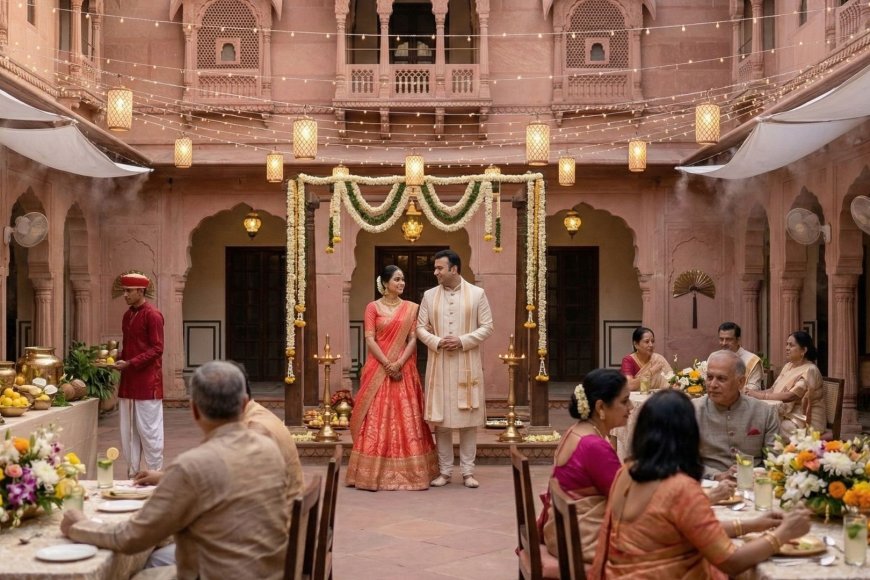
Every photograph from the May wedding in Jaipur is beautiful — the golden light, the pink sandstone of the venue's facade, the bride's lehenga in the specific shade of coral that had taken four months to source, the mandap decorated with the marigolds and the white flowers whose names the bride had learned for the occasion and forgotten immediately after. The photographs are the photographs that the couple had imagined when they had chosen the venue — the Rajasthani heritage property with the courtyard and the arched doorways and the specific atmosphere of the historic building that the air-conditioned hotel in the same city could not have provided.
Every photograph is beautiful.
Nobody photographs the afternoon.
The afternoon — the three hours between the morning ceremony's end and the evening reception's beginning, when the guests were in the courtyard of the heritage property because the indoor spaces were too small for the full guest count and the courtyard was the only space large enough — was the three hours that the guests discuss when they discuss the wedding, which is not in the terms of the photographs.
The bride's London colleagues, who had flown to Jaipur for the occasion, experienced their first Indian summer afternoon in a Rajasthani courtyard in May. The temperature was forty-one degrees. The humidity was lower than Mumbai but the sun was direct and the stone of the courtyard reflected the heat upward from the ground while the sun delivered it downward from above. The misting fans that the venue had provided were three in number and were positioned at the courtyard's three corners, which left the courtyard's centre — where the majority of the guests were — without coverage. The water station was a single table with a jug and twelve glasses, which was adequate for twelve people and inadequate for two hundred and twenty.
The groom's aunt, who was seventy-three and who had travelled from Ahmedabad for the wedding, sat in the single chair that had been placed in the courtyard's one shaded corner and did not move for two hours. Her daughter sat beside her and fanned her with the wedding programme.
The evening reception was wonderful. The guests who had survived the afternoon arrived at the reception with the specific relief of people who had been through something together and who were now, gratefully, in the air-conditioned ballroom with the cold drinks and the beautiful food and the music that was everything the couple had planned it to be.
The afternoon that nobody photographs is the afternoon that the guests remember.
Not the mandap. Not the lehenga. Not the golden light on the pink sandstone. The afternoon in the courtyard. The forty-one degrees. The three misting fans at the wrong corners. The single table with the twelve glasses.
This guide is the planning framework that prevents that afternoon — the complete approach to the summer Indian wedding that takes the heat as seriously as the décor, the guest comfort as seriously as the photography, and the practical realities of the Indian summer as the primary design constraint rather than the afterthought that the venue's brochure photographs always omit.
Understanding the Indian Summer: The Planning Context
The Temperature Reality
The Indian summer — the months from March through June, with April and May as the peak in most regions — is not the inconvenience that the word summer suggests in a temperate climate. It is a meteorological event of genuine intensity whose planning implications for an outdoor or semi-outdoor wedding are significant and must be taken seriously.
The regional variation:
The Indian summer's character varies significantly by region — and the planning response must be calibrated to the specific region rather than to the generic concept of Indian heat.
Rajasthan and the desert north: The driest and the hottest. Temperatures in Jaipur, Jodhpur, and Udaipur reach forty-two to forty-eight degrees Celsius in May. The humidity is low — which makes the heat more bearable than the humid alternatives — but the direct sun and the heat-retaining stone and marble of the heritage properties that are the most sought-after venues make the afternoon hours genuinely dangerous for the elderly and the very young.
Delhi and the northern plains: The combination of the heat and the pre-monsoon humidity that builds through May and June — the loo, the hot wind that blows from the west — produces a heat that is both high in temperature and high in the specific discomfort of the wind-driven heat. Delhi in May can reach forty-four degrees with the loo making the outdoor exposure feel significantly worse.
Mumbai and the coastal west: The coastal humidity that precedes the monsoon — the muggy, airless heat of Mumbai in May and June — is the heat that the temperature number understates. Mumbai at thirty-four degrees in May feels, to the body, significantly more demanding than Jaipur at thirty-eight because the humidity prevents the sweat's evaporation that is the body's primary cooling mechanism. The monsoon's arrival in Mumbai — typically in the first week of June — transforms the heat challenge into the rain management challenge.
Hyderabad and the Deccan plateau: The Deccan summer — hot and dry before the monsoon, increasingly humid as the monsoon approaches — reaches forty degrees in April and May. Hyderabad's specific microclimate, elevated on the plateau, is marginally more manageable than the coastal cities but requires the same planning attention as the northern venues.
Chennai and the coastal south: Chennai's summer is the year-round heat of the tropical coast, with the April-June period adding the specific intensity of the pre-monsoon heat to the baseline humidity that the city sustains throughout the year. Chennai at thirty-eight degrees with ninety percent humidity is the specific planning challenge that the coastal south Indian summer wedding presents.
The Time of Day
The Indian summer's temperature follows a specific daily curve whose understanding is the foundation of the summer wedding's programme design.
The morning — from six to ten AM — is the summer's most manageable window. The temperature is at its daily minimum, the sun is at a low angle, and the outdoor spaces that will become unbearable by noon are genuinely pleasant in the early morning. The summer wedding's outdoor elements belong in this window.
The late morning — ten to twelve — is the transition. The temperature is rising quickly. The sun is approaching its peak angle. The outdoor programme that runs long into this window is the programme that loses its comfort before it ends.
The afternoon — twelve to four PM — is the day's most dangerous window for the outdoor gathering. The peak temperature, the peak sun angle, the accumulated heat in the surfaces of the outdoor venue — this is the window that the programme must protect the guests from rather than expose them to.
The late afternoon — four to six PM — is the beginning of the recovery. The temperature is dropping, the sun's angle is reducing, and the outdoor spaces are becoming manageable again. The late afternoon outdoor programme is the programme that is warm but survivable.
The evening — after six PM — is the summer wedding's premium outdoor window. The temperature is significantly reduced from the afternoon peak, the golden hour light is the specific gift of the summer evening, and the outdoor dinner or the outdoor reception in the summer evening is the occasion that the photographs capture and that the guests genuinely enjoy.
The programme design principle: concentrate the outdoor elements in the early morning and the evening. Protect the guests from the afternoon. Design the afternoon programme entirely within the air-conditioned indoor spaces.
The Venue: The First and Most Important Decision
The Air Conditioning Audit
The summer wedding venue must be assessed specifically for its air conditioning capacity — not the air conditioning's existence, which most venues will confirm enthusiastically, but its capacity, its coverage, and its reliability under the load of the full guest count.
The capacity assessment:
The air conditioning system that maintains eighteen degrees Celsius in an empty hall may maintain twenty-six degrees when the hall is full of two hundred and twenty guests whose bodies are each generating heat. The venue's air conditioning capacity should be assessed for the full guest count rather than for the empty space.
Ask the venue specifically: what temperature does the air conditioning maintain when the hall is at full guest capacity? Ask to visit the venue during a function — not during a venue tour when the hall is empty and the air conditioning is performing at its peak — to experience the temperature under load. The venue that cannot or will not demonstrate its air conditioning performance under load is the venue whose air conditioning capacity is the unknown that the wedding day will reveal.
The coverage assessment:
The air conditioning system that cools the centre of the hall may leave the perimeter — the edges where the seating is — significantly warmer. The coverage assessment should map the temperature across the full space rather than at the air conditioning's output point. Ask the venue coordinator to walk you through the hall's temperature zones.
The generator backup:
The Indian summer's peak demand period — the afternoon hours when every air conditioning unit in the city is operating simultaneously — is the period of maximum load on the electrical grid and the period of maximum power cut risk. The venue's generator backup should be confirmed as sufficient to run the air conditioning at full capacity for the duration of the event. The generator that powers the lights but not the full air conditioning load is the generator that is not, for the summer wedding, sufficient.
The Indoor-Outdoor Balance
The summer wedding's venue should be selected for its indoor-outdoor balance — the specific configuration of indoor spaces and outdoor spaces that allows the programme to use the outdoor setting for the visually significant moments while protecting the guests in the indoor spaces during the afternoon.
The ideal configuration:
The venue with a grand indoor ceremony hall that allows the ceremony to be conducted in air-conditioned comfort — supplemented by the outdoor courtyard or garden that is available for the morning pre-ceremony gathering and the evening reception. The ceremony in the air-conditioned hall. The outdoor space for the photographs and the evening dinner.
The heritage property whose architecture provides natural shade — the deep verandahs, the covered walkways, the interior courtyards with the cross-ventilation that the traditional Indian building's design optimised for the heat — is the heritage property whose summer experience is more manageable than the heritage property whose courtyard is open to the direct afternoon sun.
The Programme Design: Protecting the Guests
The Summer Wedding Timeline
The summer wedding's programme timeline must be built around the temperature's daily curve rather than around the conventional wedding programme structure.
The morning ceremony:
The ceremony begins at seven or eight AM — early enough to be completed before the peak heat of the late morning. The early morning ceremony has the specific gift of the cooler temperature and the softer light. It also has the specific challenge of the guest who must arrive at the venue at six thirty AM — a challenge that the programme communication must address with the specific motivation of the early morning's beauty rather than the apology for the inconvenience.
The early morning ceremony's post-ceremony programme — the family photographs, the wedding breakfast, the first celebrations — occupies the nine to eleven AM window that is still manageable before the heat's peak.
The afternoon protection:
The programme between noon and four PM should be entirely indoors — the air-conditioned lunch, the rest period, the indoor entertainment, the activities that keep the guests comfortable and engaged without exposing them to the afternoon's peak heat. The indoor afternoon programme is not the compromise — it is the specific gift of the air-conditioned space to the guests who have been in the heat of the morning ceremony and who need the recovery before the evening.
The evening reception:
The evening reception begins at seven or eight PM — after the peak heat has passed, in the golden hour and the early evening when the outdoor space is at its most beautiful. The outdoor dinner under the stars, the evening reception in the heritage property's courtyard with the temperature at twenty-eight degrees rather than forty-one — this is the programme that the photographs capture and that the guests genuinely enjoy.
The Children and Elderly Programme
The children and the elderly family members require specific programme protection beyond the general guest management — they are the guests whose heat tolerance is most limited and whose heat-related health risk is most significant.
The dedicated cool space:
A dedicated air-conditioned space for the children and the elderly — separate from the main guest area, comfortable, with the specific amenities each group needs — should be maintained throughout the wedding's outdoor elements. The elderly relative who has a cool space to retreat to during the outdoor ceremony is the elderly relative who can attend the ceremony without the health risk of the sustained outdoor exposure. The children who have the cool play space during the adult programme are the children who are comfortable rather than miserable.
The supervision:
The dedicated cool spaces for the children require supervision — the family member or the professional coordinator who manages the children's space and who ensures that the children and the elderly who are using it have everything they need. The cool space that exists but is not supervised is the cool space that does not fulfil its function.
The Cooling Infrastructure: What to Provide
The Air Cooling Systems
The outdoor spaces that the summer wedding uses — the morning ceremony, the evening reception, the outdoor photograph spaces — require specific cooling infrastructure to be manageable.
The industrial air coolers:
The industrial evaporative cooler — the large air cooler that draws in the warm outdoor air, passes it through the water-saturated pads, and outputs the cooled air — is the most effective cooling system for the large outdoor space in the low-humidity summer environment. In the dry heat of Rajasthan, the evaporative cooler can reduce the perceived temperature by eight to twelve degrees across a significant radius.
The evaporative cooler is less effective in the high-humidity coastal environment — Chennai, Mumbai, Kochi — where the air is already saturated and the evaporative cooling mechanism is limited. In the high-humidity summer, the air conditioning of the indoor spaces is more valuable than the outdoor cooling systems.
The misting systems:
The misting fan — the fan with the fine water mist that cools the air as the mist evaporates — is the most commonly used outdoor cooling system at Indian wedding venues. The misting fan is effective within a limited radius and requires the correct positioning to provide coverage across the full guest area rather than at the perimeter where the positioned units produce the least benefit.
The misting system design for the outdoor wedding space should be treated as a planning task with the same seriousness as the décor design — the positioning of the misting units, the number required for the coverage area, the water supply and the electrical supply, the specific units whose mist output is appropriate for the space. The three misting fans at the corners of the two-hundred-person courtyard is the misting system that produces the Monday morning story rather than the guest comfort the couple intended.
The shade structures:
The shade structure — the marquee, the shamiana, the specific tent structure that provides overhead cover for the outdoor space — is the cooling system that requires no electricity and that addresses the primary heat source: the direct sun. The outdoor space under a white or light-coloured shade structure is significantly cooler than the same space exposed to the direct sun — the shade alone can reduce the surface temperature of the ground beneath it by ten to fifteen degrees.
The shade structure should cover the full guest area rather than the edges — the structure that provides shade for the perimeter while the centre remains exposed to the sun is the structure that provides the illusion of coverage without the reality.
The combination approach:
The most effective summer wedding outdoor cooling is the combination — the shade structure that eliminates the direct sun, the evaporative coolers or misting fans that reduce the air temperature beneath the shade, and the positioning that ensures coverage across the full guest area. The combination approach requires the planning investment and the vendor coordination but produces the outdoor experience that is genuinely comfortable rather than merely survivable.
The Hydration Infrastructure
The summer wedding's hydration infrastructure is not the decoration decision that the drink station sometimes becomes — it is the health infrastructure that the guest group's wellbeing depends on.
The water provision:
Cold water should be available continuously, in sufficient quantity for the full guest count, at multiple locations throughout the venue. The single water table with the twelve glasses is the story the guests tell. The multiple hydration stations — at the venue's entrances, in the ceremony space, at the reception — each with the cold water that is replenished before it runs out, is the infrastructure that serves the guest group's actual needs.
The calculation: the guest in the Indian summer heat requires approximately one litre of water per hour of outdoor exposure at a minimum. Two hundred guests at two hours of outdoor exposure requires four hundred litres of cold water — the planning starting point, not the ceiling.
The electrolyte provision:
The Indian summer's heat, combined with the physical demands of the wedding's dancing and the social energy that the occasion requires, produces significant electrolyte loss in the guest group. The electrolyte drink — the nimbu pani, the nariyal pani, the specific Indian summer drinks whose electrolyte content is the tradition's specific wisdom — should be part of the hydration infrastructure alongside the cold water.
The coconut water station — the fresh nariyal pani served throughout the wedding's outdoor elements — is the hydration provision that is simultaneously the specific Indian hospitality gesture and the effective electrolyte replacement. It is the drink station that is both beautiful and functional, both traditional and medically appropriate.
The alcohol timing:
The alcohol service at the summer wedding requires specific attention — alcohol in the high-heat environment accelerates dehydration and reduces the body's ability to regulate temperature. The full bar service during the peak afternoon heat is the service that produces the guest whose afternoon experience is worse rather than better. The alcohol service concentrated in the evening — after the peak heat, in the cooler outdoor space — is the service that aligns the celebration's joy with the environmental conditions that allow it to be fully enjoyed.
The Guest Communication: Setting Expectations
The Pre-Wedding Communication
The out-of-town guests — particularly the international guests who may be encountering the Indian summer for the first time — require specific advance communication about the heat and the specific preparation it requires.
The heat advisory:
The save the date and the wedding website should include a specific section on the weather at the wedding destination during the wedding month — the expected temperature, the expected humidity, the specific advice for guests who are not acclimatised to the Indian summer. This is not the apology for the weather — it is the information that allows the guest to prepare for the experience rather than be surprised by it.
The clothing guidance:
The dress code communication for the summer wedding should specifically address the heat — the recommendation of natural fabrics, the guidance on the specific clothing weights that are appropriate for the outdoor and indoor elements, the specific advice for the international guest who may not know that the silk saree that is beautiful in the photograph is the fabric that the Indian summer makes genuinely uncomfortable for the extended outdoor ceremony.
The dress code guidance that serves the guest's comfort: natural fibres — cotton, linen, lighter silks — in the lighter weights, for the outdoor elements. The heavier fabrics and the more elaborate dress for the evening reception when the cooler temperature allows them.
The schedule communication:
The advance communication should include the specific schedule — the times of each event, the indoor versus outdoor nature of each event, the specific early morning start of the ceremony — so that the guest can manage their rest, their food, and their preparation for the heat's specific demands.
The Day-Of Communication
The wedding day's programme should include specific communication about the hydration and the heat management — not as the warning that undermines the occasion's joy but as the genuine hospitality that the host extends to their guests.
The welcome to the ceremony that includes the specific guidance: the water stations are here, the cool space is here, if you need to step away from the ceremony for any reason there is a shaded seating area available. The host who gives the guests this information is the host who has prioritised the guests' genuine comfort over the performance of the occasion's seamlessness.
The Medical Preparation
The Heat-Related Health Risks
The summer wedding must include specific preparation for the heat-related health risks that the guest group's exposure to the Indian summer heat produces.
The heat exhaustion:
Heat exhaustion — the condition produced by the body's loss of water and salt through sweating — is the most common heat-related health event at summer outdoor events. Symptoms include heavy sweating, cool pale skin, a fast weak pulse, nausea, and dizziness. The guest who is experiencing heat exhaustion needs to be moved immediately to a cool space, hydrated with cold water and electrolytes, and rested.
The heat stroke:
Heat stroke — the more serious condition in which the body's temperature regulation fails and the core body temperature rises dangerously — is the medical emergency whose specific risk at the summer wedding is the reason for the on-site medical provision.
The on-site medical provision:
Every summer wedding with a significant outdoor component should have on-site medical provision — at minimum a first aider with the specific training in heat-related illness management, and ideally a doctor or paramedic for the larger guest count. The medical provision should include: oral rehydration salts, cold water, cold packs for the neck and the wrists, a thermometer, and the direct line to the nearest hospital's emergency department.
The venue coordinator who tells the couple that the venue has never had a heat-related incident is the venue coordinator whose statement is the argument for the provision rather than against it. The provision that is never used is the provision that did its job.
The Beauty and the Practicalities
The Makeup and the Hair
The bride's and the bridal party's makeup and hair in the Indian summer require specific products and specific techniques that differ from the temperate climate wedding's standard approach.
The heat-proof makeup:
The waterproof, sweat-proof setting products — the primer, the setting spray, the specific foundations formulated for the high-heat, high-sweat environment — are the non-negotiable for the summer wedding bride. The makeup artist who does not know the summer wedding context is the makeup artist whose work does not survive the afternoon.
The brief to the makeup artist: the bride will be in forty-degree heat for portions of the day. The makeup must perform in that environment. What products and techniques will you use?
The hair:
The updo — the hair secured away from the neck and the face — is the summer bride's specific comfort choice. The hair down in the Indian summer heat is the hair that traps the neck's heat and that wilts within the hour of the outdoor ceremony. The updo that keeps the neck free and that can survive the heat without the constant management is the updo that serves the summer bride's comfort alongside her beauty.
The Flowers
The summer heat's effect on flowers is the specific planning concern that the décor design must address — the flower that is beautiful in the morning ceremony may be wilted and brown by the evening reception if the specific heat management for the floral arrangements is not planned.
The heat-resistant flowers:
The flowers that survive the Indian summer heat with grace — the marigold, the chrysanthemum, the carnation, the orchid — are the flowers whose use in the outdoor arrangements is most reliable. The more delicate flowers — the rose, the lily, the specific blooms that are beautiful in the temperate climate — require the specific protection of the cool storage and the last-minute arrangement for the outdoor settings.
The arrangement timing:
The outdoor floral arrangements should be installed as late as possible before the event — the arrangement that is placed at six AM for the eight AM ceremony has two hours in the manageable temperature. The arrangement that is placed the night before has the full overnight warmth and the morning heat before the ceremony begins.
The florist who works in the Indian summer should know these considerations without being told. The florist who does not — whose experience is primarily the cooler months — requires the specific briefing on the summer wedding's floral management.
Common Mistakes NRI Couples Make With Summer Weddings
The first mistake is not auditing the venue's air conditioning capacity under the full guest load before booking. The venue whose air conditioning maintains comfort in the empty hall and fails under two hundred guests is the venue whose summer performance is not what the brochure photographs suggested. Visit during a function. Ask the specific questions. Confirm the generator backup for the air conditioning load.
The second mistake is designing the programme without the temperature curve as the primary constraint. The afternoon outdoor programme — the cocktail hour in the courtyard at two PM, the family photographs in the garden at three PM — is the programme that was designed without the temperature reality as the design constraint. Build the timeline around the heat first and the aesthetic second.
The third mistake is under-provisioning the hydration infrastructure. The water station that is beautiful and insufficient is the water station that produces the guests whose afternoon story is the twelve glasses for two hundred people. Calculate the actual water requirement, provide it at multiple locations, and replenish before it runs out rather than after.
The fourth mistake is not communicating the heat and the specific preparation it requires to the out-of-town and international guests before the wedding. The London colleague who arrives in Jaipur in May in the wool blend suit, who has not been advised about the forty-one degree afternoon, who discovers the inadequacy of their preparation in the courtyard — this guest's experience was shaped by the information they did not receive. Communicate the heat, the clothing guidance, and the schedule as part of the pre-wedding guest information.
The fifth mistake is not having specific on-site medical provision for the heat-related health risks. The summer wedding without the first aider or the doctor is the summer wedding whose response to the heat-related incident is the improvised response rather than the prepared one. Provide the medical cover. It is the planning investment whose value is measured in the incident that it prevents.
The Afternoon That Gets Planned
The couple who books the Jaipur heritage property for May does not give up the beautiful photographs.
They do not surrender the golden light on the pink sandstone, the specific atmosphere of the historic building, the courtyard that the brochure photographs correctly identified as extraordinary.
They give up the courtyard at two PM. They give up the afternoon outdoor programme. They give up the specific assumption that the venue's beauty is available at all hours with equal comfort and equal consequence.
And in giving these up they get something the original planning did not include:
The ceremony at eight AM when the courtyard is twenty-four degrees and the light is the specific quality of the early Rajasthani morning. The lunch in the air-conditioned hall at one PM when the guests are comfortable and fed and grateful for the cool. The rest period in the hotel rooms at three PM when the heat is at its peak and the guests are resting rather than enduring. The evening reception in the courtyard at eight PM when the temperature is thirty-one degrees and the stars are visible and the marigolds are still beautiful and the guests have the energy for the dancing that the afternoon's heat would have consumed.
The afternoon that nobody photographs becomes the afternoon that nobody needs to survive.
The afternoon that was the story becomes the afternoon that was planned.
Audit the air conditioning before booking.
Build the timeline around the temperature curve.
Provision the hydration for the actual guest count.
Install the shade before the sun arrives.
Tell the guests what to expect and what to wear.
Have the doctor on site.
And let the wedding be what the Indian summer evening actually is — the specific, extraordinary beauty of the occasion that was planned for the environment it was in rather than despite it.
The photographs are still beautiful.
And so is the afternoon.
Published by NRIWedding.com — The Premium Global Platform for Non-Resident Indians Planning Indian Weddings From Abroad.
0 comments
Real names and courtesy, please. Every comment is read by a person before it appears.
Nothing yet. Start it off.
Comments are closed on this article.