The Wedding You've Always Wanted — Without the Guilt That Follows
You've spent the last decade recycling religiously, carrying reusable bags to Whole Foods, switching to an electric vehicle, and genuinely caring about what kind of world you're leaving behind.
And now you're planning your wedding.
And somewhere between the third vendor call about 3,000 imported roses flown in from the Netherlands and the quote for single-use plastic chair covers for 400 guests, a quiet but persistent discomfort has settled in your chest.
This isn't who you are. This isn't how you live. So why is it how you're getting married?
This tension is real, and it's growing. Across London, Toronto, Dubai, Sydney, and New York, a new generation of NRI couples is arriving at wedding planning with a values conflict that previous generations simply didn't face — or didn't prioritize. You care deeply about sustainability. You also care deeply about your Indian heritage. And for a long time, it felt like those two things couldn't fully coexist inside a wedding that satisfied both your cultural instincts and your environmental conscience.
That feeling is about to change.
Because the truth is, India has one of the world's richest traditions of sustainable celebration. Long before "eco-conscious" became a lifestyle category, Indian weddings used banana leaves as plates, marigolds grown locally, clay diyas instead of electric lighting, cotton fabrics, and terracotta as décor. The original Indian wedding was, by modern definition, almost entirely sustainable.
What happened was scale. And imports. And the arrival of western wedding aesthetics filtered through Bollywood — the era of artificial flowers, thermocol structures, imported décor, mountains of single-use plastic, and lighting rigs that consume enough electricity to power a small village for a week.
But the pendulum is swinging back. And NRI couples are leading that swing with intention, taste, and the resources to make it beautiful.
This guide is for the couple who wants a wedding that is visually stunning, culturally rooted, emotionally powerful — and something they can look back on without environmental regret.
Let's build that wedding.
The Core Reality: Why Indian Weddings Have a Sustainability Problem — And Why NRIs Are Uniquely Positioned to Solve It
The average large Indian wedding generates an extraordinary volume of waste. Floral waste alone at a single multi-day wedding event can run into hundreds of kilograms. Add thermocol and styrofoam décor structures, synthetic fabric draping that goes directly to landfill, single-use plastic across catering setups, imported flowers with significant carbon footprints, and lighting installations running on diesel generators — and the environmental cost of a single wedding becomes significant.
This isn't a judgment. It's a context. Because understanding the problem is the first step to designing around it intelligently.
NRI couples have a particular advantage here — and a particular responsibility. You've been exposed to global conversations around sustainability in a way that isn't yet mainstream across all Indian wedding markets. You've attended events in Europe or North America where sustainable design is the norm, not the exception. You understand that eco-conscious doesn't mean cheap, sparse, or joyless. You know what sustainable luxury looks like.
And because you're often working with higher budgets than the average India-based couple, you have the financial capacity to choose better materials, source ethically, hire specialists, and invest in sustainable alternatives that cost more upfront but generate far less waste and far more meaning.
The challenge is navigating a vendor ecosystem in India that is still catching up — and managing family expectations that may equate scale and excess with love and status.
Both are solvable. Here's how.
The Strategic Framework: Building a Sustainable Wedding Decor Plan from Abroad
Pillar 1 — Redefine "Beautiful" Before You Begin
The first and most important move is internal. Before you search for vendors or build mood boards, have an honest conversation with your partner about what "beautiful" means for your wedding.
Sustainable wedding décor requires letting go of certain aesthetics — massive imported flower walls, thermocol structures, synthetic draping — and replacing them with alternatives that are often more visually interesting but require more explanation to family members who have a different reference point.
Define your aesthetic first. Are you drawn to earthy, organic textures? Botanical and garden-inspired setups? Minimalist luxury? Heritage Indian craft aesthetics? Once you have a clear visual language, sustainable sourcing becomes a much more targeted exercise.
Pillar 2 — Go Local, Go Seasonal, Go Native
The single most impactful sustainable decision you can make in wedding décor is sourcing locally and seasonally.
Flowers: India has an extraordinary native flower vocabulary — marigold, jasmine, tuberose, mogra, lotus, chrysanthemum, banana flower, and dozens of regional blooms. These are grown locally, available in abundance, and when composted after the wedding, return to the earth cleanly. Contrast this with imported roses or peonies flown in from Holland or Kenya, which carry a significant carbon footprint before they even arrive at the venue.
Work with a florist who sources from local wholesale markets — not imported stock. Ask specifically: where do these flowers come from? How far did they travel?
Foliage and greenery: Banana leaves, mango leaves, neem, jasmine vines, ferns, and palm fronds are available across India, deeply culturally resonant, and create lush, dramatic green installations that photograph beautifully. Mango leaf torans, banana trunk mandap bases, and jasmine garland canopies are all traditional, all sustainable, and all visually stunning.
Seasonal alignment: Plan your wedding month around what's in bloom locally. A February wedding in Rajasthan has access to different floral abundance than a November wedding in Goa. Ask your floral vendor what's in season — and design around it rather than against it.
Pillar 3 — Choose Materials That Have a Life After the Wedding
One of the most damaging aspects of conventional wedding décor is that it's designed for a single event and discarded immediately after. Sustainable wedding décor flips this model entirely.
Potted plants instead of cut flowers: Replace centerpiece arrangements with potted plants — succulents, herbs, small flowering plants — that guests can take home or that can be donated to community gardens, schools, or temples after the wedding. This is increasingly popular and adds a deeply personal touch.
Terracotta and clay: Terracotta vases, clay diyas, handmade pottery — all of these can be used as décor, gifted to guests, or returned to the earth. India's terracotta craft tradition is extraordinary. Rajasthan, Tamil Nadu, West Bengal, and Madhya Pradesh all have distinct terracotta aesthetics that bring regional character into your décor story.
Brass and copper: Heirloom-quality metals that can be rented from specialist wedding prop companies, used, and returned. Brass urns, copper water vessels, and bronze lamps create a warm, luminous aesthetic that no synthetic material can replicate.
Natural textiles: Cotton, jute, khadi, silk, and handloom fabrics for draping and table runners. These can often be washed and reused, donated to artisan communities, or repurposed into home furnishings after the wedding.
Bamboo and rattan: For structural elements — arch frames, seating areas, signage boards — bamboo is rapidly renewable, structurally strong, and aesthetically warm. Many boutique décor vendors in Goa, Kerala, and Bangalore now work extensively with bamboo.
Pillar 4 — Rethink Lighting
Lighting is one of the most transformative elements of wedding décor — and one of the most wasteful when done conventionally.
Clay and brass diyas: Nothing in the world creates atmosphere quite like hundreds of diyas arranged across a heritage property or garden. They're traditional, deeply beautiful, cost-effective, and entirely sustainable.
Solar-powered fairy lights: For outdoor spaces, solar-powered string lights are now widely available in India and eliminate generator dependency for ambient lighting.
LED installations: Where electric lighting is necessary, LED systems consume a fraction of the power of conventional bulbs and generate significantly less heat.
Candles in reusable holders: Beeswax or soy candles in brass or terracotta holders that can be repurposed or returned after the event.
Avoid: thermocol or plastic lighting structures, excessive neon signage, and single-use decorative lighting that has no life beyond a single event.
Pillar 5 — The Mandap
The mandap is the spiritual and visual heart of the wedding. It's also one of the areas where sustainable choices create the most dramatic visual impact.
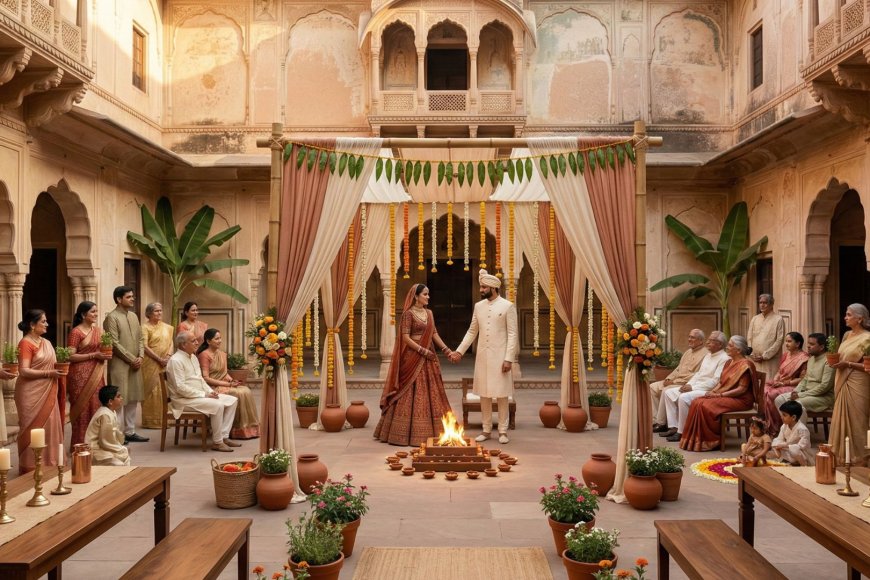
Floral mandaps using native blooms: A mandap built entirely from marigold, jasmine, tuberose, and mango leaves is not only sustainable — it's breathtaking. And it's deeply, authentically Indian in a way that imported flower installations simply aren't.
Bamboo frame mandaps: Structural bamboo frames draped in natural textiles and fresh greenery create a mandap that is architecturally interesting, photographically stunning, and entirely sustainable.
Copper and brass mandap pillars: Rented metal pillars with terracotta base elements and fresh floral accents. Timeless, reusable, and culturally resonant.
Avoid: Thermocol or styrofoam mandap structures, synthetic flower decorations, and plastic embellishments that look cheap in photographs and contribute significantly to post-wedding waste.
Common Mistakes Eco-Conscious NRI Couples Make
Greenwashing Without Scrutiny A vendor who says "we use natural flowers" may still be importing them from overseas. Ask specifically: where were these flowers grown? How were they transported? What happens to the floral waste after the event? Sustainable claims require verification, not assumption.
Treating Sustainability as an Afterthought Eco-conscious décor requires planning from the very beginning — not a last-minute attempt to swap out a few elements after the main design has been built. Bring sustainability into your first vendor conversation, not your fifth.
Choosing Sustainability Over Guest Comfort An outdoor wedding lit only by diyas sounds beautiful until guests are squinting to read menus in low light at 9 PM. Sustainable choices must be balanced against genuine hospitality. Discomfort is not eco-consciousness — it's poor planning.
Not Planning for Décor Afterlife What happens to every element of your décor after the wedding ends? If you don't have a plan — donation, composting, return to vendor, gifting to guests — even well-intentioned sustainable décor can end up in a landfill. Build the afterlife plan into every décor decision.
Assuming Sustainable Means Cheaper Quality natural materials, local artisan craftsmanship, and specialist sustainable vendors often cost as much as — or more than — conventional alternatives. Budget accordingly, and frame the investment as an ethical premium, not an unexpected expense.
The Emotional and Cultural Layer: Sustainability as a Return to Roots
Here's something worth sitting with.
The most sustainable Indian wedding is also, in many ways, the most authentically Indian wedding.
Marigold garlands. Banana leaf mandaps. Clay diyas. Handloom textiles. Terracotta vessels filled with fresh water. Locally grown jasmine strung into canopies. These are not modern sustainable design choices — they are ancient Indian aesthetic choices that happen to align perfectly with contemporary environmental values.
When you choose sustainable décor for your wedding, you are not making a compromise. You are not sacrificing beauty for conscience. You are, in the most literal sense, returning to something your grandparents' generation practiced naturally.
This is a powerful frame to share with parents who push back. This isn't a Western eco-trend imposed on an Indian wedding. This is an Indian wedding, restored to its original material vocabulary — marigolds instead of imported roses, clay instead of thermocol, handloom instead of polyester.
For NRI couples navigating the space between two cultural identities, this framing matters. Your sustainability isn't a rejection of Indian tradition. It's a reclamation of it.
Sustainable Wedding Décor Checklist for NRI Couples
Flowers and Greenery
- Source all flowers from local and regional growers
- Prioritize native blooms — marigold, jasmine, tuberose, lotus
- Use mango leaves, banana leaves, and neem for traditional garlands and torans
- Plan floral composting or temple donation for post-wedding waste
- Replace some cut flower arrangements with potted plants guests can take home
Materials
- Choose terracotta, clay, brass, and copper over plastic and synthetic
- Use bamboo or rattan for structural décor elements
- Select natural textiles — khadi, cotton, jute, handloom silk — for draping
- Avoid thermocol, styrofoam, and single-use synthetic materials entirely
Lighting
- Use clay and brass diyas for ambient and ceremonial lighting
- Specify LED systems for all electric lighting requirements
- Explore solar-powered string lights for outdoor spaces
- Avoid single-use plastic lighting structures
Mandap
- Design around native floral varieties and natural greenery
- Use bamboo frames or rented metal pillars instead of synthetic structures
- Incorporate terracotta base elements for grounding visual warmth
Vendor Vetting
- Ask all vendors where materials are sourced
- Confirm post-event waste management plans
- Request references from previous eco-conscious weddings
- Specify sustainability requirements in every contract
Post-Wedding Plan
- Arrange floral donation to temples, hospitals, or composting facilities
- Plan potted plant gifting to guests or donation to community gardens
- Return rented items — brass, copper, bamboo — to vendors
- Donate natural textile draping to artisan communities or NGOs
Your Eco-Conscious Wedding Is Not a Compromise — It's a Statement
There will be moments in this planning process when someone — a vendor, a relative, perhaps even a quieter voice inside your own head — suggests that choosing sustainable décor means settling for something less spectacular.
That voice is wrong.
The most visually arresting weddings being celebrated across India right now — the ones that travel across Instagram and into genuine cultural conversation — are increasingly the ones that made courageous, intentional material choices. The marigold-draped heritage haveli. The jasmine canopy mandap. The terracotta and candlelight reception. The bamboo arch ceremony at sunset with native wildflowers at every table.
These weddings don't look sustainable in a sparse, sacrificial way. They look like the work of couples who knew exactly what they wanted and had the confidence to pursue it — couples who understood that beauty rooted in place, culture, and craft is always more powerful than beauty assembled from a generic import catalog.
As an NRI couple, you are planning a wedding that bridges two worlds. Let your décor reflect the best of both — the global consciousness you've developed abroad, and the deep material richness of Indian craft and natural abundance.
That's not a compromise. That's a wedding worth remembering.
0 comments
Real names and courtesy, please. Every comment is read by a person before it appears.
Nothing yet. Start it off.
Comments are closed on this article.