Taj Fisherman's Cove, Mahabalipuram — A Dutch Fort Wedding on the Bay of Bengal: The NRI Tamil Nadu Guide
The Fort Wall
The groom had found it by accident.
They had been on the site visit — the Taj Fisherman's Cove, the specific, thirty-acre beachfront resort on the Coromandel Coast between Chennai and Mahabalipuram whose position on the Bay of Bengal and whose specific, only-in-Tamil-Nadu combination of the seventeenth-century Dutch fort, the curved beach, and the Taj Hotels' professional management had been on the planner's shortlist for three months.
The planner had been walking them through the standard site visit sequence — the main event lawn, the beach, the outdoor spaces, the indoor ballroom, the pool area — the specific, professional, covering-the-bases tour whose purpose was the assessment of the event infrastructure rather than the exploration of the historical.
The groom had wandered.
Not the distracted wandering of the person whose attention has been lost — the intentional wandering of the person whose attention has been caught by something at the edge of the vision, the specific, peripheral, half-seen thing that the focused tour most commonly walks past because the tour's agenda is the event space rather than the archaeology.
He had seen the wall.
The specific, seventeenth-century, Dutch-built, laterite-and-lime-mortar wall whose construction in the sixteen-fifties was the construction of the Dutch East India Company's fortification at the specific, strategically significant point on the Coromandel Coast where the trade routes and the fishing harbours and the specific, commercially important geography of the Bay of Bengal most directly intersected.
He had touched the wall.
The seventeenth-century laterite — the specific, red-brown, iron-rich stone of the Tamil Nadu coast whose quarrying and whose construction in the Dutch fort's walls had been the work of the local Tamil craftsperson directed by the Dutch East India Company's engineers in the sixteen-fifties — was warm from the Bay of Bengal morning sun.
He had stood at the wall for a long time.
Then he had called to the bride across the site visit's directed path.
He had said: come and see this.
She had come.
She had touched the wall.
She had said: how old is this?
He had said: sixteen-fifties. Dutch East India Company. This wall has been here for three hundred and seventy years.
She had looked at the wall. Then at the Bay of Bengal visible beyond the resort's grounds. Then at the groom.
She had said: we are getting married against this wall.
The planner had been called over.
The ceremony had been planned around the wall.
And the wedding had happened at the foot of the three-hundred-and-seventy-year-old Dutch fort on the Bay of Bengal coast of Tamil Nadu — the specific, only-at-Taj-Fisherman's-Cove, only-on-the-Coromandel, only-in-the-Tamil-Nadu-where-the-seventeenth-century-Dutch-and-the-twenty-first-century-Tamil-and-the-ancient-Bay-of-Bengal-all-meet wedding that the groom had found by accident when he wandered away from the planner's tour toward the thing at the edge of the vision.
This guide is for the NRI couple who is ready to wander — and who needs the complete knowledge to plan the wedding that the Dutch fort wall most powerfully frames.
The Place: Mahabalipuram and the Coromandel Coast
Mahabalipuram: The Shore Temple and the Seventh-Century Pallava
Mahabalipuram — the Mamallapuram, the specific, UNESCO World Heritage-listed town on the Coromandel Coast whose seventh-century Pallava dynasty rock-cut temples and whose Shore Temple represent the South Indian classical tradition's most ambitious and most specifically, extraordinarily preserved architectural achievement — is the nearest significant heritage town to the Taj Fisherman's Cove, approximately fifteen kilometres north of the property.
The Shore Temple: the Shore Temple of Mahabalipuram — the specific, seventh-century, Pallava-dynasty, granite-built temple complex whose position at the water's edge of the Bay of Bengal has been the position for thirteen centuries and whose specific, granite-and-sea-spray, ancient-temple-on-the-coast quality gives it the specific, atmospheric character of the monument that has been watching the Bay of Bengal since the Pallava kings built it — is the guest programme's primary heritage destination and the specific, ancient, only-in-Tamil-Nadu cultural dimension of the Coromandel Coast wedding.
The Pallava rock-cut sculptures: the Arjuna's Penance — the specific, extraordinarily detailed, cliff-face bas-relief carving of the Pallava period whose single, thirty-metre panel contains the most concentrated narrative sculptural programme of any single surface in Indian art — is the heritage programme element whose quality as the art-historical experience gives the international guest the Tamil Nadu classical tradition at its most technically, visually, narratively extraordinary.
The UNESCO heritage: the Group of Monuments at Mahabalipuram — the UNESCO World Heritage Site designation that covers the Shore Temple, the Five Rathas, Arjuna's Penance, and the specific, accumulated, Pallava-period monuments of the Mamallapuram site — is the heritage designation whose proximity to the Taj Fisherman's Cove gives the wedding's guest programme the UNESCO World Heritage experience within the twenty-minute drive.
The Coromandel Coast
The Coromandel Coast — the specific, southeastern, Bay-of-Bengal-facing coastline of Tamil Nadu whose name the Dutch East India Company gave to the trading coast whose Coromandel trade in textiles and the spices and the specific, commercially significant goods of the Tamil Nadu hinterland was the trade that the Dutch fort at the Taj Fisherman's Cove site was built to protect — is the coast whose specific, only-in-Tamil-Nadu combination of the ancient temple heritage, the Dutch colonial history, and the Bay of Bengal's specific, eastern, slightly different-from-the-Arabian-Sea quality gives the Taj Fisherman's Cove wedding its specific, layered, historically resonant character.
The Bay of Bengal: the Bay of Bengal — the specific, eastern, slightly different ocean from the Arabian Sea whose specific, slightly rougher, more temperamental, storm-season-affected quality gives the Coromandel Coast its specific, maritime character — is the ocean whose specific, visual, ambient, Bay-of-Bengal quality is the ocean whose specific, only-in-Tamil-Nadu character is the character of the southeastern coast rather than the Kerala or the Goa coast.
The Dutch legacy: the Dutch East India Company's specific, seventeenth-century presence on the Coromandel Coast — the trade posts, the forts, the specific, commercially oriented colonial engagement with the Tamil Nadu coast whose specific legacy in the laterite walls and the traded textiles and the specific, Indo-Dutch cultural exchange is the legacy that the Taj Fisherman's Cove's Dutch fort most directly embodies — is the colonial heritage dimension that gives the property its specific, only-here, three-hundred-and-seventy-year historical depth.
The Property: Taj Fisherman's Cove
The Dutch Fort: The Property's Defining Heritage
The seventeenth-century Dutch fort at the Taj Fisherman's Cove — the specific, laterite-and-lime-mortar, Dutch East India Company fortification whose walls the groom had touched on the site visit and whose construction in the sixteen-fifties was the construction of the commercial empire's specific, defensive infrastructure on the Coromandel trading coast — is the property's most specific, most irreplaceable, most historically resonant dimension.
The Dutch East India Company: the VOC — the Vereenigde Oost-Indische Compagnie, the specific, seventeenth-century, Amsterdam-chartered, commercially extraordinary Dutch East India Company whose global trading empire is the largest commercial enterprise in history and whose specific, Coromandel Coast engagement was the engagement of the institution that understood the specific, commercially significant geography of the southeastern Indian coast — built the fort at the Taj Fisherman's Cove site in the sixteen-fifties as the specific, defensive fortification of the trading post whose Coromandel textiles were the textiles that the Dutch empire traded across the Indian Ocean world.
The fort today: the Dutch fort's surviving walls — the specific, seventeenth-century, laterite-and-lime-mortar construction whose preservation within the Taj Fisherman's Cove's grounds is the preservation of the actual, original, Dutch East India Company fortification — are the walls that the groom had touched and that the bride had said we are getting married against. Not the replica. Not the heritage-themed construction. The actual, three-hundred-and-seventy-year-old fort wall whose warm laterite is the laterite that the Tamil craftsperson quarried and laid in the sixteen-fifties under the Dutch engineers' direction.
The Taj Hotels Management
The Taj Hotels — the Indian luxury hospitality group whose century of operation and whose specific, institutional commitment to the Indian heritage and the Indian hospitality tradition are the institutional standards described in the Taj Fateh Prakash Palace and the Taj Corbett articles earlier in this guide series — is the management whose Mahabalipuram property delivers the Taj's institutional standards at the Coromandel Coast's specific, heritage-and-beach, Dutch-fort-and-Bay-of-Bengal setting.
The Taj Heritage Hotels programme: the Taj Fisherman's Cove's management under the Taj's heritage property approach — the management philosophy whose specific commitment to the authentic, the sensitively managed, the historically respectful operation gives the Dutch fort's preservation the institutional framework most appropriately suited to the monument's specific, seventeenth-century character — is the management that most directly serves the fort's historical integrity while providing the contemporary luxury standard whose quality the Taj's institutional commitment most reliably delivers.
The Thirty-Acre Beachfront Estate
The Taj Fisherman's Cove's thirty-acre estate on the Coromandel Coast — the specific, Bay-of-Bengal-fronted, beach-and-fort, coastal Tamil Nadu property whose grounds contain the Dutch fort, the curved beach, the outdoor event spaces, and the Taj's accommodation — is the setting that most completely produces the wedding whose three-hundred-and-seventy-year fort wall is the ceremony backdrop and whose Bay of Bengal is the reception's horizon.
The curved beach: the Taj Fisherman's Cove's beach — the specific, curved, relatively private, Bay-of-Bengal-fronted beach whose shape is the shape of the small cove that gives the resort its name and whose specific, eastern-facing, Bay-of-Bengal character is the character of the Tamil Nadu coast — is the beach whose different quality from the Goa and the Kerala beaches gives the Coromandel wedding its specific, only-in-Tamil-Nadu, eastern-ocean character.
The Bay of Bengal sunrise: the Bay of Bengal sunrise — the specific, eastern-facing, ocean-horizon sunrise of the Tamil Nadu coast whose specific, early-morning, sea-and-sky quality is the quality of the sunrise that the Goa and the Kerala properties face away from and that the Taj Fisherman's Cove faces directly — is the specific, only-at-this-property wedding photography opportunity whose quality the western-facing coastal properties cannot replicate. The sunrise beach photography session at the Taj Fisherman's Cove is the photography whose specific, eastern-ocean, early-morning, Bay-of-Bengal light quality is the quality that the photographer whose experience is exclusively the Arabian Sea's evening light has not worked with before.
The Fisherman's Heritage
The Coromandel Coast's specific, traditional fishing community — the Tamil coastal fisherfolk whose specific, traditional, catamaran-and-net fishing tradition is the tradition of the coast that the Dutch fort's builders found already operating when they arrived in the sixteen-fifties — gives the Taj Fisherman's Cove's name its specific, cultural-heritage connection to the working coastal tradition that predates the Dutch fort and that continues today in the Tamil Nadu fishing villages along the Coromandel Coast.
The traditional catamaran: the Tamil catamaran — the specific, log-tied, sail-and-paddle traditional fishing vessel of the Coromandel Coast whose specific, seaworthy, simple construction is the construction that the Tamil fisherman has been launching through the Bay of Bengal surf for centuries — is the guest programme's most specifically, only-in-Tamil-Nadu maritime heritage element whose arranged morning launch from the beach gives the international guest the living, working, centuries-old tradition of the Coromandel fishing community in the most directly, experientially engaged form.
The Wedding Spaces
The Dutch Fort — The Ceremony Space
The Dutch fort's walls — the specific, seventeenth-century, laterite, three-hundred-and-seventy-year structure whose preservation within the Taj Fisherman's Cove's grounds gives the property its most specific, most irreplaceable, most historically resonant dimension — are the ceremony backdrop that the bride had identified at the site visit and around which the wedding programme had been planned.
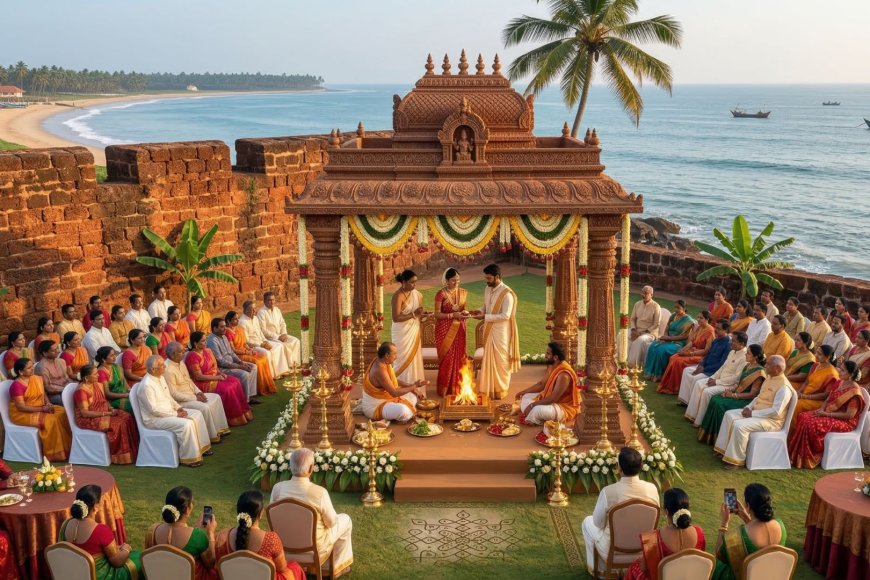
The ceremony at the Dutch fort — the mandap positioned at the fort wall's base, the seventeenth-century laterite behind the couple, the Bay of Bengal visible beyond the resort's grounds at the ceremony's horizon, the Tamil Nadu sky above, the three-hundred-and-seventy-year wall behind — is the ceremony whose setting is the specific, layered, historically resonant combination that no other Tamil Nadu wedding venue provides: the Dutch fort, the Tamil Nadu coast, the Bay of Bengal, the Taj Hotels' professional management, and the UNESCO World Heritage at fifteen kilometres.
The Dutch fort ceremony accommodates up to two hundred guests for the seated ceremony and up to three hundred for the standing reception — the moderate to substantial scale that the fort area's specific, outdoor grounds most naturally contain.
The ceremony photograph: the wedding photograph taken at the Dutch fort — the mandap, the couple, the three-hundred-and-seventy-year laterite wall, the Bay of Bengal in the distance — is the photograph that is most specifically, most unmistakably, most irreducibly at the Taj Fisherman's Cove. No other property in this guide series has a seventeenth-century Dutch fort as the ceremony backdrop.
The Beach
The Taj Fisherman's Cove's curved beach — the specific, Bay-of-Bengal-fronted, cove-shaped beach whose eastern-facing orientation gives it the sunrise and the specific, different-from-the-Arabian-Sea quality of the Bay of Bengal at the Tamil Nadu coast — is the primary outdoor wedding space for the reception dinner, the welcome dinner, and the outdoor occasion whose character the Bay of Bengal's specific, eastern-ocean character most naturally produces.
The beach reception — the dinner on the Coromandel Coast beach at the Bay of Bengal, the Tamil Nadu evening whose specific, slightly cooler, eastern-coastal quality is the quality of the Tamil Nadu beach wedding rather than the Goa or the Kerala — is the reception whose setting is the specific, only-in-Tamil-Nadu, only-on-the-Coromandel, Bay-of-Bengal-fronted quality of the eastern coast.
The Bay of Bengal sunrise photography: the sunrise photography session on the Taj Fisherman's Cove's beach — the couple on the Coromandel Coast beach in the specific, Bay of Bengal, eastern-horizon, pre-dawn quality of the Tamil Nadu sunrise — is the pre-wedding photography session whose specific, eastern-ocean, sunrise quality most directly distinguishes the Taj Fisherman's Cove wedding's photography from every other coastal property in this guide series.
The beach accommodates up to two hundred and fifty guests for the standing reception and up to two hundred for the seated dinner.
The Main Event Lawn
The Taj Fisherman's Cove's main event lawn — the primary outdoor event space whose position within the thirty-acre estate provides the large outdoor occasion's setting — is the wedding space for the sangeet, the large outdoor reception, and the outdoor function whose scale requires the greater expanse than the beach or the fort area most naturally contains.
The main event lawn accommodates up to three hundred guests for the standing reception and up to two hundred and fifty for the seated dinner — the moderate to substantial scale that makes the Taj Fisherman's Cove the destination for the NRI wedding whose guest count is the medium-large rather than the intimate.
The Grand Ballroom
The Taj Fisherman's Cove's Grand Ballroom — the primary indoor event space whose Taj Hotels' finish quality and whose professional banquet infrastructure provide the large indoor setting for the sangeet and the reception and the weather contingency for the outdoor primary programme — is the indoor wedding space whose scale and whose quality are the Taj's institutional standard applied to the Coromandel Coast setting.
The Grand Ballroom accommodates up to five hundred guests for the standing reception and up to three hundred for the seated dinner — the substantial indoor scale that the Taj Fisherman's Cove's primary indoor space provides and that the large Tamil NRI wedding's indoor functions most comfortably fills.
The Pool Area and the Pre-Function Spaces
The Taj Fisherman's Cove's pool area and the pre-function spaces — the outdoor recreational and the transitional gathering spaces whose Taj Hotels' quality and whose coastal setting give them the specific, managed, professional character of the luxury beach resort's amenity spaces — are the wedding spaces for the mehendi, the cocktail reception, and the pre-wedding gathering whose character the pool setting most naturally produces.
The Coromandel Experience: The Guest Programme
The Mahabalipuram UNESCO Heritage Visit
The Mahabalipuram UNESCO World Heritage Site — the Group of Monuments whose seventh-century, Pallava-dynasty, rock-cut and structural temples represent the South Indian classical architectural tradition at its most ambitious and most extraordinarily preserved — is the guest programme's primary heritage excursion and the fifteen-kilometre drive from the Taj Fisherman's Cove whose accessibility makes the UNESCO heritage the morning excursion rather than the full-day journey.
The Shore Temple at sunrise: the Shore Temple of Mahabalipuram at sunrise — the specific, seventh-century, granite temple at the Bay of Bengal's edge in the specific, pink-and-gold quality of the Tamil Nadu coast's sunrise light — is the heritage programme element whose combination of the ancient monument and the Bay of Bengal sunrise produces the specific, only-in-Mahabalipuram photographic experience whose quality the wedding party's sunrise visit most powerfully exploits.
Arjuna's Penance: the thirty-metre Pallava bas-relief carving — the specific, seventh-century, cliff-face sculptural programme whose narrative complexity and whose technical mastery are the mastery of the South Indian classical tradition at its most ambitious single surface — is the heritage programme element whose guided interpretation by the specialist art historian gives the international guest the specific, deep, only-in-Tamil-Nadu engagement with the Pallava artistic tradition whose quality the general tour's surface engagement does not provide.
The Dutch Heritage Walk
The Coromandel Coast's Dutch heritage — the specific, seventeenth-century, Dutch East India Company legacy whose fort at the Taj Fisherman's Cove is the physical, preserved evidence and whose specific, Indo-Dutch, trading-coast history gives the wedding's heritage dimension the specific, European-colonial, Tamil-Nadu-coast character of the contact zone — is the heritage dimension whose guided walk most specifically engages the international guest whose knowledge of India includes the European colonial engagement with the subcontinent.
The Dutch fort orientation: the guided orientation of the Dutch fort at the Taj Fisherman's Cove itself — the specific, expert-led, historically informed introduction to the fort's construction, its Dutch East India Company context, its specific, Coromandel trading history, and its preservation within the Taj's grounds — is the heritage programme element that most directly gives every wedding guest the understanding of what the wall behind the mandap is and what it means that the ceremony happened at its foot.
The Traditional Catamaran Launch
The traditional Tamil catamaran — the specific, log-tied, traditional fishing vessel of the Coromandel Coast whose morning launch through the Bay of Bengal surf is the living, working, centuries-old tradition — is the guest programme's most specifically, physically, only-in-Tamil-Nadu maritime heritage experience whose arrangement through the Taj Fisherman's Cove's local community relationships gives the international guest the direct, hands-on engagement with the working fishing tradition.
The Chennai Day Excursion
The Chennai — the Tamil Nadu capital whose thirty-kilometre proximity to the Taj Fisherman's Cove makes the city the accessible day excursion for the wedding guest whose cultural programme includes the Marina Beach, the Kapaleeshwarar Temple, and the Government Museum's Chola bronzes — is the guest programme's city-culture dimension whose combination with the Mahabalipuram heritage excursion gives the complete Coromandel-and-Chennai, ancient-and-colonial, temple-and-beach Tamil Nadu experience.
The Mammalapuram Seafood Market
The local Mahabalipuram seafood market — the specific, working, daily-catch, coastal Tamil Nadu market whose specific, fresh, Bay-of-Bengal-sourced seafood is the seafood of the coast whose fishing tradition the catamaran launch most directly embodies — is the guest programme element whose combination of the culinary heritage and the local cultural engagement gives the international guest the Tamil Nadu coastal market experience in its most directly, authentically, daily-life form.
The Season: The Coromandel Wedding Calendar
The Bay of Bengal Calendar
The Coromandel Coast's specific, Bay-of-Bengal-facing weather pattern — different from the Arabian Sea coast's pattern whose monsoon arrives from the southwest in June and departs in September — is the weather pattern whose specific, northeast monsoon character gives the Tamil Nadu coast a different seasonal calendar from the Goa and the Kerala coast.
November through February — the optimal window: the post-northeast-monsoon, dry-season window whose specific, cooler, less-humid, clearer quality makes the outdoor event the most practically, the most visually, and the most photographically comfortable outdoor event. The December and January Coromandel Coast wedding — the cool evening, the Bay of Bengal visible, the Dutch fort illuminated, the specific, Tamil Nadu winter quality — is the wedding whose outdoor programme the season most completely supports.
The northeast monsoon: the specific, October through December Northeast Monsoon of the Tamil Nadu coast — whose specific, Bay-of-Bengal-originating, southeastern-India-targeting rainfall gives the Tamil Nadu coast its primary annual rainfall during the period that is the dry season for the rest of India — is the weather condition whose specific, Coromandel Coast impact the planner must specifically address. The December wedding whose timing falls after the Northeast Monsoon's usual departure is the wedding whose outdoor programme the season supports. The October and November wedding requires the specific, managed, indoor-contingency planning whose preparation the experienced Coromandel Coast planner most reliably provides.
March through May — the hot season: the pre-monsoon warming whose temperatures in the Coromandel area approach the specific, coastal-Tamil-Nadu hot quality that the outdoor evening manages but the outdoor midday does not. The March wedding is the last of the comfortable outdoor window before the April heat begins.
The Complete Planning and Pricing Table
Comprehensive Wedding Planning Table: All Spaces, Costs, Accommodation, and Budget
| Category | Detail | Capacity / Scope | Approx. Cost (INR) | Approx. Cost (USD) | Notes |
|---|---|---|---|---|---|
| WEDDING SPACES AND VENUE COSTS | |||||
| Dutch Fort – Ceremony | 370-year fort wall, Bay | Up to 200 seated / 300 standing | ₹15,00,000 – ₹28,00,000 | $18,000 – $33,600 | Most historically unique ceremony |
| Beach – Reception Dinner | Bay of Bengal, Coromandel | Up to 200 seated / 250 standing | ₹20,00,000 – ₹38,00,000 | $24,000 – $45,600 | Bay of Bengal reception |
| Beach – Welcome Dinner | Arrival evening, eastern sea | Up to 180 seated / 230 standing | ₹15,00,000 – ₹28,00,000 | $18,000 – $33,600 | First evening, Bay of Bengal |
| Grand Ballroom – Sangeet | Taj indoor, full scale | Up to 300 seated / 500 standing | ₹25,00,000 – ₹45,00,000 | $30,000 – $54,000 | Large Tamil sangeet |
| Grand Ballroom – Reception | Formal Taj indoor | Up to 300 seated / 500 standing | ₹30,00,000 – ₹55,00,000 | $36,000 – $66,000 | Weather contingency primary |
| Main Lawn – Sangeet | Outdoor, fort backdrop | Up to 250 seated / 300 standing | ₹20,00,000 – ₹38,00,000 | $24,000 – $45,600 | Outdoor fort-view sangeet |
| Main Lawn – Cocktails | Fort and bay, outdoor | Up to 200 seated / 300 standing | ₹10,00,000 – ₹20,00,000 | $12,000 – $24,000 | Pre-dinner outdoor |
| Pool Area – Mehendi | Coastal poolside | Up to 80 seated / 120 standing | ₹5,00,000 – ₹10,00,000 | $6,000 – $12,000 | Pre-wedding daytime |
| Pool Area – Haldi | Morning coastal ritual | Up to 50 seated / 80 standing | ₹3,50,000 – ₹7,00,000 | $4,200 – $8,400 | Inner circle, morning |
| Dutch Fort – Family Gathering | Heritage fort, intimate | Up to 40 seated / 60 standing | ₹3,00,000 – ₹7,00,000 | $3,600 – $8,400 | Most heritage intimate |
| Beach – Sunrise Photos | Bay of Bengal dawn | Couple and party | ₹1,00,000 – ₹3,00,000 | $1,200 – $3,600 | Eastern ocean sunrise |
| Dutch Fort – Pre-Wedding Photos | Fort wall, heritage | Couple and party | ₹1,00,000 – ₹3,00,000 | $1,200 – $3,600 | 370-year wall session |
| Property Approach – Baraat | Coastal Tamil arrival | Procession / 300 standing | ₹4,00,000 – ₹8,00,000 | $4,800 – $9,600 | Bay of Bengal procession |
| Full Property – Exclusive Buyout | All spaces, 30 acres | Per day | ₹1,50,00,000 – ₹2,80,00,000 | $1,80,000 – $3,36,000 | Complete resort exclusive |
| Full 3-Day Wedding Package | All functions, full prog | 150–300 guests | ₹1,50,00,000 – ₹3,20,00,000 | $1,80,000 – $3,84,000 | Dutch fort Tamil wedding |
| GUEST PROGRAMME COSTS | |||||
| Mahabalipuram Shore Temple | UNESCO sunrise visit | Up to 100 guests | ₹1,00,000 – ₹3,00,000 | $1,200 – $3,600 | Dawn UNESCO heritage |
| Arjuna's Penance Guided Tour | Art historian specialist | Up to 30 per group | ₹80,000 – ₹2,50,000 | $960 – $3,000 | Pallava bas-relief |
| Dutch Fort Heritage Walk | Expert-led orientation | All guests | ₹50,000 – ₹1,50,000 | $600 – $1,800 | Property heritage essential |
| Traditional Catamaran Launch | Working boat, morning | Up to 20 guests | ₹50,000 – ₹1,50,000 | $600 – $1,800 | Coromandel tradition |
| Chennai Day Excursion | Marina, Kapaleeshwarar | Up to 100 guests | ₹1,00,000 – ₹3,00,000 | $1,200 – $3,600 | Capital city programme |
| Seafood Market Visit | Local Mahabalipuram | Up to 30 per group | ₹30,000 – ₹1,00,000 | $360 – $1,200 | Culinary heritage |
| CATERING PER HEAD | |||||
| Welcome Cocktails | Tamil snacks, coastal | Per head | ₹2,500 – ₹4,500 per head | $30 – $54 per head | Taj coastal standard |
| Tamil Wedding Feast | Banana leaf, traditional | Per head | ₹3,000 – ₹6,000 per head | $36 – $72 per head | Tamil ceremonial meal |
| Buffet Dinner | Tamil, South Indian, continental | Per head | ₹6,000 – ₹10,000 per head | $72 – $120 per head | Bay of Bengal seafood |
| Seated Dinner | Formal Taj full service | Per head | ₹9,000 – ₹15,000 per head | $108 – $180 per head | Fort backdrop formal |
| ACCOMMODATION | |||||
| Deluxe Room | Garden or pool view | Per night | ₹15,000 – ₹25,000 per night | $180 – $300 per night | Entry level, Taj coastal |
| Premium Room | Bay of Bengal view | Per night | ₹22,000 – ₹35,000 per night | $264 – $420 per night | Sea view, upgraded |
| Deluxe Bay Cottage | Bay-fronted cottage | Per night | ₹35,000 – ₹55,000 per night | $420 – $660 per night | Key family, senior guests |
| Bay Suite | Premier suite, full Bay | Per night | ₹55,000 – ₹85,000 per night | $660 – $1,020 per night | VIP family, close relatives |
| Presidential Suite | Finest, panoramic Bay | Per night | ₹90,000 – ₹1,40,000 per night | $1,080 – $1,680 per night | Wedding couple, finest suite |
| Total Rooms Available | Boutique Taj coastal | ~100–120 rooms | Full buyout recommended | Group rate negotiated | Boutique, intimate scale |
| OVERFLOW ACCOMMODATION | |||||
| Mahabalipuram area hotels | Heritage town, 15 min | Per night | ₹5,000 – ₹20,000 per night | $60 – $240 per night | Heritage area overflow |
| Chennai city hotels | Capital, 30 minutes | Per night | ₹6,000 – ₹30,000 per night | $72 – $360 per night | City overflow option |
| Coastal Tamil Nadu resorts | Coromandel proximity | Per night | ₹4,000 – ₹18,000 per night | $48 – $216 per night | Coastal overflow |
| COMPREHENSIVE BUDGET SUMMARY | |||||
| Venue hire – all functions (3 days) | All spaces, full programme | All events | ₹80,00,000 – ₹1,60,00,000 | $96,000 – $1,92,000 | Taj Coromandel premium |
| Catering – all functions (200 guests) | Taj in-house, Tamil feast | Three events | ₹75,00,000 – ₹1,40,00,000 | $90,000 – $1,68,000 | Bay of Bengal seafood |
| Accommodation (80 rooms, 3 nights) | Group rate, Taj coastal | Full block | ₹35,00,000 – ₹70,00,000 | $42,000 – $84,000 | Taj boutique rate |
| Decoration and florals | Dutch fort responsive | Full programme | ₹30,00,000 – ₹60,00,000 | $36,000 – $72,000 | Fort wall and jasmine |
| Photography and videography | Fort and Bay specialist | Full programme | ₹14,00,000 – ₹30,00,000 | $16,800 – $36,000 | Sunrise Bay session req |
| Entertainment | Tamil folk, sangeet, DJ | Full programme | ₹15,00,000 – ₹35,00,000 | $18,000 – $42,000 | Tamil Kollywood market |
| Destination wedding planner | Taj Fisherman's Cove spec | Full service | ₹8,00,000 – ₹18,00,000 | $9,600 – $21,600 | Northeast monsoon expertise |
| Guest programme | UNESCO, fort, Chennai | All days | ₹3,00,000 – ₹8,00,000 | $3,600 – $9,600 | Complete Coromandel prog |
| Bridal and groom's clothing | Kanjivaram Tamil silk | Personal | ₹10,00,000 – ₹30,00,000 | $12,000 – $36,000 | Kanjivaram at Bay of Bengal |
| Hair and makeup | Tamil bridal specialist | On-site | ₹3,00,000 – ₹8,00,000 | $3,600 – $9,600 | Tamil coastal tradition |
| Guest transport | Chennai airport, coastal | All guests | ₹5,00,000 – ₹12,00,000 | $6,000 – $14,400 | 45-minute airport |
| Dutch fort heritage programme | Expert guide, all guests | All guests | ₹50,000 – ₹1,50,000 | $600 – $1,800 | Essential heritage brief |
| Invitations and stationery | Dutch fort and Bay design | Full suite | ₹2,00,000 – ₹5,00,000 | $2,400 – $6,000 | Coromandel heritage aesthetic |
| Priest and religious requirements | Tamil ceremony, fort | Ceremony | ₹1,50,000 – ₹4,00,000 | $1,800 – $4,800 | Dutch fort ceremony protocol |
| Miscellaneous and contingency (12%) | Northeast monsoon premium | Higher % | ₹12,00,000 – ₹28,00,000 | $14,400 – $33,600 | Higher for monsoon variance |
| TOTAL ESTIMATED RANGE | 200 guests, 3-day wedding | Full programme | ₹2,94,00,000 – ₹6,10,50,000 | $3,53,000 – $7,33,000 | Dutch fort Coromandel value |
| PLANNING TIMELINE | |||||
| Initial inquiry | Taj Fisherman's Cove team | 15–18 months | 15–18 months before | Taj coastal, peak dates | |
| Northeast monsoon assessment | Dec–Feb optimal confirmed | 15 months | 15 months before | Coromandel weather calendar | |
| Contract and room block | Negotiate simultaneously | 12–14 months | 12–14 months before | Taj rate, all spaces | |
| Destination planner engaged | Coromandel specialist | 12 months | 12 months before | Northeast monsoon expertise | |
| Dutch fort ceremony design | Heritage specialist brief | 10 months | 10 months before | Fort wall mandap design | |
| Photography confirmed | Fort and Bay specialist | 10–12 months | 10–12 months before | Sunrise Bay session req | |
| Dutch fort heritage guide | Expert art historian | 8 months | 8 months before | All-guests heritage brief | |
| Mahabalipuram UNESCO visit | Heritage guide booking | 6 months | 6 months before | Sunrise Shore Temple timing | |
| Northeast monsoon contingency | Indoor protocol confirmed | 8 months | 8 months before | Specific October–November | |
| Guest communications | Invitation, Coromandel guide | 6 months | 6 months before | Include Dutch fort note | |
| Catamaran programme | Local fishing community | 6 months | 6 months before | Working tradition arranged | |
| Final guest count | Confirmed to Taj team | 6–8 weeks | 6–8 weeks before | Coastal scale precise | |
| Final payments | All vendors and venue | 4 weeks | 4 weeks before | Confirm in writing |
The Taj Fisherman's Cove's total budget range sits at the guide series mid-range for the Tamil Nadu coastal destination — the Taj Hotels' institutional standard at the Coromandel Coast property whose Dutch fort, Bay of Bengal beach, and Mahabalipuram UNESCO proximity are the credentials that most completely justify the investment for the NRI couple whose wedding vision is the specifically Tamil Nadu, historically layered, Dutch-fort-and-Bay-of-Bengal Coromandel wedding. The NRI couple whose one hundred and fifty to two hundred and fifty guest count and whose historically resonant Tamil Nadu coastal wedding vision most naturally fit the property will find the Taj Fisherman's Cove the most specifically, layered, and irreplaceable Tamil Nadu coastal wedding destination.
The Honest Assessment: The Two Tamil Nadu Properties
The ITC Grand Chola vs The Taj Fisherman's Cove
The Tamil Nadu NRI wedding guide series presents two properties whose specific Tamil Nadu credentials address the two distinct Tamil wedding visions — the ITC Grand Chola for the grand, large-format, eleven-hundred-guest, South India's-largest-ballroom Chennai wedding, and the Taj Fisherman's Cove for the historically resonant, Dutch-fort-and-Bay-of-Bengal, Mahabalipuram-UNESCO-proximate, medium-large Coromandel Coast wedding.
The ITC Grand Chola is the scale — the six hundred rooms, the Grand Chola Ballroom's eight-hundred-seated capacity, the one-thousand-one-hundred-and-thirty-guest accommodation, the Chola-heritage-inspired architecture, the specific, grand, South India's-largest Tamil wedding.
The Taj Fisherman's Cove is the heritage layering — the three-hundred-and-seventy-year Dutch fort, the Bay of Bengal beach, the Mahabalipuram UNESCO at fifteen kilometres, the Coromandel Coast's specific, Dutch-and-Tamil, ancient-and-colonial, eastern-ocean character.
The choice is the vision. The grand scale at the South India's largest hotel or the historically layered, Dutch-fort-and-UNESCO-proximate, medium-large boutique Taj coastal resort. Both are the Tamil Nadu wedding. The choice is the Tamil Nadu.
Common Mistakes NRI Couples Make When Planning the Taj Fisherman's Cove Wedding
The first mistake is not making the Dutch fort heritage briefing a formal programme element for every guest rather than the informal, background knowledge of the venue's historical feature. The Dutch fort — the three-hundred-and-seventy-year, laterite, Dutch East India Company construction whose walls are the walls that the groom had touched and around which the ceremony had been planned — is the wedding's most historically resonant, most specifically irreplaceable credential and the heritage element whose understanding by every guest most completely transforms the ceremony from the beautiful-venue outdoor occasion into the occasion of the specific, layered, historically extraordinary place. The international guest who stands at the ceremony without knowing what the wall behind the mandap is has the experience of the beautiful setting. The international guest who knows that the wall was built by the Dutch East India Company in the sixteen-fifties to protect the Coromandel trading coast's commercial routes — who knows that the Tamil craftsperson quarried and laid the laterite under the Dutch engineers' direction, that the fort has been on this coast for three hundred and seventy years, that the ceremony is happening at the foot of one of the oldest surviving European colonial structures in Tamil Nadu — has the experience of the genuinely extraordinary. Include the Dutch fort heritage briefing in the formal welcome programme. Engage the expert guide whose specific knowledge of the VOC's Coromandel Coast engagement gives every guest the understanding the wall deserves.
The second mistake is not timing the Mahabalipuram Shore Temple visit to the sunrise. The Shore Temple of Mahabalipuram — the seventh-century, Pallava-dynasty, granite temple at the Bay of Bengal's edge — is the heritage programme element whose quality as the destination experience is the quality of the monument at its most atmospheric and most photographic. The Shore Temple at the noon tourist hour is the Shore Temple without the light and without the quiet. The Shore Temple at the sunrise — the specific, pre-dawn, Bay-of-Bengal-horizon, pink-and-gold quality of the Tamil Nadu coast's morning — is the Shore Temple whose specific, ancient-monument-on-the-eastern-sea, sunrise quality is the quality that the guided heritage visit most specifically produces and that the standard midday tour cannot replicate. Arrange the Shore Temple visit at the sunrise. The wedding party at the UNESCO World Heritage Site on the Bay of Bengal at dawn on the morning before the ceremony is the wedding party whose pre-ceremony experience is the pre-ceremony experience of the genuinely extraordinary.
The third mistake is not briefing the decorator with the Dutch fort wall's specific, heritage, three-hundred-and-seventy-year character as the ceremony's primary visual element rather than the backdrop to the decorator's standard mandap installation. The Dutch fort wall — the warm laterite, the seventeenth-century mortar, the specific, aged, textured, historically extraordinary surface of the actual Dutch East India Company construction — is the ceremony's most powerful visual element and the one whose specific, heritage, authentic character the decorator most commonly overwhelms rather than amplifies when the standard mandap's scale and the standard floral installation's density compete with the wall rather than engaging it. The mandap whose scale is the scale appropriate to the fort wall's proportions, the florals whose selection and whose placement reference the fort's warm-stone palette rather than obscuring it, the ceremony installation whose specific, restrained quality allows the three-hundred-and-seventy-year wall to be the primary visual subject — this is the installation that the Dutch fort most deserves. Brief the decorator with the fort photographs and the specific instruction: the wall is the centrepiece. Build toward it, not over it.
The fourth mistake is not confirming the Northeast Monsoon contingency in the specific, operational detail that the Coromandel Coast's specific weather pattern most urgently requires. The Northeast Monsoon's specific, Bay-of-Bengal-originating, Tamil Nadu-coast-targeting rainfall is the weather condition whose Coromandel impact is the impact that distinguishes the Tamil Nadu coast's wedding calendar from the rest of India's — the monsoon that arrives in October and November on the coast that the rest of India calls the dry season. The Taj Fisherman's Cove wedding whose date falls in October or early November is the wedding whose outdoor programme requires the specific, detailed, operational indoor contingency — not the general knowledge that the Grand Ballroom is available but the specific protocol: the trigger for the indoor move, the fifteen-minute transition plan, the guest communication, the décor protection. Confirm this protocol at eight months with the planner and the Taj events team. The December and January dates whose placement after the Northeast Monsoon's usual departure are the dates whose outdoor programme the season most reliably supports.
The fifth mistake is not including the Bay of Bengal sunrise photography session as the pre-wedding photography programme's primary session rather than the standard afternoon session. The Taj Fisherman's Cove's specific, eastern-facing, Bay-of-Bengal-fronted beach orientation — the specific, only-on-the-Coromandel, only-at-the-eastern-coast quality of the sunrise that the Goa and the Kerala beaches face away from and that this beach faces directly — is the photography opportunity whose engagement most completely distinguishes the Taj Fisherman's Cove wedding's visual record from every other coastal property in this guide series. The sunrise beach session — the couple on the Coromandel Coast beach in the pre-dawn Bay of Bengal light, the specific, eastern-horizon, pink-and-gold quality of the Tamil Nadu coastal sunrise — is the session that the photographer who has only worked the Arabian Sea's evening light has not produced before and whose specific, eastern-ocean, sunrise quality most directly communicates the wedding's specific, only-at-this-beach, Bay-of-Bengal character. Confirm the sunrise session at four months. The Bay of Bengal sunrise is the most distinctive single photography opportunity the Taj Fisherman's Cove provides.
The Wandering
The groom had found it by accident.
He had wandered away from the planner's directed tour toward the thing at the edge of the vision and had found the wall.
The three-hundred-and-seventy-year laterite. The Dutch East India Company's sixteen-fifty-something construction. Warm from the Bay of Bengal morning sun.
He had called to the bride.
She had come.
She had touched the wall.
She had said: we are getting married against this wall.
The wandering had produced the wedding.
Not the directed tour's assessment of the event infrastructure. Not the ballroom capacity or the catering specification or the planner's professional evaluation of the outdoor spaces. The wandering — the specific, intentional, edge-of-the-vision attention of the person who follows the thing that catches the peripheral awareness rather than the thing that the agenda has prepared for — had produced the discovery.
The Taj Fisherman's Cove is the discovery that the wandering produces — the property whose most extraordinary dimension is not the dimension the directed site visit most prominently features but the three-hundred-and-seventy-year Dutch fort wall whose warm laterite the groom had touched when he wandered away from the tour.
Not the most famous Tamil Nadu wedding venue. The ITC Grand Chola is the most famous. Not the largest. The ITC Grand Chola is the largest. Not the most internationally recognised wedding destination in Tamil Nadu.
The most historically layered. The most specifically, irreducibly, only-at-this-property credential of the Dutch East India Company fort on the Coromandel Coast of the Bay of Bengal beside the UNESCO World Heritage Site that was built a thousand years before the Dutch arrived.
The Pallava temple at fifteen kilometres, built in the seventh century.
The Dutch fort on the property, built in the seventeenth century.
The Tamil Nadu coast that has been the Tamil Nadu coast for longer than either.
And the Bay of Bengal that was here before all of it.
Contact the Taj Fisherman's Cove events team at fifteen months.
Confirm the December or January date after the Northeast Monsoon's departure.
Plan the Dutch fort ceremony around the wall rather than in spite of it.
Include the Dutch fort heritage briefing as the formal programme's essential first element.
Brief the decorator with the specific instruction: the wall is the centrepiece.
Arrange the Shore Temple sunrise visit on the pre-wedding morning.
Confirm the Bay of Bengal sunrise photography session before any other session.
And on the site visit — when the planner is leading the directed tour through the event lawn and the beach and the ballroom and the specific, professional, covering-the-bases sequence of the site visit agenda — wander.
Follow the thing at the edge of the vision.
Find the wall.
Touch it.
It is warm from the Bay of Bengal morning sun.
It has been here since the sixteen-fifties.
And the wedding that happens at its foot — the mandap, the pheras, the priest's recitation, the Bay of Bengal beyond — will be the wedding that the three-hundred-and-seventy-year wall has been waiting to witness.
It has been waiting a long time.
It can wait until you contact the Taj Fisherman's Cove events team at fifteen months.
Published by NRIWedding.com — The Premium Global Platform for Non-Resident Indians Planning Indian Weddings From Abroad.
0 comments
Real names and courtesy, please. Every comment is read by a person before it appears.
Nothing yet. Start it off.
Comments are closed on this article.