Taj West End, Bengaluru — A 140-Year-Old Colonial Garden Wedding in the Heart of Bangalore: The NRI Guide
The Trees
The bride's grandfather had planted a tree in Bangalore in 1962.
Not at the Taj West End — the specific, colonial-era, Sankey Road, Race Course Road-adjacent hotel was not the kind of place where private citizens planted trees in 1962. He had planted the tree in the garden of the house in Malleswaram whose specific, north-Bangalore, tree-lined, old-residential-neighbourhood character was the character of the Bangalore he had grown up in and that the subsequent decades of the city's technological transformation had made increasingly, specifically, only-in-the-old-residential-parts-of-the-city available.
He had planted it because the Bangalore he loved was the Bangalore of the garden.
Not the Silicon Valley of the East, not the IT corridor, not the startup ecosystem, not the specific, globally-indexed, economically significant, internationally recognised Bangalore of the contemporary urban technology narrative. The Bangalore of the garden — the specific, colonial, garden-city, tree-lined, bungalow-and-compound, Cantonment-and-Civil-Lines, slower-air-and-specific-green character of the city that the British had built on the Mysore Plateau's specific, altitude-and-vegetation, six-thousand-foot elevation and that the subsequent decades of the Indian Republic had inherited and maintained with the specific, only-Bangalore, garden-city quality that no other Indian metropolitan city replicates in the same form.
The bride had grown up in the grandfather's house in Malleswaram.
She had grown up under the tree.
When she had come to look at venues for the wedding — the specific, NRI-London-bride, returning-to-Bangalore, want-the-wedding-in-the-city-but-not-the-city-the-IT-corridor-made wedding whose vision had been the garden-city Bangalore rather than the startup-ecosystem Bangalore — the planner had taken her to the Taj West End on a Tuesday morning in March.
She had walked through the entrance.
She had seen the twenty-acre garden.
She had seen the trees.
The rain trees and the silk-cotton trees and the golden shower trees and the specific, accumulated, planted-by-someone-long-ago-and-grown-into-the-specific-canopy-of-the-mature-garden trees of the Taj West End's twenty-acre grounds whose specific, colonial, garden-city, Bangalore-specific botanical character was the character of the garden that had been accumulating for one hundred and forty years since 1887.
She had stopped walking.
She had said to the planner: these trees are old.
The planner had said: the oldest have been here since the hotel was built. Some since before.
The bride had been quiet for a moment.
Then she had said: my grandfather planted a tree in Bangalore in 1962. He planted it because the Bangalore he loved was the Bangalore of the garden.
She had looked at the Taj West End's twenty-acre garden — the oldest trees, the specific, canopy-and-shade-and-Bangalore-light quality of the hundred-and-forty-year-old garden in the city that had been built on the garden principle and that had been fighting to maintain the garden against the concrete for six decades.
She had said: this is the Bangalore he was trying to preserve.
The Taj West End, Bengaluru — the 1887 colonial-era hotel on the Race Course Road whose specific, twenty-acre, mature, garden-city, Bangalore-tree-lined grounds are the most direct, most specifically, most irreducibly only-in-Bangalore expression of the garden-city character that the bride's grandfather had been trying to preserve by planting the tree in Malleswaram in 1962 — is the wedding venue that the tree is about.
This guide is for the NRI couple whose Bangalore wedding is the garden-city Bangalore — the specific, colonial, tree-lined, canopy-and-shade, grandfather's-Bangalore rather than the IT-corridor Bangalore — and who needs the complete knowledge to plan the occasion that the hundred-and-forty-year-old garden most powerfully frames.
The Hotel: 1887 and the Hundred and Forty Years Since
The 1887 Foundation
The Taj West End was established in 1887 — the specific, late-Victorian, colonial Bangalore year whose position in the city's history is the position of the garden city at its most specifically, deliberately, only-in-Bangalore cultivated.
The colonial Bangalore context: the 1887 Bangalore — the specific, British India, Cantonment-and-Civil-Lines, Race-Course-and-Residency, deliberate-garden-planning, Mysore-Plateau-altitude, year-round-spring-climate city of the late-Victorian colonial administration whose specific, urban-planning, bungalow-and-compound, tree-lined-avenue design most directly produced the garden-city character that the Taj West End's 1887 foundation most specifically inherits — is the Bangalore whose specific, colonial, garden quality gives the hotel its irreplaceable historical foundation.
The 1887 property: the specific, 1887, colonial-bungalow, garden-hotel whose establishment as the hotel for the colonial Bangalore's specific, racing-and-club, social-and-recreational, garden-city-and-club-culture circuit is the foundation whose twenty-acre ground accumulation — the specific, planted, accumulated, one-hundred-and-forty-year botanical investment whose maturity is the maturity of the trees that the bride had stopped to look at — is the accumulation that no new hotel, however generously funded, however beautifully designed, can replicate in the year of the opening.
The Twenty Acres: The Garden
The Taj West End's twenty-acre garden — the specific, accumulated, one-hundred-and-forty-year, mature, colonial-garden-city botanical collection whose rain trees and silk-cotton trees and golden shower trees and specific, only-Bangalore, garden-city vegetation constitute the most directly, most specifically, most irreducibly only-at-this-hotel expression of the Bangalore garden-city tradition — is the property's most defining, most irreplaceable, most historically resonant dimension.
The rain tree: the rain tree — Samanea saman, the specific, large-canopy, flat-topped, spread-wide, leguminous tree whose specific, only-in-tropical-garden-city character is the character of the colonial Bangalore garden whose planted rain trees have been the shade-providing, garden-character-defining, city-specific botanical signature of the Bangalore garden city — is the tree whose specific, mature, hundred-year-plus canopy is the canopy of the Taj West End's most ancient specimens and whose specific, dappled-shade, only-in-this-garden quality gives the outdoor ceremony and the wedding photography the specific, only-in-the-mature-Bangalore-garden botanical setting that no new planting most naturally replicates.
The one hundred and forty years: the maturity of the garden — the specific, accumulated, planted-in-1887-and-grown-for-one-hundred-and-forty-years botanical quality of the Taj West End's oldest trees — is the quality that the bride had recognised and that the grandfather's 1962 Malleswaram tree had been the attempt to participate in and that the guide series can describe but the garden most completely delivers.
The Taj Hotels Institutional Standard
The Taj Hotels — whose institutional standard has been described across the multiple guide series articles — is the group whose Bangalore property delivers the Taj's specific, Indian-hospitality-tradition, century-of-experience, service-excellence standard at the garden-city hotel whose one-hundred-and-forty-year botanical accumulation gives the Taj's institutional management the specific, only-in-this-garden setting whose quality the institution most specifically honours.
The heritage hotel management: the Taj West End's management under the Taj's heritage property approach — the management philosophy whose specific commitment to the authentic, the sensitively managed, the historically respectful operation gives the twenty-acre garden's preservation the institutional framework most appropriately suited to the hundred-and-forty-year botanical collection's specific requirements — is the management that most directly serves the garden's integrity while providing the contemporary luxury standard whose quality the Taj's institutional commitment most reliably delivers.
The Race Course Road Location
The Taj West End's Race Course Road location — the specific, central Bangalore, Race-Course-adjacent, Sankey-Road-accessible, Cubbon-Park-proximate, Cantonment-heritage position whose specific, only-in-central-Bangalore, colonial-and-contemporary quality gives the property the simultaneously historical and accessible character — is the location that most directly produces the garden-city Bangalore wedding's specific, central-but-not-the-IT-corridor, colonial-but-not-the-museum, Bangalore-proper-not-the-outer-ring-road quality.
The Kempegowda International Airport: the Kempegowda International Airport is approximately forty to fifty minutes from the Taj West End in the standard Bangalore traffic — the manageable transfer whose specific, Bangalore-traffic, NH-44-highway, city-to-airport quality is the transfer that the large NRI wedding's coordinated arrival most practically manages.
The Garden: What the Twenty Acres Produces
The Ceremony Under the Rain Tree
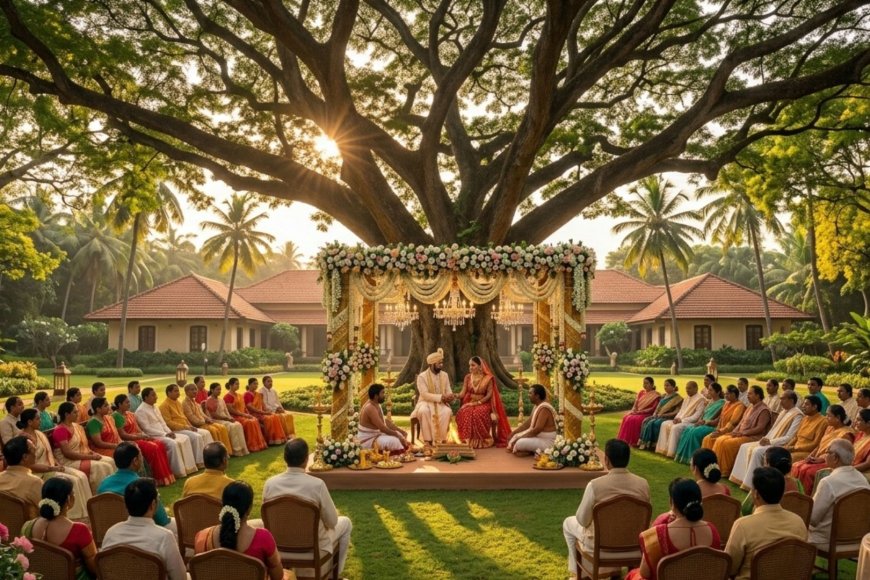
The ceremony under the Taj West End's rain tree — the specific, large-canopy, dappled-shade, hundred-year-plus, mature-garden, only-in-this-specific-tree outdoor ceremony whose setting is the setting of the garden-city Bangalore at its most specifically, botanically irreplaceable — is the ceremony setting that the bride had come to the Taj West End to find and that the planner had known she would find when the twenty-acre garden's mature trees were seen rather than described.
The dappled light: the specific, dappled, rain-tree-canopy, late-afternoon, Bangalore light — the specific quality of the Bangalore sun filtered through the spread-wide canopy of the hundred-year rain tree at the specific, late-afternoon, only-this-angle-and-this-hour quality that the ceremony timing most powerfully exploits — is the photographic quality that the photographer who has worked the Taj West End's garden knows as the garden's finest offering and that the photographer who arrives without the prior knowledge discovers at the wrong hour.
The botanical setting: the ceremony under the Taj West End's rain tree is not the generic outdoor ceremony. It is the specific, only-in-this-garden, hundred-and-forty-year-accumulated, botanical, garden-city, Bangalore-specific ceremony whose setting is the setting of the place that the bride's grandfather had been trying to preserve by planting the tree in Malleswaram in 1962.
The Garden Spaces
The Taj West End's twenty-acre garden — the accumulated, mature, colonial-garden-city botanical collection whose specific, multiple-event, multi-day, wedding-programme spaces are distributed across the twenty acres in the specific, only-this-property, garden-city, walk-through-the-heritage-garden spatial organisation — is the wedding's primary, most extensively used, most specifically, irreducibly only-in-this-garden event setting.
The lawn spaces: the Taj West End's multiple lawn spaces — the specific, manicured, garden-surrounded, tree-adjacent lawns whose distribution across the twenty acres gives the three-day wedding programme the specific, multiple-outdoor-spaces, walk-from-one-to-the-next, garden-city spatial variety of the large estate rather than the single outdoor-event-space hotel's managed monoculture — are the wedding spaces whose variety most completely exploits the twenty-acre garden's specific, multi-event capability.
The garden walk: the wedding programme that uses the Taj West End's twenty-acre garden as the programme's ambient setting rather than the specific, designated event space most completely expresses the garden-city Bangalore wedding's specific, only-in-this-property quality: the pre-wedding photography walk through the mature-garden paths, the sangeet on the rain-tree-adjacent lawn, the ceremony under the specific heritage tree, the reception dinner under the garden's evening canopy. The garden is not the backdrop. The garden is the wedding.
The garden lawns accommodate up to four hundred guests for the standing reception and up to two hundred and fifty for the seated dinner — the moderate to substantial scale that the Taj West End's outdoor garden spaces most naturally provide.
The Indoor Event Spaces
The Taj West End's indoor event spaces — the Peacock Hall and the Blue Bar and the specific, heritage-hotel, colonial-aesthetic, professionally managed indoor spaces whose Taj Hotels' finish quality and whose professional banquet infrastructure provide the weather contingency and the formal indoor setting — are the sangeet and the formal reception spaces for the occasion whose programme requires the indoor setting or whose Bangalore pre-monsoon or monsoon timing most specifically requires the covered event infrastructure.
The Peacock Hall: the Taj West End's Peacock Hall — the primary indoor banquet space whose heritage-hotel, colonial-aesthetic, Taj-standard finish gives it the specific, warm, only-in-the-heritage-hotel quality of the indoor space that has been the indoor event setting of the important Bangalore occasion — accommodates up to three hundred and fifty guests for the standing reception and up to two hundred for the seated dinner.
The Pool and the Heritage Spaces
The Taj West End's pool — the resort pool whose position within the twenty-acre garden gives it the specific, garden-surrounded, heritage-hotel, colonial-aesthetic quality of the outdoor recreational space in the mature botanical setting — and the heritage spaces of the original colonial bungalow building are the pre-wedding function spaces for the mehendi, the family gathering, and the intimate pre-wedding occasions whose character the garden-adjacent, colonial-heritage setting most warmly produces.
The Bangalore Experience: The Garden City Programme
The Cubbon Park
The Cubbon Park — the specific, central Bangalore, 300-acre, Victorian-era, colonial-planned public park whose specific, mature, garden-city, tree-lined, Victorian-bandstand-and-statue, walking-and-evening-gathering public park character is the public expression of the garden-city Bangalore that the Taj West End's private twenty acres most directly extends — is the wedding programme's primary heritage outdoor destination and the fifteen-minute walk from the hotel.
The Cubbon Park morning: the Cubbon Park morning walk — the specific, early-morning, dew-on-the-grass, mature-tree-canopy, dog-walkers-and-serious-joggers, Bangalore-morning quality of the central park whose specific, only-in-Bangalore, colonial-and-contemporary, public-heritage-and-daily-life character is the character that the garden-city Bangalore most specifically embodies in the public space — is the guest programme element that most directly gives the international guest the Bangalore garden-city experience that the IT corridor does not provide and that the grandfather's 1962 Malleswaram tree was the attempt to participate in.
The Bangalore Palace
The Bangalore Palace — the specific, 1887, Tudor-style, wood-panelled, only-in-Bangalore, Mysore-royal-family, Gothic-and-Renaissance, only-at-this-address heritage building whose specific, colonial, royal-and-garden-city quality gives it the specific, Bangalore-heritage, royal-and-Victorian character — is the heritage programme's primary architectural destination and the twenty-minute drive from the Taj West End.
The 1887 coincidence: the Bangalore Palace's 1887 construction — the same year as the Taj West End's establishment — is the specific, historical, only-in-Bangalore coincidence that most directly connects the two properties in the specific, only-in-1887-Bangalore, colonial-and-royal-and-garden-city year whose architectural legacy is the architectural legacy of the central Bangalore heritage.
The Lalbagh Botanical Garden
The Lalbagh Botanical Garden — the specific, 240-acre, eighteenth-century, Hyder Ali-and-Tipu Sultan-founded, East India Company-developed, UNESCO-recognised, botanical, tropical, glass-house-and-heritage-tree, only-in-Bangalore public botanical garden whose specific, only-in-India, Mughal-and-colonial, royal-and-scientific, botanical-heritage quality gives it the most directly, specifically, irreducibly only-in-Bangalore botanical experience — is the heritage programme's primary botanical destination and the twenty-minute drive from the hotel.
The Lalbagh and the Taj West End: the botanical conversation between the Lalbagh's 240-acre public botanical collection and the Taj West End's twenty-acre private mature garden — the same Bangalore garden-city tradition expressed in the public and the private, the royal and the colonial, the eighteenth-century and the Victorian — is the garden programme's most specifically, only-in-Bangalore, botanical continuity that most directly gives the international guest the garden-city tradition in its complete form.
The Bangalore Craft and the Silk Heritage
The Bangalore silk — the specific, Karnataka, mulberry-silk, Mysore-tradition, Government-Silk-Weaving-Factory, only-in-the-Deccan craft heritage whose specific, traditional, woven, Karnataka-design vocabulary is the textile tradition of the region — and the Bangalore craft market — the Commercial Street, the MG Road, the specific, Bangalore, shopping-and-craft, local-and-artisan market whose specific, Karnataka-craft, Channapatna-toy and Mysore-silk and Bidriware heritage is the heritage of the Mysore Plateau's craft tradition — are the guest programme's shopping and craft heritage dimensions whose engagement gives the international guest the Bangalore beyond the IT corridor.
The Season: The Bangalore Wedding Calendar
The Optimal Window
The Bangalore wedding season — the specific, garden-city, Mysore-Plateau, altitude-moderated, two-monsoon-season, year-round-relatively-pleasant Bangalore calendar whose specific, optimal-for-the-outdoor-garden-wedding window is the window that the Taj West End's twenty-acre garden most powerfully exploits — requires the specific, only-in-Bangalore, two-monsoon seasonal understanding.
October through February: the post-northeast-monsoon, dry-season, cooler-Bangalore window whose specific, post-rain, garden-freshness, relatively-cool, clear-Bangalore-sky quality most powerfully supports the outdoor ceremony under the rain tree and the garden reception dinner. The November and December Bangalore garden wedding — the specific, post-monsoon, mature-garden, dappled-light, cool-Bangalore-evening quality — is the wedding whose outdoor programme the season most specifically enables.
March and April: the Bangalore spring — the specific, warm, pre-southwest-monsoon, golden-shower-tree-flowering quality of the Bangalore March and April whose golden shower trees produce the specific, only-in-the-Bangalore-garden-spring, yellow-flowering, canopy-transformation that the Taj West End's mature golden shower trees most powerfully produce. The wedding in the golden shower tree's flowering season is the wedding whose natural decoration is the natural decoration of the hundred-and-forty-year-old mature tree in full bloom.
May through September: the Bangalore monsoon season — the specific, Southwest Monsoon, June-through-September, Bangalore rainfall whose specific, moderate, altitude-moderated, Bangalore-monsoon quality is the rainfall that the Taj West End's indoor spaces most specifically address. The Peacock Hall and the indoor event spaces are the monsoon's complete, heritage-hotel, Taj-standard indoor answer.
The Complete Planning and Pricing Table
Comprehensive Wedding Planning Table: All Spaces, Costs, Accommodation, and Budget
| Category | Detail | Capacity / Scope | Approx. Cost (INR) | Approx. Cost (USD) | Notes |
|---|---|---|---|---|---|
| WEDDING SPACES AND VENUE COSTS | |||||
| Rain Tree Lawn – Ceremony | 140-year canopy, dappled | Up to 200 seated / 300 standing | ₹15,00,000 – ₹28,00,000 | $18,000 – $33,600 | Most Bangalore ceremony |
| Garden Lawn – Reception Dinner | 20-acre mature garden | Up to 250 seated / 350 standing | ₹22,00,000 – ₹40,00,000 | $26,400 – $48,000 | Garden-city reception |
| Garden Lawn – Welcome Dinner | Arrival evening, garden | Up to 200 seated / 280 standing | ₹18,00,000 – ₹32,00,000 | $21,600 – $38,400 | First evening, heritage garden |
| Garden Lawn – Sangeet | Outdoor mature garden | Up to 250 seated / 350 standing | ₹20,00,000 – ₹35,00,000 | $24,000 – $42,000 | Garden sangeet, tree canopy |
| Peacock Hall – Sangeet | Heritage interior, formal | Up to 200 seated / 350 standing | ₹20,00,000 – ₹38,00,000 | $24,000 – $45,600 | Heritage indoor sangeet |
| Peacock Hall – Reception | Colonial-aesthetic formal | Up to 200 seated / 350 standing | ₹25,00,000 – ₹45,00,000 | $30,000 – $54,000 | Heritage ballroom reception |
| Garden – Cocktails | Mature garden, tree canopy | Up to 200 seated / 300 standing | ₹10,00,000 – ₹20,00,000 | $12,000 – $24,000 | Pre-dinner garden cocktails |
| Heritage Space – Mehendi | Colonial bungalow, garden | Up to 80 seated / 120 standing | ₹6,00,000 – ₹12,00,000 | $7,200 – $14,400 | Pre-wedding heritage setting |
| Pool Area – Haldi | Garden pool, morning | Up to 50 seated / 80 standing | ₹4,00,000 – ₹8,00,000 | $4,800 – $9,600 | Inner circle, morning |
| Heritage Lawn – Nalangu | South Indian ritual, garden | Up to 100 seated / 150 standing | ₹6,00,000 – ₹12,00,000 | $7,200 – $14,400 | Karnataka tradition space |
| Private Dining – Family | Garden view, Taj dining | Up to 30 seated | ₹4,00,000 – ₹10,00,000 | $4,800 – $12,000 | Rehearsal family dinner |
| Garden Walk – Pre-Wedding | Mature garden photography | Couple and party | ₹1,00,000 – ₹3,00,000 | $1,200 – $3,600 | Rain tree and golden shower |
| Property Approach – Baraat | Race Course Road, colonial | Procession / 250 standing | ₹4,00,000 – ₹8,00,000 | $4,800 – $9,600 | Garden-city baraat |
| Full Property – Exclusive Buyout | All spaces, 20-acre garden | Per day | ₹1,50,00,000 – ₹2,80,00,000 | $1,80,000 – $3,36,000 | Complete estate exclusive |
| Full 3-Day Wedding Package | All functions, garden primary | 150–300 guests | ₹1,50,00,000 – ₹3,20,00,000 | $1,80,000 – $3,84,000 | 140-year garden wedding |
| GUEST PROGRAMME COSTS | |||||
| Cubbon Park Morning Walk | Colonial park, guided | All guests | ₹50,000 – ₹1,50,000 | $600 – $1,800 | Garden-city public park |
| Lalbagh Botanical Garden | Heritage botanical, guided | Up to 80 guests | ₹80,000 – ₹2,50,000 | $960 – $3,000 | Botanical heritage essential |
| Bangalore Palace Heritage | 1887 Tudor, royal | Up to 60 guests | ₹80,000 – ₹2,50,000 | $960 – $3,000 | 1887 coincidence story |
| MG Road Silk and Craft | Karnataka craft market | Up to 30 per group | ₹50,000 – ₹1,50,000 | $600 – $1,800 | Silk and Channapatna |
| Bangalore Heritage Walk | Civil Lines, Cantonment | Up to 20 per group | ₹50,000 – ₹1,50,000 | $600 – $1,800 | Colonial heritage walk |
| Vidhan Soudha Evening | Government building, lit | All guests | ₹30,000 – ₹80,000 | $360 – $960 | Bangalore landmark evening |
| CATERING PER HEAD | |||||
| Welcome Cocktails | Karnataka snacks, Taj | Per head | ₹2,500 – ₹4,500 per head | $30 – $54 per head | Taj garden standard |
| Karnataka Oota Feast | Banana leaf, traditional | Per head | ₹3,000 – ₹6,000 per head | $36 – $72 per head | Karnataka feast option |
| Buffet Dinner | Karnataka, continental | Per head | ₹7,000 – ₹12,000 per head | $84 – $144 per head | Taj garden culinary |
| Seated Dinner | Formal Taj full service | Per head | ₹10,000 – ₹16,000 per head | $120 – $192 per head | Garden formal dining |
| ACCOMMODATION | |||||
| Heritage Room | Garden view, colonial | Per night | ₹20,000 – ₹35,000 per night | $240 – $420 per night | Entry level, heritage |
| Deluxe Heritage Room | Enhanced garden view | Per night | ₹32,000 – ₹50,000 per night | $384 – $600 per night | Better garden position |
| Heritage Suite | Separate sitting, garden | Per night | ₹50,000 – ₹80,000 per night | $600 – $960 per night | Key family, senior guests |
| Premier Suite | Premier garden heritage | Per night | ₹80,000 – ₹1,25,000 per night | $960 – $1,500 per night | VIP family, close relatives |
| Presidential Suite | Finest, garden panorama | Per night | ₹1,40,000 – ₹2,20,000 per night | $1,680 – $2,640 per night | Wedding couple, finest suite |
| Total Rooms Available | Heritage garden hotel | ~100–120 rooms | Full buyout recommended | Group rate negotiated | Boutique heritage scale |
| OVERFLOW ACCOMMODATION | |||||
| Leela Palace Bengaluru | Five-star, central | Per night | ₹18,000 – ₹80,000 per night | $216 – $960 per night | Premium overflow option |
| ITC Gardenia Bengaluru | Five-star, central Bangalore | Per night | ₹15,000 – ₹60,000 per night | $180 – $720 per night | Quality overflow, central |
| Standard central Bangalore | Mid-range, accessible | Per night | ₹6,000 – ₹20,000 per night | $72 – $240 per night | Budget overflow option |
| COMPREHENSIVE BUDGET SUMMARY | |||||
| Venue hire – all functions (3 days) | All spaces, garden primary | All events | ₹80,00,000 – ₹1,60,00,000 | $96,000 – $1,92,000 | Heritage garden premium |
| Catering – all functions (200 guests) | Taj in-house, all meals | Three events | ₹75,00,000 – ₹1,40,00,000 | $90,000 – $1,68,000 | Karnataka feast primary |
| Accommodation (80 rooms, 3 nights) | Group rate, garden pref | Full block | ₹35,00,000 – ₹70,00,000 | $42,000 – $84,000 | Heritage garden rate |
| Decoration and florals | Garden-responsive, natural | Full programme | ₹30,00,000 – ₹60,00,000 | $36,000 – $72,000 | Botanical and Karnataka florals |
| Photography and videography | Garden and rain tree spec | Full programme | ₹14,00,000 – ₹30,00,000 | $16,800 – $36,000 | Dappled light specialist |
| Entertainment | Karnataka folk, sangeet, DJ | Full programme | ₹12,00,000 – ₹28,00,000 | $14,400 – $33,600 | Bangalore entertainment |
| Destination wedding planner | Taj West End specialist | Full service | ₹8,00,000 – ₹18,00,000 | $9,600 – $21,600 | Garden season expertise |
| Guest programme | Lalbagh, Cubbon, Palace | All days | ₹2,50,000 – ₹7,00,000 | $3,000 – $8,400 | Garden-city programme |
| Bridal and groom's clothing | Bangalore Karnataka silk | Personal | ₹10,00,000 – ₹30,00,000 | $12,000 – $36,000 | Karnataka silk tradition |
| Hair and makeup | Bangalore bridal specialist | On-site | ₹3,00,000 – ₹8,00,000 | $3,600 – $9,600 | Bangalore beauty market |
| Guest transport | Kempegowda airport, hotel | All guests | ₹5,00,000 – ₹12,00,000 | $6,000 – $14,400 | 40-50 minute airport |
| Invitations and stationery | Rain tree and garden design | Full suite | ₹2,00,000 – ₹5,00,000 | $2,400 – $6,000 | Botanical garden aesthetic |
| Priest and religious requirements | Multi-tradition, Karnataka | Ceremony | ₹1,50,000 – ₹4,00,000 | $1,800 – $4,800 | Garden ceremony protocol |
| Miscellaneous and contingency (10%) | Garden weather variance | Standard | ₹8,00,000 – ₹18,00,000 | $9,600 – $21,600 | Monsoon contingency |
| TOTAL ESTIMATED RANGE | 200 guests, 3-day wedding | Full programme | ₹2,86,00,000 – ₹5,90,00,000 | $3,43,000 – $7,08,000 | Most Bangalore garden wedding |
| PLANNING TIMELINE | |||||
| Initial inquiry | Taj West End events team | 15–18 months | 15–18 months before | Garden dates fill ahead | |
| Season and tree confirmed | Rain tree vs golden shower | 15 months | 15 months before | Season shapes entire programme | |
| Contract and room block | Negotiate simultaneously | 12–14 months | 12–14 months before | Taj rate, garden preference | |
| Destination planner engaged | Bangalore garden specialist | 12 months | 12 months before | Dappled light expertise | |
| Rain tree ceremony design | Garden-responsive mandap | 10 months | 10 months before | Botanical mandap brief | |
| Photography confirmed | Dappled light specialist | 10–12 months | 10–12 months before | Rain tree experience essential | |
| Karnataka Karnataka oota | Feast specialist confirmed | 8 months | 8 months before | Banana leaf programme | |
| Lalbagh and Cubbon programme | Heritage botanical guides | 6 months | 6 months before | Seasonal garden guide | |
| Monsoon contingency | Indoor protocol confirmed | 8 months | 8 months before | Bangalore two-monsoon | |
| Guest communications | Invitation, garden story | 6 months | 6 months before | Include grandfather story | |
| Golden shower season | March-April bloom check | If applicable | If applicable | Bloom timing confirmed | |
| Final guest count | Confirmed to Taj team | 6–8 weeks | 6–8 weeks before | Garden scale precision | |
| Final payments | All vendors and venue | 4 weeks | 4 weeks before | Confirm in writing |
The Taj West End Bengaluru's total budget range sits at the guide series mid-range for the heritage garden city wedding — the Taj Hotels' institutional standard at the 140-year colonial garden hotel whose mature botanical collection, Race Course Road location, and garden-city Bangalore identity most specifically justify the investment for the NRI couple whose wedding vision is the specifically, irreducibly, grandfather's-Bangalore, garden-city, mature-tree, only-in-this-twenty-acre, hundred-and-forty-year-garden occasion. The couple whose one hundred and fifty to two hundred and fifty guest count and whose specific, garden-city, botanical, heritage-Bangalore wedding vision most naturally fit the property will find the Taj West End the most specifically, irreducibly, only-at-this-garden Bangalore wedding destination in the guide series.
The Honest Assessment
What the Taj West End Offers That No Other Bangalore Property Does
The Taj West End's specific credential — the twenty-acre, one-hundred-and-forty-year, mature, colonial-garden-city botanical collection whose rain trees and silk-cotton trees and golden shower trees constitute the most directly, specifically, irreducibly only-in-this-garden expression of the Bangalore garden-city tradition — is the credential that no other Bangalore wedding property in any guide series possesses.
The ITC Gardenia has the contemporary architecture. The Leela Palace Bengaluru has the grand scale. The JW Marriott has the convention infrastructure. None of them has the twenty-acre, one-hundred-and-forty-year garden.
The garden is the credential. Not the architecture. Not the ballroom's capacity. Not the brand's international recognition.
The garden whose oldest trees were planted in 1887 and whose accumulated, matured, canopied, Bangalore-garden-city botanical quality is the quality that the bride had recognised when she stopped walking and said: these trees are old. And the planner had said: the oldest have been here since the hotel was built. Some since before.
The Karnataka Wedding's Specific Case
The Karnataka NRI couple — the couple whose family is the Bangalore family, whose wedding is the Bangalore homecoming, whose specific, Karnataka, garden-city, Kannada-and-English, south-Indian-and-cosmopolitan, IT-professional-and-heritage-Bangalorean identity is the identity that the grandfather's 1962 Malleswaram tree most directly embodies — is the couple for whom the Taj West End wedding is not the destination wedding in the conventional sense but the homecoming wedding in the garden-city Bangalore's most specific, most irreplaceable, most heritage-botanical form.
The Karnataka oota: the Karnataka oota — the specific, traditional, banana-leaf-served, multi-dish, Karnataka culinary feast whose specific, south-Karnataka, coconut-and-tamarind-and-curry-leaf vocabulary is the culinary tradition of the Mysore Plateau and the Mangalore Coast and the specific, only-in-Karnataka, botanical-and-culinary, garden-and-plate quality of the feast — is the wedding catering dimension whose engagement at the Taj West End gives the occasion the specific, Karnataka cultural identity whose expression on the plate most directly complements the twenty-acre garden's expression in the canopy.
Common Mistakes NRI Couples Make When Planning the Taj West End Wedding
The first mistake is not timing the rain tree ceremony to the late-afternoon dappled light. The Taj West End's rain tree — the specific, large-canopy, spread-wide, hundred-year-plus specimen whose filtered, dappled, late-afternoon-angled light quality is the light quality that the photographer who has worked the Taj West End garden most specifically prizes — is the ceremony setting whose photographic quality is fully realised only at the specific, late-afternoon, low-angle-sun, canopy-filtered hour. The ceremony at two PM in the overhead-sun quality has the rain tree and the garden but not the light that the photographer had waited for. The ceremony at four thirty PM in the November Bangalore afternoon has the rain tree and the garden and the specific, dappled, low-angle, filtered-through-the-century-old-canopy quality of the light that the Taj West End's most exceptional ceremony photographs most powerfully produce. Confirm the ceremony timing at the late-afternoon dappled-light window. The garden's most extraordinary photographic quality is a matter of the hour.
The second mistake is not including the Karnataka oota as the wedding's primary meal rather than the supplementary cultural addition. The Karnataka feast — the banana leaf, the twenty-plus-dish, holige and bisibele-bath and rasam and the specific, Karnataka culinary vocabulary whose regional depth and whose botanical-and-agricultural-tradition quality is the culinary tradition of the Mysore Plateau and the Mangalore Coast — is the wedding meal whose engagement at the Taj West End most completely expresses the garden-city Bangalore wedding's specific, cultural identity on the plate. The wedding whose catering menu is the generic North Indian wedding banquet has used the Bangalore garden-city Taj West End's setting and left the Karnataka culinary tradition in the kitchen. Include the Karnataka oota as the welcome lunch or the reception dinner's primary cultural statement. The banana leaf is the tablecloth. The Karnataka feast is the credential on the plate.
The third mistake is not briefing the decorator with the garden-responsive, botanical-vocabulary, canopy-honouring brief that the Taj West End's twenty-acre mature garden most urgently requires. The ceremony under the rain tree is the ceremony whose decoration most rewards the restraint — the mandap whose scale engages the canopy's proportions rather than competing with them, the florals whose selection references the Karnataka botanical tradition's specific vocabulary rather than the generic imported florals of the standard luxury wedding, the installation whose effect is the amplification of the garden's own botanical quality rather than the garden's covering with the decoration that could have been delivered in any hotel ballroom. The Taj West End garden's own botanical quality — the mature canopy, the dappled light, the specific, only-in-this-garden, one-hundred-and-forty-year accumulated quality — is the decoration's most powerful element. The decorator whose brief acknowledges this and whose installation is built toward the garden rather than over it produces the ceremony whose visual quality is the visual quality of the genuine place in the genuine celebration. Brief the decorator with the rain tree photographs and the specific instruction: the garden is the decoration. Build from it.
The fourth mistake is not including the Lalbagh Botanical Garden in the guest programme as the essential heritage botanical experience that most directly extends the Taj West End's twenty-acre garden into the public, historical, royal-and-colonial botanical tradition. The Lalbagh Botanical Garden — the 240-acre, eighteenth-century, Hyder Ali-founded, colonial-era-developed, glass-house-and-heritage-tree botanical garden whose specific, only-in-Bangalore, public botanical heritage is the public expression of the same botanical tradition that the Taj West End's twenty-acre private garden most directly embodies — is the guest programme destination whose botanical and historical quality most completely gives the international guest the garden-city Bangalore experience in its complete, public-and-private, royal-and-colonial, 240-acre-and-20-acre form. The international guest who visits the Lalbagh arrives at the Taj West End's garden with the specific, botanical, garden-city understanding that most completely transforms the rain tree ceremony from the beautiful hotel garden occasion into the occasion of the Bangalore garden-city tradition in its most historically continuous, most botanically resonant, most specifically, irreducibly only-in-Bangalore form.
The fifth mistake is not including the grandfather's story — or the equivalent personal, family, Bangalore-garden-city narrative whose specific, personal, only-this-family quality gives the wedding its irreplaceable human dimension — in the formal welcome communication to every guest. The bride had told the planner about the grandfather's 1962 Malleswaram tree on the first site visit. The planner had understood immediately that the story was the wedding's most powerful single narrative element — the specific, personal, generational, garden-city-preservation, grandfather-and-granddaughter, 1962-and-2024, Malleswaram-tree-and-Taj-West-End-garden continuity whose communication to every guest most completely transforms the wedding from the beautiful heritage garden hotel event into the occasion of the specific, personal, generationally meaningful, garden-city Bangalore heritage. Every wedding has the equivalent story — the family connection, the personal geography, the specific, only-this-family narrative whose communication to the guests gives the occasion the human depth that the venue's history alone cannot provide. Find the story. Include it in the welcome letter. The Taj West End's garden is most extraordinary to the guest who knows why the bride had to get married here.
The Bangalore He Was Trying to Preserve
The bride had looked at the Taj West End's twenty-acre garden.
The rain trees and the silk-cotton trees and the golden shower trees and the specific, accumulated, planted-by-someone-long-ago-and-grown-into-the-specific-canopy-of-the-mature-garden trees whose one-hundred-and-forty-year botanical quality was the quality of the garden that had been accumulating since 1887.
She had said: this is the Bangalore he was trying to preserve.
She had not been wrong.
The Taj West End's twenty-acre garden is the Bangalore that the bride's grandfather had been trying to preserve by planting the tree in Malleswaram in 1962 — the specific, colonial, garden-city, tree-lined, bungalow-and-compound, Cantonment-and-Civil-Lines, slower-air-and-specific-green character of the city that the British had built on the Mysore Plateau and that the subsequent decades of the Indian Republic's technological transformation had been most specifically, most inexorably, making more difficult to find in its original, most purely accumulated form.
The Taj West End is the most purely accumulated form.
The twenty acres that have been accumulating since 1887. The rain trees that have been spreading their canopy for a hundred years or more. The golden shower trees that flower in the March Bangalore spring in the specific, only-in-the-mature-garden, yellow-flowering, hundred-year-canopy transformation that the new planting most honestly cannot replicate.
The Bangalore he was trying to preserve is here.
Not in the IT corridor. Not in the outer ring road. Not in the startup ecosystem or the Global Capability Centre or the specific, economically significant, internationally recognised contemporary Bangalore narrative.
Here. In the twenty-acre garden of the Taj West End on the Race Course Road. Behind the gates that the bride had walked through on the Tuesday morning in March and whose trees she had stopped to look at and whose specific, only-in-this-garden, hundred-and-forty-year quality she had immediately recognised as the quality her grandfather had been trying to preserve.
Contact the Taj West End events team at fifteen months.
Confirm the season — the October-February dappled-light window or the March-April golden-shower-flowering season.
Brief the decorator with the garden as the decoration's foundation.
Time the ceremony to the late-afternoon dappled light.
Include the Karnataka oota as the primary meal.
Visit the Lalbagh before the wedding day.
Write the welcome letter with the grandfather's story.
And on the morning of the site visit — before the contract, before the deposit, before the fifteen months of the planning — walk through the garden.
Stop when you see the old trees.
Say: these trees are old.
Listen to the planner say: the oldest have been here since 1887.
Then say what the bride said.
This is the Bangalore he was trying to preserve.
You will not be wrong.
Published by NRIWedding.com — The Premium Global Platform for Non-Resident Indians Planning Indian Weddings From Abroad.
0 comments
Real names and courtesy, please. Every comment is read by a person before it appears.
Nothing yet. Start it off.
Comments are closed on this article.