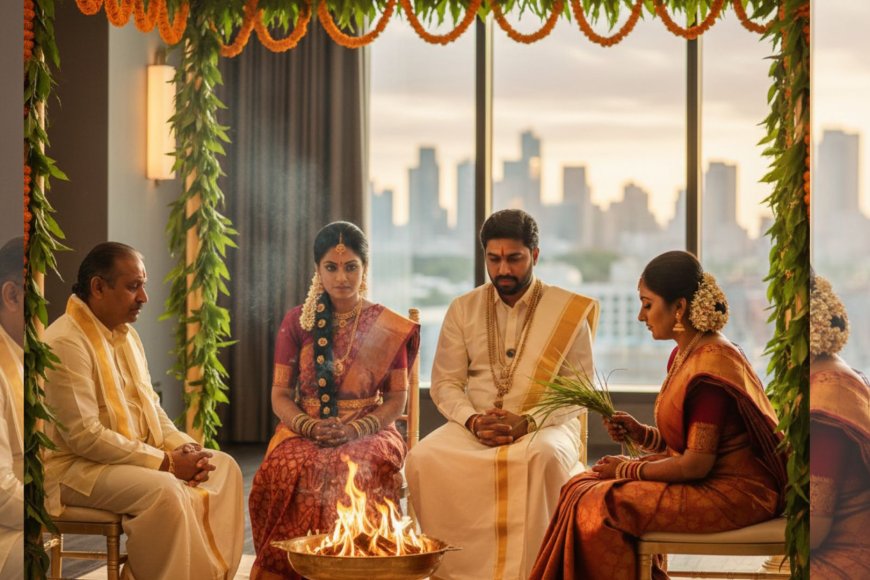
The Tamil Brahmin wedding is not a ceremony — it is a cosmos assembled in a single afternoon. For NRI families carrying this sacred lineage across oceans, understanding every ritual is an act of devotion, defiance, and extraordinary love.
You grew up watching your grandmother fold a silk saree into perfect pleats before dawn, the scent of fresh jasmine woven through her silver hair. You remember the sound of Vedic chanting drifting from a neighbour's house in Chennai during wedding season — syllables you didn't fully understand but felt deep in your chest, like a tuning fork struck against something ancient. You filed that sound away somewhere quiet and carried it with you to Chicago, or Melbourne, or Mississauga.
Now it is your wedding. Or your child's. And somewhere between booking a banquet hall in Scarborough and calling your uncle in T. Nagar for advice at 2 a.m., you realise with full force what it means to be the custodian of something irreplaceable. You want to do this properly. You want the chanting, the sacred fire, the silk, the exact ritual sequence that has remained virtually unchanged for over three thousand years.
This guide exists for you. Not for the casual curious — for the families who already know this matters, and now need to know how.
🌟 DID YOU KNOW?
The Tamil Brahmin wedding, known as Brahmin Kalyanam, follows the Apastamba Sutras — a codified body of ritual law believed to be over 2,500 years old, making it one of the most precisely documented wedding traditions in human history.
Tamil Brahmin diaspora communities in the US, UK, Canada, and Australia number over 400,000, and according to community cultural organisations, more than 60% of second-generation Tamil Brahmin NRIs actively seek traditional religious ceremonies for their weddings rather than civil-only formats.
The ritual of Kashi Yatra — where the groom dramatically pretends to renounce the world and walk to the holy city of Varanasi before being persuaded back by the bride's father — is performed even in hotel ballrooms in New Jersey, complete with an umbrella, a walking stick, and a fan, drawing tears and laughter in equal measure every single time.
What Is a Tamil Brahmin Wedding?
A Brahmin Kalyanam [Tamil Brahmin wedding] is a Vedic ceremony rooted in the Smartha or Iyengar tradition, depending on the family's sectarian lineage, though both share a broadly similar ritual architecture. Unlike many Indian weddings where the celebration is the centrepiece and the ritual a beautiful background, in a Tamil Brahmin wedding, the ritual is the event. Every gesture, every Sanskrit verse, every grain of rice and drop of ghee carries precise theological weight.
The ceremony typically unfolds over one primary day, though some traditional families still observe pre-wedding rituals across two or three days. It begins with the Janavasam [groom's ceremonial procession], followed the next morning by the Kashi Yatra [the groom's mock renunciation], then Nichayathamboolam [formal exchange of betel leaves sealing the alliance], Oonjal [the beloved swing ceremony], Muhurtham [the auspicious moment of marriage], which includes Maangalya Dharanam [tying of the sacred thread], Saptapadi [seven steps], and Aashirvadham [elder blessings].
The Maangalyam [sacred thread, equivalent to the mangalsutra] holds particular sanctity — tied by the groom around the bride's neck in three knots, each representing a different dimension of marital commitment: body, mind, and soul. The specific syllables chanted during this moment, the Maangalya Mantra, have been recited at Tamil Brahmin weddings across centuries with near-perfect consistency. That thread connects your daughter not just to her husband, but to an unbroken lineage of women who wore it before her.
What makes the Tamil Brahmin ceremony distinct is its intimacy of scripture. This is not a wedding with a pandit performing rituals while guests chat over cocktails. The family participates actively, physically, and the Vadhyar [priest] explains each step's meaning as it unfolds. For families doing this abroad, that participatory quality becomes its most powerful emotional asset.
Community Comparison Table
| Community/State | Local Name | Key Tradition | How NRIs Abroad Adapt It |
|---|---|---|---|
| Tamil Brahmin (Iyer) | Brahmin Kalyanam | Full Vedic ritual per Apastamba Sutra; Kashi Yatra, Oonjal, Saptapadi | Condense to single-day format; stream Kashi Yatra for India relatives |
| Tamil Brahmin (Iyengar) | Iyengar Kalyanam | Pancharatra Agama tradition; Talambralu (rice on heads) prominent | Sourced raw rice often brought from India; shorter Vedic sequence abroad |
| Kashmiri Pandit | Lagan | Elaborate pre-wedding Livun (purification); Vandun songs by women | Women's song sessions done over group video calls with Indian family |
| Punjabi Hindu | Anand Karaj / Vedic Mix | Milni ceremony, pheras under mandap | Mandap built in banquet halls; phera smoke managed via catering kitchen |
| Himachali | Shaadi with Devta customs | Village deity must be consulted; Nati dance at reception | Devta consultation done via video call with priest in village; Nati taught to diaspora youth before wedding |
| Garhwali | Byah | Ritual seed-sowing (Jau) before wedding; community feast | Jau ritual done symbolically in a pot; feast adapted to local Indian caterers |
| Kumaoni | Shaadi | Chhachhari folk music; oil lamp rituals | Chhachhari music played via recording; diyas used with LED alternatives at strict venues |
| Bengali (Brahmin) | Biye | Shubho Drishti (first gaze ritual), Sampradaan (bride giving) | First gaze kept intact as most photogenic; Sampradaan conducted by elder uncle abroad |
| Marathi (Brahmin) | Vivah | Antarpaat (cloth screen between bride and groom before first look), Mangalashtaka chanting | Antarpaat recreated with a silk dupatta; Mangalashtaka chanted by family if pandit unavailable |
| Rajasthani | Vivah | Palla ceremony (bride's dupatta tied to groom's shawl); Pheras with large family | Palla adapted using family dupatta; Pheras sometimes reduced to four at civil-registered venues |
The Meaning Behind the Ritual
To understand a Tamil Brahmin wedding is to understand an ancient cosmology of transition. In the Vedic worldview, marriage is not simply a social contract — it is a Dharmic [cosmic-order-aligned] passage in which two individuals leave their previous Ashrama [stage of life] and enter Grihastha [the householder stage], which ancient texts describe as the most essential of all life stages because it sustains every other.
The fire at the centre of the Homam [sacred fire ritual] is not decorative. Agni [the fire deity] is the eternal witness — present at every Vedic rite since the Rigvedic period — and the couple's vows spoken into the fire are considered literally received by the cosmos. The Saptapadi, the seven steps taken together, map onto seven specific life aspirations: nourishment, strength, prosperity, happiness, progeny, seasons of life, and friendship. The seventh step is perhaps the most radical — the couple pledges lifelong friendship. In a tradition thousands of years old, this is quietly revolutionary.
The Oonjal [swing ceremony], in which the couple is seated on a decorated swing while women sing Carnatic-style wedding songs, represents the soul's oscillation between the earthly and the divine — the moment of marriage as a threshold between two states of being.
For a non-Indian partner or parent-in-law trying to understand: this wedding is a conversation with the universe, conducted on behalf of two souls and all the ancestors who made them.
Doing a Tamil Brahmin Wedding Abroad: The Practical Reality
This is where love meets logistics, and where most NRI families quietly panic at 11 p.m. on a Tuesday. Let's be honest and specific.
Finding the right Vadhyar abroad is the single most important task. A Tamil Brahmin wedding conducted by a generic Hindu pandit who is unfamiliar with the Apastamba or Pancharatra tradition will feel wrong to your grandparents watching via video call, and wrong in your own chest. In the UK, the Tamil Brahmin community in Harrow, Wembley, and East Ham has a small but active network of qualified Vadhyars who have been serving diaspora families for decades — NRI.Wedding's pandit network can connect you to verified, community-recommended priests who know the full sequence. In Toronto, look toward the Scarborough Tamil community network and Brampton temples. In the US, Houston's Sugar Land area has a strong community presence, as does Edison, New Jersey. In Sydney, Parramatta and Westmead have long been the Tamil Brahmin heartland of Australia.
Sourcing ritual items is the next challenge. You will need specific items: Pasupu [turmeric], Kumkum [vermillion], raw rice, betel leaves and areca nuts, Dharbai [a specific sacred grass used throughout Tamil Vedic ritual], mango leaves, Pancha Patra [ritual vessel set], coconut, silk sarees for key ritual moments, and the specific thread for the Maangalyam. In London, Wembley's Ealing Road, Chennai's own diaspora outposts in Tooting, and Southall's Lady Margaret Road all carry most ritual supplies. In Toronto, Gerrard Street East (Little India) and Pape Avenue stores stock Tamil ritual items. In Houston, Hillcroft Avenue is your destination. In Sydney, Harris Park on Wigram Street has multiple Indian grocery suppliers. Dharbai grass is the item most commonly unavailable — ask your Vadhyar to bring their own supply, or order from specialist Vedic ritual websites that ship internationally. Order at least six weeks in advance.
The fire problem is real. Most UK and Australian venues have strict no-open-flame policies. The solution is not to skip the Homam — it is to negotiate. Work with venues that have professional catering kitchens, request a designated outdoor or courtyard space, or find Indian community halls that already have ventilation systems designed for this purpose. Some families use a contained fire-safe vessel rather than a full earthen pit. Your Vadhyar will guide you — most experienced diaspora priests have performed the Homam in remarkably creative settings.
For the India video call, the time zone calculation is critical and non-negotiable. If the Muhurtham is at 10 a.m. in Toronto (EST), that is 8:30 p.m. IST — your Indian family can join. If it is at 11 a.m. in Melbourne (AEST), that is 5:30 a.m. IST — be prepared for bleary-eyed grandparents in Chennai who would not miss it for the world. Use a dedicated iPad or laptop on a stand positioned so that India-based family can see the full ritual, not just the bride and groom's backs.
Doing a Tamil Brahmin Wedding as a Destination Wedding in India
For NRI families returning to India, Chennai is the natural home of the Tamil Brahmin wedding — and the city's Mylapore [the ancient Brahminic heart of Chennai] remains the most emotionally resonant location, with the Kapaleeshwarar Temple complex nearby and generations of family memory embedded in the neighbourhood. Traditional Kalyana Mandapams [wedding halls designed specifically for Brahmin rituals] in Mylapore, T. Nagar, and Adyar are built with proper fire ventilation, sufficient space for all ritual arrangements, and experienced support staff who understand the sequence.
Beyond Chennai, Madurai, Srirangam, and Kumbakonam — all temple cities — offer deeply atmospheric settings for Iyengar families in particular, as the Vaishnavite tradition is especially strong in these regions.
When briefing your local pandit as a diaspora family, bring a written note of your specific sub-tradition (Iyer vs Iyengar, gotra name, family's Vedic shakha), your preferred ritual sequence, and any adaptations that matter to your non-Indian guests. Most experienced Chennai Vadhyars are accustomed to NRI families and will provide an English commentary track for international guests if asked in advance. For coordinating from abroad, a local wedding coordinator who specialises in NRI returnee weddings will be worth every rupee.
What You Need: Ritual Checklist
Ritual Items Pasupu (turmeric in quantity), Kumkum, raw rice (unbroken grains), betel leaves and areca nuts (at least 50 pairs), Dharbai grass, mango leaves (for doorway and ritual pots), two coconuts minimum, Pancha Patra vessel set, ghee, camphor, specific flowers (as directed by Vadhyar), silk sarees for key moments, the Maangalyam thread (prepared by the Vadhyar), and an Oonjal swing or decorated chair if a traditional swing is unavailable.
People Required A qualified Tamil Brahmin Vadhyar familiar with your sub-tradition, the bride's parents (or elder stand-ins if deceased), the groom's parents, a maternal uncle (Mama) for the bride — his role is structurally essential across several rituals, two women to sing Oonjal songs (family members or arranged through the Vadhyar), and ideally a family elder to lead Aashirvadham blessings.
Preparation Steps Confirm the Muhurtham date and time with your Vadhyar at least three months ahead. Book your venue and confirm fire/flame policies in writing. Source all ritual items eight weeks before the wedding. Arrange a dedicated video call setup for India relatives. Share the full ritual sequence with all participating family members one week before. Brief non-Indian guests with a simple printed guide on what each ritual means.
NRI.Wedding's verified Vadhyar network, Tamil Brahmin-specialist vendors, and ritual item sourcing partners can support every step of this list — explore our directory to connect with vetted professionals across the UK, US, Canada, UAE, and Australia.
5 Questions NRI Couples Always Ask
Can we do a Tamil Brahmin wedding in a hotel ballroom instead of a traditional hall?
Absolutely — and many families do, with beautiful results. The key is advance communication with the venue about your requirements: a designated space for the Homam (even if outdoors or in a managed indoor area), a raised mandap area, and flexibility on the room setup during the ceremony. Book a site visit with your Vadhyar present so the priest can assess the space and advise on adaptations. Hotels with South Asian wedding experience in cities like Toronto, Houston, and London are generally well-prepared for this conversation.
My partner is not Tamil or not Indian. Can they still participate fully?
Yes — and many Vadhyars are experienced at including non-Indian partners with warmth and explanation. The key rituals require the couple to be present and engaged, not to speak Sanskrit fluently. Your Vadhyar should walk your partner through each step as it unfolds, and many diaspora families now provide a printed bilingual guide for the non-Indian partner to follow along and understand what they are committing to spiritually. The Saptapadi in particular translates beautifully across cultures when its seven pledges are explained.
How do I find a Vadhyar who specifically knows the Apastamba or Pancharatra tradition outside India?
This is the right question to be asking, and the answer requires specificity. Do not simply contact the nearest Hindu temple and ask for a pandit — ask explicitly for a Tamil Brahmin Vadhyar familiar with your tradition. NRI.Wedding maintains a verified directory of community-recommended Vadhyars across the UK, US, Canada, UAE, and Australia. Community organisations like local Tamil Brahmin sabhas in your city are also a reliable source of personal referrals. Always conduct a video call with the Vadhyar before booking, to confirm they know the specific sequence your family follows.
How do we coordinate with relatives in India during the Muhurtham?
Set up a dedicated device — not someone's phone that will receive calls during the ceremony — on a stable stand, angled to show the full ritual space. Test the connection and frame 24 hours before. Designate one person in India to manage the India side of the call, so your family there is organised and present at the right moment. Share the ritual timeline with your India family so they know exactly when to be watching — the Maangalya Dharanam moment especially, when the thread is tied, is one that every grandmother will want to witness in real time, through whatever screen she can find.
Should we do the civil registration before or after the religious ceremony?
Most NRI families in the UK, US, and Canada complete civil registration either well before or immediately after the religious ceremony — often several days before — to ensure the legal marriage is not contingent on venue or scheduling issues. The religious Muhurtham is the emotionally and spiritually primary event for Tamil Brahmin families; the civil paperwork is simply a legal parallel. Confirm with your local Vadhyar, as some families prefer a specific sequence for auspiciousness.
The Emotional Angle
There is a particular grief that comes with being the family that left. It is not a simple sadness — it is the complicated ache of watching something irreplaceable exist in a place you no longer fully inhabit. For Tamil Brahmin NRI families, the wedding is the moment this grief becomes most acute and, paradoxically, most transformed.
Your mother packed a small brass Pancha Patra in her suitcase when she immigrated. She didn't know why, exactly. She just knew it needed to come. That instinct — to carry the sacred across the border — is the same instinct that drives you now to find a Vadhyar who knows the correct chant, to source Dharbai grass from a website that ships internationally, to stay on a video call with your Madurai grandmother at 4 a.m. her time, showing her the Oonjal swing decorated with jasmine flowers bought from a Gerrard Street shop in Toronto.
The Tamil Brahmin wedding, performed in a banquet hall in Mississauga or a garden in Melbourne, is not a diminished version of the original. It is, in many ways, more deliberate. Every ritual item was sourced with effort. Every syllable was chosen consciously. Every family member who flew in from three continents made a declaration with their ticket purchase. This wedding did not happen because it was easy or convenient. It happened because your family decided that some things are worth the full weight of intention.
That is not a compromise. That is devotion.
A Moment to Smile
At a Tamil Brahmin wedding in Mississauga two years ago, the Kashi Yatra was going beautifully — the groom striding purposefully across the banquet hall with his umbrella and walking stick, announcing his intention to renounce worldly life and travel to Varanasi. The bride's father stepped forward to persuade him back, as tradition demands, offering his daughter's hand in a speech that had been rehearsed.
What had not been rehearsed was the groom's walk taking him directly into the path of the banquet hall's swinging kitchen door, sending his ceremonial umbrella clattering into a tray of south Indian snacks. For a full three seconds, there was silence. Then the grandmother in the front row, watching via iPad from T. Nagar, erupted into laughter that the entire room could hear through the speaker. The groom, still in character, picked up his umbrella with great dignity, straightened his dhoti, and continued his renunciation of the world. Nobody could stop laughing for the rest of the Homam. The grandmother still tells this story every time a wedding is mentioned. It has become the best part of the whole day.
Quotes From the Diaspora
"My mother-in-law flew in from Chennai carrying two kilos of Dharbai grass in her check-in luggage. Customs in Heathrow were very confused. She was completely calm. She said, 'It is for my son's wedding.' They let her through. That grass sat at the centre of the Homam, and I don't think I have ever felt so held by a family in my life." — Kavitha Srinivasan, Iyengar bride, London
"We did the Oonjal, and I had asked my cousin to sing the traditional songs. She'd learned them from a YouTube recording of our grandmother from fifteen years ago. When she started singing, I looked at my husband — who is from Ohio and had never attended any Indian wedding before — and he had tears streaming down his face. He told me later he didn't understand a single word, but he understood everything." — Priya Venkataraman, Iyer bride, Houston
"People kept asking me why we didn't just do a small civil ceremony since we live so far from India. I told them: because my son deserves to have the Maangalyam tied properly, with the right mantra, by a Vadhyar who knows our gotra. Because in fifty years, when he tells his own children about his wedding, I want him to tell the truth of who we are. Not a shortened version." — Meenakshi Parthasarathy, mother of the groom, Scarborough, Toronto
Your Roots Travel With You
A Tamil Brahmin wedding is one of the most intricate, ancient, and beautiful ceremonies in the human tradition. The fact that it is now performed in hotel ballrooms in Houston, community halls in Harrow, and rented gardens in Melbourne is not a sign of dilution — it is a sign of extraordinary tenacity. NRI families are doing something remarkable: holding an unbroken ritual lineage in one hand and a boarding pass in the other, refusing to let go of either.
NRI.Wedding exists to support exactly this — with a verified directory of Tamil Brahmin Vadhyars across the UK, US, Canada, UAE, and Australia, Tamil-specialist vendors, photographers who understand the ritual sequence, and planning checklists built specifically for diaspora families navigating weddings across two continents. You should not have to do this alone, and with the right support, you absolutely do not have to.
Carry the chant. Light the fire. The ancestors are listening.
0 comments
Real names and courtesy, please. Every comment is read by a person before it appears.
Nothing yet. Start it off.
Comments are closed on this article.