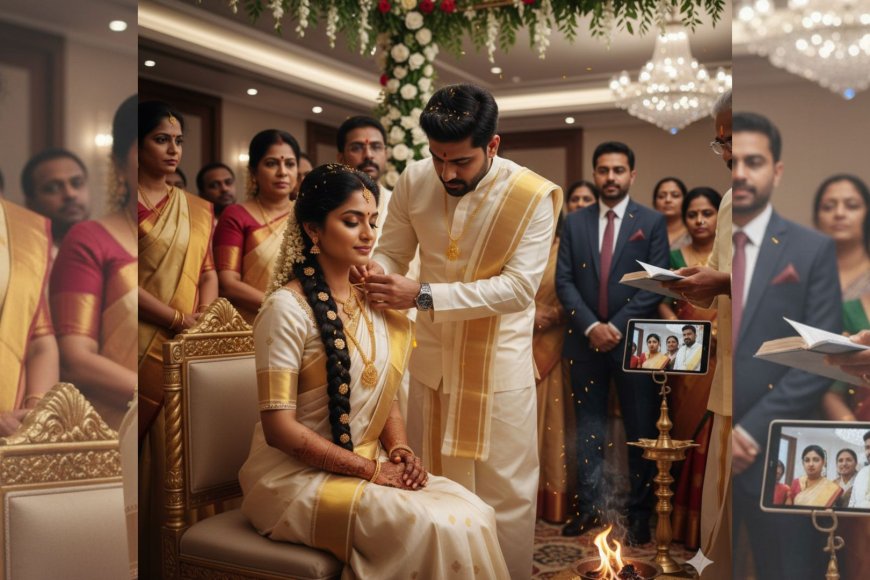
In Kerala Hindu tradition, the most sacred moment of the entire wedding is not the exchange of rings, not the walk around the fire, not the feast that follows — it is the eleven seconds it takes for a groom to tie a small gold pendant on a thread around his bride's neck. The Thali is Kerala's most ancient symbol of marriage, and for Malayali NRI families from Thiruvananthapuram to Toronto, from Kozhikode to Melbourne, from Ernakulam to Dubai, understanding what it means — truly means — is the beginning of understanding Kerala itself.
You have seen it in photographs your whole life. Your mother's thali, worn every day without exception, even with her office clothes in the city she moved to before you were born. Even in the swimming pool. Even sleeping. You asked her once why she never took it off and she looked at you the way she looked at questions that had no adequate answer and said, simply, "It is not something you remove."
You didn't fully understand then. You were in Sharjah or Slough or Saskatchewan, and the thali was just a gold thing your mother wore. But now you are planning your own wedding, and the pandit has told you the muhurtham window for the tying is twenty-three minutes, and your photographer has been briefed, and your mother is flying in from Kerala, and something has shifted in how you understand the object that will be placed around your neck.
It is not jewellery. It is a cosmology. It is a claim. It is a thread that connects you — backward to every woman in your lineage who wore one, forward to every morning you will wake up and feel its weight and remember what you chose.
🌟 DID YOU KNOW?
- The Kerala Thali is distinct from the mangalsutra worn in North and Central Indian traditions — while the mangalsutra typically features black beads on a gold chain, the Kerala Thali is a single gold pendant on a plain gold or yellow thread, with the pendant's design varying by community, caste, and family lineage, making each thali a unique identifier of a woman's specific heritage.
- The tying of the thali in Kerala tradition must occur within the precise muhurtham window calculated by the family's purohitan — this window can be as narrow as three to eleven minutes, making it one of the most time-critical ritual acts in any wedding tradition globally, and the single moment around which every other element of a Kerala wedding is scheduled.
- In traditional Kerala Nair households, the thali was historically tied not by the groom but by the bride's maternal uncle in a ceremony called Talikettu Kalyanam — a coming-of-age ritual separate from marriage — reflecting the matrilineal Marumakkathayam [inheritance through the mother's line] system that shaped Kerala's unique social structure for centuries.
What Is the Tying of the Thali?
The Thali [the sacred wedding pendant, also called Minnu in some Kerala communities] is the central symbol of marriage in Kerala Hindu tradition — a small gold ornament worn by married women as the outward, physical sign of their union. The act of tying it — Thali Charthal or Thali Kettu [the tying of the thali] — is the sacred climax of the Kerala Hindu wedding ceremony, the moment toward which every preceding ritual has been building and from which every subsequent ritual flows.
The thali itself varies by community. In Nair tradition, it is typically a simple gold leaf or stylised tulasi [sacred basil] leaf pendant on a gold thread. In Namboothiri Brahmin tradition, it takes a more elaborate form with specific sacred geometry. In Ezhava tradition, the pendant may feature the Om symbol or a stylised flower. In many families, the thali design is inherited — a specific form passed down through the maternal line that identifies a woman as belonging to a particular community and lineage. Some families commission a new thali cast from the same mould used for the mother's and grandmother's thali, creating a physical continuity across generations.
The ceremony begins with the Muhurtham preparation — the pandit announces that the auspicious window is approaching, and the assembled guests fall into a particular quality of attention. The bride is seated at the vivaha mandapam [the sacred wedding platform], dressed in her Kasavu saree [Kerala's traditional cream and gold silk]. The groom takes the thali — which has been kept on the nirapara [the sacred rice vessel] overnight, absorbing the auspiciousness of its resting place — and holds it in both hands while the pandit chants the mangala mantras [auspicious sacred verses].
At the precise muhurtham moment, the groom moves behind the bride and ties the thali around her neck with three knots. The three knots are not incidental — they are specific. The first knot is tied by the groom and represents his commitment. The second knot is tied by the groom's sister and represents the acceptance of the groom's family. The third knot is tied by the groom or his sister and seals the union. In some traditions, all three knots are tied by the groom; in others, the distribution of knot-tying among family members is a ritual statement of collective commitment.
As the thali is tied, the assembled women shower the couple with akshata [turmeric-blessed rice grains] and the nadaswaram [the sacred double-reed wind instrument, traditional to South Indian temple music] plays — its particular sound, ancient and penetrating, marking the exact moment of the union for everyone in the room.
The entire act of tying takes seconds. Its meaning lasts a lifetime.
Community Comparison: How Different Indian Communities Mark the Sacred Moment of Union
| Community / State | Local Name | Key Tradition | How NRIs Abroad Adapt It |
|---|---|---|---|
| Kerala Hindu (Nair) | Thali Kettu / Thali Charthal | Gold thali tied in three knots; groom and groom's sister participate; precise muhurtham; nadaswaram played | Ceremony preserved fully; nadaswaram replaced by recorded music or live shehnai player in some cities |
| Kerala Namboothiri Brahmin | Thali Kettu | More elaborate pendant design; full Vedic mantra sequence; strict muhurtham observation | Namboothiri purohitans flown from Kerala or consulted via video; ceremony fully preserved |
| Kerala Ezhava | Minnu Kettu | Minnu pendant specific to community; ceremony similar in structure to Nair tradition | Ezhava community associations in Gulf and UK support ritual continuity |
| Tamil Brahmin | Mangalya Dharanam | Three-stranded gold and black bead mangalsutra; tied by groom in three knots at muhurtham | Extremely well-preserved in Tamil diaspora globally; Tamil pandits widely available |
| Telugu Hindu | Mangala Sutram | Gold pendant on black bead chain; tied during saptapadi at precise muhurtham | Telugu pandits available in Houston, London, Melbourne; ceremony fully observed |
| Kannada Brahmin | Mangalasutra Dharane | Gold pendant tied at muhurtham; design varies by sub-community | Smartha and Madhwa pandits available in major diaspora cities |
| Himachali | Nau-thread ceremony | Sacred thread tied around bride's neck by groom; simpler than South Indian thali | Adapted to living room ceremony; thread sourced from temple |
| Punjabi | No direct equivalent | Union marked by Anand Karaj [Sikh wedding ceremony] with four circumambulations | Anand Karaj very well-preserved globally in Gurdwaras |
| Marathi | Mangalsutra Gharapon | Black and gold beaded mangalsutra; tied at auspicious moment | Maharashtra Mandals support ceremony; mangalsutras available in diaspora cities |
| Bengali | Sindoor Daan | Red sindoor applied to bride's hairline by groom — equivalent sacred act | Bengali community centres in London, Toronto support tradition |
| Rajasthani | Var Mala / Mangalsutra | Floral garland exchange followed by mangalsutra tying | Rajasthani Samaj networks in UAE and UK coordinate |
| Kashmiri Pandit | Dejhoor | Unique earring placed by groom — distinctly Kashmiri equivalent of the sacred union marker | Kashmiri Pandit sabhas in New Jersey, London preserve tradition |
The Meaning Behind the Ritual
The Kerala Thali encodes one of the most sophisticated ideas in Hindu sacred thought: that the invisible can be made visible, that a spiritual reality can be given physical form, and that wearing that physical form every day is itself a practice — a daily, embodied reminder of a commitment made in sacred space.
In Shaiva tradition, which deeply influences Kerala Hindu practice, the universe is understood as the interplay of Shiva[pure consciousness] and Shakti [divine creative energy]. Marriage is not the subordination of one to the other — it is their sacred meeting, the moment two streams of prana [life force] consciously choose to flow together. The thali, worn over the heart, marks the location of that meeting. It is placed at the Anahata [the heart chakra, the centre of love and connection in yogic anatomy] — not accidentally, but with the full weight of this understanding.
The gold of the thali is not merely precious metal. In Kerala's Tantric tradition, gold is associated with the sun, with Surya [solar energy], with consciousness and clarity. A gold thali worn over the heart is a daily invocation: may this union be luminous, may it be conscious, may it generate warmth.
The three knots speak to the Trimurti [the Hindu trinity of Brahma, Vishnu, and Shiva] — creation, preservation, and transformation — suggesting that the marriage being sealed encompasses all three phases of existence. It is not a static bond but a living, evolving, sacred relationship.
For a non-Indian partner or family member: "It is the most personal piece of sacred architecture a woman can wear — a temple she carries at her heart every day."
Doing the Thali Tying Abroad: The Practical Reality
The single most important logistical reality of the thali tying abroad is the muhurtham window — and unlike some other rituals where timing has some flexibility, the thali tying muhurtham is non-negotiable for most Kerala Hindu families. A window of three to twenty minutes means that everything else — the catering schedule, the photographer's positioning, the family seating, the nadaswaram or recorded music cue — must be structured around this precise moment.
Begin this conversation with your venue at least three months before the wedding. Share the muhurtham time in writing. Explain that at this specific minute, the ceremony reaches its sacred climax and requires: complete silence from the venue staff, no movement of catering equipment, the music cue ready, and the photographer and videographer in their confirmed positions. Most professional wedding venues, when they understand the significance and the brevity of the moment, will accommodate this without difficulty. The key word is brevity — you are asking for eleven minutes of complete logistical alignment, not a restructuring of the entire event.
For the thali itself: if your family has a traditional thali mould or a specific design associated with your lineage, commission the thali from a jeweller in Kerala and have it couriered or carried to your ceremony location well in advance. Do not leave this to the last minute — Kerala gold jewellers in Thrissur and Ernakulam who specialise in traditional thali designs often have waiting lists. If you are ordering from abroad, Joyalukkas, Kalyan Jewellers, and Malabar Gold all have international branches and online services, and their Kerala design collections include traditional thali pendants. In London, the gold jewellery shops on Ealing Road in Wembley and Upton Lane in Forest Gate carry South Indian gold designs; call ahead specifically asking for Kerala thali pendants. In Dubai, the Gold Souk in Deira and the Kerala-owned jewellery shops in Karama carry the widest selection of Kerala-specific thali designs. In Toronto, the jewellery shops on Gerrard Street East and in the Mississauga South Asian retail corridor carry South Indian gold. In Sydney, the Parramatta area has Kerala-owned jewellery shops that stock traditional designs.
The nadaswaram — traditionally played live at the moment of thali tying — is one of the most logistically challenging elements to recreate abroad. Live nadaswaram players are rare outside South India and the Gulf. In the UK, the Tamil and Telugu communities in London and Leicester have the largest pool of nadaswaram musicians; contact South Indian temple networks for referrals. In the US, the Hindu temple networks in Houston, New Jersey, and the Bay Area maintain contacts with South Indian classical musicians. In the Gulf, nadaswaram players are more readily available given the large South Indian population. If a live player cannot be sourced, a high-quality audio recording played at the exact muhurtham moment is a widely accepted alternative — ensure your sound system operator has been briefed precisely on the cue.
For the purohitan: the thali tying mantras are specific to Kerala Hindu tradition and differ from Tamil, Telugu, and Kannada Brahmin equivalents. A South Indian generalist pandit who is not familiar with Kerala-specific vivaha mantraswill conduct a ceremony that feels slightly wrong to family elders. Specify "Kerala Hindu" and your community — Nair, Namboothiri, or Ezhava — when searching for a pandit. NRI.Wedding's pandit directory filters by regional tradition. Additionally, the Guruvayur Temple in Kerala maintains a network of trained priests, some of whom are based abroad or available to travel internationally for significant ceremonies.
For relatives in India watching via video: position your streaming device at the mandap, angled toward the thali tying moment. The nadaswaram cue, the akshata shower, and the groom's hands at the bride's neck — these are the three visual elements India relatives most need to see. A 10 AM ceremony in Dubai is 9:30 AM IST — perfectly timed. From London, a 10 AM ceremony is 3:30 PM IST. From Toronto, an 11 AM ceremony is 9:30 PM IST.
Doing the Thali Tying as a Destination Wedding in India
Kerala offers some of the most naturally resonant settings for a thali tying ceremony in the world. The backwater properties of Alleppey, the heritage homes of Thrissur, the colonial-era bungalows of Kozhikode, and the temple town atmosphere of Guruvayur all provide a geographical and spiritual context that deepens the ceremony's meaning in ways no overseas venue can replicate.
Guruvayur — home to the most sacred Vishnu temple in Kerala — is the most auspicious location for a Kerala Hindu wedding, and the Guruvayur Devaswom [the temple administration] maintains a comprehensive wedding booking system for families wishing to marry in or near the temple complex. The spiritual weight of a thali tied in Guruvayur's shadow is considerable for Nair and other Kerala Hindu families for whom Lord Guruvayurappan is the family deity.
For NRI families coordinating a destination wedding in Kerala, most experienced Kerala wedding planners in Thrissur, Ernakulam, and Thiruvananthapuram are deeply familiar with the muhurtham logistics, the nadaswaram coordination, and the specific community customs of Nair, Namboothiri, and Ezhava ceremonies. Brief your planner on your community, your family's specific thali design tradition, and the names of both families' gotras — these details shape every decision the planner and purohitan will make.
For non-Indian guests, the thali tying moment is the most universally moving element of the Kerala wedding. Brief them in advance that this is the equivalent of the exchange of rings — the single moment of formal, sacred union — but older, more symbolically dense, and concentrated into a handful of seconds that the entire ceremony has been building toward.
What You Need: Ritual Checklist
Ritual Items — the thali pendant in the family's traditional design (commissioned in advance from a Kerala jeweller); gold or yellow thread for the thali; the nirapara [sacred rice vessel] on which the thali rests overnight before the ceremony; the vivaha mandapam setup including fresh flowers, lamp, and sacred arrangement; akshata [turmeric-blessed rice grains] for the shower at the moment of tying; homa kundam [sacred fire pit] and associated ritual items if a full fire ceremony accompanies the thali tying; nadaswaram music [live player or high-quality recording with confirmed sound cue]; Kasavu sarees for the bride and female family members; new dhoti for the groom; thamboolam [ritual tray with betel, coconut, and banana] for the post-ceremony exchange; prasadam ingredients for distribution.
People Required — the kula purohitan or Kerala Hindu priest; the bride and groom; the groom's sister (for the second knot in traditions that observe this); both sets of parents; the bride's maternal uncle [ammavan] whose role in Kerala ceremonies is traditionally significant; assembled family and community as witnesses; a designated family timekeeper with a watch synchronised to the muhurtham; photographer and videographer briefed on the exact moment; sound operator briefed on the nadaswaram cue.
Preparation Steps — commission the thali at least three months before the wedding. Confirm the muhurtham window in writing from your purohitan and share it with the venue, photographer, and sound operator. Place the thali on the nirapara the night before the ceremony. Brief the groom on the three-knot sequence and his positioning. Confirm the groom's sister's role and her readiness. Prepare the akshata portions for all guests. Test the sound system for the nadaswaram cue at least one day before.
NRI.Wedding connects Kerala Hindu families with verified purohitans, Kerala gold jewellery sourcing guidance, nadaswaram musicians, and photographers who specialise in capturing the thali tying moment across diaspora cities worldwide. Begin at NRI.Wedding.
5 Questions NRI Couples Always Ask
Our muhurtham window is only seven minutes — how do we ensure everything is ready at exactly the right moment?
The answer is a detailed written ceremony timeline shared with every person who has a role in the seven-minute window, distributed at least two weeks before the wedding. This timeline should name: the purohitan's pre-muhurtham signal, the sound operator's nadaswaram cue, the photographer's confirmed position, the groom's sister's readiness, the akshata distribution to guests, and the venue staff's confirmed silence protocol. Assign one trusted family member as the muhurtham coordinator — their only job is to ensure that when the purohitan signals the approach of the window, everyone is in position. Practice the sequence with all involved parties at the venue rehearsal.
My partner is not from Kerala — can the thali tying still be the central ceremony?
Yes, and many NRI couples in intercommunity or interfaith marriages choose to retain the thali tying as the central sacred act while building a ceremony that honours both partners' backgrounds around it. The thali's meaning is universal enough — a sacred symbol of committed love worn at the heart — that most non-Indian partners, once they understand it, embrace it fully. Some couples choose to add a reciprocal element — a ring exchange or a symbolic gift from the bride to the groom — that makes the ceremony feel balanced for both families. Discuss the structure with your purohitan and both families early in the planning process.
Can we use a thali design from my mother's family even if it is not the traditional design for my specific community?
In Kerala Hindu tradition, the thali design carries lineage information — it identifies the woman as belonging to a particular community and family line. Using your mother's family's traditional design is entirely appropriate and in many families deeply preferred, as it maintains the visual continuity of the maternal line's sacred symbol. If there is any ambiguity about which design your family traditionally uses, consult your kula purohitan or the eldest female relative of the family — they will know.
How do we handle the three-knot tradition if the groom has no sister?
In families where the groom has no sister, the second knot is typically tied by the groom's closest female relative — a cousin, an aunt, or the wife of his closest male relative. The spirit of the tradition is the participation of the groom's family's female line in the act of acceptance, not the specific relationship. Your purohitan will guide you on which family member is most appropriate given your specific family structure.
We are doing a civil wedding first and the Kerala ceremony later — does the thali have the same significance if we are already legally married?
Completely and without reservation. The thali tying is a sacramental act, not a legal one — it operates in an entirely different register from civil registration. Many NRI couples register legally in their country of residence for practical reasons and then conduct the full Kerala Hindu ceremony including the thali tying at a later date. The spiritual, cultural, and emotional significance of the thali tying is entirely independent of the civil paperwork. In Kerala Hindu tradition, it is the thali, not the certificate, that makes the marriage real.
The Emotional Angle
Nobody tells you that the moment the thali is tied, time does something strange.
The minutes before it are the longest of your life — you are aware of every second, every shift of fabric, every breath in the room. And then it happens. His hands are at your neck. The thread is cool. The knot is quick. The nadaswaram starts — that sound, ancient and enormous, filling the room from the floor up — and the akshata rains down on both of you from every direction at once, and there is a moment where you cannot tell if you are crying or if it is simply that the world has become too full of meaning to be held in a body without leaking.
And then it is done. The thali is at your throat. It weighs almost nothing. It will weigh nothing every morning for the rest of your life when you wake up and feel it there, and it will weigh everything.
For NRI Malayali mothers watching this moment happen in a banquet hall in Dubai or a community centre in Wolverhampton or a garden venue in Melbourne — the women who carried this tradition inside them across oceans, who wore their own thalis through decades of foreign winters, who never once considered removing them — this is the moment of arrival. This is why they came. This is what they brought.
The thread was never just gold. It was always the line they refused to let go of. It was always the thing that ran, unbroken, from Kerala to everywhere they went and back again.
A Moment to Smile
At a Kerala Hindu wedding in Melbourne three years ago, the muhurtham window was eleven minutes and the family had prepared everything with military precision. The purohitan had been briefed. The photographer was in position. The sound operator had the nadaswaram recording queued. The groom's sister had the thread ready.
What nobody had anticipated was that the groom — a software architect who had lived in Australia for eight years and prided himself on his composure — discovered at the moment of tying that his hands were shaking so badly he could not complete the first knot.
He tried. He looked at his hands with genuine surprise, as if they belonged to someone else. His mother, seated in the front row, covered her mouth. His best friend, standing to his left, made a sound that was technically a cough.
The purohitan, without breaking his chanting, simply placed his own hand briefly over the groom's, steadied it, and nodded once.
The knot was tied. All three knots. The nadaswaram played. The akshata fell.
Afterward, the groom said it was the steadiest his hands had ever felt — after.
Quotes from the Diaspora
"My mother wore her thali every single day for forty-one years in this country. Every day. I watched her put it on every morning in our house in Sharjah. When they put mine on at my wedding, I understood for the first time that she wasn't wearing jewellery. She was wearing a decision she made when she was twenty-two. She was wearing her whole life." — Priya Nair, Nair community, Sharjah, UAE
"We had the nadaswaram recording playing through the venue speakers. My husband is from Cork. He had never heard that sound before in his life. He told me afterward that when it started, something happened to him that he didn't have words for. He said it felt like the building itself was agreeing to something. That is exactly what it is." — Anupama Menon, Nair community, London
"I commissioned the thali from the same jeweller in Thrissur who made my mother's thali thirty years ago. The old man who ran the shop had retired but his son remembered our family. He cast it from the same mould. When I put it on after the ceremony, my mother touched it once with one finger, very lightly, and didn't say anything. She didn't need to." — Sreelakshmi Varma, Nair community, Toronto, Canada
Your Roots Travel With You
The thali has crossed more oceans than almost any other object in the Kerala diaspora's collective life. It has been worn in Gulf summers and British winters and Canadian snowstorms and Australian springs. It has been worn to office meetings and hospital waiting rooms and school pickups and grocery runs in cities whose names the women who first tied it in Kerala could not have imagined.
It has never been removed.
NRI.Wedding supports Kerala Hindu families across the diaspora with verified purohitans, Kerala gold jewellery sourcing guidance, nadaswaram musician connections, muhurtham logistics support, and ceremony photographers who understand that the eleven seconds of the thali tying are the photograph the whole day has been building toward. From Dubai to London to Toronto to Melbourne — wherever you are, the ceremony can be complete and the moment can be honoured.
Tie the thali. Let it mean everything it has always meant. Let it travel.
0 comments
Real names and courtesy, please. Every comment is read by a person before it appears.
Nothing yet. Start it off.
Comments are closed on this article.