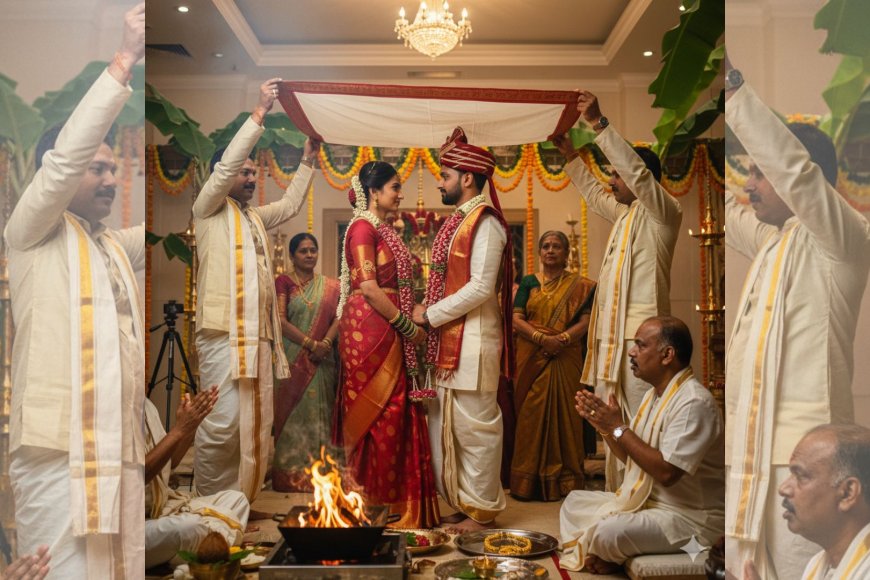
Goan Hindu weddings are among the most layered, visually magnificent, and spiritually intricate ceremonies on the Indian subcontinent — shaped by the Konkani coast, ancient Saraswat Brahmin traditions, and a cultural memory that survived centuries of colonial pressure. For NRI families from Goa now living in Dubai, London, Toronto, and Sydney, these ceremonies represent far more than ritual — they are an act of devotion to everything that was almost lost.
You grew up knowing your family was from Goa, but not quite knowing what that meant until the weddings. Until the smell of fresh coconut and marigold filled every room. Until the women brought out silk sarees in colours so deep they looked painted. Until the pandit began chanting in Sanskrit and your grandmother mouthed every word from memory, standing at the back of the room with her eyes half-closed, somewhere between this world and the one she came from.
Now you are planning your own wedding. You are in Toronto, or Doha, or somewhere in West London where the rain has been relentless for eleven days straight. You have a spreadsheet open in one tab and a Google search for "Goan Hindu wedding rituals" open in another. You feel the weight of everything you want to get right — not for tradition's sake alone, but because something in you knows that these rituals are the thread. Pull them through your wedding, and you stay connected to everything that made you.
This is the complete guide you have been looking for.
🌟 Did You Know?
- Goan Hindu wedding traditions are primarily drawn from the Goud Saraswat Brahmin (GSB)community — one of India's oldest Brahmin lineages, believed to have migrated from the banks of the Saraswati river over three thousand years ago. Their wedding customs retain Vedic elements that have been simplified or lost in many other North and South Indian Brahmin communities.
- During the Portuguese Inquisition in Goa (1560–1812), Hindu rituals were formally banned across large parts of the territory. Goan Hindu families in the Old Conquests region preserved their wedding customs by performing them secretly, often inside homes with doors bolted from inside — which is why many Goan Hindu rituals carry an unusual intimacy and interiority compared to other Indian wedding traditions.
- The Konkani-speaking GSB diaspora is one of the most geographically dispersed Indian communities in the world, with significant populations in Karwar, Mangalore, Mumbai, Pune, and major NRI hubs including Dubai, Kuwait City, Bahrain, London, and Toronto — and GSB Sabhas [community associations] in most of these cities actively support wedding ritual preservation.
What Is a Traditional Goan Hindu Wedding?
A traditional Goan Hindu wedding — primarily as practiced by the Goud Saraswat Brahmin (GSB), Daivadnya, Kudali, and other Goan Hindu communities — is a multi-day ceremony rooted in Vedic [ancient scriptural] tradition, shaped by coastal Konkani culture, and distinguished by its particular combination of Sanskrit ritual formality and warm, music-filled domestic celebration.
Unlike the grand procession-style weddings of North India or the elaborate multi-ritual formats of Tamil Brahmin weddings, the Goan Hindu wedding is characterised by intimacy. Many of its most sacred moments happen inside the home, within family, away from spectacle. The mangalashtak [auspicious wedding verses in Marathi-Konkani tradition] are sung by family members, not hired performers. The antarpat [the cloth screen separating bride and groom before the sacred moment of union] is held by uncles and cousins, not strangers.
The wedding sequence typically spans three to four days and includes pre-wedding rituals such as the Seemant Puja[boundary worship], Haldi [turmeric ceremony], Gruha Shanti [home purification ritual], and Varan Puja [the formal welcoming of the groom]; the main wedding day with the Muhurtham [auspicious time], Saptapadi [seven sacred steps], and Mangalsutra Dharana [tying of the sacred necklace]; and post-wedding ceremonies including the Gruhapravesh [bride's entry into the new home].
Each ritual carries specific Konkani coastal inflections — coconut features prominently, the soparibag [betel nut and leaf offering] is present at every threshold moment, and the sea itself, for families from coastal villages, is often visited as part of the ceremonial sequence.
Community Comparison Table
| Community / State | Local Wedding Name | Key Distinctive Tradition | How NRIs Abroad Adapt It |
|---|---|---|---|
| Goan GSB (Goud Saraswat Brahmin) | Lagna | Antarpat moment; Mangalashtak sung by family; coconut-heavy rituals | GSB Sabhas in Dubai, London, Toronto assist with pandits and cultural guidance |
| Goan Daivadnya | Lagna | Gold-working community traditions; specific ornament rituals for the bride | Jewellery rituals performed symbolically; heirloom pieces couriered from Goa |
| Goan Kudali / CKP | Lagna | Distinct Konkani customs with Marathi influences; specific post-wedding rites | Combined with Marathi community resources in diaspora cities |
| Himachali Hindu | Shaadi / Vivah | Outdoor mountain rituals; Dev Puja[deity worship] at village temple mandatory | Temple visits arranged at local Hindu mandirs; mountain elements symbolically incorporated |
| Garhwali | Shaadi | Dwar Puja [door worship] and community folk singing essential | Folk songs played from recordings; door ritual performed at venue entrance |
| Kumaoni | Vivah | Dhuliargh [ceremonial welcome of groom with water] at village boundary | Performed at venue gate with water vessel; adapted seamlessly |
| Kashmiri Pandit | Lagan | Ladishah [wedding satirical songs]; Devgon [deity invocation night] | Kashmiri Pandit Sabhas in London and Toronto support full ritual preservation |
| Punjabi Hindu | Anand / Shaadi | Vatna [turmeric paste ceremony]; Chunni Chadana [scarf ceremony] for bride | Large diaspora means full rituals possible; bhangra and classical elements both preserved |
| Marathi Brahmin | Vivah | Antarpat shared with GSB tradition; Kanyadan [gift of the bride] central | Close ritual overlap with Goan GSB; pandits often interchangeable |
| Bengali Hindu | Biye | Shubho Drishti [auspicious first look]; Sindoor Khela [vermillion play] | Performed in community halls; Bengali associations in most diaspora cities active |
| Tamil Brahmin (Iyer/Iyengar) | Kalyanam | Oonjal [ritual swing ceremony]; Nalangu [turmeric games] | Tamil Sangams in every major diaspora city; full ritual infrastructure available |
| Rajasthani | Vivah | Toran [ceremonial door hanging struck by groom]; Pheras with distinctive songs | Toran sourced from Indian craft stores or ordered online; songs from family recordings |
The Meaning Behind the Ritual
A Goan Hindu wedding is not a party with rituals attached. It is a ritual that graciously allows a party to happen around it. Every element — the coconut, the fire, the cloth screen, the seven steps — operates within a unified philosophical system that understands marriage as a cosmic realignment, not merely a social contract.
The Agni [sacred fire] at the centre of the ceremony is not decorative. In Vedic understanding, fire is the witness that cannot lie, the element that carries prayers directly to the divine. When a couple circles it seven times, they are not performing a tradition — they are making vows in front of the most ancient and incorruptible witness available to them.
The antarpat — the cloth held between bride and groom until the auspicious moment — represents the threshold between two states of being. Before the cloth drops, they are two separate people with two separate destinies. After it drops and their eyes meet for the first time in the ceremony, the Vedic tradition holds that the universe has witnessed and ratified their union. The gasp that goes through a room at that moment is not theatrical. It is recognition.
The coconut offered at every threshold is the Konkani coast's most sacred symbol — hard-shelled and protective outside, nourishing and abundant within. It is offered because the community is praying that the marriage will be the same.
For a non-Indian partner or guest trying to understand: "Every element in this ceremony has been doing the same job for three thousand years — witnessing, blessing, and protecting two people who have chosen each other."
Performing Goan Hindu Wedding Rituals Abroad: The Practical Reality
This is the section your family WhatsApp group has been circling around for six months without quite landing on.
The first and most critical challenge for Goan Hindu NRI couples is finding a GSB-specific pandit who knows the correct Konkani-Sanskrit ritual format. A general Hindu priest, however experienced, may not know the specific mangalashtakverses, the precise sequence of the Varan Puja, or the particular Konkani customs that distinguish a GSB wedding from a generic North or South Indian ceremony. In Dubai and the wider UAE, the GSB Sabha of Dubai maintains an active list of community priests and can be contacted directly — this is the single most useful resource for Gulf-based NRI Goan families. In London, the Konkani community network around Wembley and Harrow has informal but effective priest referral systems; the Shree Goud Saraswat Brahmin Association in the UK is your first call. In Toronto, the Hindu Temple Society of Canada and community networks in Brampton and Mississauga can assist, and GSB community groups on social media have become surprisingly effective for pandit referrals. In Sydney, the Konkani community in Parramatta and the western suburbs has grown substantially enough that community elders can guide you to the right priest.
For ritual items, the Goan Hindu wedding requires fresh coconuts, betel leaves and areca nuts, specific flowers including marigold and jasmine, turmeric, rice, and a range of items that vary by specific ritual. In London, Green Street in East Ham and Ealing Road in Wembley will cover almost everything. In Toronto, the Patel Brothers on Albion Road and the stores along Gerrard Street East are reliable. In Dubai, Meena Bazaar carries fresh ritual items daily. In Sydney, Harris Park in Parramatta is your best single destination. In Houston, the Hillcroft corridor has multiple stores stocking South Asian ritual supplies including specialty items.
Fire and smoke at venues is the most commonly raised practical concern, and for good reason — the sacred Agni [fire] is non-negotiable in a Vedic wedding. The practical solution most NRI Goan couples use successfully is a havan kund[fire pit vessel] placed within a venue that has been confirmed to have adequate ventilation and that has been briefed on the fire's ceremonial role. Many hotels and banquet venues in diaspora cities now have specific protocols for Hindu fire ceremonies — ask explicitly at the venue booking stage, request written confirmation, and if possible, connect the venue coordinator with your pandit directly. Some couples in cities with strict fire regulations have successfully used very small ceremonial flames rather than a full havan fire, with their pandit's guidance on maintaining the ritual's integrity.
For coordinating with India, Goa is IST (GMT+5:30). Key ritual moments are worth live-streaming — the antarpat moment in particular is something grandparents in Panaji or Ponda will never forgive missing. Test your video setup 24 hours before the ceremony, assign one dedicated family member as the streaming coordinator, and position the camera where it can see both the couple and the fire without being obstructed by the antarpat cloth itself.
Destination Wedding in Goa: Bringing It Home
If there is a single wedding tradition in India that rewards being celebrated in its place of origin, it is the Goan Hindu wedding. The villages of the Salcete, Bardez, and Ponda talukas carry a living memory of these rituals — the temples know the customs, the pandits speak Konkani as their mother tongue, and the landscape itself participates. A Gruha Shanti performed in an ancestral home in Quepem or a Saptapadi conducted inside a centuries-old family temple in Shiroda carries a weight that no overseas venue, however beautifully decorated, can replicate.
When planning a destination wedding in Goa, brief your local coordinator — or NRI.Wedding's Goa-based planning team — on your specific community customs well in advance. A GSB pandit from Karwar may conduct rituals slightly differently from one in Margao. Establish which family's customs take precedence and give your pandit a written brief.
For non-Indian guests, a printed or digital ceremony guide explaining each ritual in English as it unfolds transforms observer experience into genuine participation. Goa's natural beauty, food, and warmth mean your non-Indian guests will require very little convincing that this was worth the journey.
What You Need: Ritual Checklist
Ritual Items: Fresh coconuts, betel leaves and areca nuts (soparibag), turmeric, kumkum [vermillion powder], rice grains, marigold and jasmine garlands, the antarpat cloth, a havan kund [fire vessel] and firewood or compressed wood blocks, ghee, camphor, a mangalsutra [sacred necklace] for the groom to present, new silk clothing for the bride and groom, and banana leaves for offerings.
People Required: A GSB-knowledgeable pandit, the bride's and groom's parents, a minimum of two family members to hold the antarpat, family members who know the mangalashtak verses, a designated streaming coordinator for India-based relatives, and a professional photographer experienced in documenting Hindu Vedic ceremonies.
Preparation Steps: Book your pandit minimum six months in advance and confirm their GSB ritual knowledge explicitly. Confirm your venue's fire ceremony policy in writing. Source all ritual items at least two weeks before the wedding and store carefully. Prepare a ceremony timeline with your pandit and share it with immediate family. Test your live-stream setup 24 hours before. Brief non-Indian guests with a ceremony guide. Arrange your post-wedding Gruhapravesh items separately.
NRI.Wedding's vendor directory connects Goan Hindu couples with GSB-knowledgeable pandits, ritual item suppliers, and Goa-based wedding planners. Visit our directory to begin building your team.
5 Questions NRI Couples Always Ask
We can't find a GSB pandit in our city. Can any Hindu priest perform these rituals?
A general Hindu priest can perform the broad structure of a Vedic wedding, but several elements of a GSB ceremony — the specific mangalashtak verses, the Konkani ritual sequencing, the particular form of the Varan Puja — require community-specific knowledge. The best approach is a two-step one: find the most knowledgeable pandit available locally, and then connect them via video call with a GSB elder or priest in Goa or Mumbai who can guide the Konkani-specific elements. This collaborative approach is increasingly common in the diaspora and produces excellent results when both priests are willing to work together.
My partner is not Indian. How do we integrate them into a Vedic ceremony meaningfully?
The Saptapadi — the seven steps — is the moment that matters most, and it requires both partners to be fully present and moving together. Many GSB pandits working with mixed-heritage couples now provide English explanations of each vow as it is made, transforming what might feel like an opaque ceremony for a non-Indian partner into something deeply moving and comprehensible. The antarpat moment — when the cloth drops and the couple sees each other — requires no translation at all. It communicates across every cultural boundary instantly.
What is the correct sequence of rituals across multiple days?
We keep getting different answers from different family members. This is one of the most common points of confusion for NRI couples planning Goan Hindu weddings, and the honest answer is that specific customs vary by family lineage, village of origin, and gotra [ancestral clan]. The authoritative source for your specific family's sequence is the senior-most pandit in your family's ancestral village in Goa, ideally consulted via video call before you brief any overseas pandit. Establish your family's specific tradition first, then work outward from there.
Can we do the civil registration before the Hindu ceremony without it affecting the ritual's validity?
From a legal standpoint in most diaspora countries, yes — and most NRI Goan Hindu couples do precisely this, registering civilly weeks or even months before the Hindu ceremony. The Hindu ceremony's spiritual validity is entirely independent of civil registration. Your pandit will conduct the ceremony with the same sanctity and completeness regardless of prior civil status. What matters spiritually is the intention, presence, and the performance of the rituals in full.
Our venue has a strict no-fire policy. Is there any way to maintain the ceremony's integrity without the sacred fire?
This requires an honest conversation with your pandit, because the Agni is theologically central to a Vedic ceremony — it is the divine witness. Some pandits will work with a very small lamp flame as a symbolic representation when venue restrictions make a full havan impossible, while maintaining the full mantric structure of the ceremony. Others will not compromise on the fire element and will advise seeking a different venue. Have this conversation with your pandit early, and if fire is truly impossible, consider whether performing the full ceremony at a Hindu temple — which typically has proper fire ceremony facilities — before or after a venue celebration is an option worth exploring.
The Emotional Angle
There is something that happens to Goan NRI families at weddings that is difficult to articulate but impossible to miss. It is most visible in the generation that left Goa in the 1970s and 1980s — the parents and grandparents who packed their lives into suitcases and built new ones in Bahrain or Nairobi or Leicester, who told their children about the village temple and the ancestral home and the smell of the sea in the morning, who held those memories like something fragile for forty years.
When their children's weddings arrive — here, abroad, in a hired hall in Wembley or a hotel ballroom in Jumeirah — these parents do not simply attend. They perform a kind of reckoning. Every ritual they recognise is proof that the transmission succeeded. Every mangalashtak verse their child knows is a victory over distance and dilution. Every coconut broken at a threshold is a small, private act of defiance against everything that tried to make them smaller.
The Goan Hindu wedding, performed abroad, is not a diminished version of the real thing. It is the real thing, carrying the additional weight of everything the family survived to be here. The rituals did not shrink to fit the diaspora. The diaspora grew to hold them.
You are not preserving culture. You are living it, three thousand miles from where it was born, with everything you have.
A Moment to Smile
At Vikram and Pooja's wedding in Southall last spring, the antarpat moment arrived — the most sacred beat of the entire ceremony, when the cloth drops, the couple sees each other, and everyone holds their breath. The pandit raised his hand. The family leaned in. And then Vikram's four-year-old niece, who had been impeccably behaved for two hours and forty minutes, chose precisely that moment to announce at full volume that she needed the bathroom. Immediately. Non-negotiably.
The cloth stayed up for an additional ninety seconds while her mother conducted a rapid and whispered negotiation. The pandit waited with the patience of a man who has seen everything. When the antarpat finally dropped and Vikram and Pooja saw each other through tears and barely-suppressed laughter, everyone in the room was already smiling so wide that the photographs from that moment look less like a wedding and more like a party that stumbled into something sacred.
Which, when you think about it, is exactly what a Goan wedding is.
Quotes From the Diaspora
"I was so worried the ceremony would feel incomplete without being in Goa, without our family temple, without the village. But when the pandit began the Saptapadi and my husband took my hand, I realised the ritual doesn't need the geography. It carries the geography inside it." — Deepa Kamat, GSB Brahmin, Toronto
"My son didn't know all the customs. Why would he? He grew up in Dubai. But he sat with the pandit for three hours the week before the wedding and learned. He wanted to know. That wanting — that is everything. That is how we survive." — Sulochana Prabhu, mother of the groom, Goan GSB, Dubai
"The antarpat moment is the one I will never be able to describe to people who weren't there. You spend your whole life in this community hearing about it. And then it happens to you, and it is exactly as extraordinary as everyone said, and also completely different, because it is yours." — Ananya Shenoy, Goan GSB, London
Your Roots Are Older Than Your Passport
A Goan Hindu wedding is a document written in fire and coconut and Sanskrit — three thousand years of accumulated wisdom about how two people become one, how a family becomes larger, how a community reaffirms its own existence through the act of celebration. For NRI families carrying this tradition across oceans, performing it is not nostalgia. It is an assertion of identity. It is saying: we know who we are, we know where we come from, and we are choosing, deliberately and joyfully, to carry it forward.
NRI.Wedding exists to make that choice as supported, as informed, and as beautiful as possible. Our network of GSB-knowledgeable pandits, Goa-based wedding planners, ritual item suppliers in every major diaspora city, and photographers who understand how to document sacred Vedic moments — all of it is built for you.
The fire your ancestors lit has crossed oceans. Keep it burning.
This complete guide to traditional Goan Hindu wedding customs covers GSB Brahmin rituals, Vedic ceremony sequences, Konkani traditions, and practical advice for NRI families in Dubai, London, Toronto, Sydney, and Houston planning authentic Goan Hindu weddings at home or in Goa.
0 comments
Real names and courtesy, please. Every comment is read by a person before it appears.
Nothing yet. Start it off.
Comments are closed on this article.