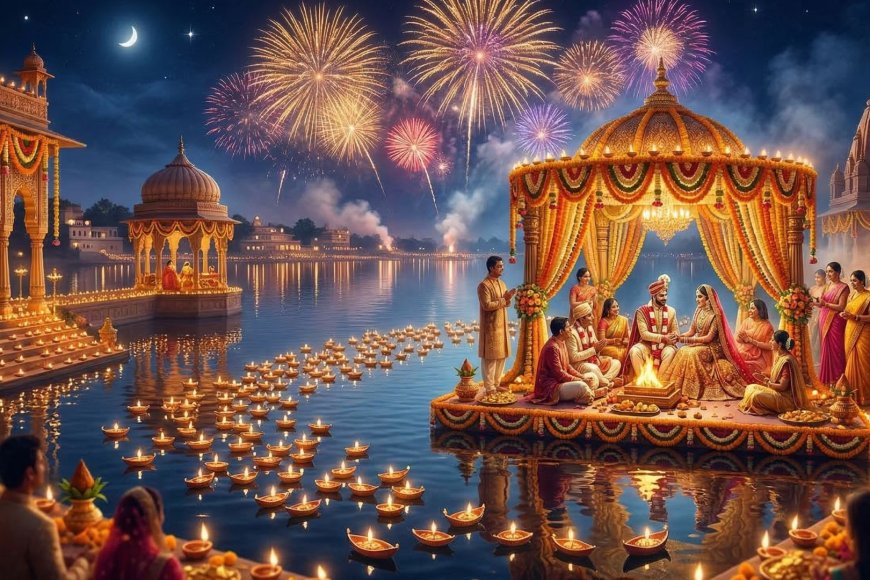
Unique Diwali Rituals From Across India — What NRI Couples Getting Married in the Festival Season Need to Know
The message arrived in the family WhatsApp group at eleven-twenty-three on a Tuesday night, which was the hour at which Nandini's father, a retired civil servant from Bhopal who had spent his career posted across seven different states and who had consequently accumulated what he described as an unreasonable amount of knowledge about how other people celebrated things, sent his most considered observations.
The message said:
I want to say something about the wedding week and Diwali. I know we are all focused on the ceremony and the vendor arrangements and the guest list, and all of that is correct and good. But I have been thinking about the fact that the wedding falls across Diwali, and I want to say that this is not a complication. This is an extraordinary gift. In my postings across this country I have seen Diwali celebrated in ways that most Indians, including our own family, have never seen. I have seen the Diwali of Varanasi and the Diwali of Kerala — which is almost nothing like what we call Diwali — and the Diwali of Rajasthan and the Diwali of Odisha and the Diwali of Punjab and the Diwali of Chhattisgarh. They are not the same festival. They are the same name for many different festivals, each of which has something to say that the others do not. Our wedding falls in the middle of all of them. I am asking the family to think about what that means.
The family group was quiet for a moment — the specific, WhatsApp-quiet of forty-three people in seven countries who have received a message that requires more than a thumbs-up emoji.
Then Nandini, who was in Toronto, typed: Tell us what you have seen.
Her father, who had been waiting for exactly this invitation, typed for the next forty-seven minutes. His children and siblings and cousins in Toronto and London and Melbourne and Singapore and Dubai and Hyderabad read what he wrote in their various time zones, in the specific, unhurried way that a message from a parent who has seen things deserves to be read.
He wrote about the Diwali of Varanasi, where the lamps on the ghats outnumber the stars and the Ganga receives the light of a hundred thousand flames on the night of Kartik Purnima and the city becomes, for those hours, something that people who have not seen it cannot adequately be told about. He wrote about the Diwali of Kerala, which is barely Diwali in the sense the north knows it but is instead the Kali puja and the specific, temple-drum quality of the Kerala night in Kartik. He wrote about the Govardhan Puja of Mathura, where the mountain of food built for Lord Krishna is so elaborate and so specifically Braj in its construction that it constitutes a culinary tradition in its own right. He wrote about the Bhai Dooj and the Chitragupta Puja and the Dhan Teras traditions of communities he had lived among for years and that most of his family had never heard of.
He ended with: Our wedding is in the middle of all of this. Every one of these traditions has something to offer us. Not to perform — not to appropriate. But to know. To understand. To carry into the week with the awareness that the festival we are celebrating is not one thing but many things, and that the many things together are what the festival actually is.
The family group responded for three hours.
Nandini sent the message to her fiancé Rohan in London. He read it at six in the morning.
He called her at six-seventeen.
He said: "Your father is extraordinary."
She said: "I know."
He said: "Tell him I want to know everything he knows."
This guide is written for that family — the one whose wedding falls in the Diwali season and who deserves to understand, across the full breadth of the Indian tradition, what Diwali is in all its variety, so that the wedding week can be enriched by the season's full offering rather than only the fireworks and the sweets.
Why the Diversity of Diwali Matters for the NRI Wedding
The Diwali that the Indian diaspora knows — the Diwali transmitted across the generations of the NRI experience into the homes of Southall and Mississauga and Edison and Parramatta — is predominantly the North Indian Hindu Diwali, with its specific, five-day structure, its Lakshmi puja on the main night, its diyas and its crackers and its sweets and its new clothes and its specific, festive, family-gathered quality.
This transmission is not wrong. It is the Diwali of the communities that constitute the largest proportion of the Indian diaspora, and it is a beautiful and genuinely rich tradition that this guide honours fully.
But it is not all of Diwali.
The Diwali of India — across its twenty-eight states and eight union territories, across its dozens of regional cultures and hundreds of community traditions — is a constellation of related but distinct festivals that share the Kartik month and the lamp-lighting tradition and the general orientation toward the triumph of light over darkness, and that differ in almost every other particular: the specific deity invoked, the specific ritual performed, the specific food prepared, the specific day on which the main celebration occurs, the specific mythological story understood to be the occasion's foundation.
For the NRI couple whose wedding falls in the Diwali season, the diversity of Diwali is not an academic matter. It is the specific, practical, experiential offering of the season — the possibility that the wedding week can include encounters with dimensions of the festival that the diaspora transmission has not carried, that can enrich the guests' experience of both the festival and the wedding with the specific depth of a tradition encountered in its full breadth rather than its diaspora-transmitted portion.
Nandini's father had said: not to appropriate. To know. To understand. This is the correct frame. The NRI couple whose wedding week includes a brief, informed, respectful engagement with the Kali puja of Bengal or the Govardhan Puja of Mathura or the Chitragupta Puja of the Kayastha community is not performing another community's tradition. They are widening the circle of their awareness, enriching the week with the knowledge that the festival they are celebrating is larger than any single community's experience of it.
The Five-Night Structure — What the Sequence Actually Is
Before the regional variations can be understood, the structure of the five-day Diwali sequence must be established — because the structure is the foundation from which the regional variations depart, and understanding the departures requires first understanding the base.
The five days of the Diwali sequence in the mainstream North Indian Hindu tradition are:
The first day is Dhanteras — the thirteenth lunar day of Kartik's dark fortnight, the day of Dhanvantari and the day of the Yamadeepa. The guide in this series on the Yamadeepa has addressed this day in full, and this guide acknowledges it as the sequence's beginning without repeating what has already been said at length.
The second day is Narak Chaturdashi — the fourteenth lunar day, also called Chhoti Diwali or Roop Chaturdashi. This is the day associated with the killing of the demon Narakasura by Lord Krishna and Satyabhama, the occasion in the mythology that the South Indian communities in particular celebrate as the primary Diwali night rather than the third day. The pre-dawn oil bath — the abhyanga snan — is the specific ritual of Narak Chaturdashi: the household rises before sunrise, applies the specific oil preparation to the body, and bathes in the darkness of the pre-dawn hours as the mythological enactment of the purification that followed the demon's destruction.
The third day is Diwali proper — Lakshmi puja night, the new moon of Kartik, the night of maximum darkness in which the lamps are most needed and most beautiful. Lakshmi — the goddess of abundance, wealth, and auspiciousness — is invoked with the full puja, the new clay vessels, the rangoli at the threshold, the sweets arranged in the offering, the family gathered for the invocation of prosperity. This is the night that the North Indian diaspora's Diwali transmission has centred.
The fourth day is Govardhan Puja — Annakoot, the mountain of food, the celebration of Lord Krishna's lifting of the Govardhan hill to protect the people of Braj from Indra's rain. It is also Padwa in Maharashtra and Gujarat — the new year day of the Vikram Samvat calendar, the day on which husbands honour their wives and the new year is welcomed.
The fifth day is Bhai Dooj — Bhai Tika in Nepal, Bhau Beej in Maharashtra, Yama Dwitiya in the Vedic tradition. The sibling festival, the day on which sisters pray for their brothers' longevity, which makes it the specific, gendered counterpart to the Yamadeepa's acknowledgement of death — the day on which the love between siblings performs its protective function against the Dharmaraja's claim.
The Diwali of Bengal — Kali Puja Night
The Bengali Diwali is not Diwali in the north Indian sense. On the night that the rest of India lights lamps for Lakshmi, Bengal lights lamps for Kali — for the goddess in her most fierce, most powerful, most uncompromising form, the dark goddess whose tongue is out and whose garland is skulls and whose feet are on Shiva's chest and who is, in the Bengali Shakta tradition, the most beloved face of the divine.
Kali puja on the new moon of Kartik is among the most important festivals of the Bengali calendar — as significant as Durga puja in the broader devotional landscape, though less well-known outside Bengal. The puja is performed at night, in the darkness, which is the correct context for the goddess whose domain is the night and the cremation ground and the space beyond the ordinary comforts. The specific, elaborate, multi-hour Kali puja — the mantras, the offerings, the specific ritual items that the Shakta tradition requires — takes place as the rest of India is lighting celebratory diyas.
The Kali of the Bengali puja is not a fearsome deity to be propitiated. She is Maa Kali — the mother in her most protective and most honest form, the one who kills because she loves, who destroys because the destruction is the protection, who stands on Shiva to remind the cosmic consciousness that without Shakti's dynamic power even Shiva is inert. The Bengali devotee's relationship with Kali is the most intimate relationship in the Bengali devotional tradition — more intimate, in many Bengali families, than the relationship with any other form of the divine.
For the NRI couple whose wedding week includes a Bengali guest community — or for any couple whose week encompasses the new moon night — the awareness of the parallel Kali puja, happening simultaneously with the Lakshmi puja in another part of the country, in another theological tradition within the same broad Hindu framework, is the awareness that enriches the understanding of what the festival night is. The same darkness, the same new moon, the same lamp-lit hour — and in Bengal, the goddess is Kali, and the celebration is for the power that destroys what needs to be destroyed so that what needs to live can live.
The Diwali of South India — The Narakasura Tradition
The South Indian Diwali — across the Tamil, Telugu, Kannada, and Malayalam communities — centres not on the third night of the sequence but on the second: Narak Chaturdashi, the night of Narakasura's defeat by Krishna and Satyabhama.
The story is specific and significant. Narakasura was a demon king who had accumulated enormous power and who had, among his many depredations, imprisoned sixteen thousand and one hundred women in his palace, keeping them against their will. Krishna's wife Satyabhama — a woman of exceptional capability and equal partnership with her husband — fought alongside Krishna in the battle against Narakasura. In some tellings, it is Satyabhama who delivers the killing blow. The liberation of the imprisoned women followed — and on the night after the battle, when Narakasura was defeated and the women were freed, the celebration of lights began.
The South Indian Diwali is therefore the celebration of a different story than the North Indian Diwali. Not Rama's return to Ayodhya, which is the primary North Indian mythological foundation, but Narakasura's defeat and the liberation of the women who had been imprisoned. The specific, South Indian quality of this foundation — the story in which a woman fights alongside her husband, in which the liberation of women is the occasion for the festival's celebration — is worth sitting with by the NRI couple who is beginning a marriage. The festival that is celebrated in their South Indian heritage, if they have one, or that is celebrated alongside their North Indian tradition by the South Indian guests at their wedding, has at its centre a story about partnership and liberation.
The abhyanga snan of Narak Chaturdashi — the oil bath before dawn on the second morning of the sequence — is the South Indian Diwali's most specific and most intimate ritual. The household rises before the sun. The oil — the specific, fragrant, traditional oil that each family has maintained — is applied. The bath follows. The darkness before the dawn, the oil, the water, the purification — and then, as the sun rises on Narak Chaturdashi morning, the first cracker is burst and the celebration begins. The South Indian Diwali's loudest and most joyful moment is the pre-dawn cracker, the sound of Narakasura's defeat reverberating in the neighbourhood's darkness, the specific, raucous, unapologetically celebratory noise of the victory that liberated the imprisoned.
The Diwali of Mathura — Govardhan Puja and the Mountain of Food
The Govardhan Puja of Mathura and Vrindavan is the most specifically, beautifully, extravagantly Braj expression of the Diwali sequence — the tradition that the mythology of Krishna's lifting of the Govardhan hill has produced in the heartland of the Krishna devotional tradition.
The story: Indra, the king of the gods, had long received the worship and the offerings of the people of Braj — the elaborate yagnas and the first-fruits offerings and the devotional attention that had been their tradition. Krishna, as a young man, persuaded the people of Braj to offer to the Govardhan hill instead — to honour the earth that fed their cattle and to recognize that the mountain was a more immediate source of their sustenance than the distant king of the gods. Indra, furious at the withdrawal of his worship, sent seven days of torrential rain to punish the community. Krishna lifted the Govardhan hill on his little finger and held it as an umbrella over the entire community of Braj for seven days, protecting them from Indra's fury until Indra acknowledged the futility of his anger and withdrew.
The Govardhan Puja celebrates this protection. And the specific, material expression of the celebration is the Annakoot — the mountain of food, an elaborate construction of fifty-six food items — the Chhappan Bhog — offered to Krishna as the representation of the Govardhan hill and then distributed to the community.
The NRI couple whose families have roots in the Braj region — in Mathura, Vrindavan, Agra, the broader western UP Krishnaite tradition — will carry the Annakoot tradition in their family practice, and the wedding week that falls in Govardhan Puja can include the construction of the Annakoot as the fourth-day programme: the family gathering to arrange the fifty-six food items in the mountain form, the puja, the distribution of the food among the wedding guests as the sacred offering that the tradition has always shared with the community.
The Annakoot is also the most visually extraordinary of all the Diwali tradition's ritual elements — the elaborately arranged mountain of food, the specific items of the Braj culinary tradition, the offering laid before the deity in the profusion that is the Braj tradition's specific expression of devotion. As a wedding week programme element, it is among the most distinctive and most culturally specific things that a Diwali season wedding can offer its guests.
The Diwali of Gujarat — Padwa and the New Year
Gujarat celebrates the fourth day of the Diwali sequence — the day after Diwali night — as Nutan Varsha, the New Year, the first day of the Vikram Samvat calendar. The Gujarati Diwali's centre of gravity is not the third night but the fourth day, and the new year's character is given to it by a specific set of traditions that are distinct from the North Indian Diwali's primary focus.
The Chopda Puja is the most distinctively Gujarati of these traditions — the puja of the account books, the ritual in which the new financial year's ledgers are opened and blessed, the specific, commercially-conscious, prosperity-acknowledging ritual of a trading community that understands that the goddess Lakshmi invoked on Diwali night is most specifically honoured by the careful, righteous, diligent management of the accounts she has blessed.
The Chopda Puja is not, as it might sound from this description, a dry commercial ceremony. It is the specific, beautiful, dignity-conferring acknowledgement that honest commerce — the maintenance of accurate accounts, the fair treatment of business relationships, the specific integrity that the trading community's prosperity depends on — is itself a sacred practice. The new account books are opened with Lakshmi's invocation not because wealth is sacred but because the manner in which wealth is created and managed is the measure of the community's relationship with the divine.
For the NRI couple with Gujarati heritage, the Chopda Puja in the wedding week is the occasion to reflect on what the account books of the marriage will look like — not the financial accounts, though those matter, but the moral accounts: the ledger of the relationship's integrity, the specific, Chopda Puja sense in which the marriage will be conducted with the same careful, honest, righteous attention that the trading community's best tradition brings to its business.
The New Year greeting in Gujarat — Saal Mubarak, Nutan Varsha ni Shubhkamna — is offered on the morning of Padwa, and the NRI couple whose wedding falls in this period has the specific, Gujarati gift of beginning the marriage in the week of the new year, which is the most auspicious possible beginning: not just a wedding but a new year, the fresh account book opened, the new page blank and ready.
The Diwali of Punjab — The Bandi Chhor Divas
The Sikh community's Diwali — observed on the same new moon night of Kartik that the Hindu Diwali celebrates — is the Bandi Chhor Divas: the Day of Liberation, the celebration of Guru Hargobind Sahib Ji's release from the Gwalior Fort in 1619, where he had been imprisoned by the Mughal emperor Jahangir along with fifty-two Hindu kings.
The Guru, whose devotion to justice and whose personal authority were such that Jahangir agreed to release him when pressured by the broader public response to his imprisonment, agreed to leave only on the condition that the fifty-two Hindu kings imprisoned with him could also leave. The emperor, whose offer of release was conditional on the Guru leaving through a narrow door that only one person at a time could pass, was outmanoeuvred when the Guru had a special garment made with fifty-two strings attached, so that each of the fifty-two kings could hold a string and pass through the narrow door together, the Guru leading them out.
The Bandi Chhor Divas — the day the liberator came home — is celebrated at Harmandir Sahib, the Golden Temple in Amritsar, with an illumination that is among the most extraordinary visual spectacles in India: the golden temple reflected in the sacred pool, the diyas on the parikrama, the lamps on the water, the specific quality of the Amritsar night on Bandi Chhor Divas that people who have seen it speak about for the rest of their lives.
For the NRI couple whose wedding community includes the Punjabi Sikh diaspora — which is to say, virtually every NRI wedding whose guest list reflects the composition of the British, Canadian, or Australian Indian community — the Bandi Chhor Divas is the tradition that runs alongside the Hindu Diwali in the same week, celebrating a different story of liberation on the same night of lamps. The awareness of this parallel tradition, the briefing of the wedding guests on its significance, the acknowledgement that the lamp-lit night is celebrated across communities for different reasons that share a common human yearning — the recognition of liberation, the relief of the one who has been freed returning home — is the wedding week's most specifically generous and most inclusive cultural act.
The Diwali of Odisha — The Boita Bandana
The Bali Yatra and the Boita Bandana of Odisha are among the least known of all the Diwali-season traditions outside their home state, and among the most specifically, beautifully meaningful.
On the night of Kartik Purnima — the full moon of Kartik, five days after Diwali proper — the people of Odisha go to the rivers and the ponds and the sea and launch small boats made of banana stems or paper or plantain leaves, with a lamp burning in the centre. The Boita Bandana — the floating of the boat — is the commemoration of the ancient Odishan maritime tradition, the memory of the Sadhabas — the merchant sailors of ancient Kalinga whose trade routes extended from the Odishan coast to Bali, to Southeast Asia, to the islands of the Java Sea.
The tradition is the memory of departure — of the Sadhabas who set out from the coast of Odisha every year in the Kartik season, sailing toward Southeast Asia with their goods, and of the women and families who went to the shore and launched the small boats as prayers for their safe return. The lamp in the boat is the prayer set adrift — the hope sent across the water toward the ones who have gone far and who may return.
For the NRI couple and the NRI family, the Boita Bandana is the most specifically resonant of all the Diwali traditions — the one that speaks most directly to the diaspora experience. The launching of the small boat with the lamp toward the horizon, the acknowledgement of the ones who have gone far, the prayer that the journey is safe and the return is possible — this is the ritual that the NRI experience has been enacting without the ritual's form for generations. The diaspora has been the Sadhabas — the ones who set out in the Kartik season, who sailed toward far shores, who established their trade and their lives in places that were not their origin.
The Boita Bandana at the NRI wedding — the small boat launched from the nearest water, the lamp burning in its centre, the family gathered on the shore — is the most specifically, honestly NRI ritual available in the entire Diwali season. Not because it is from the NRI family's home state, necessarily, but because its meaning is exactly the NRI experience: the voyage, the distance, the lamp set afloat as the prayer for safe journeys and returns.
The Diwali of Rajasthan — The Devuthani Ekadashi and the Diya Ladi
Rajasthan's Diwali has its own specific, elaborate, visually extraordinary traditions that the state's culture of ceremony and colour — the same culture that has produced its palace weddings and its heritage hotels and its specific, maximalist, nothing-understated aesthetic of celebration — brings to the festival season.
The Diya Ladi — the specific, Rajasthani tradition of the continuous line of diyas that runs from the home to the nearest body of water, from the threshold to the pond or the river or the bawdi — is the most visually dramatic of the Rajasthani Diwali traditions. The lamp line — hundreds of small clay diyas in a continuous illuminated path — is the visual expression of the connection between the domestic and the sacred, between the threshold and the water, between the home and the larger world that the festival acknowledges.
The Devuthani Ekadashi — the eleventh day after Diwali, the day on which the cosmic sleep of Vishnu ends and the auspicious season of marriages begins — is the tradition that has the most specific relevance for the NRI couple marrying in the Diwali season. The Devuthani Ekadashi is the opening of the wedding season in the North Indian tradition — the day after which marriages are auspicious and before which the sleeping Vishnu's absence from the cosmic order makes weddings inauspicious.
The NRI wedding that falls in the Diwali week, or in the days immediately following Devuthani Ekadashi, is beginning in the most specifically auspicious possible position in the Hindu calendar: the day after the cosmic order has been restored, the day after the sleeping god has awakened, the day after the season of marriages has been formally opened.
The Diwali of Chhattisgarh — The Matki Phod and the Tribal Traditions
Chhattisgarh's Diwali — the specific, tribal, Adivasi, Gondi and Chhattisgarhi tradition — is among the most distinctively Indian of all the Diwali celebrations, and among the most remote from the diaspora transmission.
The Matki Phod — the breaking of the clay pot — is the specific, Chhattisgarhi tradition in which the clay pot, filled with rice and ghee and specific offerings, is broken at the threshold on the Diwali night as the act of abundance — the deliberate, celebratory waste of the filled pot as the demonstration that there is enough, that the household's prosperity is sufficient to give even to the breaking, that the giving is the celebration.
The Adivasi Diwali traditions of Chhattisgarh — the specific, forest-related, earth-honoring, ancestor-acknowledging practices of the Gond and Baiga and Oraon communities — are the Diwali of the first peoples, the traditions that predate the Puranic mythology and that carry in their lamp-lighting the memory of the fire as the first human technology, the lamp as the first human victory over the darkness that preceded all culture.
For the NRI couple, the Chhattisgarhi and Adivasi traditions are not practices to be borrowed but knowledge to be carried — the awareness that the festival whose lamps illuminate the wedding week is a festival with roots deeper than any Puranic story, that the human impulse to light a lamp in the darkness is older than Rama's return to Ayodhya and older than Narakasura's defeat and older than Kali's dance on the new moon and older than the Sadhabas' boats setting out from the Odishan coast.
The NRI Planning Reference Table
| Planning Parameter | Regional Diwali Tradition Detail | NRI Action Required | Recommended Timeline |
|---|---|---|---|
| Wedding Date and Diwali Sequence | Identify which days of the five-day sequence and the broader Kartik month fall within the wedding week; each day has a different tradition | Map the wedding week against the Kartik calendar; identify Dhanteras, Narak Chaturdashi, Diwali night, Govardhan Puja, Bhai Dooj within the programme | 12–14 months before wedding |
| Family Tradition Identification | NRI family may carry North Indian, South Indian, Gujarati, Punjabi, Bengali, or other regional Diwali tradition; identify specifically | Conduct family tradition conversation with grandparents from both families; document each family's specific Diwali practice by day; identify overlaps and distinctions | 10–12 months before wedding |
| Kali Puja Awareness | Bengali Diwali centres on Kali puja not Lakshmi puja; if wedding has Bengali guests or Bengali family heritage, acknowledge the parallel tradition | If Bengali community present in wedding, acknowledge Kali puja night alongside Lakshmi puja; brief guests briefly on the parallel celebration | 4–6 months before wedding |
| Abhyanga Snan Coordination | South Indian Narak Chaturdashi pre-dawn oil bath; requires specific oil preparation, pre-dawn timing, family coordination | If South Indian tradition present in family, coordinate Narak Chaturdashi abhyanga snan for immediate family on Chhoti Diwali morning; source correct oil tradition | 6–8 months before wedding |
| Annakoot Programme Element | Govardhan Puja fourth day; Chhappan Bhog mountain of food; specific Braj culinary tradition | If family has Mathura or Braj heritage or Krishna devotional tradition, incorporate Annakoot as fourth-day programme element; source traditional items with Braj caterer | 6–8 months before wedding |
| Chopda Puja for Gujarati Families | New year account books puja; specifically Gujarati trading community tradition; fourth day of sequence | If Gujarati heritage present, arrange Chopda Puja as fourth-day family ritual; source new account books; brief family on tradition's philosophical significance | 6–8 months before wedding |
| Bandi Chhor Divas Acknowledgement | Sikh community's Diwali night celebration of Guru Hargobind Sahib Ji's liberation; same night as Hindu Diwali | If Punjabi Sikh community present among wedding guests, acknowledge Bandi Chhor Divas in wedding programme; brief guests on the parallel liberation tradition | 4–6 months before wedding |
| Boita Bandana for NRI Context | Odishan tradition of launching lamp-boats toward far shores; most specifically resonant tradition for diaspora experience | Consider Boita Bandana as wedding week evening programme element regardless of family's home state — its NRI resonance is universal; identify nearest water body at venue | 6–8 months before wedding |
| Devuthani Ekadashi Timing | Eleventh day after Diwali opens the auspicious wedding season; wedding after this day is specifically auspicious in the North Indian calendar | Confirm whether wedding date falls before or after Devuthani Ekadashi; if after, acknowledge the specific auspiciousness in the wedding programme context | 12–14 months before wedding |
| Diya Ladi at Rajasthani Venues | Continuous line of diyas from threshold to water; most visually dramatic of Rajasthani Diwali traditions | If wedding at Rajasthani heritage venue, discuss Diya Ladi with venue and decorator as an authentic local Diwali tradition to be incorporated | 6–8 months before wedding |
| Yamadeepa Integration | Yamadeepa on Dhanteras is covered in the dedicated guide in this series; ensure it is planned separately and early | Confirm Yamadeepa planning from the dedicated guide; coordinate with this regional traditions guide to ensure the full Diwali week is covered | 10–12 months before wedding |
| Guest Cultural Briefing | Wedding programme booklet should include one-paragraph briefing on the regional Diwali traditions present in the wedding week | Prepare regional Diwali traditions page for programme booklet; brief MC on regional tradition context for guest orientation | 2–3 months before wedding |
| Destination Venue and Local Tradition | Wedding destination's local Diwali tradition should be acknowledged; Rajasthani venues have Rajasthani Diwali, Kerala venues have Kerala Kartik traditions | Research the wedding destination's local Diwali tradition; incorporate one element of the local tradition as the venue-specific Diwali acknowledgement | 6–8 months before wedding |
| Sweets and Mithai by Region | Each regional tradition has specific Diwali sweets; incorporating regional sweets reflects the full breadth of the tradition | Source one or two specific regional Diwali sweets from traditions other than the family's own as a culinary acknowledgement of the festival's diversity | 2–4 weeks before wedding |
| Communication Protocol | Family tradition conversations across IST gap: UK +4.5 hrs, US East +9.5 hrs, Australia East −5.5 hrs | Schedule regional tradition conversations with grandparents at times workable for elderly family members; document each tradition in the family's own words | 10–12 months before wedding |
Common Mistakes NRI Couples Make With the Diwali Season Wedding
The first mistake is treating the Diwali season wedding as a complication to be managed rather than an opportunity to be embraced. The NRI couple whose wedding falls in the Kartik month sometimes expresses frustration at the additional complexity — the vendor availability on Diwali night, the fireworks noise during outdoor ceremonies, the extended family arrivals disrupted by the festival travel season. These are legitimate logistical concerns, and they deserve practical planning attention. But they are the cost of the extraordinary gift that the season offers: the most mythologically rich, the most visually beautiful, the most culturally layered season in the Hindu calendar as the context for the most significant occasion of the couple's life. The cost is real. The gift is greater.
The second mistake is celebrating only the family's own community's Diwali tradition and missing the opportunity to introduce the wedding guests to the diversity of the festival. The wedding brings together people from multiple communities, multiple regional traditions, multiple countries — the most diverse social gathering that most NRI families assemble. The wedding week that includes a brief, informed, respectful acknowledgement of the Kali puja alongside the Lakshmi puja, of the Bandi Chhor Divas alongside the North Indian Diwali, of the Boita Bandana alongside the lamp-lighting celebration, is the wedding week that gives every guest something they did not know before they arrived. The knowledge costs nothing. The enrichment it produces is real.
The third mistake is neglecting the specific, destination-relevant Diwali tradition in favour of the family's home community's tradition. The NRI couple married at a Rajasthani heritage hotel during Diwali and who celebrates their North Indian family's Diwali traditions while ignoring the Rajasthani Diya Ladi and the specific Braj traditions of the region has missed the most immediate and most authentic cultural resource available at the destination. The Boita Bandana at the Alibaug wedding, the Kali puja context at the Bengali-heritage wedding, the Govardhan Puja at the Mathura region destination — each destination's own Diwali tradition is the most immediately available and the most culturally honest element of the festival week, and the couple who engages it is celebrating the festival in the place where it is being celebrated rather than importing their own tradition over the destination's own.
The fourth mistake is treating all regional Diwali traditions as equally accessible for incorporation into the wedding programme. The Yamadeepa is the family's own ritual, performed privately. The Annakoot is a beautiful programme element for families with Braj heritage. The Kali puja is the Bengal tradition, observed with the depth of generations of Bengali devotional practice — it is not a theme to be borrowed by a non-Bengali couple looking for a distinctive programme element. The line between the respectful acknowledgement of another community's tradition and the appropriation of it is drawn at the point where the acknowledgement includes genuine understanding and the borrowing does not. Know the tradition. Acknowledge it. Do not perform it unless it is yours.
The fifth mistake is failing to ask the grandparents what they know. Nandini's father had spent his career posted across seven states and had seen the Diwali of Varanasi and Kerala and Rajasthan and Odisha and had been waiting, at eleven-twenty-three on a Tuesday night, for someone to ask him to tell them. Every NRI family has a version of this person — the grandmother who has been to places the children have not been to, the uncle who has worked in states the family is not from, the elder who has accumulated, across a long life in a diverse country, a knowledge of the festival's full breadth that nobody has thought to ask about. The knowledge recovery conversation for the Diwali season wedding is not only the conversation about the family's own tradition. It is the conversation that begins: what have you seen? What do you know that we do not?
Resolution
Nandini's father finished typing at twelve-ten in the morning. The family group had responded for three hours — questions, memories, the specific, textured, deeply personal recollections of Diwali that people share when someone has opened the space for them.
Nandini's aunt in Hyderabad had described the Kali puja she had attended in Kolkata forty years ago, during her husband's posting, and had said: I have never forgotten the drums. I can still hear the drums.
Nandini's cousin in Melbourne had written about the Boita Bandana he had read about and how it made him think of his own family's departure from India three generations ago, the boat that had set out from the coast with the lamp burning in the bow.
Rohan's mother had written from London: I did not know about the Govardhan Puja's fifty-six foods. My mother-in-law used to make something she called the Annakoot but I never knew the full story.
The family had been talking, for three hours, about things they had not talked about before. Not because they had been avoiding them. Because nobody had asked.
Nandini's father had asked. Or rather, he had created the condition in which the asking was possible.
At twelve-thirty, Rohan sent a message to the group. He was in London. It was seven-thirty in the morning for him. He had read everything.
He wrote: I want to launch the Boita Bandana on Kartik Purnima. At the property in Jaisalmer where we are having the wedding — there is a lake. I want us all to go to the lake on the full moon night and launch the boats. Not because it is Odishan and we are not Odishan. Because we are NRIs. Because our boats have always been going toward far shores. Because it is the right lamp to light for the people in this family.
The group was quiet for a moment.
Then Nandini's father typed: Yes. Exactly that.
Then, one by one, across seven countries and as many time zones, the forty-three people in the group sent the same response.
Yes.
Map the wedding week against the full Kartik calendar at twelve months. Ask the grandparents what they have seen — not just your family's tradition but all of it. Acknowledge the parallel traditions of the communities present among your wedding guests. Launch the Boita Bandana at the nearest water on Kartik Purnima — its meaning belongs to every NRI family regardless of home state. And receive the Diwali season not as a complication but as the most extraordinary gift the Hindu calendar can give to a wedding: the festival of light, in all its diversity, as the context for the most important beginning of your lives.
The festival is not one thing.
It is many things, lit from the same impulse — the human decision, in the face of the dark, to light a lamp.
Your wedding is in the middle of all of them.
Published by NRIWedding.com — The Premium Global Platform for Non-Resident Indians Planning Indian Weddings From Abroad.
0 comments
Real names and courtesy, please. Every comment is read by a person before it appears.
Nothing yet. Start it off.
Comments are closed on this article.