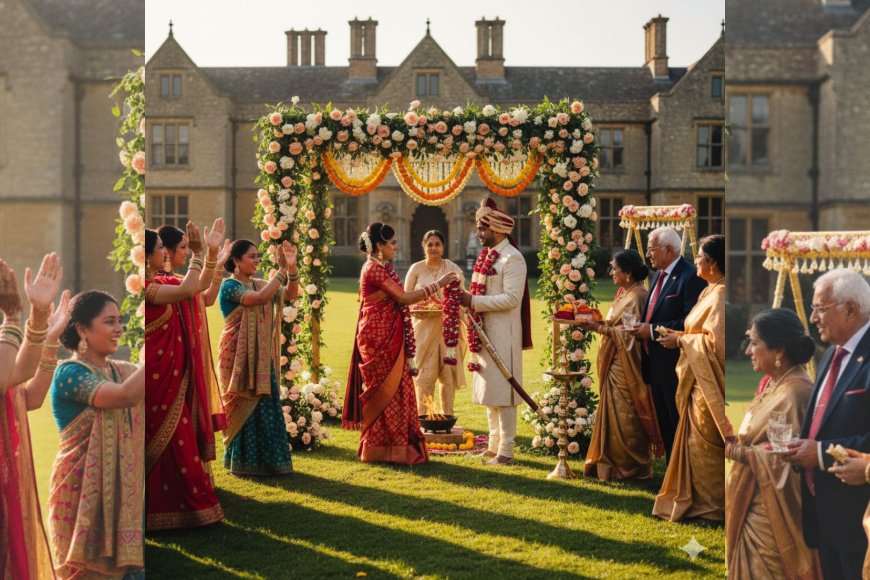
From the fish-ceremony weddings of Bengal to the sword-bearing grooms of Rajasthan, from Kerala brides wearing their own garlands to Himachali weddings that begin with the village itself — India does not have one wedding tradition. It has thousands. For NRI couples navigating heritage from a distance, this is both the challenge and the extraordinary gift.
You grew up knowing one kind of Indian wedding. The one your family did. The music your parents danced to, the rituals your grandmother insisted upon, the specific sweet that appeared at every ceremony whether anyone remembered why or not. You assumed, perhaps, that this was more or less what all Indian weddings looked like — with minor variations.
Then you attended a colleague's Bengali wedding in London, or a Tamil friend's reception in Toronto, or a Malayali ceremony in Melbourne, and you realised: India is not one wedding tradition wearing regional costumes. It is hundreds of entirely distinct civilisations, each with its own theology of marriage, its own understanding of what a union requires, its own cast of rituals so specific and so rooted in local geography, agriculture, mythology, and social structure that no other community on earth practices anything quite like them.
For NRI couples, this realisation lands differently than it does for those at home. Because you are not just planning a wedding — you are deciding which of these extraordinary traditions to carry forward, which to explain to a partner who grew up elsewhere, and which to fight to preserve in a city that has never heard of them. This article is for all of you. Every tradition here is real, specific, and worth knowing.
🌟 DID YOU KNOW?
India recognises multiple personal law systems governing marriage, with Hindu, Muslim, Christian, Parsi, and Jewish communities each operating under distinct legal frameworks — yet the cultural diversity within the Hindu tradition alone encompasses traditions so different from one another that a Punjabi and a Tamil wedding share almost no ritual elements beyond the presence of fire.
The Nadar community of Tamil Nadu practices a wedding tradition in which the bride's family and groom's family exchange garlands simultaneously before any ceremony begins — a rare instance of a fully symmetrical opening ritual that encodes equality between the two families from the very first gesture.
According to community surveys of Indian diaspora populations in the UK, Canada, and Australia, over 67% of second-generation NRIs report that preserving specific regional wedding traditions — rather than generic "Indian" ones — is their primary cultural priority when planning their own weddings, driving significant demand for region-specific pandits, vendors, and ceremony guidance abroad.
What Makes Indian Wedding Traditions Unique?
Before travelling region by region, it is worth understanding why Indian wedding traditions are so extraordinarily diverse — because the diversity is not accidental. It is the product of geography, ecology, agricultural cycles, local deity worship, caste and community social structures, trade history, and thousands of years of relatively isolated regional cultural development.
India's wedding traditions did not emerge from a single religious authority issuing uniform guidelines. The Grihya Sutras [ancient Vedic household ritual texts] provided a broad framework, but local communities interpreted, adapted, and layered that framework with their own lok parampara [folk tradition] in ways that reflected their specific relationship with their land, their gods, their seasons, and their social organisation. A fishing community in Kerala developed different wedding symbols than a wheat-farming community in Punjab. A mountain community in Himachal developed different procession customs than a desert community in Rajasthan. A matrilineal community in Meghalaya developed an entirely different understanding of who gives whom to whom.
The result is a country in which the word "wedding" refers to ceremonies that share a spiritual philosophy but almost nothing else — and in which every regional tradition, however obscure it may seem to outsiders, carries within it a complete and coherent worldview about love, partnership, family, and the cosmos.
For NRI couples, this means your specific regional tradition is irreplaceable. There is no generic Indian wedding that can substitute for a Kumaoni one, or a Coorgi one, or a Bunt one. The specificity is the point.
North India: Where Weddings Are a Village Affair
Punjab — The Anand Karaj and the Giddha That Never Stops
The Punjabi wedding is, for many people globally, the archetypal Indian wedding — enormous, loud, joyful, and structured around a series of rituals that span multiple days and involve, at various points, most of the extended family and a significant portion of the neighbourhood. But within this familiarity lie specific traditions that are less well known than the bhangra [Punjabi folk dance] and the baraat [groom's procession].
The chunni ceremony — in which the groom's mother formally covers the bride's head with a chunni [embroidered cloth] — is one of the most emotionally significant pre-wedding rituals in Punjabi tradition, marking the bride's formal acceptance into the groom's family before the wedding day itself. The vatna [turmeric ceremony] in Punjabi tradition is performed separately for bride and groom at their respective homes, with female relatives singing specific geet [songs] that have been passed down for generations and are considered as important as the ritual itself. And the sagan ceremony, in which the groom's family formally gifts the bride, involves specific items — a gold necklace, specific sweets, a piece of red fabric — whose composition varies by family but whose sequence is strictly observed.
For NRI Punjabi families, the giddha [women's folk dance and song performance] is often the first casualty of diaspora weddings — it requires women who know the specific songs, and that knowledge does not always travel. The most culturally conscious NRI families in Toronto, Southall, and Melbourne now specifically hire giddha groups or elder women who can lead the songs, treating the performance as a cultural preservation act as much as a celebration.
Rajasthan — The Sword, the Elephant, and the Royal Procession
Rajasthani weddings carry the aesthetic memory of royal courts in every detail, and nowhere is this more visible than in the groom's procession. In traditional Rajasthani and Marwari families, the groom arrives on a decorated ghodi [mare] or, in genuinely aristocratic families, on an elephant, wearing a full safa [turban] with kalgi [jewelled ornament] and a sevrau [Rajasthani sehra] of extraordinary elaborateness. In some communities, the groom carries a ceremonial sword — the talwar — as a symbol of his role as protector of the family he is about to enter.
The teen paanch ritual — a playful negotiation ceremony in which the bride's female relatives bar the groom's entry and demand payment in the form of gifts, cash, or promises before allowing him to proceed — is a beloved Rajasthani tradition that encodes, in comedic form, the idea that the bride's family has something precious and the groom must demonstrate his worthiness before receiving it.
Uttar Pradesh — The Kanyadaan That Lasts Hours
In traditional Brahminical Uttar Pradesh wedding ceremonies, the kanyadaan [gifting of the daughter] is not a single moment but an extended ritual sequence that can last several hours, involving specific mantras for each element of the gift — the daughter's hand, her jewellery, her household items, her future — each accompanied by the pouring of water from a copper vessel over joined hands. The specificity of the mantra tradition in UP weddings is extraordinary, and NRI families from this region are among the most insistent on finding pandits who know the exact regional mantra tradition.
South India: Where Weddings Honour the Bride's Power
Tamil — The Oonjal and the Gold That Witnesses
The Tamil Brahmin wedding begins, most distinctively, with the oonjal [swing ceremony] — a ritual in which the bride and groom sit together on a decorated swing and are gently swayed back and forth by female relatives while specific songs called oonjal paattu are sung. The swing is understood as a symbol of the rhythm of married life — the movement between ease and effort, between stillness and motion — and the songs sung around it are among the oldest in the Tamil wedding repertoire, their lyrics specific to this moment and no other.
The Tamil wedding's relationship with gold is also distinctive. The thali [sacred marriage pendant, equivalent to the mangalsutra in North Indian tradition] is tied around the bride's neck by the groom at the central moment of the ceremony, but the specific design of the thali varies by sub-community — a Brahmin thali looks entirely different from an Iyer thali, which differs from a Mudaliar thali — and the tying of the wrong thali design is considered a serious ritual error. NRI Tamil families frequently bring the thali from India rather than purchasing it abroad, or commission it from specialist Tamil jewellers in cities like London's Wembley area or Toronto's Scarborough.
Kerala — Where the Bride Gives Herself
The Malayali wedding tradition contains one of the most philosophically distinctive elements in all of Indian wedding culture: in the classical Nair and certain other Kerala communities, the bride does not receive a garland from the groom — she places it on herself, in a ritual acknowledgement that she is entering this marriage as a self-possessed individual, not as someone being decorated by another. The groom then receives a garland from the bride. The sequence encodes a specific understanding of womanhood and agency that is rooted in Kerala's historically matrilineal social structure.
The Pudamuri ceremony, in which the groom's family gifts the bride a new silk saree that she wears for the ceremony, and the Nirangaporu ritual involving a decorated lamp and specific offerings to the household deity, are Kerala-specific traditions that NRI Malayali families in Dubai, London, and Sydney work hard to preserve, often sourcing specific Kerala silk from specialist vendors or requesting it be brought from Kerala by travelling family members.
Karnataka — The Kashi Yatra That Goes Nowhere
The Kashi Yatra — a ritual in which the groom pretends to renounce the world, picking up an umbrella, a walking stick, and a bundle of belongings and announcing his intention to walk to Kashi [Varanasi] to become a sanyasi [ascetic renunciant] — is one of the most theatrically charming traditions in any Indian wedding. The bride's father then intercepts him, argues that the responsibilities of grihasta [householder] life are spiritually equal to renunciation, and convinces him to return and marry his daughter instead.
The ritual is comedic in execution but profound in philosophy — it encodes the Dharmic understanding that marriage is not a lesser spiritual path than renunciation, but an equally valid and demanding form of devotion. NRI families from Karnataka communities in Melbourne and Toronto perform this ritual with tremendous theatrical enthusiasm, and it is consistently one of the most photographed moments of the wedding day.
Telugu — Fish, Rice, and the Groom's Lap
The Pellikuthuru and Mangalagandham ceremonies of Telugu weddings are elaborate pre-wedding beauty rituals performed separately for bride and groom, involving turmeric, specific oils, and family songs. But the most distinctively Telugu wedding tradition may be the Talambralu — a ceremony in which the bride and groom pour talambralu [a mixture of rice, turmeric, and rose petals] over each other's heads, three times. What makes this distinctly Telugu is not just the act but the energy — it is a rare moment of playfulness within a formal ceremony, the couple laughing and the family cheering as the golden mixture cascades down.
In some Telugu communities, a live fish is introduced into the ceremony — placed in a vessel of water that the couple touch together — as a symbol of fertility and abundance. NRI Telugu families in Houston, one of the largest Telugu diaspora communities in the world, often source specific Telugu ritual items from the city's substantial South Asian grocery and speciality store network.
East India: Where the Earth and the Divine Are the Same Thing
Bengal — The Shubho Drishti and the Bride Who Cannot Look
The Bengali wedding's most iconic moment is the shubho drishti [auspicious seeing] — the first mutual gaze between bride and groom during the ceremony, performed with the bride seated on a wooden piri [low stool] and carried in by her brothers. As the couple see each other for the first time in the ritual context, they exchange paan [betel leaf] and flowers, and the moment is considered the spiritual core of the Bengali wedding — the point at which the union becomes real.
What is distinctive is the preparation for this moment: the bride is instructed, throughout the early portions of the ceremony, to keep her eyes cast down, looking at a paan leaf she holds before her face. The contrast when she finally raises her eyes and meets the groom's gaze is deliberately constructed for maximum emotional impact. NRI Bengali families in London's Newham area and Toronto's Scarborough work with Bengali pandits to ensure the specific Bengali ceremony sequence — so different from North Indian structures — is preserved in full.
Assam — The Juroon and the Silk That Speaks
Assamese weddings are inseparable from Muga silk [the golden silk unique to Assam, produced by Muga silkworms found nowhere else on earth]. A bride in full Assamese ceremonial dress wears Muga silk that her family may have spent years sourcing and acquiring, and the Juroon ceremony — in which gifts are exchanged between the two families — includes specific Assamese handwoven textiles as non-negotiable elements. The gifting of gamosa [a white cotton cloth with red borders that is the most sacred textile in Assamese culture] at various points in the ceremony encodes respect, identity, and belonging simultaneously.
NRI Assamese families abroad often bring Muga silk and gamosa directly from Assam, unwilling to substitute — and rightly so. The silk itself is the ceremony's witness.
Odisha — The Goddess Who Must Approve
In traditional Odishan weddings, the ceremony does not begin until the kuldevata [family deity] and, in many communities, the local gram devata [village deity] have been formally consulted and their approval received through a ritual performed by a family elder or priest. The understanding that a marriage requires divine approval not from a generic cosmic authority but from the specific deity who has watched over this family's particular lineage for generations is distinctly Odishan — and it gives the wedding a rootedness in local sacred geography that no venue change can entirely replicate.
West India: Where Weddings Celebrate the Earth's Abundance
Maharashtra — The Antarpat and the Moment Before
The antarpat ceremony is one of Maharashtra's most visually dramatic wedding traditions. A white cloth is held between the bride and groom as they stand facing each other, preventing them from seeing one another. The mangalashtaka [eight auspicious Sanskrit verses] are recited, building in speed and intensity. At the final verse — savadhan [attention] — the cloth is dropped simultaneously with a shower of akshat [rose petals and unbroken rice] and the couple sees each other for the first time in the ritual context. The collective gasp and cheer from the gathered family at this reveal is one of the most joyful sounds in Indian wedding culture.
NRI Maharashtrian families in Melbourne, Houston, and London preserve the antarpat with tremendous fidelity, often rehearsing the timing with the pandit the day before so that the cloth drop and the mangalashtaka conclusion are perfectly synchronised.
Gujarat — The Maameru and the Maternal Uncle's Sacred Role
In Gujarati weddings, the bride's mama [maternal uncle] plays a ceremonially central role that has no equivalent in most other Indian wedding traditions. The maameru ceremony — in which the mama brings specific gifts including the bride's wedding saree, jewellery, and household items — is considered one of the most important pre-wedding rituals, and the relationship between a bride and her mama is understood to be among the most auspicious in her life. NRI Gujarati families in Leicester, New Jersey, and East Africa — where a substantial Gujarati diaspora has maintained traditions for generations — preserve the maameru with particular intensity.
Goa — The Catholic-Hindu Confluence
Goan weddings, particularly in communities with a history of Portuguese influence and Catholic conversion, represent one of India's most remarkable cultural confluences. A Goan Catholic wedding may include konkani folk songs, specific coastal seafood at the feast, a roce ceremony [a coconut milk blessing ritual with clear parallels to the Hindu haldi/turmeric ceremony], and an aesthetic that blends European Catholic formality with the warmth and colour of Indian coastal culture. Goan Hindu weddings, meanwhile, maintain traditions specific to the Gaud Saraswat Brahmincommunity that are found nowhere else in India.
The Himalayan Traditions: Where the Mountain Itself Witnesses
Himachal Pradesh — The Devta Must Attend
In traditional Himachali weddings, particularly in the inner valleys of Kullu, Mandi, and Kinnaur, the devta [local deity, carried in a ceremonial palanquin called a rath] is invited to attend the wedding and must be present before the ceremony can begin. The devta's rath, decorated and carried by hereditary kardar [deity attendants], arrives at the wedding venue, and the ceremony begins only when the deity is formally in place. The understanding that the local god is a literal guest at the wedding — not a symbolic presence but an actual attendee who must be received, fed, and seen off properly — gives Himachali weddings a sacred specificity that no other Indian tradition quite replicates.
Uttarakhand (Garhwal and Kumaon) — The Mangal Geet That Never Ends
Garhwali and Kumaoni wedding traditions are built as much around music as around ritual. Mangal geet [auspicious wedding songs in the Garhwali and Kumaoni languages] are performed at every stage of the wedding sequence — the tilak [groom's ceremonial marking], the janaav [sacred thread ceremony for the groom], the dwarchar [bride's reception at the groom's home] — by groups of women who know the specific songs for each moment. These songs are not generic wedding music; they are liturgically specific, their words precisely matched to the ritual they accompany. NRI Garhwali and Kumaoni families in Vancouver and London work hard to find elders who know these songs, understanding that without the mangal geet, the ritual loses something unreplaceable.
Ladakh — Where Buddhism Blesses the Union
In Ladakhi Buddhist wedding traditions, the ceremony involves the consultation of astrologers to determine the auspicious timing, the preparation of chang [barley beer] as the ceremonial drink, and the participation of Buddhist monks in specific blessing ceremonies. The wedding feast — Gyathuk [a noodle soup of significant ritual importance] — is prepared communally and served as an act of collective blessing. NRI Ladakhi families in diaspora cities, small in number but deeply community-minded, preserve these traditions with remarkable fidelity.
Kashmir — The Wanwun and the Night of Songs
Kashmiri Pandit weddings contain wanwun — an all-night singing tradition performed by women in which specific songs mark every stage of the wedding sequence from the pre-wedding preparations through to the bride's departure. The wanwun songs are in the Kashmiri language, their melodies ancient, their words specific to each ritual moment. For Kashmiri Pandit NRI families — a diaspora born of displacement rather than economic migration — the preservation of wanwun carries an additional weight of cultural survival. Community organisations in New Jersey, London, and Delhi have worked to document and teach the songs to younger generations who grew up outside Kashmir.
What Unites All of These?
Across every one of these traditions — from the Kerala bride who garlands herself to the Himachali devta who attends the wedding, from the Bengali bride who keeps her eyes down to the Rajasthani groom who arrives on a horse with a sword — there is a common thread that is worth naming.
Every single one of these traditions is doing the same thing: it is making the invisible visible. It is taking the abstract — love, commitment, family, divine blessing, the hope for children and prosperity and long life — and giving it a physical form that can be seen, touched, witnessed, and remembered. The ceremonies are not decorating a marriage. They are the marriage, made real through the body and the senses and the gathered community.
For NRI couples, this is the deepest reason to preserve your specific tradition rather than accepting a generic version. The specific ritual — your community's particular way of making the invisible visible — carries within it everything your ancestors understood about what a marriage actually is. Replacing it with something approximating it is like replacing a Muga silk saree with any orange fabric. The colour is similar. The thing itself is entirely different.
Doing Regional Traditions Abroad: The Practical Reality
The single greatest practical challenge for NRI couples preserving regional wedding traditions is the pandit problem — finding a priest who knows not just Hindu ritual in general, but your community's specific ritual sequence, mantras, and customs. A Garhwali mangal geet cannot be performed by a Punjabi pandit. A Kashmiri Pandit lagan ceremony cannot be officiated by a Tamil Brahmin priest. The regional specificity is not incidental — it is the substance.
NRI.Wedding's pandit network is organised by regional tradition across North, South, East, and West Indian communities as well as Himalayan traditions. This is one of the most important services we offer, and the demand for it has grown significantly as second and third-generation NRI couples become more — not less — insistent on regional authenticity.
For ritual items, the sourcing landscape varies by tradition. Most North and South Indian ritual items are available in major diaspora cities through established South Asian grocery and speciality store networks. For more regionally specific items — Muga silk from Assam, gamosa, specific Rajasthani puja materials, Kashmiri wanwun recordings, Himachali devta ritual arrangements — NRI.Wedding's vendor network includes specialists who can source and ship these items or advise on faithful local alternatives.
Venue fire policies affect any ceremony involving havan [sacred fire], and advance negotiation is essential. Most experienced South Asian wedding venues in Brampton, Southall, Parramatta, Dandenong, and Houston's South Asian corridor are fully equipped to handle controlled fire ceremonies — but always confirm in writing, months in advance.
For ceremonies requiring specific community musicians — Garhwali mangal geet singers, Bengali mangalacharanaperformers, Assamese folk musicians — the diaspora community itself is your best resource. Cultural associations in major NRI cities often maintain connections to musicians who know specific regional traditions. Start asking at least six months before your wedding date.
What You Need: The Regional Wedding Checklist
Research First — identify the three to five most important rituals specific to your community and region, and build your ceremony around preserving these fully rather than attempting to include everything at reduced depth. Depth over breadth always produces a more meaningful ceremony.
People Required — a regional pandit matched to your specific community tradition, at least one elder from your community who knows the ritual sequence and can guide and correct, a photographer briefed on which moments are ritually significant so nothing is missed, and family members assigned specific ceremonial roles well in advance.
Preparation Steps — source all region-specific ritual items at least two months before the wedding; book your regional pandit as early as possible, particularly for less common regional traditions; brief non-Indian guests or cross-community family members with written ceremony guides; and conduct a full rehearsal with the pandit the day before.
NRI.Wedding's full regional wedding planning resources — including community-specific pandits, vendor directories, ceremony guides, and photographer networks — are available at nri.wedding.
5 Questions NRI Couples Always Ask
Our families are from different regions of India. How do we honour both traditions without the ceremony becoming three hours of confused compromise?
The most successful cross-community NRI weddings are those that identify the two or three most emotionally significant rituals from each tradition and perform those in full, rather than attempting to include every ritual from both communities at reduced depth. Have an honest conversation with both sets of parents about which moments matter most to them — you will almost always find that the non-negotiables are fewer than you feared, and that the remaining ceremony space can be shared graciously.
My partner is not Indian. How do I explain traditions that have no Western equivalent?
The most effective approach is to provide written ceremony guides — brief, warm, specific explanations of each ritual moment — to your non-Indian guests and family in advance of the wedding. NRI.Wedding's bilingual ceremony cards are designed for exactly this purpose. Additionally, brief your non-Indian partner's family personally, focusing on the emotional meaning rather than the ritual mechanics. Most non-Indian families find Indian wedding traditions profoundly beautiful once they have the vocabulary to understand what they are witnessing.
We are second-generation NRIs and don't fully know our own community's traditions. Where do we start?
Start with your oldest living relative on both sides and record a conversation about their wedding and their parents' wedding. This oral archive is more valuable than any written source for recovering specific regional customs. NRI.Wedding's cultural consultants can also help identify your community's specific traditions and connect you with pandits and elders who can guide the reconstruction.
Can we perform regional ceremonies at a non-Indian venue — a hotel, a garden, or a country house?
Yes, with advance planning. The key variables are fire policy for any havan-based ritual, outdoor access for procession-based traditions, and sound policy for music-heavy ceremonies. NRI.Wedding's venue consultation service can help you identify venues in your city that have successfully hosted your community's specific traditions, saving significant negotiation time.
How do we find community-specific musicians for traditions like Garhwali mangal geet or Bengali wanwun?
Your community's cultural association in your diaspora city is the first resource — most maintain informal networks of musicians and elders who know specific traditions. NRI.Wedding's vendor network includes regional musicians across major diaspora cities, and for very specific traditions, we can connect you with musicians in India who can participate via video for ceremonial portions that do not require physical presence.
The Emotional Angle
There is a specific grief that arrives when an NRI couple sits down to plan their wedding and realises they do not fully know their own tradition.
It is not the grief of ignorance — they are educated, curious, loving people who have simply lived their whole lives in a place where nobody around them knew these songs, performed these rituals, or carried this knowledge. The wanwun was not sung in Birmingham. The devta did not travel to Mississauga. The oonjal was not installed in any Melbourne garden. And so the knowledge thinned, generation by generation, not through carelessness but through distance and circumstance.
What NRI couples do when they insist on recovering and performing their specific regional traditions is not nostalgia. It is archaeology. It is the deliberate excavation of something buried under decades of diaspora life — something that was not lost, exactly, but was waiting. It was waiting in the oldest aunt's memory, in a photograph from a cousin's wedding in the hometown, in the specific way a grandmother's eyes filled when a particular song was mentioned.
When you perform your community's specific wedding tradition — really perform it, with the right pandit and the right sequence and the right songs — you are not recreating the past. You are insisting that the past has a future. You are saying: this knowledge will not end with the generation that emigrated. It will continue. In this country, in this century, with this person I am marrying, it will continue.
That is an act of love that extends in both directions — backward to every ancestor who married this way, and forward to every child who will one day be told: this is how your people have always begun a life together.
A Moment to Smile
In Houston, Texas, at a Telugu-Kashmiri Pandit cross-community wedding, the families had agreed in advance that the ceremony would honour both traditions fully — Telugu traditions in the morning, Kashmiri Pandit traditions in the afternoon, with a shared feast in the evening.
What nobody had fully accounted for was the Kashi Yatra — the Karnataka tradition that the groom's Kashmiri Pandit mother had enthusiastically adopted from a YouTube video she had watched three times in preparation. Her son, Vikram, was a software engineer from Austin who had never heard of the Kashi Yatra and was not informed of its inclusion until he was handed an umbrella and a small bundle during the ceremony and told to walk toward the door.
Vikram walked with great conviction toward the exit. The Telugu bride's father, who had also not been fully briefed, assumed something had gone wrong and stood up from his chair in alarm. The Kashmiri Pandit mother called across the room, "No, no — it's a tradition, he's supposed to leave and then come back!" The Telugu family's pandit, who had been briefed, nodded vigorously. The Kashmiri pandit, who had not been briefed on this addition, looked at his notes with understandable confusion.
Vikram was intercepted two metres from the door, convinced to return, and married his bride Ananya with great happiness forty minutes later. The Kashi Yatra is now performed at every family function as an encore. Vikram always makes it a little further toward the door.
Quotes from the Diaspora
"When we told our pandit in London that we wanted the full Kumaoni ceremony — mangal geet, specific Kumaoni mantras, the traditional sequence — he said he had never been asked to do this outside India. He cried a little. I cried a lot. My mother, who had been telling me for two years that we could just do a 'normal Hindu wedding,' called me after the ceremony and said it was the most beautiful thing she had attended since her own wedding in Almora in 1978. I consider that a win." — Preethi Joshi, Kumaoni, London, UK
"My son married a Malayali girl. We are Rajasthani. The two ceremonies were on the same day. I watched her place the garland on herself during the Malayali ritual and I thought — we have never done it that way, but I understand immediately why they do. She is not being given. She is arriving. I have thought about that moment every day since." — Savitri Rathore, Rajasthani, mother of groom, Dubai, UAE
"I grew up in Melbourne knowing I was Bengali but not really knowing what that meant for our wedding traditions. My grandmother flew from Kolkata for the ceremony. When the pandit began the shubho drishti sequence and I was carried in on the piri by my brothers, I looked up and saw my grandmother's face. She was not crying. She was smiling the way people smile when something lost has been found. That is the only way I know how to describe it." — Debolina Sen, Bengali, Melbourne, Australia
Your Roots Travel With You
India does not have one wedding tradition. It has a continent's worth of them — each one a complete civilisation's answer to the question of how two people should begin a life together. The fishing community's fish. The mountain community's devta. The matrilineal community's self-garlanded bride. The wheat-farming community's fire. Every one of these answers is right. Every one of them is worth preserving.
For NRI couples planning weddings from a distance, the work of recovering and performing your specific regional tradition is some of the most important cultural work a generation can do. NRI.Wedding exists to support exactly this work — with regional pandits matched to your community, vendor networks that source the specific items your tradition requires, photographers who understand the ritual moments that must be captured, and planning resources built around cultural specificity rather than generic Indian wedding checklists.
Your tradition did not die when your family emigrated. It has been waiting. For you. For this wedding. For the day you decide it matters enough to bring it back.
One country, a million ways to wed. Find yours. Perform it fully. Pass it on.
This article explores unique wedding traditions across India's diverse cultural regions, covering Punjabi, Rajasthani, Tamil, Telugu, Kerala, Karnataka, Bengali, Assamese, Odishan, Maharashtrian, Gujarati, Goan, Himachali, Garhwali, Kumaoni, Ladakhi, and Kashmiri Pandit communities, with guidance for NRI couples preserving regional traditions in Toronto, London, Melbourne, Houston, and Dubai.
0 comments
Real names and courtesy, please. Every comment is read by a person before it appears.
Nothing yet. Start it off.
Comments are closed on this article.