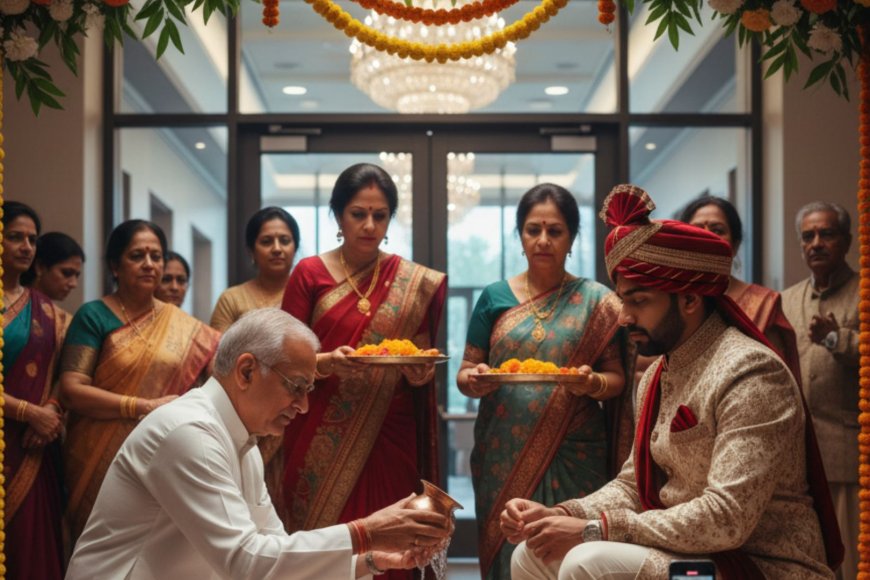
In the elaborate ceremonial architecture of a Gujarati Hindu wedding, there is a moment that belongs entirely to the groom — a moment when he is not merely a man in a sherwani arriving at a mandap but a living embodiment of Lord Vishnu himself, welcomed, honoured, and worshipped by the bride's family with the same reverence they would offer a deity at a temple. Vara Puja is not a greeting ceremony. It is a theological statement about what marriage means, who the groom is in the eyes of the tradition, and what the bride's family is truly doing when they give their daughter to his care. For Gujarati NRIs from Ahmedabad to Auckland, from Surat to Surrey, from Vadodara to Vancouver, Vara Puja is the ritual that reframes everything.
You may have watched it without fully understanding it. The groom arriving at the mandap, the bride's mother stepping forward with a thali, the washing of feet, the offering of gifts, the specific formality of the welcome that felt like something more than hospitality. You were at a cousin's wedding in Gujarat, or at a community function in a temple hall in Harrow, or at a banquet venue in Scarborough, and you registered that this was important without quite knowing why.
You know why now. Or you are about to. Because understanding Vara Puja changes the way you understand not just Gujarati weddings but the entire Vedic concept of what it means to welcome another person into your family. This is not the bride's family being polite to the groom. This is the bride's family recognising the divine in the man their daughter has chosen. This is theology made into a threshold ceremony.
You are planning your wedding now. You are in a house in New Jersey or a flat in Wembley or an apartment in Brampton, and your future mother-in-law is on the phone from Ahmedabad asking about the Vara Puja arrangements — the thali, the priest, the sequence, whether the groom's feet will be washed properly or symbolically, whether the right offerings are prepared. She is asking because this is the ritual that welcomes her son as Vishnu. She wants it done correctly. She is right to want this.
This is Vara Puja. And after you understand it, you will never look at a groom's arrival the same way again.
🌟 DID YOU KNOW?
- The theological basis for Vara Puja rests on a specific verse from the Manusmriti and the Grihyasutras which state that "Dauhitra Vishnu swaroopah" — the son-in-law is the form of Vishnu. This is not metaphor or polite convention in the Vedic understanding. It is a precise theological identification: the man who is about to receive the Kanyadanam (the sacred gift of the daughter) occupies, at that moment, the position of the divine recipient, and must be honoured accordingly.
- The Madhuparka — the sacred mixture of honey, curd, ghee, sugar, and water offered to the groom during Vara Puja — is one of the oldest documented ritual offerings in the Vedic tradition, appearing in the Rigveda and Atharvaveda as the specific welcome offering made to guests of the highest honour. Ancient texts describe Madhuparka as the appropriate offering for only six categories of guests: a teacher, a priest, a king, a father-in-law, a maternal uncle, and a dear friend. Its presence in the wedding ceremony specifically for the groom elevates him into this highest category of honoured guest.
- In the traditional Gujarati Vara Puja sequence, the groom's feet are washed by the bride's father — not by a servant, not by a junior family member, but by the father of the woman who is about to be given in marriage. This specific act — a father washing the feet of the man who will receive his daughter — is considered one of the most profound expressions of vinaya (humility and honour) in the entire Hindu wedding sequence, and is cited by Gujarati cultural scholars as the ritual moment that most completely expresses the theological vision of Kanyadanam.
What Is Vara Puja?
Vara Puja — from the Sanskrit vara (the chosen one, the groom, but also meaning excellent, superior, or the best) and puja (worship, the ritual act of honouring the divine) — is the ceremony in which the bride's family formally receives and worships the groom at the threshold of the wedding mandap, treating him as a manifestation of Lord Vishnu before the wedding ceremony begins. It occurs at the very opening of the formal wedding sequence, after the Ganesh Puja (the ritual honouring of Ganesha that opens all auspicious ceremonies) and before the Kanyadan and the central wedding rites.
What physically happens is precise and layered. The groom arrives at the wedding venue in the Vara Yatra (the groom's procession) accompanied by his family and the wedding party. At the threshold of the mandap — the specific boundary between the outside world and the sacred wedding space — the bride's mother and senior female relatives receive him with a formal welcome. The bride's mother performs Aarti (the ritual of waving a lighted lamp before the groom in a circular motion, the same act performed before deity images in temple worship) while other female relatives shower him with akshata (turmeric-dusted rice) and flower petals.
The groom is then led to a specific seat — the Vara Asana (the groom's throne, often a decorated wooden seat or paat) — where he is formally received by the bride's father. The bride's father performs Paadya (the washing of the groom's feet with water, sometimes mixed with Panchamrut — the sacred five-substance mixture of milk, honey, ghee, curd, and sugar) while chanting the appropriate mantras. This foot-washing is not merely symbolic in many Gujarati families — the water genuinely flows, the feet are genuinely washed, and the father genuinely kneels to perform the act.
Following the foot-washing, the bride's father or the officiant pandit presents the Madhuparka — the ancient honey-curd-ghee-sugar-water mixture in a small vessel — to the groom, who receives and tastes it as a ritual of acceptance. The pandit chants the Madhuparka mantras, invoking the blessings of the tradition upon this act of supreme hospitality. Gifts — traditionally including new clothes, gold ornaments, and fruits — are presented to the groom by the bride's family at this point, though the specific gifts vary by family tradition and economic custom.
The entire Vara Puja sequence, from the threshold Aarti to the Madhuparka presentation, takes between fifteen and thirty minutes and is one of the most visually and emotionally rich segments of the Gujarati wedding. It is also, because it happens in the excitement and movement of the groom's arrival, one of the most commonly under-documented — couples who have a dedicated photographer for this moment often discover that it produced some of the most powerful images of their entire wedding.
Community Comparison Table
| Community / State | Local Name | Key Tradition | How NRIs Abroad Adapt It |
|---|---|---|---|
| Gujarati (Hindu — Vaishnava) | Vara Puja | Aarti, foot washing, Madhuparka offered; bride's father washes feet; groom as Vishnu | Full sequence preserved; Madhuparka prepared fresh; pandit guides sequence |
| Gujarati (Hindu — Shaiva) | Vara Puja | Similar sequence with Shaiva mantras; Shiva invocation rather than Vishnu identification | Shaiva pandit coordinates; Shiva imagery at threshold optional |
| Gujarati (Jain) | Vara Puja equivalent | Jain families perform modified welcome without deity identification; community elder officiates | Jain elder coordinates; strictly non-violent and vegetarian context maintained |
| Rajasthani | Dwarcharya / Milni | Families exchange garlands; groom welcomed at threshold; bride's male relatives garland groom's male relatives | Garlands sourced from local Indian florists; Milni preserved as family meeting ritual |
| Punjabi (Hindu) | Milni Ceremony | Formal meeting of bride and groom's male relatives; garlands exchanged; emotional family reunion | Garlands prepared in advance; families briefed on sequence; widely preserved in diaspora |
| Marathi | Vara Puja / Antarpat | Groom welcomed with Aarti; silk curtain separates couple until auspicious moment | Silk curtain sourced from Indian stores; Aarti thali prepared by bride's mother |
| Tamil (Iyer/Iyengar) | Vara Varaippu | Groom welcomed at threshold; Kashi Yatrai sequence follows; bride's father pleads for daughter | Full Kashi Yatrai preserved; Tamil Brahmin priest essential for sequence |
| Telugu | Vara Swagatanam | Groom welcomed with Aarti and flowers; feet washed; Madhuparka equivalent offered | Telugu pandit coordinates; full welcome sequence preserved in diaspora |
| Bengali | Boron | Bride's mother receives groom with Aarti and sweets; conch shells blown; ululation by women | Conch shells from Bengali stores; ululation (uluru) taught to younger women |
| Himachali | Vara Swagat | Groom welcomed by bride's family with Pahadi songs; elder women perform Aarti | Pahadi songs played from recordings; elder women's Aarti preserved |
| Kashmiri Pandit | Lagan Vara Puja | Groom received with specific Kashmiri welcome ritual; walnut and rice offerings | Walnut and rice universally available; Kashmiri pandit essential |
The Meaning Behind the Ritual
To understand Vara Puja at its depth, you need to sit with the theological identification at its centre — that the groom, at the moment of his arrival for the wedding, is Vishnu. Not like Vishnu. Not as a metaphor for Vishnu. In the Vedic ritual understanding, at this specific moment, for this specific purpose, the groom occupies the position of the divine.
This identification has profound implications for every gesture in the Vara Puja sequence. When the bride's mother performs Aarti before the groom, she is performing exactly the same act she performs before the deity at her home shrine every morning — waving the lamp, invoking the divine light, acknowledging the sacred in what stands before her. The Aarti before the groom is not a different ritual that happens to share a name with the temple Aarti. It is the same ritual, applied to the same understanding.
When the bride's father washes the groom's feet, he is performing Paada Puja — the worship of the feet, which in Hindu philosophical tradition is the most grounded and humble form of divine honour. The feet are the point of contact between the divine and the earth. To wash them is to acknowledge that the divine has walked into your home, your family, your life. For a father to perform this act for the man who is about to receive his daughter is the most complete expression of the tradition's understanding: I am not giving my daughter to a man. I am giving her to the form of God. And I honour that form with my own hands.
The Madhuparka — the five-substance mixture of honey, curd, ghee, sugar, and water — carries its own cosmological grammar. In Vedic hospitality tradition, madhura (sweet) is the quality associated with the highest guests — those whose presence is a blessing. To offer five sweet substances together is to offer the five mahabhutas (great elements — earth, water, fire, air, and space) transformed by sweetness. It is to say: every element of our home, every dimension of our existence, we offer in welcome.
The tradition is also making a statement about the nature of a good marriage. The husband who is honoured as Vishnu is being reminded, in the most public and ceremonial way possible, of the standard to which he is being held. Vishnu in Hindu tradition is the preserver — the one who sustains, protects, and maintains the cosmic order. To receive a daughter's hand as Vishnu is to accept the responsibility of Vishnu: to preserve, protect, and sustain the woman being entrusted to your care.
For a non-Indian partner or family member seeking the simplest truth: the bride's family is not just welcoming the groom — they are recognising the divine in him, and in doing so, telling him exactly what they expect him to be.
Doing Vara Puja Abroad: The Practical Reality
Vara Puja abroad is one of the more straightforward Gujarati wedding rituals to manage logistically — it requires no fire, no large quantities of ingredients, and no special venue arrangements beyond a designated threshold space and a prepared thali. The complexity, such as it is, lies in the preparation and the personnel.
The Madhuparka preparation is the central ingredient task and it is entirely manageable in any diaspora city. The five components — honey, curd (plain yogurt), desi ghee, sugar, and water — are universally available. The specific proportions are traditionally determined by family custom — your pandit or family elder will know your family's ratio. The Madhuparka should be prepared fresh on the morning of the wedding, combined in a small copper or silver vessel, and kept covered until the moment of offering. The vessel matters — a copper or silver kalash or small bowl carries the ritual appropriateness that a glass or plastic container does not. Small copper vessels are available at Indian puja supply stores in Southall London, Harwin Drive Houston, Brampton Toronto, Harris Park Sydney, and Meena Bazaar Dubai.
The Aarti thali for Vara Puja requires specific preparation. The bride's mother's thali should include a diya or nilavilakku (oil lamp — a small diya is traditional for the Vara Puja Aarti), kumkum (vermillion powder) for applying the tilak (forehead mark) to the groom, akshata (turmeric-dusted rice) for showering, chandanam (sandalwood paste), fresh flower petals, and optionally a small amount of dahi (curd) for the tilak application in some family traditions. All of these items are available at Indian grocery and puja supply stores in every major diaspora city. Prepare the thali the morning of the ceremony — not the night before — so the diya is freshly set and the flowers are fresh.
The threshold space is the element that requires the most advance planning in a diaspora venue context. The Vara Puja happens at the threshold — the point of entry into the mandap or ceremony space — and the physical arrangement of this space matters for the ritual's integrity and the photography. Speak to your venue coordinator at least four weeks before the wedding about the threshold arrangement: you will need a clear entry point that can be decorated (with flower garlands, banana leaf columns, or a simple decorated arch), space for the bride's mother and female relatives to stand on one side of the threshold, and a small area where the groom can be seated for the Paadya (foot-washing). Many NRI couples use the venue's main entrance or the mandap entry archway as the threshold, which often produces the most beautiful Vara Puja photographs.
Finding a Gujarati pandit who knows the full Vara Puja sequence is essential — the specific Madhuparka mantras, the Paadya chants, and the sequence of gifts and blessings vary between Vaishnava and Shaiva traditions and between family sub-traditions. Use the Gujarat community networks in your city and NRI.Wedding's pandit directory to find a priest who is specifically familiar with Gujarati Vara Puja. When interviewing your pandit, ask specifically: "Are you familiar with the full Vara Puja sequence including Paadya and Madhuparka?" A knowledgeable priest will engage with this question immediately and will likely ask which community and sub-tradition your family follows.
Coordinating the groom's family for the Vara Yatra (the arrival procession) requires a brief but specific conversation with the groom's side about timing and sequence. The Vara Puja cannot begin until the groom has arrived at the threshold in the traditional manner — not slipped in through a side entrance, not arrived early and been waiting in a back room. The groom's arrival must be the arrival, visible to the assembled family and guests, processed from the entry point to the threshold where the bride's mother and family are waiting. Brief the groom's family on this at least a week before the wedding and ensure your venue's event coordinator understands the arrival sequence.
For streaming to family in India, Vara Puja is one of the most visually spectacular and emotionally resonant moments to share. The threshold Aarti, the foot-washing, and the Madhuparka presentation each have their own visual drama. Position your camera wide enough to capture the full threshold scene — the groom, the bride's mother with the thali, the assembled family — and then switch to a closer angle for the Paadya and Madhuparka moments. Begin the stream at least fifteen minutes before the groom's arrival so your India-side family is present for the full Vara Yatra approach.
Doing Vara Puja as a Destination Wedding in Gujarat
To perform Vara Puja in Gujarat — at the threshold of a heritage haveli in Ahmedabad, or at the ornate entrance of a traditional mandap in Surat, or at the carved stone doorway of an ancestral family home in Vadodara — is to perform it in the architectural language it was designed for. The threshold in a traditional Gujarati home or wedding venue is not simply a doorway. It is a cosmologically significant boundary, often decorated with rangoli (auspicious floor patterns), torana (hanging garlands of mango leaves and marigolds), and the footprints of Lakshmi (the goddess of abundance, invited into the home) painted in red powder.
The most resonant destination wedding locations for a Vara Puja with full architectural authenticity are the heritage havelis of Ahmedabad's walled city — whose intricately carved wooden thresholds and inner courtyards create the exact ceremonial space the ritual envisions — the traditional mandap venues of Surat and Vadodara, and the royal palace wedding properties of Gondal, Wankaner, and Rajkot in Saurashtra, which offer a grandeur that frames the Vara Puja as the ceremonially significant event it is.
Brief your local pandit in Gujarat on any specific family traditions within your Vara Puja sequence — the specific Madhuparka proportions, whether the feet are washed with plain water or Panchamrut, which gifts are traditionally presented and by whom. Most Gujarat-based pandits who perform traditional Gujarati weddings are entirely familiar with Vara Puja and will coordinate the sequence naturally. Regional variations between Ahmedabad, Surat, Kathiawad, and Kutch traditions are best navigated with your family elder's guidance.
What You Need: The Vara Puja Ritual Checklist
Ritual Items The Aarti thali (a brass or silver plate carrying a small diya, kumkum, akshata, chandanam, and fresh flower petals), a small copper or silver vessel for the Madhuparka mixture, Madhuparka ingredients (honey, plain curd, desi ghee, sugar, and water — prepared fresh the morning of the wedding), a low wooden paat (seat) for the groom during the Paadya sequence, a small copper vessel and pouring ladle for the foot-washing water (water may be mixed with Panchamrut or simply consecrated with mantras), a clean white cloth for the groom's feet, gifts for the groom as per family tradition (new clothes, fruits, gold ornament — confirm specifics with family elder), fresh flower garlands for the threshold decoration, torana (mango leaf and marigold garland) for the threshold arch, and rangoli powder for the threshold floor pattern if the venue permits.
People Required The officiant pandit with full knowledge of Gujarati Vara Puja sequence including Paadya and Madhuparka mantras, the bride's mother as the primary Aarti performer (her role is ceremonially central), the bride's father as the Paadya performer (his foot-washing role is theologically the most significant act in the entire sequence), senior female relatives of the bride's family for the threshold welcome, the groom and his accompanying family for the Vara Yatra arrival, and your wedding photographer and videographer briefed specifically that the Paadya moment — the father's hands washing the groom's feet — is the single most important frame of the Vara Puja sequence.
Preparation Steps Prepare the Aarti thali the morning of the ceremony with fresh flowers and a freshly filled diya. Prepare the Madhuparka mixture one hour before the groom's expected arrival. Set up the threshold space — decorations, rangoli, torana, paat — at least two hours before the ceremony. Brief the bride's father privately on the Paadya sequence the evening before so he is emotionally and practically prepared. Confirm the groom's arrival timing and Vara Yatra sequence with the groom's family at least one week before. Set up and test the India video call connection thirty minutes before the groom's expected arrival. Brief the photographer on the Paadya moment as the priority capture.
NRI.Wedding connects Gujarati couples abroad with verified pandits experienced in the full Vara Puja sequence, puja item suppliers, and photographers who understand that the father's hands at the groom's feet is the frame that changes how you understand everything else. Begin planning at NRI.Wedding.
5 Questions NRI Couples Always Ask
Our venue does not have a clear threshold or entrance arch. How do we create the Vara Puja space?
The threshold for Vara Puja is not a fixed architectural feature — it is a designated, decorated boundary that the family creates. In a hotel ballroom or banquet venue, this is typically done by placing a decorated arch or toran at the entry point to the mandap or ceremony space, marking it clearly with flower garlands, marigold strings, and rangoli on the floor in front of it. Many Indian wedding décor suppliers in diaspora cities supply portable decorated arches specifically for this purpose — check with your wedding decorator at least four weeks before. The threshold does not need to be elaborate. It needs to be clearly the threshold — a point of transition that everyone present, including the groom, understands he is crossing. A flower arch with a rangoli in front and the bride's family waiting on the far side of it is entirely sufficient.
The bride's father has health issues and cannot physically kneel to wash the groom's feet. What are the options?
This is addressed graciously in the tradition itself — the Paadya can be performed with the groom's feet placed in a small vessel of water that is carried to the groom at seated level, allowing the bride's father to pour the water and perform the washing gesture without kneeling. In some family traditions, the foot-washing is a symbolic gesture — water poured over the groom's feet into the vessel below — rather than a physical kneeling and washing, and this symbolic version carries the full ceremonial and theological significance of the act. Discuss the specific adaptation with your pandit before the wedding, explain the father's situation, and allow the priest to guide a solution that preserves both the father's dignity and the ritual's integrity. A knowledgeable pandit will have navigated this before.
My partner is not Indian. How do we incorporate the Vara Puja meaningfully for them and their family?
Vara Puja is actually one of the most powerful rituals for a non-Indian partner to experience, because its meaning — that the family of the person you are marrying is choosing to see the divine in you, choosing to honour you as if you were God — is both culturally specific and universally moving. Brief your partner and their family in advance: what is happening, what the Madhuparka is, what the foot-washing means. For the non-Indian family watching, a bilingual ceremony booklet with a specific explanation of Vara Puja — including the theological identification of the groom with Vishnu — transforms observers into witnesses of something they will not forget. Many non-Indian partners who have received Vara Puja describe it as the moment they understood, for the first time, what it truly means to be welcomed into an Indian family. Not welcomed like a guest. Welcomed like God.
We want to include both the groom's Vara Puja and a reciprocal welcome for the bride. Is there a traditional equivalent?
The traditional Gujarati wedding sequence does include specific ritual welcomes for the bride as well — the Kanyadan sequence and the Swagatam (welcome) performed by the groom's family for the bride are the counterpart ceremonies, though they are structurally different from the Vara Puja and occur at different moments in the ceremony. Some contemporary NRI couples choose to create a parallel moment of welcome for both partners — a Vara Puja for the groom and a decorated threshold welcome with Aarti for the bride when she enters the mandap — which many family elders and pandits support as an expression of equality and mutual honour. Discuss this specific desire with your pandit and your family elder before the wedding. The tradition has always had the capacity for adaptation when the adaptation is made in the spirit of the tradition rather than against it.
How do we manage the Vara Puja timing when the groom's procession is running late?
This is one of the most practical and least discussed challenges in NRI wedding planning, and it deserves a direct answer. The Vara Puja cannot begin until the groom arrives at the threshold — and the groom's arrival at the threshold cannot be rushed or staged. Build a minimum thirty-minute buffer into your wedding timeline between the groom's scheduled arrival and the beginning of the main ceremony. If the procession is running late, the bride's family can use the additional time to complete any Ganesh Puja preparations at the mandap without disruption. If the delay extends beyond thirty minutes, have your wedding coordinator communicate with the groom's side for an updated arrival time and brief the assembled guests on the delay — a brief, warm explanation from a family member or MC that the groom is en route maintains the atmosphere without creating anxiety. The Vara Puja that begins on time but with a rushed and breathless groom is less meaningful than the Vara Puja that begins ten minutes late with a groom who has arrived properly, processed correctly, and stands at the threshold ready to be received as he deserves.
The Emotional Angle
Nobody prepares the bride's father for what happens when he kneels at the groom's feet.
He has been managing this wedding for months. He has been the one who handled the venue deposit and the caterer negotiations and the guest list spreadsheet and the relative who needed a specific vegetarian meal option that nobody communicated properly. He has been practical and capable in the specific way that fathers are practical and capable when they are trying not to think about what the wedding actually means — that his daughter is leaving, that the family as it has been is becoming something different, that the person being welcomed at this threshold will, from today, be the person his daughter calls first.
He has been managing all of this very successfully by not thinking about it.
And then the priest gives him the vessel of water. And the groom sits on the paat before him. And the priest begins the Paadya mantra. And the bride's father — this man who has negotiated with caterers and argued with relatives and driven to the airport at 4am more times than he can count — kneels.
He kneels before the man who is about to become his son. He pours the water over his feet with his own hands. He chants what the priest gives him to chant. And somewhere in the chanting and the water and the specific weight of what he is doing, the managing stops. The spreadsheet closes. The caterer negotiations end. What is left is just a father, kneeling before the man his daughter loves, saying with his hands what he has never been able to say with words: I trust you. I honour you. I am giving you the most important thing in my life and I am doing it with my own hands and I am not looking away.
The water falls over the groom's feet. The mantra continues. The father's hands are steady.
He does not know how. But they are steady.
A Moment to Smile
At a Gujarati wedding in Wembley, west London, in the spring of 2022, the Vara Puja was proceeding with great dignity — the threshold beautifully decorated, the bride's mother performing the Aarti with the composure of a woman who had been waiting for this moment since her daughter's first school play — when the groom, who had been standing at the threshold looking appropriately solemn and godly, was struck from behind by a small child who had been chasing a balloon and mistaken the decorated archway for a game obstacle.
The groom took a small step forward. The diya on the Aarti thali wobbled. The bride's mother, who is a woman of extraordinary reflexes and even more extraordinary composure, steadied the thali without breaking her circumambulation or her expression.
The child bounced off the groom's sherwani and continued running.
The groom straightened. The priest continued his mantra without pause. The bride's mother completed the Aarti.
Afterward, the bride's mother said to the groom: "Vishnu would not have flinched."
The groom thought about this. "I didn't flinch," he said. "I adjusted."
She accepted this. He had, in her assessment, responded appropriately for a god.
The child was not reprimanded. The balloon was eventually caught.
Quotes from the Diaspora
"When my father knelt to wash my husband's feet, I was not prepared for it. I have seen Vara Puja twenty times. I was not prepared for it to be my father. He is not a man who kneels for anything. He knelt for my husband. I understood in that moment that he was not just welcoming Rahul into our family. He was telling me that he believed in my choice. That is what that kneeling meant. I will never forget it." — Priyanka Mehta, Gujarati Vaishnava community, London, UK
"My son's wife is from Dublin. Her father watched the Vara Puja from the front row. He watched my husband wash our son-in-law's feet. Afterward he came to me and said: 'In our tradition, the father of the bride gives the bride away. In yours, he washes the groom's feet.' He paused. Then he said: 'I think yours might be more honest about what is really happening.' I have thought about this every day since." — Hansaben Patel, Gujarati Hindu community, mother of the groom, Toronto, Canada
"Our pandit in New Jersey had to drive two hours. He arrived exactly on time, set up his items in twelve minutes, and performed the most beautiful Vara Puja I have ever witnessed — the Madhuparka, the Paadya, the full sequence, every mantra in its correct place. At the end he said to my husband: 'You have been received as Vishnu. Now live accordingly.' My husband has told this story at every family gathering since. He is trying." — Nisha Shah, Gujarati Vaishnava community, New Jersey, USA
Your Roots Travel With You
Your bride's father sourced the copper vessel from a puja store in Brampton two weeks before the wedding. He asked the shopkeeper twice whether it was the right size for Madhuparka. He brought it home and placed it on the puja shelf in his bedroom next to the Ganesha that has been there since he arrived in this country. He did not tell you this. He told you about the parking arrangements and the timeline and the caterer's final confirmed menu. He handled the practical things because that is his language.
And then the morning came. And the threshold was decorated with marigolds and mango leaves in a banquet hall in Mississauga that had hosted corporate events on Tuesday and now held something two thousand years older. And the pandit began the Paadya mantra. And the bride's father knelt.
His hands poured the water. The mantra continued. The groom sat still and received it. And in that moment — in the water falling over joined feet in a Mississauga banquet hall that smelled of flowers and ghee and the specific combination of cultures that an NRI wedding produces — something was said that no wedding speech has ever managed to say as precisely.
I honour you. I trust you. I give you what I love most. With my own hands.
NRI.Wedding is here for every sacred drop of that journey — from finding your Gujarati pandit to sourcing your Madhuparka vessel, from planning your threshold decoration to connecting you with photographers who know that the father's kneeling is the frame that changes everything.
Your roots traveled with you. Today, on your knees, they showed their full depth.
This article explores Vara Puja, the sacred groom worship ceremony at the heart of Gujarati Hindu weddings, its Vedic and theological roots in the identification of the groom with Lord Vishnu, the Madhuparka and Paadya sequences, and complete practical guidance for Gujarati NRI couples planning the ceremony in the US, UK, Canada, UAE, and Australia — and as a destination wedding in Gujarat.
0 comments
Real names and courtesy, please. Every comment is read by a person before it appears.
Nothing yet. Start it off.
Comments are closed on this article.