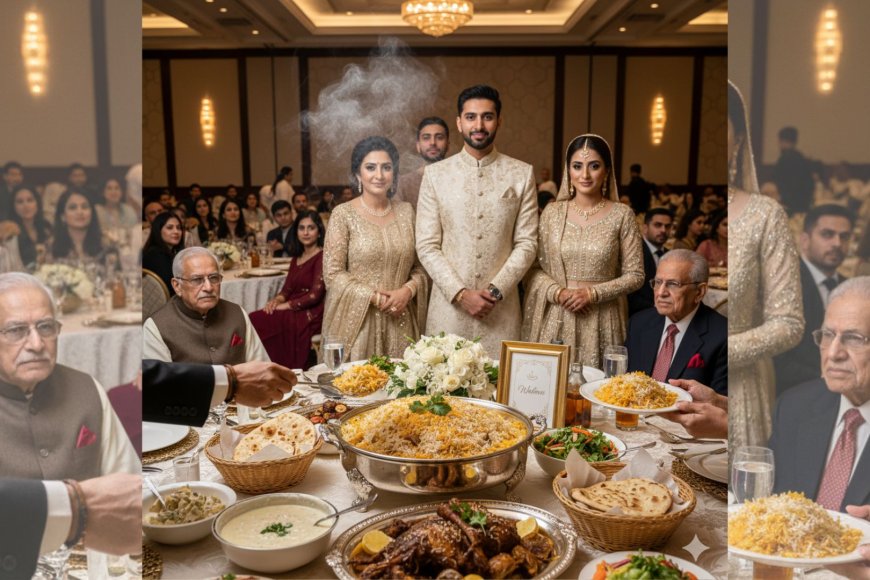
Walima — the celebratory banquet hosted by the groom's family after the consummation of an Islamic marriage — is one of the most joyful, most communal, and most theologically significant acts in Muslim wedding tradition. For NRI Muslim families in London, Toronto, Houston, Dubai, and Sydney, the Walima is not merely a reception party — it is a religious obligation, a community declaration, and the moment an Islamic marriage steps fully and publicly into the world.
You have attended enough South Asian Muslim weddings to know the shape of the celebration. The Nikah [Islamic marriage ceremony], the Rukhsati [bride's departure from her family home], the reception that follows — and somewhere in the sequence, often the day after, a gathering at the groom's family home or a hired hall that feels different from everything that came before. Less formal. More food. More laughter. The groom's mother in the kitchen since four in the morning. The uncles arranged in a specific corner with their specific opinions. The children running between tables. The sense, unmistakable, that something is being celebrated not just by a family but by a community that has claimed this marriage as its own.
That gathering is the Walima. And it is older than you think, more obligatory than many families realise, and more beautiful in its theology than its reputation as "the reception" suggests.
Now you are planning your own Nikah. In Mississauga. In East London. In some suburb of Sydney where the neighbours will smell the biryani from three streets away and consider themselves fortunate. And you want to do the Walima properly — not just as a party but as the Sunnah [prophetic tradition] it is. This is where that begins.
🌟 Did You Know?
- The word Walima derives from the Arabic root walama — meaning to gather, to assemble, to bring together. The Walima is therefore not merely a feast but a gathering — a formal, public assembly of the community to witness and celebrate a marriage that has been completed. The distinction matters theologically: the Walima announces the marriage to the world, transforming a private contract into a public social reality.
- The Prophet Muhammad ﷺ explicitly commanded the Walima — in an authenticated Hadith narrated in Sahih Bukhari, he instructed: "Give a Walima, even if only with a sheep." This command establishes Walima as Sunnah Mu'akkadah [a strongly emphasised prophetic practice] — not optional, not merely customary, but a practice whose abandonment without valid reason is considered blameworthy in classical Islamic scholarship. The minimum threshold — even a single sheep — establishes that the obligation is real regardless of economic circumstance.
- The Prophet Muhammad ﷺ himself hosted Walimas for each of his marriages, and the descriptions preserved in classical Hadith literature reveal a striking range — from simple dates and barley bread served to the poorest companions, to a feast of meat and bread for others. This range establishes the principle that Walima scales to means but is never abandoned — a principle of particular relevance to NRI families navigating the enormous social pressure to produce lavish celebrations regardless of financial reality.
What Is Walima?
Walima [the Islamic wedding banquet — from Arabic meaning assembly or gathering] is the celebratory meal hosted by the groom or the groom's family following the completion of the Islamic marriage — specifically, following the consummation of the marriage after the Nikah [marriage contract ceremony]. It is a Sunnah Mu'akkadah [strongly emphasised prophetic practice] in all four major schools of Islamic jurisprudence — Hanafi, Maliki, Shafi'i, and Hanbali — and its performance is considered an act of worship as well as celebration.
The timing of the Walima is specified in classical Islamic scholarship. The majority opinion across the four madhabs [schools of jurisprudence] holds that the Walima should be held within seven days of the marriage being consummated, with the first three days considered the most virtuous window. The Shafi'i school is most specific, recommending the day immediately following consummation as the ideal time. In contemporary NRI practice, the Walima is most commonly held the day after the Nikah and Rukhsati — a timing that aligns with classical guidance and with the practical reality of family and guests assembled for the wedding.
What distinguishes Walima from other wedding celebrations is its specific theological character. It is hosted by the groom's family — this is the standard across all madhabs, establishing the groom's family as the hosts of the public announcement of their son's marriage. It is an act of Shukr [gratitude] — the family thanking Allah for the blessing of a completed marriage by feeding others. And it is a community obligation in a specific sense — classical Islamic scholars hold that accepting an invitation to a Walima is itself Wajib [obligatory] for those who receive it, unless they have a valid excuse, establishing a reciprocal duty between the hosts and the community.
The food of the Walima is its most tangible element, and the prophetic guidance on this is both practical and philosophically rich. The minimum — even a single sheep — establishes the obligation as real. The presence of meat is considered strongly recommended (Mustahabb) where it is affordable. The inclusion of the poor and the needy in the Walima is not merely encouraged but specifically emphasised in multiple Hadith — a Walima attended only by the wealthy is explicitly critiqued in prophetic narration, establishing a social justice dimension to the celebration that is often lost in the grandeur of contemporary South Asian Muslim wedding receptions.
The duration of the Walima — one day in some scholarly opinions, up to three days in others — establishes it as a sustained celebration rather than a single meal, though in contemporary practice a single gathering is most common.
Community Comparison Table
| Community / Region | Local Name | Traditional Format | Key Food Traditions | How NRIs Abroad Adapt It |
|---|---|---|---|---|
| South Asian Muslim (Pakistani) | Walima | Large banquet; groom's family hosts; held day after Nikah | Biryani, mutton dishes, desserts including zarda[sweet rice] and kheer [rice pudding] | Hired banquet halls in diaspora cities; South Asian catering widely available; biryani central |
| South Asian Muslim (Indian/UP/Hyderabadi) | Walima | Grand banquet tradition; elaborate menu; community gathering | Hyderabadi biryani, haleem [slow-cooked meat dish], sheermal[saffron bread] | Hyderabadi and Lucknawi catering available in London, Toronto, Houston; menu maintains regional identity |
| South Asian Muslim (Bangladeshi) | Walima / Bou Bhaat** | Bride's first meal as wife at groom's home; combined with community feast | Rice, fish dishes, rezala [white mutton curry], sweets | Bangladeshi catering in East London, Toronto, Sydney preserves regional menu tradition |
| Arab Muslim tradition | Walima / Walimah** | Separate men's and women's gatherings traditional in conservative families; large community feast | Whole roasted lamb (ouzi), mansaf[Jordanian national dish], kabsa [Saudi rice dish] | Gender separation maintained in religiously conservative NRI Arab families; Arab catering available in major diaspora cities |
| West African Muslim (Nigerian) | Walima / Wedding Reception** | Community celebration; extended family hosting; music and dance prominent | Jollof rice, egusisoup, suya [spiced grilled meat], pepper soup | Nigerian Muslim community celebrations in London, Houston, Toronto maintain cultural food traditions |
| Iranian/Persian Muslim | Walima / Jashn-e-Aroosi** | Multi-day celebration tradition; elaborate Persian menu | Chelo kebab, ash reshteh [noodle soup], shirini[Persian sweets], saffron rice | Iranian diaspora communities in London, Toronto, Sydney maintain Persian food traditions |
| Turkish Muslim | Düğün Yemeği** | Community feast; music and dance traditional; civil celebration prominent | Düğün çorbası[wedding soup], lamb dishes, baklava | Turkish diaspora communities in London and Berlin maintain düğün traditions |
| Malay Muslim | Walimatul Urus / Kenduri** | Community feast; gotong royong[communal cooperative cooking] traditional | Nasi minyak[fragrant rice], rendang [slow-cooked beef], kuih[traditional cakes] | Malay community associations in Singapore diaspora and Australian cities maintain kenduri traditions |
| Somali Muslim | Walima / Qado** | Community gathering; elder blessing central; xeedho [communal food sharing] | Camel meat traditional; rice dishes; cambuulo[bean dish]; goat | Somali diaspora communities in London, Minneapolis, Toronto maintain communal food traditions |
| Moroccan/North African Muslim | Walima / Aacha** | Multi-day celebration; henna night integrated; music prominent | Couscous, pastilla[savoury-sweet pie], tagine, mint tea | Moroccan catering available in Paris, London, Montreal; multi-day format compressed to single event |
| Kerala Muslim (Mappila) | Walima / Valima** | Large community feast; mosque community invited | Malabar biryani, pathiri [rice flatbread], fish curry, unnakaya [banana sweet] | Kerala Muslim community associations in Gulf cities and UK maintain Malabar food traditions |
| Bohra/Ismaili Muslim | Walima / Jamaat Celebration** | Community-organised; Jamaat hall celebration; modesty in scale emphasised | Community-prepared food; vegetarian options prominent; modest presentation | Jamaat community organisations coordinate celebration; community hall venues used |
The Meaning Behind Walima
In Islamic theological understanding, the Walima occupies a unique position — it is simultaneously an act of Ibadah[worship], an act of Shukr [gratitude], and an act of I'lan [public announcement]. Understanding all three dimensions is essential to understanding why the Walima is not optional and why its character matters as much as its occurrence.
As an act of Ibadah, the Walima is worship through feeding — an expression of the Islamic principle that providing food to others, particularly in celebration of a divine blessing, is one of the most direct ways a human being can express gratitude to Allah. The Prophet Muhammad ﷺ is recorded as saying that the food of a Walima attended by the poor and the needy is the best of foods — establishing that the Walima's spiritual value is enhanced by its inclusivity, not by its grandeur.
As an act of Shukr [gratitude], the Walima is the groom's family saying publicly: we have been given a blessing. A marriage has been completed. A family has expanded. We feed others from our abundance because this is what gratitude looks like in action. The rizq [provision, sustenance] shared at a Walima is understood as the family's material acknowledgment that all they have comes from Allah and returns to Allah through generosity.
As an act of I'lan [public announcement and declaration], the Walima performs a function that is simultaneously social and legal in the Islamic understanding. A marriage announced publicly through Walima is protected from Siri Nikah[secret marriage] — a practice discouraged in Islamic tradition precisely because a marriage without public announcement lacks the community witness that stabilises and protects all parties. When the community gathers at a Walima, they become collective witnesses to the marriage's reality — and this witnessing carries social and moral weight.
The classical scholars' critique of a Walima attended only by the wealthy is not incidental. It reflects the Quranic and prophetic insistence that celebrations of abundance must include those without abundance — that a feast from which the poor are excluded has failed its most essential purpose.
For a non-Muslim partner or guest: "This celebration is not just a party. It is the groom's family feeding their community as an act of gratitude to God for the blessing of this marriage — and in feeding others, making the marriage publicly real in the world."
Hosting Walima Abroad: The Practical Reality
For NRI Muslim families, the Walima presents a specific set of challenges that sit at the intersection of religious obligation, cultural tradition, community expectation, and the practical realities of diaspora life. Navigating these honestly — with full knowledge of what the Sunnah requires and what it does not — is the most useful thing an NRI family can do before beginning to plan.
The first and most liberating practical clarification is this: the Walima does not need to be large. The prophetic minimum of a single sheep — or its equivalent in contemporary terms — establishes that the obligation is about the act of feeding and gathering, not about the scale of the production. NRI families who are under significant financial pressure from the combined costs of Nikah, Mehr, and wedding celebrations should know that a Walima of modest scale, performed sincerely and with genuine invitation to the community including those of limited means, is more Islamically complete than a lavish reception that has bankrupted the family and excluded the poor.
For halal catering in diaspora cities, the infrastructure is well-established in every major NRI Muslim hub. In London, the South Asian Muslim catering corridor runs through East London, Wembley, Southall, and Whitechapel — with Pakistani, Bangladeshi, Hyderabadi, and Gujarati Muslim caterers available for every scale of event. In Toronto, the South Asian Muslim catering community in Mississauga and Brampton is extensive, with Pakistani, Bangladeshi, and Arab caterers serving the GTA Muslim community. In Houston, the Islamic Society of Greater Houston area has a well-developed halal catering network. In Dubai, the halal catering infrastructure is the default rather than the exception — the challenge is selection rather than availability. In Sydney, the halal catering community in Auburn, Lakemba, and Bankstown serves the city's significant Muslim population across South Asian, Arab, and Southeast Asian traditions.
The gender separation question is one that NRI Muslim families navigate differently depending on their religious tradition, community background, and venue constraints. Classical Islamic scholarship on gender mixing at wedding celebrations varies by madhab and by scholarly interpretation — Hanafi tradition is generally more flexible than Hanbali tradition on this question. NRI families are advised to consult their own scholar or imam on what is appropriate for their specific tradition, and to communicate clearly with their venue about their requirements well in advance. Most diaspora wedding venues can accommodate partitioned arrangements with sufficient notice.
The inclusion of the poor and needy — so specifically emphasised in prophetic tradition — is something NRI Walima hosts can observe in several practical ways that are adapted to diaspora reality. Inviting members of the local mosque community who might not otherwise be included in a family celebration. Donating a portion of the Walima food budget to a local food bank or Islamic charity in the family's name. Ensuring that community members of limited means receive genuine invitations rather than perfunctory ones. These adaptations honour the spirit of the prophetic guidance within diaspora social reality.
For timing in diaspora weddings, the Walima is most commonly held the day after the Nikah — which aligns with classical guidance and with the practical reality of family assembled for the wedding. However, for NRI families whose guests have travelled internationally, holding the Walima within three days of the Nikah while guests are still present is both practically sensible and Islamically sound. Discuss the timing with your imam or Qazi to confirm what is most appropriate for your specific circumstances.
For coordinating with family in Pakistan, Bangladesh, or India, most diaspora Walima celebrations are held in the morning or early afternoon in the diaspora city — streaming to South Asia in real time places the broadcast at a reasonable evening hour for Pakistani and Bangladeshi family, and the food-heavy nature of the Walima means the most engaging parts of the broadcast are easily identifiable. Designate one person as streaming coordinator and ensure they are not also responsible for hosting duties.
Walima as a Destination Celebration in South Asia or the Gulf
For NRI Muslim couples returning to Pakistan, Bangladesh, India, or the Gulf for their Nikah, the Walima infrastructure in these regions is both deeply established and culturally specific in ways that diaspora celebrations can only approximate.
In Lahore, Karachi, and Islamabad, the Walima banquet hall tradition is among the most elaborate in the world — multi-course meals, live qawwali [Sufi devotional music] or naats [prophetic praise songs] in religiously observant families, and guest lists that reflect the full breadth of extended family and community networks. NRI couples returning for a Lahori Walima should begin venue booking minimum six months in advance for the winter wedding season.
In Dhaka, the Bou Bhaat [bride's first meal at the groom's home, often combined with Walima] is a deeply cherished tradition — the bride is formally welcomed into the groom's household through a meal that is simultaneously domestic and communal. For NRI Bangladeshi families, this tradition is worth preserving in its domestic rather than purely banquet-hall form wherever possible.
In Dubai, Abu Dhabi, and Riyadh, the expatriate Muslim wedding celebration infrastructure is comprehensive — Arabic, South Asian, and mixed-tradition Walima celebrations are held regularly in hotel ballrooms and dedicated event spaces that understand halal requirements, gender considerations, and the specific cultural needs of different Muslim communities.
For non-Muslim guests attending a destination Walima in South Asia, the experience of a Pakistani or Bangladeshi Walima — the scale, the food, the music, the community warmth — is consistently described as one of the most generous and most joyful hospitality experiences of their lives. A brief explanation of what the Walima is and why it is being hosted is all the preparation they need.
What You Need: Walima Checklist
Venue and Catering: A venue appropriate to your guest list size and gender arrangement requirements, confirmed minimum three months in advance. A halal caterer with experience in your community's specific food tradition — confirm halal certification explicitly. A menu that includes meat as the strongly recommended centrepiece, with sufficient quantity to feed all guests generously. A designated portion of food for distribution to those who cannot attend, including the poor and needy of the local community.
Timing and Invitation: Walima held within seven days of the Nikah, ideally within three days. Genuine invitations extended to the full community including mosque members, neighbours, and those of limited means — not limited to family and social equals. Your imam or Qazi briefed on the Walima timing to confirm it meets the requirements of your madhab.
Preparation Steps: Confirm Walima timing with your imam minimum one month before. Book venue and caterer minimum three months before. Plan halal menu with specific inclusion of meat. Identify a local Islamic charity or food bank for donation of a portion of the food budget. Brief your streaming coordinator for relatives joining remotely. Designate a family member to ensure the invitation genuinely extends beyond the immediate family and social circle.
NRI.Wedding connects Muslim couples with halal caterers, Walima venue coordinators, and Islamic ceremony resources across London, Toronto, Dubai, Sydney, and Houston. Visit our vendor directory to begin.
5 Questions NRI Couples Always Ask
We have already had a large wedding reception. Do we still need to do a separate Walima?
This is one of the most commonly asked questions in NRI Muslim communities, and the scholarly answer requires nuance. If your wedding reception was held after the Nikah was consummated, was hosted by the groom's family, included meat, and was genuinely open to the community including those of limited means — many scholars would consider it to have fulfilled the Walima obligation. If, however, the reception was held before the Nikah, was hosted by the bride's family, or was exclusively a ticketed or socially restricted event, a separate Walima would be advisable. Consult your imam with the specific details of your celebration sequence — the answer depends on the particulars, and general rules do not substitute for specific scholarly guidance.
Can the Walima be combined with the Nikah celebration on the same day?
Classically, the Walima is held after consummation — which means after the Nikah, not simultaneously with it. However, in contemporary NRI practice where the Nikah and the main celebration often occur on the same day or across a compressed timeline, many scholars make accommodation for the practical realities of diaspora wedding logistics. The key requirement is that the Walima occur after the Nikah contract is completed. A celebration held on the Nikah evening, after the contract has been signed and the marriage formalised, is considered by many contemporary scholars to be a valid Walima even if it occurs on the same day. Consult your specific madhab's scholarly guidance on this question.
Our guest list for the Walima is enormous due to family and community obligations. How do we manage the costs without compromising the Sunnah?
The prophetic minimum — a single sheep — is your most important reference point here. The Sunnah requires genuine hospitality, not spectacular hospitality. A Walima of modest but sincere food, served generously to a large community, fulfils the obligation more completely than a lavish spread that has required the family to go into debt. Islamic scholars across all schools are unanimous that going into significant debt for wedding celebrations — including the Walima — is not sanctioned and may be actively discouraged. Serve what you can afford generously and sincerely. That is the Sunnah.
Is music and entertainment permitted at the Walima?
This is a question on which Islamic scholars genuinely differ, and the answer depends significantly on your madhab and your family's specific scholarly tradition. The Hanbali and more conservative Salafi scholarly tradition generally restricts music at wedding celebrations to the duff [frame drum] for women's gatherings. The Hanafi tradition in practice has historically been more accommodating of cultural musical traditions at wedding celebrations, though scholars within the tradition vary. Qawwali [Sufi devotional music] and naat[prophetic praise poetry] are broadly accepted across traditions as appropriate Walima music. Consult your own imam on what is appropriate for your specific tradition and context rather than applying a general rule.
We want to honour the prophetic emphasis on including the poor and needy in the Walima but we are holding it in a hired venue. How do we practically do this?
There are several approaches that NRI families use successfully. First, genuine invitation to the local mosque community — including members who are not part of the family's social circle — is itself an expression of this principle. Second, a donation to a local Islamic food charity or food bank in an amount equivalent to a portion of the Walima food budget fulfils the spirit of the obligation when direct inclusion is logistically difficult. Third, some NRI families prepare additional food packages from the Walima and distribute them through the local mosque to families in need after the event. Any of these approaches, done sincerely and not as a token gesture, honours the prophetic emphasis on communal inclusion that is at the Walima's theological heart.
The Emotional Angle
There is a specific quality to the morning of a Walima that exists nowhere else in the wedding sequence.
The Nikah is solemn and sacred. The Rukhsati is grief and release. The reception — if there is one — is spectacle and performance and the management of a hundred logistics simultaneously.
But the Walima morning — the groom's mother in the kitchen since before Fajr, the smell of biryani beginning its slow, magnificent journey through the house, the uncles arriving early because they know there will be work to do and they want to do it, the children sent to the masjid for Fajr and returning to find the house already transformed into something between a family home and a feast hall — this morning has a quality of pure, uncomplicated joy that is rare and specific and worth protecting.
For NRI Muslim families, this morning carries additional weight. The groom's mother who has been cooking since 4 AM learned to cook this biryani from her mother in Lahore or Dhaka or Hyderabad. She has never cooked it in a house that looked like this one — this house in Mississauga or East London or Western Sydney that does not look like home and has somehow, over the years, become exactly home. She is cooking the same rice her mother cooked, in a pot she brought from Pakistan twenty years ago and has never once considered replacing, in a kitchen that smells today — just today, on this morning — exactly like the kitchen she grew up in.
Her son is married. She is feeding her community. She is grateful. She is expressing that gratitude in the only language that has ever fully contained it.
The biryani is the prayer. The feeding is the worship. The gathering is the Walima, exactly as it has always been.
A Moment to Smile
At Omar and Nadia's Walima in East London last summer, everything had been planned with exemplary care — the halal catering confirmed, the venue booked, the guest list carefully managed across three competing aunties who each had strong views about who deserved an invitation.
What had not been planned was Omar's father Rashid's decision, at approximately 6 AM on the morning of the Walima, that the catered biryani — however professionally produced — was insufficient and that he would be making an additional pot himself. From scratch. Starting immediately.
By the time the catering team arrived at 10 AM, Rashid had produced a pot of biryani of such magnificent scale that it occupied the entire back left quadrant of the kitchen and had developed its own atmosphere.
The caterers looked at the pot. They looked at Rashid. They looked at each other.
"Is that going on the table?" one of them asked.
"Yes," said Rashid, with the calm of a man who has never once been wrong about biryani.
It went on the table. It was finished first. Three separate guests asked for the recipe. Rashid gave it to none of them, on the grounds that some things are family.
The Walima was, by general agreement, perfect.
Quotes From the Diaspora
"My mother-in-law hosted our Walima in her house in Mississauga for eighty people. She started cooking three days before. When I tried to help, she looked at me with great kindness and said — no, this is my gift to you. This is how I welcome you. I understood then that the Walima was not a party she was throwing. It was something she was giving. That is completely different." — Sana Qureshi, Pakistani Muslim, Toronto
"We had a large wedding reception and then a separate Walima the following day. Some people questioned whether we needed both. Our imam was very clear — the reception was ours, the Walima is the Sunnah. They are not the same thing. The Walima is when we feed people as an act of gratitude to Allah. Once I understood that, I stopped questioning why we were doing it and started understanding why we had to." — Tariq Hussain, Bangladeshi Muslim, London
"Our Walima in Houston was modest — we simply could not afford a large celebration after everything else. But we invited the whole mosque community, we made sure there was enough food for everyone, and we donated to the local Islamic food bank in Omar's name. Our imam told us afterward that it was one of the most complete Walimas he had attended in years. Not because of the food. Because of the intention behind it." — Fatima Al-Rashid, Arab Muslim married into a Pakistani family, Houston
Your Roots Travel With You
The Walima has been feeding communities in gratitude for completed marriages since the time of the Prophet Muhammad ﷺ — in seventh-century Medina, in Mughal courts, in the villages of Punjab and Bengal and Kerala, and now in the hired halls and family homes and mosque community rooms of London, Toronto, Houston, Dubai, and Sydney where NRI Muslim families are building their lives and their marriages and their traditions.
The biryani recipe travels. The obligation travels. The theology of gratitude-expressed-through-generosity travels. What does not travel — what cannot be packed in a suitcase or downloaded or approximated — is the specific quality of a community gathered around food that was made with love, eating together in witness of a marriage that has been completed and announced and celebrated in the way the Prophet ﷺ commanded.
NRI.Wedding supports Muslim couples with halal caterer connections, Walima venue coordination, imam and Qazi networks, and wedding planning resources across London, Toronto, Dubai, Sydney, and Houston — because the Walima deserves to be done properly, whatever properly looks like in the city where you have built your life.
Feed your community. Thank your God. Announce your marriage to the world.
The feast that makes the marriage public has been doing this for fourteen hundred years. Let it do it for you.
This complete guide to Walima in Muslim wedding tradition covers the religious obligation across Hanafi, Maliki, Shafi'i, and Hanbali schools of jurisprudence, the prophetic Sunnah of the wedding banquet, community variations across South Asian, Arab, West African, Iranian, Malay, and Somali Muslim traditions, halal catering resources in diaspora cities, and practical advice for NRI Muslim families in London, Toronto, Houston, Dubai, and Sydney hosting authentic Walima celebrations.
0 comments
Real names and courtesy, please. Every comment is read by a person before it appears.
Nothing yet. Start it off.
Comments are closed on this article.