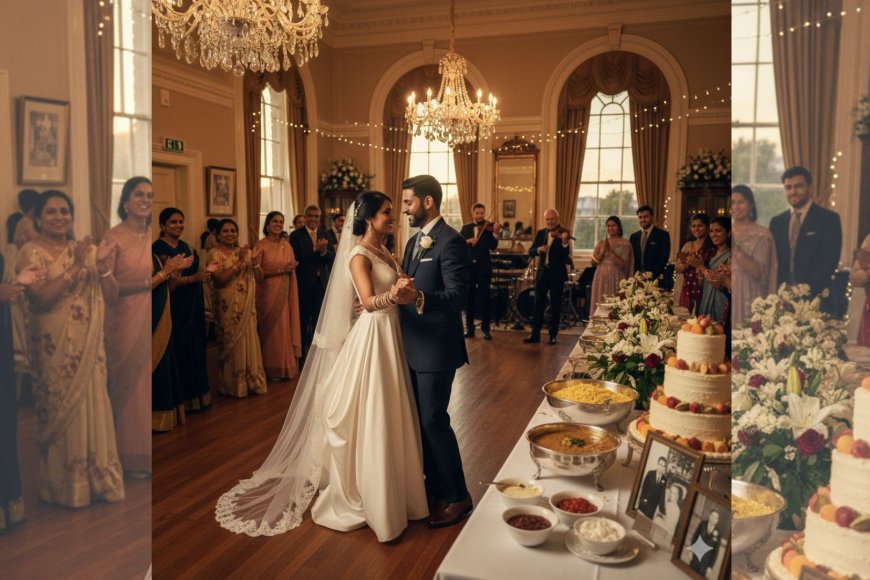
Anglo-Indian weddings have always lived at the crossroads — part colonial ballroom, part Indian courtyard, entirely their own. For NRI couples with Anglo-Indian heritage, these traditions carry a double displacement: a community already in-between, now celebrating love from even further away.
You grew up knowing you were different, even before you had the words for it. The Christmas cake came out in July for the wedding. The bride wore white — not red — but her wrists were heavy with gold bangles that jangled like temple bells. Someone played "Here Comes the Bride" on a keyboard, and someone else sang a Hindi film song, and nobody thought that was strange at all. That was just how it was done.
You're in Melbourne now, or Houston, or Slough, and you're planning your own wedding. You want to honour that in-between space — that unique, proud, often misunderstood identity that is Anglo-Indian. And you're realising that there are almost no guides for this. Almost no one telling you how to make it work abroad, how to explain it to your non-Indian partner's family, how to find a priest who understands that you need both a Hail Mary and a moment for the elders to bless you with akshat [sacred rice].
This article is for you.
🌟 DID YOU KNOW?
The Anglo-Indian community is one of the oldest Eurasian communities in the world, with origins tracing back to the early 1600s when the British East India Company actively encouraged intermarriage between British soldiers and Indian women. At their population peak in the mid-20th century, there were an estimated 500,000 Anglo-Indians in the subcontinent.
After Indian Independence in 1947, the largest Anglo-Indian emigration in history took place — communities relocated en masse to the UK, Australia, and Canada, particularly to cities like Melbourne, Toronto, and Birmingham, creating tight-knit diaspora enclaves that still hold community dances and host railway colony reunions today.
Anglo-Indian weddings traditionally featured a wedding breakfast — a multi-course meal served in the morning after the church ceremony — a custom borrowed from Victorian England and blended with Indian dishes like pepper water soup, country captain chicken, and coconut rice that no English cookbook has ever printed.
What Is an Anglo-Indian Wedding?
The Anglo-Indian community emerged from centuries of intermingling between Europeans — primarily British, but also Portuguese, French, and Dutch — and Indian women across the subcontinent. Over generations, this produced a distinct community with its own language patterns, cuisine, music, dress, and of course, its own wedding rituals that exist nowhere else on earth.
An Anglo-Indian wedding is, at its heart, a Christian ceremony — typically Roman Catholic or Protestant — conducted in a church with full liturgical rites. The bride wears white or ivory, the church is decorated with fresh flowers, and vows are exchanged before God and family. So far, so familiar to any Western observer. But look closer and you'll see something entirely different.
The roti ceremony or its spiritual equivalent lives quietly inside the celebration. The elders of the family — usually the grandmother or senior aunties — perform a private blessing at home before the church, placing their hands on the couple and murmuring prayers that are half scripture, half something older. The wedding feast is never just cake. There is yellow rice [saffron-tinted rice cooked with whole spices], mulligatawny [the Anglo-Indian pepper broth that travelled to London and back], devil chutney [a fiery tomato-based condiment], and a ball curry that has been simmering since the day before.
The music swings between a church organ, a violin-heavy ballroom band, and at least one uncle insisting on an old Hindi number. The dancing — and there is always dancing — is the Pride of Erin, the Veleta, and the Military Two-Step, all danced with the precision of people whose grandparents learned these steps in railway colony social clubs from Jabalpur to Kharagpur.
The wedding happens at once in India and in England, in the 19th century and the present, in two cultures simultaneously choosing each other.
Community Comparison Table
| Community/State | Local Name for Blessing/Wedding Ceremony | Key Tradition | How NRIs Abroad Adapt It |
|---|---|---|---|
| Anglo-Indian | Wedding Breakfast & Church Ceremony | White dress church wedding + Indian feast, ballroom dances | Hold ceremony in Catholic churches abroad, recreate feast with community recipes, hire Anglo-Indian bands |
| Goan Catholic | Roce (coconut milk blessing) | Pre-wedding roce ceremony, Portuguese-influenced Mass | Source coconut milk ritual from Indian grocery, find Goan parish priests in UK/Canada |
| Kashmiri Pandit | Lagan ceremony | Pandit-led rites, walnut offerings, traditional wazwan feast | Connect with Kashmiri Pandit Samaaj chapters in diaspora cities |
| Punjabi | Anand Karaj | Sikh ceremony with four laavaan (rounds) around Guru Granth Sahib | Conduct at local Gurdwara, most major diaspora cities have accessible Gurdwaras |
| Tamil (Christian) | Thirumana Nichayam | Church wedding with South Indian reception, silk sarees alongside white gown | Tamil Christian churches in Toronto, Sydney, and London cater to this blend |
| Bengali (Christian) | Church ceremony + Aashirwad(family blessing) | Elder blessing ritual at home, church wedding, Bengali sweets at reception | Recreate aashirwad at home or hotel suite before main ceremony |
| Marathi (Christian) | Kelvan | Pre-wedding family feast with traditional Marathi dishes alongside church rites | Source ingredients from Laxmi stores in Southall or Devon Avenue Chicago |
| Rajasthani | Saat Phereequivalent adapted | Rajasthani families occasionally have Christian converts; rituals blend folk customs with church | Maintain folk elements like folk songs at the reception |
| Himachali | Local deity blessing pre-wedding | Village deity invoked before ceremony | Perform deity prayer via video call with family in hills; recreate symbolically |
| Garhwali | Jaan procession | Groom's procession with community singing | Recreate procession at venue with recorded folk music |
| Kumaoni | Aipan ritual art | Aipan patterns drawn at threshold for blessing | Bride draws aipan patterns herself or sources Kumaoni artist online to create printed versions |
The Meaning Behind the Ritual
Anglo-Indian wedding traditions are not a confusion of cultures. They are a philosophy made visible. To celebrate a wedding this way is to say: I hold both, and I release neither.
The church ceremony draws from the Christian conviction that marriage is a covenant — not merely a contract — made before God and witnessed by community. The liturgy, the vows, the exchange of rings: these carry centuries of spiritual weight. But the Indian soul of the celebration insists on something the Western church alone cannot provide — the presence of ancestors, the blessing of elders, the sanctification of food, the understanding that a marriage is not just between two people but between two lineages, two histories, two futures.
The wedding breakfast is not simply a meal. It is a sacred act of feeding the community, of saying: our home is open, our table is abundant, we are grateful. The spiced rice and the coconut curry on that table are not decoration — they are devotion. The ballroom dancing is not frivolity — it is the living memory of a community that refused to disappear, that kept its particular joy alive across generations of displacement and prejudice.
When an Anglo-Indian couple dances the Pride of Erin at their wedding in 2025, they are dancing with every generation that came before them, in every railway colony hall that no longer exists.
For anyone unfamiliar with this community, the simplest explanation is this: Anglo-Indian weddings celebrate the belief that love itself is a kind of cultural bridge, and that a family built across differences is not a compromise — it is an achievement.
Doing an Anglo-Indian Wedding Abroad: The Practical Reality
This is where the love story meets the logistics, and where NRI couples with Anglo-Indian heritage often find themselves most alone. Here is what actually works.
The Church: Most Anglo-Indian families are Roman Catholic or Church of South India. The good news is that Catholic churches worldwide will perform marriages for baptised Catholics regardless of their ethnic background. In the UK, parishes in Southall, Wembley, and Croydon have long served Indian Christian communities. In Canada, St. Francis Xavier parish in Mississauga and several Brampton churches have significant South Asian Christian congregations. In Melbourne, the parishes of Dandenong and Springvale have been celebrating Indian Christian weddings for decades. Call ahead, explain your heritage, and ask whether the priest has any familiarity with Anglo-Indian traditions — many will be delighted.
The Feast: This is where your heart will ache a little, and then your aunties will save you. The Anglo-Indian wedding feast depends on recipes that are almost never written down — they live in muscle memory and telephone calls. Your first step is to call the oldest woman in your family and record everything she tells you. Your second step is to find an Anglo-Indian caterer in your city. Melbourne and Sydney have established Anglo-Indian community associations that maintain catering networks. In the UK, the Anglo-Indian community in Cheltenham and parts of Birmingham still gathers and can often point you toward cooks. For ingredients — Byadgi chillies for the devil chutney, the right curry powders, coconut vinegar — look to Wembley's South Asian grocery strip, Toronto's Gerrard Street India Bazaar, Houston's Hillcroft Avenue, and Dubai's Meena Bazaar.
The Music and Dancing: This is easier than you think. Anglo-Indian ballroom dance groups exist in Melbourne, Toronto, and the UK, often affiliated with the Anglo-Indian Association. Many are thrilled to perform at weddings. Search for "Anglo-Indian Association" in your city — these organisations are the connective tissue of the diaspora and their members will welcome you.
Fire and Smoke: Anglo-Indian weddings do not traditionally involve open fire indoors, so this is one area where the community actually has an advantage over Hindu ceremonies. However, if you wish to incorporate any Hindu-adjacent blessings with incense or diyas, check venue policies in advance. Most UK and Australian venues will require smoke alarms to be managed.
Time Zones: If key family members are joining from India via video call — especially elderly grandparents who cannot travel — the sweet spot for a live-streamed ceremony sits around 5–6 PM local time in your city, which typically lands between 9:30 AM and 11:30 AM IST the following morning. Brief your AV team in advance; streaming a church ceremony requires permission from the parish.
Doing an Anglo-Indian Destination Wedding in India
The natural heartlands of Anglo-Indian wedding tradition in India are Kolkata, Chennai, Bangalore, and the old railway towns like Jabalpur, Secunderabad, and Kharagpur. Each of these cities retains pockets of Anglo-Indian community life, and each has churches that have been solemnising Anglo-Indian weddings for generations.
For a destination wedding with genuine Anglo-Indian character, Kolkata remains unmatched. The city's old Park Street corridor, its colonial churches like St. Paul's Cathedral and St. Thomas's Church, and its remaining Anglo-Indian families create an atmosphere that is irreplaceable. A wedding held here, with a reception at one of the heritage hotels, will transport your non-Indian guests into a world they have never imagined.
When briefing local priests and event planners, be explicit: you want the full Anglo-Indian wedding breakfast tradition, you want the ballroom dancing, you want the specific dishes. Kolkata and Chennai planners with Anglo-Indian community connections exist — NRI.Wedding can connect you with vendors who specialise in exactly this heritage. Brief them in writing, share family photographs of past weddings as references, and if possible, involve your oldest relatives in menu planning conversations. For non-Indian guests, prepare a small printed card explaining the significance of each tradition — they will treasure it.
What You Need: Ritual Checklist
Ritual Items: Church flowers and pew decorations, wedding rings (traditionally plain gold bands), white or ivory bridal gown, bouquet, buttonhole for groom, wedding cake (traditionally a rich fruit cake), yellow rice, ball curry ingredients, devil chutney, mulligatawny ingredients, coconut vinegar, wedding breakfast tableware, music for ballroom dances.
People Required: Parish priest or minister, church organist or music ensemble, best man and bridesmaids, flower girl, family elder for home blessing, Anglo-Indian cook or caterer, ballroom dance ensemble or DJ familiar with traditional dances, AV team for video streaming if relatives abroad.
Preparation Steps: Book church six to twelve months ahead. Record all family recipes immediately. Source Anglo-Indian caterer or community cook at least four months ahead. Contact Anglo-Indian Association in your city for music referrals. Order specialty ingredients three to four weeks before the wedding. Arrange video call setup for India-based family. Prepare tradition explanation card for non-Indian guests.
NRI.Wedding connects couples with Anglo-Indian community vendors, knowledgeable priests, heritage photographers, and planning checklists built specifically for this community. You don't have to piece this together alone.
5 Questions NRI Couples Always Ask
Can we hold the wedding breakfast at a non-church venue if our guest list is too large for the parish hall?
Absolutely, and many Anglo-Indian families prefer this. The church ceremony remains in the church; the breakfast and reception move to a separate venue — a heritage hotel, a garden marquee, or a private banquet hall. The key is maintaining the sequence: church first, feast second, dancing third. That structure is the tradition. The venue is just the container.
My partner is not Christian and not Indian. How do we include them meaningfully without the wedding feeling like a performance for guests?
The most successful approach is genuine inclusion rather than token gestures. Have your partner learn the significance of two or three specific elements — the wedding breakfast, a particular song, the elder blessing — and speak briefly during the reception about what they mean. Guests from outside the community respond far more warmly to real engagement than to a stranger reciting something they clearly don't understand. The Anglo-Indian tradition, born of cross-cultural love, is actually the most welcoming possible context for an interfaith or intercultural wedding.
How do I find a priest who actually understands Anglo-Indian wedding customs rather than just reading a generic Christian ceremony?
The Anglo-Indian Association chapters in major diaspora cities often maintain lists of recommended clergy. In their absence, contact CSI (Church of South India) or Catholic parishes with South Asian congregations — priests who have served these communities understand the cultural nuances. Be specific when you call: describe the wedding breakfast tradition, ask whether they are familiar with it, and if not, offer to share resources. Most priests are genuinely interested.
Our family in India wants to be part of the ceremony in real time. What is the best way to manage the video call without it disrupting the service?
Position a dedicated tablet or laptop on a stable stand where elderly relatives can see the altar without the device being visible in professional photographs. Assign one tech-savvy cousin specifically to manage the connection throughout — not someone who also has a ceremonial role. Test the connection the day before at the same time of day to check lighting and audio. For the wedding breakfast, move the device to the reception table so relatives in India can watch the toasts and feel present at the meal.
We had our civil registry marriage last year. Does the church wedding still count as the "real" wedding for our families?
In every way that matters emotionally and spiritually, yes. Many NRI couples complete civil registration separately for legal purposes in their country of residence and then hold the full religious and cultural celebration — church ceremony, wedding breakfast, dancing — as the true wedding. Anglo-Indian families in particular understand this distinction intuitively. The civil certificate is a piece of paper. The wedding breakfast is the event your grandmother will describe to strangers for the rest of her life.
The Emotional Angle
There is a particular loneliness that Anglo-Indian families carry that is almost impossible to explain to outsiders. You are Indian, but some Indians have spent generations telling you that you are not Indian enough. You are British or Australian by passport, but no one there has ever quite seen you as that, either. You live in the hyphen. You have always lived in the hyphen.
And then you plan a wedding, and something shifts.
Because the wedding is the moment when the hyphen stops being a wound and starts being a bridge. You stand at the altar of a Catholic church in Mississauga or Melbourne and you can feel — physically feel — the weight of generations who held this same faith, ate this same rice, danced these same steps, and refused to let the world's categories diminish them. Your grandmother crossed an ocean with a recipe for ball curry folded inside her mind because she knew that one day her grandchildren would need it. She was right.
The tears at an Anglo-Indian wedding are not only for the couple. They are for everything the family carried to get here. For the identity that was nearly lost and wasn't. For the child who grew up not quite belonging anywhere, who is now, at this altar, exactly where they belong.
A Moment to Smile
At a wedding in Southall three years ago, the bride's aunt — the family's designated ball curry specialist, who had flown in from Bangalore specifically for this purpose — arrived to discover that the venue's kitchen had a broken hob with exactly one functioning burner. The caterers were panicked. The aunt was not. She commandeered that single burner for six uninterrupted hours, rotating pots with the calm authority of someone who had cooked for forty people in a Secunderabad railway quarter with similar limitations.
The ball curry was, by every account, the best anyone had ever tasted. The bride's new mother-in-law — a third-generation Brummie who had never encountered the dish — had two helpings and asked for the recipe. The aunt gave her a version of it. A heavily edited version, naturally. Some things must be earned.
Quotes From the Diaspora
"My mum kept saying, 'Just have a normal wedding.' But there is no normal for us — normal for our family is the Military Two-Step and yellow rice at midnight, and I wasn't giving that up for anyone." — Priya Fernandes, Anglo-Indian, third generation, Melbourne
"When my son married, I insisted on the wedding breakfast. Everyone said it was old-fashioned. But when those dishes came out and the old songs started, I saw my son's face. He finally understood what we've been carrying all these years."— Margaret D'Souza, Kolkata-born, resident of Mississauga for thirty-one years
"We had to explain everything to my husband's family — what the dances were, why the rice was yellow, why the cake was a fruit cake in September. But by the end of the night, his English gran was doing the Pride of Erin with my uncle from Chennai. That image is my whole life." — Natasha Lobo, Anglo-Indian Catholic, Houston
Your Roots Travel With You
The Anglo-Indian wedding tradition is not a museum piece. It is not nostalgia for a colonial past. It is the living proof that a community can be forged from love across difference, can survive displacement and dismissal, can carry its particular genius — its music, its food, its dance, its faith — across every ocean it is asked to cross.
If you are planning your Anglo-Indian wedding abroad, NRI.Wedding is here to help you do it fully, with vendors who know this community's traditions, photographers who understand what they are documenting, pandits and priests who can navigate the beautiful complexity of your heritage, and planning checklists built for couples who refuse to choose between the parts of themselves.
Find your Anglo-Indian caterer. Book your church. Call your aunt about the ball curry recipe. Do it all.
Your roots travel with you. Set the table for all of them.
This article explores Anglo-Indian wedding traditions and their cultural significance for NRI couples across diaspora communities in Melbourne, Mississauga, Southall, Houston, and Dubai, covering church ceremonies, wedding breakfast customs, ballroom dance traditions, and practical planning guidance for Anglo-Indian heritage weddings abroad and as destination weddings in India.
0 comments
Real names and courtesy, please. Every comment is read by a person before it appears.
Nothing yet. Start it off.
Comments are closed on this article.