Wildflower Hall, Shimla — Lord Kitchener's Mountain Residence at 8,250 Feet as Your NRI Wedding Venue
The Altitude
The wedding planner had a specific test she applied to every mountain venue.
Not the checklist — the accessibility score and the accommodation count and the catering capacity and the vendor proximity and the specific, manageable criteria whose assessment the professional applies to every destination with the systematic thoroughness of the person who has been disappointed by the beautiful venue that failed the practical requirement. She had the checklist. She used it. The checklist was not the test.
The test was simpler.
She asked every couple she took to a mountain venue: when did you first feel the altitude?
Not the scientific interest in the acclimatisation — she was not the cardiologist or the altitude medicine specialist whose professional concern was the oxygen saturation and the barometric pressure. She asked because the answer told her everything about the couple's relationship to the venue. The couple who felt the altitude at the first step from the car — whose body registered the eight thousand two hundred and fifty feet immediately, in the first breath of the cold, thin, pine-scented mountain air — was the couple whose wedding belonged in the mountain. The couple who had to think about the answer, whose awareness of the altitude arrived only when the acclimatisation made the thin air consciously notable rather than simply present, was the couple whose instinctive relationship to the mountain setting was the relationship of the appreciation rather than the recognition.
The bride had not waited for the question.
She had stepped out of the car at the Wildflower Hall's entrance — the specific, cedar-and-pine-forested hillside of the Chharabra ridge above Shimla at eight thousand two hundred and fifty feet — and had said: there it is.
The planner had said: you felt it.
The bride had said: I felt it the moment the car turned off the Shimla road. The air changed. Everything changed. It felt like arriving somewhere I had been before and had forgotten until now.
The planner had said: that is the test.
She had said: what test?
The planner had said: the one that tells me the wedding belongs here.
The Wildflower Hall, Shimla — the Oberoi property whose specific, extraordinary position on the Chharabra ridge at eight thousand two hundred and fifty feet above sea level, in the cedar forest above the Himalayan hill town of Shimla, on the site of the country retreat that Lord Kitchener of Khartoum built when he was Commander-in-Chief of the Indian Army — is the wedding venue whose test is the test the bride had passed before the planner had administered it.
The altitude. The cedar forest. The Himalayan view. The colonial estate on the mountain ridge.
When you feel it at the first breath, the wedding belongs here.
This guide is the complete knowledge of what that means.
The Property: Wildflower Hall, Shimla
The Kitchener Connection
Lord Kitchener of Khartoum — the specific, formidable, Victorian-era British military figure whose career spanned the Sudan, the Boer War, and the Indian Army's command, and whose name the British Empire's military history most permanently associates with the specific, hard, uncompromising style of the soldier-administrator whose competence was the competence of the person who did what was necessary rather than what was comfortable — chose the Chharabra ridge above Shimla for his mountain residence.
The choice was not the accidental choice of the convenient location. Kitchener chose the ridge because the ridge is the specific, commanding position above the Himalayan hill town that the Victorian soldier-administrator most naturally gravitates toward — the high ground, the view in every direction, the specific, defensive, surveying quality of the elevated position whose military logic is the military logic of the person who instinctively understands terrain.
The original building: Kitchener's original Wildflower Hall — the specific, Edwardian country house whose construction in 1906 was the construction of the mountain retreat whose cedar-and-pine setting and whose specific, colonial-estate aesthetic were the aesthetic of the British India hill station at its most naturally beautiful — was the building that the subsequent century's use and the Shimla earthquakes eventually rendered beyond the restoration and that the Oberoi Hotels replaced in 1997 with the current building whose design honours the Edwardian original while providing the contemporary luxury standard.
The Oberoi reconstruction: the current Wildflower Hall — built in 1997 on the site of Kitchener's original estate, in the cedar forest whose trees predate the building's construction, at the same eight thousand two hundred and fifty feet whose altitude Kitchener had chosen — is the building that the Oberoi Hotels designed with the specific intention of the Edwardian country house recreation: the stone and the cedar and the pitched roofs and the specific, warm, colonial-estate aesthetic whose evocation of the original is the evocation of the genuine rather than the pastiche.
The Oberoi Standard
The Oberoi Hotels and Resorts — the Indian luxury hospitality group whose standard is the standard that produced the Oberoi Udaivilas's world's best hotel rating and whose application to the mountain property produces the specific, considered, deeply professional quality of the Wildflower Hall — is the management whose presence at the Chharabra ridge means the specific, uncompromising quality of the institution applied to the mountain venue.
The Oberoi mountain difference: the Wildflower Hall's specific character within the Oberoi portfolio is the character of the mountain property — the property whose challenge is not the lakeside's grandeur or the palace's heritage but the mountain's specific demands: the altitude's effect on the guest, the winter's severity, the forest's maintenance, the specific, year-round management of the property whose position at eight thousand two hundred and fifty feet imposes the specific, seasonal, environmental requirements that the plain's luxury hotel does not face.
The Oberoi's management of these requirements — the heating infrastructure whose quality keeps the cedar-and-stone rooms warm in the Himalayan winter, the food and beverage whose provision at altitude requires the specific adjustments whose management the trained professional most reliably provides, the specific, attentive service whose quality in the mountain setting is the quality of the institution that understands the mountain rather than merely occupying it — is the management that makes the Wildflower Hall the destination whose luxury standard the altitude does not compromise.
The Eight Thousand Two Hundred and Fifty Feet
The altitude is the Wildflower Hall's most defining characteristic — the specific, physical, sensory, immediately present fact of the property that no description and no photograph can adequately communicate and that the first breath from the car most completely conveys.
What the altitude produces: the specific, clean, cold, pine-scented air of the eight-thousand-foot ridge — the air that the lungs register immediately as different, as thinner, as carrying the specific quality of the mountain whose elevation is the elevation of the genuine Himalayan foothills rather than the hill station's modest altitude — is the air that changes everything. The light at this altitude — the specific, slightly more intense, clearer quality of the mountain light whose atmosphere is thinner and whose specific, sharp, detail-revealing quality the photographer requires the specific exposure adjustment to most beautifully capture — is the light that the wedding photograph most powerfully benefits from.
The cedar forest at eight thousand two hundred and fifty feet — the specific, deodar cedar whose tall, straight-trunked, aromatic presence at this altitude is the presence of the tree whose specific, resinous scent is the scent of the Himalayan forest at the upper edge of the temperate zone — is the forest whose ambient quality gives the Wildflower Hall its specific, irreplaceable character as the property that smells like the mountain.
The snow: the Wildflower Hall in the winter snow — the December and January snowfall whose specific, white, cedar-branch-laden quality transforms the Chharabra ridge into the specific, extraordinary landscape of the snow-covered Himalayan forest — is the wedding setting whose visual quality the summer mountain and the spring mountain and the autumn mountain do not produce. The wedding in the snow at the Wildflower Hall is the wedding in the specific, seasonal, geographically extraordinary setting of the Himalayan winter at eight thousand feet — the snow on the cedar branches, the Himalayan panorama across the white valley, the Wildflower Hall's stone-and-cedar building in the specific, warm, contrasting quality of the lit interior against the white exterior.
The Shimla Context
Shimla — the specific, colonial, Himalayan hill town whose position as the summer capital of British India made it the most politically significant hill station in the subcontinent and whose specific, Victorian and Edwardian architectural legacy gives the town its particular, only-in-India character of the English country town transplanted to the Himalayan ridge — is the nearest significant town to the Wildflower Hall, approximately thirteen kilometres down the ridge.
The colonial heritage: the Shimla Mall Road, the Christ Church, the Viceregal Lodge — the specific, preserved, actively used colonial-era architecture of the Shimla town whose specific, atmospheric, hill-station character is the character that no other Indian town replicates in the same form — is the wedding programme's primary heritage excursion whose quality and whose proximity give the Wildflower Hall wedding the specific, colonial-Himalayan cultural dimension that the mountain setting alone does not provide.
The Viceregal Lodge: the Rashtrapati Niwas — the former Viceregal Lodge of British India, now the Indian Institute of Advanced Study, whose specific, Scottish Baronial architecture on the Shimla Observatory Hill is among the finest examples of the late-Victorian institutional building in India — is the guest programme's primary heritage destination and the specific, historical connection between the Shimla colonial legacy and the Wildflower Hall's own Kitchener provenance that the informed guest most specifically appreciates.
The Himalayan View
The Panorama
The Wildflower Hall's view — the specific, panoramic, Himalayan view that the Chharabra ridge's position provides — is the view of the mountain range that the plain cannot see and that the lower hill station sees only partially and that the eight-thousand-foot ridge sees in the specific, complete form of the elevated position above the valley whose depth creates the visual distance that the mountain panorama requires.
On the clear winter morning — the specific, cold, post-snow-clarity morning of the Himalayan December or January — the Wildflower Hall's view extends to the snow-covered peaks of the higher Himalayan range whose identification requires the guide and whose presence requires nothing more than the standing on the Wildflower Hall's terrace and the looking north.
The cedar forest view: the view from the Wildflower Hall is not only the distant mountain panorama. It is the immediate, surrounding, close-range view of the deodar cedar forest whose tall, straight-trunked trees frame every outdoor space and every window and every terrace of the property in the specific, living, aromatic framing of the forest that is both the setting and the subject of the view.
The Wedding Spaces
The Grand Ballroom
The Wildflower Hall's Grand Ballroom — the primary indoor event space whose Edwardian country house aesthetic, whose stone-and-cedar interior, and whose specific, warm, fireplace-anchored quality give it the character of the grand mountain lodge's formal room — is the sangeet and the reception dinner space for the occasion whose guest count requires the large indoor setting and whose mountain setting most naturally requires the climate-controlled interior for the Himalayan evening's specific, cold quality.
The Grand Ballroom accommodates up to one hundred and fifty guests for the standing reception and up to eighty for the seated dinner — the intimate to moderate scale that the Wildflower Hall's specific character most naturally serves and that the mountain wedding's inner-circle guest count most comfortably fills.
The fireplace: the Grand Ballroom's fireplace — the specific, working, wood-burning fireplace whose presence in the mountain lodge's formal room is the presence of the functional warmth rather than the decorative motif — is the Grand Ballroom's defining feature for the winter wedding whose ceremony happens in the snow and whose reception retreats to the warm interior of the cedar-and-stone ballroom with the fire burning. The reception dinner by the Wildflower Hall fireplace in the Himalayan December evening — the fire, the cedar interior, the snow on the branches outside the windows — is the reception whose specific, warm, mountain-winter quality no other wedding venue in this guide series can produce.
The Outdoor Terraces
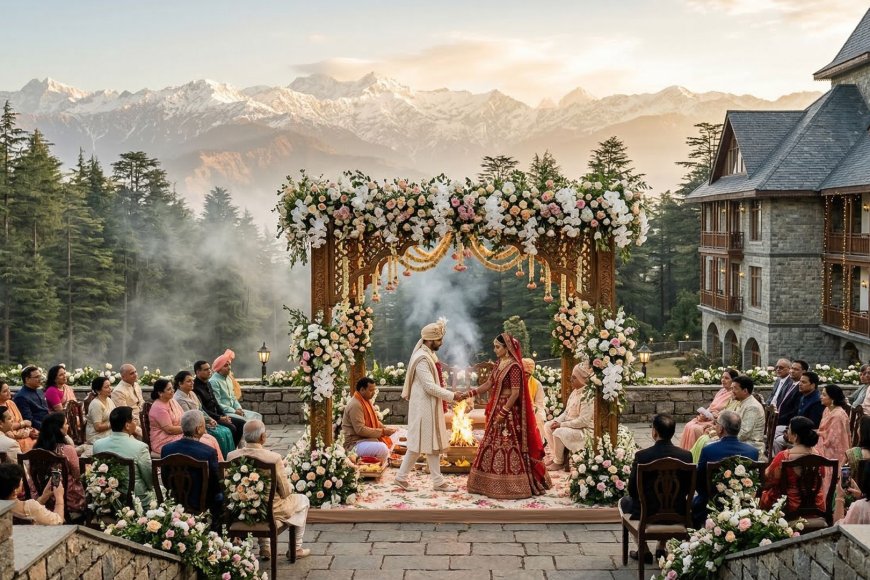
The Wildflower Hall's outdoor terraces — the elevated outdoor spaces whose position on the Chharabra ridge provides the specific, panoramic Himalayan view and whose cedar-forest setting gives the outdoor occasion the ambient quality of the mountain forest — are the primary ceremony spaces for the spring, summer, and autumn wedding and the photographic spaces for the winter wedding whose ceremony may require the indoor setting but whose outdoor moments most powerfully exploit the snow-covered cedar landscape.
The outdoor terraces accommodate up to one hundred guests for the ceremony — the intimate to moderate scale that the mountain terrace's specific, naturally limited dimensions most naturally contain and that the Wildflower Hall's character most appropriately serves.
The ceremony on the terrace: the ceremony on the Wildflower Hall's outdoor terrace — the mandap installed on the mountain ridge, the cedar forest surrounding, the Himalayan panorama as the backdrop, the specific, clear, mountain-light quality of the Himalayan winter or spring or autumn sky above — is the ceremony whose setting is the specific, geographically extraordinary quality of the eight-thousand-foot ridge above the most historic hill station in India.
The Lawns and the Forest Clearings
The Wildflower Hall estate's lawns and the forest clearings — the outdoor spaces within the cedar forest whose specific, natural, forest-floored character gives them the quality of the outdoor occasion in the genuine mountain forest rather than the manicured resort lawn — are the wedding spaces for the intimate outdoor gathering, the forest ceremony, and the specific occasion whose character the mountain forest setting most naturally produces.
The forest ceremony: the ceremony in the Wildflower Hall's cedar forest clearing — the mandap surrounded by the deodar cedar's tall, straight trunks, the forest floor, the specific, green, filtered light of the mountain forest at the altitude where the cedars grow in the specific, cathedral-like quality of the old-growth forest — is the ceremony whose setting is the most specifically, intimately natural of any ceremony setting in this guide series. Not the landscape view. The forest interior — the specific, enclosed, living, aromatic space of the eight-thousand-foot cedar forest.
The Pool and the Spa
The Wildflower Hall's heated pool — the indoor pool whose specific, warm-water-in-the-cold-mountain-air quality is the quality of the mountain resort pool in the Himalayan winter — and the Oberoi spa are the pre-wedding wellness spaces whose engagement by the couple and the wedding party most directly addresses the specific demands of the destination wedding's final days at altitude.
The altitude acclimatisation: the guest who arrives at the Wildflower Hall at eight thousand two hundred and fifty feet from the sea-level plain requires the specific, managed acclimatisation whose primary requirement is the rest, the hydration, and the gentle activity rather than the strenuous programme. The spa's pre-wedding treatment programme — the massage, the specific treatments whose design accounts for the altitude's effect on the body — is the programme whose engagement at the arrival day most directly supports the guest's acclimatisation and whose quality at the Oberoi's mountain property is the quality of the institution that understands the mountain.
The Dining Spaces
The Wildflower Hall's dining spaces — the cedar-panelled, mountain-view-facing dining rooms whose specific, warm, Edwardian-country-house quality is the quality of the room designed for the mountain meal, the room where the warmth is the warmth of the building against the mountain cold — are the spaces for the intimate family dinner, the rehearsal dinner, the post-wedding morning breakfast whose character the mountain dining room most warmly provides.
The private dining at the Wildflower Hall — the family dinner in the cedar-panelled room whose windows frame the Himalayan view, the fire in the hearth, the specific, warm, mountain-lodge quality of the private occasion in the Oberoi's finest mountain property — is the private dining whose ambient quality no plain or beach or lake property can replicate.
The Shimla Experience: The Guest Programme
The Shimla Heritage Walk
The Shimla Mall Road heritage walk — the specific, colonial-era pedestrian promenade whose Victorian and Edwardian buildings and whose specific, hill-station, horse-and-cart-era urban design are the design of the Indian hill town that was built for the British Empire's summer administration — is the guest programme's primary cultural experience and the specific, only-in-Shimla combination of the heritage architecture and the Himalayan setting that gives the international guest the understanding of where they are.
The Shimla experience: the international guest who walks the Shimla Mall Road — the Christ Church, the Gaiety Theatre, the specific Victorian facades whose maintenance by the Himachal Pradesh government reflects the town's continued pride in the colonial-era heritage — has had the specific, irreplaceable experience of the hill station that was the British Empire's most political hill town and whose specific, atmospheric, Victorian-in-the-Himalayas character is the character that no other Indian town replicates.
The Kufri and the Snow Activities
The Kufri — the specific, higher-altitude Himalayan resort above Shimla whose winter snow activities include the skiing, the sledding, and the specific, active outdoor programme of the Himalayan winter destination — is the guest programme's adventure dimension for the winter wedding whose guests include the younger international family members whose engagement with the Himalayan setting includes the active outdoor experience.
The skiing at Kufri — the small but specific, Himalayan ski slope whose operation in the December through February window provides the skiing experience that the international guest from the northern European or North American winter most naturally connects with — is the guest programme element that gives the Wildflower Hall wedding the specific, mountain winter activity whose combination with the heritage Shimla walk and the cedar forest morning gives the three-day programme the complete Himalayan experience.
The Jakhu Temple
The Jakhu Temple — the specific, ancient Hindu temple dedicated to Hanuman on the Jakhu Hill above Shimla whose eight-thousand-和-forty-eight-foot summit is visible from the Wildflower Hall's terrace and whose specific, resident monkey population and whose panoramic Himalayan view from the summit make it the Shimla heritage programme's most specifically memorable element — is the guest programme excursion that the Wildflower Hall's proximity to the Shimla ridge most directly enables.
The Jakhu Temple visit — the ropeway ascent or the walking path through the cedar forest, the summit temple, the panoramic view of the Himalayan range, the specific, abundant, irreverent, photogenic Shimla monkeys whose presence at the temple is the presence of the tradition's living inhabitants — is the guest programme element whose combination of the religious heritage, the natural beauty, and the specific, comic energy of the monkey population gives the international guest the Shimla experience that the Mall Road walk alone cannot provide.
The Season: When to Marry at Wildflower Hall
The Four Mountain Seasons
The Wildflower Hall's four seasons — each of which produces the specific, different quality of the mountain property at eight thousand two hundred and fifty feet — are the four distinct wedding settings whose character the couple should understand before the date is chosen.
The winter (December through February): the snow season — the specific, white, cedar-branch-laden, fireplace-and-warm-interior quality of the Himalayan winter at eight thousand feet. The most visually extraordinary. The most logistically demanding. The wedding in the snow whose ceremony is the ceremony in the Himalayan winter and whose reception is the reception by the fireplace in the warm cedar interior. The road access requires the confirmed, managed transport plan. The altitude's cold requires the specific, warmth-infrastructure management whose quality the Oberoi's winter preparation most reliably provides.
The spring (March through April): the post-snow season — the specific, fresh, newly green quality of the mountain forest whose winter snow has left and whose spring growth is the growth of the forest that has been waiting. The rhododendron bloom — the specific, red-and-pink flowering of the Himalayan rhododendron in the March and April mountain forest — is the spring wedding's specific, natural decoration whose quality the decorator cannot replicate and whose timing most powerfully amplifies the outdoor ceremony's setting.
The summer (May through June): the school-holiday season — the warmer, clearer, more accessible season whose specific quality is the quality of the mountain summer rather than the mountain winter. The views are clearest in the pre-monsoon summer. The outdoor occasions are the most comfortable.
The autumn (September through November): the post-monsoon season — the specific, clear, freshly washed quality of the mountain after the monsoon's departure. The air is the clearest of the year. The views extend furthest. The specific, autumn-light quality of the Himalayan October — the warm, slightly horizontal light of the season that is not yet winter but is no longer summer — is the light that the photographer most specifically prizes.
The Complete Planning and Pricing Table
Comprehensive Wedding Planning Table: All Spaces, Costs, Accommodation, and Budget
| Category | Detail | Capacity / Scope | Approx. Cost (INR) | Approx. Cost (USD) | Notes |
|---|---|---|---|---|---|
| WEDDING SPACES AND VENUE COSTS | |||||
| Outdoor Terrace – Ceremony | 8,250 ft Himalayan view | Up to 80 seated / 100 standing | ₹12,00,000 – ₹22,00,000 | $14,400 – $26,400 | Mountain ridge ceremony |
| Grand Ballroom – Sangeet | Edwardian interior, fireplace | Up to 80 seated / 150 standing | ₹18,00,000 – ₹32,00,000 | $21,600 – $38,400 | Mountain lodge sangeet |
| Grand Ballroom – Reception Dinner | Cedar interior, fireplace | Up to 80 seated / 150 standing | ₹22,00,000 – ₹40,00,000 | $26,400 – $48,000 | Fireplace winter reception |
| Outdoor Terrace – Welcome Dinner | Cedar forest, mountain air | Up to 80 seated / 120 standing | ₹14,00,000 – ₹25,00,000 | $16,800 – $30,000 | Arrival evening, mountain |
| Forest Clearing – Ceremony | Cedar cathedral, forest floor | Up to 60 seated / 80 standing | ₹10,00,000 – ₹20,00,000 | $12,000 – $24,000 | Intimate forest ceremony |
| Estate Lawns – Outdoor Reception | Mountain estate grounds | Up to 80 seated / 120 standing | ₹14,00,000 – ₹26,00,000 | $16,800 – $31,200 | Spring and autumn primary |
| Dining Room – Private Family | Cedar-panelled mountain view | Up to 25 seated | ₹3,50,000 – ₹8,00,000 | $4,200 – $9,600 | Family dinner, mountain lodge |
| Garden – Mehendi | Mountain estate garden | Up to 40 seated / 60 standing | ₹4,00,000 – ₹8,00,000 | $4,800 – $9,600 | Pre-wedding, mountain air |
| Garden – Haldi | Morning ritual, cedar forest | Up to 25 seated / 40 standing | ₹3,00,000 – ₹6,00,000 | $3,600 – $7,200 | Inner circle, mountain morning |
| Terrace – Sundowner Cocktails | Himalayan panorama, dusk | Up to 60 seated / 100 standing | ₹6,00,000 – ₹12,00,000 | $7,200 – $14,400 | Pre-dinner, mountain sunset |
| Pre-Wedding Photography | Cedar forest and terrace | Couple and party | ₹1,00,000 – ₹3,00,000 | $1,200 – $3,600 | Mountain light specialist |
| Snow Photography Session | Winter snow, cedar branches | Couple and party | ₹1,00,000 – ₹3,00,000 | $1,200 – $3,600 | Winter wedding signature shot |
| Full Property – Exclusive Buyout | All spaces, full estate | Per day | ₹2,00,00,000 – ₹3,50,00,000 | $2,40,000 – $4,20,000 | Complete estate exclusive use |
| Full 3-Day Wedding Package | All functions, full programme | 60–100 guests | ₹2,00,00,000 – ₹4,00,00,000 | $2,40,000 – $4,80,000 | Mountain wedding, full prog |
| GUEST PROGRAMME COSTS | |||||
| Shimla Heritage Walk | Mall Road, Christ Church | All guests | ₹1,00,000 – ₹3,00,000 | $1,200 – $3,600 | Colonial heritage programme |
| Viceregal Lodge Visit | Rashtrapati Niwas, guided | Up to 80 guests | ₹1,00,000 – ₹3,00,000 | $1,200 – $3,600 | Kitchener connection heritage |
| Jakhu Temple Excursion | Summit, monkeys, panorama | Up to 60 per group | ₹80,000 – ₹2,50,000 | $960 – $3,000 | Himalayan temple, memorable |
| Kufri Snow Activities | Skiing, sledding, winter | Up to 40 guests | ₹1,50,000 – ₹4,00,000 | $1,800 – $4,800 | Winter active programme |
| Cedar Forest Morning Walk | Estate trails, guided | Up to 20 per group | ₹30,000 – ₹1,00,000 | $360 – $1,200 | Dawn mountain forest walk |
| CATERING PER HEAD | |||||
| Welcome Cocktails | Mountain herbs, local | Per head | ₹4,000 – ₹7,000 per head | $48 – $84 per head | Oberoi mountain standard |
| Buffet Dinner | Continental and Indian | Per head | ₹10,000 – ₹16,000 per head | $120 – $192 per head | Altitude-adapted menu |
| Seated Dinner | Formal Oberoi full service | Per head | ₹15,000 – ₹25,000 per head | $180 – $300 per head | Mountain lodge formal dining |
| ACCOMMODATION | |||||
| Deluxe Room | Mountain or forest view | Per night | ₹40,000 – ₹65,000 per night | $480 – $780 per night | Entry level, Oberoi mountain |
| Premium Room | Enhanced Himalayan view | Per night | ₹58,000 – ₹85,000 per night | $696 – $1,020 per night | Better position, peak views |
| Luxury Suite | Separate sitting, panorama | Per night | ₹85,000 – ₹1,25,000 per night | $1,020 – $1,500 per night | Key family, senior guests |
| Heritage Suite | Kitchener-era wing, finest | Per night | ₹1,25,000 – ₹1,80,000 per night | $1,500 – $2,160 per night | VIP family, close relatives |
| Presidential Suite | Finest suite, full panorama | Per night | ₹2,00,000 – ₹3,20,000 per night | $2,400 – $3,840 per night | Wedding couple, finest suite |
| Total Rooms Available | Boutique mountain resort | ~85 rooms | Group rate negotiated | Full buyout recommended | Oberoi mountain boutique |
| OVERFLOW ACCOMMODATION | |||||
| Shimla heritage hotels | Colonial-era properties | Per night | ₹8,000 – ₹35,000 per night | $96 – $420 per night | Heritage overflow, Shimla |
| Shimla mid-range hotels | Quality city options | Per night | ₹5,000 – ₹18,000 per night | $60 – $216 per night | Mid-range overflow |
| Chail Palace Hotel | Heritage, 45 minutes | Per night | ₹10,000 – ₹40,000 per night | $120 – $480 per night | Heritage alternative overflow |
| COMPREHENSIVE BUDGET SUMMARY | |||||
| Venue hire – all functions (3 days) | All spaces, full programme | All events | ₹85,00,000 – ₹1,70,00,000 | $1,02,000 – $2,04,000 | Oberoi mountain premium |
| Catering – all functions (80 guests) | Oberoi in-house, altitude | Three events | ₹65,00,000 – ₹1,20,00,000 | $78,000 – $1,44,000 | Altitude-adapted catering |
| Accommodation – full estate (3 nights) | 85 rooms, group rate | Full buyout | ₹1,20,00,000 – ₹2,20,00,000 | $1,44,000 – $2,64,000 | Oberoi mountain rate |
| Decoration and florals | Mountain and Edwardian install | Full programme | ₹30,00,000 – ₹60,00,000 | $36,000 – $72,000 | Cedar and rhododendron design |
| Photography and videography | Mountain light specialist | Full programme | ₹15,00,000 – ₹35,00,000 | $18,000 – $42,000 | Snow and altitude specialist |
| Entertainment | Intimate, classical, folk | Mountain format | ₹12,00,000 – ₹28,00,000 | $14,400 – $33,600 | Himachali folk tradition |
| Destination wedding planner | Oberoi mountain specialist | Full service | ₹10,00,000 – ₹22,00,000 | $12,000 – $26,400 | Altitude logistics expertise |
| Guest programme | Shimla, Jakhu, Kufri | All days | ₹3,00,000 – ₹8,00,000 | $3,600 – $9,600 | Complete Shimla programme |
| Guest transport | Delhi or Chandigarh, Shimla | All guests | ₹8,00,000 – ₹18,00,000 | $9,600 – $21,600 | Mountain road management |
| Bridal and groom's clothing | Full trousseau, mountain warm | Personal | ₹15,00,000 – ₹45,00,000 | $18,000 – $54,000 | Warmth layer consideration |
| Hair and makeup | Travels from Delhi or Shimla | On-site | ₹4,00,000 – ₹10,00,000 | $4,800 – $12,000 | Artists travel to property |
| Invitations and stationery | Cedar and mountain design | Full suite | ₹2,00,000 – ₹6,00,000 | $2,400 – $7,200 | Himalayan estate aesthetic |
| Pandit and religious requirements | Ceremony at altitude | Ceremony | ₹1,50,000 – ₹4,00,000 | $1,800 – $4,800 | Mountain ceremony protocol |
| Miscellaneous and contingency (12%) | Mountain weather premium | Higher % | ₹18,00,000 – ₹38,00,000 | $21,600 – $45,600 | Higher for mountain variance |
| TOTAL ESTIMATED RANGE | 80 guests, 3-day wedding | Full buyout | ₹5,88,50,000 – ₹11,84,00,000 | $7,07,000 – $14,21,000 | Premium Oberoi mountain |
| PLANNING TIMELINE | |||||
| Initial inquiry | Wildflower Hall events team | 20–24 months | 20–24 months before | Limited dates, global demand | |
| Season decision confirmed | Snow vs spring vs autumn | 20 months | 20 months before | Season shapes entire programme | |
| Full buyout confirmed | Essential for wedding | 18–20 months | 18–20 months before | Full buyout strongly rec | |
| Destination planner engaged | Mountain wedding specialist | 18 months | 18 months before | Altitude logistics expertise | |
| Weather and snow plan | Winter contingency | 12 months | 12 months before | Road access confirmed | |
| Transport plan confirmed | Delhi or Chandigarh routing | 8 months | 8 months before | Mountain road management | |
| Photographer confirmed | Mountain light specialist | 14–16 months | 14–16 months before | Snow and altitude experience | |
| Guest programme confirmed | Shimla, Jakhu, Kufri | 6 months | 6 months before | Season-specific activities | |
| Altitude acclimatisation brief | All guests briefed | 3 months | 3 months before | Medical consideration | |
| Guest communications | Invitation, mountain guide | 6 months | 6 months before | Include altitude and warmth note | |
| Clothing warmth brief | International guests informed | 6 months | 6 months before | Winter layering essential | |
| Final guest count | Confirmed to Wildflower team | 6 weeks | 6 weeks before | Boutique, precise catering | |
| Final payments | All vendors and venue | 4 weeks | 4 weeks before | Confirm in writing |
The Wildflower Hall's total budget range places it in the guide series' premium tier — the Oberoi standard at the mountain property whose altitude, whose Kitchener heritage, and whose specific, extraordinary setting are the setting that justifies the investment. The NRI couple whose sixty to one hundred guest count and whose mountain wedding vision most naturally fit the property will find the Wildflower Hall the most geographically extraordinary and the most specifically irreplaceable venue in the Himalayan wedding market.
The Honest Assessment
What Wildflower Hall Offers That No Other Property Does
The Wildflower Hall, Shimla's specific credential — the Oberoi's finest mountain property at eight thousand two hundred and fifty feet on Lord Kitchener's estate in the cedar forest above the most storied hill station in India — is the credential of the combination: the mountain altitude, the colonial heritage, the Oberoi standard, the cedar forest, and the Himalayan panorama in the single, specifically extraordinary property.
The Ananda in the Himalayas has the sacred geography and the world's finest wellness programme. The Wildflower Hall has the colonial heritage and the mountain altitude and the snow. The two are different mountains — the Ananda's sacred river and the yoga capital versus the Wildflower Hall's Kitchener estate and the Shimla hill station. Both are the Himalayan wedding. The choice is the mountain.
The Altitude Consideration
The eight thousand two hundred and fifty feet is the altitude that the planning must specifically address — not as the obstacle but as the specific, practical, health-and-logistics consideration whose management most directly determines the guest experience.
The acclimatisation brief: every international guest attending the Wildflower Hall wedding should receive the specific, practical acclimatisation brief — the arrive-a-day-early recommendation, the hydration, the rest-on-arrival advice, the specific medical considerations for the guest whose health history includes the cardiovascular or the respiratory condition. The planner who manages the Wildflower Hall wedding has the acclimatisation management as the operational standard. Confirm the protocol at twelve months.
Common Mistakes NRI Couples Make When Planning the Wildflower Hall Wedding
The first mistake is not deciding the season before any other planning begins. The Wildflower Hall's four seasons produce four fundamentally different weddings — the snow wedding, the rhododendron spring wedding, the clear-sky summer wedding, the autumn-light wedding — and the programme, the decoration, the clothing, the guest activities, and the specific photography brief are all determined by the season rather than the other way around. The couple who selects the December date because December is the peak wedding month without specifically choosing the snow wedding has chosen the season without choosing the setting. Choose the season deliberately. Understand what each produces. The snow wedding is the most visually extraordinary and the most logistically demanding. The spring wedding is the most naturally decorated and the most accessible. The autumn wedding is the clearest-sky and the most photographically gifted. Choose the one that is your wedding. Then plan everything from the season outward.
The second mistake is not managing the guest transport as the mountain road management rather than the standard hotel transfer. The road from Delhi to Shimla — the six-hour journey through the northern plains and into the Himalayan foothills, the final approach up the Shimla ridge whose hairpin bends and whose mountain road conditions in the winter require the specific, managed, experienced-driver transport — is the transport whose management is the mountain road management rather than the city hotel transfer's straightforward logistics. The Chandigarh alternative — the three-hour Delhi to Chandigarh drive followed by the two-hour Chandigarh to Shimla mountain road — reduces the total journey while maintaining the mountain approach. The Chandigarh flight — the domestic connection whose forty-five minutes from Delhi produces the two-hour total journey — is the most time-efficient. Confirm the transport routing at eight months. Include the mountain road management in the planner's brief.
The third mistake is not briefing every international guest about the altitude and the clothing requirement before the invitations are sent. The eight thousand two hundred and fifty feet is the altitude at which the international guest from the sea-level city whose India wardrobe is the India wardrobe of the summer heat will be insufficiently clothed for the Himalayan winter evening's specific, extreme cold. The international guest who arrives at the Wildflower Hall in December with the standard Indian wedding outfit and without the warmth layering has the experience of the cold rather than the mountain — the physical discomfort of the temperature difference that the prior communication most preventably addresses. Include in the formal invitation and the welcome letter the specific, clear clothing guidance: the warmth layers required, the specific temperature range at eight thousand feet in December, the suggestion of the rental thermals for the guest whose luggage cannot accommodate the mountain wardrobe. The clothing brief is the single most practical pre-wedding communication the Wildflower Hall wedding requires.
The fourth mistake is not engaging the Himachali folk tradition as the sangeet's primary entertainment rather than the generic Bollywood programme. The Himachal Pradesh folk tradition — the Nati, the specific, circle-dance-and-folk-music tradition of the Himalayan hill state whose specific, communal, participatory character is the character of the celebration whose roots are the roots of the mountain community's seasonal and ceremonial occasions — is the sangeet entertainment whose engagement at the Wildflower Hall cedar ballroom with the fireplace burning and the cedar branches outside carrying the Himalayan snow gives the occasion the specific, authentic, mountain-cultural dimension whose quality the Bollywood DJ set does not provide and whose specific, participatory warmth — the guests drawn into the dance, the circle forming on the cedar floor — is the sangeet's most memorable single element. Engage the Nati performers. The cedar ballroom, the mountain winter, the fireplace, and the Himachali folk dance — this is the sangeet that the Wildflower Hall most specifically deserves.
The fifth mistake is not photographing the dawn from the terrace before any other programme element on the wedding morning. The Wildflower Hall's terrace at the Himalayan dawn — the specific, cold, clear, pre-sunrise quality of the eight-thousand-foot ridge at the hour when the mountain night becomes the mountain morning, the cedar forest in the first light, the Himalayan peaks visible in the specific, pink-and-gold quality of the dawn light that finds the snow-covered summits from the east — is the photography moment whose quality is the quality of the place at its most specifically, irreducibly itself. The wedding couple on the Wildflower Hall terrace at dawn — the mountain morning, the cedar forest, the Himalayan light, the specific, cold, clear, thin air of the eight-thousand-foot altitude in the first light — is the wedding photograph that the Wildflower Hall's specific setting most completely produces and that no other hour of the day replicates. Confirm the dawn session with the photographer before any other timing is fixed. The mountain morning is brief and specific. Begin there.
The Test
The wedding planner had a test she applied to every mountain venue.
She asked: when did you first feel the altitude?
The bride had not waited for the question.
She had stepped from the car and said: there it is. The air changed. Everything changed. It felt like arriving somewhere I had been before and had forgotten until now.
That is the test.
And the bride had passed it before it was administered — the specific, involuntary, completely unprepared recognition of the person who steps onto the eight-thousand-foot cedar ridge and whose body and whose lungs and whose entire physical awareness registers immediately: this is a different place. The mountain. The altitude. The specific, thin, cold, pine-scented air of the Himalayan estate at eight thousand two hundred and fifty feet.
The Wildflower Hall, Shimla is the wedding venue for the couple whose test is this test — the couple whose first breath on the Chharabra ridge produces the recognition that the photographs had prepared the expectation for and that the arrival most completely fulfilled.
Lord Kitchener chose this ridge in 1906 because the soldier who understands terrain understands immediately when the terrain is extraordinary. The cedar forest. The Himalayan panorama. The commanding height. The specific, irreplaceable quality of the elevated position above the most storied hill station in India.
The NRI couple who chooses this ridge in the present century chooses it for the same reason, differently expressed: the altitude, the cedar, the Oberoi standard, the colonial heritage, the mountain wedding that no other Indian destination provides in this specific, complete form.
Contact the Wildflower Hall events team at twenty-two months.
Decide the season before any other planning begins.
Book the full estate buyout from the first conversation.
Brief the international guests on the altitude and the clothing at the invitation stage.
Manage the transport as the mountain road management it is.
Engage the Nati performers for the cedar ballroom sangeet.
Photograph the dawn from the terrace before anything else on the wedding morning.
And when the car turns off the Shimla road onto the Chharabra ridge — the thirteen kilometres above the hill station, the cedar forest beginning, the altitude arriving in the first breath of the mountain air — say what the bride said.
There it is.
The test administered and passed in the same moment.
The wedding belonging here before the question was asked.
That is Wildflower Hall.
That is eight thousand two hundred and fifty feet.
That is your wedding.
Published by NRIWedding.com — The Premium Global Platform for Non-Resident Indians Planning Indian Weddings From Abroad.
0 comments
Real names and courtesy, please. Every comment is read by a person before it appears.
Nothing yet. Start it off.
Comments are closed on this article.