You've seen it at every puja your mother ever conducted. You've watched your grandmother fill it with water, place a coconut on top, and whisper something in Sanskrit you never quite caught. Now you're in Vancouver, planning your own wedding, and someone just texted you: "Don't forget the Kalash for the mandap." You nod. But quietly, you Google it. Because the Kalash has always been there — at every beginning, every threshold, every sacred moment — and somehow, you never stopped to ask: what exactly is it, and why does it matter so much? Today, we answer that.
Did You Know? 🪔
The NRI.Wedding Wow Fact Box
- The Kalash appears in the Rigveda, making it one of the oldest continuously used ritual symbols in human history — over 3,500 years old and still placed at the centre of your wedding mandap.
- The distinctive Amalaka shape atop Hindu temple towers — that ribbed circular disc you see on shikhars — is architecturally derived from the Kalash. Every temple in India is, in essence, a giant sacred vessel.
- Over 60% of NRI couples planning destination weddings in Varanasi, Udaipur, and Jaipur specifically request a traditional Purna Kalash setup — yet many arrive not knowing what goes inside it or why. NRI.Wedding's vendor network includes priests and decorators across India who brief overseas families in English before the ceremony begins.
What Is the Kalash? The Explanation
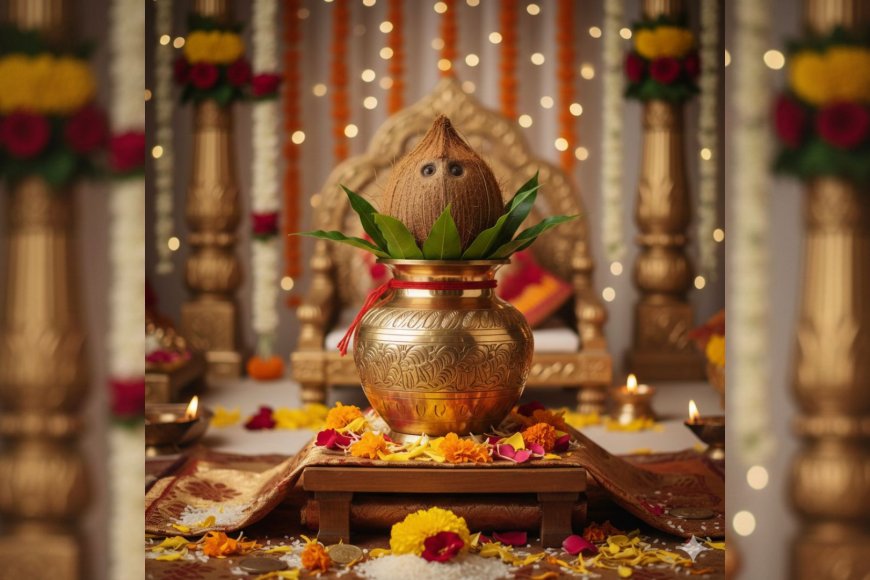
The Kalash — also spelled Kalasha — is a sacred copper, brass, silver, or clay pot, typically filled with water or Gangajal (water from the Ganges), adorned with mango leaves arranged in a fan at its mouth, and crowned with a whole coconut. Wrapped with a red or gold thread (mauli), sometimes filled with coins, rice, or betel nuts, it is placed at the entrance of homes, at the four corners or centre of a wedding mandap, and beside the sacred fire during Vedic ceremonies.
The Kalash is not decoration. It is considered a living symbol — a vessel into which divine energy is invoked through prayer. The priest performs a Kalash Sthapana (establishment of the Kalash) before almost any major Hindu ritual begins. It appears at Griha Pravesh (housewarming), Satyanarayan Katha, Navratri puja, and crucially, at every stage of a traditional Hindu wedding — from the engagement ceremony to the final pheras. When a bride enters her new home for the first time, she often tips a Kalash filled with rice across the threshold — an act of inviting abundance in.
The Global Community Comparison Table
| Community / State of Origin | Local Name of Ritual | Key Tradition | How NRIs Abroad Often Adapt It |
|---|---|---|---|
| Punjabi / Sikh | Kalash Sthapana | Brass or copper Kalash placed at mandap; coconut wrapped in red chunni | Families in Brampton and Birmingham source Kalash sets from Indian grocery stores or Amazon; priests often brought from India |
| Rajasthani / Marwari | Mangal Kalash | Elaborately decorated with silver filigree; five-metal (Panchdhatu) Kalash preferred | NRI families in New Jersey and Houston order antique-finish Kalash sets from Jaipur artisans via WhatsApp and ship internationally |
| Bengali | Ghot | Clay pot (Ghot) filled with water, mango leaves, a betel nut; placed beside turmeric-smeared banana plants | Bengali families in London and Sydney use terracotta pots from Indian homeware shops; banana plants sometimes replaced with decorative alternatives |
| Gujarati | Purna Kalash | Kalash placed on a mound of rice, covered with a coconut; bride's mother often places it | Gujarati communities in East Africa and New Zealand maintain this with great precision; community mandirs often lend ritual items |
| Tamil | Karagam / Kalasam | Brass pot filled with water and neem leaves; carried on the head during procession rituals | Tamil families in Melbourne and Singapore often hire bharatanatyam dance troupes to carry the Karagam in procession at venue events |
| Telugu | Kalasam | Placed at entrance; banana stems flanking the door with Kalasam on top | Telugu NRI families in the USA recreate banana-stem entrance décor using artificial props; fully accepted by most priests |
| Malayalam / Keralite | Nirapara & Kalasam | Kalasam placed alongside a Nirapara (a flat vessel filled with paddy) | Keralite families in the Gulf recreate this with imported rice and copper vessels; Guruvayur-style setups available in Dubai via NRI.Wedding vendors |
| Marathi | Kalash | Copper Kalash with five mango leaves; wife of an elder (Sumangali) places it | Marathi families in Pune diaspora (UK/USA) maintain this tradition; sourcing mango leaves is the most common challenge abroad |
| Sindhi | Lotah Sthapana | Silver Lotah (small vessel) used; associated with Varuna, god of water | Sindhi communities in London and Hong Kong maintain this with strong community organisation support |
| Parsi | Afarganyu (parallel concept) | Not a Kalash per se, but a sacred fire vessel anchors Parsi ceremonies similarly | Parsi NRI families in Toronto and London keep their traditions with Atash (fire) as the central symbol; some incorporate both in interfaith weddings |
| Kashmiri Pandit | Kalash with Kashur elements | Walnut leaves instead of mango leaves; mustard oil lamp beside Kalash | Kashmiri Pandit families in the diaspora (large communities in Delhi-NCR origin, now in USA/Canada) often source walnut leaves from specialty stores |
| Hyderabadi Muslim | No Kalash (parallel: Itr & Sherbet vessels) | Sacred vessels of rosewater and Itr (perfume) serve a parallel role of blessing | In interfaith weddings increasingly common in London and Toronto, symbolic vessels of water and flowers are used as cultural bridges |
The Meaning Behind the Ritual
In Vedic cosmology, water is not simply H₂O — it is Apas, one of the five primordial elements, carrying consciousness and memory. The Kalash is a microcosm of the universe: the water inside represents creation, the mango leaves (typically five) represent the five senses or the five pranas (life forces), and the coconut — whose three eyes are said to represent the Trimurti of Brahma, Vishnu, and Shiva — sits as the divine head. The thread wrapped around it traces the sacred geography of rivers: Ganga, Yamuna, Saraswati, Godavari, Narmada, Sindhu, and Kaveri are all invoked into the vessel through mantra.
When a priest performs Kalash Sthapana, he is not being symbolic. In the Vedic tradition, he is literally inviting the divine into the space, making the Kalash a temporary temple. This is why the Kalash cannot simply be bought online and placed without ceremony — its power comes from invocation. For your non-Indian partner or guests, explain it this way: "Before we begin, we create a sacred space. The Kalash is how we invite the universe to witness our wedding."
Doing This Ritual Abroad: The Practical Reality
Here is what no generic wedding website tells you: a copper Kalash is surprisingly hard to source at short notice in Manchester or Melbourne. Mango leaves — fresh ones, the kind that stay green for a ceremony — are nearly impossible unless you have an Indian grocery with a plant section or a very dedicated aunty.
Practical solutions for NRI couples:
Copper and brass Kalash sets are available on Amazon UK, Amazon Canada, and through Indian homeware retailers in cities like Leicester, Mississauga, and Melbourne's Dandenong. Order at least three weeks early. Mango leaves can sometimes be sourced from specialty South Asian grocery stores or Indian sweet shops, which often stock them for Diwali and Dussehra. In a pinch, five betel leaves are a widely accepted Vedic substitute, acknowledged by most priests. Gangajal — purified Ganga water — is available in sealed bottles from Indian grocery shops globally, or can be sent by relatives in India in your checked baggage (it is permitted).
For the priest: NRI.Wedding maintains a network of English-speaking pandits in the UK, USA, Canada, Australia, and UAE who can either officiate in person or guide families through the Kalash Sthapana via video call with a local officiant. If your venue prohibits open flames, discuss the Mangal Deepam (lamp beside the Kalash) alternative with your pandit in advance. Most trained priests abroad are experienced with venue restrictions and carry battery-operated diyas as backup — ask specifically for this when booking.
For families with relatives joining from India over video call: time the Kalash Sthapana at the start of your ceremony and ensure your videographer frames it clearly. It is the moment your India-based family will respond to most emotionally.
Doing This Ritual as a Destination Wedding in India
If you are among the growing number of NRI families choosing to bring the wedding home — to Jaipur's palatial havelis, Goa's beachside resorts, Kerala's backwater venues, or Varanasi's ghats — the Kalash ceremony takes on an entirely different dimension.
Cities best suited for a traditional Kalash-led ceremony: Varanasi (for deeply Vedic setups), Haridwar, Jaipur, Udaipur, Mysuru, and Tirupati. These cities have abundant access to trained pandits, fresh ritual ingredients, and vendors who understand classical ceremony design.
When briefing your local pandit or coordinator, communicate clearly: what is the community origin of the family? (A Punjabi family should have a Punjabi-tradition Kalash setup, not a generic South Indian style.) Are there non-Indian guests who need the ritual explained in English during the ceremony? Many pandits in destination wedding hubs now offer bilingual ceremonies as standard. Ask your NRI.Wedding-verified vendor coordinator in India to specifically confirm this. Also request that the Kalash be placed visually prominently — destination wedding photographers, especially those used to shooting for international clients, know how to frame it magnificently.
What You Need for the Kalash Ritual: The Practical Checklist
- The Kalash vessel — copper, brass, or silver preferred; clay acceptable
- Clean water — Gangajal ideal; purified water acceptable
- Mango leaves — five to seven, fresh; betel leaves are an accepted substitute
- A whole coconut — unhusked traditionally; dehusked acceptable with priest's consent
- Red or yellow mauli thread — to wrap the vessel
- Rice or whole grains — placed inside the vessel and beneath it as a base
- Betel nuts and coins — placed inside; represent prosperity
- A red or gold cloth — to drape beneath the Kalash
- Agarbatti / incense — to perform the initial aarti of the Kalash
- A trained priest — to perform the Sthapana mantra and invocation
- Placement timing — always before the main ceremony begins; ideally at auspicious Muhurat
Whether you're planning this in Dubai, Delhi, or Detroit — NRI.Wedding connects you with verified vendors, priests, and decorators who understand exactly what you need and where you are.
5 Questions NRI Couples Always Ask
-
Question 1: Can we perform the Kalash Sthapana at a hotel venue that doesn't allow open flames?
-
Answer 1: Absolutely. Many experienced pandits abroad carry battery-operated diyas as standard practice. The Kalash itself requires no flame — the lamp beside it is a separate element. Discuss this clearly when booking your priest, and notify your venue coordinator. NRI.Wedding's priest listings clearly indicate which officiants are experienced with venue-restriction ceremonies.
-
Question 2: My partner is not Indian — how do we include them in the Kalash ritual meaningfully?
-
Answer 2: The Kalash Sthapana is traditionally witnessed by all present, not just family. Your partner can be invited to place their hands beside yours as the priest completes the invocation — symbolically co-creating the sacred space. A bilingual priest can explain each step in English as it happens, which also helps non-Indian guests feel included rather than confused.
-
Question 3: We cannot source fresh mango leaves in Toronto — what are the accepted substitutes?
-
Answer 3: Five betel (paan) leaves are the most widely accepted Vedic substitute and are available at almost every South Asian grocery store globally. Some priests also accept tulsi (holy basil) leaves. When in doubt, call your pandit first — most are practical and understanding about diaspora challenges.
-
Question 4: My parents are in Amritsar and I'm in Sydney — can they be present for our Kalash Sthapana over video call?
-
Answer 4: Yes, and this is increasingly common. Set up a stable, well-lit video link before the ceremony begins and test it. Ask your priest to pause and allow your Amritsar family to view and bless the Kalash before proceeding. The Vedic tradition has always understood that intention and presence are not the same thing.
-
Question 5: Do we need a separate Kalash for each ritual — the engagement, the mehendi, the wedding?
-
Answer 5: Ideally, yes — a fresh Kalash Sthapana is recommended at the start of each major ceremony, as each event is considered a distinct sacred occasion. However, in practical NRI settings, many priests perform a single comprehensive Kalash Sthapana at the beginning of the wedding day that covers all subsequent events. Ask your priest about this option.
Bridging Two Worlds: The Emotional Angle
There is something quietly profound about an NRI family unpacking a copper Kalash in a Birmingham hotel suite the night before a wedding. It has been wrapped in a dupatta, packed inside checked luggage between shawls and sweets, carried across nine time zones. And yet the moment it is placed on a cloth and filled with water — something shifts. The room feels different. The grandmother stops giving instructions and simply sits. The ritual knows no postcode.
For the Indian diaspora, the Kalash is more than a vessel for water. It is a vessel for everything that was carried across the ocean — the language half-remembered, the prayers whispered imperfectly, the longing for something that feels completely yours even when you are 10,000 kilometres from where it began. When your pandit speaks the invocation and the family gathers, the Kalash becomes a meeting point: between India and here, between then and now, between what was inherited and what you have chosen to carry forward.
A Moment to Smile 😄
There is a family legend — frequently told at Punjabi weddings in Mississauga — about a certain taiji who, on a flight from Delhi to Toronto, convinced the Air Canada crew that the copper Kalash in her hand luggage was a "traditional thermos." She made it through security. The Gangajal inside did not. She refilled it at the airport bathroom tap, muttered a prayer, and declared: "Ganga is everywhere. God will understand." The Kalash sat at the mandap. The wedding was beautiful. And somewhere, presumably, God did understand.
Quotes From the Diaspora
"I had never seen a Kalash Sthapana explained properly until I started researching for my son's wedding. I always assumed I knew. But sitting with the pandit in Amritsar and finally understanding every step — I cried. We had been doing it right all along, we just didn't know why." — Kamaljit Brar, 61, now in Brampton; son married in Amritsar, 2023
"My fiancé is British — his family had never been to an Indian wedding before. I asked our pandit to explain the Kalash in English during the ceremony. When he described it as 'inviting the universe to witness your marriage,' my future mother-in-law actually teared up. That moment made everything worth it." — Priya Venkataraman, 29, Manchester; married in Chennai, 2024
"We ordered the Kalash from an online store in New Jersey. It arrived with a small dent. My mother spent three days deciding if it was still sacred. The pandit assured her it was the intention that mattered. She has since told everyone the Kalash was 'hand-selected.'" — Arjun Mehta, 34, Edison, New Jersey; married in Udaipur, 2023
Closing: Your Roots Travel With You
The Kalash has sat at the centre of Indian weddings for more than three millennia. It has been placed in palaces and village courtyards, on riverbanks and temple floors. And now it sits in hotel ballrooms in Houston, banquet halls in Birmingham, and garden venues in Auckland — carried there by families who refused to let distance dissolve what matters most.
You don't need a particular postcode to begin with the sacred. You need intention, preparation, and the right support.
NRI.Wedding exists precisely for this — to help Indian families across the world plan ceremonies that are culturally authentic, practically executable, and emotionally unforgettable. Browse our community-specific wedding guides, explore our verified pandit and vendor listings across India and 20+ countries, and download your personalised NRI wedding planning checklist today.
Your roots don't end at the airport. They travel with you — and so does the Kalash.
The Kalash is the sacred vessel at the heart of every Hindu wedding — but how do NRI families in Toronto, London, Dubai, and Sydney recreate this ancient Vedic ritual correctly? This complete NRI.Wedding guide covers the meaning, community variations, practical checklist, and expert tips for performing the Kalash Sthapana beautifully, wherever in the world your wedding takes place.
0 comments
Real names and courtesy, please. Every comment is read by a person before it appears.
Nothing yet. Start it off.
Comments are closed on this article.