





































































Destination Weddings in Kashmir: The Complete NRI Planning Guide for Dal Lake Shikaras, Snow-Covered Meadows and Paradise Venues
Planning a destination wedding in Kashmir from abroad? This complete NRI guide covers every extraordinary setting the valley offers — from Dal Lake houseboats and shikara ceremonies to the Mughal Gardens of Srinagar, Gulmarg's snow-covered meadows, Pahalgam's river valleys, and the remote alpine beauty of Sonamarg. Covering venue permits, J&K UT regulatory framework, seasonal windows, Kashmiri craft traditions, security monitoring, and marriage registration, this is the authoritative resource for NRI couples planning India's most breathtaking and most carefully considered destination wedding from abroad.


Destination Weddings in Kashmir — Dal Lake Shikaras, Snow-Covered Meadows and Paradise Venues: NRI Guide
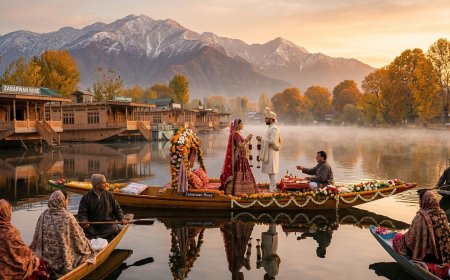
The photograph was taken in 1987. Sadia knew this because her mother had written the year on the back in the careful handwriting of someone who understood that photographs needed anchoring to time. It showed her parents on a shikara on Dal Lake — her father in a cream sherwani, her mother in a deep green salwar with gold embroidery that Sadia had seen in person, folded in a trunk in the Lucknow house, every time she visited. The shikara had flowers along its canopy edge. The water was absolutely still. The Zabarwan mountains were visible behind them, snow on the upper reaches even in what must have been late autumn. Her mother was laughing at something outside the frame. Her father was looking at her mother with an expression that Sadia, at thirty-four, living in a flat in Amsterdam's Oud-Zuid neighbourhood, recognised as the specific look of a man who cannot believe his luck.
She had grown up with this photograph. It had sat on her parents' bedroom dresser in Lucknow for her entire childhood, moved to the living room bookshelf when they redecorated, and now existed in three digital versions on her phone because she had photographed it on three separate visits home, each time thinking she should do something with it and each time not knowing quite what. She knew what now.
She wanted the same lake. The same mountains. The same quality of stillness.
Her fiancé Rohan was from Pune and had never been to Kashmir. He was a structural engineer who approached most problems with a calm analytical patience that Sadia found both admirable and, in the context of wedding planning, occasionally maddening. When she showed him the photograph — on a Sunday evening in the Amsterdam flat, the Dutch autumn outside doing its grey and honest best — he looked at it for a long time and then said: This is what you want. It was not a question. She said: This is what I want. He said: Then we find out how to do it.
Finding out how to do it turned out to be a project of considerable complexity. Kashmir is not a destination wedding location in any established sense — there is no industry ecosystem, no roster of wedding planners with Kashmir-specific portfolios, no venue guidebook that curates the options and explains the permits. What there is instead is one of the most extraordinarily beautiful landscapes in the world, a set of venues that range from the historic houseboats of Dal Lake to the meadows of Gulmarg and Pahalgam, a regulatory and logistical environment that requires specific knowledge and specific relationships to navigate, and a set of practical realities about the security situation, the seasonal windows, and the infrastructure limitations that the NRI couple must hold with complete honesty before making the decision.
Sadia spent three weeks researching before she called her mother. Her mother picked up on the second ring and Sadia said: I want to get married in Kashmir. On the lake. Her mother was quiet for a moment that felt longer than it was. Then she said, in Urdu: Your father will cry. And Sadia understood that the decision was made.
This guide is for Sadia and Rohan — and for every NRI couple who has looked at a Kashmir photograph and understood that the most beautiful place in India is also the most carefully planned.
Why Kashmir Is Both the Most Extraordinary and the Most Considered Wedding Choice
Kashmir demands a different kind of honesty than any other Indian wedding destination. It is genuinely, objectively, without qualification one of the most beautiful places on earth — the Dal Lake at dawn, the Mughal gardens in bloom, the meadows of Gulmarg with the Apharwat peak behind them, the walnut forests of Pahalgam in the autumn. Photographs of Kashmir weddings produce a quality of beauty that no other Indian landscape quite matches, and the couples who have married there describe the experience in terms that go beyond the aesthetic — the feeling of having chosen something rare and real and completely their own.
The honest counterpart to this is the acknowledgment that Kashmir's political and security situation is a real consideration that must be part of the planning conversation rather than something the couple papers over with optimism. The situation in Jammu and Kashmir has evolved significantly since the reorganisation of the state in 2019 — the restoration of tourism, the growth of the hospitality industry, and the increased civilian confidence in the region's stability have made Kashmir a viable wedding destination in ways that were not true a decade ago. But the NRI couple planning a wedding in Kashmir must make the decision with current, accurate information about the security situation rather than with either the outdated anxiety of the pre-2019 context or the uncritical optimism that sometimes accompanies destination wedding enthusiasm.
The practical implication is straightforward: consult current official travel advisories from your country of residence — the Dutch Ministry of Foreign Affairs, the UK Foreign, Commonwealth and Development Office, the Australian Department of Foreign Affairs and Trade — in the months immediately before the wedding, not at the booking stage. Make the decision to book with the understanding that the situation is monitored rather than assumed, and that the contract with every vendor must include a force majeure clause with specific provisions for the scenarios that Kashmir's specific context might produce.
This is not a reason not to marry in Kashmir. It is the reason to marry in Kashmir with the specific preparation that the location requires.
The 2019 Reorganisation and What It Changed for Wedding Planning
The reorganisation of Jammu and Kashmir into two Union Territories — Jammu and Kashmir, and Ladakh — in August 2019 changed the administrative framework within which wedding planning in the region operates. The regulatory environment for events, the permit processes for heritage sites and government-managed gardens, and the local authority structures now reflect the Union Territory administration rather than the state government framework that preceded it.
The practical implications for the wedding couple include the changed jurisdiction for marriage registration — now under the UT administration rather than a state government — and the updated frameworks for event permissions at sites like the Mughal Gardens, which are managed by the Floriculture Department of the J&K government. The NRI couple should verify the current regulatory position through a planner with active, recent Kashmir experience — meaning experience in the post-2019 framework, not simply prior experience of Kashmir weddings from an earlier period.
The Kashmir Wedding Landscape: Five Settings of Extraordinary Distinction
Kashmir's wedding geography divides into five settings, each with its own character, its own season, its own infrastructure profile, and its own relationship to what makes Kashmir beautiful. The choice between them is not simply a question of aesthetics. It is a question of what kind of wedding experience the couple is making and what the practical realities of each setting will require.
Dal Lake: The Shikara and the Houseboat Wedding
Dal Lake is Kashmir's most iconic image and its most intimate wedding setting. The lake — fourteen square kilometres of water, the Zabarwan mountains on the eastern shore, the city of Srinagar on the western edge, the Mughal gardens at the northern end — is a world that exists outside ordinary categories. The houseboats moored on the lake are among the most extraordinary accommodations in India — large, elaborately carved cedar structures with furnished rooms and private verandahs that were built in the British era and that have been maintained, in the best cases, with a combination of original character and modern comfort.
A wedding on Dal Lake — a ceremony on a decorated shikara, a reception on a houseboat's roof deck with the lake and the mountains as the backdrop — is the most intimate and the most distinctively Kashmiri wedding experience available. It is also the most limited in scale. The houseboat accommodation on Dal Lake can house a small wedding party with genuine style, but a guest list of more than sixty to eighty people overwhelms the lake's intimate infrastructure. The Dal Lake wedding is for the couple who wants the Kashmir experience in its most concentrated, most personal form — not the large family celebration of the Delhi model, but the gathering of the people who matter most, in a setting of absolute beauty, in a scale that the lake can hold without strain.
The logistics of the Dal Lake wedding require specific attention. Guests access the houseboats by shikara — the flat-bottomed wooden boats that are the lake's primary transport — which means that arrival and departure are governed by the shikara schedule and the water conditions. Evening events on the lake must account for the fact that the lake can be cold after dark, that the mist descends in the autumn and winter months with a speed and completeness that is beautiful and also practically significant, and that the sound system requirements for a water-based event are different from those for a land venue.
The Mughal Gardens: Shalimar, Nishat, and Chashme Shahi
The three great Mughal gardens on the eastern shore of Dal Lake — Shalimar Bagh, Nishat Bagh, and Chashme Shahi — are among the most beautiful formal gardens in the world. Built by the Mughal emperors in the seventeenth century as pleasure gardens for the imperial court, they are now managed by the J&K Floriculture Department and are open to the public as tourist sites. Events in these gardens — including wedding ceremonies — require permission from the Floriculture Department, and the process, the timeline, and the specific conditions under which permission is granted have evolved significantly in recent years.
The visual case for a Mughal garden wedding is overwhelming. The terraced lawns, the central water channels fed by mountain streams, the chinar trees that are centuries old and that turn extraordinary colours in the autumn — these are spaces that produce wedding photographs of a quality that no constructed venue can approximate. The practical case requires more careful assessment. The permissions are not guaranteed, the conditions attached to them may constrain the scale and the character of the event, and the public access to the gardens — they remain tourist sites — creates a context that requires management.
For the NRI couple considering a Mughal garden ceremony, the path runs through a planner with current, specific experience of the Floriculture Department permission process, and through a realistic assessment of what the permission will and will not allow.
Gulmarg: The Snow Meadow Wedding
Gulmarg sits at two thousand six hundred and fifty metres above sea level, fifty-six kilometres from Srinagar, at the edge of a meadow that in the winter months becomes one of Asia's premier ski destinations and in the summer months becomes a landscape of extraordinary alpine beauty — the meadow grass, the wildflowers, the forest edge, and above everything the Apharwat peak with its permanent snow. A wedding at Gulmarg in the summer season — June through September — is a wedding conducted in a landscape that most Indian wedding guests will have seen only in films, if at all.
The accommodation infrastructure at Gulmarg has improved significantly in recent years. The Khyber Himalayan Resort and Spa is the premier property on the mountain — a large, architecturally distinctive property with genuine event capability, mountain views of extraordinary quality, and the infrastructure for multi-day wedding celebrations of reasonable scale. The Welcomhotel Pine-N-Peak and several boutique properties provide supporting accommodation capacity.
The Gulmarg wedding has specific logistical requirements that the NRI couple must address early. The road from Srinagar to Gulmarg is approximately two hours and is a hill road — not extreme by Himalayan standards, but not suitable for large vehicle convoys without coordination. The altitude of two thousand six hundred and fifty metres requires the same guest health briefing that applies to any high-altitude event, with particular attention to elderly guests and those with cardiac or respiratory conditions. And the weather, even in the summer season, is capable of the sudden changes that mountain weather produces everywhere — clear morning, dramatic afternoon, clear evening — which requires the now-familiar outdoor event contingency planning.
Pahalgam: The Valley and the River
Pahalgam sits in the Lidder River valley at two thousand one hundred and thirty metres, ninety-five kilometres from Srinagar, in a landscape that combines the river, the pine forests, the meadows of Baisaran above the town, and the Himalayan peaks beyond in a composition that has made it one of India's most beloved mountain destinations since the Bollywood films of the 1960s established it in the national imagination.
The wedding venues in Pahalgam range from the Heritage Hotel Pahalgam — a property with a colonial history and a riverside setting — to a set of resort properties that have developed around the town's tourism infrastructure. The meadows of Baisaran, above Pahalgam, are accessible by pony or on foot and offer an outdoor ceremony setting of remarkable beauty — the open meadow, the pine forest fringe, the mountain backdrop — that requires a planner with specific Pahalgam experience to organise and that rewards the logistical effort with photographs that are genuinely extraordinary.
Sonamarg: The Meadow of Gold
Sonamarg — the Meadow of Gold — sits at two thousand eight hundred metres in the Sindh River valley, eighty-seven kilometres northeast of Srinagar on the road toward the Zoji La pass and Ladakh. It is the least developed of Kashmir's major tourist destinations and the most dramatically alpine — the glacier above the meadow, the Sindh River below, the peaks surrounding it on three sides. A wedding at Sonamarg is genuinely for the couple who wants the most remote and the most visually extreme of the Kashmir options.
The accommodation infrastructure at Sonamarg is more limited than Gulmarg or Pahalgam, and the logistical demands of organising a wedding event at this altitude and this remoteness require a level of planning effort that is significant even by Kashmir standards. For the right couple — the couple who wants the most extraordinary possible setting and is willing to invest the planning effort that it requires — Sonamarg produces wedding photographs that are in a category entirely their own.
The Seasonal Windows: Kashmir's Four Wedding Seasons
Kashmir has four distinct seasons, and each creates a different wedding experience. Unlike most Indian wedding destinations where the seasonal choice is binary — the good season and the monsoon — Kashmir's seasonal diversity is genuine, and each season has a case to make.
The spring season — April and May — is the season of the tulips and the almond blossoms and the chinar trees coming into full leaf. The Indira Gandhi Memorial Tulip Garden in Srinagar blooms in April and is one of the most extraordinary floral landscapes in Asia. A spring Kashmir wedding has the flowers and the warming temperatures and the extraordinary quality of the spring light on the lake and the mountains. The risk is the late spring rain, which in Kashmir can be significant, and the cold nights that persist into May.
The summer season — June through August — is Kashmir's most reliable weather window and its peak tourist season. The temperatures at Srinagar level are comfortable, the mountain meadows are at their most lush, and the days are long and clear. This is the season for the Gulmarg and Pahalgam weddings, for the outdoor ceremonies in the Mughal gardens, and for the Dal Lake events that make the most of the long evenings. The summer season is also the period of heaviest tourism, which affects accommodation availability and requires booking timelines that reflect the peak demand.
The autumn season — September through November — is arguably Kashmir's most beautiful season and its most underused wedding window. The chinar trees turn from green to the extraordinary palette of orange and red and gold that makes Kashmir's autumn one of the great natural spectacles of the subcontinent. The air is clear and cold, the lake is still, and the quality of the October light on the Zabarwan mountains is the light that the 1987 photograph of Sadia's parents was taken in. The autumn wedding in Kashmir is the choice that most rewards the couple willing to look beyond the conventional season.
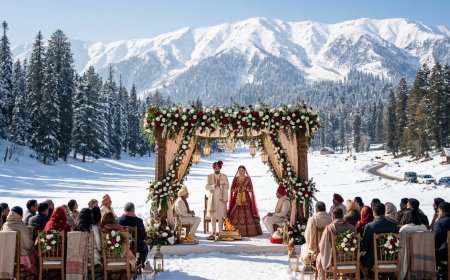
The winter season — December through February — is Gulmarg's season. The snow arrives in November and the skiing begins in December and the meadow that was wildflowers in June is a landscape of complete white in January. A winter wedding at Gulmarg, in the snow, with the frozen landscape and the mountain peaks and the extraordinary cold air clarity, is a wedding of a completely different character from any other Indian wedding option. It requires cold-weather planning of a seriousness that the plains wedding never demands — the heating infrastructure, the guest clothing guidance, the contingency for heavy snowfall — and it rewards that seriousness with images and memories of absolute distinction.
Building the Kashmir Wedding Infrastructure From Abroad
The planning architecture for a Kashmir wedding managed from Amsterdam or London or Toronto is more demanding than for any mainland Indian city wedding, and the NRI couple must approach it with a specific set of understandings that are unique to Kashmir's context.
The Srinagar Planner: The Essential Foundation
The Kashmir wedding planning industry is growing but is not yet as mature as the Rajasthan or Delhi industries. There are planners based in Srinagar who have genuine experience with destination weddings — who understand the permit processes, who have the vendor relationships, who have managed the shikara logistics and the houseboat event setups and the Mughal garden permissions. There are also a larger number of operators presenting themselves as wedding planners whose experience is primarily in travel and tourism rather than event management.
The NRI couple must apply the most rigorous selection criteria to the Kashmir planner, because the planner is doing more work that is invisible to the couple than in any other destination. Ask for references from NRI couples specifically — couples who managed the planning from abroad and who can speak to the quality of the remote communication and representation. Ask for documented experience with the specific venue type you are considering — the Dal Lake houseboat wedding and the Gulmarg resort wedding require entirely different skills. And ask, specifically and directly, about the planner's approach to the security monitoring and the force majeure provisions in the event contracts.
The Vendor Landscape: Srinagar, Jammu, and Delhi
The vendor ecosystem for a Kashmir wedding draws from three sources. Srinagar has a local vendor community — decorators, photographers, caterers — whose knowledge of the local context and the local materials is irreplaceable. Jammu has a larger vendor community that is more accessible for certain categories of specialized talent. And Delhi provides the destination wedding specialists — the top-tier photographers, the elaborate decoration teams, the event production professionals — who travel to Kashmir for significant commissions.
The Kashmiri decoration aesthetic deserves specific engagement. The craft traditions of Kashmir — the papier-mâché, the crewelwork embroidery, the walnut wood carving, the kani shawl textiles — offer wedding decoration materials of extraordinary beauty and cultural authenticity that no mainland decorator can replicate. The NRI couple with the intelligence to engage with these traditions rather than importing a generic destination wedding aesthetic from Delhi will produce a wedding that is genuinely Kashmiri in its visual character.
Permits, Legal Framework, and the J&K Administration
The regulatory environment for weddings in Jammu and Kashmir under the Union Territory administration requires specific attention to several permit categories.
Events in the Mughal Gardens require written permission from the J&K Floriculture Department, with the application process, timeline, and conditions subject to the current administrative policy. Events adjacent to protected water bodies — including Dal Lake — are subject to the J&K Lakes and Waterways Development Authority's jurisdiction. The LAWDA has regulations around commercial activities on and adjacent to the lake that affect the scale and character of wedding events and that must be navigated through a planner with current LAWDA experience.
Noise regulations and event curfews apply in Srinagar and the other inhabited areas, enforced by the local administration. Fireworks on or near the lake have specific restrictions related to both the noise regulations and the environmental sensitivity of the water body. Any outdoor fireworks in the mountain areas carry forest fire risk assessments that the local forest authority evaluates as part of the permit process.
The marriage registration process in J&K now operates under the UT administration framework. The Hindu Marriage Act and the Special Marriage Act both apply, with the Sub-Registrar jurisdiction determined by the address of residence during the registration period. The Special Marriage Act's thirty-day notice requirement applies, and the apostille of the marriage certificate for use in the Netherlands, the United Kingdom, or other Hague Convention countries follows the MEA process with the standard four-to-eight-week timeline.
Common Mistakes NRI Couples Make When Planning a Kashmir Wedding
The first mistake is treating the security situation as a settled question that was resolved in 2019 and requires no further monitoring. The reorganisation of J&K and the subsequent period of relative stability have made Kashmir a viable destination, but the situation requires ongoing attention rather than a single assessment at the booking stage. The NRI couple must build the monitoring of current travel advisories into the planning process as a regular checkpoint — not an anxiety to be suppressed, but a responsibility to be managed — and must ensure that every vendor contract has the force majeure provisions that Kashmir's specific context warrants.
The second mistake is over-scaling the wedding for the Dal Lake setting. The houseboat and shikara wedding is intimate by nature and by infrastructure. The couple who books the Dal Lake for the large family wedding with two hundred and fifty guests is misunderstanding the relationship between the setting and the scale. The lake holds the intimate wedding with extraordinary grace. It holds the large wedding with considerable strain. The couple must be honest about which wedding they are actually making.
The third mistake is not engaging with the Kashmiri craft traditions in the decoration and the wedding elements. The couple who imports a generic Delhi wedding aesthetic to Kashmir and overlays it on the Dal Lake or the Mughal garden setting is producing a visual incoherence that the location does not deserve and that the best wedding photographs will not forgive. The Kashmir wedding should use Kashmir — the crewelwork, the papier-mâché, the chinars, the shikara flowers, the local textiles — as the foundation of its visual identity.
The fourth mistake is underestimating the cold. Kashmir is cold — genuinely, seriously cold — for a significant part of the year, including the autumn season that produces its most beautiful light. The evening reception at Dal Lake in October requires heating infrastructure, warm guest clothing guidance, and a contingency for the mist and the cold that arrives after dark with a speed that the daytime temperature does not predict. The NRI couple planning an autumn or winter Kashmir wedding must address the thermal comfort of their guests with the same seriousness they bring to the aesthetics.
The fifth mistake is not making the recce trip. This is the mistake that applies to every destination wedding and that is more serious in Kashmir than anywhere else, because the gap between what Kashmir looks like in a photograph and what it requires in person is larger here than in any other destination. The Srinagar street that looked manageable on Google Maps is a narrow lane that a catering truck cannot enter. The houseboat that looked spacious on the property website holds twenty guests comfortably and thirty-five with difficulty. The Mughal garden that looked available for a private event has conditions attached that significantly change the character of what is possible. The recce trip — the in-person visit, with the planner, at the specific venues, in the actual season — is the only thing that makes the planning real.
The Complete Kashmir NRI Wedding Planning Reference Table
| Category | Specific Consideration | Timeline / Action Required | NRI-Specific Note |
|---|---|---|---|
| Security Monitoring | Current travel advisory assessment | Ongoing from booking through wedding | Check Dutch, UK, Australian advisories regularly |
| Force Majeure Provisions | All vendor contracts | Include at contract signing stage | Kashmir-specific provisions required in every contract |
| Setting Selection | Dal Lake / Mughal Gardens / Gulmarg / Pahalgam / Sonamarg | Decide before venue search begins | Each setting has distinct scale and logistics profile |
| Dal Lake Houseboat | Intimate scale; 60–80 guests maximum | 12–14 months in advance | Shikara logistics and water conditions must be planned |
| Mughal Garden Permission | J&K Floriculture Department clearance | 4–6 months before event | Not guaranteed; planner must have current process knowledge |
| LAWDA Compliance | Dal Lake and waterway event regulations | 4–6 months before event | Commercial lake activities have specific restrictions |
| Gulmarg Resort — Khyber | Premium mountain property; limited peak dates | 14–18 months in advance | Altitude briefing mandatory for all guests |
| Pahalgam Heritage Hotel | Riverside setting; moderate capacity | 12–14 months in advance | Baisaran meadow ceremony requires specialist logistics |
| Sonamarg Venue | Remote alpine; limited infrastructure | 14–18 months in advance | Most logistically demanding Kashmir option |
| Seasonal Window — Spring | April–May; tulips and blossoms | Set date before booking | Late spring rain risk; cold nights persist into May |
| Seasonal Window — Summer | June–August; peak season optimal | Book 14–18 months in advance | Highest tourism demand; accommodation fills earliest |
| Seasonal Window — Autumn | September–November; chinar colours | Book 12–14 months in advance | Most beautiful season; underused wedding window |
| Seasonal Window — Winter | December–February; Gulmarg snow | Book 14–18 months in advance | Full cold-weather infrastructure required |
| Cold Weather Planning | Heating, guest clothing guidance | Define at planning stage | Evening temperatures require serious thermal provision |
| Srinagar Wedding Planner | NRI-specific experience essential | Engage 12–14 months in advance | Verify post-2019 regulatory knowledge specifically |
| Kashmiri Craft Integration | Crewelwork, papier-mâché, local textiles | Discuss with decorator at brief stage | Foundation of visual identity; not decorative addition |
| Delhi Vendor Extension | Top-tier photographers and specialists | Confirm logistics 6–8 months ahead | Srinagar routing; road condition buffer required |
| Noise and Curfew Permit | Local UT administration compliance | 4–6 weeks before event | Srinagar residential proximity makes this active |
| Fireworks Restrictions | Lake environmental and forest fire rules | Confirm at planning stage | Specific restrictions near water and forest areas |
| Marriage Registration | Sub-Registrar, J&K UT jurisdiction | Begin 45–60 days before ceremony | Post-2019 UT framework applies; confirm current process |
| Special Marriage Act Notice | 30-day mandatory notice period | Begin 45 days before ceremony | Residency requirement must be met in advance |
| Marriage Certificate Apostille | MEA authentication for foreign use | 4–8 weeks post-registration | Required for Netherlands, UK, Australia, Canada legal use |
| Guest Travel Coordination | Srinagar airport routing | Begin 8–10 months in advance | Direct flights from Delhi, Mumbai, Bangalore available |
| Accommodation — Dal Lake | Houseboat block booking | 12–14 months in advance | Limited premium houseboats; book before invitations |
| Accommodation — Mountain | Gulmarg or Pahalgam property block | 12–14 months in advance | Distribute overflow to secondary properties |
| Budget Contingency | 20–25% over base estimate | Set from planning start | Kashmir logistics and weather variables add cost |
| Recce Trip | In-person visit with Srinagar planner | 10–12 months before wedding | Non-negotiable; photograph and reality gap is significant |
The Emotional Weight of the Kashmir Wedding
There is no Indian landscape that carries more emotional weight for the diaspora than Kashmir. It is the place that appears in the films that shaped the imagination of every Indian who grew up in the twentieth century. It is the place that parents and grandparents speak about with a specific tenderness — as paradise, as lost paradise, as the place that represents the best of what India contains and the tragedy of what conflict does to beauty. For the Muslim Indian family, Kashmir carries the specific weight of a cultural and spiritual heartland. For the Hindu family with Kashmiri Pandit roots, it carries the weight of a displacement that is still unresolved. For the broader Indian diaspora, it carries the weight of an idealised beauty that the political reality has complicated.
The NRI couple who chooses Kashmir for their wedding is choosing to place their celebration inside all of this — the beauty and the history and the weight and the hope. This is not a burden to avoid. It is a context to hold with the seriousness it deserves. The Kashmir wedding is not simply an aesthetic choice. It is a statement about where you come from, what you value, and what you believe about the place that produced the photograph on your parents' dresser.
The couple who marries on Dal Lake is, among other things, saying that the lake is still there. That it is still beautiful. That it is still possible to be happy on its waters. That the place in the photograph is real and accessible and worth the planning and the complexity and the careful attention to the things that require careful attention.
This is not a small thing to say. The lake has been waiting for someone to say it.
Sadia Stood on the Shikara in October
She had been to Kashmir twice before the wedding — once for the recce trip in January, with Rohan and the Srinagar planner Tariq who had the kind of specific local knowledge that comes only from having grown up in a place, and once alone in April when she needed to see the tulips and needed to be in the place without the logistics conversation happening simultaneously.
The wedding was in October. The chinar trees were at the beginning of their turn — the first orange appearing at the edges of the leaves, the Zabarwan behind them already showing the full autumn palette. Sixty-one guests came — from Lucknow, from Pune, from Amsterdam, from London, from Toronto. They came by shikara from the ghat to the houseboats in the early evening, and several of them cried before they had reached the middle of the lake, which Tariq had told Sadia would happen and which she had not quite believed until she watched it from the ceremony houseboat, the decorated shikara approaching through the still water with her parents in it, her father in a cream sherwani because her mother had asked him to, and her father's expression as he stepped onto the houseboat deck and looked at the mountains, which was the expression of a man who had been here before and who understood what it meant to be here again.
The marriage certificate was apostilled six weeks later in Amsterdam. The photograph of the ceremony — the shikara on the still water, the mountains behind, the October chinar colours at the edges of the frame — sat on their Amsterdam mantelpiece within the month.
Her mother called to say she had seen it on Instagram. She said: It looks exactly like ours. Sadia said: That was the point. Her mother said nothing for a moment and then said: Your father cried. Which was what she had predicted, and which was exactly right.
Monitor the travel advisories from the booking date to the wedding day. Hire the Srinagar planner with the post-2019 regulatory knowledge. Make the recce trip in the season you are planning to marry in. Build the force majeure provisions into every contract. Get the apostille process started before the visa deadline makes it urgent.
Then stand on the shikara on the still water with the mountains behind you, and understand that the most beautiful place in India has been waiting, with complete patience, for you to come home and be married in it.
Published by NRIWedding.com — The Premium Global Platform for Non-Resident Indians Planning Indian Weddings From Abroad.
What's Your Reaction?
 Like
0
Like
0
 Dislike
0
Dislike
0
 Love
0
Love
0
 Funny
0
Funny
0
 Angry
0
Angry
0
 Sad
0
Sad
0
 Wow
0
Wow
0