























































The Doli in 2025: How NRI Brides Are Reimagining the Farewell Ritual When Home Is a Flight Away
The doli is not the palanquin. It is the farewell to the self that grew up in the natal home — and in 2025, that farewell happens at airport security gates, on Sunday mornings in Wolverhampton living rooms, and on video calls where the grandmother in Chandigarh sings the vidhaayi song her own mother sang at her farewell. This complete guide explores how NRI brides across the diaspora are reimagining the doli and the vidhaayi for the contemporary reality of the NRI life — the extended vidhaayi, the airport farewell, the two-stage doli, the digital inclusion of remote family, and the preservation of the vidhaayi songs that cannot be replaced by a playlist. For every NRI bride standing at the intersection of the ancient farewell and the departure terminal, this is the complete and honest guide.

The Doli in 2025 — How NRI Brides Are Reimagining the Farewell Ritual When Home Is a Flight Away
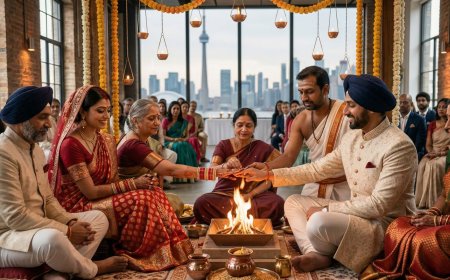
The crying started before the ceremony was over, which was not unusual, and before the doli was even mentioned, which was. Simran's mother had been holding it together through the mehendi and the haldi and the baraat and the pheras with the specific controlled composure of a woman who has decided that she will not be the one who starts the crying and who has been largely successful at this until the moment in the saptapadi when the priest spoke the words about the daughter leaving the father's protection and the mother looked at Simran's hands in Arjun's hands across the agni and the decision became impossible to keep.
The doli conversation had been happening in the family for three months before the wedding, with the specific quality of the Indian family conversation in which the thing being discussed is never quite directly named because the naming of it would require an acknowledgment of the emotion that the family is managing. The conversation had gone in circles around the central question — how do you conduct the doli when the bride is not going to her new in-laws' house but to the departure lounge of Heathrow Airport? When the palanquin bearers, traditionally the bride's brothers, would be accompanying her not to a house twenty minutes away but to a check-in queue? When the vidhaayi — the farewell — marked not the leaving of the father's house for the husband's house in the same city or the same town but the leaving of the United Kingdom, possibly for years?
Simran had grown up in Wolverhampton. Arjun was from Toronto. They had met at a wedding — the classic NRI origin story — and had been conducting the long-distance relationship across the Atlantic for two years before the wedding, which everyone had agreed should be in the UK because Simran's grandmother was eighty-nine and was not going to Toronto under any circumstances and the grandmother's presence was the non-negotiable. The wedding had been beautiful and complete and the question of the doli had been the one element that had resisted the planning and the research and the honest conversation that Simran had brought to every other element.
She had called her cousin Preethi in Leicester — the cousin who reads everything, who is the family's cultural reference point for the questions that Google does not straightforwardly answer — and said: How do I do the doli when I am literally leaving on a flight? Preethi had been quiet for a moment and then said something that had become, for Simran, the sentence that organised the rest of the thinking: The doli is not the palanquin. The doli is the farewell to the self that grew up in this house. You can do that at an airport. You can do that anywhere. The question is whether you do it consciously or accidentally.
This article is for Simran — and for every NRI bride who has stood at the specific intersection of the ancient farewell ritual and the departure terminal and understood that the question is not whether to do the doli but how to do it when the geography of the contemporary NRI life has changed everything about what the farewell means and where it happens.
The Doli: What It Was, What It Is, and What It Has Always Been Doing
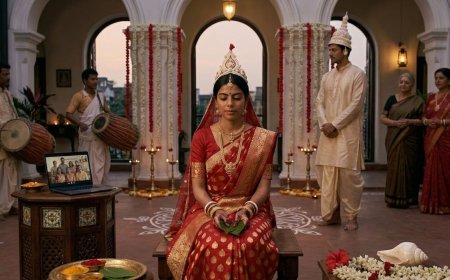
The doli — in its original, literal form — is the palanquin in which the bride was carried from her natal home to her marital home, borne by her brothers or by the designated bearers of the family, accompanied by the weeping of the women and the music of the departure and the specific heartbreak of the vidhaayi, the farewell. The word doli comes from the Hindi and Punjabi, from the root for the swinging, rocking motion of the carried chair — the specific movement of being borne by other people's hands to the next stage of the life.
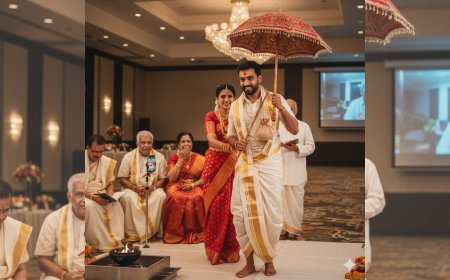
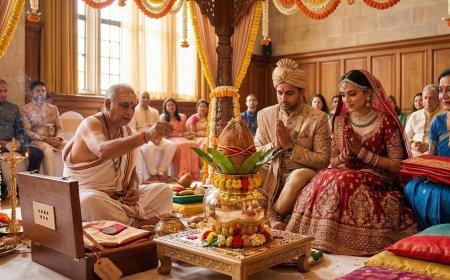
The literal palanquin has, in the contemporary Indian wedding context, been replaced by the decorated car — the flower-covered vehicle that carries the bride from the wedding venue to the marital home, still accompanied by the vidhaayi and the brothers and the specific music of the farewell. In some families, the palanquin itself is still used as a ceremonial element at the wedding venue — the bride carried a short distance in the doli as a ritual gesture before transitioning to the car — and this gesture is the tradition's own acknowledgment that the ritual meaning of the doli does not require the literal palanquin to be expressed.
The ritual meaning of the doli — the meaning that survives the transition from the literal palanquin to the decorated car to the airport departure — is the meaning that Preethi was pointing to when she said the doli is not the palanquin. The doli is the ritual marking of the bride's transition from the identity she has held in her natal family — the daughter, the child who grew up in this house, the person whose primary belonging was here — to the identity she is now entering in the marital family and the marital home. It is the moment at which the transition between these two identities is acknowledged, mourned, and celebrated simultaneously.
The crying is not incidental to the doli. It is the ceremony. The vidhaayi is the ritual acknowledgment that something genuine is being lost in the transition — the specific form of the daughter's belonging to the natal home, the specific relationship of the child to the parents, the specific identity that the natal family created and sustained and is now releasing. The Hindu tradition — unlike some other traditions that celebrate the wedding as entirely joyful — is honest about this loss. The doli names it. The vidhaayi cries it. And in the naming and the crying, the loss is acknowledged rather than denied, which is the tradition's specific wisdom about how human beings process the significant transitions of their lives.
Why the Doli Has Always Been More Than a Transport Arrangement
The palanquin in the historical Indian context was, literally, the transport — the technology of the bride's movement from one house to another in a period when the alternatives were less dignified and less protected. But the ritual that developed around the transport — the specific songs of the vidhaayi, the specific roles of the brothers, the specific weeping of the women, the specific foods the bride takes from her natal home into the new one — transformed the transport into a ceremony whose meaning far exceeded its logistical function.
The vidhaayi songs — the Punjabi songs of the farewell, the Bengali vidai songs, the Tamil songs of the bride's departure — are among the most emotionally direct and most artistically accomplished expressions of the transition in the Indian musical tradition. They are songs about leaving — about the specific leaving of the specific house, the specific tree in the courtyard, the specific smell of the kitchen, the specific sound of the family in the morning. They name the leaving with a specificity that makes the loss concrete rather than abstract, and in making it concrete they make it survivable — the thing that is named can be mourned, and the thing that is mourned can be held alongside the joy of the new beginning.
The doli is not the end of the daughter's relationship with her natal family. The tradition knows this and has always known it — the daughter returns for the festivals, for the births, for the deaths, for the ordinary visits that the continuing relationship requires. The doli is the ending of a specific form of the relationship — the form in which the natal home is the primary home, the form in which the parents are the primary authority, the form in which the daughter belongs here first. This specific form ends with the doli. The relationship continues in a different form.
The NRI Doli: The Specific Geography of the Contemporary Farewell
The NRI bride's doli — the farewell that happens when home is a flight away — is the ancient ceremony in an entirely new geography, and understanding what changes and what does not is the foundational task of the NRI bride who wants to honour the tradition honestly in the context of her actual life.
What Changes in the NRI Doli
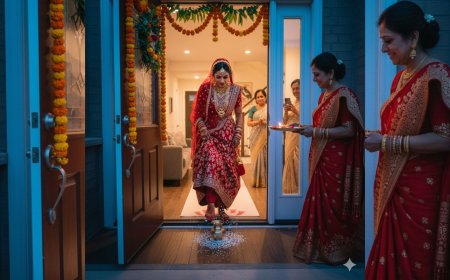
The most obvious change is the destination. The traditional doli ends at the marital home — the specific house, near or far, where the groom's family lives and where the bride is beginning the next chapter of her life. The NRI doli ends at the airport — or at the hotel where the couple is staying before the flight, or at the departure lounge, or in the car that is driving to the terminal. The destination is not a home. It is a transit point between homes.
The distance changes. The traditional doli covered a distance that the brothers could walk or the bearers could carry — a distance measured in hours at most, a distance that kept the natal home within the geography of reasonable visitation. The NRI doli covers a distance measured in time zones and flight hours — a distance that makes the Tuesday afternoon visit impossible and the casual return for the festival logistically complex. The leaving in the NRI context is a more complete leaving, and the doli that marks it is marking something of greater weight.
The timeline changes. The traditional bride who left in the doli could return within days for the post-wedding visits — the muklawa, the specific visits that the tradition provides as the mechanism of the transition's adjustment, the organised returns that acknowledge that the leaving is not absolute. The NRI bride who leaves in the doli may not return for months, or for the specific occasion of the next family emergency or the next significant celebration.
The composition of the farewell party changes. The traditional doli was witnessed by the whole community — the women of the mohalla who had been present at every stage of the bride's growing up, the neighbours whose relationship to the family was dense enough to make the leaving a community event rather than a family one. The NRI doli is typically witnessed by the family and the close friends — the community has already dispersed across the geography of the diaspora, and the dense neighbourhood community that made the traditional vidhaayi a collective event is not the typical social structure of the Wolverhampton or Leicester or Mississauga NRI family.
What Does Not Change in the NRI Doli
The meaning does not change. The bride who is leaving her parents' house in Wolverhampton for Toronto is leaving in the same fundamental sense that the bride who was leaving her parents' house in Amritsar for Delhi was leaving. The specific identity that the natal home created — the daughter, the child of this specific household — is undergoing the same transition. The parents who are releasing the daughter are releasing her in the same fundamental sense. The brothers who are symbolically bearing the doli are performing the same symbolic role. The ceremony's emotional substance is identical.
The songs do not change — or they should not, because the vidhaayi songs are the element of the doli most worth preserving in the NRI context. The Punjabi songs of the farewell — Babul Ki Duaayen Leti Ja, the classical vidhaayi songs that the film tradition has preserved and that the grandmother remembers from her own doli — are not transport songs. They are transition songs, and the transition they describe is as true at Heathrow as it was at the Amritsar haveli gate. The words about leaving the father's house are as true when the father's house is in Wolverhampton as when it was in Punjab.
The roles do not change. The brothers carry the doli — literally or symbolically — because the brothers are the family members who will bear the bride's transition on behalf of the natal family, who will be the continuing male presence in her life from the natal side, who will ensure that the leaving is a transition and not an abandonment. In the NRI context, the brothers who drive the bride to the airport are performing the same role as the brothers who carried the palanquin — they are bearing her to the next stage, accompanying her as far as the role permits them to go.
How NRI Brides Are Reimagining the Doli in 2025
The NRI brides who have approached the doli honestly — who have neither abandoned it as incompatible with the contemporary context nor performed it unchanged as though the geography had not shifted — have arrived at a range of creative and meaningful adaptations that deserve to be documented and shared.
The Extended Vidhaayi: The Farewell That Is Not Rushed
The most widely adopted adaptation is the extension of the vidhaayi — the formal farewell — into a dedicated event rather than a hasty conclusion to the wedding reception. The traditional doli happens at the end of the wedding — the guests are beginning to leave, the reception is concluding, and the bride is departing in a rush of emotion and logistics that does not always honour the significance of the moment. The NRI bride who is leaving for the airport the next morning has the possibility of the extended vidhaayi — the dedicated farewell event that gives the transition the time and the attention that the tradition intended it to have.
The extended vidhaayi might be the morning after the wedding reception, in the hotel or the family home, with the immediate family and the closest friends. It is the time when the vidhaayi songs are sung without the competition of the departing guests, when the specific conversations happen that the reception's crowd does not permit, when the mother and the daughter have the specific hour that the tradition was always trying to create — the hour of the genuine farewell, the hour of the songs and the tears and the specific words that are said between the two people who understand what is actually happening.
Simran's extended vidhaayi happened on the Sunday morning, the day after the wedding reception, in her parents' Wolverhampton house. Eight people were present — her parents, her two brothers, Arjun's parents who had flown from Toronto for the wedding, and her two cousins from Leicester who knew all the words of the vidhaayi songs. The songs were sung. The doli moment — the symbolic carrying, the brothers on either side of Simran as she walked out of the house for the last time as its primary resident — was marked with the full attention of eight people who understood what they were witnessing rather than the distracted attention of two hundred reception guests who did not.
The Airport Vidhaayi: The Farewell at the Threshold of Departure
The most literal adaptation of the doli to the NRI context is the airport vidhaayi — the farewell conducted at the airport departure terminal, at the specific moment of the bride's entry into the international departure system that represents the contemporary equivalent of the palanquin's transit beyond the familiar geography.
The airport vidhaayi has been adopted by a growing number of NRI families with a creativity and a sincerity that the airport environment, with its fluorescent lighting and its retail offerings and its general indifference to the emotional significance of the events that happen within it, does not necessarily encourage but does not prevent. The family that arrives at the airport with the specific intention of conducting the vidhaayi at the departure — the songs in the car on the way, the specific words at the terminal door, the brothers who walk with the bride to the last point that the non-travelling family can access — is conducting the doli in the most honest available form for the NRI context.
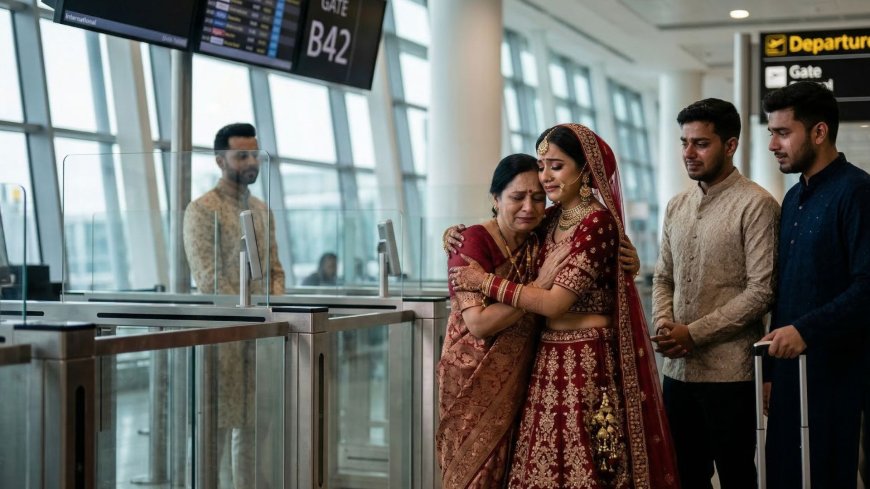
The specific moment of the airport vidhaayi is the security gate — the point beyond which the non-travelling family cannot follow. This is the contemporary doli's threshold: the point at which the brothers can no longer carry the palanquin, at which the mother's hand must release the daughter's, at which the territory of the natal family ends and the territory of the next stage begins. The threshold is not the front door of the natal home. It is the security gate. But the threshold is real, and the ceremony that marks it can be as genuine and as complete as the ceremony that marked the earlier threshold.
The songs can be played in the car on the way to the airport rather than sung at the departure — the Punjabi vidhaayi playlist on the phone, the grandmother's voice in the recording that the family made the week before the wedding. The moment at the security gate can be the moment of the specific words — not the improvised words of the emotional rush but the considered words that the bride and her parents have thought about and prepared, the specific saying of the things that the tradition always knew needed to be said at this moment.
The Two-Stage Doli: The Symbolic and the Literal
A growing number of NRI families are conducting the doli in two stages — the symbolic doli at the wedding venue, maintaining the traditional form of the ceremony within the wedding context, followed by the second departure at the airport or at the parents' home, which is the literal farewell in the NRI context.
The symbolic doli at the wedding venue — the decorated palanquin, the brothers carrying the bride a ceremonial distance, the vidhaayi songs, the formal farewell — provides the ritual completeness that the traditional form requires and that the family elders value. The literal farewell at the airport or the home provides the honest acknowledgment of the specific departure that is actually happening — the leaving that is a flight away rather than a neighbourhood away.
This two-stage approach honours both the tradition's form and the contemporary reality — neither collapsing the tradition into the new geography nor pretending that the new geography has not changed what the farewell means.
The Digital Doli: Including the Diaspora Grandparents
One of the specific challenges of the NRI doli is the geographic dispersal of the people whose presence the farewell requires. The grandmother in Chandigarh who cannot attend the Wolverhampton wedding, the aunt in Melbourne who was at the wedding but has already returned by the time the extended vidhaayi happens, the cousin in New York who knows all the words of the vidhaayi songs and whose voice the bride most wants to hear singing them — these are the people whose presence the doli specifically calls for and whose absence the NRI geography specifically produces.
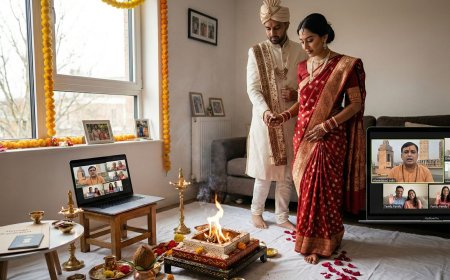
The digital doli — the vidhaayi conducted on a video call that includes the family members who cannot be physically present — is an adaptation that the NRI community has arrived at with varying degrees of self-consciousness and varying degrees of success. The video call that is an afterthought — opened during the farewell to include the grandmother in Chandigarh without prior planning or preparation — is less than the genuine adaptation. The video call that is planned as an integral part of the farewell — the grandmother in Chandigarh who has been asked to sing the specific vidhaayi song that she sang at the bride's mother's doli, whose face fills the screen at the moment of the farewell — is the adaptation at its most meaningful.
The Vidhaayi Songs: What They Are and Why They Cannot Be Replaced by a Playlist
The vidhaayi songs — the songs of the farewell — are the element of the doli that is most worth preserving in the NRI context and that is most at risk of being replaced by the general wedding playlist that the DJs provide at the reception. The vidhaayi songs are a specific genre — not the songs of the celebration, not the songs of the baraat, not the sangeet playlist — and their specificity is the expression of the doli's specific emotional register.
The Punjabi vidhaayi songs — Babul Ki Duaayen Leti Ja, Ik Pal Ke Liye, the specific songs that the grandmother's generation sang at their own vidhaayis and that were preserved in the popular music tradition of the mid-twentieth century — are the most widely known and most emotionally direct of the Indian farewell song tradition. They are songs that name the leaving with a specificity that the general wedding song cannot achieve — songs that speak to the father, to the threshold, to the specific tree in the courtyard, to the sounds of the childhood home that the bride is leaving.
The Bengali vidai songs have their own tradition — the specific songs of the bidai in Bengali, which have been set to music by the great composers of the Bengali tradition and which carry the specific emotional weight of the Bengali cultural relationship to departure and longing. The Tamil departure songs, the Marathi vidhaayi tradition, the specific regional musical expressions of the farewell — each carries the tradition's honest naming of the loss that the doli represents.
For the NRI family in Wolverhampton or Toronto or Melbourne, the preservation of the vidhaayi songs requires the deliberate effort that the tradition's preservation in any diaspora context requires: the grandmother who still knows the words must be asked to sing them before the knowledge is lost, the recording must be made while the voice is still there, the children must be taught the songs that the tradition has designated for this specific moment.
The vidhaayi songs are not replaceable by Arijit Singh's latest release or the current Bollywood wedding soundtrack. They are the specific musical vocabulary of the specific transition, and the doli conducted without them is the doli that has the emotion without the form — the crying without the words that the tradition developed to name what the crying is about.
The Specific Protocols of the NRI Doli: Who Does What and When
The Brothers' Role in the Contemporary Context
The brothers' role in the doli — the carrying, the accompanying, the final act of the natal family's men bearing the daughter to the next stage — is as significant in the contemporary context as it was in the traditional one, and the NRI family must find the form of this role that the contemporary geography allows.
The brothers who accompany the bride to the airport — who drive her there, who carry her luggage, who stand with her at the security gate — are performing the doli's essential male role in the most literal available contemporary form. The brothers who walk on either side of the bride at the extended vidhaayi, who are present at the specific moment of the formal farewell at the house, who say the specific words that the tradition designates for the brothers — these are the brothers performing the ritual role without the literal palanquin.
The NRI bride who has no brothers — who is an only child, or whose siblings are all sisters — should understand that the tradition's designation of the brothers' role reflects the family's male members as the natal family's representatives in the public act of bearing and accompanying. The male cousins, the uncles, the male friends who are close enough to the family to understand the role — these are the contemporary forms of the brothers' traditional role, and the tradition's own flexibility within the family unit makes the adaptation legitimate rather than a departure.
The Foods of the Farewell: The Natal Home in the New One
One of the most practical and most meaningful elements of the traditional doli is the food — the specific foods that the bride takes from her natal home into the new one, the specific tastes and smells that the natal family's kitchen provides and that the new home will now recreate. The mukhwas, the specific sweets, the pickle that the mother has been making for thirty years — these are the natal home's food in a portable form, the tastes that will appear in the new home and that will, in the appearing, carry the natal home into the new geography.
For the NRI bride who is flying from Wolverhampton to Toronto, the foods of the farewell must be navigated within the customs and biosecurity regulations of the destination country — the pickle may not cross the Canadian border in the form the tradition specifies. The adaptation here is the recipe — the mother's recipe for the pickle, the specific proportions and the specific technique, written down and given to the daughter at the farewell. The recipe is the natal home's kitchen in a form that the airport security can accommodate.
Common Mistakes NRI Families Make With the Doli
The first mistake is rushing the vidhaayi at the end of the reception because the logistics require it. The reception ends, the venue closes, the guests are leaving, and the doli becomes the hurried last ten minutes rather than the dedicated ceremony that the tradition intended. The NRI family who plans the extended vidhaayi as a separate event — the morning after, at the family home, with the people who understand what is happening — avoids this mistake. The doli that is rushed is not the doli. It is the ending of an event. The doli is the marking of a transition, and transitions require time.
The second mistake is not preparing the vidhaayi songs in advance. The family that discovers at the moment of the farewell that no one remembers the words to the vidhaayi songs — that the grandmother who knew them is not present, that the playlist does not include them, that the emotional moment is occurring without the musical vocabulary that the tradition developed specifically for it — is the family that has let the most culturally specific element of the doli slip away without noticing. The vidhaayi songs should be identified, sourced, recorded, and prepared months before the wedding, not improvised at the moment of departure.
The third mistake is treating the airport farewell as logistically inconvenient rather than ritually significant. The family that rushes through the airport drop-off because the parking is expensive and the terminal is busy is the family that has allowed the contemporary geography to reduce the doli to a transport arrangement. The airport farewell can be the doli in its most honest contemporary form — but it requires the family to arrive with the intention that the tradition requires, to have the specific words prepared, to treat the security gate as the threshold that it is.
The fourth mistake is not including the remote family members in the vidhaayi in a planned way. The grandmother in Chandigarh who is watching the WhatsApp live stream of the farewell while eating her lunch and doing other things simultaneously is not participating in the vidhaayi. The grandmother who has been asked to sing the vidhaayi song on the video call, whose face fills the screen at the moment of the farewell, who has prepared her words for this moment — she is participating fully. The difference is the intentionality of the inclusion.
The fifth mistake is separating the doli's emotional dimension from its ritual dimension — crying at the farewell without the ritual form, or performing the ritual form without allowing the emotional dimension to be present. The doli is both simultaneously — the ritual form that holds the emotional dimension, the ceremony that gives the feeling the shape it needs to be experienced rather than simply endured. The NRI family that conducts only the emotional dimension without the form has the feeling without the container. The family that conducts only the form without the feeling has the ceremony without the truth. The complete doli is the form and the feeling together, which is what the tradition has always known and always provided.
The Complete Reference Table: The NRI Doli — Forms, Adaptations, and Considerations
| Element | Traditional Form | NRI Adaptation | What Must Be Preserved | What Can Change | Planning Timeline |
|---|---|---|---|---|---|
| The palanquin | Literal doli; brothers carry | Symbolic carry at venue; decorated car; brothers walk alongside | Brothers' accompanying role | The literal vehicle | Discuss with family 3–6 months before |
| The destination | Marital home nearby | Airport; hotel; new city | The threshold moment | The specific destination | Accept the new geography honestly |
| The vidhaayi songs | Sung live by family women | Recorded; video call; planned playlist | Specific vidhaayi songs; not general wedding music | The medium of delivery | Source and prepare 3–6 months before |
| The timing | End of wedding ceremony | Extended next morning; dedicated farewell event | Adequate time for the ceremony | The position in the wedding sequence | Plan as separate event from reception |
| The participants | Whole community; mohalla women | Immediate family; closest friends; video call for remote | The essential family members | The scale of the gathering | Identify participants 1–2 months before |
| The brothers' role | Literal bearing of palanquin | Driving to airport; walking alongside; carrying luggage | Male presence from natal family | The literal carrying | Brief brothers specifically on their role |
| The threshold | Front door of natal home | Security gate at airport; hotel door; departure point | A specific threshold moment | The specific location | Identify the threshold in advance |
| The foods | Natal home foods into new home | Recipes; preserved items within customs rules | The transmission of the natal kitchen | The specific form of the food | Prepare recipes in advance; check customs |
| The crying | Collective; communal | Still collective; perhaps smaller group | The honest emotional acknowledgment | The scale of the collective | Do not manage the emotion; allow it |
| The words | Traditional; priest's guidance | Prepared personal words; traditional combined | Something specific said between parents and daughter | The exact traditional wording | Prepare personal words in advance |
| The grandmother's role | Present; singing | Video call; recorded voice; prepared song | The grandmother's specific participation | The physical presence | Plan the digital inclusion formally |
| The muklawa returns | Organised return visits | Planned visits; video calls; specific dates | The continuing of the relationship | The logistical form of the continuation | Plan first return visit before the doli |
What Happened at the Security Gate
The extended vidhaayi had been on the Sunday morning, which was what they had planned and which had been everything the planning had hoped for — the eight people, the songs, the brothers on either side of Simran at the front door of the Wolverhampton house, the specific hour that had been given over entirely to the farewell without the competition of the reception or the logistics or the hundred guests who did not understand what was happening.
But the moment that stayed — the moment that Simran would carry longest, the moment that her mother would describe to the extended family in Chandigarh for the months that followed — was the security gate at Birmingham Airport on the Monday morning.
Arjun had gone through first, to wait on the other side with their bags, because they had understood that the security gate was the threshold and that the threshold moment required the natal family to be on one side and the new beginning to be on the other.
Simran's mother had held her at the gate for a long time — not the embrace of the rushed farewell but the specific embrace of a woman who is consciously experiencing the last moment of a specific form of her relationship with her daughter and who is choosing to be fully present in it rather than managing it. She said, in Punjabi, the words that she had been thinking about for three months and that she had prepared and that she said now in the specific form she had prepared rather than the improvised form that the emotional moment otherwise produces. She said the words that named what was being released and what was being wished for the daughter who was about to cross the gate.
Simran's brothers stood on either side of her in the way that they had been asked to stand — the doli without the palanquin, the bearing without the literal carrying. The youngest brother, who was twenty-three and who had been trying not to cry since the mehendi, did not try not to cry at the security gate. The grandmother in Chandigarh was on the phone in Simran's mother's hand — not on video, just on the call, her voice singing the last line of the vidhaayi song that she had sung at her own daughter's farewell forty years ago.
Simran crossed the gate. The threshold was passed. The doli was complete.
Plan the extended vidhaayi as a dedicated event, not as the rushed conclusion of the reception. Identify the threshold — the security gate, the hotel door, the specific point of the genuine departure — and treat it as the threshold. Source and prepare the vidhaayi songs months in advance. Brief the brothers on their role. Include the grandmother on the call. Prepare the words that need to be said rather than relying on the improvised words of the emotional moment.
And at the threshold — wherever the contemporary geography has placed the threshold — allow the ceremony to be what the tradition has always known it to be: the honest, specific, ritually marked farewell to the self that grew up in that house, conducted with the people who made that self, in the words and the songs that the tradition developed precisely for this moment.
Published by NRIWedding.com — The Premium Global Platform for Non-Resident Indians Planning Indian Weddings From Abroad.
What's Your Reaction?
 Like
0
Like
0
 Dislike
0
Dislike
0
 Love
0
Love
0
 Funny
0
Funny
0
 Angry
0
Angry
0
 Sad
0
Sad
0
 Wow
0
Wow
0