





































































Fire, Light, and Permission: The NRI Couple's Complete Guide to Fireworks and Special Effects Permits and Planning in India
The heritage fort display that happened without a permit, the fine that arrived after the honeymoon, and the venue relationship that was damaged by an oversight nobody had taken responsibility for preventing. Fireworks and special effects at Indian weddings involve a legal and logistical complexity that is not visible from the outside and that is not consistently managed even by experienced wedding professionals. This guide delivers a complete framework covering the permit framework across PESO licensing, local authority, police, heritage property and environmental clearances, the full special effects landscape from cold sparks and drone light shows to confetti cannons and fog effects, the planning timeline that starts six months out, the non-negotiable safety requirements, the vendor assessment checklist, display design and musical synchronization, and the honest conversation about which spectacular vision is worth the specific planning commitment it requires.

Fireworks and Special Effects: Permits and Planning in India
The NRI couple's complete guide to the most visually spectacular and most legally complex element of the Indian wedding — understanding what is possible, what is permitted, what requires advance planning, and how to ensure the moment of fire and light that the occasion deserves does not become the moment everything goes wrong
The Fireworks That Did Not Have a Permit
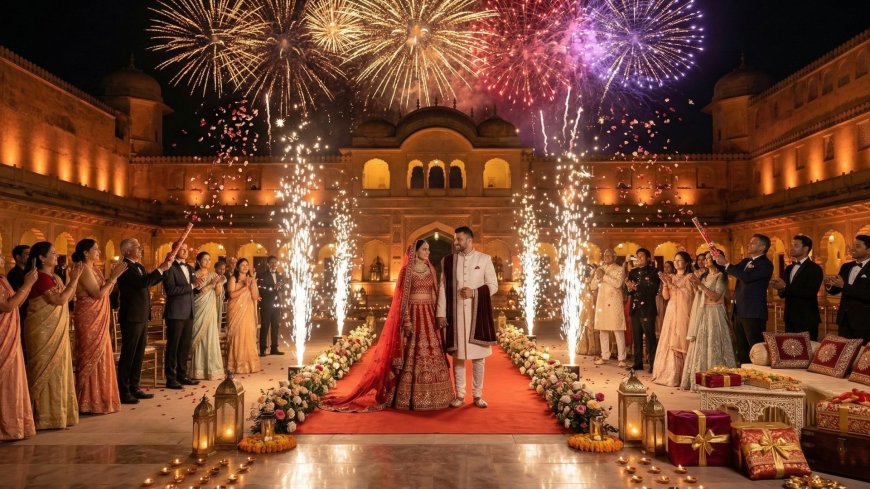
The wedding was at a heritage fort outside Jaipur. The venue was extraordinary — the kind of property that makes the planning worth every complicated moment, whose ramparts and courtyards and centuries of accumulated beauty create an atmosphere that no purpose-built wedding venue can replicate.
The couple had asked their wedding planner about fireworks. The wedding planner had spoken to the venue. The venue had said fireworks were possible. A fireworks vendor had been contacted. A price had been agreed. The fireworks had been specified — a twelve-minute display, synchronized to a specific musical sequence, timed to coincide with the couple's exit from the reception.
Nobody had applied for a permit.
This was not an oversight born of malice or negligence. It was an oversight born of the specific assumption — common in certain Indian wedding planning contexts — that the permit requirement was either not applicable, or would be managed informally, or would be handled by someone else in the chain. The vendor assumed the venue had the permit. The venue assumed the wedding planner had applied. The wedding planner assumed the vendor managed this routinely.
The fireworks happened. They were spectacular. The exit was everything the couple had imagined.
The consequences arrived later — a formal notice from the local municipal authority citing the display as unpermitted, a fine that was significant, and a specific difficulty for the heritage venue whose relationship with the local authority was important to its continued operation and whose management was understandably unhappy about the situation.
The couple were not present for the consequences. They were on their honeymoon. The consequences were managed — at cost — by people who had not been responsible for the original oversight but who were responsible for its resolution.
This story is not unusual. It is, in the specific landscape of Indian wedding fireworks and special effects, a story that recurs with variations across venues, across cities, and across the full range of the NRI wedding market — because the fireworks and special effects planning process in India involves a legal and logistical complexity that is not visible from the outside and that is not consistently managed even by experienced wedding professionals.
This guide makes it visible.
Understanding the Legal Landscape
The Permit Framework
Fireworks and pyrotechnic displays in India are regulated at multiple levels — central government, state government, and local municipal authority — and the applicable regulations vary by state, by city, by venue type, and by the specific category of fireworks being used.
The central regulatory framework: the Explosives Act of 1884 and the Explosives Rules of 2008 govern the manufacture, storage, transport, and use of explosives in India, including pyrotechnics. The Petroleum and Explosives Safety Organisation — PESO — is the central licensing authority for explosives-related activities.
The state and local overlay: state governments and local municipal authorities have their own regulations that apply in addition to the central framework — restrictions on display locations, curfew times for noise-producing activities, specific requirements for heritage property displays, and environmental restrictions that vary significantly by jurisdiction.
The practical consequence: the couple planning fireworks at a wedding in Jaipur is operating under a different regulatory environment from the couple planning fireworks in Mumbai, Udaipur, or Hyderabad — and the regulatory environment in each city has changed over time, with increasing restrictions in many urban areas in response to pollution and noise concerns.
The Permit Types
The permits required for a fireworks display at an Indian wedding typically include some combination of the following, depending on the jurisdiction and the specific display:
The PESO license: The fireworks vendor must hold a current PESO license for the handling and use of explosives. This is the vendor's responsibility, not the couple's — but the couple should verify that the vendor holds a current, valid license before any booking is confirmed. The vendor who cannot produce their PESO license documentation on request is the vendor the couple should not use.
The local authority permission: The municipal authority or the district administration must grant permission for the display — specifying the location, the date, the time, the duration, and the type of fireworks. The application for this permission is submitted by the venue or the vendor on behalf of the event, and the timeline for approval varies by jurisdiction from a few days to several weeks.
The police permission: In many jurisdictions, a public display of fireworks requires prior notification to or permission from the local police authority — typically the District Superintendent of Police or the local Station House Officer. The police permission application is typically straightforward but must be submitted in advance of the display.
The heritage property permission: For displays at heritage properties — the category that includes many of the most prestigious NRI wedding venues in Rajasthan, Madhya Pradesh, and elsewhere — additional permissions may be required from the Archaeological Survey of India or the state's heritage authority. Heritage properties have specific restrictions on the type of fireworks that can be used near historic fabric, the distance from the structure at which the display must take place, and the conditions under which permission is granted.
The environmental clearance: In cities and periods where air quality restrictions are in effect — particularly during the Diwali season and in cities under pollution emergency orders — additional environmental clearances may be required, or specific categories of fireworks may be banned entirely. The couple whose wedding falls during a period of air quality restriction in their wedding city should verify the current regulatory environment specifically, because the restrictions that applied in November of the previous year may have been extended, modified, or replaced by the time of the current wedding.
The Noise Curfew
Every Indian city and most panchayat jurisdictions have noise curfew regulations — times after which sound-producing activities above a specified decibel level are prohibited. The curfew time and the decibel limit vary by jurisdiction and by the type of area — residential zones have stricter limits than commercial zones, and the specific zone in which the wedding venue sits determines the applicable restriction.
Fireworks are among the loudest activities regulated under noise curfew provisions. The wedding whose fireworks display is timed to coincide with the midnight exit risks operating after the applicable noise curfew — particularly in urban residential areas where curfew times as early as ten in the evening are common.
The timing of the fireworks display should be confirmed against the applicable noise curfew before the programme is set — not after the display has been designed and the musical synchronization has been choreographed.
The Special Effects Landscape: Beyond Fireworks
Fireworks are the most visible and most regulated of the Indian wedding's special effects options — but they are not the only option, and several alternatives offer spectacular visual impact with significantly lower regulatory complexity.
Cold Spark Machines
Cold spark machines — devices that produce the appearance of indoor fireworks using titanium powder at a controlled temperature — are among the most popular special effects at NRI weddings and represent a significantly lower regulatory burden than traditional pyrotechnics.
Cold sparks are not technically classified as fireworks under most Indian regulatory frameworks because they do not produce the combustion temperature of traditional pyrotechnics — they can be operated at temperatures that do not set fabric or skin on fire, which is the specific characteristic that makes them appropriate for indoor use.
What cold sparks offer:
The visual impact of fireworks at close range — the fountain of sparks ascending four to six feet from the machines — synchronized with music and timed to specific programme moments such as the couple's entrance, the first dance, or the cake cutting. The possibility of indoor use — at the sangeet, at the reception — where traditional fireworks are impossible. The relatively straightforward operational requirements — no PESO license required for the specific machines, no local authority permit required in most jurisdictions, operation by a trained technician rather than a licensed pyrotechnician.
The limitations:
Cold sparks are a close-range effect — they are impressive in immediate proximity and less impressive at a distance. They are most effective as a frame or a foreground effect rather than as a sky-high display. And the couple whose vision is the fireworks display visible from the ramparts of the heritage fort will not find it in cold sparks, which is simply a different and more intimate effect.
The safety considerations:
Cold sparks are significantly safer than traditional fireworks but are not without risk. The titanium powder that produces the effect is a fine particulate that should not be inhaled in significant quantities. The machines produce heat at the point of operation. And the "cold" designation refers to the relatively low temperature of the sparks — not to the absence of any heat production. Guests, performers, and fabric should be kept at a minimum distance from operating machines, and the technician operating them should be experienced with the specific equipment.
Fountain Fireworks
Fountain fireworks — ground-based pyrotechnic effects that produce cascading showers of colored sparks from a fixed point — are a middle category between the full aerial fireworks display and the cold spark machine. They produce genuine pyrotechnic effects and require the appropriate handling and safety precautions, but their ground-based operation means they are appropriate in a wider range of venues than aerial fireworks and their regulatory requirements are typically less complex.
Fountain fireworks are particularly effective as framing effects — lining the driveway for the baraat's arrival, framing the entrance to the ceremony space, or creating a corridor of fire and light for the couple's exit. Their visual impact is significant at close range and they create the specific atmosphere of fire and celebration that is part of the Indian wedding's aesthetic vocabulary.
Smoke and Fog Effects
Smoke machines and fog systems — devices that produce atmospheric haze, ground fog, or specific directional smoke effects — are among the most versatile and most underused special effects in the Indian wedding context.
Atmospheric haze — a light, even diffusion of fine water-based vapor throughout the venue space — transforms the appearance of lighting effects, particularly pin spotting and gobo projection, by making the light beams visible. The lighting design that looks good in a clear room looks extraordinary in a hazed room, because the haze gives the light beams a physical presence and a depth that they do not have without it.
Ground fog — produced by a chilled fog machine that keeps the fog low and dense rather than allowing it to rise and diffuse — creates the specific dreamlike quality that is particularly effective for the couple's entrance and for the first dance. The fog that conceals the floor and gives the impression of the couple walking on clouds is a visual effect whose impact on the photographs and the video is significant.
Smoke and fog effects are entirely unregulated in most Indian jurisdictions — they are weather, not explosives — and their only planning requirements are technical: the appropriate machines, the appropriate fluids, a technician who knows how to operate them for the specific effect, and an awareness of the venue's smoke detection system, which may need to be temporarily disabled to prevent the fire alarm triggering in response to the artificial haze.
Confetti and Petal Cannons
Confetti cannons and petal cannons — devices that project a burst of confetti, dried petals, or biodegradable material at high velocity — are a high-impact, low-complexity special effect that works at both the intimate scale of an indoor ceremony and the grand scale of an outdoor reception.
The petal cannon is particularly resonant at an Indian wedding — the shower of rose petals or marigold petals at the couple's exit, at the baraat's arrival, or at the first dance has a specific cultural and aesthetic coherence with the Indian wedding's vocabulary of flowers and celebration.
Confetti and petal cannons are entirely unregulated, operationally straightforward, and effective in a wide range of venue contexts. Their primary planning considerations are practical: the venue's policy on confetti and petals, the cleanup requirements, and the choice of biodegradable materials if the display takes place outdoors or in an environmentally sensitive location.
Drone Light Shows
Drone light shows — coordinated displays by fleets of illuminated drones that create aerial formations and moving images in the night sky — are an emerging special effects category at the premium end of the NRI wedding market.
Drone light shows offer what traditional fireworks offer — a spectacular aerial visual display — with significant advantages in terms of environmental impact, noise production, and repeatability. They are silent, produce no smoke or particulate, and can be programmed to display specific images, patterns, or text — including the couple's names, initials, or a specific symbol that has personal meaning.
The regulatory landscape:
Drone operations in India are regulated by the Directorate General of Civil Aviation under the Unmanned Aircraft System Rules of 2021. Commercial drone operations require specific operator permissions, and displays in controlled airspace — near airports, in certain urban areas, and in certain security-sensitive zones — require additional clearances that can be complex and time-consuming to obtain.
The drone light show operator must hold the appropriate DGCA permissions for their specific fleet and operation. The couple should verify these permissions as part of the booking process — the drone operator who cannot produce current, valid DGCA documentation should not be engaged regardless of the visual quality of their demonstrations.
The Planning Timeline: What Needs to Happen When
The permit and planning timeline for fireworks and special effects at an Indian wedding is significantly longer than most couples anticipate — and significantly longer than the vendor's initial assurances may suggest.
Six to eight months before the wedding:
Confirm the venue's specific policy on fireworks and special effects. Some venues prohibit aerial fireworks entirely due to heritage restrictions or fire risk. Some venues permit only cold spark and non-pyrotechnic effects. Some venues have no restrictions but require the couple to manage all permits independently. Understanding the venue's specific position before the display is designed prevents the specific situation where the couple has planned a display that the venue cannot accommodate.
Four to six months before:
Engage the fireworks or special effects vendor. The most experienced vendors in the major Indian wedding markets are booked well in advance of peak season. The vendor engagement at four to six months provides adequate time for the permit applications and the display design.
Three to four months before:
The vendor begins the permit application process. The local authority permission, the police permission, and any heritage or environmental clearances should be applied for at this stage — not in the weeks before the wedding. The applications that are submitted three to four months before the display have adequate time for processing, for any additional information requests, and for resubmission if the initial application is returned.
Six to eight weeks before:
Confirm permit status. All permits should be in hand — not pending, not expected, but confirmed in writing — at this stage. The display that does not have confirmed permits at six weeks is the display that may not happen, and the couple who discovers this at six weeks has sufficient time to pivot to a permitted alternative. The couple who discovers it at six days does not.
Two to four weeks before:
The display design is finalized and synchronized to the musical programme. The technical requirements — the firing positions, the safety perimeter, the crew requirements — are confirmed with the venue. The safety assessment is conducted.
Two to three days before:
The venue site inspection by the fireworks crew — confirming the firing positions, assessing any changes in the venue's setup since the design was completed, and confirming the safety perimeter is achievable in the final event configuration.
The Safety Framework
The Non-Negotiable Safety Requirements
Every fireworks or pyrotechnic display at an Indian wedding requires a specific safety framework — not because Indian weddings are uniquely dangerous, but because fire and explosives in proximity to large groups of people require specific management regardless of the context.
The safety perimeter:
Every fireworks display requires a defined safety perimeter — a minimum distance between the firing position and the nearest person — that is determined by the specific fireworks being used and the specific display configuration. The perimeter must be maintained throughout the display. The guests who wander into the perimeter during the display are not adequately protected — and the display operator who does not enforce the perimeter is not operating safely.
The designated safety officer:
A designated safety officer — a person with specific pyrotechnics safety training whose sole responsibility during the display is safety monitoring rather than display operation — should be present at every fireworks display. This person's job is to watch the crowd, the perimeter, and the surrounding environment rather than the display itself — monitoring for the specific situations that require immediate intervention.
The fire suppression provision:
Adequate fire suppression equipment — fire extinguishers appropriate for pyrotechnic fires, positioned at specific points around the display area — should be available and accessible throughout the display. The venue's existing fire suppression infrastructure may not be adequate for a pyrotechnic display, and the vendor should provide specific fire suppression equipment as part of their operational setup.
The weather assessment:
Wind speed and direction affect both the safety and the visual quality of a fireworks display. High winds can carry burning material beyond the safety perimeter and can direct smoke toward the guest audience. The display should have a defined weather threshold — a maximum wind speed above which the display is postponed or cancelled — and the weather should be assessed immediately before the display rather than only in the advance planning.
The medical provision:
A first aid capability — at minimum, a trained first aider with an adequate first aid kit — should be specifically available during the fireworks display, in addition to whatever general first aid provision the wedding has in place. Burns are the specific medical risk of a fireworks display, and the first aid provision should include specific burn treatment materials.
The Vendor Assessment: Choosing the Right Provider
The Verification Checklist
Every fireworks or special effects vendor should be assessed against a specific checklist before the booking is confirmed.
PESO license: Valid, current, and applicable to the specific category of fireworks being used. Ask to see the physical license and verify its validity date.
Experience with wedding events specifically: The vendor who has experience with Diwali displays, construction celebrations, and other large public events but who has not worked in the intimate, high-density environment of a wedding reception requires specific additional assessment. The wedding display's proximity to guests and the quality requirements of the occasion are different from a public display.
Insurance: Public liability insurance covering the specific display activity. The vendor who is not insured for the display they are conducting is a vendor whose risk is being transferred to the couple and the venue.
References from comparable events: Three to five references from comparable Indian wedding events — similar scale, similar venue type — within the past twelve months.
Permit management capability: The specific question of whether the vendor manages the permit applications on the couple's behalf or whether the couple is expected to manage the permit process independently. The experienced wedding fireworks vendor manages the permits — that is part of their service. The vendor who leaves the permits to the couple is not a full-service wedding fireworks operator.
The Display Design: Creating the Right Moment
The Programme Integration
The fireworks or special effects display is most powerful when it is integrated into the wedding programme rather than appended to it — when it is the specific culmination of a specific programme moment rather than an additional spectacle that follows the programme's conclusion.
The specific programme moments that fireworks and special effects serve best:
The couple's exit: The exit under a cascade of fireworks or petal cannons — the specific moment when the wedding's last formal programme element becomes a spectacular farewell — is the most common display timing and the one whose integration into the programme is most natural.
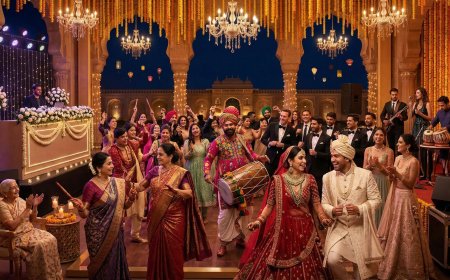
The baraat's arrival: The fireworks that greet the baraat's arrival at the venue — accompanying the dhol, the music, and the procession's energy with aerial fire — create the specific atmosphere of celebration and welcome that the baraat's arrival moment deserves.
The couple's entrance at the reception: The entrance announced by cold sparks or fountain fireworks — framing the couple's arrival in fire and light — creates a visual spectacle whose impact on both the live experience and the photographs is significant.
The midnight moment: A defined midnight moment — marked by a fireworks display or a drone light show that creates a specific shared experience for the assembled guests — is a design decision that gives the evening a specific peak whose memory is lasting.
The Musical Synchronization
The fireworks or special effects display synchronized to music — where specific effects are timed to specific musical moments — is significantly more impactful than the same display without synchronization. The shell that bursts on the final beat of the musical climax is a different experience from the shell that bursts slightly before or after it.
The musical synchronization requires: a specific audio track provided to the display operator in advance, a cue sheet that maps specific effects to specific musical moments, and the technical capability to fire effects on specific cues rather than on a general timer. Not all vendors have this capability. The couple who wants a synchronized display must confirm the vendor's synchronization capability as part of the briefing process.
The Conversation About What Is Worth It
The fireworks display — the full aerial show visible from the heritage fort's ramparts — is one of the most visually spectacular elements of any Indian wedding. It is also among the most logistically complex, most permit-dependent, and most expensive of the available special effects options.
The couple who is planning fireworks for their NRI wedding should have a specific conversation about whether the display they are imagining is achievable in the specific venue, in the specific city, in the specific regulatory environment of the specific date — and whether the investment of time, cost, and complexity produces the specific moment they are imagining.
The cold spark machine at the couple's entrance, the petal cannon at the exit, the ground fog at the first dance, the atmospheric haze that transforms the lighting design throughout the evening — these are the effects that produce consistent, high-quality impact across a wide range of venues and circumstances, without the regulatory complexity and the permit risk of the full aerial display.
The aerial fireworks display at the heritage fort in Jaipur, synchronized to a twelve-minute musical sequence, visible from the ramparts against the Rajasthani night sky — this is the specific, extraordinary, unreplicable moment that no cold spark machine produces.
Both are legitimate visions. The planning commitment they require is different. The permit requirement is different. The risk profile is different.
Know which one you are planning for. Then plan for it specifically, completely, and early enough that the moment arrives as imagined rather than as a story about what was supposed to happen.
NRIWedding.com — Expert guidance for Indian weddings planned across borders.
What's Your Reaction?
 Like
0
Like
0
 Dislike
0
Dislike
0
 Love
0
Love
0
 Funny
0
Funny
0
 Angry
0
Angry
0
 Sad
0
Sad
0
 Wow
0
Wow
0