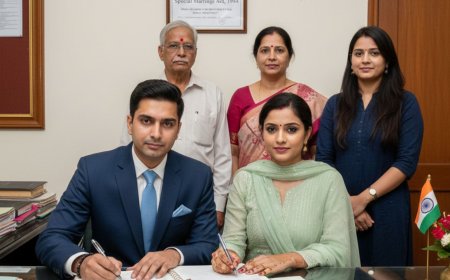








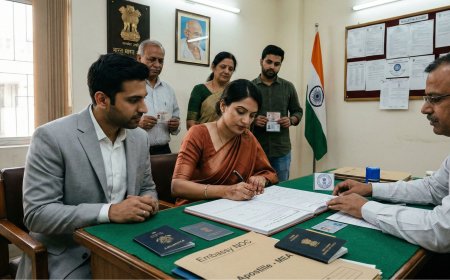






































































Marriage Registration Timeline — How Long Does Each Step Actually Take for NRI Couples?
Most NRI couples dramatically underestimate how long the complete marriage registration and apostille process takes — and discover the gap only when a visa application or immigration process requires a document that does not yet exist. This complete guide breaks down every stage of the marriage registration and apostille timeline for NRI couples — from Hindu Marriage Act and Special Marriage Act registration through state authentication, MEA apostille, certified translation, and international courier — with realistic stage-by-stage processing times, state-level variation, best-case and worst-case scenarios, and the common mistakes that extend an already long process into one that misses critical immigration and administrative deadlines.

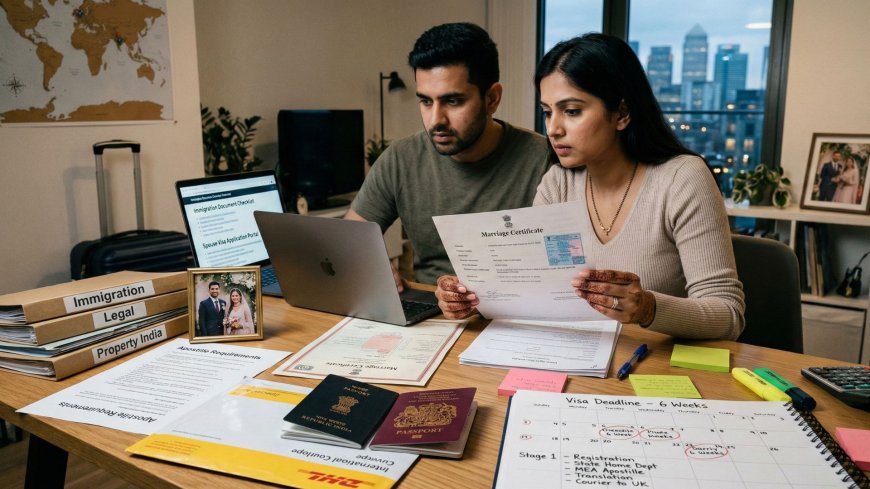
The Question You Ask When You Realise How Little Time You Have
It starts with a conversation you were not expecting.
The visa application form is open on your laptop. Or the HR portal for the dependent visa process. Or the immigration lawyer's intake questionnaire. And somewhere in the list of required documents — between the passport copies and the proof of address and the financial statements — there it is.
Marriage certificate. Apostilled. Issued by a recognised government authority.
You look at your partner. Your partner looks at you. The wedding was six weeks ago. The ceremony was extraordinary. The photographs are still being edited. And the marriage certificate — the actual government-issued legal document, apostilled and ready for international use — does not yet exist.
How long is this going to take?
The answer, as NRI couples discover consistently and often painfully, is longer than they expected. Not because the process is impossibly complex. Not because Indian bureaucracy is uniquely obstructive. But because the process has multiple sequential stages, each with its own timeline, each dependent on the completion of the one before it — and the cumulative timeline of all those stages, end to end, is significantly longer than most couples factor into their post-wedding planning.
The marriage registration timeline is one of the most consequential and most consistently underestimated planning challenges in the entire NRI post-wedding process. Couples who planned meticulously for the wedding itself — who tracked vendor payments to the day and managed family logistics across time zones with spreadsheet precision — arrive at the post-wedding administrative process without a timeline, without a plan, and without the awareness that a visa application or immigration process they were planning to begin in six weeks depends on a document that takes twelve to sixteen weeks to produce.
This guide fixes that.
It gives you the complete, realistic, stage-by-stage timeline for the entire marriage registration and apostille process — from the day the wedding ceremony takes place to the day the apostilled marriage certificate is in your hands and ready for use in any international context.
Every stage is examined honestly — not the best-case timeline that assumes everything goes right, but the realistic timeline that accounts for the normal delays, the state-level variation, the processing backlogs, and the specific logistical challenges that NRI couples face managing this process from abroad.
Because knowing how long each step actually takes is the foundation of planning it correctly — and planning it correctly is the difference between having your documents ready when you need them and discovering their absence at the worst possible moment.
The Core Reality: Why the Timeline Is Longer Than You Think
The Sequential Dependency Problem
The marriage registration and apostille process is not a single step. It is a chain of sequential steps — each dependent on the completion of the one before it — with no ability to skip ahead or run stages in parallel.
You cannot begin state authentication before you have the marriage certificate. You cannot submit to the MEA for apostille before state authentication is complete. You cannot use the apostilled certificate for a visa application until the apostille is in hand.
Each stage has its own processing time. Each stage has its own points of failure — wrong documents, office closures, processing backlogs, administrative errors — that reset the clock rather than simply pausing it. And the cumulative timeline of a chain of sequential processes, each with its own realistic range of processing times, is significantly longer than any individual stage suggests.
The State-Level Variation Problem
Marriage registration in India is administered at the state level — and processing times vary significantly between states. What takes seven working days in Maharashtra may take twenty-one working days in Uttar Pradesh. What the Maharashtra Home Department processes in ten days may take the Rajasthan Home Department six weeks.
Generic timeline guidance — which does not account for state-level variation — consistently underestimates real-world processing times for couples whose registration is in slower-processing states.
The NRI Logistics Problem
NRI couples face an additional layer of timeline complexity that domestic couples do not. Documents must be physically present in India at the right stage — which means international courier timelines must be factored into every stage where documents need to move between the couple abroad and authorities in India. Physical appearances — where required — must be timed around India visits. Representatives managing the process on behalf of the couple must be briefed, available, and reliable.
Every NRI-specific logistical step adds time to a process that is already sequential and already variable.
The Complete Stage-by-Stage Timeline
Stage 1 — The Marriage Registration
What it is: The formal registration of the marriage with the relevant Indian government authority — the Registrar of Marriages for the relevant act and district.
The two registration tracks:
Track A — Hindu Marriage Act Registration More straightforward process, faster timeline, suitable for same-religion Hindu couples.
• Appointment scheduling: one to three working days in most states
• In-person appearance: both parties must appear with witnesses
• Document verification: typically completed on the day of appearance
• Certificate issuance: same day to fifteen working days depending on state
Realistic timeline for Track A: four to twenty-one working days from initiation to certificate in hand.
Track B — Special Marriage Act Registration More complex process, mandatory waiting period, produces more internationally portable documentation.
• Thirty-day prior residency requirement: must be met before notice can be filed
• Notice filing: one to three working days after residency is established
• Mandatory thirty-day notice period: thirty calendar days — this is a legal minimum and cannot be shortened
• In-person appearance after notice period: within a few days of notice period expiry
• Certificate issuance: same day to ten working days after appearance
Realistic timeline for Track B: sixty-five to eighty working days from commencement of residency to certificate in hand — or approximately ten to twelve weeks minimum.
The state variation reality:
Certificate issuance times vary enormously by state. The following gives a realistic sense of variation:
• Maharashtra, Delhi, Karnataka: typically faster — certificate often issued same day or within five working days
• Uttar Pradesh, Bihar, Rajasthan, Madhya Pradesh: typically slower — ten to twenty-one working days is common
• Smaller district offices in any state: potentially slower than state capital offices due to lower staffing and higher relative workload
NRI-specific complication — the in-person appearance requirement:
Both parties must typically appear in person before the registering authority. For NRI couples who return abroad quickly after the wedding, this requirement means either completing registration before departure or making a specific return visit. The cost of a return India visit specifically for registration — in flights, accommodation, and time — is a real timeline and financial consideration.
The representative option:
Some states and some registration acts allow a duly authorised representative — holding a notarised power of attorney — to appear on behalf of one or both parties. This option is not universally available — it varies by state and by the specific act under which registration is sought. Verify availability with a local advocate before relying on it.
Cumulative timeline from wedding day to certificate in hand:
• Track A, faster states: one to two weeks
• Track A, slower states: two to four weeks
• Track B, any state: ten to twelve weeks minimum from residency commencement
Stage 2 — Obtaining Certified Copies
What it is: Requesting and receiving certified copies of the marriage certificate from the registering authority — in sufficient numbers for all subsequent uses.
Why it matters for timeline:
Certified copies are required for multiple subsequent stages and multiple parallel processes. If insufficient copies are obtained at registration, subsequent copy requests add time to the overall process — particularly if the registering authority has processing backlogs for copy requests.
Timeline for certified copy issuance:
• Same day as registration in many cases — if requested at the time of registration
• One to five working days if requested after the fact — in most states
• Up to ten to fifteen working days in slower-processing states or for older registrations requiring archive retrieval
NRI recommendation: Request minimum five to eight certified copies at the time of registration. The marginal cost of additional copies at this stage is minimal. The timeline cost of requesting additional copies later — particularly from abroad — can be significant.
Cumulative timeline from wedding day to certified copies in hand:
• Best case: same day as registration
• Typical case: registration timeline plus two to five working days
• Slower states: registration timeline plus ten to fifteen working days
Stage 3 — State-Level Authentication
What it is: The first stage of the apostille process — authentication of the marriage certificate by the State Home Department or equivalent state authority in the state where the certificate was issued.
Why it comes before MEA apostille:
The MEA cannot apostille a document whose issuing authority's signature and seal it has not verified. The state authentication certifies that the registering authority's signature and seal on the certificate are genuine — which is what the MEA then apostilles for international recognition.
The state authentication process:
• Submission of original marriage certificate and required supporting documents to the State Home Department
• Processing and verification by the state authority
• Authentication sticker or endorsement affixed to the original certificate
• Return of authenticated certificate
Processing times by state:
This is where state-level variation has its most significant timeline impact.
• Maharashtra — State Home Department, Mumbai: typically seven to ten working days
• Delhi — Home Department: typically seven to fourteen working days
• Karnataka — Home Department, Bengaluru: typically ten to fifteen working days
• Tamil Nadu — Chennai: typically ten to fifteen working days
• Andhra Pradesh and Telangana: typically ten to twenty working days
• Gujarat: typically seven to fourteen working days
• Rajasthan, UP, Bihar, MP: typically fifteen to thirty working days — longer periods reported in backlogs
The physical submission requirement:
State authentication requires physical submission of the original certificate. For NRI couples managing from abroad, this means either:
• Completing the submission during the India visit before departing
• Couriering the original certificate to a representative in India for submission — adding international courier time
• Engaging a professional document services agency to handle submission
International courier time consideration:
If the original certificate needs to be couriered from abroad to India for state authentication submission — a common scenario for NRI couples who have returned abroad before initiating the process — add:
• International courier from UK/USA/Canada/Australia to India: typically three to five working days
• Receipt and processing time for the representative: one to two working days
Cumulative timeline from wedding day to state-authenticated certificate:
• Best case — submission during India visit, faster states: three to five weeks from wedding
• Typical case — courier from abroad, average states: five to eight weeks from wedding
• Slower states with courier: seven to ten weeks from wedding
Stage 4 — MEA Apostille
What it is: The Ministry of External Affairs apostille — the internationally recognised certification that authenticates the state-authenticated marriage certificate for use in all Hague Convention member states.
The submission options:
Direct MEA Authentication Section submission: Physical submission at a MEA Authentication Section office — New Delhi, Mumbai, Chennai, Kolkata, Hyderabad, Goa, Chandigarh, or Bhopal.
Processing time at MEA Authentication Sections: typically three to five working days from submission to apostilled certificate ready for collection.
VFS Global Document Authentication Centres: MEA-authorised external service provider centres available in multiple cities across India.
Processing time through VFS Global centres: typically seven to fifteen working days from submission.
Online initiation through MEA e-Sanad portal: Reduces administrative burden but still requires physical document submission at a MEA centre or VFS Global location. Does not reduce processing time — streamlines the application management process rather than the physical processing time.
The physical submission to MEA requirement:
Like state authentication, MEA apostille requires physical submission of the state-authenticated original certificate. For NRI couples whose representative in India is managing the process:
• State-authenticated certificate moves from state authority to MEA submission point — typically same city or different city within India
• Domestic courier within India: typically one to three working days
The return of the apostilled document:
Once the apostille is affixed, the document must be collected or couriered:
• Collection from MEA or VFS Global centre: zero additional time
• Domestic courier to Indian address: two to four working days
• International courier from India to NRI abroad: three to seven working days
Cumulative timeline from state authentication to apostilled certificate in NRI hands abroad:
• Best case — direct MEA submission, fastest processing: one to two weeks from state authentication completion
• Typical case — VFS Global, domestic courier, international courier: three to four weeks from state authentication completion
• Slower processing plus courier delays: four to six weeks from state authentication completion
Stage 5 — Certified Translation (Where Required)
What it is: For countries that require a certified English translation of the Indian marriage certificate alongside the apostille — the UK, USA, Canada, and Australia all commonly require this — a translation by a certified translator must be obtained.
When it is required:
• Any certificate that contains text in an Indian language — Hindi, Marathi, Tamil, Telugu, Kannada, or any other regional language
• Most Indian marriage certificates contain some text in the state's official language alongside English text
• Verify with the specific receiving authority whether translation is required
How to obtain a certified translation:
• Certified translators are available in both India and in the NRI's country of residence
• For UK immigration purposes: the translation must be by a professional translator who certifies that it is an accurate translation
• For USCIS purposes: the translator must certify competency and accuracy
• Translation services that specialise in Indian legal documents are available in all major NRI cities
Processing time for certified translation:
• Typically three to seven working days for a standard marriage certificate translation
• Rush processing available from most services: one to two working days at premium cost
This stage can be run in parallel with Stage 4:
If a scanned copy of the state-authenticated certificate is available before the apostille is affixed, the translation can be initiated during Stage 4 processing — reducing total cumulative timeline by the translation processing time.
The Complete Realistic Timeline: End to End
The following timeline table gives a realistic view of the complete process from wedding day to apostilled and translated certificate ready for use.
Best-Case Scenario — Favourable Conditions Throughout
Conditions: Track A registration, faster state, submission managed during India visit, direct MEA submission, no courier delays.
• Stage 1 — Registration: one to five working days
• Stage 2 — Certified copies: same day
• Stage 3 — State authentication: seven to ten working days
• Stage 4 — MEA apostille: three to five working days
• Stage 5 — Translation (parallel with Stage 4): three to five working days
• Document in NRI hands: three to seven working days after Stage 4 completion
Total best-case timeline: approximately five to seven weeks from wedding day
Typical Scenario — Average Conditions
Conditions: Track A registration, average state processing times, some courier involvement, VFS Global MEA submission.
• Stage 1 — Registration: seven to fourteen working days
• Stage 2 — Certified copies: three to five working days
• Stage 3 — State authentication: fourteen to twenty working days plus courier
• Stage 4 — MEA apostille: seven to fifteen working days plus courier
• Stage 5 — Translation: three to seven working days
• Document in NRI hands: five to seven working days after Stage 4 completion
Total typical timeline: approximately ten to fourteen weeks from wedding day
Challenging Scenario — Slower States, Complications, NRI Remote Management
Conditions: Slower state, courier delays, processing backlog, document correction required at any stage.
• Stage 1 — Registration: fourteen to twenty-one working days plus complication resolution
• Stage 2 — Certified copies: five to ten working days
• Stage 3 — State authentication: twenty to thirty working days plus courier
• Stage 4 — MEA apostille: fifteen to twenty working days plus courier
• Stage 5 — Translation: three to seven working days • Document in NRI hands: seven to ten working days after Stage 4 completion
Total challenging scenario timeline: approximately sixteen to twenty-four weeks from wedding day
Special Marriage Act Track
For couples registering under the Special Marriage Act, add sixty-five to eighty working days — approximately ten to twelve weeks — before Stage 1 certificate issuance. All subsequent stages follow the same timelines as above.
Total Special Marriage Act timeline: approximately twenty to thirty weeks from commencement of residency
Country-Specific Urgency Context: How Long You Actually Have
Understanding the end-to-end timeline only matters in the context of how urgently you need the apostilled certificate. The following gives realistic urgency context for the most common NRI post-wedding uses.
UK Spouse Visa Application
If one partner needs to join the other in the UK through a spouse visa application, the apostilled marriage certificate is a mandatory document. UK spouse visa processing times are currently eight to twelve weeks from complete application submission.
Critical timing: If the spouse visa application needs to be submitted within four months of the wedding, the apostille process must begin immediately — ideally within the first week after returning from India. Any delay in initiation creates risk of a complete timeline miss.
US Marriage-Based Green Card
The marriage-based green card process requires the apostilled marriage certificate for the I-130 petition. Given green card processing times of eight to twenty-four months, the urgency of having the certificate early is high but the absolute deadline is more forgiving than the UK spouse visa.
However — incomplete applications are returned by USCIS, and the absence of the marriage certificate delays the initiation of what is already a long process. Beginning immediately remains strongly recommended.
Canadian Spousal Sponsorship
Canadian spousal sponsorship processing times are currently twelve to twenty-four months. The marriage certificate is required at application submission. As with the US process, earlier initiation is significantly better than later.
Employer and HR Requirements
Many NRI employers require marriage documentation for HR system updates, insurance beneficiary changes, and dependent visa support letters. These requirements typically have administrative deadlines rather than hard legal deadlines — but delays in meeting them create inconvenience and administrative complications.
Name Change Applications
In the UK, updating the driving licence requires an updated passport — and updating the passport after a name change requires the marriage certificate. These cascading dependencies mean that delays in the marriage certificate delay every downstream document update.
Common Mistakes NRI Couples Make With the Timeline
Not Beginning the Process Before Leaving India
The most consequential timeline mistake. Every day of delay in initiating the registration process — during the India visit, before returning abroad — adds to a cumulative timeline that is already long.
The couples who begin registration on the day after the wedding — who have the appointment scheduled in advance, who arrive at the registrar's office with all documents ready, who submit to state authentication before leaving India — are the couples who receive their apostilled certificates in ten to twelve weeks rather than eighteen to twenty-four.
Correction: Schedule the marriage registration appointment before the wedding day. Have all documents prepared before arriving at the appointment. Submit to state authentication before returning abroad if at all possible.
Underestimating State Processing Variability
Couples who build their timeline based on the fastest-state processing times — because those are the times most commonly cited in online resources — consistently discover that their specific state takes significantly longer.
Correction: Research the specific processing time for the specific state where registration is taking place — not the national average. Contact the relevant state Home Department or consult a local advocate for current realistic processing times before building the timeline.
Not Factoring in Courier Times
Each physical document movement in the process — from India to abroad, from abroad to India, within India between authorities — takes time that is not always visible in stage-by-stage timeline estimates.
For NRI couples managing the process from abroad, courier times between international courier legs of three to five working days each can add two to three weeks to the overall process if not factored in explicitly.
Correction: Map every document movement in the process and assign a realistic transit time to each. Include international courier time, domestic India courier time, and the time for a representative to receive, check, and act on each document.
Submitting Documents With Errors That Cause Rejection
Documents submitted with discrepancies — name spelling variations between the certificate and the passport, incorrect dates, missing seals — are rejected at state authentication or MEA apostille and returned for correction. Each rejection resets the clock for that stage.
Correction: Before submitting at any stage, verify that every detail on the marriage certificate matches exactly the details on the passports and other identity documents of both parties. Any discrepancy should be resolved with the registering authority before initiating the apostille process.
Planning a Post-Wedding Timeline Without Building in the Registration Process
Many NRI couples plan their post-wedding life — spouse visa timeline, name change timeline, property decisions, return to work schedules — without factoring in the marriage registration and apostille process. The result is an immigration or administrative timeline that depends on a document that will not be ready when it is needed.
Correction: Build the marriage registration and apostille timeline as the first and most foundational element of the post-wedding planning process. All other timelines that depend on the marriage certificate should be built around the realistic document-ready date — not the other way around.
The Expedited Options: When You Need It Faster
Professional Document Services Agencies
Professional agencies that specialise in document authentication and apostille services for NRI clients can reduce the timeline at Stage 3 and Stage 4 through established relationships with authentication authorities and priority processing channels where available.
Realistic time saving through professional agencies: typically two to three weeks versus self-managed process through standard channels.
Cost: ₹8,000–₹20,000 above standard government fees for priority service.
What they cannot speed up: the mandatory thirty-day notice period under the Special Marriage Act, the state registration processing time where fixed by the registering authority, and international courier transit times.
Tatkal Passport and Emergency Services
In cases of genuine emergency — a medical situation, an immediately critical visa deadline — Indian missions abroad can process certain documents on an expedited basis. This is the exception rather than the rule and requires documented justification of the emergency.
Pre-Wedding Initiation of the Special Marriage Act Process
For couples who have planned sufficiently in advance, initiating the Special Marriage Act notice process before the wedding — during a pre-wedding India visit — eliminates the ten to twelve week Special Marriage Act waiting period from the post-wedding timeline entirely. The registration can be completed during the wedding visit, with the certificate ready for state authentication immediately after the ceremony.
The Marriage Registration Timeline Checklist
Before the Wedding
• Choose registration track — Hindu Marriage Act or Special Marriage Act
• If Special Marriage Act: initiate thirty-day residency and file notice during pre-wedding visit
• Schedule registration appointment at registrar's office — before wedding day
• Prepare all documents for registration — passports, address proof, witness details
• Identify state authentication authority for the wedding state
• Research current processing times for state authentication in the wedding state
• Identify professional document services agency if self-management is not feasible
• Research current MEA processing times and VFS Global centre locations
During the India Wedding Visit
• Complete marriage registration — on scheduled appointment day
• Obtain minimum five to eight certified copies on the day of registration
• Verify all details on certificate match passport details exactly before leaving the registrar's office
• Submit to state authentication before departing India if timeline allows
• If state authentication not possible before departure — leave original certificate with trusted representative for submission
After Returning Abroad
• If original certificate is with representative in India — confirm submission to state authentication within first week
• Set up tracking for state authentication processing
• Initiate certified translation process using scanned copy of certificate if translation will be required
• Book international courier service for return of apostilled certificate to address abroad
• Build all dependent timelines — visa applications, name change, HR updates — around realistic apostilled certificate ready date
On Receiving Apostilled Certificate
• Verify all details on apostille sticker match certificate and passport details
• Verify apostille on MEA online verification portal
• Store original securely — physical and digital copies in cloud storage
• Begin all dependent processes that were waiting for the apostilled certificate
Build the Timeline Before You Need It
The marriage registration and apostille process is not the most emotionally significant part of an NRI marriage. It is not the ceremony or the celebration or the beginning of a life together. It is administration — necessary, sequential, time-consuming administration.
But it is the administration on which every subsequent important process depends. The visa that reunites you in your country of residence. The name change that completes your new identity. The immigration status that secures your right to remain. The estate planning that protects everything you are building together.
All of it waits for the apostilled certificate. And the apostilled certificate waits for the chain of sequential stages that this guide has mapped — with their realistic timelines, their state-level variability, their NRI-specific logistical complications, and their cumulative end-to-end duration of ten to twenty-four weeks under typical conditions.
Know the timeline before you need the document. Build every dependent process around the realistic completion date. Begin the registration process on the day after the wedding — not the week before the visa application is due.
The certificate will come. The apostille will follow. The documents will be ready.
But only if the process begins early enough for them to be.
Start now.
Published by NRIWedding.com — The Premium Global Platform for Non-Resident Indians Planning Indian Weddings From Abroad.
What's Your Reaction?
 Like
0
Like
0
 Dislike
0
Dislike
0
 Love
0
Love
0
 Funny
0
Funny
0
 Angry
0
Angry
0
 Sad
0
Sad
0
 Wow
0
Wow
0