






















































Beyond the Buffet Line: The NRI Couple's Complete Guide to Food Stations, Live Counters and Interactive Bars at Indian Weddings
The most memorable moments at Indian weddings are rarely the ones that were formally programmed — they are the ones that happened around a live dosa station, a pani puri counter, or a freshly opened dum biryani pot. This guide gives NRI couples a complete framework for designing food presentation formats that transform wedding catering from a service transaction into a guest experience. From live chaat counters and tandoor stations to mithai trolleys and chai bars, learn exactly which formats work, where to position them, how to staff them, and how to integrate them into your overall wedding aesthetic.

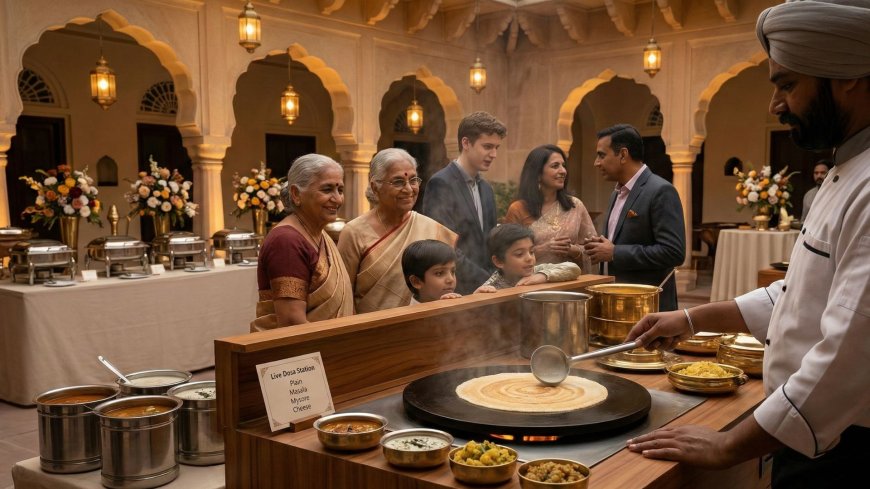
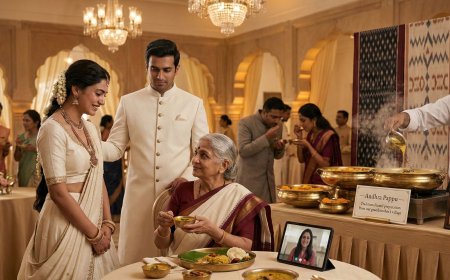
The Moment the Dosa Station Changed the Entire Reception
It was not what anyone expected to be the highlight of a wedding that had cost a significant amount of money to produce. The florals were extraordinary. The lighting was the work of someone who clearly understood what they were doing. The venue — a restored haveli in the old city — had taken years of renovation to reach its current state of quiet, considered beauty.
And then the dosa counter opened.
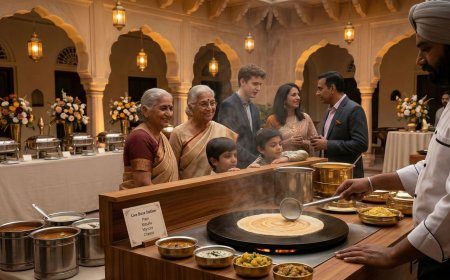
A single skilled cook, a well-seasoned iron tawa, a batter prepared over thirty-six hours, and a selection of fillings that included preparations the guests had not seen at a wedding before. Nothing elaborate. Nothing that required explanation in a press release or a concept note. Just the sight and sound and smell of fresh dosas being made — the hiss of batter hitting the hot surface, the thin crepe forming and crisping at the edges, the folding and plating that happened with the practiced ease of someone who had made ten thousand dosas before this one.
Within fifteen minutes, the dosa station had the longest queue in the room. Within thirty, it had become the social center of the reception — the place where conversations started between strangers, where family members who had not seen each other in years ended up standing together, where children who had been restless at their tables discovered something that required their full attention.
The caterer had suggested it almost as an afterthought during the planning meeting. The couple had agreed with mild enthusiasm and no particular expectation. It became the thing every guest mentioned when they described the wedding.
This is what thoughtful food presentation does when it is understood not as a catering logistics decision but as a hospitality and atmosphere design decision. It creates moments. It creates connection. It creates the kind of specific, sensory memory that stays associated with your wedding long after the flowers have wilted and the music has faded.
This guide gives you the framework to design food presentation that does exactly this.
Why Presentation Format Matters as Much as Food Quality
Most wedding food discussions center on menu composition — what is being served, from which regional tradition, with what level of authenticity and quality. These are the right questions. They are not the only questions.
How food is presented and served affects the guest experience in ways that are as significant as what is being served. A beautifully prepared biryani served from a hotel chafing dish behind a standard buffet line produces a different experience than the same biryani served from a sealed dum pot opened tableside — even if the food inside is identical. The theatre of the presentation, the sensory engagement, the human interaction involved in the service — these shape how the food is perceived and remembered.
For NRI couples whose weddings draw guests from multiple countries and cultural backgrounds, food presentation formats serve an additional function: they create points of engagement and education that help international guests navigate an unfamiliar culinary environment with curiosity rather than uncertainty. A live station with an attendant who can explain what they are preparing, describe the flavors, and guide guests through the experience transforms a potentially intimidating encounter with unfamiliar food into a genuinely enjoyable one.
And for weddings where the guest experience and the overall atmosphere are being designed with genuine intention, food presentation is one of the most powerful tools available — one of the few hospitality elements that engages all the senses simultaneously and creates organic social moments that no amount of formal event programming can manufacture.
The Standard Buffet: Why It Remains the Foundation
Before exploring alternatives and additions, an honest assessment of the standard buffet — which remains the predominant service format at Indian weddings for sound operational reasons.
The buffet works. It accommodates large guest counts efficiently. It allows guests to self-select portions and return for favorites. It scales to any number of dishes without proportional increases in service complexity. It is familiar, non-intimidating, and operationally reliable across the range of venues and catering teams that Indian weddings use.
The critique of the buffet is not that it does not work — it is that it does nothing beyond working. It is a neutral service format whose quality is entirely a function of the food it contains. It creates no atmosphere, no theatre, no organic social moments, no engagement beyond the logistics of moving through a queue and selecting from a spread.
For NRI couples who have thought carefully about guest experience and who are willing to invest in presentation alongside the menu itself, the buffet is not a replacement candidate — it is a foundation that live stations, interactive counters, and specialty bars are built alongside and on top of. The combination of a well-managed buffet for the main course spread and two or three carefully designed live stations for specialty preparations represents the approach that produces the best results across both operational reliability and experiential quality.
Live Stations: The High-Impact Presentation Format
A live station is any food presentation format where a skilled attendant prepares, finishes, or serves food in front of guests — creating a visible, active production that guests watch, engage with, and often photograph. It is the format with the highest potential for atmosphere creation and the deepest integration of food into the overall event experience.
The Chaat Station
The Indian chaat station is perhaps the most universally successful live station format for Indian weddings. Chaat — the category of savory snack preparations that spans everything from pani puri and bhel puri to aloo tikki and dahi papdi — is street food at its most social, most theatrical, and most immediately engaging.
A well-operated chaat station does several things simultaneously. It provides the highest-quality version of these dishes — made fresh, to order, with the specific balance of sweet, sour, spicy, and tangy that each preparation requires — compared to a pre-made version sitting in a chafing dish. It creates a production that guests find immediately engaging, because the assembly of a good pani puri or the layering of a dahi bhalla involves visible craft. And it creates a social gathering point — the chaat station queue is invariably a conversation starter, because standing together watching something being made and then eating it immediately produces a shared experience that seated buffet service does not.
For international guests who may not be familiar with chaat, the live station format with an attendant who can explain each preparation is the most effective introduction to this category of Indian food. The personal guidance, the ability to ask questions, the option to try a small amount before committing to a full portion — these remove the uncertainty that can make unfamiliar food formats intimidating.
The Dosa and Appam Station
The live South Indian station — dosa, uttapam, or appam made fresh on a seasoned tawa or appam pan — produces the dosa-station moment described at the opening of this article with reliable consistency across different wedding contexts.
The reasons are multisensory. The sound of batter hitting hot iron and sizzling as it spreads. The visual transformation from liquid batter to thin, golden crepe in real time. The smell of fresh dosa — the particular combination of fermented batter and hot iron — which is among the most appetizing cooking smells in the Indian culinary lexicon. And then the immediate eating — the crisp dosa with sambar and chutney, the temperature contrast between the hot crepe and the cool accompaniments.
This station works at a completely different register from a standard buffet. It is an experience, not a service transaction. And it is one of the relatively few food experiences that produces genuine multi-generational engagement — elderly guests who grew up eating fresh dosa recognize it with the particular joy of encountering something familiar in an unexpected place, while younger international guests encounter it as something genuinely new and extraordinary.
The Kebab and Tandoor Station
A live tandoor station — where a skilled cook manages the tandoor oven and produces fresh kebabs, naan, or other tandoor preparations throughout the service — brings a visual and sensory element that is unique to this cooking method. The sight of the tandoor itself, the management of the fire, the skewering and lowering of kebabs into the heat, and the emergence of charred, fragrant preparations from the oven — this is theatre that no other cooking method in the Indian culinary tradition replicates.
For non-Indian guests, the tandoor is often a revelation — most international guests have encountered tandoor-cooked food in Indian restaurants but have never seen the actual tandoor or the cooking process. The live station context transforms their relationship with these dishes from food they order to food they watch being made, which fundamentally changes how they experience eating it.
Operational note: the tandoor station requires specific venue considerations. The tandoor produces significant heat and requires ventilation management. Not every venue can accommodate a live tandoor. Confirm the venue's capacity for this setup before planning around it.
The Biryani Dum Counter
The dum biryani service — where individual or shared portions of biryani are sealed under a pastry crust or dough seal during the final cooking stage and opened tableside or at a service counter — is one of the most dramatically effective food presentation moments available at an Indian wedding.
The opening of the dum pot releases the accumulated steam and fragrance in a single moment — a cloud of spiced steam carrying the specific aromatics of the biryani preparation, saffron and whole spices and slow-cooked meat or vegetables. For guests who are nearby when a dum pot is opened, this is a sensory experience that precedes the eating and creates anticipatory engagement with the dish before it has even been plated.
The dum opening can be timed as a theatrical moment during the reception — an MC announcement that the biryani service is beginning, a deliberate gathering of guests around the service counter, the simultaneous opening of multiple dum pots. This is a presentation decision that transforms a food service moment into a wedding reception event.
The Pani Puri Counter
The pani puri — or golgappa or puchka, depending on the regional tradition — service counter is a format with almost unique social dynamics. The eating of pani puri is itself theatrical: the small hollow puri, the filling of potato and chickpea, the ladling of the cold spiced water, and the requirement to eat the entire thing in one mouthful. It is a food experience that cannot be eaten elegantly, which is exactly why it produces the social moments it does.
A pani puri counter at a wedding reception creates a space where formality collapses. Guests of all backgrounds — whether or not they are familiar with pani puri — approach the counter, receive instruction, attempt the eating, succeed or fail with good humor, and in the process connect with whoever is standing next to them in the queue. The social leveling effect of a food that requires you to be slightly undignified to eat it properly is genuinely significant.
For NRI weddings where the guest list includes people who do not know each other, the pani puri counter is one of the most reliable social integration tools available.
Dessert Presentations: Beyond the Mithai Table
The Live Jalebi Station
Fresh jalebi — the coiled, syrup-soaked deep-fried sweet made live over a karai of hot oil — is one of the most visually engaging food productions at any Indian wedding. The skill of the jalebi maker — the precise pouring of batter in the characteristic spiral pattern, the management of the oil temperature, the immersion in warm syrup — is immediately apparent as a craft, and the eating of fresh, hot jalebi is one of those food experiences that genuinely cannot be replicated by a pre-made version sitting on a dessert table.
A live jalebi station is best positioned in the later part of the reception, when the dinner service has wound down and the dancing is in full momentum. The appearance of fresh, hot jalebi at this point in the evening — accompanied perhaps by rabri or ice cream — creates a late-night food moment that re-energizes the reception and produces a specific, end-of-evening memory.
The Kulfi and Ice Cream Counter
A live kulfi service — with traditional matka kulfi served by an attendant from clay pots, or a selection of Indian ice cream preparations including falooda, rose milk ice cream, and mango sorbet — creates a dessert station that is as culturally specific as the savory live stations while being immediately accessible to guests of any background.
The presentation of kulfi from traditional clay or metal moulds, the attendant removing the kulfi and handing it directly to guests, creates an intimacy of service that a self-serve dessert table cannot replicate. And the range of Indian kulfi flavors — mango, pistachio, rose, malai, saffron — provides the same kind of discovery experience as the savory live stations for guests encountering these preparations for the first time.
The Mithai Trolley
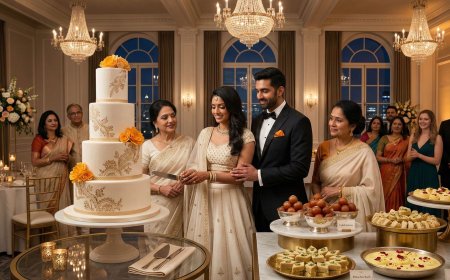
A formal mithai trolley — a beautiful presentation cart that moves through the guest tables with a selection of fresh Indian sweets, offered to seated guests by an attendant — transforms the mithai service from a buffet item into a hospitality gesture. The movement of the trolley through the room, the personal offering to each table, the conversation that happens when an attendant presents and describes the available sweets — these create engagement with the mithai selection that a static dessert table rarely achieves.
Beverage Stations: The Often Overlooked Presentation Opportunity
The Chai and Coffee Bar
A dedicated chai and coffee bar — staffed by an attendant who makes fresh, individually prepared chai to order — is one of the highest-return food presentation investments at an Indian wedding. Chai is universal across Indian backgrounds and deeply culturally resonant. A cup of properly made chai, prepared fresh rather than dispensed from an urn, is a moment of genuine comfort and familiarity at an event that can be overwhelming in its scale and formality.
For international guests, the chai bar is an accessible and welcoming encounter with one of the most beloved elements of Indian food culture. The personal preparation, the adjustable sweetness and strength, the fragrance of cardamom and ginger — these create an experience of genuine hospitality that a tea urn at the end of a buffet line cannot replicate.
Position the chai bar in the later part of the evening, when the reception energy is winding toward its close. A beautiful chai counter with handmade ceramics, a selection of accompaniments, and an attendant who makes each cup to order provides a graceful ending to the food experience of the evening.
The Welcome Drink Station
The welcome drink — discussed in earlier sections of this series — is the first food moment of your wedding for every arriving guest. A dedicated welcome drink station, staffed and visually considered, transforms this from a logistical provision into the first act of hospitality.
Whether the welcome drink is fresh coconut water, a regional specialty, a signature mocktail, or a combination of options, the presentation matters as much as the drink itself. A beautiful station with appropriate vessels — copper glasses, clay matkas, glass bottles with hand-written labels — communicates intention and care from the first moment of arrival.
At a Glance: Food Presentation Formats
| Station Format | Setup Complexity | Guest Engagement Level | Best Suited Event | Cost Tier | International Guest Accessibility |
|---|---|---|---|---|---|
| Standard buffet | Low | Moderate | All events | Base cost | High — familiar format |
| Live chaat counter | Medium | Very high | Cocktail hour, sangeet | Low-medium | High with attendant guidance |
| Dosa and appam station | Medium-high | Very high | Reception, sangeet | Medium | Very high — visually engaging |
| Tandoor kebab station | High — ventilation required | Very high | Reception cocktail hour | Medium-high | Very high — dramatic visual |
| Biryani dum counter | Medium | High — theatrical opening | Main dinner service | Medium | High |
| Pani puri counter | Low-medium | Very high — social integration | Cocktail hour, sangeet | Low | Very high — interactive format |
| Live jalebi station | Medium | High | Late reception, post-dinner | Low-medium | Very high — visual production |
| Kulfi and ice cream counter | Low | High | Dessert service | Low-medium | Very high — universally accessible |
| Mithai trolley | Low | Medium-high | Dessert service | Low | Medium — benefit from description |
| Chai and coffee bar | Low | High | Late reception | Low | Very high — universally loved |
| Welcome drink station | Low | High — first impression | Guest arrival | Low-medium | High with brief labeling |
| Regional thali service | Medium-high | High — immersive format | Lunch service, mehendi | Medium-high | Medium — benefits from context |
Design Principles for Live Stations That Work
Positioning Within the Venue
The placement of live stations within your venue determines how well they function and how much they contribute to the overall atmosphere. A live station positioned in a corner that is not on the natural guest circulation path will be underused regardless of the quality of the food and the skill of the attendant. A live station placed on the path between two high-traffic areas — the bar and the dance floor, the entrance and the seating area, the cocktail space and the dining room — becomes a natural gathering point that guests encounter organically.
Work with your venue coordinator to map the guest circulation pattern for your specific event layout and position live stations at natural intersection points. The goal is to create gathering nodes that distribute the crowd through the space rather than concentrating everyone in one area.
The Right Number of Stations
The temptation when discovering the potential of live stations is to install as many as the budget allows. More stations does not automatically mean better experience — it can mean diluted attention, overextended catering staff, and a space that feels like a food fair rather than a wedding reception.
For most Indian wedding receptions, two to three live stations operating simultaneously, alongside the main buffet, represent the optimal balance between experiential richness and operational manageability. A cocktail hour might feature one live station — the chaat counter or the kebab grill. The dinner service might feature one specialty station — the dosa counter or the biryani dum service. The post-dinner period might feature one dessert station — the jalebi counter or the kulfi bar.
This sequencing — different stations at different phases of the evening — creates variety across the event timeline and ensures that each station is a discovery rather than a background constant.
Staffing the Stations With the Right People
A live station is only as good as the person operating it. The technical skill, the temperament, and the communication ability of the station attendant determine whether the station creates the social and atmospheric moments it is capable of creating.
A skilled dosa maker who makes technically excellent dosas in silence is producing a product, not an experience. The same skilled dosa maker who acknowledges guests as they approach, who can briefly explain what they are making, who can guide an uncertain international guest through the eating with warmth and patience — this person is creating a moment that the guest will remember specifically.
When briefing your caterer on live station staffing, specify that station attendants should be able to communicate confidently with guests and should be briefed on the dishes they are making — their name, their regional origin, the key flavors — in English as well as in the local language. This is not a complicated requirement but it is one that significantly affects the quality of the guest experience.
The Aesthetic Dimension: Stations as Decor Elements
A well-designed live station is not just a food service point — it is a visual element of the overall event design. The station counter, the vessels and equipment visible to guests, the lighting above the station, the signage and labeling, the arrangement of accompaniments — all of these contribute to whether the station feels like a considered extension of the wedding aesthetic or a functional catering addition that does not quite belong.
Work with your decorator and your caterer together on live station design. The chaat counter can be designed with terracotta vessels, copper bowls, and hand-chalked blackboard menus that reflect a rustic Indian street food aesthetic. The biryani dum counter can be designed with richly decorated dum pots, brass service ladles, and Mughal-inspired design elements that reference the heritage of the dish. The kulfi counter can feature traditional matka pots, handwritten flavor labels, and a color palette that connects to the overall dessert table design.
These are not expensive additions — they are design decisions that use readily available materials to create cohesion between the food service and the overall visual environment of the wedding. And for NRI couples whose weddings are photographed extensively, a beautifully designed live station produces images with far more visual interest than a standard chafing dish arrangement.
The Memory That Lives in a Specific Moment
Years after your wedding, when guests describe what they remember about the celebration, they will almost never describe the overall buffet. They will describe a specific moment — the moment the dosa station opened, the moment they ate their first pani puri, the moment the dum pot was opened and the fragrance of the biryani filled the room, the moment someone pressed a glass of fresh kulfi into their hand at midnight.
These moments are designed. They do not happen by accident. They are the result of thinking about the food experience not as a catering logistics exercise but as a series of hospitality moments that can be crafted with intention.
The live station that became the social center of your reception. The chai bar that gave every guest a moment of quiet comfort in the middle of the celebration's intensity. The jalebi made fresh and offered hot at exactly the point in the evening when the energy needed lifting.
Every one of these moments was available to you. Every one of them required a decision — to go beyond the functional minimum, to invest in the presentation as much as the preparation, to treat the food experience of your wedding as something worth designing rather than simply ordering.
The dosa station changed the reception because someone decided it was worth trying. It costs almost nothing more than the dosa itself.
That is the economics of hospitality done right.
NRIWedding.com — Expert guidance for Indian weddings planned across borders.
What's Your Reaction?
 Like
0
Like
0
 Dislike
0
Dislike
0
 Love
0
Love
0
 Funny
0
Funny
0
 Angry
0
Angry
0
 Sad
0
Sad
0
 Wow
0
Wow
0