





































































Wedding Teaser vs. Full Film: What NRI Couples Actually Receive From Their Videographer and When
Most NRI couples sign wedding videography contracts without fully understanding the difference between a teaser, a highlights film, and a full documentary edit — or when each one actually arrives. This guide breaks down every videography deliverable format, what each is designed to do, realistic delivery timelines, and the exact questions to ask before signing anything. Stop assuming your package includes everything you expect and start knowing precisely what you are getting, in what format, and how long you will be waiting to receive it.

Wedding Teaser vs. Full Video: What to Expect and When
The NRI couple's complete guide to understanding wedding videography deliverables — so you know exactly what you are getting, when it arrives, and why both formats serve a purpose the other cannot
The Video Arrived. And You Watched It Forty Times in One Evening.
Your wedding was three months ago. You are back in Vancouver or Manchester or Dubai, the thank-you cards are sent, the lehenga is in storage, and the daily rhythm of your life has reassembled itself around the fact that you are now married.
Then the notification arrives. A link. A two-minute video. Your videographer's name in the subject line.
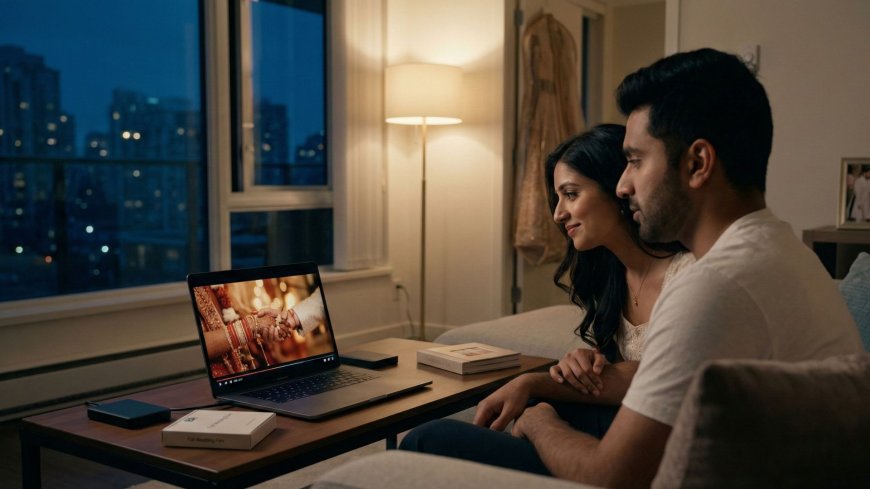
You open it on your laptop, alone, at 11 PM on a Tuesday. The first frame is a slow-motion shot of your hands being tied together during the saat pheras — the mauli thread catching the light in a way you did not notice in the moment itself. The music builds. There is a shot of your mother's face that you have never seen before, an expression she did not know anyone was capturing. The last frame is you and your partner walking away from the mandap, looking at each other, and then at the camera, and then away again into whatever comes next.
The video is two minutes and seventeen seconds long. You watch it forty times before midnight.
That is the teaser. And that is exactly what it is designed to do.
What arrives three months later — four hours of carefully edited footage spanning every ceremony, every speech, every ritual, every moment of your wedding weekend — is something different entirely. Both are valuable. Both serve a purpose that the other cannot. And understanding the difference between them, before you sign a videography contract, is one of the most practically useful things you can do as a couple planning an Indian wedding from abroad.
The Fundamental Difference: What Each Format Actually Is
The confusion between wedding teasers and full films is almost universal among couples who have not previously hired a wedding videographer. The terminology is used inconsistently across the industry, the deliverables overlap in ways that create expectation gaps, and the emotional experience of receiving each is so different that couples sometimes mistake them for different products when they are actually different expressions of the same raw footage.
A wedding teaser — sometimes called a highlight reel, a sneak peek, or a same-day edit depending on the videographer — is a short, emotionally concentrated film that captures the essence of your wedding in a condensed format. It is curated, musical, and crafted for immediate emotional impact. It prioritizes feeling over chronology, atmosphere over completeness, and cinematic quality over comprehensive documentation.
A full wedding film — sometimes called the feature film, the documentary edit, or the complete coverage — is a longer, more comprehensive document of your wedding as it actually happened. It follows the sequence of events, includes speeches and ceremonies in their complete or near-complete form, covers multiple events across the wedding weekend, and prioritizes the preservation of memory over cinematic impact.
Neither is a raw footage delivery. Both are edited products that require creative judgment and significant post-production work. The difference is in their purpose, their length, their structure, and the experience they are designed to create for the viewer.
Understanding the Wedding Teaser
What It Is
A wedding teaser is typically between ninety seconds and four minutes long. The most common format sits around two to three minutes. It is built around a music track — usually chosen by the videographer to complement the visual and emotional tone of your wedding footage — and edited to create a specific emotional arc that moves quickly, peaks powerfully, and ends memorably.
The footage selection in a teaser is highly curated. Out of potentially twenty or thirty hours of raw footage from a multi-day Indian wedding, the teaser might draw on fifteen or twenty specific clips. These are the clips that have exceptional visual quality, strong emotional content, or cinematic characteristics that work particularly well in a short, music-driven format. A meaningful glance. A slow-motion moment of laughter. An architectural wide shot of the venue in golden light. A close-up of clasped hands during a prayer.
The teaser is not trying to tell the complete story of your wedding. It is trying to capture the feeling of it — the emotional signature of the day — in a format that is immediately shareable, immediately watchable, and immediately moving.
When It Arrives
Teasers are typically delivered significantly earlier than full films. Because they draw on a small selection of footage rather than requiring the complete edit of everything that was shot, the post-production time is considerably shorter. Most videographers deliver teasers within two to eight weeks of the wedding, with some offering faster turnaround for couples who specifically request it.
For NRI couples who return home after the wedding and wait months for their full film, the teaser serves a specific psychological purpose — it is proof that the footage exists, that it is beautiful, and that the investment was worth it. It is the first tangible output from the entire videography process, and it arrives at exactly the point in the post-wedding period when the couple most needs to see something.
What It Cannot Do
A teaser cannot replace memory. It selects the most cinematic moments from your wedding and presents them in a format optimized for emotional impact — which means it necessarily leaves out most of what happened. Your grandmother's blessing. The full exchange of vows. The entire baraat. The speeches. The dinner. The dancing. None of this appears in the teaser not because it was not documented but because it does not belong in a two-minute cinematic edit.
Couples who watch only their teaser and do not receive or watch their full film are left with an emotionally intense but fundamentally incomplete record of their wedding. The teaser is the beginning of the deliverables conversation, not the end of it.
Understanding the Full Wedding Film
What It Is
A full wedding film is a substantially longer, more comprehensive edit of your wedding footage. For a multi-event Indian wedding, this typically runs between ninety minutes and four hours depending on the number of events covered, the videographer's editing approach, and what was agreed in the package.
The full film follows chronological structure in a way the teaser does not. It begins at the beginning — the getting-ready footage, the first preparations of the day — and moves through events in the sequence they occurred. Ceremonies are shown in their complete or near-complete form. Speeches are included in full. The ritual sequence is documented so that someone watching the film can follow the progression of the wedding from morning to night without gaps in the narrative.
The full film is not a raw footage dump. It is still edited — music is included for transitional sequences, color grading is applied consistently, the pacing is managed to hold attention across its length. But the editing philosophy is different from the teaser. Where the teaser prioritizes emotional impact over completeness, the full film prioritizes completeness over impact. The goal is preservation rather than cinema.
When It Arrives
Full films take significantly longer to deliver than teasers. The post-production process involves reviewing and logging all raw footage, selecting and sequencing material across multiple events, music licensing for longer-form content, color grading across potentially hundreds of clips, audio mixing for speeches and ceremony audio, and multiple rounds of review and revision.
For a large Indian wedding, a realistic delivery timeline for a full film is four to nine months after the wedding date, with the higher end of that range occurring during peak wedding season when videographers are managing multiple projects simultaneously. Some videographers offer expedited delivery at additional cost. Most will have a contractually specified delivery window that should be confirmed before booking.
What It Cannot Do
A full film, for all its comprehensiveness, is not a teaser. It is not designed for casual rewatching. It is not the format you send to friends on WhatsApp to show them highlights from your wedding. It is not the version you play at an anniversary dinner or share on social media.
The full film is an archive. It is what you sit down to watch on significant occasions — your first anniversary, the night before a milestone birthday, the evening before your children's weddings — when you want to return to the complete experience of your wedding weekend rather than the curated emotional essence of it. Its value is in its completeness, not its watchability.
The Third Format: The Highlights Film
Many Indian wedding videography packages include a third deliverable that sits between the teaser and the full film in length and purpose — typically called the highlights film, the wedding film, or the cinematic edit.
The highlights film is usually between fifteen and forty-five minutes long. It covers all the major events of the wedding in sequence, includes the key ritual moments and speeches in abbreviated form, and is edited with more cinematic intention than the full film while being more narrative and complete than the teaser.
For many couples, the highlights film is the format they actually watch most frequently. It is long enough to feel complete and short enough to be genuinely watchable. It preserves the emotional arc of the wedding weekend without the commitment of a full-length documentary. For NRI couples whose families are spread across multiple countries and who want to share their wedding experience with relatives who were not present, the highlights film is the most practical and accessible format.
If your videography package does not specify a highlights film as a distinct deliverable, ask explicitly whether it is included or whether it is an add-on. Some packages include all three formats. Others include teaser and full film only, with highlights available at additional cost. Others include only highlights and teaser, with the full documentary edit as a premium upgrade.
At a Glance: The Key Differences
| Element | Wedding Teaser | Highlights Film | Full Wedding Film |
|---|---|---|---|
| Typical length | 90 seconds – 4 minutes | 15 – 45 minutes | 90 minutes – 4 hours |
| Primary purpose | Emotional impact, shareability | Narrative overview, family sharing | Comprehensive documentation, archival |
| Structure | Non-chronological, music-driven | Broadly chronological, curated | Fully chronological, complete |
| Footage selection | Highly curated, best cinematic moments | Key moments across all events | All significant moments, full ceremonies |
| Speeches included | No | Excerpts only | Full speeches |
| Ritual coverage | Selected highlights | Key ritual moments | Complete ritual sequences |
| Typical delivery timeline | 2 – 8 weeks | 3 – 6 months | 4 – 9 months |
| Best for | Social sharing, first emotional hit | Family sharing, regular rewatching | Anniversary viewing, complete archive |
| Music approach | Single track, cinematic | Multiple tracks, mixed audio | Background music plus ceremony audio |
| Raw footage proportion used | 1 – 5% | 15 – 30% | 60 – 80% |
What NRI Couples Need to Confirm Before Signing
The gap between what couples expect from wedding videography packages and what those packages actually deliver is wider in videography than in almost any other wedding service. This is partly because videography terminology is inconsistent across the industry, partly because the deliverables are complex and take months to arrive, and partly because couples do not always know the right questions to ask before the contract is signed.
These are the questions that close those gaps.
What specific deliverables are included in this package? Ask for the complete list — teaser, highlights film, full film — with the specified length range for each. Do not accept vague descriptions like "complete coverage" or "full edit" without understanding what that means in terms of actual deliverable formats and lengths.
What is the delivery timeline for each deliverable? Get this in writing with a contractual commitment, not an estimate. Understand the difference between when you will receive your teaser — which should be relatively soon after the wedding — and when you will receive your full film, which may be many months later.
How many events are covered in each deliverable? For a multi-event Indian wedding, confirm whether the highlights film covers all functions or only the main ceremony and reception. Some packages cover all events comprehensively. Others cover a primary event with supporting coverage of secondary functions.
What music will be used and how are licensing rights handled? Music licensing for wedding films is a frequently overlooked issue that can affect whether your video can be shared on social media platforms without being muted or blocked. Ask your videographer how they handle music licensing and whether the tracks used in your deliverables are cleared for online sharing.
What is the revision process? Most videographers include one round of revisions on the highlights film and sometimes the full film. Understand what revision means in this context — whether it covers structural changes, specific clip swaps, or only color and audio adjustments — and how many rounds are included before additional charges apply.
What format are files delivered in and how are they stored? Digital delivery via an online gallery or download link is standard. Confirm the file format, the resolution, and how long the delivery link remains active. For NRI couples who may not download files immediately after delivery, understanding the link expiry is practically important.
The Emotional Timeline of Receiving Your Videos
There is a specific emotional rhythm to the wedding videography experience that couples are rarely prepared for — and that is worth understanding so that the gaps in the timeline do not create unnecessary anxiety.
The teaser arrives first, weeks after the wedding, when you are back in your regular life and the wedding already feels like it belongs to a different chapter. Its arrival is a sudden, concentrated emotional hit — a reminder of something that happened fully and completely and is now memory. Many couples describe the teaser as more emotionally intense than watching it on the day would have been, precisely because the distance and the perspective have changed how they hold the experience.
Then there is a long wait. For NRI couples who are used to immediate digital delivery of everything, the months between the teaser and the highlights film or full film can feel disproportionate. This is normal. Post-production on a full Indian wedding film is a substantial undertaking, and the timeline reflects genuine work rather than indifference.
The highlights film arrives somewhere in this gap — and for many couples, this is the deliverable they return to most in the years that follow. It is long enough to feel complete, curated enough to be genuinely watchable, and personal enough to carry the weight of the day without requiring the commitment of a four-hour documentary.
The full film arrives last, often long after the wedding has settled into your shared history. And when you watch it — the complete documentation of a day you experienced so quickly that you remember only fragments of it — you discover things you did not know happened. Moments you missed because you were somewhere else. Expressions on faces you were not watching. The full, sequential, unhurried record of a day that changed your life.
That is what the full film is for. And it arrives exactly when it should — when enough time has passed that you can watch it not as a participant but as a witness to something that, from the distance of months, already feels like history.
Choosing the Right Videography Package
For NRI couples planning Indian weddings with multiple events, the minimum viable videography package should include a teaser, a highlights film covering all functions, and either a full documentary edit or a clearly specified reason why the full edit is not being included.
Couples who are genuinely price-sensitive and need to make trade-offs within their videography budget should prioritize the highlights film over the full documentary edit — because the highlights film is the format they will actually watch, while the full documentary is the format they will intend to watch and revisit far less frequently than they imagine.
Couples for whom comprehensive documentation is a genuine priority — particularly those with large families who were not present and who want to experience the complete wedding — should ensure the full documentary edit is included and that its coverage scope across all events is explicitly confirmed.
And every couple, regardless of budget level, should receive the teaser. It is the first thing. The proof that the footage is beautiful. The two minutes and seventeen seconds you will watch forty times on a Tuesday night in Vancouver or Manchester or Dubai, alone, three months after the most significant day of your life.
It is worth making sure it is in the package.
NRIWedding.com — Expert guidance for Indian weddings planned across borders.
What's Your Reaction?
 Like
0
Like
0
 Dislike
0
Dislike
0
 Love
0
Love
0
 Funny
0
Funny
0
 Angry
0
Angry
0
 Sad
0
Sad
0
 Wow
0
Wow
0