






































































Virtual Weddings and Legal Validity — Can Your Online Indian Wedding Actually Count as a Real Marriage?
virtual-weddings-legal-validity-online-indian-wedding-nri


Virtual Weddings: Can You Have a Legally Valid Online Indian Wedding?
It was not the wedding anyone planned.
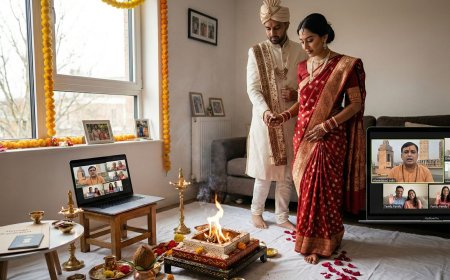
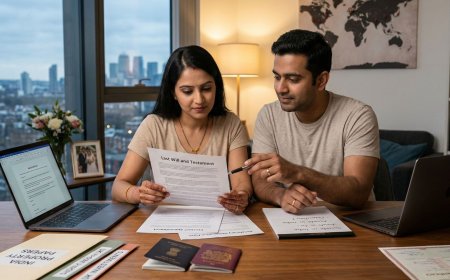
The pandit was in a small room in Ahmedabad, his face filling a laptop screen that had been propped against a stack of books to get the angle right. The bride's parents were on a different screen — a tablet balanced on a chair in the corner of the room, their faces small and slightly pixelated but unmistakably present, unmistakably emotional. The groom's family was gathered around a television in a living room in New Jersey, watching a ceremony happening in a flat in London, conducted by a pandit in Gujarat, witnessed by people scattered across four countries and seven time zones.
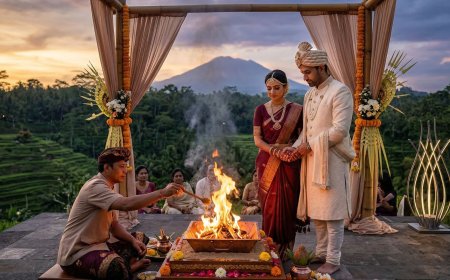
The fire was real. The pheras were real. The mantras were real. The emotion — the specific, unrepeatable emotion of two people choosing each other in the presence of everyone who loves them, even when everyone who loves them exists only as a grid of rectangles on a screen — was entirely, completely real.
But was it legal?
This question — which felt almost callous to ask in the middle of a pandemic when virtual weddings were the only option available — has not gone away with the return of in-person gatherings. If anything, it has become more relevant. Because the circumstances that made virtual weddings a necessity for some NRI couples in 2020 and 2021 continue to exist in different forms for others — a partner whose visa has not yet been approved, parents who cannot travel due to health, a family member in a country where travel is difficult or expensive, a couple who chooses the intimacy of a small ceremony over the logistics of gathering hundreds of people across continents.
The virtual wedding — or the hybrid wedding with some participants present and others attending remotely — is no longer an emergency adaptation. It is a genuine option that NRI couples are increasingly considering on its own merits.
And the legal question that surrounds it is genuinely complex.
Not because Indian law is unclear about what constitutes a valid marriage — it is, broadly speaking, clear. But because the intersection of that clarity with the specific circumstances of virtual ceremonies — ceremonies conducted partly or wholly through digital platforms, with some or all participants attending remotely — produces questions that Indian law was not designed to answer and has not yet fully answered.
This guide examines those questions completely and honestly.
It tells you what Indian law says about the validity of a marriage ceremony. It examines whether a virtual ceremony can satisfy those legal requirements. It looks at what the courts have said — and what they have not said. It addresses the hybrid wedding question — where the couple is physically present but some participants are remote. And it gives you the practical framework for understanding what a virtual or hybrid wedding can and cannot achieve legally — and what you need to do if you want the legal validity that a ceremony alone, virtual or physical, does not automatically provide.
Because the question is not just romantic or logistical. It is legal. And the legal answer has real consequences for everything that follows the ceremony.
The Core Reality: What Makes an Indian Marriage Legally Valid
The Personal Law Framework
As established in earlier guides in this series, Indian marriage law operates through a system of personal laws — legal frameworks that apply based on religious identity — alongside the secular Special Marriage Act.
For a Hindu marriage under the Hindu Marriage Act 1955, legal validity requires two elements:
Element 1 — Solemnisation according to customary rites and ceremonies
Section 7 of the Hindu Marriage Act states that a Hindu marriage may be solemnised in accordance with the customary rites and ceremonies of either party. Where such rites include the Saptapadi — the seven steps taken jointly by the parties before the sacred fire — the marriage becomes complete and binding when the seventh step is taken.
The law is clear that the ceremony must occur. It is less clear — because it was written before digital technology existed — about where the ceremony must occur and whether all participants must be physically present in the same location.
Element 2 — Capacity of both parties
Both parties must be legally capable of marriage — of marriageable age, not within prohibited degrees of relationship, and not already married.
For a Special Marriage Act marriage, legal validity requires civil registration by a Marriage Officer — a specific government official with statutory authority — which creates a clearly physical, location-specific requirement that virtual ceremony cannot satisfy.
The Physical Presence Question
The central legal question for virtual Hindu weddings is whether the law requires the couple to be physically present in the same location for the ceremony to be valid — or whether the ceremony can be conducted with parties in different physical locations, connected through digital platforms.
The Hindu Marriage Act does not explicitly address this question. It does not state that both parties must be physically co-located. It requires that the marriage be solemnised according to customary rites — and it is those customary rites that must be examined for their physical presence requirements.
What Indian Courts Have Said — And What They Have Not
The Existing Case Law
Indian courts have addressed questions about the validity of Hindu marriages in various contexts — but the specific question of whether a fully virtual ceremony constitutes a valid marriage under the Hindu Marriage Act has not been definitively resolved by the Supreme Court of India or by any High Court in a binding precedent.
What case law does establish:
The ceremony is essential: Courts have consistently held that for a Hindu marriage to be valid, the prescribed ceremonies must actually be performed — not merely symbolically acknowledged. A marriage certificate without a ceremony does not constitute a valid marriage. A registration without a ceremony is not valid under the Hindu Marriage Act.
The Saptapadi requirement: Where the Saptapadi is the applicable ceremonial rite — which it is for most Hindu weddings — the Supreme Court has confirmed that the marriage is not complete until the seventh step is taken. This ceremony-specific requirement has physical implications — the Saptapadi involves physical movement, the sacred fire, and the physical act of both parties taking the steps together.
The 2020-2021 virtual wedding period: During the COVID-19 pandemic, several Indian High Courts and government authorities took positions on virtual marriages — primarily in the context of whether employees could take marriage leave for virtual ceremonies and whether virtual marriages constituted valid grounds for dependent visa applications.
These positions were largely accommodating — acknowledging the extraordinary circumstances of the pandemic and treating virtual marriages that otherwise complied with customary rites as provisionally valid. But they were also largely contextual — applying to the specific extraordinary circumstances of the pandemic rather than establishing a permanent legal principle about the validity of virtual marriages in normal circumstances.
The Jurisdictional Gap
Indian marriage law was codified in 1955 — sixty-six years before the pandemic normalised video calling as a medium for significant human events. The Hindu Marriage Act contains no provision for digital presence, no definition of what constitutes presence for ceremonial purposes, and no anticipation of the technological circumstances that virtual weddings create.
This legislative gap is not unusual — law consistently lags behind technology. But it creates genuine legal uncertainty for couples whose wedding circumstances involve digital participation.
The absence of a definitive negative ruling — no court has said virtual Hindu marriages are categorically invalid — is not the same as a positive ruling that they are valid. It is a silence that creates uncertainty rather than comfort.
The Different Scenarios: What Is and Is Not Legally Clear
Scenario 1 — The Couple Is Physically Together, Some Guests Are Virtual
The hybrid wedding — most common NRI scenario
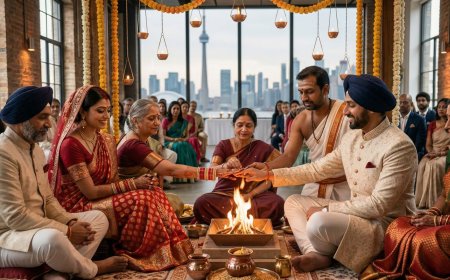
Both partners are physically present in the same location. The fire is real. The Saptapadi is performed physically by both parties. The pandit is physically present. But some guests — parents abroad, relatives in other countries, friends who cannot travel — participate virtually through video platforms.
Legal position: This scenario is the most legally robust virtual wedding arrangement. The physical co-presence of the couple and the pandit, the physical performance of the essential ceremonies, and the physical completion of the Saptapadi satisfy the core legal requirements of the Hindu Marriage Act. The virtual participation of guests does not affect the legal validity of the ceremony — witnesses at a Hindu wedding ceremony are traditionally required for registration purposes, but the legal validity of the ceremony itself under Section 7 of the Hindu Marriage Act does not depend on the physical presence of any number of guests.
Practical recommendation: For NRI couples who want the flexibility of virtual guest participation without legal risk, this hybrid model — couple and essential participants physically present, additional guests attending virtually — is the approach that most clearly satisfies legal requirements while accommodating the logistical realities of international family participation.
Scenario 2 — The Couple Is in Different Physical Locations
The separated couple ceremony
One partner is in India. The other is abroad — in the UK, USA, Canada, or elsewhere. The ceremony is conducted with both participating through screens — the bride in London, the groom in Mumbai, the pandit conducting ceremonies that each party performs in their respective location.
Legal position: This scenario presents the most significant legal uncertainty. The Saptapadi — the physical act of both parties taking seven steps together around a sacred fire — cannot literally be performed by parties in different physical locations. Symbolic equivalents, conducted separately and simultaneously in different locations, are not the same as the physical performance of the ceremony.
No Indian court has ruled definitively on whether this scenario produces a valid marriage under the Hindu Marriage Act. But the weight of legal opinion — based on the statutory text of Section 7, the Supreme Court's emphasis on the physical performance of the Saptapadi, and the absence of any legal provision for digital presence — suggests significant legal risk.
Practical recommendation: If one partner cannot travel to India for the wedding, the legally safest approach is to defer the religious ceremony until both partners can be physically present — and, in the interim, to consider whether registration under the Special Marriage Act through an Indian consulate abroad can establish the legal marriage without a ceremony.
Scenario 3 — The Pandit Is Virtual, Couple Is Physically Together
The remote pandit scenario
Both partners are physically together. The fire is lit. The ceremonies are performed. But the pandit — who would ordinarily be physically present to conduct and witness — participates remotely through video.
Legal position: Under the Hindu Marriage Act, there is no explicit requirement for the pandit to be physically present. The legal requirements relate to the performance of the ceremonies by the couple — not to the physical presence of the officiant. A pandit conducting ceremonies remotely while the couple performs the rites physically is legally distinguishable from a scenario where the ceremony itself is virtual.
This position was reinforced during the pandemic period when remote pandits conducted ceremonies that were subsequently treated as valid for registration and immigration purposes.
Practical recommendation: This scenario carries less legal risk than the separated couple scenario. The essential elements — physical performance of the ceremonies by the couple, actual sacred fire, physical Saptapadi — are present. The remote participation is of the conductor rather than the parties.
Scenario 4 — The Fully Virtual Ceremony
All parties in different locations
The couple is separated. The pandit is remote. Guests attend virtually. Symbolic ceremonies are performed by each party in their respective location simultaneously.
Legal position: This scenario carries the highest legal uncertainty of all virtual wedding arrangements. The physical performance of the essential ceremonies — particularly the Saptapadi — is symbolically rather than literally accomplished. No court has confirmed this produces a valid marriage under the Hindu Marriage Act in normal (non-pandemic emergency) circumstances.
Practical recommendation: Do not rely on a fully virtual ceremony as the legal foundation of the marriage. If a fully virtual ceremony is held for personal, family, or cultural reasons, treat it as a meaningful celebration rather than a legally constitutive act — and ensure that a legally valid marriage is established through a separate mechanism, such as civil registration through the Special Marriage Act.
The Special Marriage Act and Virtual Weddings: A Clearer Picture
For couples considering registration under the Special Marriage Act, the virtual wedding question is easier to answer — because the Special Marriage Act's requirements are more explicit.
Registration under the Special Marriage Act requires:
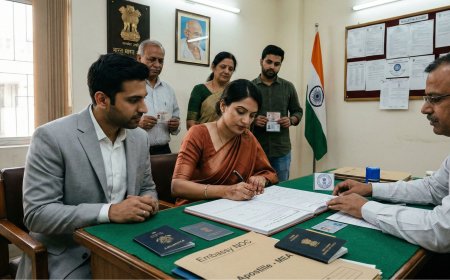
• Physical appearance before the Marriage Officer of the relevant district
• Physical signing of the marriage register by both parties and three witnesses
• The Marriage Officer's physical presence and official act
There is no provision in the Special Marriage Act for virtual registration. The physical appearance requirement is unambiguous.
However — for NRI couples where one partner is abroad and cannot travel to India, the Foreign Marriage Act 1969 provides a mechanism for marriage registration through Indian Missions abroad. This mechanism involves physical appearance before the Marriage Officer at the Indian High Commission or Consulate — satisfying the physical presence requirement in a location that is accessible to the NRI partner.
The Legal Risk Framework: What Invalidity Actually Means
Understanding what is at stake in the legal validity question is important context for the practical recommendations above.
If a Virtual Marriage Is Subsequently Found Invalid
If a Hindu marriage conducted virtually is later challenged — in divorce proceedings, in inheritance disputes, in immigration proceedings — and a court finds that the essential ceremonies were not performed in a legally valid manner, the consequences are significant.
• The marriage is void — as if it never existed
• Children born of the marriage may be affected in their legitimacy status
• Property rights acquired on the basis of marital status are affected
• Immigration status granted on the basis of the marriage may be challenged
• Succession rights acquired as a spouse are eliminated
These are serious consequences — not hypothetical concerns but real legal outcomes that flow from a finding of marriage invalidity.
The Practical Risk in NRI Contexts
For NRI couples, the most immediately relevant risk is the immigration context. UK Visas and Immigration, USCIS, IRCC, and equivalent authorities scrutinise the validity of the marriage underlying a spouse visa or dependent visa application. A marriage whose legal validity is questionable — because it was conducted through a mechanism whose legal standing under Indian law is uncertain — creates immigration risk that is entirely avoidable with proper planning.
What Actually Works: The Legally Robust Approach for NRI Virtual Weddings
Given the legal landscape described above, the approach that provides both cultural meaning and legal robustness for NRI couples who cannot all be physically present involves two elements.
Element 1 — The Hybrid Ceremony for Cultural and Family Meaning
Hold a hybrid ceremony — couple and essential participants physically together, additional family and friends joining virtually — that satisfies the cultural and emotional needs of the wedding celebration. This ceremony, with both partners physically present and the essential rites physically performed, is legally defensible under the Hindu Marriage Act and produces the ceremonial foundation for subsequent registration.
Element 2 — Immediate Registration Under the Appropriate Act
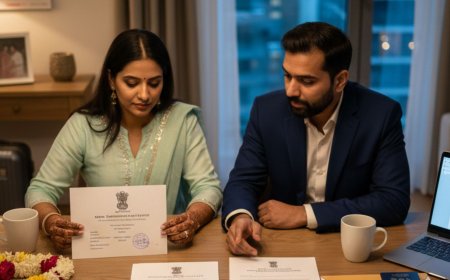
Register the marriage immediately after the ceremony — under the Hindu Marriage Act or the Special Marriage Act — to produce the government-issued documentary proof that all subsequent legal and administrative processes require.
The combination of a legally valid ceremony and prompt registration produces the strongest possible legal foundation for the marriage — regardless of whether some participants attended virtually.
Common Mistakes NRI Couples Make With Virtual Weddings
Treating the Virtual Ceremony as Legally Equivalent to a Physical One Without Verification
The most consequential mistake. Couples who hold a virtual ceremony — in any of the scenarios described above — and then attempt to register it as a valid Hindu marriage without legal advice risk either registration refusal or subsequent legal challenges to the marriage's validity.
Correction: Before holding any virtual ceremony that you intend to register as a legal marriage, obtain specific legal advice from an advocate with expertise in Hindu personal law about whether the proposed ceremony in its specific format satisfies the requirements of Section 7 of the Hindu Marriage Act in the relevant state.
Relying on Pandemic-Era Accommodations as Permanent Legal Precedent
The accommodating positions taken by some Indian authorities during the COVID-19 pandemic — treating virtual marriages as provisionally valid in extraordinary circumstances — reflected emergency pragmatism rather than legal principle. These positions do not establish permanent legal precedent for the validity of virtual marriages in normal circumstances.
Correction: Do not cite pandemic-era administrative accommodations as legal authority for the validity of a virtual marriage conducted in post-pandemic normal circumstances. Treat the current legal position as uncertain and plan accordingly.
Not Having a Physical Registration as a Backstop
Couples who hold virtual ceremonies and then do not register the marriage — perhaps because they are uncertain about registration eligibility — end up in the worst position: a ceremony of uncertain legal validity and no registration to strengthen it.
Correction: Regardless of whether the ceremony was virtual or physical, pursue registration as the definitive establishment of legal marital status. The registration creates legal certainty that the ceremony's validity question — in either direction — does not.
Using a Virtual Ceremony to Satisfy Immigration Authorities Without Legal Verification
Some NRI couples attempt to use evidence of a virtual ceremony — photographs, video recordings, pandit certificates — to satisfy immigration authorities' requirement for proof of marriage, without obtaining a government-issued marriage certificate.
Immigration authorities require government-issued documentary proof of marriage — not evidence of a ceremony, however well-documented. A virtual ceremony without subsequent registration produces no government-issued marriage certificate and therefore cannot satisfy immigration proof requirements regardless of its cultural or personal significance.
Correction: Obtain a government-issued registered marriage certificate. No form of ceremony documentation — virtual or physical, however extensive — substitutes for it in immigration contexts.
Conflating the Emotional Validity of the Virtual Ceremony With Its Legal Validity
The virtual ceremony was real. The emotion was real. The commitment was real. The family's presence — however pixelated and however distributed across time zones — was real.
None of this determines the legal validity of the ceremony under Indian marriage law. Legal validity is determined by specific statutory requirements that have nothing to do with the sincerity of the parties or the quality of the celebration.
Correction: Separate the personal and cultural significance of the virtual ceremony from the question of its legal validity. Both questions are legitimate. Only one of them — the legal one — has consequences for immigration, for property, for succession, and for the formal recognition of the marriage by institutions.
The Emotional and Cultural Layer: The Ceremony That Technology Made Possible
There is something that deserves to be said honestly about virtual weddings — beyond the legal analysis and the practical recommendations.
They happened. For many NRI couples — during the pandemic, and in the years since for a hundred different reasons — the virtual ceremony was the ceremony that was possible. The one that allowed the wedding to happen at all, rather than waiting indefinitely for logistics that would not resolve, for borders that would not open, for a family that could not travel.
And for many of those couples, the virtual ceremony was not a lesser wedding. It was a different one — with its own particular quality of presence, its own specific emotional texture, its own evidence that the people who love you will find a way to be there even when being there requires a fourteen-inch screen and a time zone conversion and a laptop balanced against a stack of books.
The legal framework has not fully caught up with that reality. Indian marriage law was written for a world where physical co-presence was the only kind of presence — where the question of whether someone was there was answered by whether their body was in the room.
Technology has complicated that question in ways that the law will eventually address more clearly than it currently does. Court decisions will come. Legislative amendments may follow. The legal landscape for virtual marriages in India will become clearer over time.
In the interim — for NRI couples navigating this question now — the honest answer is that the legal validity of a virtual ceremony depends on its specific format, carries genuine uncertainty in some scenarios, and is best supplemented or replaced by a civil registration that creates legal certainty regardless of what the ceremony established.
The virtual ceremony can be the celebration. Let the registration be the legal foundation.
Both are real. Both matter. But only one of them resolves the legal question with certainty.
Virtual and Hybrid Wedding Checklist for NRI Couples
Before Deciding on a Virtual or Hybrid Format
• Obtain legal advice on whether the proposed ceremony format satisfies Section 7 of the Hindu Marriage Act in the relevant state
• Identify which participants must be physically present — couple, pandit, witnesses — and which can participate virtually
• Confirm that the couple can be physically together if a legally valid Hindu ceremony is intended
• Assess whether Special Marriage Act registration is a preferable alternative to provide clear legal certainty
Planning the Hybrid Ceremony
• Confirm both partners will be physically present at the ceremony location
• Confirm the sacred fire will be physically present and the Saptapadi physically performed
• Arrange reliable high-quality video connection for virtual participants — test in advance
• Ensure witnesses required for registration are physically present — not participating virtually
• Document the ceremony thoroughly — video recording, photographs — for subsequent use as supporting evidence
After the Ceremony
• Initiate marriage registration immediately — within the India visit if possible
• Confirm with the registering authority that the ceremony format satisfies registration requirements before submitting
• Obtain government-issued marriage certificate before any immigration or administrative processes are initiated
• Proceed with apostille process immediately after registration
For Couples Considering Fully Virtual Ceremonies
• Obtain specific legal advice before proceeding — do not proceed on the basis of general online guidance
• Consider whether civil registration through Indian Mission abroad is a cleaner legal alternative
• If a fully virtual ceremony is held for personal reasons — treat it as a celebration, not a legal act
• Establish legal marriage through a separately organised physically valid ceremony or civil registration process
The Screen Cannot Yet Do What the Law Requires
The virtual wedding is real in every way that matters personally and culturally.
The commitment is real. The emotion is real. The family's presence — however it is achieved, through whatever screen and whatever time zone — is real. The sacred fire, lit in a small room with a laptop propped against a stack of books, is real.
But Indian marriage law — as it currently stands, without definitive judicial guidance on the specific question of virtual ceremonies — does not yet fully confirm that what the screen makes possible is equivalent to what the law requires.
For NRI couples navigating this reality, the path forward is not to abandon the virtual or hybrid ceremony as a meaningful celebration of the marriage. It is to ensure that the legal foundation of the marriage — the registration, the certificate, the apostille — is built on the strongest possible basis.
Have the hybrid ceremony with both partners physically together. Perform the Saptapadi literally and physically. Register the marriage immediately. Obtain the certificate. Get the apostille.
Let the screen carry the people who could not travel. Let it carry the parents in four countries and the grandparents in three cities and the friends scattered across six time zones. Let it carry the presence that geography makes difficult but love makes necessary.
But let the law's requirements be met by what happens in the room — the fire, the steps, the physical presence of two people choosing each other in the most literal, most ancient, most legally recognised sense.
The ceremony is for all of them — the room and the screen together.
The legal foundation is built in the room.
Published by NRIWedding.com — The Premium Global Platform for Non-Resident Indians Planning Indian Weddings From Abroad.
What's Your Reaction?
 Like
0
Like
0
 Dislike
0
Dislike
0
 Love
0
Love
0
 Funny
0
Funny
0
 Angry
0
Angry
0
 Sad
0
Sad
0
 Wow
0
Wow
0