























































Wedding Photography Copyright and Usage Rights in India: What Every NRI Couple Must Understand Before Signing
The assumption that paying for wedding photography means owning the photographs is one of the most widespread and consistently incorrect beliefs in the entire NRI wedding planning process — and the consequences of misunderstanding it can follow couples for years after the wedding. This guide covers the complete copyright framework for Indian wedding photography: photographer ownership defaults under Indian law, how copyright interacts across UK, US, Canadian, Australian and UAE jurisdictions, what a photography licence actually permits, how to negotiate usage rights before signing, the photographer's publication and third-party licensing rights, and the specific NRI scenarios involving social media, viral videos, print-on-demand platforms, and family distribution across multiple countries. The most thorough wedding photography copyright guide written specifically for NRI couples worldwide.

Understanding Photography Copyrights and Usage Rights
It begins innocently enough. Your wedding photographs arrive — beautiful, complete, everything you hoped for — and you start sharing them. You post a selection on Instagram. You send a gallery link to relatives in India. Your mother has a large canvas print made at the local print shop in Ludhiana. Your cousin in Toronto creates a wedding highlight video using twenty of your favourite images and posts it on YouTube with a Bollywood soundtrack. Your office sends a congratulatory email using a photograph your colleague found on the photographer's website. And then, three months after your wedding, you receive a message from your photographer that contains a word you weren't expecting: copyright.
The copyright conversation in wedding photography is one of the most misunderstood in the entire vendor relationship — not because the principles are complicated, but because the assumptions couples bring to it are almost universally wrong. The assumption that paying for wedding photography means owning the photographs is so widespread, so intuitively reasonable, and so consistently incorrect in law that it generates more post-wedding disputes than almost any other single issue in the photographer-client relationship.
For NRI couples planning from abroad — operating across multiple legal jurisdictions, sharing images across multiple countries, and often without the opportunity to have a face-to-face conversation about usage rights before the contract is signed — the copyright question carries additional complexity and additional consequence. Understanding it properly, before you book and before you sign, is the knowledge that prevents a post-wedding legal or relationship difficulty that should never have arisen.
The Foundational Principle: Who Owns Wedding Photographs
The answer to this question surprises almost everyone who hears it for the first time: in the default legal position in India, the United Kingdom, the United States, Canada, and Australia — the primary jurisdictions relevant to NRI couples — the photographer owns the copyright in every photograph they take, automatically and from the moment of capture, regardless of who paid for the photography.
This is not a loophole or a technicality. It is the foundational principle of copyright law in virtually every jurisdiction worldwide. Copyright in a creative work belongs to the creator — the person who made it — not to the person who commissioned or paid for it. When you hire a wedding photographer, you are purchasing their time, their skill, and a licence to use the resulting images in certain ways. You are not, by default, purchasing the copyright itself.
The practical implications of this are significant. The photographer who shot your wedding legally owns those images. They can print them, exhibit them, publish them in wedding magazines, post them on their website and social media, enter them in photography competitions, license them to third parties, and use them for commercial purposes — including advertising their services to future clients — unless the contract between you specifically restricts these rights.
You, as the client, can use the images only in the ways that your contract permits. Everything outside what the contract permits — or what the photographer has explicitly licensed to you — requires their permission.
The Indian Copyright Framework
For weddings taking place in India — which is the relevant jurisdiction for most NRI wedding photography contracts — the governing legislation is the Copyright Act, 1957, as amended, most significantly by the Copyright (Amendment) Act, 2012.
Under Indian copyright law, the author of a work is the first owner of copyright in that work. For photographs, the author is the photographer — the person who created the image. The only exception under Indian law relevant to wedding photography is the works made for hire concept, but this applies specifically to employees creating works in the course of their employment, not to independent contractors hired for a specific event. A freelance wedding photographer hired for a single occasion is not an employee, and the works-made-for-hire exception does not automatically transfer copyright to the client.
Indian copyright in photographs subsists for sixty years from the beginning of the calendar year following the year in which the work is published or made. In practical terms, the photographs from your wedding are legally protected for decades beyond your lifetime.
Moral rights are an additional dimension of Indian copyright law that NRI couples should understand. Beyond economic copyright — the right to commercially exploit the work — Indian law recognises moral rights: the right of the photographer to claim authorship of the work and the right to object to distortion or modification that would prejudice their reputation. Even if you own a photograph or have a broad licence to use it, the photographer's moral right to be credited as the author remains, and their right to object to modifications that damage their reputation is protected separately from the economic copyright.
How Copyright Works Across NRI Jurisdictions
Because NRI couples are typically resident in countries with their own copyright frameworks, understanding how those frameworks interact with the Indian copyright governing their wedding photography is important — particularly for questions about usage in their country of residence.
| Jurisdiction | Governing Legislation | Photographer Ownership Default | Copyright Duration | Key NRI Consideration |
|---|---|---|---|---|
| India | Copyright Act, 1957 (amended 2012) | Photographer owns copyright from creation | 60 years from publication or creation | Governs the wedding photography contract in most cases |
| United Kingdom | Copyright, Designs and Patents Act, 1988 | Photographer owns copyright from creation | Life of photographer + 70 years | Usage of Indian wedding photos in UK governed by contract terms |
| United States | Copyright Act, 1976 (Title 17 USC) | Photographer owns copyright from creation | Life of photographer + 70 years | Works for hire doctrine narrow — does not typically apply to independent wedding photographers |
| Canada | Copyright Act, RSC 1985 | Photographer owns copyright from creation | Life of photographer + 70 years (since 2022) | Commercial use outside contract terms requires separate licence |
| Australia | Copyright Act, 1968 | Photographer owns copyright from creation | Life of photographer + 70 years | Moral rights provisions apply — attribution required |
| UAE | Federal Law No. 38 of 2021 on Copyright | Photographer owns copyright from creation | Life of photographer + 50 years | Less developed enforcement but principles consistent |
The consistent pattern across all six jurisdictions is clear: the photographer owns the copyright, regardless of where you live. The contract is the only mechanism through which these rights are modified in your favour — and the scope of that modification determines what you can and cannot do with your own wedding photographs.
What a Photography Licence Actually Means
Because copyright ownership cannot be assumed, what you are actually receiving when you hire a wedding photographer — unless the contract says otherwise — is a licence to use the photographs. Understanding what that licence covers, what it doesn't, and how to ensure it covers what you actually need is the practical core of the copyright conversation.
Personal Use Licence
The minimum licence that every wedding photography client should receive — and that reputable photographers provide as standard — is a personal use licence. This permits you to:
Print the photographs for personal display and gifting. Share the photographs privately with family and friends through digital means. Store and archive the photographs for personal purposes. Display the photographs in your home.
A personal use licence does not permit commercial use, publication in paid media, licensing to third parties, or modifications that the photographer has not consented to.
Extended Personal Use and Social Media
In the contemporary context, a personal use licence that does not explicitly address social media is ambiguous — and that ambiguity is worth resolving before you sign. Posting wedding photographs on Instagram, Facebook, Pinterest, and similar platforms is standard behaviour that most photographers fully anticipate and accept. However, some photographers have specific requirements around social media use — tagging, credit, the specific images they are willing to have shared publicly — that should be addressed in the contract.
Ask specifically: Does my personal use licence include the right to share photographs on social media without restriction? The answer is almost always yes, but getting it in writing removes any ambiguity.
Print Rights and Commercial Printing
A personal use licence typically includes the right to print photographs for personal use — framing, family albums, personal gifts. What it does not automatically include is the right to have photographs commercially printed at a print service, sold as prints, used in any commercial product, or reproduced in any publication.
For the specific scenario of having photographs printed at a print shop — whether in India, the UK, or anywhere else — the standard personal use licence is generally understood to cover this. However, some print services, particularly professional laboratories, request proof of usage rights before printing photographs that appear to be professional photography work. Having a letter from your photographer confirming your licence to print is a practical solution to this occasionally arising issue.
Commercial Use and Brand Association
If you or your partner have a public profile — a business, a social media following, a public professional identity — the use of wedding photographs in commercial or brand contexts is a genuinely different category from personal use. Using wedding photographs in your business marketing materials, in paid social media content, on a professional website that generates commercial value, or in any context where the images contribute to commercial activity requires a commercial use licence that goes beyond the standard personal use grant.
Most photographers charge additionally for commercial use rights, and this is reasonable — commercial use creates value for the client that personal use does not, and the photographer's compensation for that value is separate from the wedding coverage fee.
The Photographer's Rights Over Your Wedding Images
This is the dimension of copyright that most surprises NRI couples: the photographer's rights to use your wedding photographs for their own purposes, without your explicit permission, unless the contract restricts this.
Portfolio and Marketing Use
By default, a photographer who shoots your wedding has the right to use any image from the shoot in their portfolio, on their website, on their social media, in their marketing materials, and in any context that promotes their professional services. Your faces, your ceremony, your family — all of this can appear in the photographer's marketing unless you have specifically restricted it in the contract.
For most couples, this is entirely acceptable — it is how the photography industry operates, and many couples actively welcome the promotional coverage. But for NRI couples with specific privacy concerns — those whose public profile, cultural context, or family dynamics make broad photographic publication uncomfortable — this default position is worth addressing explicitly.
A publication restriction clause in your contract can limit the contexts in which the photographer may publish your images. The restriction can be total — no publication of any images without prior written consent — or partial — publication permitted on the photographer's portfolio and website but not on social media, or not within the first year before the couple has had the opportunity to share themselves.
Third-Party Licensing and Editorial Publication
Beyond the photographer's own portfolio use, they may receive requests to license your wedding photographs to third parties — wedding publications, venue marketing, vendor portfolios, editorial media. A Taj Lake Palace feature in a wedding magazine might include photographs from weddings held there. A wedding photographer featured in a publication might include their best images regardless of which couples are depicted.
Understand your photographer's policy on third-party licensing before you sign. Ask whether your images might be licensed for publication in wedding media, venue marketing, or other commercial contexts, and whether your consent would be sought before any such licensing occurs. Some photographers make this a mutual consent requirement. Others consider it within the scope of their standard rights. Know which category your photographer falls into.
The Credit Requirement
Many photographers include a credit clause in their contracts — a requirement that the photographer be credited whenever their images are published or shared publicly. In the social media context, this typically means tagging the photographer's account when you post wedding images. This is a reasonable professional requirement, it costs nothing, and it is worth honouring consistently.
The moral rights dimension of this — the photographer's right to attribution under Indian law and equivalent provisions in other jurisdictions — means that the credit requirement is not purely contractual. It has a legal foundation independent of what the contract says.
Negotiating Usage Rights: What to Ask For and How
The usage rights that matter most for NRI couples are typically the following, and each is worth addressing specifically in the contract negotiation.
Unlimited Personal Use Including Social Media
Ask for explicit written confirmation that your personal use licence includes unlimited social media sharing without restriction, without mandatory credit (though crediting the photographer is courteous and professionally appropriate), and without any approval requirement before posting.
Most photographers will agree to this without hesitation. If they have specific requirements — a preference for being tagged, a request not to post certain images before the wedding has been featured in a publication — these are reasonable and easily accommodated. What you want to avoid is ambiguity that creates friction after the fact.
Printing Rights Including Large Format
Confirm that your licence explicitly includes the right to print at any size and through any print service — including commercial print laboratories and professional printing services. This protects you from the scenario where a print shop requests proof of printing rights and you have no documentation to provide.
Family Distribution Rights
Confirm that your licence permits you to share full-resolution images with family members in any country for their personal use — printing, framing, personal digital use. NRI families distribute wedding photographs across many countries and many generations, and a licence that restricts this distribution creates practical problems that are entirely avoidable.
Duration of the Licence
A personal use licence should be perpetual — it should not expire. A licence that grants you usage rights for five or ten years and then reverts to the photographer is not appropriate for wedding photography, which you will want to use for the rest of your life and potentially beyond. Confirm that your licence is perpetual in the contract.
Modification Rights
Confirm whether your licence includes the right to make reasonable modifications to delivered images — cropping for specific print sizes, converting to black and white, adjusting brightness and contrast for specific printing needs. Photographers who provide this right understand that personal use of photographs involves practical modifications that don't affect the integrity of their work. Those who restrict modification rights are protecting their creative output in ways that can create friction for clients with legitimate practical needs.
Copyright and Indian Wedding Publications
A specific scenario worth addressing directly for NRI couples: the Indian wedding publication market — WedMeGood Magazine, The Wed Cafe, Brides Today, and international platforms that cover Indian weddings — regularly features real weddings submitted by photographers and sometimes by couples themselves. If your wedding is featured in a publication, specific copyright and usage rights questions arise.
When a photographer submits your wedding for publication, they are licensing the images to the publication. The publication then has usage rights to those images within the terms of their agreement with the photographer. Your faces and your ceremony appear in a commercial publication without any separate agreement between you and that publication — because the photographer's copyright, not yours, governs the transaction.
This is standard industry practice and is not inherently problematic. But it is worth being aware of, and worth addressing in your contract if you have strong feelings about publication. A pre-publication approval clause — requiring the photographer to obtain your written consent before submitting your wedding images to any publication — is a reasonable and commonly granted request.
Specific NRI Copyright Scenarios
The Viral Wedding Video Problem
A growing trend in NRI wedding culture is the creation of wedding highlight videos by family members — compilations of photographs set to music, posted on YouTube or Instagram, celebrating the wedding with an extended audience. This seemingly harmless practice sits in a legally complex space.
The photographs in the video are the photographer's copyright. Using them in a video — particularly a publicly posted one — may exceed the scope of a personal use licence, depending on how that licence is drafted. The music in the video is almost certainly the separate copyright of a record label or composer. A YouTube video using commercial Bollywood tracks without a music licence will typically be flagged by YouTube's content identification system and may be blocked or monetised by the rights holder.
The practical guidance: for personal viewing at family events, a slideshow using your wedding photographs and favourite songs creates minimal copyright risk in practice. For any publicly posted video — particularly one that might gain significant views — the copyright dimensions are real and worth understanding before posting.
WhatsApp Sharing and Compression
As discussed in the backup guide, WhatsApp compresses images significantly. Beyond the quality dimension, sharing photographs extensively through messaging platforms raises a minor but real usage question: are you creating copies beyond the scope of your personal use licence?
In practice, personal sharing of wedding photographs through messaging platforms sits clearly within the understood scope of personal use, and no reasonable photographer would consider this a copyright issue. But the question of what happens when those shared images are then reshared, reposted, or used in contexts you didn't intend is worth thinking about — particularly for photographs that depict other guests who may have their own preferences about where their image appears.
The Print-on-Demand Problem
Services like Zazzle, Redbubble, and similar print-on-demand platforms allow users to upload images and create merchandise — mugs, phone cases, cushions, tote bags — bearing those images. Uploading wedding photographs to these platforms to create personalised gifts crosses from personal use into commercial use territory, because these platforms operate commercially and the products created are commercial goods.
If you want to create personalised merchandise using your wedding photographs — a perfectly reasonable desire — either obtain a commercial use licence from your photographer, or work directly with a vendor who creates personalised products from client-supplied photographs on a personal commission basis rather than through a public commercial platform.
What Happens When Copyright Is Violated
Copyright violations in the wedding photography context are rarely pursued through formal legal channels — the cost and complexity of litigation typically exceeds the practical value at stake in most individual disputes. But the consequences of copyright violations, even informally pursued, are worth understanding.
A photographer who discovers that their images have been used outside the scope of the client's licence — published commercially without permission, licensed to third parties, used in advertising — has several options. They can request immediate cessation of the unauthorised use. They can request compensation for the unauthorised commercial use, typically at the rate they would have charged for a commercial licence. In more significant cases, they can pursue formal legal action for copyright infringement.
More practically relevant for most NRI couples: the photographer can request that social media posts be removed, that commercial uses cease, and that any material benefit derived from the unauthorised use be acknowledged. A dispute of this kind, even if never litigated, can permanently damage a relationship that was otherwise positive — and can affect the photographer's willingness to cooperate on future requests for additional images, replacement files, or album extensions.
The simplest way to avoid copyright violations is to understand your licence clearly before you start using your images. If you want to do something with your photographs that you're not certain your licence covers, ask the photographer before doing it. Most photographers are generous with permissions when they are asked directly — it is the unauthorised use, not the use itself, that creates problems.
Common Mistakes NRI Couples Make with Photography Copyright
Assuming payment for photography confers ownership of the photographs. It does not. Copyright belongs to the photographer by default. Your contract determines what rights you have.
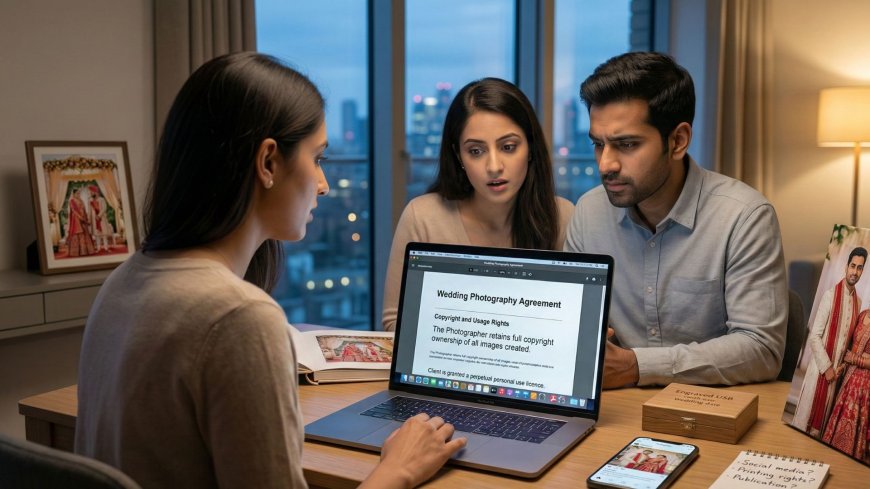
Not reading the usage rights section of the photography contract. The usage rights clause is typically brief and appears near the end of the contract, where it is easily overlooked. Read it carefully before signing.
Sharing photographs on commercial platforms without understanding the implications. Uploading wedding photographs to print-on-demand commercial platforms, using them in business marketing, or licensing them to third parties requires a commercial use licence.
Not addressing the photographer's publication rights in the contract. If you have privacy concerns about your wedding appearing in publications or on the photographer's social media, this must be addressed contractually before the wedding — not after the images appear.
Using wedding photographs in YouTube videos without understanding the music copyright dimension. The photographs raise one copyright question. The music raises a separate one. Public wedding videos using commercial music without licences are regularly flagged and can be blocked or demonetised.
Not confirming that the personal use licence is perpetual. A licence with an expiry date is not appropriate for wedding photography. Confirm perpetual licence before signing.
Failing to credit the photographer when required by contract. The credit requirement is contractual and in some jurisdictions has a legal foundation in moral rights. Honour it consistently.
Not asking about the photographer's policy on third-party licensing before signing. If you have a preference about whether your wedding appears in publications, venue marketing, or other commercial contexts, ask about it during the negotiation. After the images are published, it is too late to address.
The copyright conversation is not the most romantic part of planning your wedding. It sits alongside the insurance discussion and the force majeure clause negotiation as the category of planning tasks that couples universally wish they could skip. But it is the conversation that determines what you can and cannot do with the visual record of one of the most significant days of your life — for the next sixty years and beyond.
The photographers who produce the most beautiful work are often the ones who feel most strongly about their copyright. This is not a coincidence. The creative investment that produces extraordinary wedding photography is inseparable from the professional identity and the legal protections that copyright provides. Respecting that — understanding it, honouring it, and building a contract that protects both parties' legitimate interests — is the foundation of a photographer-client relationship that produces not just beautiful images but a genuinely positive professional experience.
Know your rights. Know their rights. Sign a contract that makes both clear.
And then use your photographs freely, generously, and without anxiety — because you know exactly what you're permitted to do with them.
What's Your Reaction?
 Like
0
Like
0
 Dislike
0
Dislike
0
 Love
0
Love
0
 Funny
0
Funny
0
 Angry
0
Angry
0
 Sad
0
Sad
0
 Wow
0
Wow
0