










































































Can Your Relationship Work Even If Kundalis Don't Match? The NRI Couple's Real Dilemma — A Complete Guide
Facing a poor kundali match score or a manglik dosha and wondering whether your relationship can still work? This complete NRI guide answers the question every globally-located Indian couple with mismatched charts eventually faces — with the philosophical honesty, the scholarly depth, and the practical framework that the generic "get the puja done" advice never provides. Learn the complete Ashtakoota system of eight compatibility categories — Varna, Vashya, Tara, Yoni, Graha Maitri, Gana, Bhakoot, and Nadi — and why the distribution of points across these categories matters as much as the total score of thirty-six. Understand the manglik dosha's actual prevalence in forty to fifty percent of all birth charts, its three traditional remedies including the Mangal dosha nivaran, the cancellation conditions that significantly reduce its severity, and why the jyotishi who treats it as an absolute unresolvable bar is applying the tradition's most conservative position rather than its mainstream scholarly one. Learn the Jyotisha tradition's own philosophical framework — the distinction between the map and the territory, between Svabhava and Svadharma, between the constitutional tendency the chart describes and the active daily choices the marriage requires — and why the Bhagavad Gita's teaching on right action is the tradition's own answer to the chart's adverse finding. Understand what the scientific literature actually shows about astrological systems' predictive validity, the full spectrum of approaches that real NRI families take from full observance through remedies engagement to conditional acceptance to thoughtful rejection, how to assess the quality of the jyotishi being consulted, when to seek a second opinion, how to convert the chart's navigational findings into specific pre-marital preparation in the areas identified, and how to identify when the kundali objection is a proxy for a deeper family concern that deserves direct conversation. Understand the five specific mistakes that cause NRI couples to treat the kundali as a binary verdict, dismiss the family's genuine concern without engagement, perform the remedies without genuine intention, or fail to convert the navigational finding into the specific preparation the finding implies. This is the complete, philosophically grounded, scientifically honest, NRI-specifically applicable guidance that every couple whose charts have raised a concern deserves before they decide what the concern means.

Can Your Relationship Work Even If Kundalis Don't Match? The NRI Couple's Real Dilemma: A Complete Guide
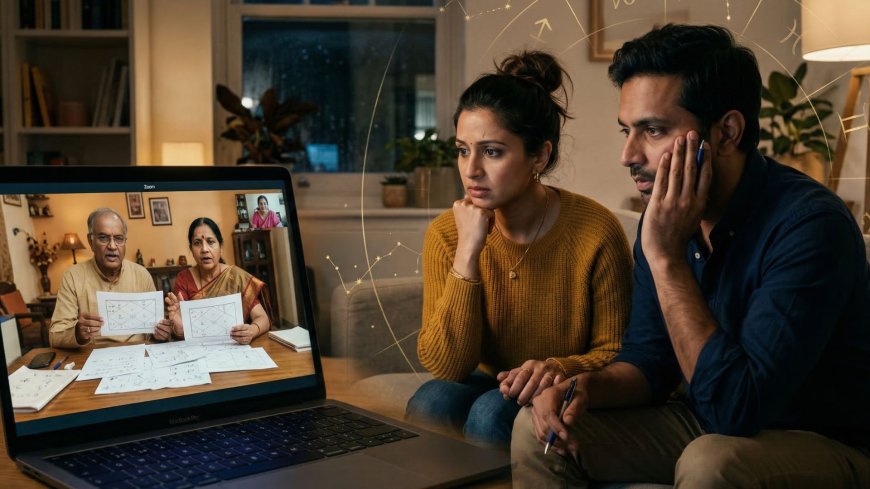
The conversation happened on a Sunday afternoon in November, in the specific, uncomfortable quiet of a video call that has been going on for long enough that both parties have run out of the easier things to say and arrived at the thing that was always going to have to be said.
Priya was in Vancouver. Her parents were in Pune. They had been on the call for forty-seven minutes, and for thirty-nine of those minutes they had been talking about everything except the kundali.
Then her father said it.
"The jyotishi has looked at both charts."
Priya knew what was coming. She had known since she and Arjun had decided to tell her parents, since the moment she had seen her mother's expression shift from the specific, warm joy of the first hearing to the specific, slightly inward quality of the mother who is already calculating what the next conversation will need to address.
"There are some concerns," her father said.
He said it in the careful, this-is-difficult-for-me-too way of a man who genuinely loves his daughter and who is genuinely caught between two things he genuinely believes in: the jyotishi he has trusted for thirty years and the daughter he has loved for twenty-nine.
"Tell me," Priya said.
He told her. The manglik dosha. The specific, astrological condition identified in Arjun's chart. The specific concerns about the match — the Guna Milan score that had come back at sixteen out of thirty-six, below the threshold that the jyotishi considered acceptable. The specific areas of incompatibility that the charts suggested: financial instability, conflict, the specific combination of planetary positions that the jyotishi had described as "challenging."
Priya listened to all of it.
Then she said: "Arjun and I have been together for four years. We have lived together for two. We have been through his father's illness and my redundancy and the pandemic and moving countries together. We know each other in ways that no chart can capture. Are you telling me that a document produced at the moment of our births should override everything we have learned about each other in four years?"
Her father was quiet for a long time.
Then he said: "I am not telling you it should override it. I am telling you it is concerning to me. I am asking you to take it seriously."
"I am taking it seriously," she said. "That is why I am asking you to explain to me what taking it seriously actually means. Not performing the concern. Actually taking it seriously. What is the kundali measuring? What does the matching actually mean? And what do people — real people, people like us — actually do when the charts don't align?"
Her father did not have a complete answer. He had the tradition's answer, which was complete in its own framework, and he had his love for his daughter, which was complete in a different framework, and the two were not currently speaking to each other.
"Talk to Pandit Raghavendra," he said finally. "The real one. Not to find a way around what he said. To understand it properly. Then we will talk again."
Priya called Pandit Raghavendra the following Tuesday.
The call lasted two hours.
This guide is what Pandit Raghavendra told her — along with everything else that the question deserves, from the philosophy, to the science, to the specific, honest, NRI-applicable framework for the couple whose relationship is real and whose charts have raised a concern.
What Kundali Matching Actually Is — The System Explained
Before the question of whether the relationship can work can be answered, the system being consulted must be understood — because the kundali matching system is significantly more sophisticated, more nuanced, and more philosophically complex than the binary "match or no match" that the popular transmission of the practice has produced.
A kundali — from the Sanskrit word for coiled, referring to the coiled serpent of the kundalini energy — is a birth chart, the specific, astronomical map of the positions of the planets, the sun, and the moon at the exact moment and location of a person's birth. Jyotisha — the Vedic astrological tradition, one of the six Vedangas or limbs of the Vedic knowledge system — holds that these planetary positions at birth establish the specific, individual characteristics, tendencies, strengths, and vulnerabilities of the person who is born at that moment.
The kundali matching system — Guna Milan, the matching of qualities — is the practice of comparing two birth charts to assess the compatibility of the couple considering marriage. The system evaluates eight categories of compatibility, called the Ashtakoota, each of which examines a different dimension of the relationship's potential. Together, the eight categories produce a maximum score of thirty-six points, and the tradition holds that a score of eighteen or above indicates an acceptable level of compatibility, while a score below eighteen raises concerns.
The eight categories of the Ashtakoota are worth understanding individually rather than as an undifferentiated total score, because each measures something specific and the total score can obscure significant variation in which dimensions are strong and which are weak.
The first category is Varna — measuring the spiritual compatibility, the alignment of the two people's spiritual and psychological orientations. The second is Vashya — measuring the power dynamic and the degree of mutual influence in the relationship. The third is Tara — measuring the birth star compatibility and the health and well-being implications of the match. The fourth is Yoni — measuring the sexual and temperamental compatibility, the nature-based alignment of the two people's fundamental drives. The fifth is Graha Maitri — measuring the friendship and mental compatibility, the alignment of the couple's intellectual and emotional orientations. The sixth is Gana — measuring the temperamental classification of the two people, whether they are Deva (divine-natured), Manushya (human-natured), or Rakshasa (demon-natured) in the tradition's classification. The seventh is Bhakoot — measuring the relationship's impact on health, family, and prosperity. The eighth is Nadi — measuring the constitution and genetic compatibility, the most medically-oriented of the eight categories, whose concern is specifically the compatibility of the couple's physiological and genetic natures.
The total of thirty-six points is distributed across these eight categories, and a sophisticated reading of the match considers not only the total but the distribution — a couple with a score of twenty-two that is weighted heavily in Graha Maitri and Yoni and lightly in Bhakoot is in a different position from a couple with the same score of twenty-two weighted heavily in Bhakoot and lightly in Graha Maitri.
The Manglik Dosha — What It Is and What It Means
The manglik dosha deserves specific treatment because it is the most widely feared and the most widely misunderstood of all the kundali's specific adverse conditions, and its misunderstanding has produced more unnecessary anxiety among NRI couples than any other element of the matching system.
The manglik dosha — also called Kuja Dosha or Chevvai Dosham in the South Indian traditions — is the condition identified when Mars occupies one of the specific houses in the birth chart that the tradition considers adverse positions for the planet: the first, second, fourth, seventh, eighth, or twelfth house, depending on the tradition followed. Mars is the planet of aggression, of drive, of the forceful application of energy, and its placement in certain chart positions is held to create an intensification of these qualities in the person's character and in the specific domains of life that those houses govern.
In the context of marriage, the concern associated with the manglik dosha is the traditional belief that the intensification of Martian energy that the dosha creates can produce conflict, dominance, and in the most extreme traditional framing, the premature death of the spouse. This extreme traditional framing — which was more common in historical treatments and less common among contemporary jyotishis of genuine scholarly depth — is the source of much of the disproportionate fear that the manglik dosha produces in contemporary families.
The more nuanced, more accurate, and more contemporary jyotishi's position on the manglik dosha is considerably less alarming. The dosha indicates, in this reading, a person whose Mars energy is intensified — who has strong drive, strong willpower, strong assertiveness, and who may, if these qualities are not appropriately channelled, bring conflict into close relationships. It is not a sentence. It is a tendency. And the tradition itself provides three specific remedies — the Mangal dosha nivaran — that are held to address the dosha's adverse effects: the performance of specific pujas and rituals, the matching of the manglik individual with another manglik (whose Martian energy balances rather than conflicts), and the waiting for the specific astrological period after which the dosha's intensity is considered to have diminished.
The critical point for the NRI couple is this: the manglik dosha is present in the birth charts of approximately forty to fifty percent of all individuals, depending on the specific school of Jyotisha being followed and the specific definition of manglik being applied. A condition that is present in half the population cannot, by any reasonable logic, be the defining obstacle to half the marriages in the world. The jyotishi who treats the manglik dosha as an absolute, unresolvable bar to marriage is applying the tradition's most conservative position in a way that even the tradition's own scholarly mainstream does not fully support.
The Philosophical Dimension — What the Tradition Actually Claims
This section is the most important section of the guide for the NRI couple who is asking Priya's question — the section that addresses not the mechanics of the kundali system but its philosophical foundation and its genuine scope of authority.
The Jyotisha tradition's claim is specific and bounded. It claims to describe tendencies, not destinations. It claims to identify the conditions — the planetary configurations, the karmic inheritances, the constitutional alignments or misalignments — that the person brings to the marriage. It does not claim to determine the outcome. The tradition that spawned the kundali system also produced the Bhagavad Gita, which is among the most sustained arguments in the world's philosophical literature for the proposition that human action — Karma Yoga, the yoga of right action — can transform the conditions that circumstance creates.
The jyotishi who reads the kundali is reading the raw material — the specific, astrological, karmic inheritance that the two people bring to the relationship. The reading is meaningful and the tendencies it identifies are worth taking seriously. But the reading is not the verdict. The reading is the map. And the map, in the Hindu philosophical tradition, is not the territory. The territory is the relationship — the specific, daily, active, choice-constituted practice of the actual marriage between two actual people.
The Gita's most direct statement on this point is the distinction between Svabhava — the innate nature, the constitutional tendency — and Svadharma — the specific, right action that the individual's nature and situation together require. The kundali identifies the Svabhava. The marriage is the arena of the Svadharma — the ongoing, active, chosen practice of the relationship between two people whose natures are known and whose choices are real.
The great jyotishi of the tradition's classical period understood this distinction. The charts were read not as deterministic verdicts but as navigational aids — the knowledge of the terrain that would allow the couple to anticipate the specific challenges their union might face and to prepare for them with the specific, targeted, right action that the preparation makes possible. The couple who knows that their charts indicate financial tension has been given the opportunity to be deliberately, carefully, proactively attentive to financial harmony. The couple who knows that their charts indicate temperamental conflict has been given the opportunity to develop the specific communication practices that the tendency requires.
This is the tradition's actual, philosophically sophisticated position on the kundali: not a verdict but a navigational aid. Not a bar but a preparation.
The Scientific Dimension — What the Research Shows
The NRI couple who has been educated in the Western scientific tradition and who approaches the kundali question with the scientific habit of wanting the evidence before accepting the claim deserves an honest treatment of what the scientific literature actually shows about the predictive validity of astrological matching systems.
The honest answer is that the peer-reviewed scientific literature does not support the predictive validity of kundali matching — or of any astrological system — as a reliable predictor of relationship outcomes. The studies that have been conducted on this question, including the large-scale statistical analyses of birth chart positions and relationship outcomes that the scientific community has undertaken, have found no correlation above the level of chance between astrological placements and the specific life outcomes that astrology claims to predict.
This finding does not prove that the tradition is without value. What science cannot measure is not thereby proved to be absent. The tradition's value may lie in dimensions that scientific measurement — which operates within a specific, materialist, empirically grounded framework — is not designed to assess. The meaning-making function of the kundali, the family conversation it initiates, the specific, ritual framework it provides for taking the marriage decision seriously, the psychological preparation it encourages — these are real and valuable even if their value cannot be expressed in a correlation coefficient.
But the NRI couple who is asking whether the relationship can work despite a low kundali score should understand that the scientific literature gives them no reason to doubt the relationship's viability on kundali grounds. The charts are a traditional tool for a traditional purpose. The scientific evidence does not support their use as a predictive instrument for relationship success.
The evidence that does exist on relationship success is worth noting: the research literature on relationship outcomes is substantial and consistent in identifying the factors that predict relationship satisfaction and longevity. Communication quality, conflict resolution patterns, mutual respect, shared values, emotional intimacy, the ability to repair ruptures — these are the factors that the research identifies as the strongest predictors of relationship success. The kundali does not measure these factors. The four years of actual relationship that Priya and Arjun had lived did.
What Real NRI Couples Actually Do — The Full Spectrum
The honest account of what real NRI couples do when the kundali match is poor is, like the Shraadh question's treatment, a spectrum rather than a simple prescription.
The Families That Proceed Regardless
A significant and growing proportion of NRI families — particularly those in which the couple is older, in which the couple has been in a long-term relationship that the family knows and has experienced, and in which the family's generation that holds the kundali tradition most firmly is the grandparent generation rather than the parent generation — proceed with the wedding despite the poor match score. The conversation happens. The concerns are named. The jyotishi is consulted. And then the family decides that the couple's actual, demonstrated, lived compatibility is a stronger foundation for the marriage than the charts' indication of challenge.
This is not the dismissal of the tradition. It is the application of the tradition's own philosophical framework — the distinction between the map and the territory, the Svabhava and the Svadharma — to the specific situation of a couple whose territory has already been substantially mapped by the actual living of the relationship.
The Remedies Approach
A second approach is the formal engagement with the tradition's own remedies for the adverse conditions identified — the Mangal dosha nivaran for the manglik dosha, the Graha Shanti puja for the specific adverse planetary positions, the specific ritual interventions that the Jyotisha tradition has developed over centuries for exactly this purpose. The couple who takes the remedies seriously — who performs the prescribed pujas with genuine intention rather than as a performative gesture — is engaging with the tradition's own offered resolution rather than rejecting the tradition or ignoring its concerns.
The remedies approach requires a jyotishi whose scholarship is genuine and whose prescription of remedies is based on the specific adverse conditions identified rather than on a generic package of reassurance. The jyotishi who prescribes the same remedies for every poor match is not applying the tradition. The jyotishi who identifies the specific adverse conditions and prescribes the specific, targeted interventions that the tradition has developed for those conditions is applying it correctly.
The Second Opinion
A third approach is the consultation of a second jyotishi — ideally one from a different school or tradition, one whose methodology is independently derived — to assess whether the first consultation's findings are confirmed or contradicted. The Jyotisha tradition contains significant internal variation in its interpretation of chart positions, its definition of the manglik dosha, its calculation of the Guna Milan score, and its weighting of the eight Ashtakoota categories. The couple who receives a poor match score from one jyotishi and then receives a significantly different reading from another has been given evidence of the tradition's internal variation that is itself philosophically significant: the system's outputs are not consistent across practitioners, which is relevant information for assessing the appropriate weight to give any single reading.
The Conditional Acceptance
A fourth approach is the conditional acceptance — the family's agreement to proceed with the wedding on the condition that the couple undertakes specific preparations that address the areas of concern the charts have identified. The couple whose charts indicate financial tension agrees to a specific, detailed pre-marital financial planning process. The couple whose charts indicate communication challenges commits to a specific programme of pre-marital counselling. The couple whose charts indicate health concerns commits to specific health assessments and lifestyle adjustments. The condition is not punitive — it is the family's way of taking the jyotishi's navigational aid seriously and converting it into the specific, right-action preparation that the tradition's philosophical framework has always intended it to produce.
The Rejection of the Authority
A fifth approach — less common in the first generation but more common in the second — is the explicit, considered, family-conversation-supported rejection of the kundali matching system's authority in the specific decision. The couple who has thought carefully about the tradition's philosophical framework, who has consulted the literature, who has spoken with knowledgeable people about the system's actual claims and limitations, and who has then decided that the system's authority over this decision is not something they accept — this couple is exercising a genuine intellectual and moral position rather than simply ignoring the tradition in convenience. The difference between the thoughtful rejection and the convenient dismissal is the thinking, and the NRI couple who has done the thinking deserves to act on its results.
The NRI Planning Reference Table
| Planning Parameter | Kundali Matching Detail | NRI Action Required | Recommended Timeline |
|---|---|---|---|
| System Understanding | Ashtakoota system of eight compatibility categories totaling 36 points; 18+ generally considered acceptable; distribution across categories as important as total | Study the eight Ashtakoota categories before the jyotishi consultation; understand which categories are strong and which are weak in the specific match | Before jyotishi consultation |
| Jyotishi Quality Assessment | Quality of jyotishi reading varies enormously; traditional scholarly jyotishi differs from commercial matchmaking astrologer; family jyotishi with three decades of relationship with the family is different from unknown online service | Assess the jyotishi's scholarly credentials, their specific knowledge of the family's community tradition, and their intellectual approach to adverse findings before accepting their reading as authoritative | Before first consultation |
| Manglik Dosha Specific Consultation | Approximately 40–50% of individuals have the dosha; three traditional remedies exist; severity varies by house position and planetary relationships | If manglik dosha is identified, ask jyotishi specifically about severity, applicable remedies, and the cancellation conditions that the tradition recognises | At first jyotishi consultation |
| Second Opinion Protocol | Internal variation in Jyotisha tradition means different jyotishis can reach different conclusions from the same charts; second opinion is legitimate and traditional | If first consultation produces adverse finding, seek second opinion from jyotishi of different school or method; compare the two readings before making any decision | After first adverse finding |
| Specific Category Analysis | Total score of 18/36 achieved with weak Graha Maitri and strong Bhakoot differs significantly from same score with reverse weighting | Request category-by-category breakdown from jyotishi; understand which specific dimensions of compatibility are strong and which are weak | At first jyotishi consultation |
| Remedies Engagement | Mangal dosha nivaran, Graha Shanti puja, and other tradition-prescribed remedies are the system's own offered resolution; engaging them is taking the tradition seriously | If adverse conditions are identified, request specific remedy prescriptions from jyotishi; confirm the specific pujas, timings, and practitioners required | After adverse finding confirmed |
| Family Consensus Process | Poor kundali match requires both families' explicit discussion and agreed position; the decision cannot be made by one family or one partner alone | Facilitate explicit family conversation about the kundali findings; both families must reach an agreed position before the wedding proceeds | Before any public engagement announcement |
| Relationship Evidence Documentation | The couple's actual demonstrated compatibility over the relationship's duration is relevant evidence; four years of lived relationship produces specific, observable compatibility indicators | Prepare honest account of the relationship's specific challenges and how they were navigated; this is the territory that the map is measuring | For family conversation |
| Pre-Marital Preparation | Areas of challenge identified in the charts are preparation opportunities; financial tension, communication challenges, temperamental conflict each have specific preparation approaches | Design specific pre-marital preparation programme addressing the areas the charts identify as challenging; engage professional support if appropriate | 6–12 months before wedding |
| Conditional Family Agreement | Some families accept the wedding conditionally on specific preparations; the condition should be specific, achievable, and genuinely addressed rather than performative | If family offers conditional acceptance, engage with the condition genuinely; the condition is the family's way of taking the tradition's navigational function seriously | As defined by family |
| Scientific Literature Awareness | No peer-reviewed evidence supports kundali matching as reliable predictor of relationship outcomes; awareness of this does not require rejection of the tradition's other values | NRI couples with scientific education should be aware of the literature without using it to dismiss the family's genuine concerns; the traditions' meaning-making value is independent of its predictive validity | Before family conversation |
| Cultural Intermediary | If couple and family are in different positions, a trusted cultural intermediary — a respected elder, a senior family member, a knowledgeable pandit — can help bridge the position | Identify and engage a trusted cultural intermediary if the family conversation is producing impasse; this person should have both traditional knowledge and genuine respect for the couple's position | If impasse is identified |
| Pandit Communication Brief | The pandit who will conduct the ceremony should be informed of the kundali situation and should confirm their willingness to proceed and their recommended approach | Brief the wedding pandit on the kundali findings and the family's agreed position; confirm pandit's approach to the ceremony in the context of the adverse findings | 6–8 months before wedding |
| Post-Wedding Ritual Practice | Ongoing ritual practice — the specific pujas, the specific remedies, the specific ancestral acknowledgements — that the tradition recommends for the management of the challenges identified | Discuss with jyotishi the ongoing post-wedding ritual recommendations for managing the specific challenges identified; treat as a living practice rather than a one-time ceremony | After wedding |
| Communication Protocol | Kundali conversations across IST gap: UK +4.5 hrs, US East +9.5 hrs, Australia East −5.5 hrs; family conversations on this topic are emotionally charged and require more time than other planning conversations | Schedule kundali family conversations at times when both parties have genuine time and emotional space; do not conduct on rushed calls or in combination with other planning items | When issue is first raised |
Common Mistakes NRI Couples Make With the Kundali Question
The first and most consequential mistake is treating the kundali question as a binary — either the charts are consulted and their verdict is accepted as final, or the charts are dismissed as superstition and the concern is ignored. Both poles of this binary are intellectually unsatisfying and practically unwise. The tradition's actual position is the nuanced middle: the charts are a navigational aid, the findings are tendencies not destinies, the remedies are real, the couple's demonstrated compatibility is evidence, and the family conversation is the mechanism by which all of these inputs are weighed toward a decision. The couple who engages with the nuanced middle — who takes the tradition seriously without being controlled by it, who respects the jyotishi's reading without treating it as the only relevant input — is the couple who has understood what the system is and what it is not.
The second mistake is allowing the kundali question to become a proxy war for other, more fundamental disagreements between the couple and the family. The poor kundali match, in some family dynamics, becomes the articulation point for parental concerns about the match that are actually about cultural fit, professional standing, community affiliation, or family background — concerns that would benefit from direct expression but that are easier to articulate through the traditional authority of the kundali. The NRI couple who finds that the kundali objection is accompanied by a lack of engagement with the remedies, a resistance to second opinions, and an unwillingness to consider the couple's actual demonstrated compatibility may be dealing with a kundali objection that is not primarily about the kundali. The underlying concern deserves to be named and addressed directly rather than managed through the proxy of the charts.
The third mistake is the NRI couple's failure to take the family's genuine concern seriously — the dismissal of the kundali question as backward or irrational without the honest engagement with what the tradition is trying to do. The family that expresses kundali concern is expressing something real: the love that wants to protect the child from predictable difficulty, the cultural transmission that holds the tradition's framework as a genuine resource for navigating the specific challenges that marriage presents, the specific anxiety of a parent who is giving away a child into a relationship that will be lived far away and that cannot be supervised or supported at close range. These concerns deserve engagement, not dismissal. The NRI couple who dismisses the kundali concern is not demonstrating sophistication. They are declining a conversation that deserves to happen.
The fourth mistake is the performance of the remedies without the genuine engagement with what the remedies are addressing. The Mangal dosha nivaran puja performed as the ticket that admits the couple to the family's reluctant acceptance — the ritual completed as a bureaucratic requirement rather than as the genuine spiritual preparation the tradition intends — is not the remedy. It is the shape of the remedy without its substance. The couple who performs the prescribed pujas with the specific intention of genuinely addressing the tendency the dosha represents — who brings to the ritual the actual, conscious, this-is-what-we-are-working-on quality of engaged practice — is doing something that the performative puja cannot do.
The fifth mistake is not converting the jyotishi's navigational finding into the specific preparation programme that the finding implies. The chart that identifies financial tension between the couple has given the couple a gift — the advance knowledge of a specific area that their relationship will need deliberate, proactive attention. The couple who receives this finding and does nothing specific with it — who proceeds to the wedding without having explicitly addressed the financial dimension of their life together — has accepted the map without using it. The finding is valuable only if it produces action. The action is the pre-marital financial planning conversation, the agreed-upon financial framework, the specific, concrete, this-is-how-we-will-manage-this preparation that the finding has made possible.
Resolution
Pandit Raghavendra had told Priya, at the end of the two-hour call, something that she had not expected.
He had told her about the eight categories. He had told her that her match score of sixteen was, in his reading, misleading as a total — because the score was low primarily due to the Nadi and Bhakoot categories, which concerned constitutional compatibility, while the Graha Maitri and Yoni scores were strong, indicating genuine mental and temperamental compatibility. He had told her that for a couple who had already been together for four years, the low Nadi score's concern about constitutional incompatibility had already been tested by reality — the test that four years of shared life provides is more specific and more reliable, for the question of whether two people's constitutions are compatible, than any chart reading of the theoretical possibility.
He had told her about the manglik dosha. He had told her that Arjun's specific chart position reduced the dosha's severity significantly from the maximum, and that in his tradition's reading, the dosha at this severity was addressed by a specific puja that the family could perform before the wedding.
He had told her that the chart's function was never to override the couple's knowledge of each other. It was to supplement it — to add the dimension that the couple's knowledge of each other does not naturally emphasise. The couple knows the shared history. The chart knows the constitutional inheritance. Both are real. Both are useful. Neither is sufficient alone.
"The charts do not say this marriage will fail," he had said. "The charts say this marriage will require specific, deliberate attention in specific areas. Every marriage requires specific, deliberate attention in specific areas. The question is whether you know which areas and whether you are prepared to attend to them."
"Financial tension," Priya had said, reading from her notes. "And the Bhakoot's concern about family harmony."
"Yes," he had said. "These are the areas to watch. These are the areas to prepare for. These are the areas to bring to your pre-marital conversations. The chart has told you where to look. It has not told you what you will find when you look. That is your work."
Priya called Arjun after the call.
She told him everything. The Ashtakoota categories. The Nadi and the Bhakoot. The manglik dosha's reduced severity. The financial tension and the family harmony concern. The puja that the pandit had recommended.
Arjun listened.
Then he said: "So the chart is saying: be careful about money and be careful about the families."
"Yes," she said.
"We already know that," he said. "We have been navigating both of those things for four years. We have specific, actual, lived experience of both of those things."
"Yes," she said. "But now we have a name for it. And a framework for it. And a puja for it."
He was quiet for a moment.
"I can work with that," he said.
They called her parents the following evening. The conversation lasted an hour. Her father, who had spent the days between the calls consulting with his own pandit and with two colleagues whose daughters had married despite adverse kundali findings and whose marriages were, by every observable measure, flourishing — came to the call with the specific, this-is-my-considered-position quality of a man who has done his thinking.
He said: "The pandit has spoken with Pandit Raghavendra. They have agreed on the remedies. We will do the puja before the wedding. And we will hold the family harmony and the financial questions as the areas that deserve our specific, ongoing attention."
He paused.
"I want you to understand," he said, "that the kundali is not nothing. It is not superstition. It is the tradition's way of taking the marriage decision seriously, of bringing the full weight of the knowledge the tradition has accumulated to the specific decision that will shape your life. I asked you to take it seriously. I did not ask you to be controlled by it."
Priya looked at her laptop screen. Her father's face, slightly grainy in the video call quality, carrying the expression of the man who has arrived at his position through genuine thought rather than convenience.
"I know," she said. "I took it seriously. That is what the two hours with Pandit Raghavendra were for."
Her father nodded.
"Good," he said. "Then we are ready."
Consult the family's own jyotishi and understand the Ashtakoota's eight categories before accepting any total score as the verdict. Ask specifically about severity and remedies for any dosha identified. Seek a second opinion if the first reading is adverse. Convert the navigational findings into specific, actionable pre-marital preparation in the areas identified. Engage with the remedies genuinely rather than performatively. And understand that the chart is the map — the territory is the four years you have lived together, and the territory is what the marriage will be made of.
The kundali does not answer whether your relationship will work.
Your relationship answers that.
The kundali tells you where to look.
Published by NRIWedding.com — The Premium Global Platform for Non-Resident Indians Planning Indian Weddings From Abroad.
What's Your Reaction?
 Like
0
Like
0
 Dislike
0
Dislike
0
 Love
0
Love
0
 Funny
0
Funny
0
 Angry
0
Angry
0
 Sad
0
Sad
0
 Wow
0
Wow
0